Cold Email Template for Staffing Agency: 7 Scripts That Work in 2026
Most staffing agency cold emails read like every other recruiter's. Here are seven templates that book meetings, the data behind them, and the send patterns that quietly kill your reply rate.
TL;DR#
- The best cold email template for staffing agency outreach is short (under 120 words), names a specific open req or hiring signal, and asks for one low-friction next step — not a call.
- Client-side emails (selling placements to hiring managers) and candidate-side emails (recruiting talent) need completely different structures. Most agencies use one template for both and wonder why reply rates sit at 2%.
- Personalization tokens beyond
{{first_name}}are what move the needle: a job req ID, a recent funding round, a departing team lead, a tech-stack change. - Deliverability kills more staffing campaigns than copy does. Bad data → bounces → domain reputation damage → your good emails land in spam.
- Seven templates below, with the exact situations they fit and the reply-rate ranges you should expect.
Why do most staffing agency cold emails get ignored?#
Because hiring managers get eleven of them a week and they all say the same thing.
Open the inbox of any VP of Engineering at a Series B company and you'll find a stack of near-identical messages: "Hi {{first_name}}, I noticed you're hiring for a Senior Backend Engineer. We specialize in placing top-tier engineering talent…" The sender has done exactly one piece of research — they read a job title off a careers page — and they've buried the ask in a paragraph of agency boilerplate.
The structural problem is that staffing is a low-differentiation service on the surface. Every agency claims speed, quality, and a network. So a template that leads with what your agency is competes against forty identical claims. A template that leads with what the recipient is currently struggling with competes against nothing.
Three things separate a cold email that gets a reply from one that gets archived:
- Proof you looked. A req ID, a specific role that's been open 60+ days, a name of someone who just left. Something the recipient knows you couldn't have guessed.
- A claim that costs you something. "We placed three backend engineers at [comparable company] in 19 days" is checkable. "We deliver quality candidates fast" is not.
- An ask sized to a stranger. Nobody books a 30-minute call with an unknown recruiter. They will reply "yes" to "want me to send two profiles?"

What does the anatomy of a high-performing staffing cold email look like?#
Every template below follows the same five-part skeleton. Deviating from it is fine — not knowing you're deviating is not.
- Subject line (3–6 words). Lowercase, no pitch, reads like an internal note.
re: your senior BE req,two profiles — backend,question about the Staff PM role. - The signal line (1 sentence). What you noticed. This is the part that has to be specific enough that the recipient thinks "how did they know that?"
- The relevance bridge (1–2 sentences). Why the signal means you can help. Include one checkable proof point — a comparable placement, a timeline, a market datapoint.
- The soft ask (1 sentence, ends in a question mark). Ask for a yes/no answer or permission to send something, never for a meeting on the first touch.
- The signature. Name, agency, one line of positioning. No banner images, no attachments, no calendar links on touch one.
Word count target: 60–120. Anything over 150 words in a first-touch staffing email is a monologue.
Client-side vs candidate-side: how do the templates differ?#
They differ in what the recipient is risking.
A hiring manager risks budget and a bad hire. A candidate risks their current job, their reputation, and twelve hours of interview time. That asymmetry changes everything about the message.
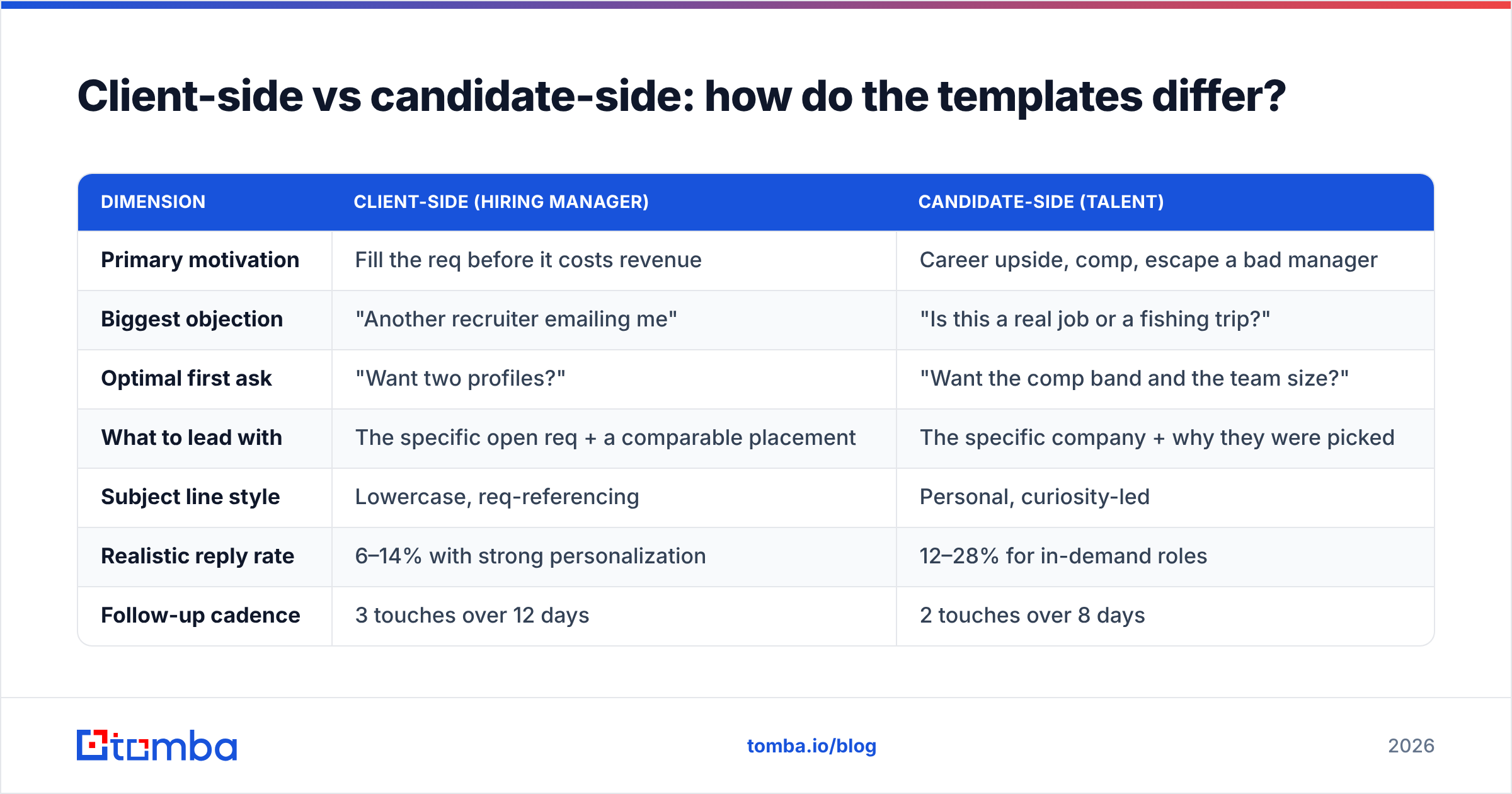
| Dimension | Client-side (hiring manager) | Candidate-side (talent) |
|---|---|---|
| Primary motivation | Fill the req before it costs revenue | Career upside, comp, escape a bad manager |
| Biggest objection | "Another recruiter emailing me" | "Is this a real job or a fishing trip?" |
| Optimal first ask | "Want two profiles?" | "Want the comp band and the team size?" |
| What to lead with | The specific open req + a comparable placement | The specific company + why they were picked |
| Subject line style | Lowercase, req-referencing | Personal, curiosity-led |
| Realistic reply rate | 6–14% with strong personalization | 12–28% for in-demand roles |
| Follow-up cadence | 3 touches over 12 days | 2 touches over 8 days |
| Deal-breaker mistake | Generic agency boilerplate | Hiding the company name |
The single most common error in staffing outreach is running a client-side structure at candidates. "We're a leading talent partner working with high-growth companies" tells a senior engineer nothing except that you can't name the client, which means either you don't have one or you don't trust them with it.
What are the 7 cold email templates that actually work?#
1. The specific-req template (client-side, cold)#
Best for: hiring managers with a role that's been posted 30+ days.
Subject: re: senior backend req
Hi Priya — your Senior Backend Engineer role has been live since April 2nd, which usually means the Go + distributed systems combo is thinning the pipeline.
We closed the same profile for [Comparable Co] in 19 days last quarter; two of those candidates are still in the market.
Want me to send the two profiles? No commitment either way.
— Marcus, Ridgeline Talent
Why it works: the posting date is checkable, the diagnosis is technical, and the ask costs the recipient one word.
2. The trigger-event template (client-side)#
Best for: post-funding, post-acquisition, or new-exec-hire companies.
Subject: post-Series B eng hiring
Hi Dan — congrats on the $24M. Companies at your stage typically triple engineering headcount within four quarters, and the first 10 hires set the bar for everything after.
We staffed the first eng cohort at two Series B fintechs in the last 18 months. Happy to share what the comp bands looked like in your market — useful whether or not you ever work with us.
Want the breakdown?
— Marcus
Why it works: it leads with a gift (market comp data), not a pitch.
3. The departing-team-lead template (client-side)#
Best for: when LinkedIn shows a key IC or manager left.
Subject: backfilling Chen's role?
Hi Elena — saw that Chen moved on from the platform team. Backfills at the staff level usually take 90+ days if the search starts from scratch.
We keep a warm bench of staff platform engineers who've shipped at your scale. Two are interviewing now.
Want me to hold them for a week while you decide on internal promotion vs external?
— Marcus
Why it works: it creates a real, non-manufactured deadline.
4. The competitor-placement template (client-side)#
Best for: when you've placed someone at a direct competitor.
Subject: the [Competitor] hire
Hi Tom — we placed the Director of RevOps at [Competitor] in March. The search took 24 days and the runner-up is now open to a move.
You're hiring for the same function. Want her profile before she goes back on the market?
— Marcus
Use with care and never disclose anything confidential. Naming a public placement is fine; naming a private search is not.
5. The comp-transparency template (candidate-side)#
Best for: senior ICs who ignore recruiters by default.
Subject: $215–245k, staff level, remote
Hi Sam — the comp band is $215–245k base, staff level, fully remote, and the team is nine engineers reporting to a VP who was previously at Stripe.
The company is [Named Client]. They're hiring because of a new payments line, not backfill.
Want the JD, or should I stop emailing?
— Marcus
Why it works: it front-loads every fact a candidate would otherwise have to extract over two emails, and the opt-out is explicit.
6. The work-specific template (candidate-side)#
Best for: engineers, designers, and anyone whose public work is visible.
Subject: your Kafka retry post
Hi Ana — your write-up on idempotent retries in Kafka consumers is the clearest explanation I've read of the exactly-once tradeoff.
A payments client is rebuilding their event pipeline and hitting exactly that problem. Staff level, $220k+, remote.
Worth 10 minutes of your time, or not right now?
— Marcus
7. The referral-ask template (works both sides)#
Best for: touch three, when a prospect has gone silent.
Subject: wrong person?
Hi Priya — I've sent two notes about the backend req and heard nothing, which usually means I've got the wrong person or the wrong timing.
If it's the former, who owns eng hiring now? If it's the latter, I'll check back in Q3.
— Marcus
This "breakup + referral" email consistently outperforms every other follow-up in staffing sequences, because it gives the recipient two effortless ways to close the loop.
How do you find the right contacts to send these to?#
The best template in the world fails against a bad list. Staffing outreach compounds this problem because your targets change fast — hiring managers get promoted, HR business partners get reorged, and the person who owned the req in March owns a different function by June.
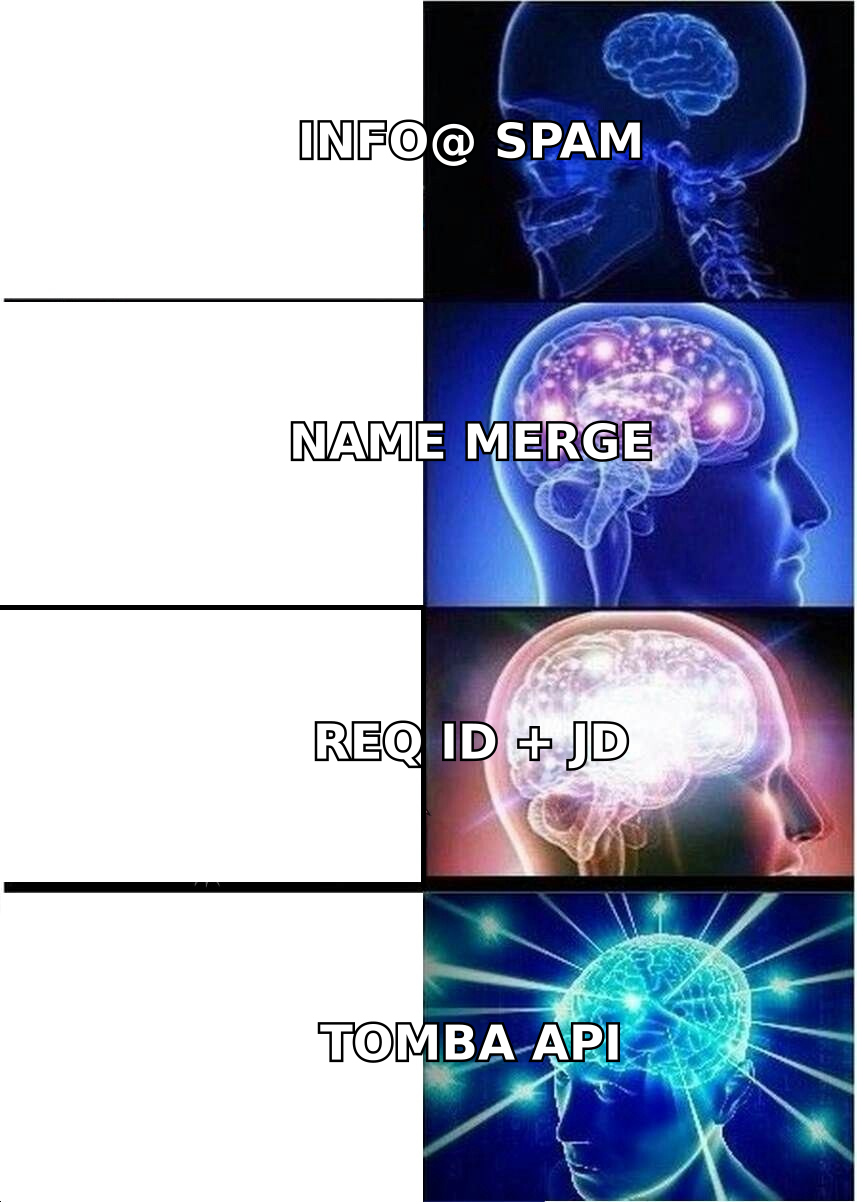
Here's the escalation ladder most agencies climb, from worst to best:
- Generic inboxes. Sending to
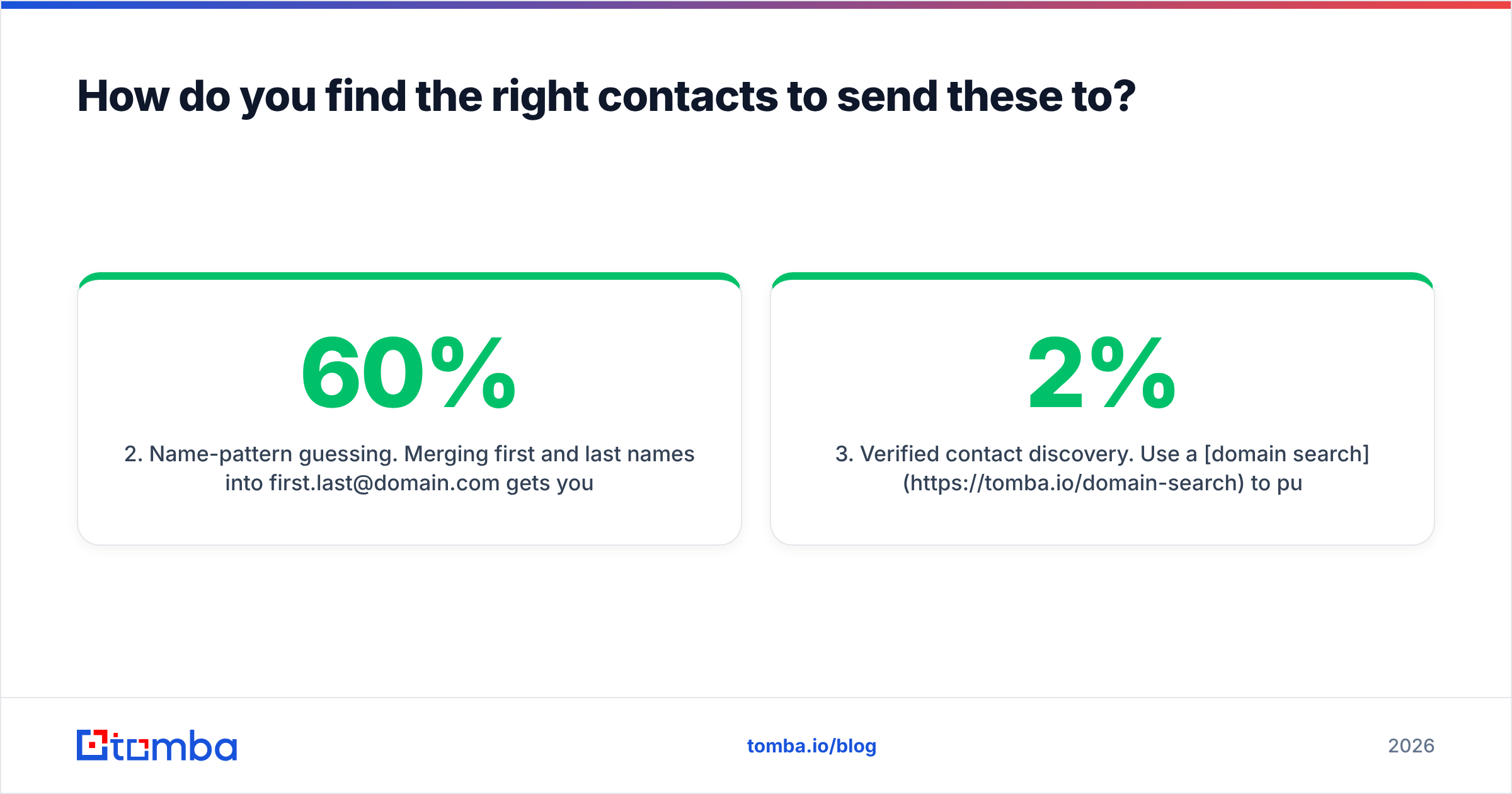
info@orcareers@guarantees you're competing with resume spam. Reply rate: effectively zero. - Name-pattern guessing. Merging first and last names into
first.last@domain.comgets you maybe 60% accuracy, which means 40% of your sends bounce. Two campaigns of that and your domain reputation is damaged. - Verified contact discovery. Use a domain search to pull every published address at a target company, then run an email verifier before a single send. Bounce rate drops below 2%.
- Enriched, signal-driven lists. Pair verified contacts with hiring signals — new job posts, funding, leadership changes — and enrich them with contact enrichment so every template token (title, seniority, company size) is populated correctly.
For candidate-side outreach, the constraint is different: you usually have a LinkedIn profile and no email. A LinkedIn finder closes that gap without requiring the candidate to accept a connection request first, which is the step where most recruiter sequences die.
Vendors in this space vary widely. BookYourData is a solid choice if you want a prebuilt, pay-as-you-go B2B list with hiring-manager filters baked in. Tomba fits better when you're building lists reactively from live signals — a job post appeared this morning, and you want the hiring manager's verified address before lunch. Both approaches are legitimate; they solve different halves of the same problem. Check current category leaders on G2 before committing to an annual contract.
Why does deliverability matter more than copy in staffing?#
Because staffing agencies send more cold email per employee than almost any other B2B category, and volume punishes bad data harder than it rewards good copy.
The math is unforgiving. A 15% bounce rate on a 2,000-contact campaign means 300 hard bounces. Google and Microsoft treat that as a spam signal. Your next campaign — with a better template — lands in the promotions tab or the junk folder, and you'll never see the reply rate that copy deserved.
Before you scale any of the templates above:
- Warm the domain. Send from a secondary domain (not your primary), ramp volume over 3–4 weeks, and keep daily sends under 50 per inbox.
- Authenticate properly. SPF, DKIM, and DMARC all need to pass. Run an SPF checker before your first send, not after your first spam complaint.
- Verify every address. Not just once — re-verify quarterly. B2B email data decays at roughly 22–30% per year, and staffing lists decay faster because the roles themselves are volatile.
- Watch your reply-to-bounce ratio. If replies fall while bounces hold steady, the copy is the problem. If both degrade together, it's deliverability.
- Know the rules. Cold B2B email is legal in the US under CAN-SPAM with a valid physical address and a working opt-out, and legal in most of the EU under legitimate-interest provisions — but the standards differ, and "everybody does it" is not a defense.
HubSpot's sales research consistently shows follow-up emails outperforming first touches, which only holds if the first touch actually reached the inbox. Deliverability isn't the boring prerequisite to good copy. It's the multiplier on it.
What should your sequence look like?#
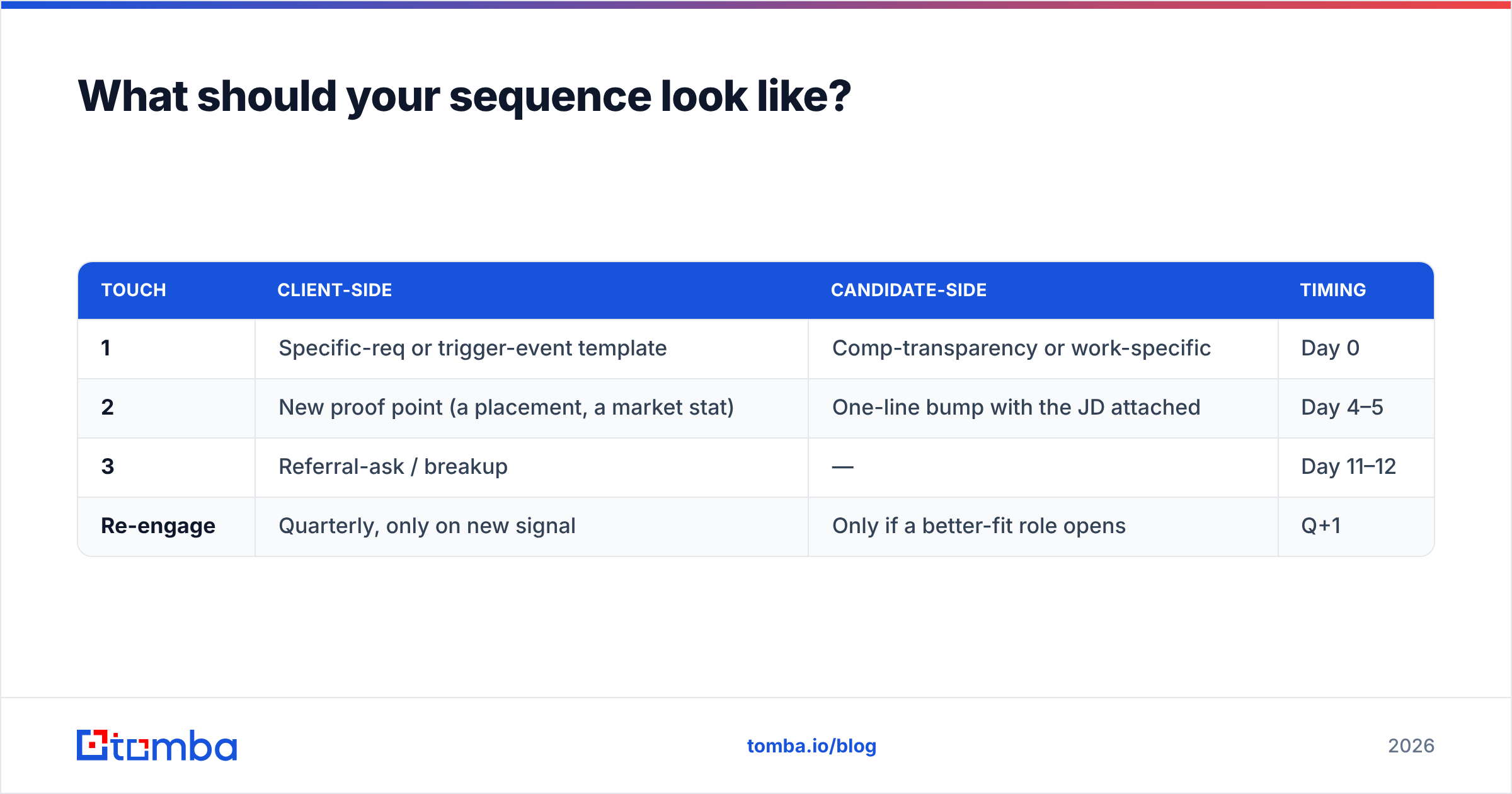
Three touches for client-side, two for candidate-side. Space them 4–5 days apart. Never send more than three cold touches to a hiring manager who hasn't replied — you're burning a relationship you'll want in eighteen months.
| Touch | Client-side | Candidate-side | Timing |
|---|---|---|---|
| 1 | Specific-req or trigger-event template | Comp-transparency or work-specific | Day 0 |
| 2 | New proof point (a placement, a market stat) | One-line bump with the JD attached | Day 4–5 |
| 3 | Referral-ask / breakup | — | Day 11–12 |
| Re-engage | Quarterly, only on new signal | Only if a better-fit role opens | Q+1 |
The mistake is treating touch two as a reminder. "Just bumping this to the top of your inbox" adds nothing and signals that you had nothing to add. Every follow-up needs one new fact.
Get the contacts your templates deserve#
A staffing cold email is a bet: you're spending your agency's domain reputation on the claim that this specific person, at this specific company, has this specific hiring problem right now. Get the person wrong and the best copy in the industry bounces.
Tomba Email Finder gives you verified professional email addresses by name, company, or domain — so the hiring manager you researched is the hiring manager who receives the email. Start on the free tier (25 searches a month, no card), and if the templates above start working, Tomba pricing scales from $49/mo Starter to $99/mo Growth without an annual lock-in. Find the right inbox first. The copy is the easy part.
Related guides#
Ready to find emails that actually work?
Join 150,000+ professionals who stopped guessing and started sending. Free credits on signup — no credit card required.
Get the Tomba newsletter
Practical outbound tactics and product updates — once every two weeks.
About the author