Cold Emailing Best Practices in 2026: The No-Fluff Guide
Most cold email advice is recycled from 2018, before Google and Yahoo rewrote the rules. Here are the practices that actually survive modern spam filtering — with benchmarks, tables, and the exact order to fix things.
TL;DR
- Deliverability is now a gating function, not a nice-to-have. Google and Yahoo's bulk-sender rules mean a >0.3% spam-complaint rate can quietly kill your domain before anyone reads your copy.
- Verify every address before you send. A 5% bounce rate is the single fastest way to torch a warm sending domain, and it is entirely preventable.
- Volume is not a strategy. 50 researched emails a day beats 500 templated ones on reply rate, meetings booked, and domain longevity.
- Your subject line matters less than your list. Segmentation and data quality explain most of the variance between a 2% and a 12% reply rate.
- Send fewer follow-ups than you think, but send them further apart. Three touches over 12 days beats seven touches over 7 days.
Cold email still works in 2026. What stopped working is the version of it that treats an inbox like a billboard. The rules changed on the infrastructure side — mailbox providers now enforce authentication and complaint thresholds that used to be suggestions — and they changed on the human side, because your prospect gets 40 of these a week and can identify a mail-merge in under two seconds.
This guide covers the cold emailing best practices that hold up under both constraints: the technical ones that keep you in the inbox, and the strategic ones that make the email worth opening once it lands.
What actually changed about cold email?#
Three things, and only one of them gets talked about enough.
First, authentication became mandatory. Since the Google and Yahoo bulk sender requirements took effect, senders pushing meaningful volume must have SPF, DKIM, and DMARC configured, must offer one-click unsubscribe, and must keep spam complaints under 0.3%. That last number is brutal. If 3 out of 1,000 recipients hit "report spam," you are over the line. There is no appeal process and no support ticket that fixes it.
Second, spam filters got semantic. Filters no longer just count exclamation marks and the word "free." They evaluate whether an email resembles the pattern of mail that recipients in your prospect's cohort mark as spam. A perfectly clean template sent to 2,000 people with the same three sentences is a pattern. It gets recognized as one.
Third — and this is the underrated one — the marginal cost of sending collapsed, so the marginal value of a generic send collapsed with it. When anyone can scrape a list and fire 10,000 emails for $99, the equilibrium shifts. Attention goes to whoever is visibly not doing that.
What is the correct order to fix cold email?#
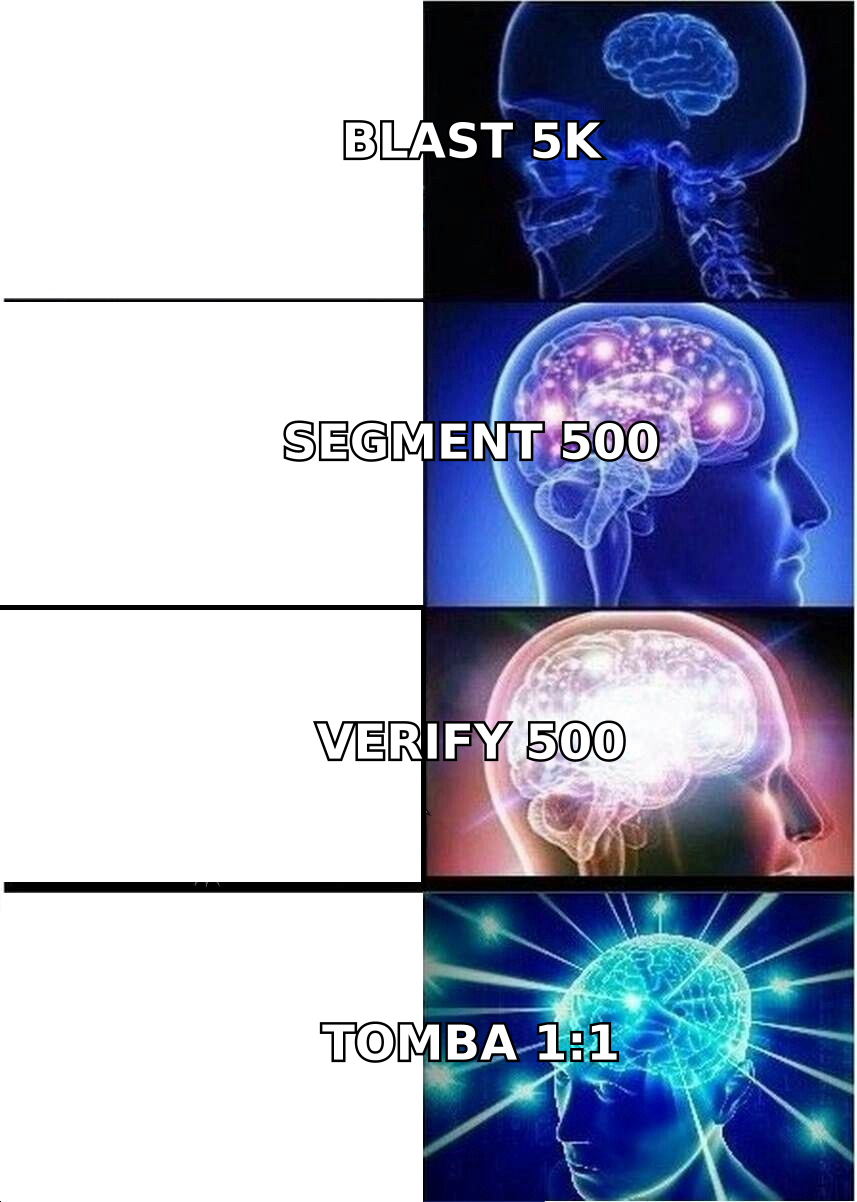
Most teams optimize in exactly the wrong sequence. They rewrite subject lines while sitting on a 40% invalid list. Here is the order that actually compounds, and the reason each step precedes the next.
- Domain and authentication. Buy a secondary sending domain, configure SPF, DKIM, and DMARC, and never send cold mail from your primary corporate domain. If your outreach domain burns, your invoices and support replies should not burn with it. Check your setup with an SPF checker before you send a single message.
- Warmup. A brand-new domain that sends 200 emails on day one looks exactly like a spammer, because it is behaving exactly like one. Ramp from 10-20 sends/day to your target over 4-8 weeks. An email warmup calculator will give you the daily ramp curve; the important part is that you actually follow it.
- List quality. Verify every address. Remove catch-all domains you cannot confirm, remove role accounts (info@, sales@, support@), remove anyone who bounced before. This step, done properly, is worth more than every other item on this list combined.
- Segmentation. Cut your list into groups of 20-100 that share a real, observable trait — same tech stack, same funding stage, same job change in the last 90 days. One template per segment, not one template per campaign.
- Copy. Now, and only now, does the wording matter. Short, specific, one ask, no attachments, no images, no tracking pixel if you can live without it.
- Cadence. Three to four touches, spaced 3-5 days apart, each adding new information rather than asking "did you see my last email?"
If you skip step 3 to get to step 5 faster, you will spend a quarter A/B testing subject lines on a list that was never going to convert.
Why does list verification matter more than copy?#
Because bounces are a reputation event and copy is not.
When you send to a dead address, the receiving server rejects the message and logs the attempt against your sending IP and domain. Mailbox providers treat a high hard-bounce rate as the signature of a purchased list — which, statistically, it usually is. Cross roughly 2% and throttling begins. Cross 5% and you are in genuine trouble; your legitimate mail to valid addresses starts landing in spam, and you will not get a warning that it happened.
The failure mode is invisible. Your open rate drops from 45% to 22% and you assume the subject lines got stale. They did not. Your sender reputation degraded, and the emails that used to hit Primary now hit Promotions or Spam.
Meanwhile, "your copy was mediocre" costs you a reply. It does not cost you the domain.
Run every list through an email verifier before it enters a sequence. For domains that accept all mail — catch-alls, which are common at enterprises running Microsoft 365 — a standard SMTP check returns "unknown," which is where a dedicated catch-all verifier earns its keep. Roughly 15-20% of B2B domains are catch-alls, so treating "unknown" as "valid" is how a 2% bounce rate becomes 7%.
How much volume is the right amount?#
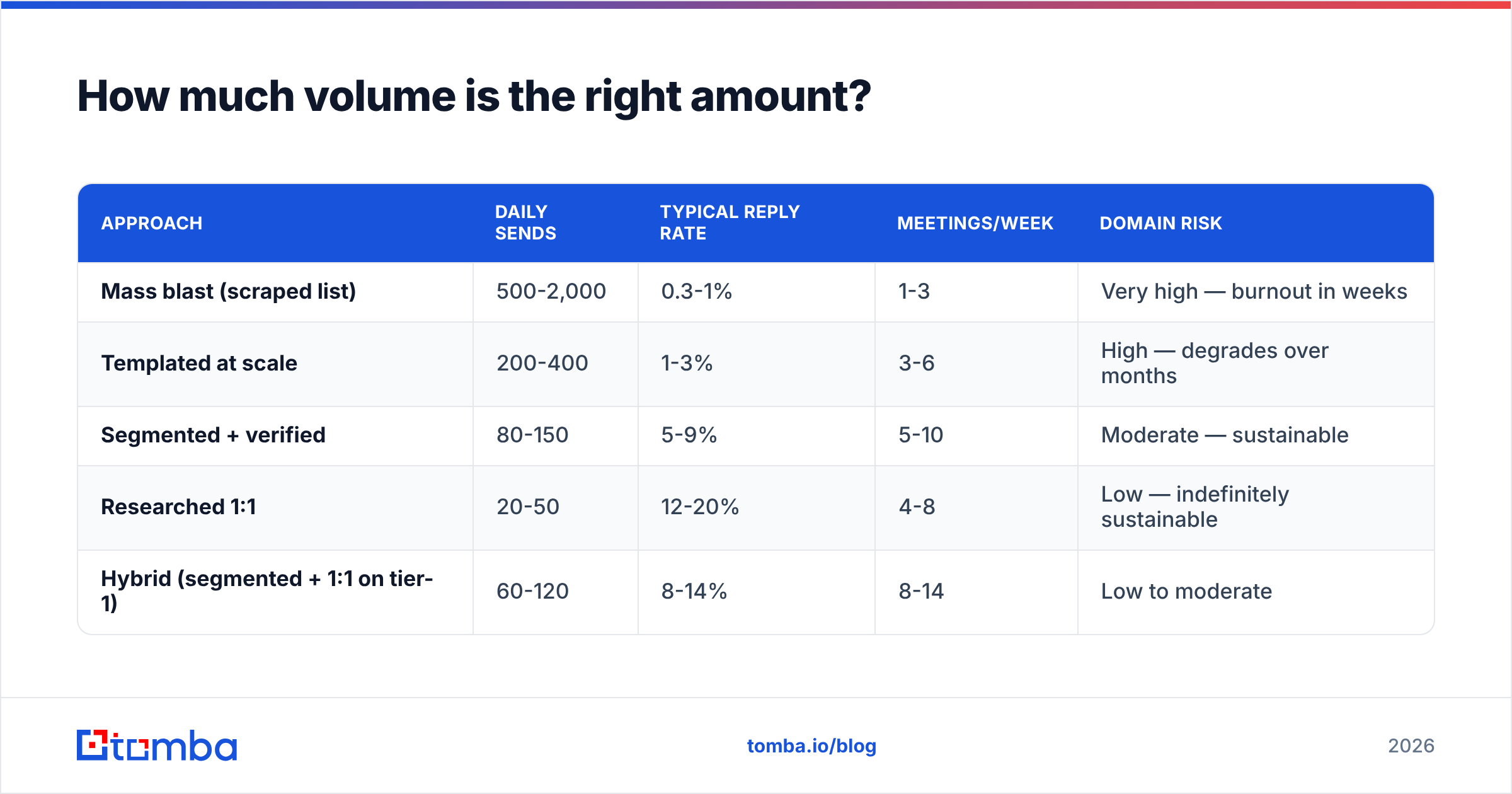
Less than your tool lets you send. Here is what different volume strategies actually produce, based on the ranges most B2B teams report across sales-engagement platforms tracked on G2:
| Approach | Daily sends | Typical reply rate | Meetings/week | Domain risk |
|---|---|---|---|---|
| Mass blast (scraped list) | 500-2,000 | 0.3-1% | 1-3 | Very high — burnout in weeks |
| Templated at scale | 200-400 | 1-3% | 3-6 | High — degrades over months |
| Segmented + verified | 80-150 | 5-9% | 5-10 | Moderate — sustainable |
| Researched 1:1 | 20-50 | 12-20% | 4-8 | Low — indefinitely sustainable |
| Hybrid (segmented + 1:1 on tier-1) | 60-120 | 8-14% | 8-14 | Low to moderate |
Two things fall out of this table. The mass blast wins on raw volume of sends and loses on literally everything else, including the asset you cannot rebuy — a domain with history. And the hybrid, not the pure 1:1, produces the most meetings, because researched personalization has a hard ceiling on how many accounts one human can cover in a day.
The practical read: reserve manual research for the 20% of accounts that justify it, and run tight, well-segmented sequences on the rest. That means your data layer needs to support both — bulk enrichment for the long tail, precise single lookups for named accounts.
What does a cold email that gets replies actually look like?#
Structurally, it is boring. That is the point.
Subject line: 3-6 words, lowercase or sentence case, no brackets, no emoji, no "Quick question." It should read like an email from a colleague, because that is the only category of email people open without thinking. "pricing page question" beats "Unlock 3x Pipeline Growth 🚀" every single time.
First line: Never about you. Never "I hope this finds you well." Reference something observable — a hire, a launch, a job posting, a stack change. The test: could this sentence be sent to anyone else on your list? If yes, delete it.
Body: Two to four sentences. State the specific problem you believe they have, and why you believe it. Do not describe your product's features. Do not include a case study PDF.
Ask: One question, answerable in one word. "Worth a look?" or "Is this on your roadmap for Q3?" Do not ask for 30 minutes. Asking for a meeting in email one is asking a stranger for a commitment before they have decided you are credible.
Signature: Plain text. No banner image, no social icon row, no "Sent from my iPhone" affectation. Images and heavy HTML increase spam scoring and add nothing.
Total length: under 90 words. If you cannot make the case in 90 words, you do not understand the prospect's problem well enough to be emailing them yet. Run the draft through a spam checker before it goes live — not because spam scores are gospel, but because they catch the phrases you stopped noticing.
How do you find the right addresses without buying a list?#
This is where most cold email programs quietly break. The advice "build your own list" is correct and almost never accompanied by instructions.
There are four honest paths, and they combine well:
- Domain search. Start from the company, not the person. A domain search returns the verified addresses associated with a company domain along with the pattern they use (first.last@, flast@, first@). Once you know the pattern, you can construct and verify addresses for anyone on the org chart.
- Name plus domain lookup. You know who you want. An email finder takes the name and the company domain and returns the address with a confidence score. This is the workhorse of targeted outbound.
- LinkedIn-sourced. You built a list from Sales Navigator filters. A LinkedIn finder resolves profiles to work emails, which matters because Sales Navigator does not hand you addresses.
- Licensed databases. Providers like BookYourData and similar B2B data vendors sell curated, permissioned contact sets — a legitimate option when you need coverage in a segment you cannot source yourself, and materially different from a scraped CSV bought off a forum.
Whichever path you take, the verification step is not optional. A confidence score of 95% still means one in twenty addresses is wrong, and twenty wrong addresses in a thousand-send campaign is a 2% bounce rate on its own.
What are the compliance rules you cannot ignore?#
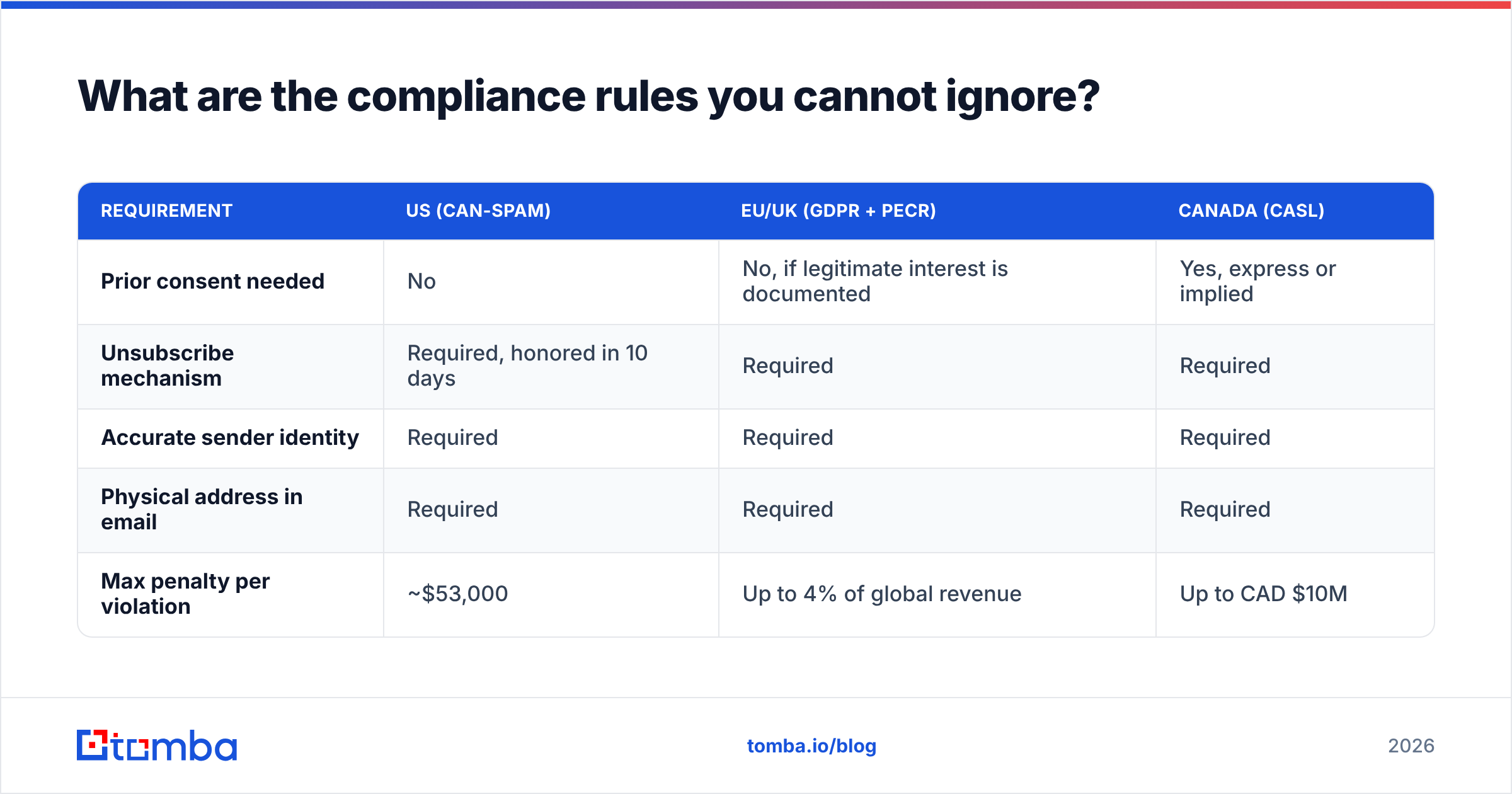
Cold email is legal in most jurisdictions. It is legal under specific conditions, and the conditions differ by where your recipient sits.
| Requirement | US (CAN-SPAM) | EU/UK (GDPR + PECR) | Canada (CASL) |
|---|---|---|---|
| Prior consent needed | No | No, if legitimate interest is documented | Yes, express or implied |
| Unsubscribe mechanism | Required, honored in 10 days | Required | Required |
| Accurate sender identity | Required | Required | Required |
| Physical address in email | Required | Required | Required |
| Max penalty per violation | ~$53,000 | Up to 4% of global revenue | Up to CAD $10M |
The practical upshot for B2B outreach: you can email a business contact about something plausibly relevant to their job. You cannot obscure who you are, you cannot make unsubscribing hard, and in Canada you need consent you can prove. The CAN-SPAM Act is far more permissive than most people assume; GDPR's legitimate-interest basis is narrower than most vendors will tell you.
Include a real unsubscribe link. Not "reply STOP." A one-click unsubscribe is now a technical requirement for bulk senders anyway, and every opt-out you honor is a spam complaint you avoid.
How do follow-ups actually work?#
Most sequences fail on the follow-up, not the first touch. The two errors are symmetric: sending too many, and sending them too close together.
A follow-up that says "just bumping this up in your inbox" contributes nothing. It signals that you have no additional reason to be in contact, which is a reasonable inference for the recipient to draw and act on. Every touch should carry new information — a relevant customer result, a piece of research, a change in their situation you noticed.
The cadence that works:
- Day 0 — the initial email. Specific, short, one ask.
- Day 4 — new angle. Different value proposition, different problem, same brevity. Do not reference the first email.
- Day 9 — social proof. One sentence about a comparable company, one sentence asking if it is relevant.
- Day 14 — the close. "I'll assume this isn't a priority — happy to circle back next quarter." This gets a surprising number of replies, because it removes the obligation to respond.
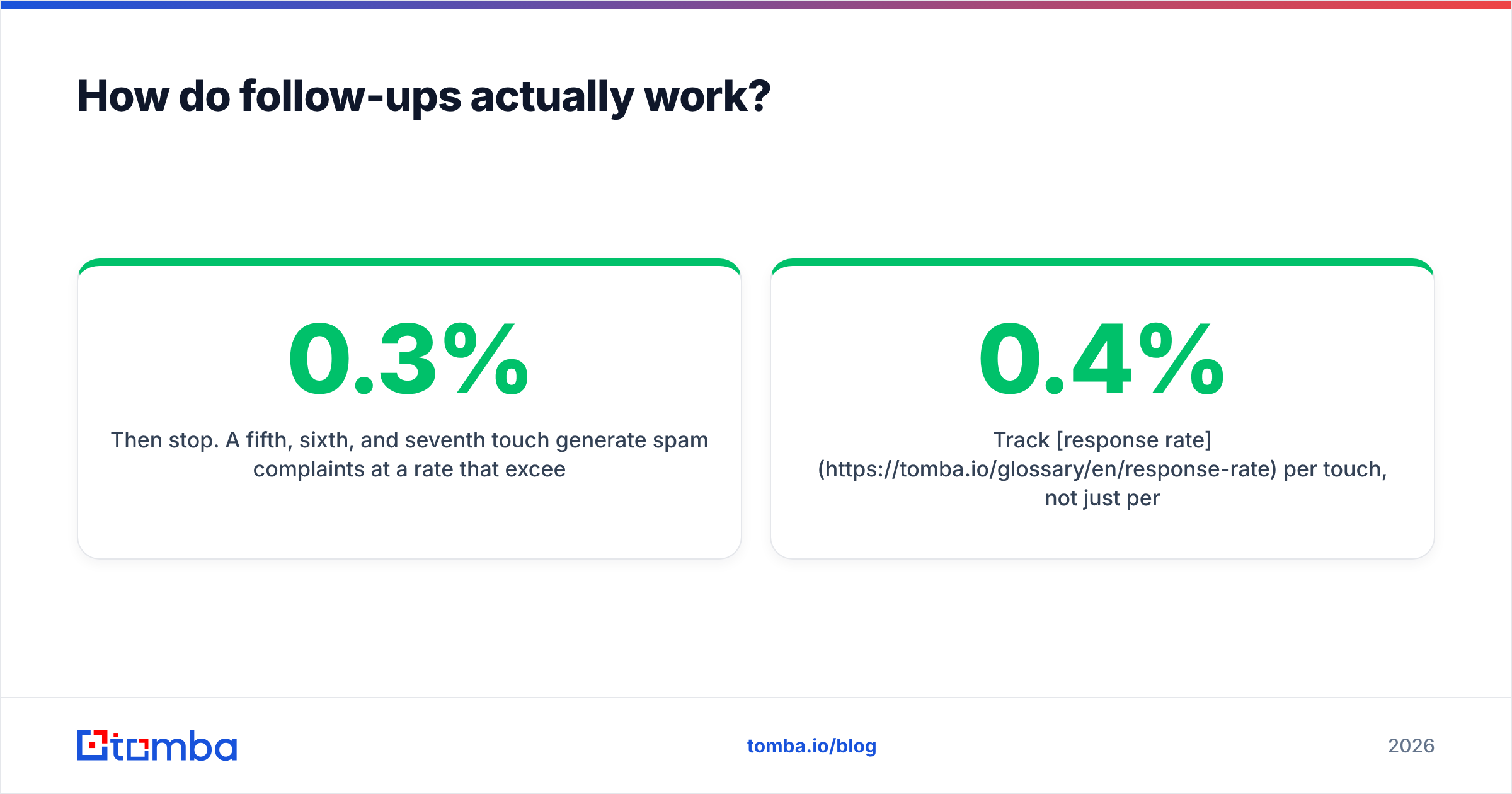
Then stop. A fifth, sixth, and seventh touch generate spam complaints at a rate that exceeds their reply rate. That trade was never good, and under a 0.3% complaint threshold it is now actively dangerous.
Track response rate per touch, not just per campaign. If touch three is generating 0.4% replies and touch one is generating 8%, the fix is not better copy at touch three. The fix is deleting touch three and putting that sending capacity into new prospects.
What should you measure?#
Open rate is the least reliable metric you have. Apple Mail Privacy Protection pre-fetches images, which means a meaningful share of your "opens" are machines. Treat open rate as a directional signal for deliverability changes and nothing more.
The metrics that survive scrutiny:
- Bounce rate. Target under 2%. Above 3%, stop the campaign and re-verify.
- Reply rate. The honest top-of-funnel number. Includes negative replies, which is correct — a "no" is information.
- Positive reply rate. Replies expressing interest, as a share of sends. Under 1% means your targeting is wrong, not your copy.
- Meetings booked per 100 sends. The only number your CFO cares about.
- Complaint rate. Under 0.1% is safe, 0.3% is the cliff. Monitor it weekly, not quarterly.
If bounce rate and complaint rate are healthy and reply rate is still under 1%, the problem is upstream of the email entirely. You are talking to people who do not have the problem you solve.
Where should you start this week?#
Pick the one that matches where you actually are.
If you have never sent cold email: buy a secondary domain, authenticate it, warm it for six weeks, and build a 200-person list by hand during that window. Do not skip the warmup. The six weeks are not wasted; they are the list-building weeks.
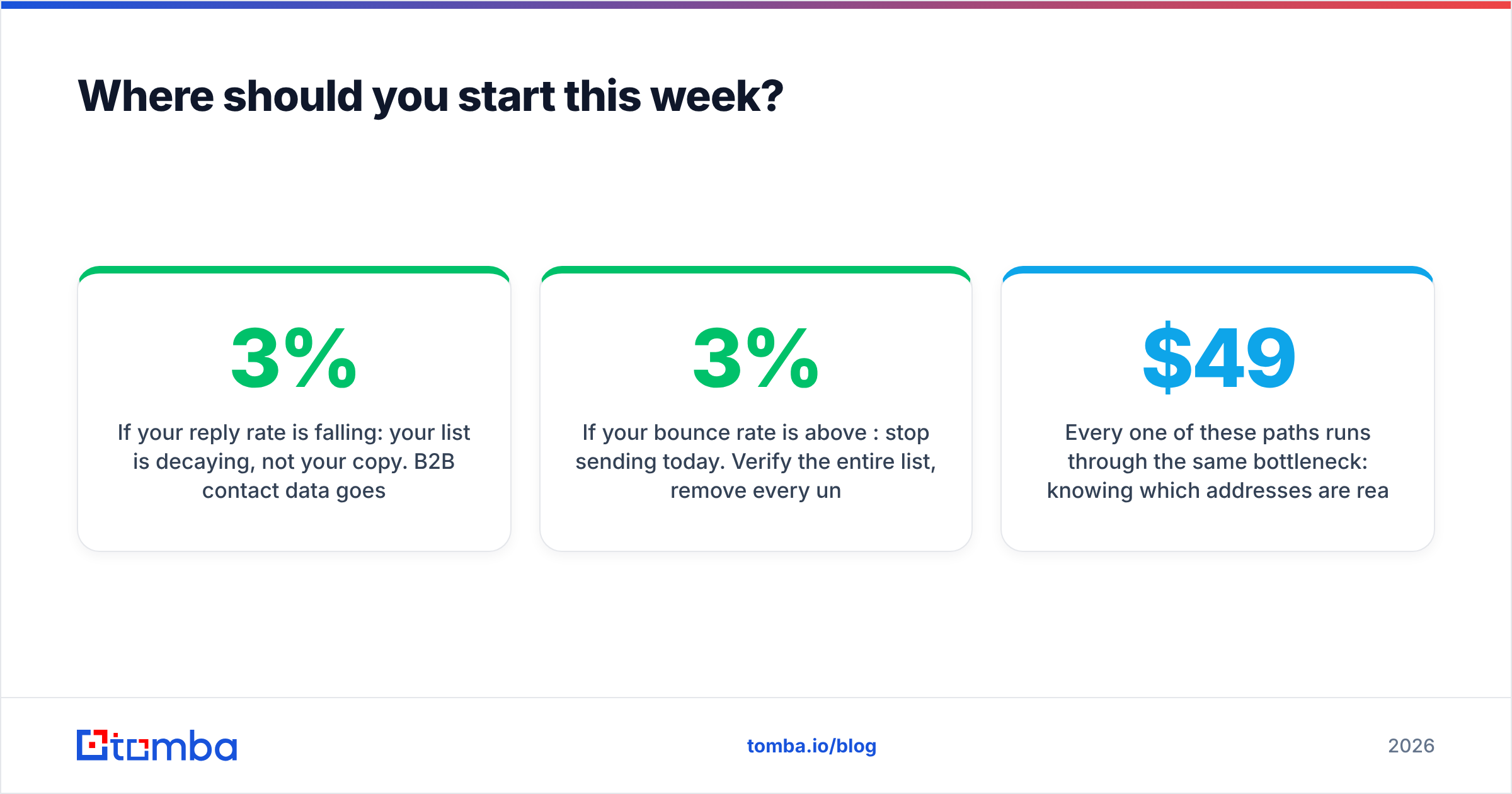
If your reply rate is falling: your list is decaying, not your copy. B2B contact data goes stale at roughly 2-3% per month through job changes alone. Re-verify everything older than 90 days.
If your bounce rate is above 3%: stop sending today. Verify the entire list, remove every unknown and catch-all you cannot confirm, and resume at 30% of your previous volume for two weeks.
If everything works and you want more: do not increase volume on the existing domain. Add a second warmed domain and split the load. Volume scales horizontally, not vertically.
Every one of these paths runs through the same bottleneck: knowing which addresses are real before you send to them. That is what Tomba's Email Finder is built for — find the address from a name and a domain, get a confidence score, and verify it in the same call. The free tier covers 25 searches a month if you want to test the accuracy on your own list before committing; paid plans start at $49/mo on Starter and scale through Growth at $99/mo. Full Tomba pricing is public, and there is an email finder API if you would rather wire verification directly into your sequencer.
Fix the list first. The copy is the easy part.
Related guides#
// get started
Find, verify and enrich your first contacts today
Start on the free plan with 25 searches a month, then scale when your team is ready.
Free plan · No credit card required · GDPR & CCPA
// about the author