Cold Emailing Prospects in 2026: The No-Fluff Playbook
Reply rates collapsed because everyone automated the same bad email. Here's what actually moves the needle when cold emailing prospects in 2026: data quality first, deliverability second, copy third.
TL;DR
- Cold emailing prospects still works in 2026, but the failure point moved. It is almost never the copy. It is the list, the mailbox, or the offer.
- Google and Microsoft now enforce bulk-sender rules that punish spam complaints above 0.3%. One bad list can burn a domain in a week.
- Verify before you send. A 4% bounce rate is the difference between landing in the inbox and landing in a filter you cannot see.
- Personalization at scale is dead as a differentiator. Relevance — right person, right trigger, right ask — is what replaced it.
- Volume is a multiplier on quality, never a substitute for it. 50 well-researched emails a day beats 500 sprayed ones, and it beats them on absolute reply count, not just percentage.
What does cold emailing prospects actually mean in 2026?#
Cold emailing prospects means sending a first-contact business email to someone who has not asked to hear from you, with a specific commercial ask, and doing it legally and at a volume that does not destroy your sending infrastructure.
That last clause is doing most of the work. Ten years ago the constraint was creativity. Now the constraint is infrastructure. Mailbox providers got very good at detecting patterns, and the tooling that made cold email easy also made it uniform — the same sequences, the same "Quick question" subject lines, the same fake-personalized first line about a LinkedIn post.
Think of it like fishing in a lake that everybody discovered at once. The fish are still there. But they have seen every lure in the tackle shop, and the game warden now checks your license at the dock.
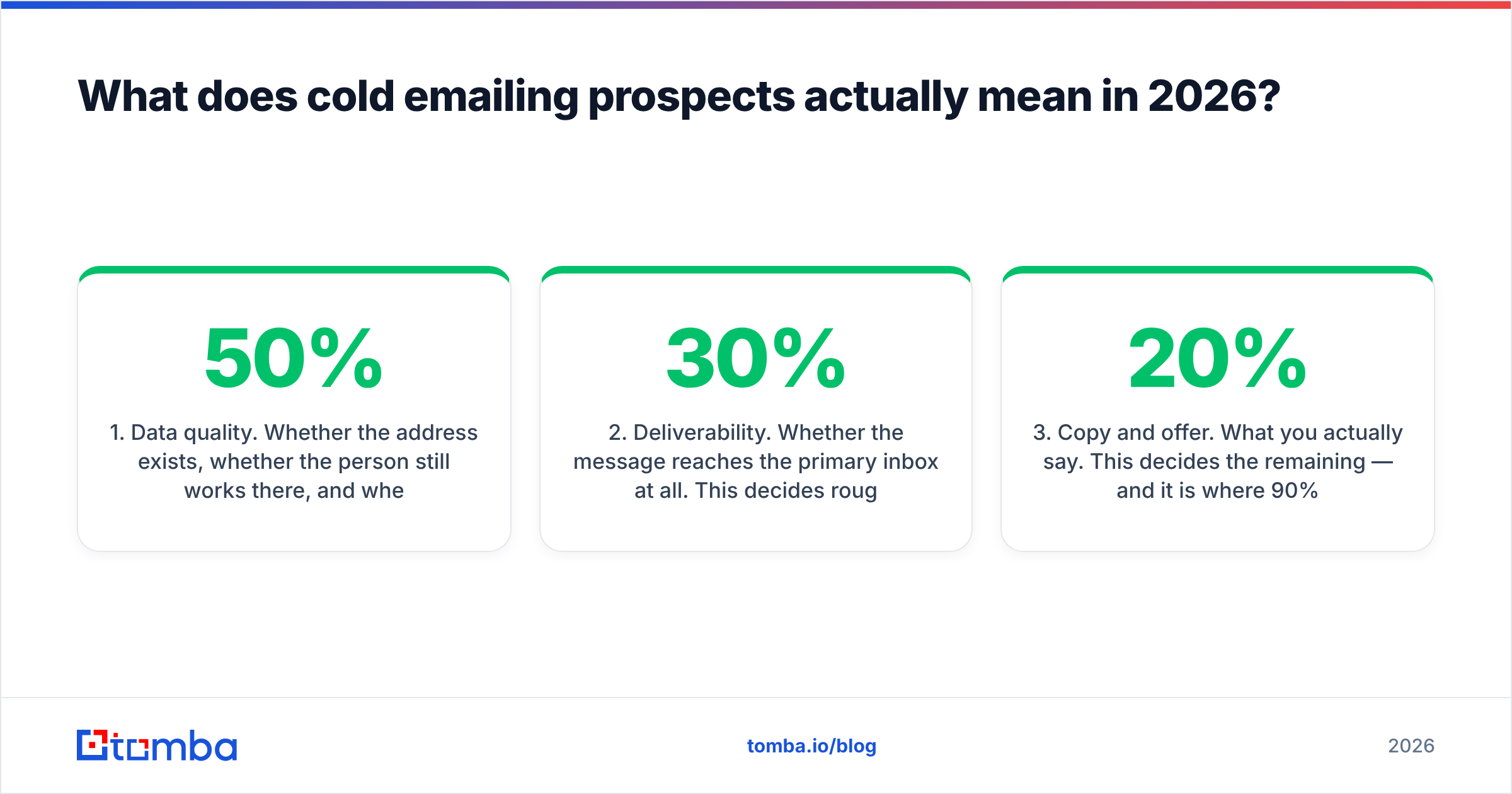
The three variables you control, ranked by how much they determine your outcome:
- Data quality. Whether the address exists, whether the person still works there, and whether they can plausibly buy what you sell. This decides 50% of your result.
- Deliverability. Whether the message reaches the primary inbox at all. This decides roughly 30%.
- Copy and offer. What you actually say. This decides the remaining 20% — and it is where 90% of blog posts about cold email spend their word count.
Most teams have that ranking exactly backwards. They rewrite the email for the fourth time while sending to a list where one address in six is dead.
Why do most cold email campaigns fail before the first send?#
Because the list was never checked. Here is the chain reaction.
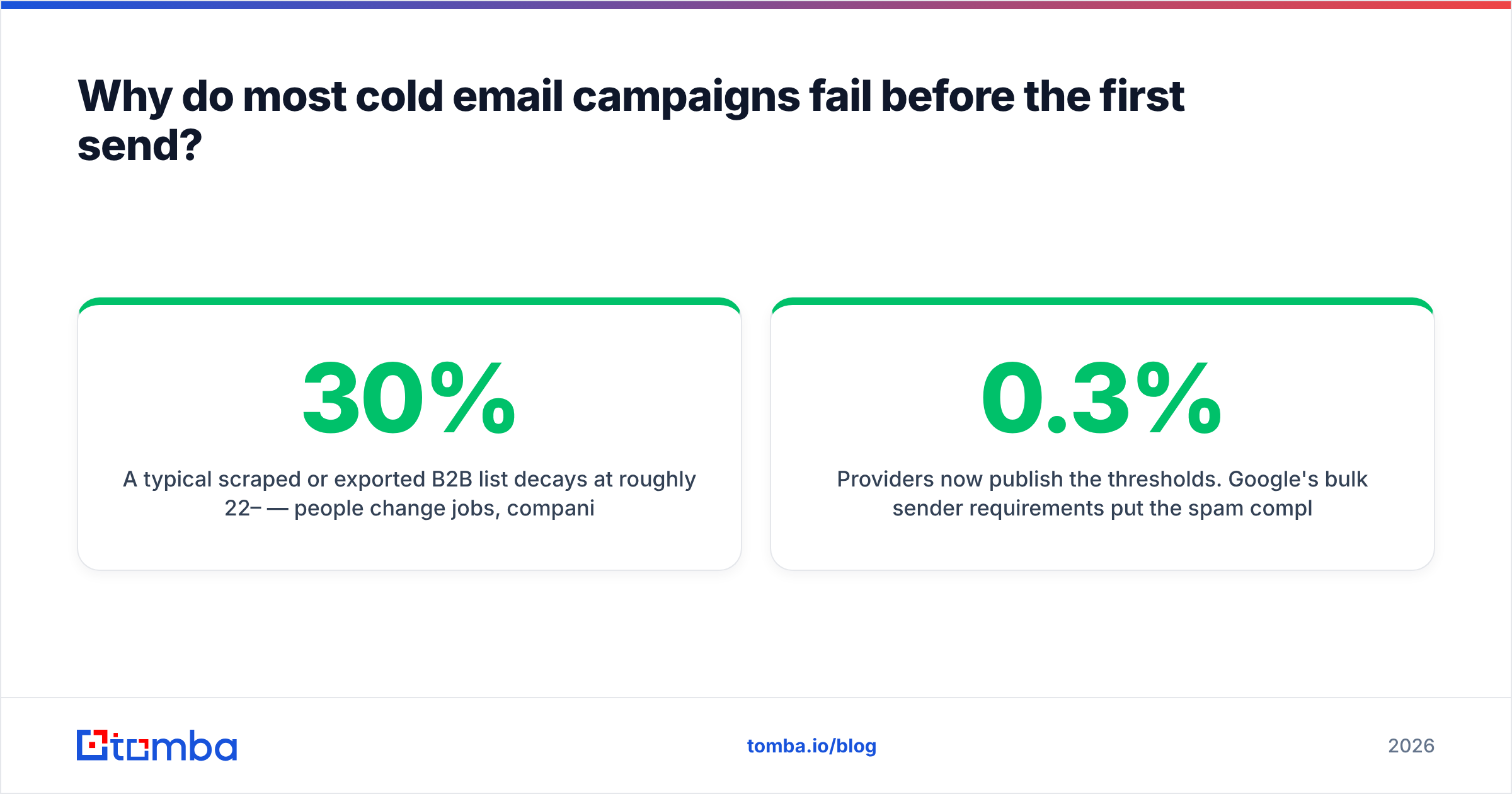
A typical scraped or exported B2B list decays at roughly 22–30% per year — people change jobs, companies rebrand domains, aliases get retired. If your list is nine months old and was 90% accurate on day one, you are now sending into a wall of hard bounces.
Hard bounces do three things at once:
- They tell the receiving provider that you do not know who you are writing to, which is the single loudest spam signal available.
- They drag your domain reputation down, which suppresses delivery to the valid addresses on the same list.
- They cost you sending volume that you cannot get back, because reputation recovers slowly.
Providers now publish the thresholds. Google's bulk sender requirements put the spam complaint ceiling at 0.3%, and you can watch your own numbers in Google Postmaster Tools. Cross that line consistently and you are not "underperforming" — you are filtered, silently, with no bounce message to tell you.
So the first thing you do before writing a single word of copy: run the list through an email verifier and cut anything that is not a confirmed deliverable. Then check what percentage of the remaining addresses sit on catch-all domains, because those are a separate problem — they accept everything and tell you nothing, which is why a dedicated catch-all verifier matters more than it used to.
How should you actually build a prospect list?#
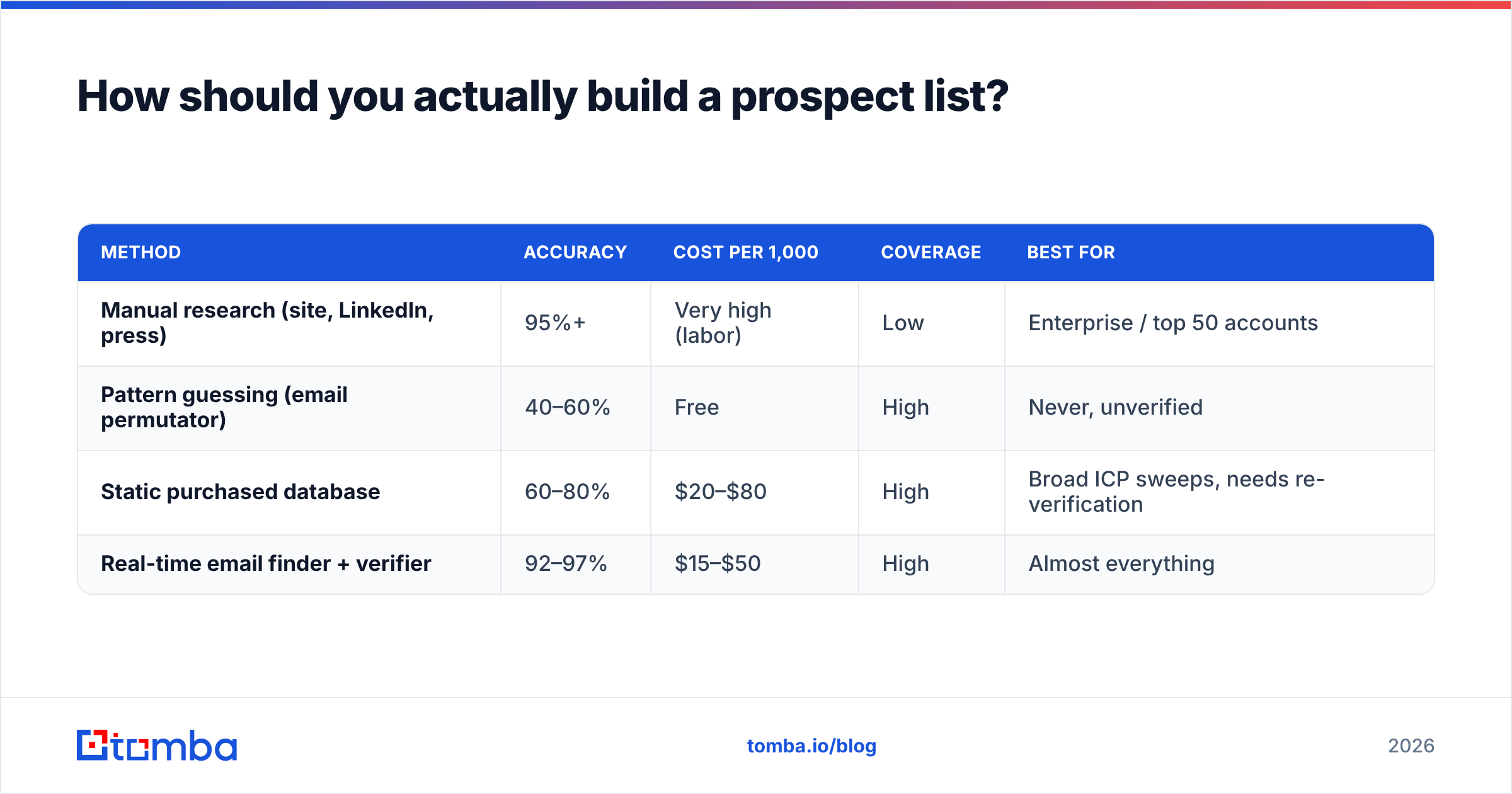
There are four ways to get an email address, and they are not equally good. This is the part where most teams overpay or over-guess.
| Method | Accuracy | Cost per 1,000 | Coverage | Best for |
|---|---|---|---|---|
| Manual research (site, LinkedIn, press) | 95%+ | Very high (labor) | Low | Enterprise / top 50 accounts |
| Pattern guessing (email permutator) | 40–60% | Free | High | Never, unverified |
| Static purchased database | 60–80% | $20–$80 | High | Broad ICP sweeps, needs re-verification |
| Real-time email finder + verifier | 92–97% | $15–$50 | High | Almost everything |
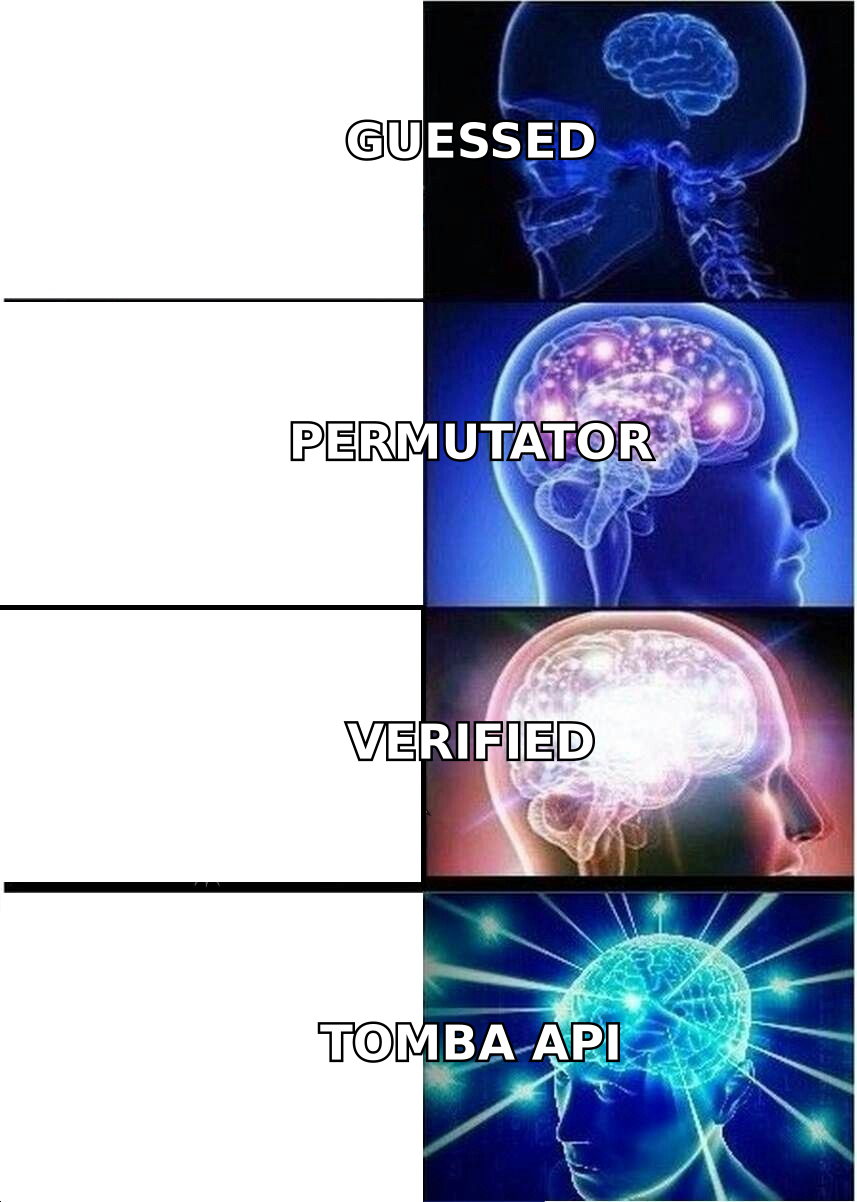
The permutator row is the trap. Generating first.last@company.com, flast@company.com, and first@company.com costs nothing, so it feels smart. But you cannot send to a guess — you either verify it (in which case you needed a verifier anyway) or you bounce. A company email pattern check is useful as an input to a finder, not as a substitute for one.
The realistic 2026 stack for cold emailing prospects at reasonable volume:
- Define the trigger, not the persona. "VP Eng at a Series B" is a persona. "VP Eng at a Series B that just posted three backend roles" is a trigger. Triggers convert 3–5x better because they answer why now.
- Source the account list from whatever signal matches the trigger — job boards, funding announcements, tech-stack changes, or your own website visitor reveal data for people already sniffing around.
- Find the contact with a domain search to see who exists at the company, then narrow by role.
- Verify every address and drop the risky ones. Do not "send and see."
- Enrich for context — seniority, department, location, sometimes a phone number — so segmentation is possible later.
- Cap the list at what you can actually follow up on. A list of 5,000 you never follow up with is worth less than a list of 400 you work three times.
What are the deliverability rules you cannot ignore?#
Deliverability is plumbing. Nobody thanks you for it and everything breaks without it.
The non-negotiables, in the order you should set them up:
- Separate sending domains. Never cold email from your primary company domain. Buy
getacme.comandacme-hq.com, point them at your main site, and send from those. If they burn, your invoices and support emails still arrive. - SPF, DKIM, and DMARC on every sending domain. All three. DMARC at
p=noneis enough to start, but the record has to exist. Check your setup with an SPF checker before you send anything. - Warmup for 3–4 weeks. New domains have no reputation, and no reputation is treated as bad reputation. Ramp from 5 emails a day to your target over several weeks. An email warmup calculator will give you the ramp schedule.
- Cap at 30–50 emails per mailbox per day. Not per domain — per mailbox. Scale by adding mailboxes, not by pushing one harder.
- Watch complaint rate weekly. Above 0.1% is a warning. Above 0.3% you are being filtered.
- No links, no images, no tracking pixels in email one. Every one of those is a small penalty. Earn the right to include them in email three.
The tracking pixel point deserves emphasis because it is counterintuitive. Open tracking has been unreliable since Apple Mail Privacy Protection started pre-fetching images in 2021, and the pixel itself is a spam signal. You are trading real deliverability for a metric that lies to you. Turn it off. Measure replies.
Also: read the actual law once. The CAN-SPAM Act permits unsolicited commercial email in the US provided you identify yourself, include a physical address, and honor opt-outs. GDPR in the EU requires a legitimate-interest basis and a clear opt-out. Neither one bans cold email. Both punish sloppiness.
Is your copy the problem, or is your offer the problem?#
Usually the offer. A prospect does not reply to a well-written email about something they do not want. They will reply to a mediocre email about something they urgently need.
Test this on yourself. When was the last time you replied to a cold email because the writing was good?
That said, structure matters, and there is a shape that consistently outperforms.
The four-part cold email:
- Opening line: proof you did work. Not "I saw you went to Michigan." A specific, recent, commercially relevant observation. "You've got three backend roles open and no one on the team has touched Rust." One sentence.
- The bridge: why that matters. Connect the observation to a cost they are already paying. Not a feature. A cost. "Teams in that spot usually spend the first two months of a new hire's ramp on tooling nobody documented."
- The proof: one number, one name. "We cut that to nine days at Linear." Skip it entirely if you do not have a real one. A fabricated case study is worse than no case study.
- The ask: absurdly small. "Worth a look?" or "Want the two-page teardown?" Never "Do you have 15 minutes on Thursday?" in email one. You are asking a stranger to schedule you.
Total: under 90 words. Sixth-grade reading level. No bold, no bullets, no signature block with four social icons. It should look like an email a person typed on a phone.
Subject lines: two to four words, lowercase, no punctuation. "quick thought on hiring" outperforms "Transform Your Engineering Velocity 🚀" by a margin so wide it is not worth testing. If you want to stress-test yours, a subject line tester will flag the spam-trigger words you stopped noticing.
For a broader survey of structures that work across industries, HubSpot maintains a regularly updated cold email guide with real examples worth stealing the bones from.
How many follow-ups, and how far apart?#
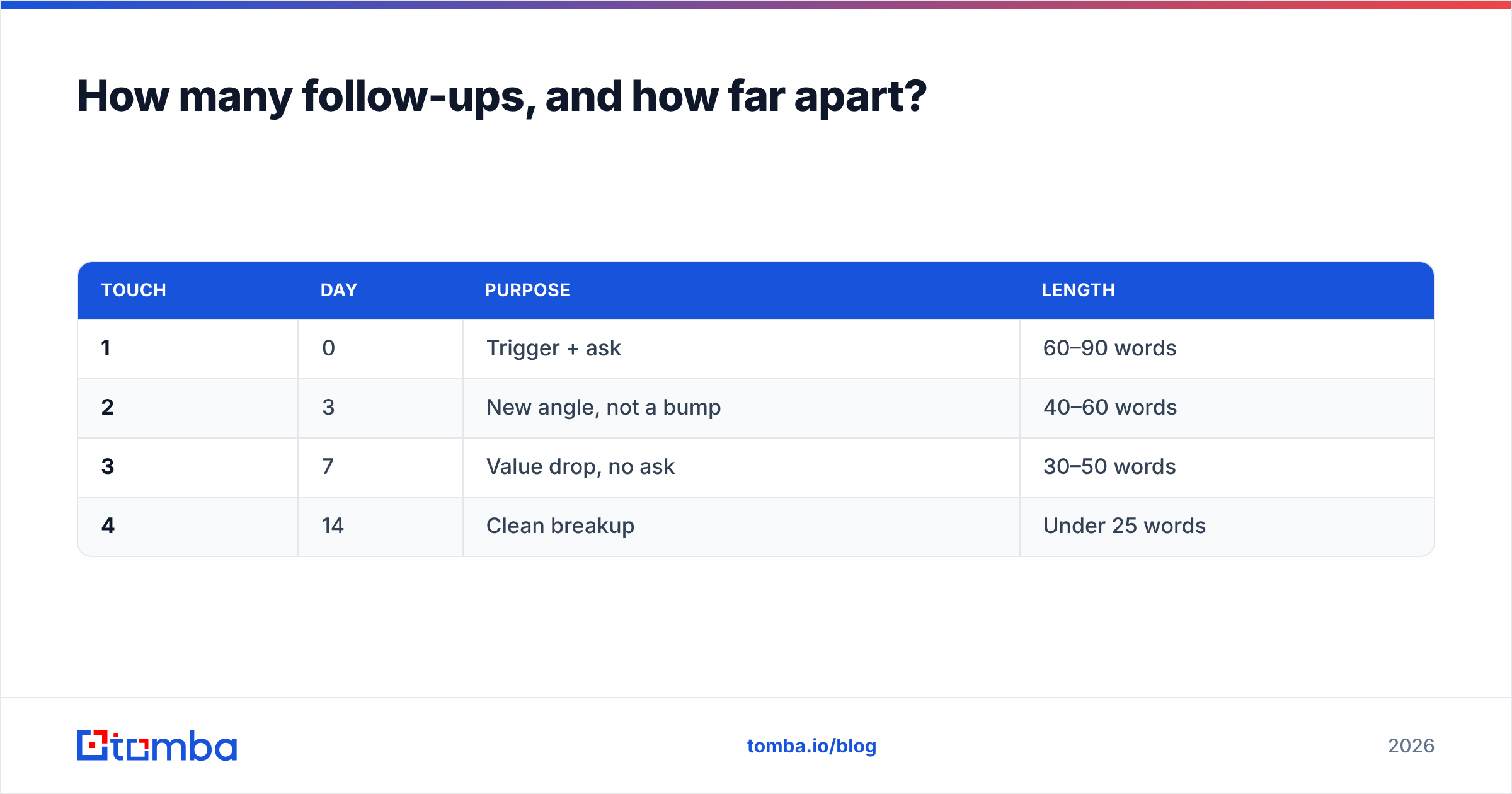
Three to four total touches, and then stop.
| Touch | Day | Purpose | Length |
|---|---|---|---|
| 1 | 0 | Trigger + ask | 60–90 words |
| 2 | 3 | New angle, not a bump | 40–60 words |
| 3 | 7 | Value drop, no ask | 30–50 words |
| 4 | 14 | Clean breakup | Under 25 words |
The rules that make this work:
- Never send "just bumping this to the top of your inbox." It communicates that you have nothing new to say, and it is true.
- Each follow-up needs a genuinely different angle. A new trigger, a new use case, a new piece of proof. If you cannot think of one, the prospect was not qualified.
- Touch 3 asks for nothing. Send a relevant teardown, benchmark, or article. No CTA. This is the single highest-reply message in most sequences.
- The breakup email is not a guilt trip. "Assuming this isn't a priority — I'll stop here. Door's open." That's it. It reliably pulls 8–12% of the total replies in a sequence.
Reply rate benchmarks worth calibrating against, per G2's sales engagement category data and what most well-run teams see: 1–3% is a broken list or a broken offer. 4–8% is functional. 10%+ means you found a real trigger and should pour money into it.
What does a realistic weekly cadence look like?#
Assume one SDR, three sending domains, two mailboxes each.
- Capacity: 6 mailboxes × 40 emails/day = 240 sends/day, 1,200/week.
- Split: roughly 400 first touches, 800 follow-ups.
- List cost: 400 verified new contacts a week, ~1,600/month. On Tomba pricing, the Growth plan at $99/mo covers this comfortably; the Starter plan at $49/mo covers a lighter cadence or a founder doing this solo.
- Expected output at 6% reply: ~24 replies/week, of which maybe 8 are positive, of which 3–4 become meetings.
Three or four meetings a week from one rep, at a $99/month data cost. That math only holds if the list is verified. Drop accuracy to 75% and you lose the bounces, you lose the reputation, and the same effort yields one meeting.
If you are running this at team scale, do the finding and verifying through the Tomba API or a bulk email finder job rather than by hand — the manual version is where SDR hours quietly disappear.
Where do people still get this wrong?#
The three failure modes, in order of frequency:
Sending to a list nobody checked. Fixable in an afternoon. Costs a quarter of pipeline if you don't.
Optimizing copy before fixing deliverability. If 40% of your sends never reach the primary inbox, an A/B test on subject lines is measuring noise. Fix the plumbing, then test.
Confusing volume with pipeline. Volume is a multiplier. Multiply zero by 500 and you still have zero — you just burned three domains getting there.
There is a fourth, subtler one: treating every prospect identically because the tool makes it easy. If your sequence would read the same to a 12-person startup and a 4,000-person enterprise, you have written a template, not an email. Segment first, even if segments are small.
Start with the list, not the copy#
Everything in this post reduces to a single sequence: find the right people, confirm the addresses are real, protect the domain you send from, and then say something worth reading.
Step two is where campaigns quietly die. The Tomba Email Finder handles steps one and two together — search by domain, name, or company, get a confidence score on every result, and push clean addresses straight into your sequencer via the API or the Chrome extension. The free tier gives you 25 searches a month to sanity-check your current list before you commit to anything. If your bounce rate is above 3%, that check will pay for itself in a single campaign.
Fix the data. The rest is just writing.
Related guides#
// get started
Find, verify and enrich your first contacts today
Start on the free plan with 25 searches a month, then scale when your team is ready.
Free plan · No credit card required · GDPR & CCPA
// about the author