Cold Emailing Strategies That Actually Book Meetings in 2026
Most cold emailing strategies fail at the infrastructure layer, not the copy layer. Here's the full 2026 playbook: list hygiene, sending setup, targeting, sequence design, and the metrics that tell you when to kill a campaign.
TL;DR
- Cold emailing strategies fail at the infrastructure layer far more often than the copy layer. Fix bounce rate and authentication before you rewrite a single subject line.
- A verified 200-contact list beats an unverified 5,000-contact list on both replies and inbox placement. Precision compounds; volume decays.
- The highest-performing 2026 sequences run 4–5 touches over 14–18 days, with each email under 120 words and exactly one ask.
- Personalization only pays when it references something the prospect would recognize as effort — a hiring signal, a product change, a specific number. Merge tags do not count.
- Track reply rate and positive reply rate. Open rate has been unreliable since Apple Mail Privacy Protection and is now closer to noise than signal.
What are cold emailing strategies, really?#
A cold emailing strategy is not a template. It is the full chain from who you contact to whether the message arrives to what you ask them to do. Break any link and the rest is decoration.
Most teams get this backwards. They spend three weeks A/B testing subject lines while 30% of their sends bounce, their domain has no DMARC record, and their list came from a scraper that guessed firstname.lastname@ and called it a day. The copy was never the problem.
Think of cold email like a restaurant delivery. You can plate the food beautifully, but if the address is wrong, the driver has no license, and the customer never ordered — the presentation is irrelevant. Deliverability is the address. Authentication is the license. Targeting is whether they wanted it in the first place.
So the order of operations for any serious cold emailing strategy is:
- Data quality — is this person real, at this company, at this address, right now?
- Sending infrastructure — will the message land in the inbox rather than spam?
- Targeting — is this person plausibly in pain about the thing you sell?
- Message — does the email earn 20 seconds of attention?
- Sequence — how many times do you follow up, and how do you stop being annoying?
- Measurement — which of the above five is actually broken?
Everything below follows that order, because that's the order the problems bite you.
Why do most cold emails fail before they're read?#
Because they never arrive. Gmail and Microsoft tightened bulk sender enforcement significantly, and the tolerances that used to be forgiving are now hard walls. Google's bulk sender guidelines require SPF and DKIM alignment, a published DMARC policy, one-click unsubscribe on marketing mail, and a spam complaint rate held under 0.3%. Miss those and your mail is filtered before a human ever sees the subject line.
Here's what actually determines whether you land in the inbox:
- Bounce rate. Under 2% is safe. Between 2% and 5% you are on notice. Above 5% and mailbox providers start treating your domain as a list-buyer. This is the single fastest way to burn a domain, and it is entirely preventable with an email verifier run before the first send.
- Authentication records. SPF, DKIM, and DMARC on the sending domain. Not the parent domain — the actual sending domain. If you send from
getcompany.combut authenticatedcompany.com, you authenticated nothing. - Domain age and warmup. A domain registered last Tuesday sending 300 emails on Wednesday is a spam signal so obvious it's almost polite. Ramp over 3–4 weeks. Run the numbers with a warmup calculator rather than guessing.
- Spam complaint rate. The 0.3% threshold is not a suggestion. Three complaints per thousand sends puts you in the penalty box, and recovery takes months.
- Content signals. Link-heavy emails, tracking pixels on every send, image-only bodies, and attachment-first messages all raise flags. Send plain-looking text from a real human account.
- Engagement history. Providers weigh whether recipients on your domain have historically opened, replied, or moved your mail out of spam. Low-quality lists poison this permanently.
Notice that five of the six have nothing to do with what you wrote. That's the point. Email deliverability is a prerequisite, not an optimization.
Is a big list or a small list the better cold emailing strategy?#
Small and verified. It is not close, and the math is not subtle.
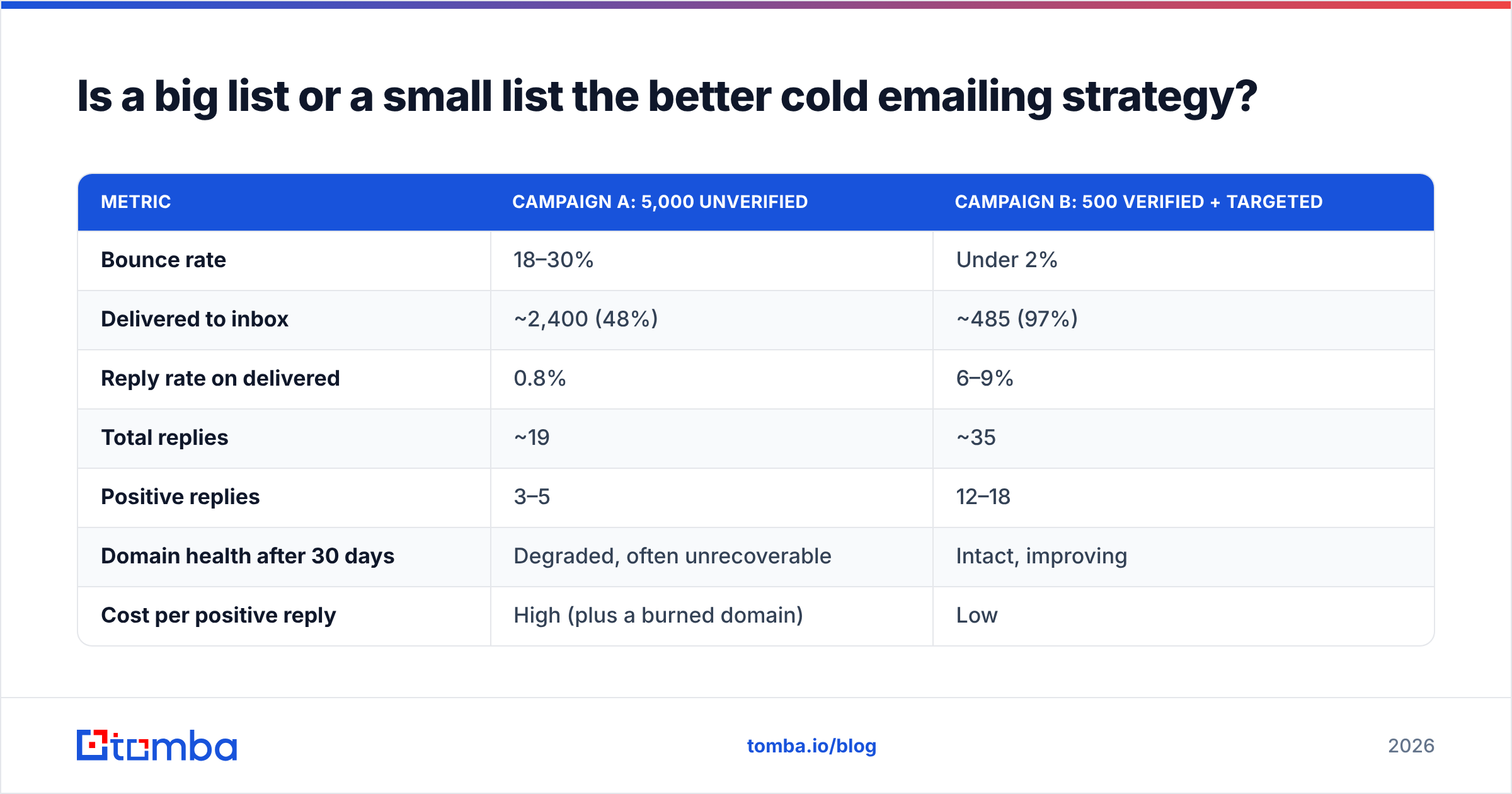
Take two campaigns with the same copy. Campaign A sends 5,000 unverified contacts scraped from a list vendor with no verification step. Campaign B sends 500 contacts, each verified, each matched to a specific hiring or funding trigger.
| Metric | Campaign A: 5,000 unverified | Campaign B: 500 verified + targeted |
|---|---|---|
| Bounce rate | 18–30% | Under 2% |
| Delivered to inbox | ~2,400 (48%) | ~485 (97%) |
| Reply rate on delivered | 0.8% | 6–9% |
| Total replies | ~19 | ~35 |
| Positive replies | 3–5 | 12–18 |
| Domain health after 30 days | Degraded, often unrecoverable | Intact, improving |
| Cost per positive reply | High (plus a burned domain) | Low |
Campaign B produces roughly twice the replies from one-tenth the sends, and — critically — the domain survives to run Campaign C. Campaign A borrowed against future deliverability to buy present volume. That loan comes due.
This is why the modern stack front-loads data work. Pull contacts from a source that maintains provenance rather than a bulk dump. Providers like Tomba's B2B database and BookYourData both take the position that sourced, maintained records outperform indiscriminate scrapes, and the deliverability numbers back that up. Then verify anyway, because even good data decays at roughly 2–2.5% per month as people change jobs.
For anything above a few hundred contacts, run the whole list through a bulk verify pass before it touches your sequencer. Catch-all domains deserve their own treatment — an SMTP check returns "accept" for every address on a catch-all, which means an unverified catch-all list looks clean and bounces anyway.
How do you target so the email isn't actually cold?#
The best cold email isn't cold. It's unexpected but obviously relevant.
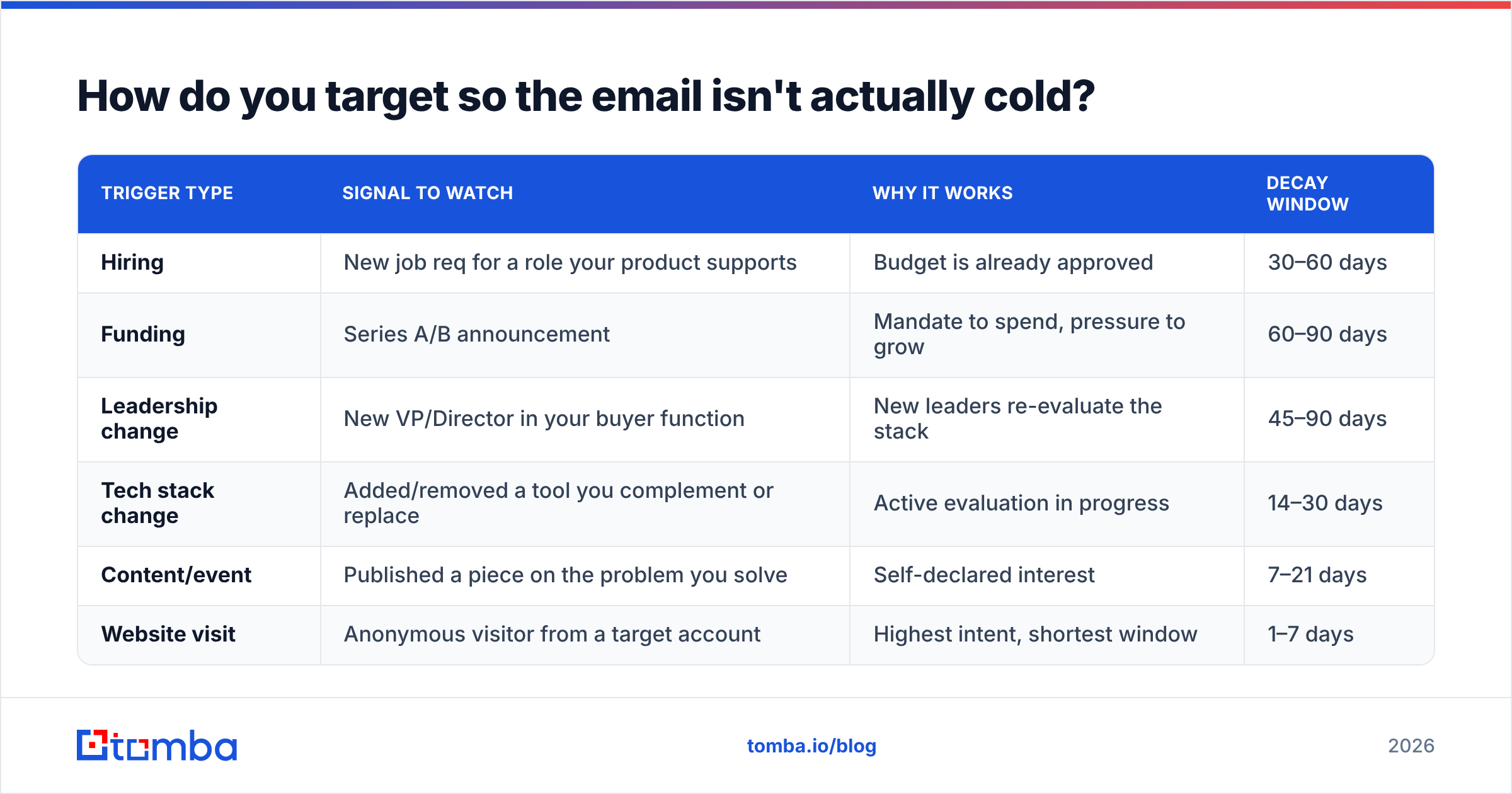
Relevance comes from a trigger — an observable event that makes your product timely. Without a trigger you are guessing, and the prospect can tell.
| Trigger type | Signal to watch | Why it works | Decay window |
|---|---|---|---|
| Hiring | New job req for a role your product supports | Budget is already approved | 30–60 days |
| Funding | Series A/B announcement | Mandate to spend, pressure to grow | 60–90 days |
| Leadership change | New VP/Director in your buyer function | New leaders re-evaluate the stack | 45–90 days |
| Tech stack change | Added/removed a tool you complement or replace | Active evaluation in progress | 14–30 days |
| Content/event | Published a piece on the problem you solve | Self-declared interest | 7–21 days |
| Website visit | Anonymous visitor from a target account | Highest intent, shortest window | 1–7 days |
The decay window matters more than most teams think. A funding-triggered email sent nine months after the round is not a triggered email — it's a cold email wearing a costume, and the prospect knows the round was old news.
Pair the trigger with the right person. Finding a real, current address for a named human at a named company is the mechanical part; a domain search surfaces the pattern and the people, and an email finder resolves the specific contact. The judgment part — deciding that this VP of Engineering, at this Series B company that just posted three platform roles, plausibly cares about your problem — is still yours.
What does a cold email that gets replies look like?#
Short. Specific. One ask.
The structure that consistently outperforms is four moves in under 120 words:
- The observation (1 sentence). What you noticed. Concrete, checkable, and about them. "You've posted three backend roles in six weeks" beats "I see you're scaling."
- The bridge (1 sentence). Why that observation connects to a problem you know how to talk about. This is where you demonstrate you've thought about their situation rather than pattern-matched their industry.
- The evidence (1–2 sentences). One relevant proof point. A named customer with a similar shape, a number, a specific outcome. Not a feature list. Not three case studies.
- The ask (1 sentence). Exactly one, and make it small. "Worth a 12-minute call Thursday?" converts better than "Let me know if you'd like to explore how we might partner." Interest-based asks ("is this even a priority this quarter?") outperform meeting asks on first touch for senior buyers.
What to cut, without mercy:
- Your company's founding story
- The word "solution"
- Any sentence beginning with "I wanted to reach out"
- More than one link
- Attachments
- Calendar links on the first email
- Anything that reads as though a template produced it, because one did
Subject lines should be lowercase, two to four words, and descriptive rather than clever. "backend hiring" outperforms "Quick question 🚀" and outperforms "Transform Your Engineering Velocity." Curiosity gaps get opened and deleted. Specificity gets read.
Run the draft through a spam checker before it goes out. Words that trip filters change quarterly, and your instincts are usually a year behind.
How many follow-ups, and how far apart?#
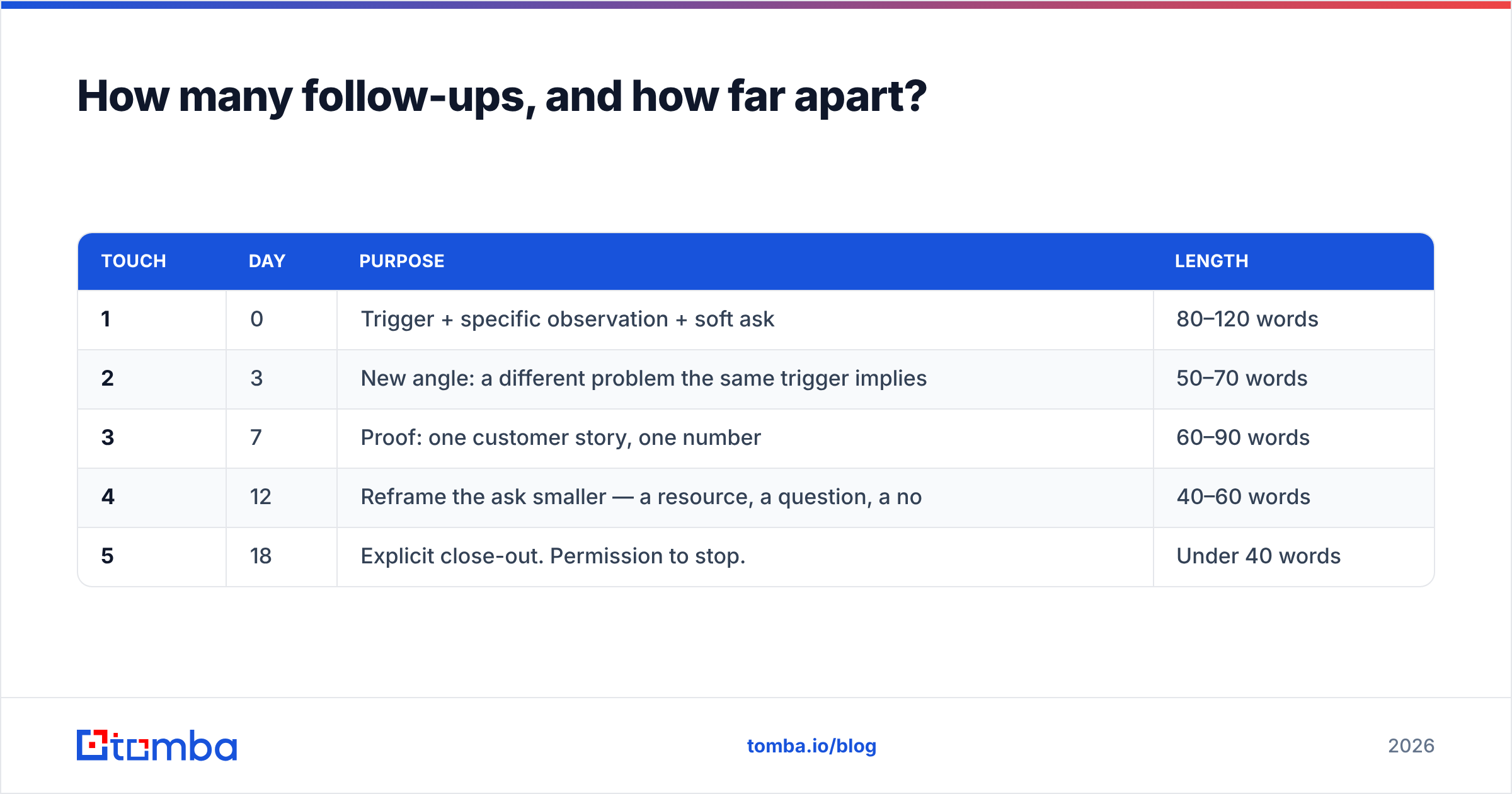
Four to five touches over 14–18 days, then stop. Roughly 40–50% of positive replies arrive after the first email, but the curve flattens hard after touch four. Touches five through nine mostly generate complaints, and complaints cost you the domain.
Each follow-up must add something. A bump that says "just following up" teaches the recipient that ignoring you was correct.
| Touch | Day | Purpose | Length |
|---|---|---|---|
| 1 | 0 | Trigger + specific observation + soft ask | 80–120 words |
| 2 | 3 | New angle: a different problem the same trigger implies | 50–70 words |
| 3 | 7 | Proof: one customer story, one number | 60–90 words |
| 4 | 12 | Reframe the ask smaller — a resource, a question, a no | 40–60 words |
| 5 | 18 | Explicit close-out. Permission to stop. | Under 40 words |
The close-out email is the highest reply-rate message in most sequences, and it should not be manipulative. "I'll assume the timing's wrong and stop here — happy to reconnect if that changes" gets genuine responses. The passive-aggressive breakup ("I guess this isn't a priority for you") gets spam complaints and screenshots on LinkedIn.
Multi-channel helps when it's genuinely additive. A LinkedIn view before touch one, a connection request after touch two, and a call between touches three and four raise reply rates meaningfully — as long as the message is consistent. Six channels repeating the same paragraph is not multi-channel; it's surround-sound spam.
Which metrics actually tell you what's broken?#
Open rate is broken as a metric. Apple Mail Privacy Protection pre-fetches tracking pixels, which means a meaningful slice of your "opens" are machines. Treat open rate as directional at best, and never optimize a subject line against it in isolation.
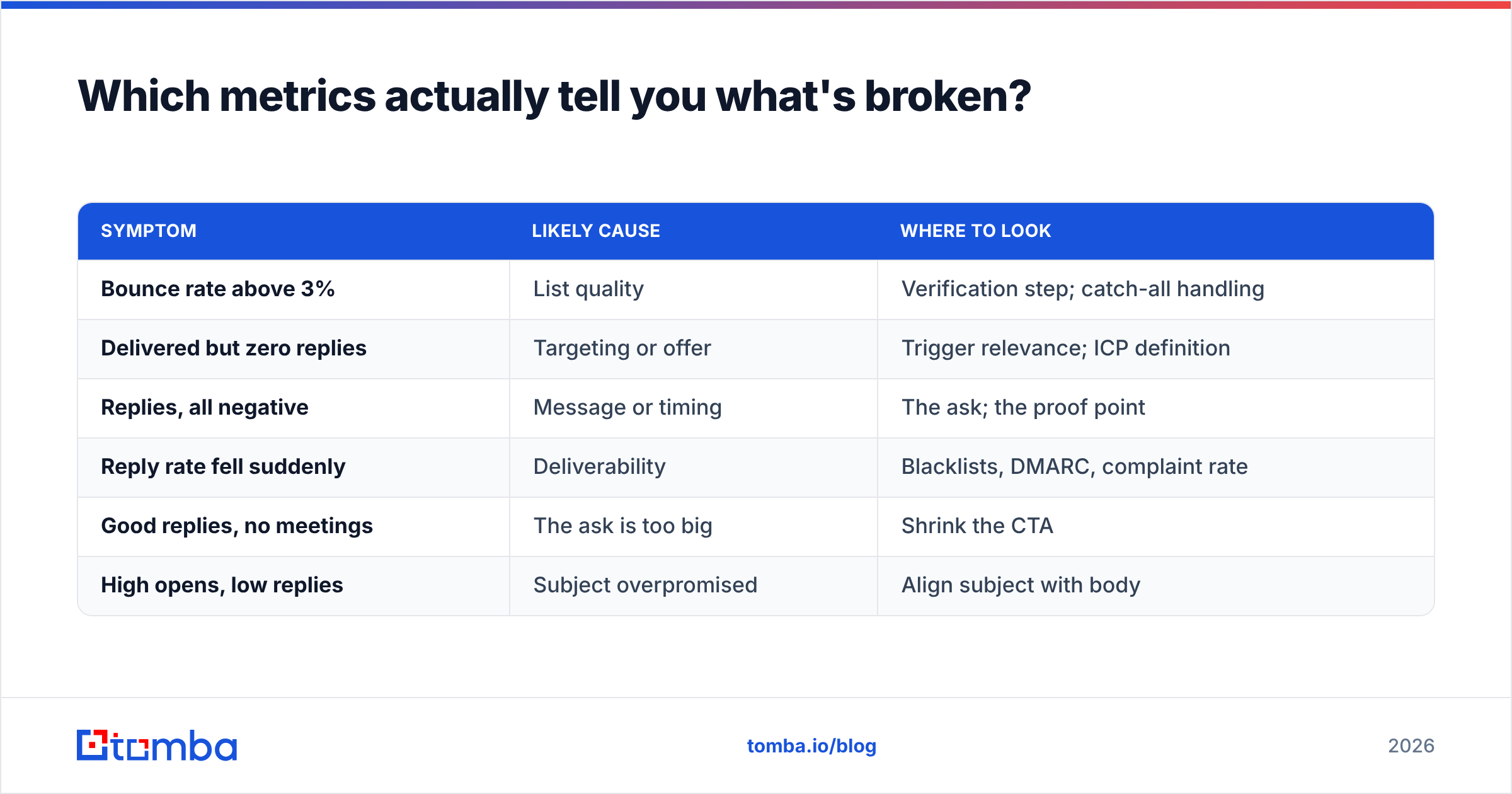
Diagnose by symptom instead:
| Symptom | Likely cause | Where to look |
|---|---|---|
| Bounce rate above 3% | List quality | Verification step; catch-all handling |
| Delivered but zero replies | Targeting or offer | Trigger relevance; ICP definition |
| Replies, all negative | Message or timing | The ask; the proof point |
| Reply rate fell suddenly | Deliverability | Blacklists, DMARC, complaint rate |
| Good replies, no meetings | The ask is too big | Shrink the CTA |
| High opens, low replies | Subject overpromised | Align subject with body |
The metric that matters is positive reply rate — replies expressing interest, divided by emails delivered. Anything above 3% is a working campaign. Below 1% and something in the chain above is broken; the table tells you which link.
A tertiary check worth running monthly: your sender reputation and blacklist status. Both are lagging indicators, which is exactly why you check them before they become the reason nothing works.
What are the legal limits on cold email?#
Cold email is legal in most jurisdictions, with conditions that vary sharply by geography.
Under the US CAN-SPAM Act, you must not use deceptive headers or subject lines, must identify the message as an advertisement where applicable, must include a valid physical postal address, and must honor opt-out requests within ten business days. Notably, CAN-SPAM does not require prior consent.
The EU is stricter. GDPR requires a lawful basis, and legitimate interest is the usual one for B2B — but it's a defensible position, not a blank check. Some member states layer additional consent requirements on top. Canada's CASL is stricter still, with consent generally required and penalties that are not theoretical.
Practical rule: send to business addresses, about business matters, with an obvious way to opt out, from a real identifiable company. If you're doing something you'd be uncomfortable explaining to the recipient, that discomfort is legal advice.
Where should you start?#
Start at the bottom of the stack, not the top.
Run this week: pull your current list and verify it. If your bounce rate is above 2%, everything downstream of that is unmeasurable — you cannot tell whether your copy is bad or simply undelivered. Then check SPF, DKIM, and DMARC on the exact domain you send from. Then, and only then, look at your targeting.
Copy is the last thing to fix, because it's the only thing that's obviously visible and therefore the thing everyone fixes first. HubSpot's outbound research and the practitioner reviews on G2 point at the same conclusion from different directions: the teams that win at cold email are the ones who treated it as a data problem before treating it as a writing problem.
Get the data right and mediocre copy still books meetings. Get the data wrong and Hemingway couldn't save the campaign.
Build the list before you build the sequence. The Tomba Email Finder resolves verified professional addresses by name, domain, or company — with confidence scoring and source attribution on every result, so you know what you're sending to before you send it. Start free with 25 searches per month, or move to the $49/mo Starter plan when your pipeline needs volume. Check Tomba pricing for the full tier breakdown, and run your existing list through the email verifier first — it costs less than a burned domain.
Related guides#
// get started
Find, verify and enrich your first contacts today
Start on the free plan with 25 searches a month, then scale when your team is ready.
Free plan · No credit card required · GDPR & CCPA
// about the author