Cold Emailing vs Cold Calling: Data, Costs, and Our Pick
Cold email scales cheap but converts slowly. Cold calling converts fast but burns rep hours. Here's the real math on reply rates, cost per meeting, and which channel deserves your 2026 budget.
TL;DR
- Cold email wins on cost per touch (roughly $0.30–$1.50 fully loaded) and scales to thousands of prospects a week. Cold calling wins on cost per conversation and gives you an answer in 90 seconds instead of 9 days.
- Realistic 2026 benchmarks: cold email books meetings at 0.5–2% of contacts reached. Cold calling books at 1–3% of dials, but a rep only makes 50–80 dials a day.
- Neither channel works on bad data. A 30% bounce rate kills your domain; a 40% wrong-number rate kills your rep's morale. Data quality is the variable that dominates both.
- The highest-performing teams don't choose. They sequence: email to create name recognition, call to convert it, email again to close the loop.
- Pick calling for deals above ~$25k ACV and for personas who still answer phones. Pick email for high-volume, low-ACV, or personas who live in Slack.
What actually separates cold emailing from cold calling?#
The honest answer: latency and leverage.
Cold email is a leveraged, asynchronous bet. You spend an hour building a list, then a machine touches 500 people while you sleep. The catch is that you find out whether the bet worked in three to nine days, and most of the time the answer is silence you can't interpret.
Cold calling is an unleveraged, synchronous bet. You spend the same hour and touch 40 people, but you get a verdict in real time — a no, a maybe, a "call me next quarter," or a discovery call booked on the spot. You cannot scale it without hiring, but you also never wonder what happened.
Everything else — deliverability, gatekeepers, spam filters, call blocking — is downstream of those two properties.
Think of it like fishing. Cold email is a net: cheap to throw, catches whatever swims into it, and you sort the haul later. Cold calling is a spear: expensive per throw, but you choose the fish and you know immediately whether you hit.
What do the numbers actually say in 2026?#
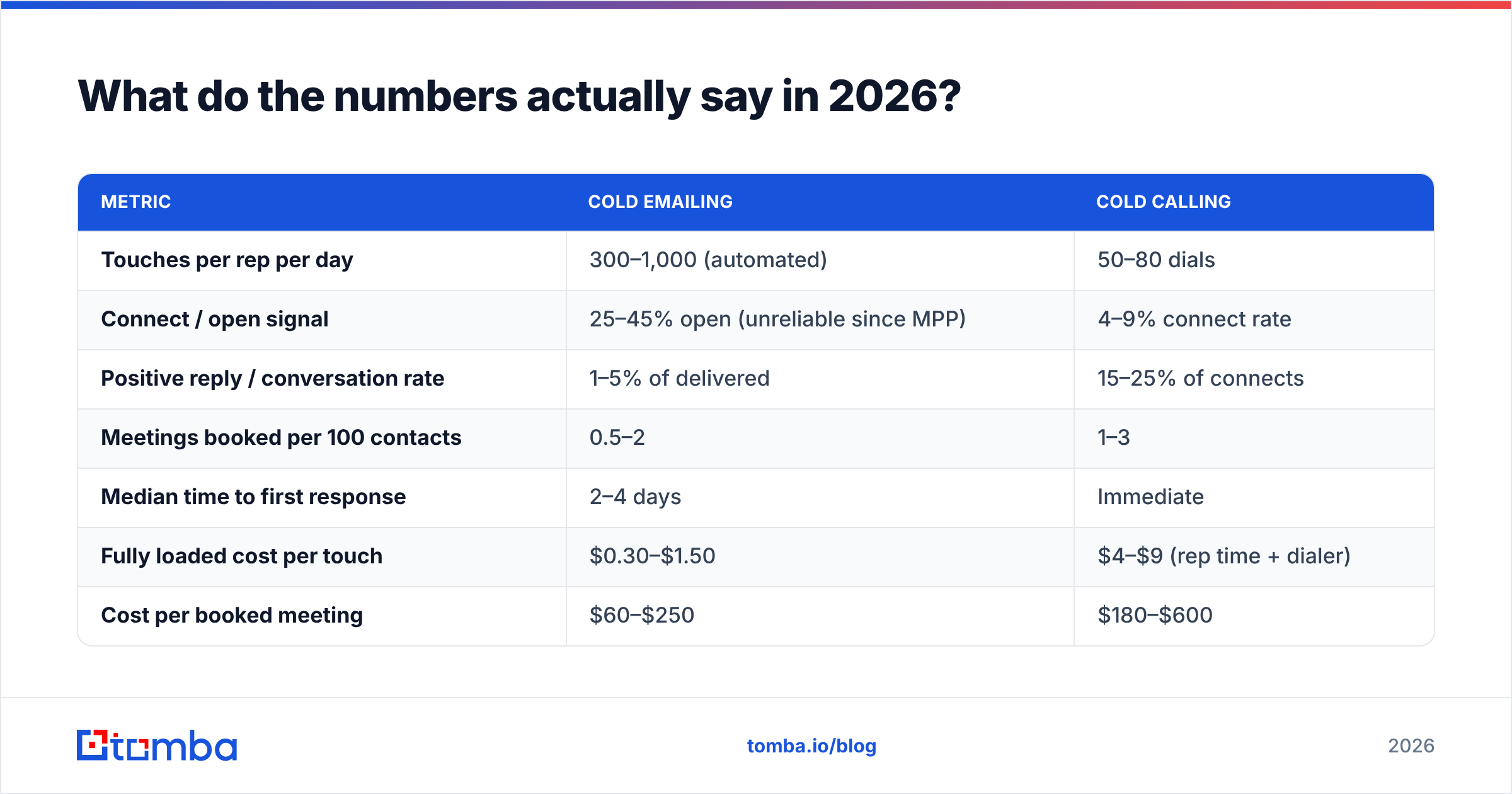
Here is the comparison most vendor blogs won't give you straight, because both sides sell software.
| Metric | Cold Emailing | Cold Calling |
|---|---|---|
| Touches per rep per day | 300–1,000 (automated) | 50–80 dials |
| Connect / open signal | 25–45% open (unreliable since MPP) | 4–9% connect rate |
| Positive reply / conversation rate | 1–5% of delivered | 15–25% of connects |
| Meetings booked per 100 contacts | 0.5–2 | 1–3 |
| Median time to first response | 2–4 days | Immediate |
| Fully loaded cost per touch | $0.30–$1.50 | $4–$9 (rep time + dialer) |
| Cost per booked meeting | $60–$250 | $180–$600 |
| Ramp time for a new rep | 1–2 weeks | 6–12 weeks |
| Fails when… | Domain reputation tanks | Prospect never picks up |
| Scales by… | Adding domains + inboxes | Adding headcount |
Two things jump out.
Email is cheaper per meeting, but not by 10x. Once you add sending infrastructure, warmup, list building, verification, and the copywriter's time, the gap narrows to roughly 2–3x. People who quote "$5 per meeting" for cold email are counting the tool subscription and nothing else.
Calling has a much higher conversion rate per human contact. Getting a person on the phone is hard. Once you have them, the throughput is enormous — a quarter of connected conversations move somewhere. No email sequence converts a quarter of readers.
So the real question isn't "which channel is better." It's which constraint is binding for you right now — budget, or headcount?

Actually, embed the meme properly:
Which channel should you pick for your deal size?#
Use a structured decision, not vibes. Run your motion through these six checks and count the answers:
- Average contract value. Under $10k ACV, calling rarely pays for itself — the rep hour costs more than the margin on the deal. Above $25k ACV, a single conversation justifies a week of dialing. Between the two, sequence both.
- Persona phone behavior. VPs of Sales, RevOps leaders, agency owners, and anyone in construction, logistics, staffing, or field services still answer. Engineering managers, security leads, and most IC-level SaaS buyers do not. Ask five customers how they'd prefer to be reached and believe them.
- List size available. If your total addressable market is 800 companies, you cannot run a volume email play — you'll burn the TAM in six weeks. Call them. If your TAM is 80,000, you cannot dial your way through it. Email.
- Deliverability posture. New domain, no SPF/DKIM/DMARC, no warmup? You are not ready to send. Every message you push now costs you six months of sender reputation later. Start on the phone while your domains warm.
- Data completeness. Do you have verified emails, or verified phone numbers, or both? Whichever field is 90%+ accurate is the channel you can actually run. Running a channel on 55%-accurate data is not a channel, it's a lottery.
- Speed to first signal. If you're validating a new ICP and need to know within a week whether the message resonates, call. Twenty conversations teach you more than 2,000 emails and a 0.8% reply rate.
Three or more answers pointing one way? That's your primary channel. The other becomes support.
Is cold email dying because of spam filters?#
No, but the version of it that worked in 2019 is dead.
Google and Microsoft tightened bulk-sender enforcement in 2024, and the ratchet has only turned further. What actually changed:
- Authentication is table stakes. SPF, DKIM, and DMARC alignment are now required for bulk senders, not optional. Run your domain through an SPF checker before your first send, not after your first bounce spike.
- Spam complaint thresholds are enforced. Sustained complaint rates above 0.3% get you throttled. That's roughly 3 complaints in 1,000 sends — a bar that generic, obviously-blasted copy fails constantly.
- Bounce rate is a reputation signal. Sending to a list with 20% invalid addresses tells the receiving MTA that you don't know who you're writing to. It doesn't matter that the other 80% were real.
None of this kills cold email. It kills lazy cold email. Teams that verify every address before send, warm domains for 3–4 weeks, cap volume at 30–50 sends per inbox per day, and write copy a human would actually reply to are seeing the same or better reply rates than they did five years ago — because the noise floor dropped.
The practical implication: your list-building step is now the most important step. Run every contact through an email verifier before it enters a sequence, and treat catch-all domains as a separate risk bucket rather than assuming they're valid.
Google's own guidance for bulk senders is worth reading directly rather than through a vendor's summary — see Google's sender guidelines for the authoritative version.
Is cold calling dying because nobody answers the phone?#
Also no, but connect rates are down and the math has shifted.
The two structural changes:
Carrier-level spam labeling. If your outbound number gets flagged, you show up as "Scam Likely" and your connect rate collapses to near zero. Rotating local presence numbers helps; abusing them gets you flagged faster. Monitor your numbers monthly.
Mobile-first prospects. Office DIDs route to voicemail permanently. The reps hitting 8–9% connect rates are dialing mobile numbers, not switchboards. That makes mobile-number accuracy the single biggest lever in a calling program — more than script, more than cadence, more than the dialer you bought.
Which is exactly where most calling programs quietly fail. A rep with a list of 200 "phone numbers" where 90 are main office lines, 40 are disconnected, and 70 are correct mobiles isn't making 200 dials. They're making 70. Their dial-to-meeting ratio looks catastrophic and they get coached on their script when the problem was the data.
If you're running a phone motion, validate before you dial: a phone validator that separates mobile from landline and flags disconnected lines converts a 200-row list into 70 real attempts before your rep wastes three hours discovering it.
How do the best teams combine both channels?#
They stop treating it as versus. The reason is simple: a cold call to someone who has seen your name twice is not a cold call.
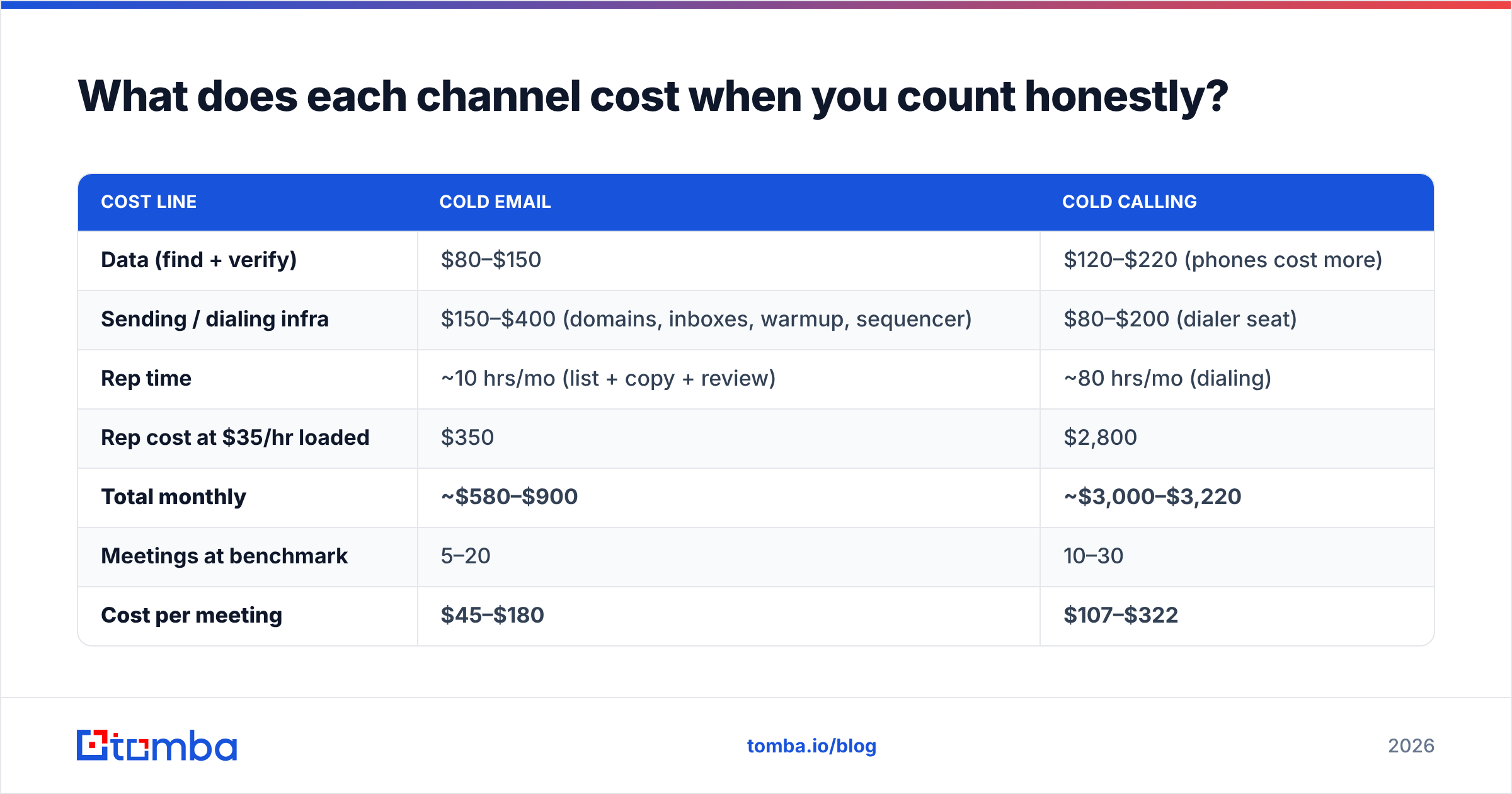
A sequence that consistently outperforms either channel alone:
| Day | Channel | Purpose |
|---|---|---|
| 1 | Short, specific, one ask. Plant the name. | |
| 3 | LinkedIn view or connect | Passive recognition, no pitch |
| 5 | Call | "I sent you a note Tuesday about X" — warm open |
| 5 | Voicemail + email | Reference the voicemail in the email subject |
| 9 | Call | Different time of day |
| 12 | Breakup or resource share |
The call on day 5 is the whole point. Reps who open with "I emailed you about X on Tuesday" get a materially different reception than reps who open cold, because the prospect now has a reason to believe this isn't random. The email did the recognition work; the call does the conversion work. Neither could do both.
This is also why the two channels share one dependency: the contact record. If your email is right and your phone number is wrong, the day-5 call never happens and the sequence degrades to email-only. If your phone is right but the email bounced on day 1, the rep opens cold and loses the advantage.
Get both fields right on the same record, or you're running two separate half-programs and calling it multi-channel. Building a contact record with a verified work email and a validated direct dial is what data enrichment is for.
What does each channel cost when you count honestly?#
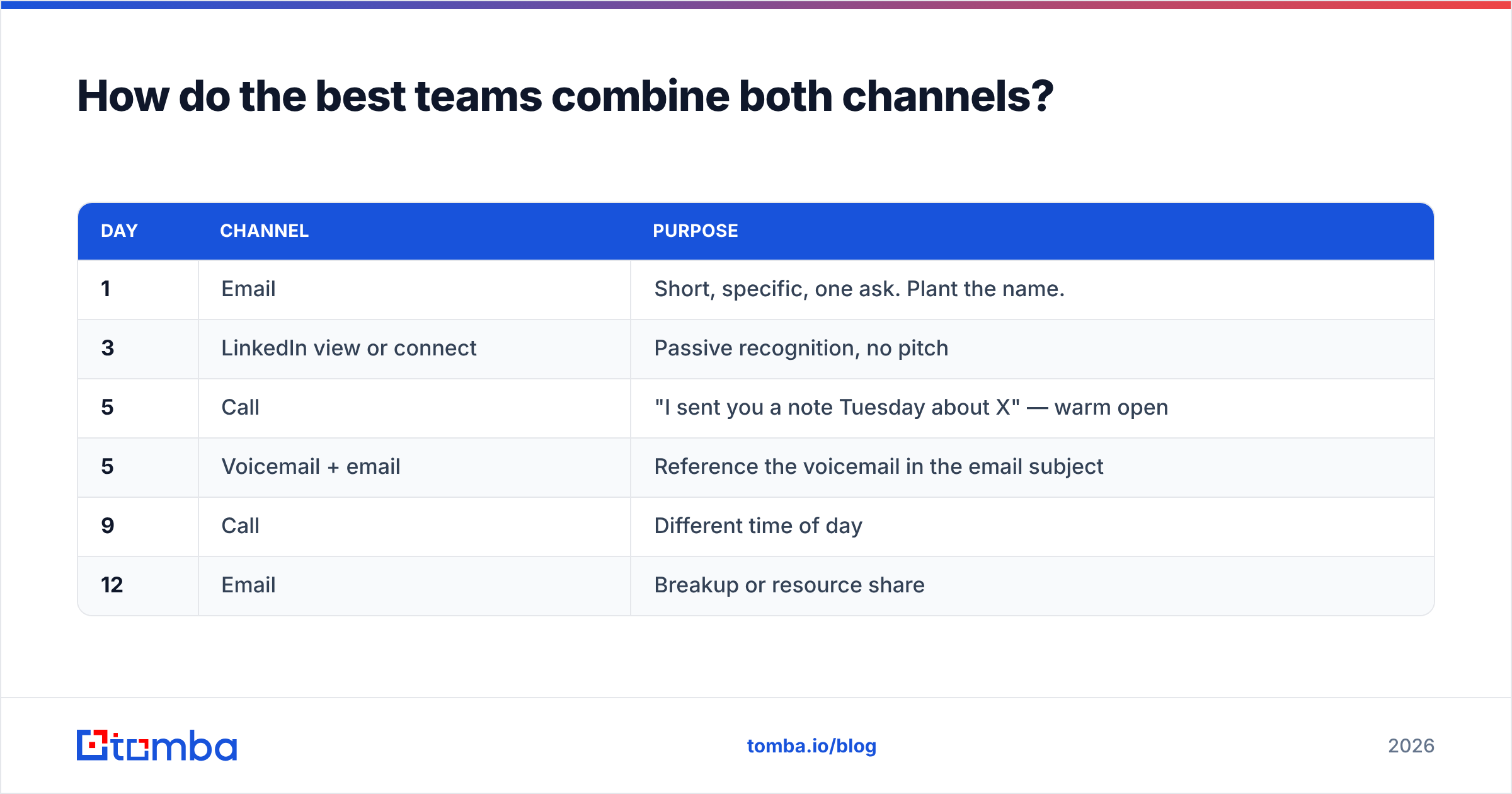
Most cost comparisons only count software. Here's the fully loaded version for a team running 1,000 prospects per month.
| Cost line | Cold Email | Cold Calling |
|---|---|---|
| Data (find + verify) | $80–$150 | $120–$220 (phones cost more) |
| Sending / dialing infra | $150–$400 (domains, inboxes, warmup, sequencer) | $80–$200 (dialer seat) |
| Rep time | ~10 hrs/mo (list + copy + review) | ~80 hrs/mo (dialing) |
| Rep cost at $35/hr loaded | $350 | $2,800 |
| Total monthly | ~$580–$900 | ~$3,000–$3,220 |
| Meetings at benchmark | 5–20 | 10–30 |
| Cost per meeting | $45–$180 | $107–$322 |
The rep-time line is the whole story. Cold email's advantage isn't cheaper software — it's that a machine does the touching. The moment you need a human on every touch, your cost per meeting roughly triples.
But notice the meetings column. Calling produces more of them from the same 1,000 prospects. If your capacity constraint is pipeline, not budget, calling is still the right buy — you're paying $322 for a meeting on a $40k deal. That's a rounding error.
Independent benchmark data on sales-engagement performance is worth cross-checking against your own numbers; G2's sales engagement category and HubSpot's sales statistics are reasonable starting points, though both skew toward vendor-supplied figures. Treat any single-source benchmark as directional, not gospel.
What breaks first in each channel?#
Knowing the failure mode tells you what to instrument.
Cold email fails at the domain. The sequence is always the same: bad list → high bounces → complaint rate creeps up → deliverability drops → replies vanish → someone increases send volume to compensate → domain is blacklisted. By the time reply rate visibly drops, the damage is 2–3 weeks old. Instrument bounce rate and complaint rate per domain, weekly, and treat a bounce rate above 3% as a stop-the-line event. Not a "look into it next sprint" event.
Cold calling fails at the rep. Low connect rates from bad numbers produce demoralized reps, who dial less, which lowers meetings, which triggers more activity-metric pressure, which accelerates burnout. Instrument connect rate — not dial count. A rep making 80 dials at a 3% connect rate is losing; a rep making 45 dials at a 9% connect rate is winning. Managing on dials rewards the wrong behavior.
Both failure modes trace back to the same root cause. Neither is a copywriting problem, a script problem, or a tooling problem. They are data problems that present as motivation problems.
So which one should you run?#
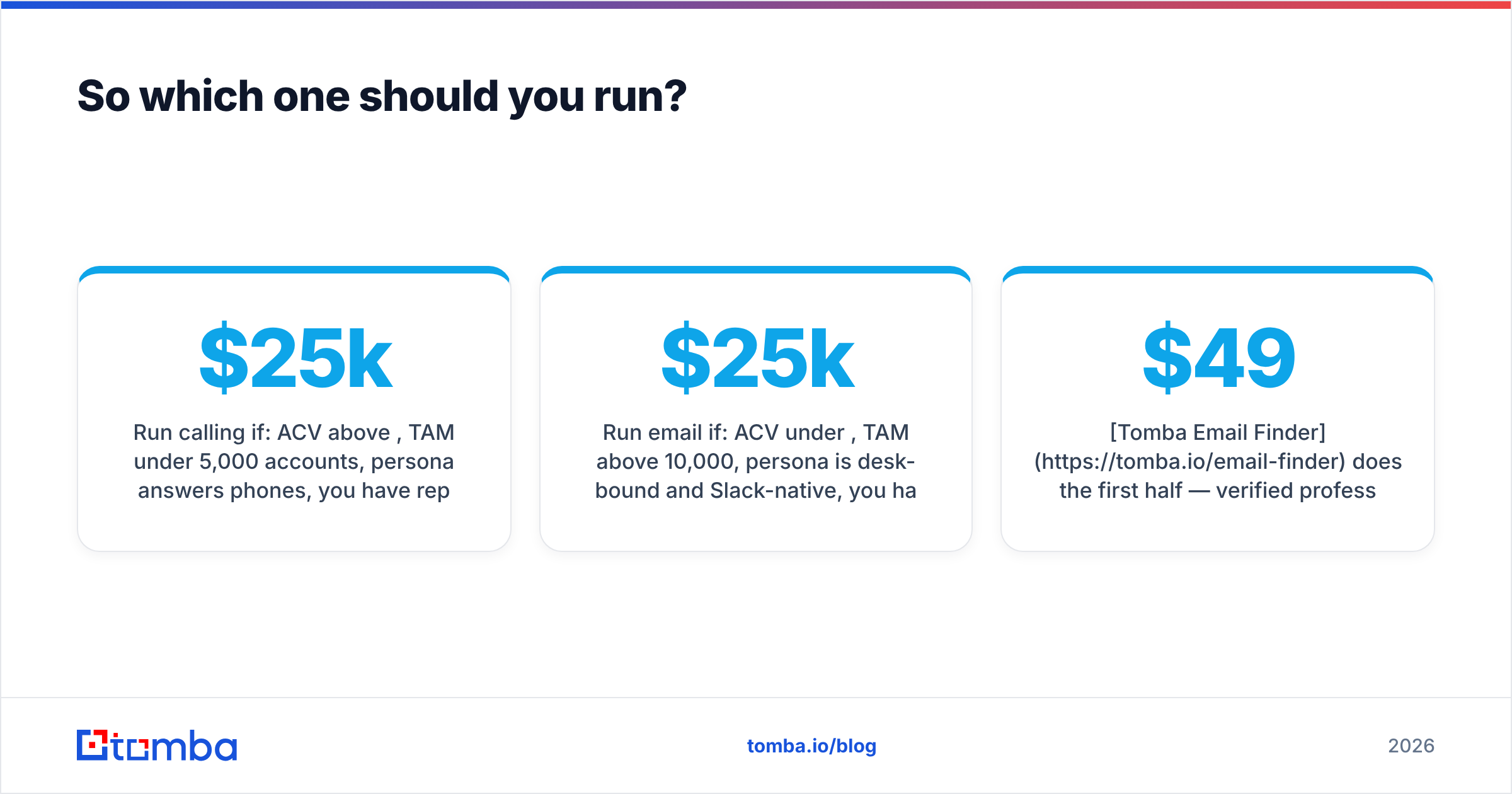
Run calling if: ACV above $25k, TAM under 5,000 accounts, persona answers phones, you have reps to deploy, and you need signal this month.
Run email if: ACV under $25k, TAM above 10,000, persona is desk-bound and Slack-native, you have 3–4 weeks to warm domains, and you're optimizing cost per meeting.
Run both, sequenced, if: you're serious. The email-then-call cadence outperforms either channel run in isolation by a wide enough margin that it's the default for most B2B teams above ten reps. Just don't fool yourself: multi-channel means the same person gets touched on both channels in a coordinated order, not that you have an email team and a phone team who never speak.
And whichever you choose, fix the data first. Every argument in this post collapses into one line: a channel is only as good as the contact record underneath it. Bounce rates, connect rates, rep morale, deliverability, cost per meeting — all of them are downstream of whether the email address and the phone number on that row are correct.
Start with the record, not the channel#
Before you argue about email versus phone, get one clean, verified contact record per target. Find the work email by name and domain, verify it before it enters a sequence, and attach a validated direct dial so your day-5 call actually connects.
Tomba Email Finder does the first half — verified professional email addresses by domain, name, or company, with the verifier built into the same workflow so nothing enters your sequencer unchecked. The free tier gives you 25 searches a month to test it against your own list; Starter runs $49/mo and Growth $99/mo if the numbers hold up. Check the pricing details and run a hundred of your existing contacts through it. If your bounce rate doesn't move, you didn't have a data problem. If it does, you now know which channel was never really the issue.
Related guides#
Ready to find emails that actually work?
Join 150,000+ professionals who stopped guessing and started sending. Free credits on signup — no credit card required.
Get the Tomba newsletter
Practical outbound tactics and product updates — once every two weeks.
About the author