Cold Emails for Sales: The 2026 Playbook That Gets Replies
Most cold emails for sales die before anyone reads them — bad data, bad inbox placement, bad first line. Here's the structure, cadence, and stack that actually books meetings in 2026.
TL;DR
- Cold emails for sales fail in a predictable order: bad list → bad inbox placement → bad first line → bad ask. Fix them in that order, not in reverse.
- A verified list beats clever copy. Teams that verify before sending typically see bounce rates under 2%; unverified lists routinely hit 8–15%, which torches sender reputation within a week.
- The highest-performing cold email in 2026 is short (50–125 words), single-ask, and references something the recipient did — not something you sell.
- Sequences of 4–6 touches over 18–21 days outperform both one-shot sends and 12-step "nurture" monsters.
- Volume is not a strategy. 200 well-researched emails per week to verified contacts beat 2,000 sprayed at a scraped list, and they keep your domain alive.
What Are Cold Emails for Sales, Really?#
A cold email for sales is an unsolicited, one-to-one message sent to a prospect who has no prior relationship with you, with the goal of starting a conversation — not closing a deal.
That last clause is where most reps go wrong. They treat the cold email as a pitch deck compressed into 400 words. It isn't. It's a door knock. The only job of a cold email is to earn a reply.
Think of it like walking into a stranger's office. You wouldn't open with a 12-slide overview of your Series B. You'd say who you are, why you're standing there specifically, and ask one question. Technically, a cold email is a permissionless interruption of someone's attention — so the burden of relevance sits entirely with you.
Cold email is also legally distinct from spam in most jurisdictions. Under CAN-SPAM in the US and GDPR's legitimate-interest basis in the EU, B2B cold outreach is permitted when you identify yourself, provide a real physical address, honor opt-outs, and can justify why this specific person is a plausible fit. Spam is a behavior — bulk, indiscriminate, unremovable — not a category of email.
Why Do Most Cold Emails for Sales Fail?#
They fail in a chain, and the chain has an order. Fixing your subject line while your bounce rate is 11% is like repainting a car with no engine.
Here is the failure cascade, in the order you should attack it:
- Bad data. The email doesn't exist, or belongs to someone who left in 2023. Every hard bounce is a direct hit on your sender reputation.
- Bad inbox placement. Missing SPF/DKIM/DMARC, a cold domain, or a spam-word-stuffed template lands you in Promotions or Junk. Nobody reads what they never see.
- Bad relevance. The message could have been sent to 5,000 people, and the reader can tell within one sentence.
- Bad ask. "Do you have 30 minutes next week?" from a stranger is an expensive request. "Is this even a priority for you this quarter?" is cheap.
- Bad follow-up. One email, no sequence. Most replies arrive on touch two through four.
Notice that steps 1 and 2 are infrastructure. Steps 3–5 are craft. Reps love to obsess over craft because it's fun. Infrastructure is boring and it's where 80% of the loss happens.
How Do You Build a List That Doesn't Bounce?#
Start with a definition of fit, not a definition of volume.
Write down the firmographic and behavioral triggers that make someone worth emailing: company size band, tech stack, recent funding, a new VP of Sales, an open role that implies your problem. If you can't name a trigger, you don't have a prospect — you have a row in a spreadsheet.
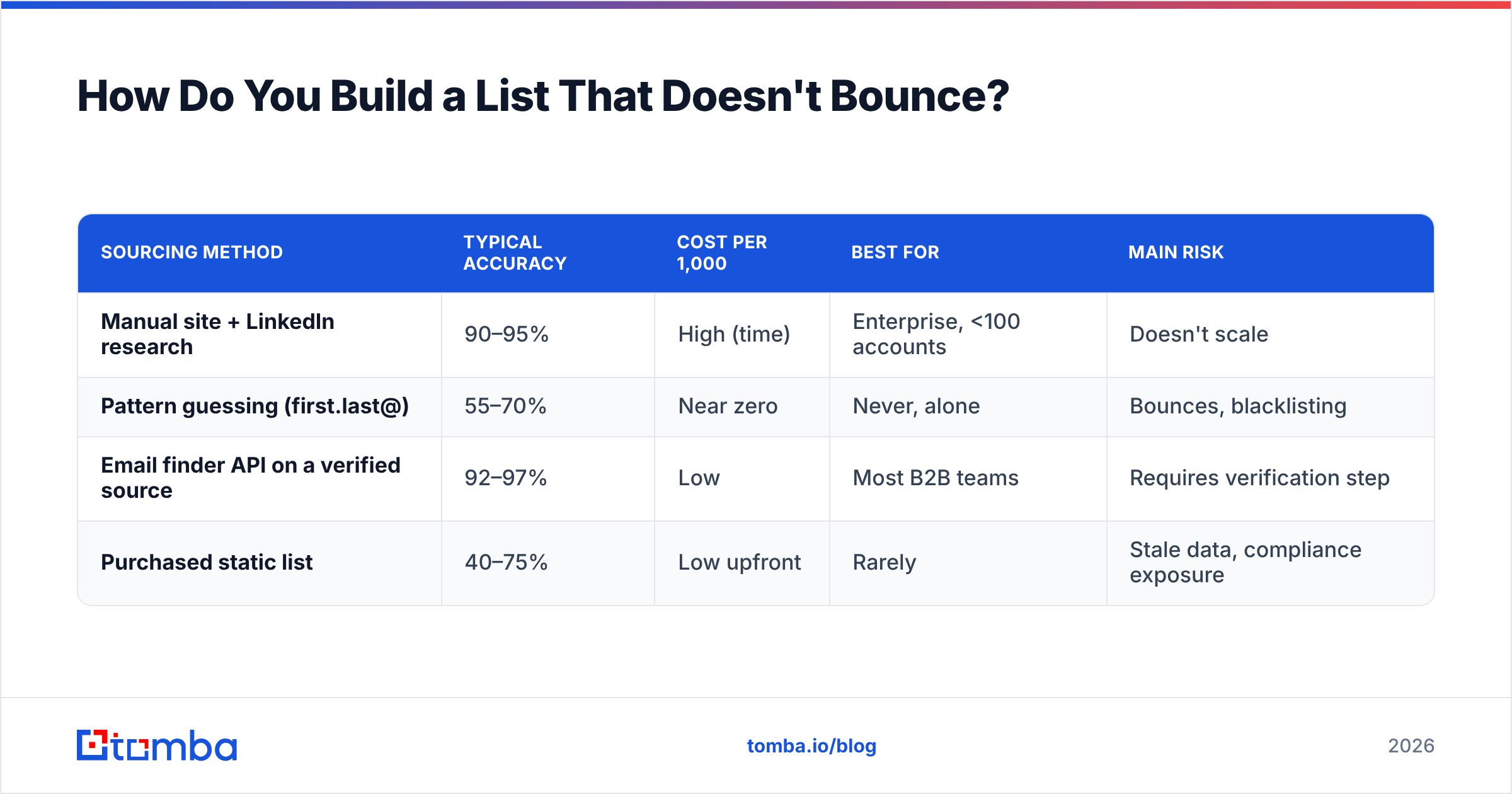
Then source the contact. There are four common paths, and they differ sharply in accuracy and cost:
| Sourcing method | Typical accuracy | Cost per 1,000 | Best for | Main risk |
|---|---|---|---|---|
| Manual site + LinkedIn research | 90–95% | High (time) | Enterprise, <100 accounts | Doesn't scale |
| Pattern guessing (first.last@) | 55–70% | Near zero | Never, alone | Bounces, blacklisting |
| Email finder API on a verified source | 92–97% | Low | Most B2B teams | Requires verification step |
| Purchased static list | 40–75% | Low upfront | Rarely | Stale data, compliance exposure |
A hybrid is what actually works: use an email finder to resolve name + domain into an address, then run every result through an email verifier before it ever touches your sending tool. The finder gets you the address; the verifier tells you whether the mailbox will accept it.
Catch-all domains deserve their own note. A catch-all accepts everything at SMTP time and silently discards the invalid ones, which means a naive verifier marks them "valid" and your bounce report lies to you for two weeks. If more than a fifth of your list is catch-all, use a dedicated catch-all verifier or segment those contacts into a lower-volume, higher-caution send.
For teams processing thousands of rows, a bulk email finder run followed by verification is the difference between a 1.4% bounce rate and a 12% one. That gap is not a rounding error — it's the difference between a working domain and a burned one.
What Does Inbox Placement Actually Require in 2026?#
Google and Yahoo tightened bulk-sender rules in 2024, and the enforcement has only gotten stricter since. If you send from a domain without authentication, you are not competing for attention — you're competing for existence.
The non-negotiable checklist:
- SPF, DKIM, and DMARC all published and passing. Check with a free SPF checker before your first send, not after your first drop in reply rate.
- A separate sending domain. Never burn your primary corporate domain on outbound. Buy
getyourcompany.com, point it at the main site, send from there. - Warmup. New domains need 3–4 weeks of gradually ramping volume before they can carry real sequences. A warmup calculator will give you a realistic ramp instead of a guess.
- Volume caps. 30–50 emails per mailbox per day. If you need 500/day, you need ten mailboxes, not one heroic one.
- Spam complaint rate under 0.3%. Google's bulk sender guidelines name this explicitly. Above 0.3% and placement degrades fast.
Sender reputation compounds like credit. It takes months to build and a single bad week to destroy. If you want the mechanics, our glossary entry on email deliverability covers the signals mailbox providers weigh.
What Structure Do High-Reply Cold Emails Use?#
Four parts. Every one of them earns the next.
1. The opener (one sentence, about them). Not "Hope you're well." Not "I came across your profile." Reference a specific, checkable fact: a job posting, a product launch, a podcast appearance, a metric on their pricing page.
2. The bridge (one to two sentences). Connect that fact to a problem they plausibly have. This is where you demonstrate you understand their world, not your product.
3. The proof (one sentence, optional). A named customer with a number. "We took Acme's SDR ramp time from 90 days to 41." If you don't have a number, skip it — vague proof is worse than none.
4. The ask (one sentence, cheap). Ask a question, not for a calendar slot. "Is reducing ramp time on your list for Q3, or is it something else this year?" Questions get answered. Calendar links get ignored.
Total: 50–125 words. If you cannot say it in 125 words, you do not understand the prospect well enough yet.
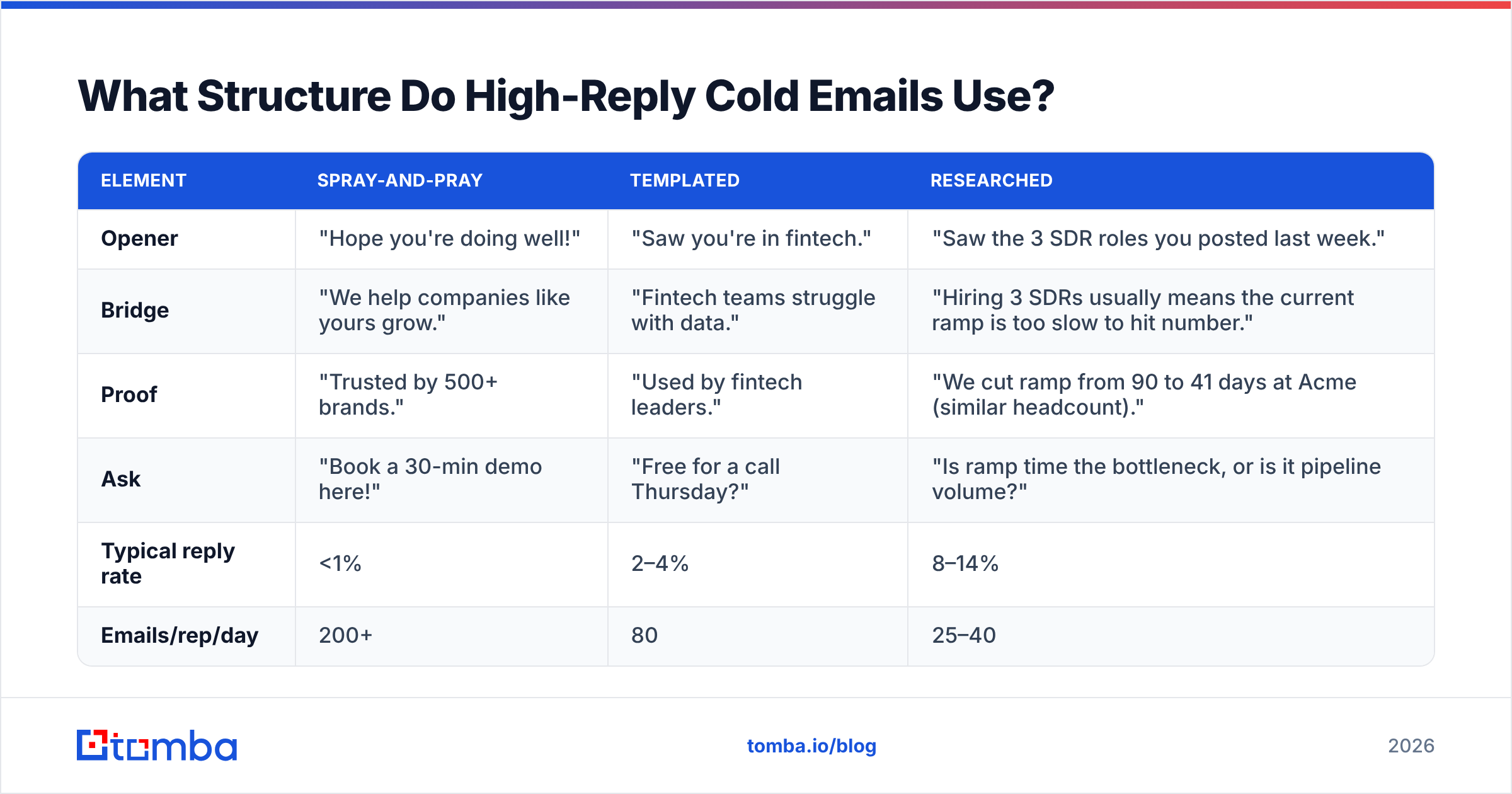
Here is what the same message looks like at three levels of effort:
| Element | Spray-and-pray | Templated | Researched |
|---|---|---|---|
| Opener | "Hope you're doing well!" | "Saw you're in fintech." | "Saw the 3 SDR roles you posted last week." |
| Bridge | "We help companies like yours grow." | "Fintech teams struggle with data." | "Hiring 3 SDRs usually means the current ramp is too slow to hit number." |
| Proof | "Trusted by 500+ brands." | "Used by fintech leaders." | "We cut ramp from 90 to 41 days at Acme (similar headcount)." |
| Ask | "Book a 30-min demo here!" | "Free for a call Thursday?" | "Is ramp time the bottleneck, or is it pipeline volume?" |
| Typical reply rate | <1% | 2–4% | 8–14% |
| Emails/rep/day | 200+ | 80 | 25–40 |
The researched column sends one-eighth the volume and produces more meetings. That's the whole argument against spray-and-pray, in one table.
How Many Follow-Ups, and How Far Apart?#
Four to six touches over 18–21 days. Anything shorter under-harvests; anything longer irritates.
The cadence that consistently performs:
- Day 1 — Initial email. Full structure above.
- Day 3 — Reply in-thread. One new angle, two sentences. No "just bumping this."
- Day 7 — New thread, new subject line. Different pain point, different proof.
- Day 12 — Value drop. Send something useful with no ask: a benchmark, a teardown, a relevant article.
- Day 18 — Breakup. "I'll assume this isn't a priority — should I close the loop?" This email frequently outperforms every one before it.
Each follow-up should be able to stand alone. If your day-7 email only makes sense to someone who read day-1, you've built a dependency chain on an event that probably didn't happen.
HubSpot's ongoing sales research has repeatedly found that a majority of reps stop after one or two attempts, while most positive replies land later in the sequence. The gap between those two facts is where quota lives.
Cold Email vs. Other Outbound Channels: When Does Each Win?#
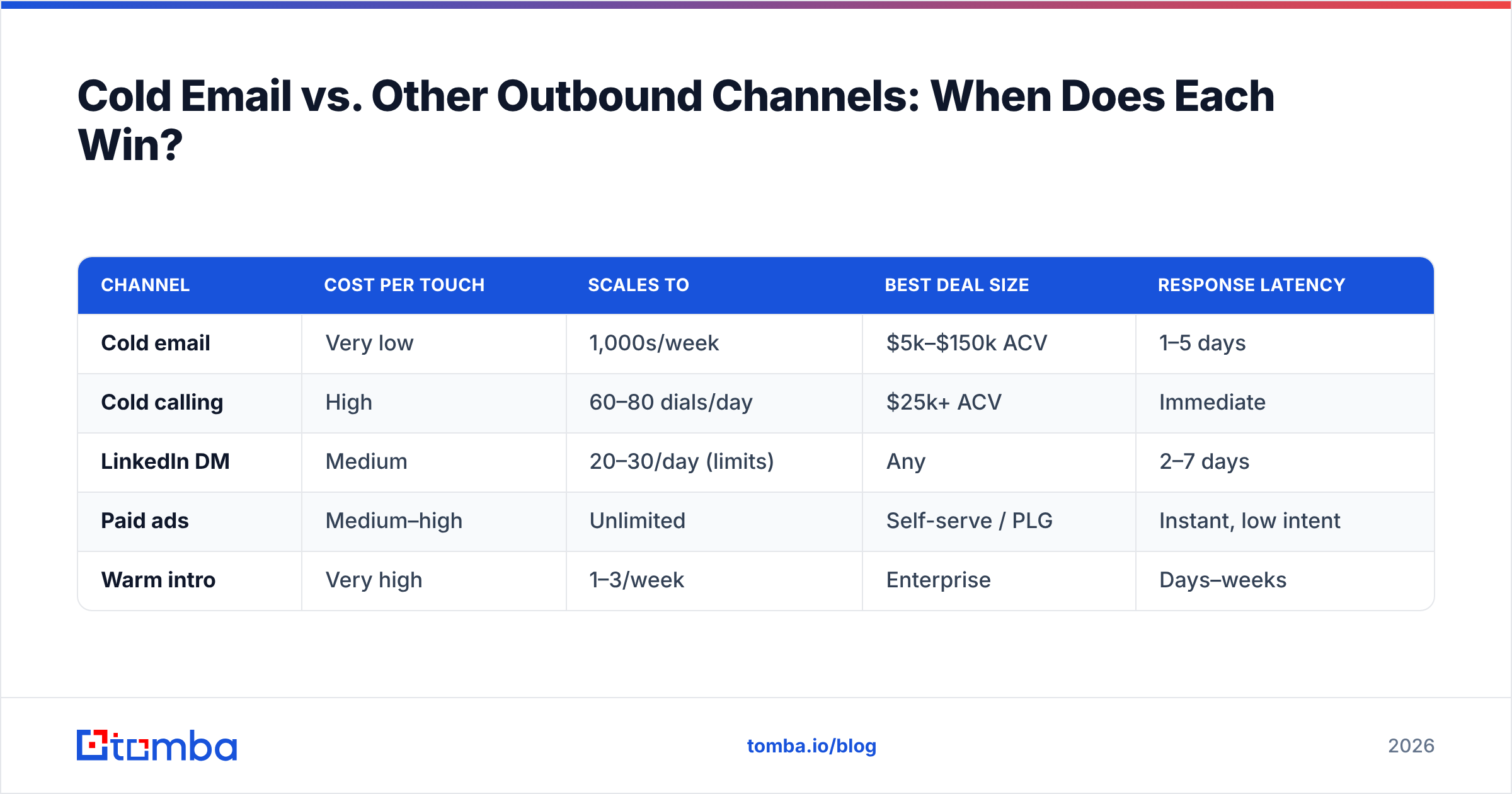
Cold email is not universally superior. It's the highest-leverage channel for a specific shape of deal.
| Channel | Cost per touch | Scales to | Best deal size | Response latency |
|---|---|---|---|---|
| Cold email | Very low | 1,000s/week | $5k–$150k ACV | 1–5 days |
| Cold calling | High | 60–80 dials/day | $25k+ ACV | Immediate |
| LinkedIn DM | Medium | 20–30/day (limits) | Any | 2–7 days |
| Paid ads | Medium–high | Unlimited | Self-serve / PLG | Instant, low intent |
| Warm intro | Very high | 1–3/week | Enterprise | Days–weeks |
Use email as the volume layer and phone as the conversion layer. A prospect who opened your email three times and then picks up the phone is a fundamentally different conversation. If your motion needs both, pair the email finder with a phone finder so the rep isn't switching tools mid-sequence.
For a broader view of the tooling landscape, G2's sales engagement category is a reasonable place to see how buyers actually rate these platforms — including established data providers like BookYourData, which many teams pair with a real-time finder for coverage on hard-to-source contacts.
What Metrics Should You Actually Watch?#
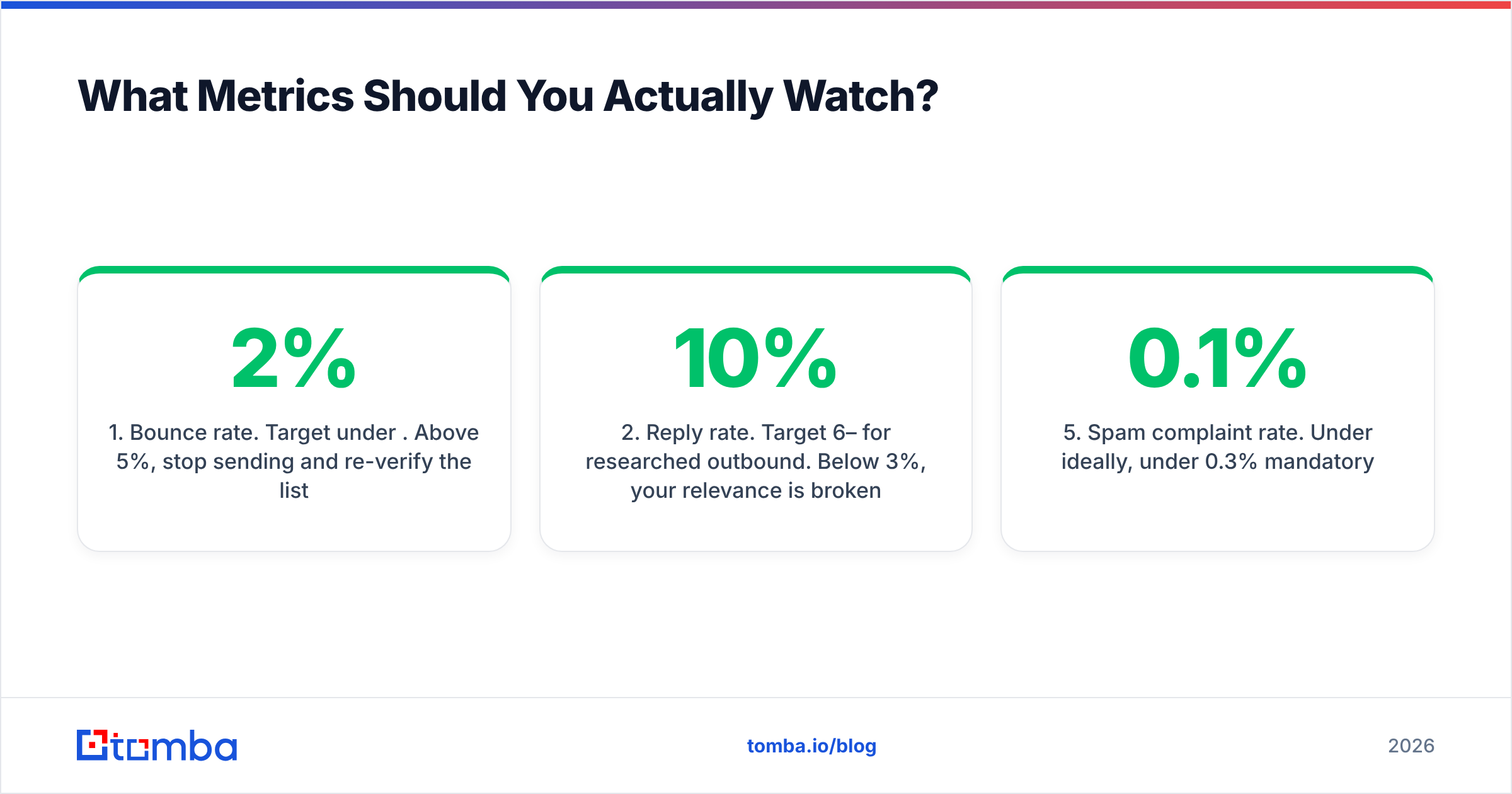
Open rate is dying. Apple Mail Privacy Protection inflates it, and Gmail's image proxying makes it directionally useless. Track what survives:
- Bounce rate. Target under 2%. Above 5%, stop sending and re-verify the list.
- Reply rate. Target 6–10% for researched outbound. Below 3%, your relevance is broken.
- Positive reply rate. Replies that aren't "unsubscribe" or "wrong person." Target half of all replies.
- Meetings booked per 100 emails. The only number your VP cares about. 2–4 is healthy for mid-market.
- Spam complaint rate. Under 0.1% ideally, under 0.3% mandatory.
- Domain health. Check blacklists monthly with a blacklist checker.
If reply rate is fine but meetings are low, your ask is wrong. If bounce rate is fine but reply rate is low, your research is thin. If both are bad, you have a list problem masquerading as a copy problem.
What Should You Do This Week?#
Pick one segment. Fifty accounts, not five hundred. Define the trigger that makes them relevant right now. Source and verify every contact before a single email leaves. Write four emails, not fourteen. Send from a warmed secondary domain at 30 per day. Measure replies, not opens.
Then do it again next week with what you learned.
The teams that win at cold emails for sales in 2026 aren't the ones with the cleverest subject lines. They're the ones whose emails arrive, at the right person, at a moment when the message is obviously about them. Everything else is decoration on a message nobody received.
Start with the part that breaks first. Bad data is the root cause behind most dead outbound programs, and it's the cheapest thing to fix. Tomba's Email Finder resolves names and domains into verified professional addresses with the verification step built in, so your bounce rate stays where it belongs. The free tier gives you 25 searches a month to test it against your own list — see Tomba pricing if you need volume beyond that. Verify first, then write the clever subject line.
Related guides#
Ready to find emails that actually work?
Join 150,000+ professionals who stopped guessing and started sending. Free credits on signup — no credit card required.
Get the Tomba newsletter
Practical outbound tactics and product updates — once every two weeks.
About the author