How to Write a Cold Sales Email That Gets Replies in 2026
Most cold sales emails get deleted in under three seconds. Here is the structure, timing, and data that turn a cold sales email into a booked meeting — with templates you can steal today.
How to Write a Cold Sales Email That Gets Replies in 2026
A cold sales email is a first-touch message you send to someone who has never heard of you, with the goal of starting a conversation — not closing a deal in one shot. Done well, it books meetings on autopilot. Done badly, it trains inboxes to filter you into spam forever.
Most reps get it wrong because they treat cold email like a numbers game and skip the two things that actually move reply rates: accurate contact data and a message written for one specific human. This guide fixes both.
TL;DR#
- A cold sales email should be 50–125 words, one clear ask, and zero attachments — long pitches tank reply rates.
- Deliverability comes first. If your email lands in spam, copy quality is irrelevant. Warm the domain, authenticate it, and verify every address before sending.
- Personalization beats volume. A researched line in the first sentence can 2–3x replies versus a generic blast.
- Use a repeatable structure: hook → relevance → value → soft CTA. Templates below.
- Bad data is the silent killer. Bounces above 3–5% hurt sender reputation and get whole campaigns throttled — verify lists with an email verifier before you hit send.
What is a cold sales email (and what it is not)?#
A cold sales email is an unsolicited but permission-respecting outreach message to a prospect who fits your ideal customer profile. Think of it like knocking on the right door at a networking event and introducing yourself in one sentence — not cornering a stranger and reading them your entire brochure.
It is not spam. Spam is irrelevant, unsegmented, and often illegal. A legitimate cold sales email is targeted, honest about who you are, includes a real way to opt out, and complies with regulations like CAN-SPAM and GDPR. The difference is relevance and consent posture, not the fact that the recipient did not ask for it.
It is also not a newsletter, a nurture email, or a follow-up to an inbound lead. Those audiences already know you. Cold email's entire job is to earn the first reply.
Why do most cold sales emails fail?#
Four reasons, in order of impact:
- They never reach the inbox. New domains with no warmup, missing SPF/DKIM/DMARC, and high bounce rates get filtered before a human sees them.
- The data is wrong. You are emailing
john@company.comwhen it is actuallyjohn.smith@company.com, or the person left 18 months ago. - The message is about you. "We are a leading provider of..." is an instant delete. Nobody cares about your company in sentence one.
- The ask is too big. "Can we book a 45-minute demo?" from a stranger is a hard no. Lower the friction.
Fixing #1 and #2 is unglamorous but it is where the biggest gains hide. You can write the best copy in the world and still get 0% replies if half your list bounces and the other half never leaves the spam folder.
How do you set up deliverability before writing a single word?#
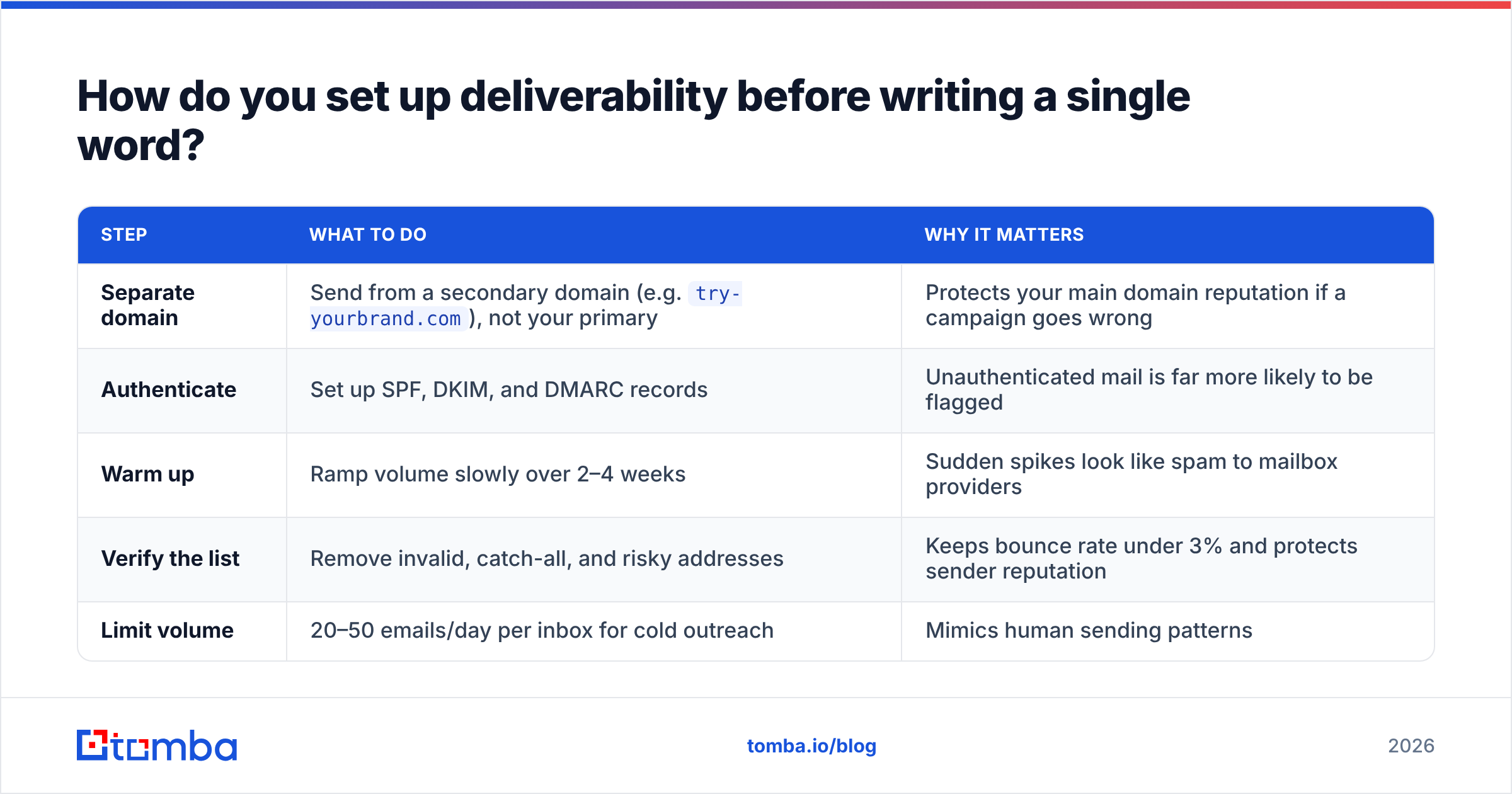
Deliverability is the plumbing. Get it right once and everything else works better. Here is the pre-send checklist every cold sales email campaign needs.
| Step | What to do | Why it matters |
|---|---|---|
| Separate domain | Send from a secondary domain (e.g. try-yourbrand.com), not your primary |
Protects your main domain reputation if a campaign goes wrong |
| Authenticate | Set up SPF, DKIM, and DMARC records | Unauthenticated mail is far more likely to be flagged |
| Warm up | Ramp volume slowly over 2–4 weeks | Sudden spikes look like spam to mailbox providers |
| Verify the list | Remove invalid, catch-all, and risky addresses | Keeps bounce rate under 3% and protects sender reputation |
| Limit volume | 20–50 emails/day per inbox for cold outreach | Mimics human sending patterns |
Do not skip verification. A single dirty list can spike bounces past 5% and get your domain throttled by Google and Microsoft. Run addresses through an email verifier and use a catch-all verifier for domains that accept everything, so you are not guessing which risky addresses will bounce. If you want the science behind inbox placement, Google's own Postmaster Tools guidelines are the authoritative source.
You can pressure-test your setup with a free SPF checker and a spam checker before your first real send.
What is the structure of a cold sales email that converts?#
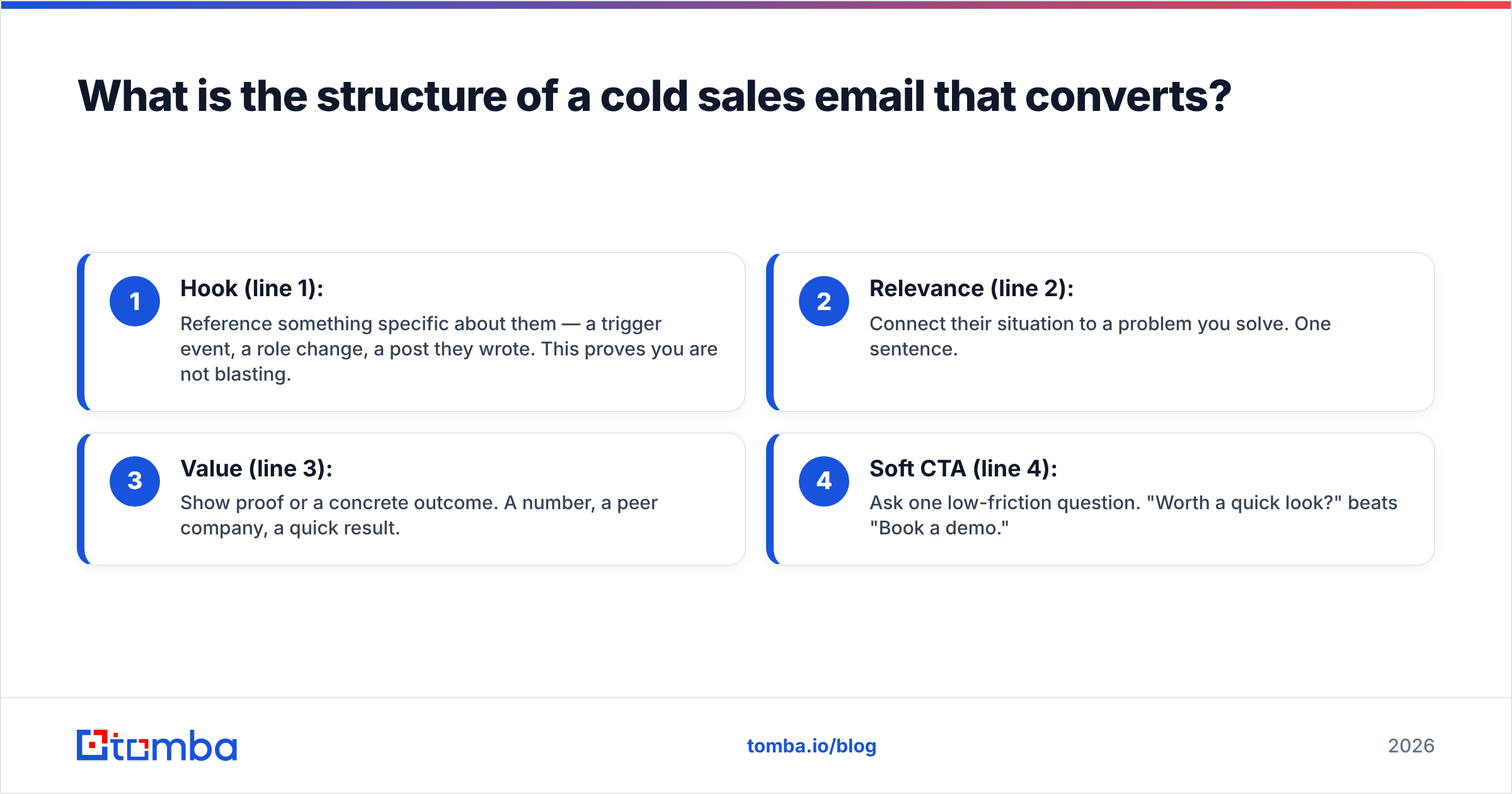
Every high-performing cold sales email follows the same four-part skeleton. Fill it in and you will never stare at a blank screen again.
- Hook (line 1): Reference something specific about them — a trigger event, a role change, a post they wrote. This proves you are not blasting.
- Relevance (line 2): Connect their situation to a problem you solve. One sentence.
- Value (line 3): Show proof or a concrete outcome. A number, a peer company, a quick result.
- Soft CTA (line 4): Ask one low-friction question. "Worth a quick look?" beats "Book a demo."
Keep the whole thing under 125 words. Read it aloud — if you run out of breath, it is too long.
A worked example#
Subject: quick question about {Company}'s SDR ramp
Hi {First name}, saw you just grew the SDR team to 12 — congrats on the hiring push.
Teams scaling reps that fast usually hit the same wall: onboarding new reps onto clean contact data without weeks of manual list-building.
We helped {Peer company} cut their list-building time by ~60% and lift reply rates in the first month.
Worth a quick look, or should I send a 2-minute Loom instead?
Notice: no attachments, no "I hope this email finds you well," one ask, and the CTA gives them an easy out. That last part matters more than reps think — offering a smaller alternative ("or should I...") lifts replies because it feels like a conversation, not a pitch.
How long should a cold sales email be?#
Short. Data from large-scale outreach studies consistently shows that emails between 50 and 125 words get the best response rates, and reply rates fall off steeply past 200 words. Your prospect is reading on a phone between meetings. Respect that.
Subject lines should be 3–7 words, lowercase-friendly, and curiosity-driven without being clickbait. Test them with a free subject line tester before committing a whole campaign to one line.
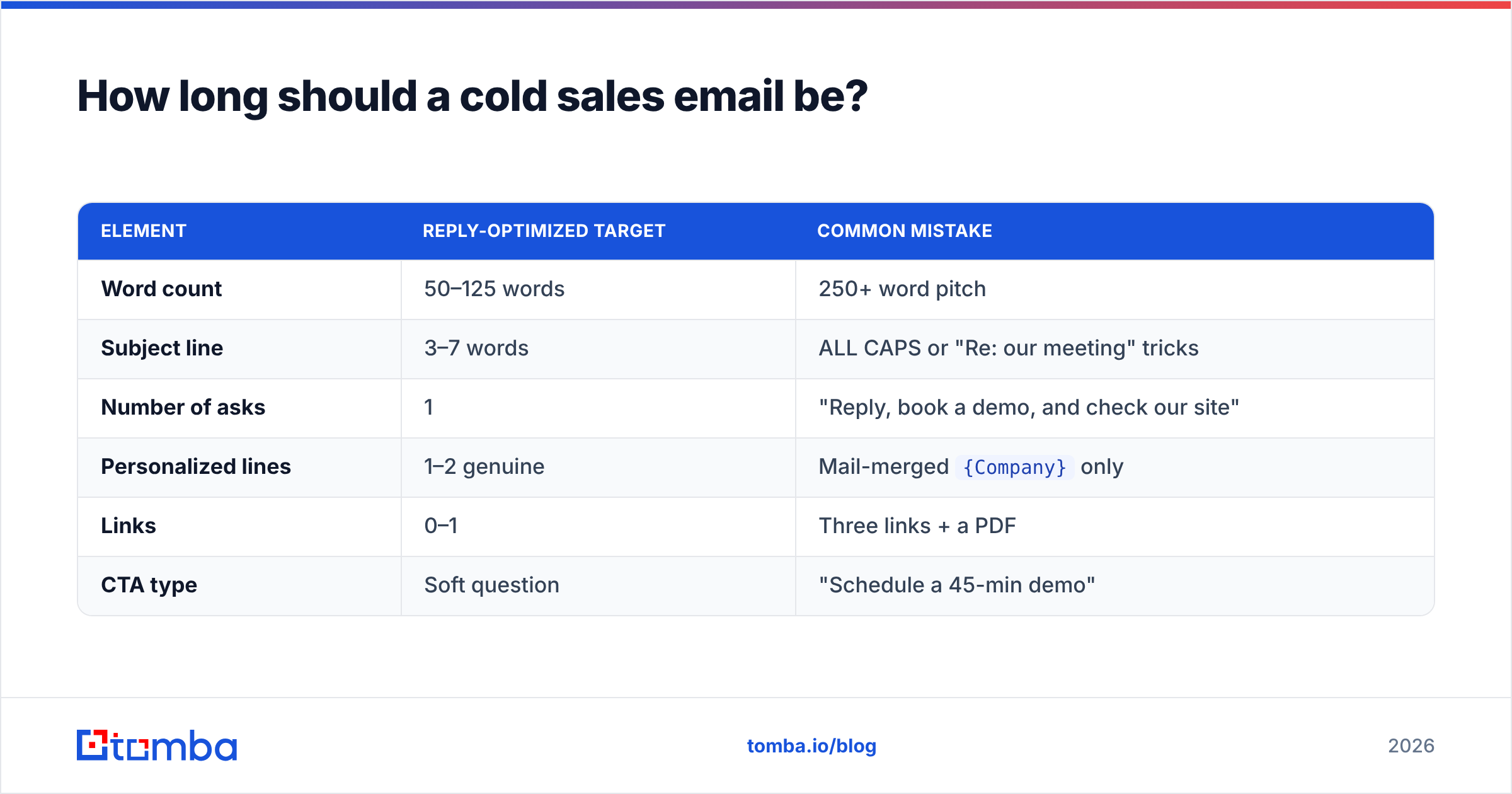
Here is how the core elements stack up when you optimize for replies.
| Element | Reply-optimized target | Common mistake |
|---|---|---|
| Word count | 50–125 words | 250+ word pitch |
| Subject line | 3–7 words | ALL CAPS or "Re: our meeting" tricks |
| Number of asks | 1 | "Reply, book a demo, and check our site" |
| Personalized lines | 1–2 genuine | Mail-merged {Company} only |
| Links | 0–1 | Three links + a PDF |
| CTA type | Soft question | "Schedule a 45-min demo" |
Where does the data come from, and why does it decide everything?#
Your copy is only as good as the person it reaches. If the email address is wrong or stale, none of the structure above matters.
This is the step reps love to skip and then blame the copy when replies flatline. Getting the right address means finding the correct format for the company, confirming the person still works there, and verifying the mailbox actually exists.
- Use a domain search to pull every known email pattern for a target company in seconds.
- Use an email finder to get a specific person's address from their name and company.
- Use a LinkedIn finder when you are prospecting from LinkedIn and only have a profile.
- For large lists, a bulk email finder plus verification keeps your bounce rate clean at scale.

Third-party review sites like G2 rank email finder and verification tools on match rate and accuracy — check them before you commit a budget, because a 95% accurate source and a 70% source produce wildly different campaign math. If you enrich contacts with firmographics or job titles, data enrichment fills in the context you need for that personalized first line.
What are three cold sales email templates you can steal?#
Copy these, swap the variables, and personalize the first line. Do not send them verbatim to 500 people — templates are scaffolding, not a substitute for research.
1. The trigger-event opener
Subject: congrats on the {round/launch/role}
Hi {First name}, saw {specific trigger}. That usually means {predictable challenge} lands on your plate fast.
We help {role} handle that by {one-line outcome} — {Peer company} saw {result}.
Open to a quick chat, or want me to send details over email?
2. The problem-first opener
Subject: {problem} at {Company}?
Hi {First name}, most {role}s I talk to at {industry} companies are fighting {specific problem}.
If that is on your radar, we cut {metric} by {number} for teams like {Peer}. If not, no worries — happy to be a resource down the line.
Worth 10 minutes next week?
3. The referral / mutual-context opener
Subject: {mutual connection / shared context}
Hi {First name}, {mutual context}. Given {reason it is relevant}, thought I would reach out directly.
{One-sentence value}. {One proof point}.
Is this worth exploring, or should I point you to someone else on your team?
Want more starting points? Browse a library of cold email templates and adapt the framing to your ICP.
How many follow-ups should you send?#
Send 3–5 total touches, spaced 2–4 days apart. Roughly 50–70% of replies to cold campaigns come from follow-ups, not the first email. The mistake is sending the same "just bumping this" message five times.
Each follow-up should add a new angle: a different value prop, a relevant case study, a short question, and finally a polite break-up email ("Should I close the loop on this?"). The break-up email is often the highest-replying message in the whole sequence because it triggers a mild fear of missing out.
Keep follow-ups even shorter than the opener — two or three sentences. And always reply in the same thread so the context carries.
How do you measure whether your cold sales email is working?#
Track these four numbers and fix them in order. There is no point optimizing reply rate if your emails are bouncing.
| Metric | Healthy benchmark | If it is low, fix... |
|---|---|---|
| Bounce rate | Under 3% | Data quality — verify the list |
| Open rate | 40–60% | Deliverability + subject line |
| Reply rate | 5–15% | Personalization + relevance |
| Positive reply rate | 1–5% | Targeting (are these the right people?) |
A low open rate with a clean list usually means deliverability, not copy. A healthy open rate but near-zero replies means your message or targeting is off. Diagnose before you rewrite everything.
For a deeper primer on inbox placement, the concept of email deliverability covers the technical and reputation factors that decide whether your mail even gets seen.
Common cold sales email mistakes to avoid#
- Emailing without verifying. The fastest way to burn a domain.
- Writing paragraphs. Nobody reads a wall of text from a stranger.
- Multiple CTAs. One ask per email. Always.
- Fake personalization.
{Company}in a merge field is not personalization; it is a tell that you mail-merged 2,000 people. - No opt-out. Legally risky and a trust-killer. Include a plain-text way to unsubscribe.
- Ignoring send timing. Mid-morning on Tuesday through Thursday tends to outperform Monday mornings and Friday afternoons.
- Giving up after one email. The money is in the follow-up sequence.
Frequently asked questions#
Is cold email legal in 2026? Yes, when done correctly. In the US, CAN-SPAM requires honest headers, no deceptive subject lines, a physical address, and a working opt-out. In the EU, GDPR requires a lawful basis and clear opt-out. B2B cold email is generally permissible with legitimate interest, but always include an easy unsubscribe.
How is cold email different from spam? Relevance and honesty. A cold sales email targets a specific, qualified person with a genuine reason to reach out and an easy way to say no. Spam is untargeted, deceptive, and ignores opt-outs.
How many cold emails can I send per day? For cold outreach, keep it to roughly 20–50 per inbox per day and use multiple inboxes to scale. Sending hundreds from one new mailbox is the fastest route to the spam folder.
Do I need a separate domain for cold email? Strongly recommended. A secondary sending domain protects your primary domain's reputation if a campaign underperforms or triggers spam complaints.
The bottom line#
A great cold sales email is not a clever trick — it is clean data, solid deliverability, and one honest sentence written for one real person, followed up a few times. Nail the plumbing first, then the copy, then the sequence.
The single highest-leverage move is starting with accurate contacts. If you are emailing the wrong address, nothing downstream can save the campaign. Start free with the Tomba Email Finder to pull verified, up-to-date addresses for your target accounts, then verify the list before you send. The free tier gives you 25 searches a month, and paid plans start at $49/mo — see full Tomba pricing when you are ready to scale your outreach.
Related guides#
Ready to find emails that actually work?
Join 150,000+ professionals who stopped guessing and started sending. Free credits on signup — no credit card required.
Get the Tomba newsletter
Practical outbound tactics and product updates — once every two weeks.
About the author