Communication Skills in Sales: A 2026 Guide That Closes Deals
Scripts don't close deals — communication does. Here's the 2026 framework top reps use to listen harder, frame value, handle objections, and turn conversations into revenue.
Most sales training obsesses over the wrong thing. It drills scripts, memorized rebuttals, and closing "techniques" — while ignoring the one variable that actually predicts whether a rep hits quota: how well they communicate. You can have the best product, the cleanest data, and a perfect pipeline, and still lose the deal because you talked when you should have listened.
This guide breaks down the communication skills in sales that separate top performers from everyone else in 2026 — what they are, how to measure them, and how to build them on your team without a six-week seminar.
TL;DR#
- Communication skills in sales are learnable, not innate. The best reps aren't smoother talkers — they're sharper listeners who frame value in the buyer's language.
- The talk-to-listen ratio is the single most measurable skill. Top closers listen roughly 55–60% of a discovery call; average reps flip that ratio.
- Objection handling is a communication problem, not a scripting problem. Acknowledge, clarify, then reframe — never fire back a canned rebuttal.
- Channel fluency matters more every year. The same rep now writes cold email, sends async video, comments on LinkedIn, and runs live calls — each demands a different register.
- Better inputs make better conversations. Accurate contact data and research let you open with relevance instead of a generic pitch.
What are communication skills in sales, really?#
Communication skills in sales are the set of verbal, written, and non-verbal abilities that let a rep understand a buyer's situation and move them toward a decision without friction. That's broader than "being good on the phone."
Think of a great rep like a skilled interpreter, not a broadcaster. A broadcaster pushes a message out and hopes it lands. An interpreter listens to what the other person actually means, translates their problem into the language of your solution, and hands it back so the buyer says, "Yes, that's exactly it." The revenue follows the translation, not the volume.
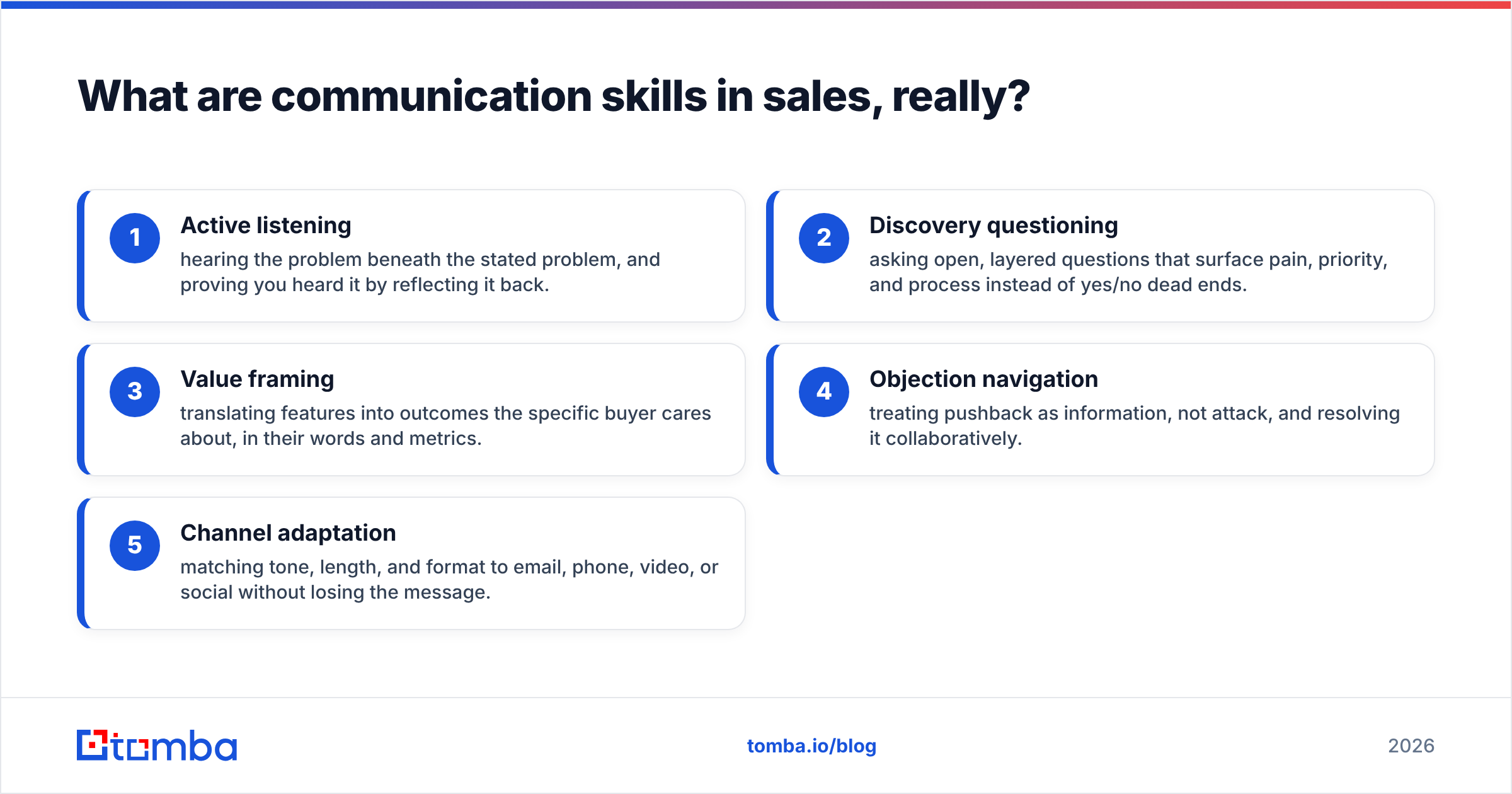
Concretely, strong sales communication breaks into five core competencies:
- Active listening — hearing the problem beneath the stated problem, and proving you heard it by reflecting it back.
- Discovery questioning — asking open, layered questions that surface pain, priority, and process instead of yes/no dead ends.
- Value framing — translating features into outcomes the specific buyer cares about, in their words and metrics.
- Objection navigation — treating pushback as information, not attack, and resolving it collaboratively.
- Channel adaptation — matching tone, length, and format to email, phone, video, or social without losing the message.
Master those five and everything else — rapport, storytelling, negotiation — becomes downstream. Miss the first two and no clever close will save you.

Why do communication skills matter more than product knowledge?#
Because buyers can Google the product. They cannot Google whether you understand their business.
Research from Gong's conversation analytics — drawn from millions of recorded sales calls — consistently shows that the behaviors correlating with won deals are communication behaviors: talk-to-listen ratio, number of thoughtful questions asked, and how objections are handled. Not feature recall. HubSpot's sales research points the same direction: reps who lead with relevance and listening out-convert reps who lead with a pitch.
Product knowledge is table stakes. It gets you in the room. Communication is what determines whether you're still in the room by the end of the call. And in a 2026 market where buyers are more informed, more skeptical, and harder to reach, the margin sits almost entirely in how you talk to them — not what you know about your own SKU.
There's also a compounding effect. A rep with strong communication skills books more meetings from cold outreach, gets more honest answers in discovery, and hits fewer late-stage surprises because they surfaced the real objections early. Each conversation makes the next one easier.
What does strong vs. weak sales communication look like?#
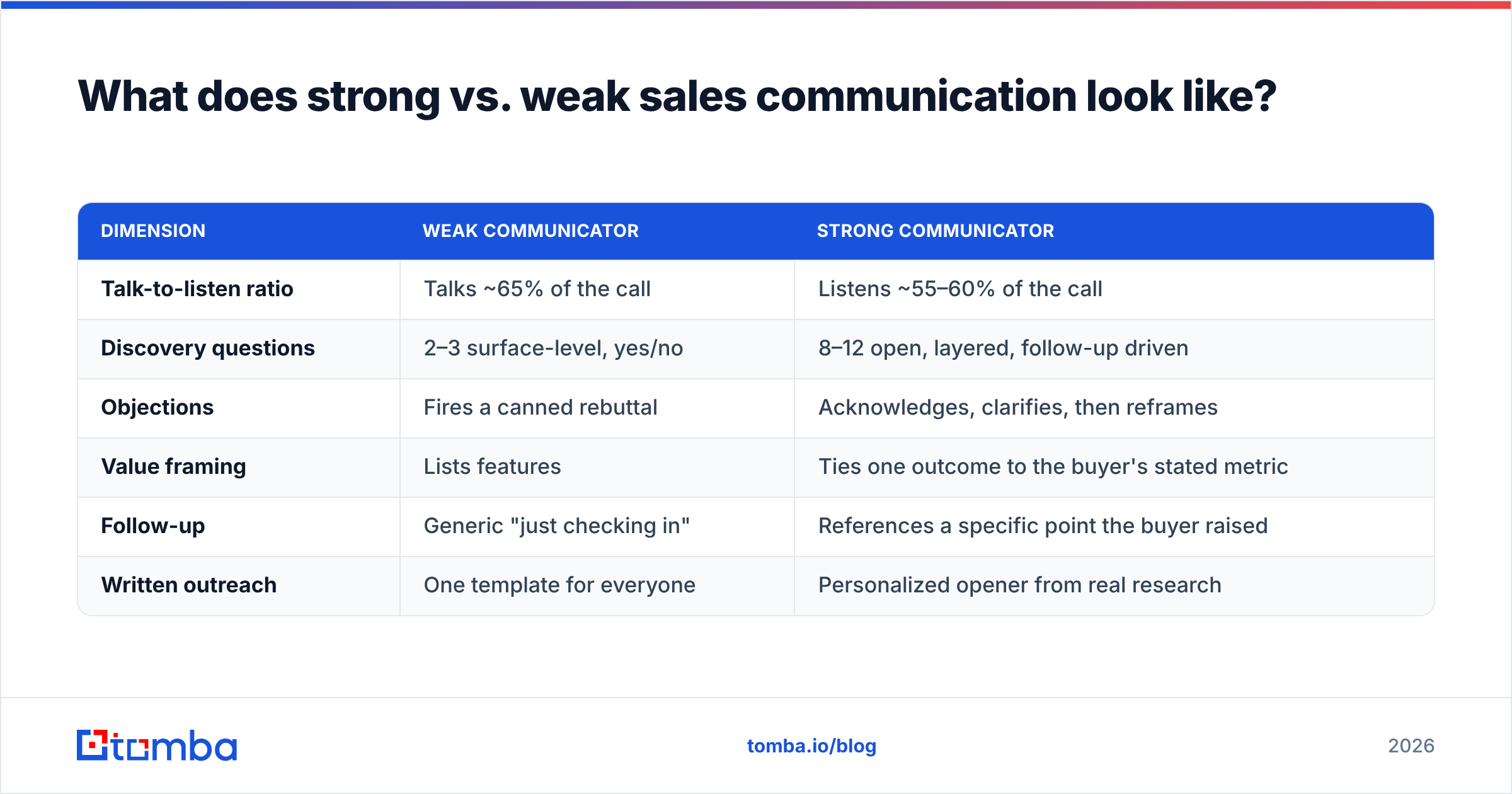
The difference is easiest to see side by side. Here's how the same moments play out with a weak communicator versus a strong one.
| Dimension | Weak communicator | Strong communicator |
|---|---|---|
| Talk-to-listen ratio | Talks ~65% of the call | Listens ~55–60% of the call |
| Discovery questions | 2–3 surface-level, yes/no | 8–12 open, layered, follow-up driven |
| Objections | Fires a canned rebuttal | Acknowledges, clarifies, then reframes |
| Value framing | Lists features | Ties one outcome to the buyer's stated metric |
| Follow-up | Generic "just checking in" | References a specific point the buyer raised |
| Written outreach | One template for everyone | Personalized opener from real research |
None of the "strong" column requires charisma. It requires discipline and preparation. That's the good news: every one of those behaviors can be coached, scored, and improved.
How do you improve your talk-to-listen ratio?#
Shut up sooner, and ask better questions. That's the whole skill, and it's brutally hard to execute under the pressure of a live call.
Three practical moves that work immediately:
- Ask, then count to three before you speak. Most reps step on the buyer's answer within a second. The silence feels like an eternity to you and like thinking time to them. The best answers arrive in that pause.
- Replace statements with questions. Instead of "Our platform automates that," try "How are you handling that today?" You'll learn whether automation is even the pain.
- Use reflective summaries. Every few minutes, say "So what I'm hearing is…" and play back their situation. It proves you listened, catches misunderstandings early, and buys you credibility for the eventual recommendation.
If you record calls (with consent), your talk ratio is the first metric to review. Reps who consciously track it for two weeks almost always improve it — measurement alone changes behavior. Tie it to a concrete outcome like response rate on your follow-ups, and the habit sticks because you can see it pay off.
How should you handle objections without sounding defensive?#
Treat the objection as a request for information, not a rejection of you. A price objection often means "help me justify this internally." A "we're happy with our current vendor" often means "convince me it's worth switching costs." The stated objection is rarely the whole story.
Use a simple three-step pattern instead of a rebuttal:
- Acknowledge — "That's fair, budget is tight this quarter." You lower the temperature and signal you're not going to fight.
- Clarify — "When you say it's too expensive, is it the total number, or how it's structured versus the ROI you'd expect?" You find the real objection.
- Reframe — Address the actual concern with a specific outcome, not a feature dump.
The mistake is skipping straight to step three with a memorized line. Buyers can smell a scripted rebuttal, and it makes you sound like every other rep. Salesforce's own selling guidance emphasizes the same thing: consultative, curious handling beats combative rebuttals every time.

Which communication channel should you use — and when?#
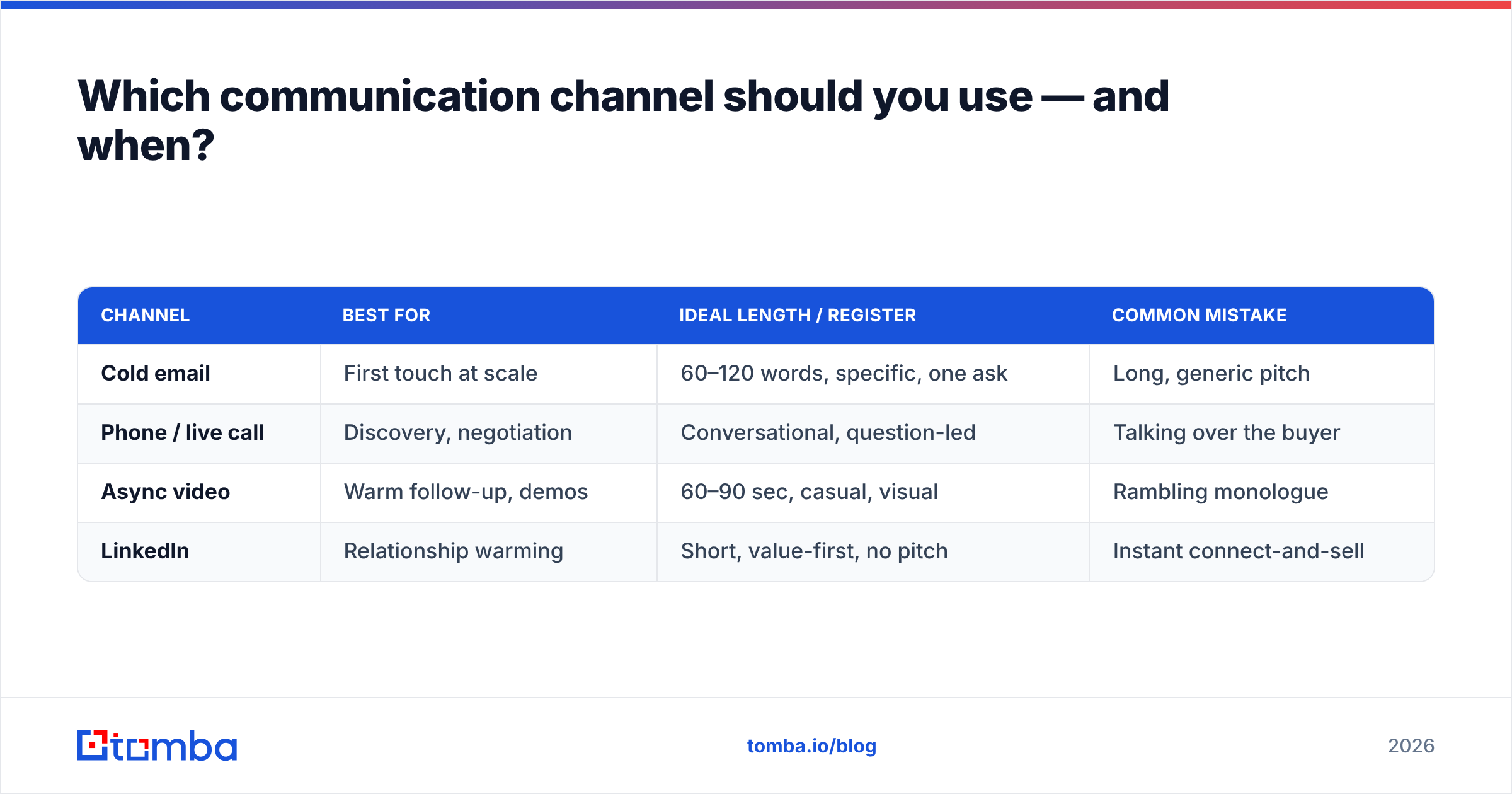
The modern rep is multilingual across channels, and each one has its own grammar. Sending an email in the register of a LinkedIn comment — or vice versa — is how outreach dies.
| Channel | Best for | Ideal length / register | Common mistake |
|---|---|---|---|
| Cold email | First touch at scale | 60–120 words, specific, one ask | Long, generic pitch |
| Phone / live call | Discovery, negotiation | Conversational, question-led | Talking over the buyer |
| Async video | Warm follow-up, demos | 60–90 sec, casual, visual | Rambling monologue |
| Relationship warming | Short, value-first, no pitch | Instant connect-and-sell |
The skill isn't picking a favorite channel — it's sequencing them. A strong cadence might open with a researched cold email, follow with a LinkedIn touch that references shared context, then earn the call. If you run outbound at volume, using proven cold email templates as a starting point keeps your written register tight, and an AI cold email assist can personalize the opener without turning it into a form letter. For the social layer, tighten your LinkedIn outreach so it warms rather than pitches.
Whatever the channel, the underlying communication principle is constant: lead with relevance to them, not features about you.
How does good data make you a better communicator?#
You cannot personalize what you don't know. The single biggest reason cold outreach reads as spam isn't bad writing — it's that the rep had nothing specific to say, so they defaulted to a generic pitch.
Communication and data are two sides of the same coin. When you know the prospect's role, company, tech stack, and a recent trigger event, your opening line writes itself: relevant, specific, human. When you're guessing, you fall back on "I wanted to reach out regarding your business needs," and the message dies on arrival.
That's why accurate contact data is a communication asset, not just an ops line item. Reaching the right person with a verified address means your carefully crafted message actually lands in a human inbox instead of bouncing or hitting the wrong contact. If you're building lists, a reliable email finder and clean email verification protect both your deliverability and your credibility — because nothing undercuts a great message faster than sending it to the wrong person or a dead address.
Good research turns a cold conversation into a warm one before you've said a word. That's the quiet half of communication skills nobody puts on the seminar agenda.
How do you coach communication skills across a team?#
Individual improvement is straightforward; scaling it is the hard part. A few things that separate teams who actually raise the bar from teams who just run a workshop and forget it:
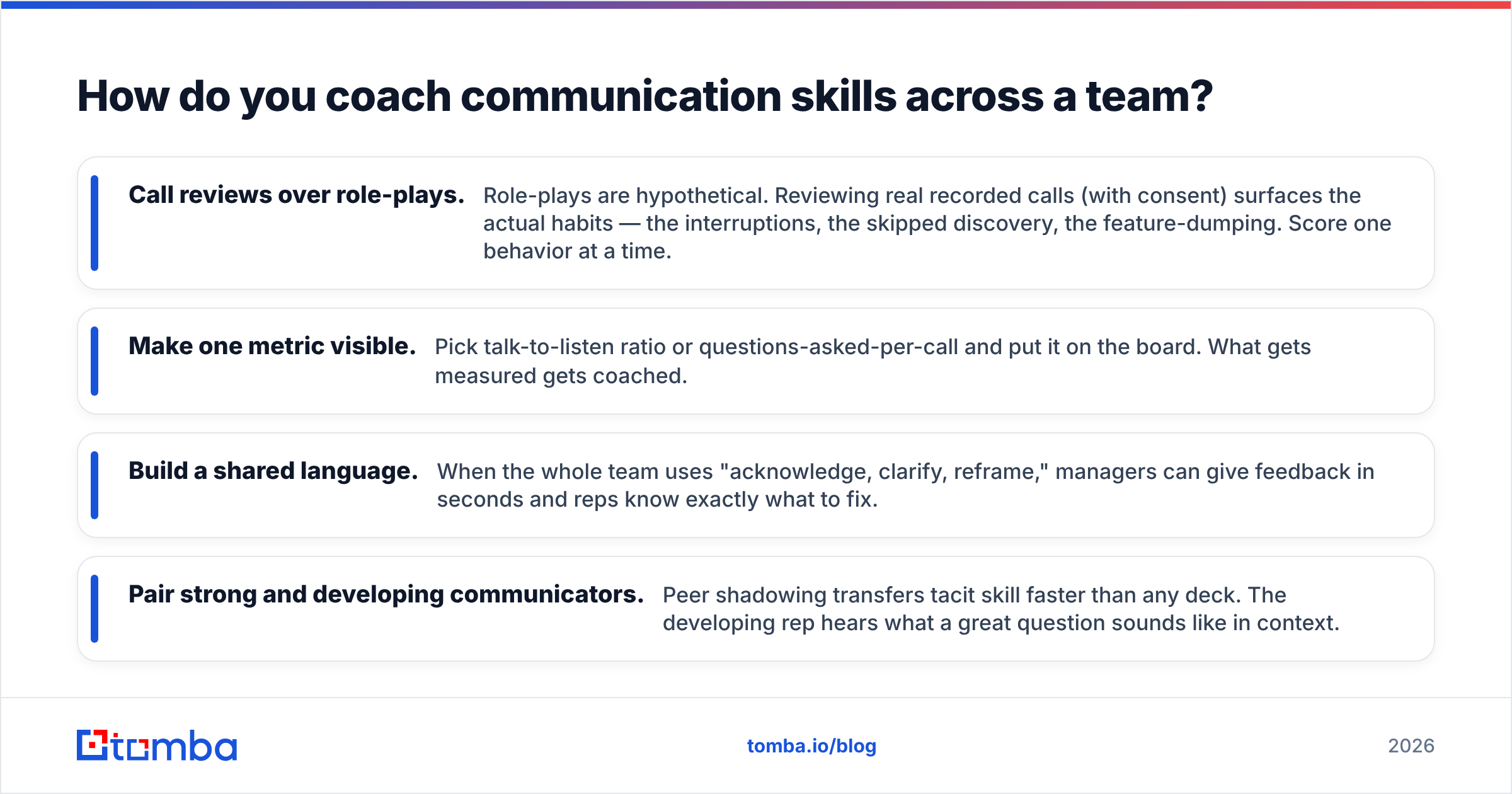
- Call reviews over role-plays. Role-plays are hypothetical. Reviewing real recorded calls (with consent) surfaces the actual habits — the interruptions, the skipped discovery, the feature-dumping. Score one behavior at a time.
- Make one metric visible. Pick talk-to-listen ratio or questions-asked-per-call and put it on the board. What gets measured gets coached.
- Build a shared language. When the whole team uses "acknowledge, clarify, reframe," managers can give feedback in seconds and reps know exactly what to fix.
- Pair strong and developing communicators. Peer shadowing transfers tacit skill faster than any deck. The developing rep hears what a great question sounds like in context.
Enablement isn't a one-time event — it's a weekly rhythm of listening to real conversations and nudging one behavior at a time. Compare that with the alternative of hiring "natural talkers" and hoping, and the coachable-behaviors approach wins every quarter.
What are the most common sales communication mistakes?#
Even experienced reps fall into predictable traps. Watch for these:
- Feature-dumping. Listing everything your product does instead of the one thing that solves their stated problem. More features stated ≠ more value perceived.
- Happy ears. Hearing enthusiasm that isn't there because you want the deal. Confirm interest with a concrete next-step commitment, not a vague "sounds great."
- Premature pitching. Presenting before you've earned the right through discovery. If you don't know their pain yet, you're not ready to pitch.
- Generic follow-up. "Just circling back" tells the buyer you weren't really listening the first time. Reference something specific they said.
- Talking price too early or too defensively. Anchor on value first; handle price with clarifying questions, not apologies.
Every one of these is a communication failure, not a knowledge failure. And every one is fixable with awareness plus reps.
Frequently asked questions#
Can communication skills in sales actually be taught, or are they innate? They're taught. The behaviors that predict won deals — listening ratio, discovery questioning, objection handling — are all observable and coachable. "Natural" reps mostly just picked these habits up earlier.
What's the fastest communication skill to improve? Your talk-to-listen ratio. Simply becoming aware of it and pausing before you respond produces a measurable shift within two weeks, no course required.
Does written communication matter as much as verbal? Increasingly, yes. First touches now happen in email and on LinkedIn far more than on the phone, so written clarity and personalization often decide whether you ever get the call.
How does data quality affect communication? Directly. Relevance requires knowledge. Accurate role, company, and contact data let you open with something specific — the foundation of every message that doesn't get ignored.
Start every conversation from a position of relevance#
Communication skills in sales come down to a simple loop: know something real about the buyer, listen more than you talk, frame value in their language, and handle pushback with curiosity instead of scripts. The reps who do this consistently don't just close more — they build the kind of trust that turns one deal into a referral engine.
But great communication starts before the first word. If you're reaching the wrong person, or your message bounces, none of the skill matters. Give your team the inputs to be relevant from the first line: use the Tomba Email Finder to reach verified decision-makers by name, domain, or company, so every carefully crafted message actually lands where it counts. Check the Tomba pricing plans — starting free with 25 searches a month and scaling from $49/mo — and let your reps spend their energy on the conversation, not the guesswork.
Related guides#
Ready to find emails that actually work?
Join 150,000+ professionals who stopped guessing and started sending. Free credits on signup — no credit card required.
Get the Tomba newsletter
Practical outbound tactics and product updates — once every two weeks.
About the author