Company Introduction Email Example: 7 Templates That Get Replies
A great company introduction email opens doors; a bad one gets deleted in two seconds. Here are 7 real templates, subject lines, and a checklist to introduce your business the right way.
A company introduction email is the first impression your business makes in someone's inbox — and most of them fail. They're too long, too vague, and too focused on the sender. This guide fixes that with real, copy-paste examples you can adapt today.
TL;DR#
- A strong company introduction email example leads with the reader's problem, not your company history.
- Keep it under 150 words, use one clear call to action, and personalize the first line.
- Subject line and sender reputation decide whether it's even opened — get both right before you obsess over body copy.
- Below you'll find 7 templates: cold prospect, warm referral, new point of contact, partnership, post-event, investor, and re-introduction.
- Sending to a verified, accurate contact list matters more than clever wording — a perfect email to a bounced address earns you nothing.
What is a company introduction email?#
A company introduction email is a short message that tells a specific person who you are, why you're relevant to them, and what you'd like to happen next. Think of it like introducing yourself at a networking event: you don't recite your resume, you find common ground and open a conversation.
There are two broad flavors:
- Outbound (cold) — you're reaching someone who has never heard of you. The bar is high; you have to earn attention.
- Warm — there's an existing thread: a referral, a demo request, a form fill, a conference badge scan, or a handoff between colleagues.
The mistake almost everyone makes is writing the same self-centered paragraph for both. "We are a leading provider of end-to-end solutions founded in 2015..." No one finishes that sentence. Your reader cares about one thing: what's in it for me?

What makes a company introduction email actually work?#
Five elements separate an email that gets a reply from one that gets archived. Use this as your pre-send checklist.
- Relevance first — the opening line must prove you know who they are and why you're writing them specifically. Not "Hi there."
- Brevity — 50 to 150 words. If it needs scrolling on a phone, it's too long.
- One clear ask — a single, low-friction call to action (a 15-minute call, a reply, a link). Two asks means zero action.
- Credibility — one proof point: a recognizable client, a metric, a mutual connection. Not five.
- Deliverability — the email has to land in the primary inbox. That depends on your sender reputation, authentication, and whether the address is even valid.
Here's the part most "email templates" articles skip: the best copy in the world can't rescue a message sent to an unverified, guessed address. Bounces tank your domain reputation and push future emails to spam. Before you send anything at scale, run your list through an email verifier so you're only reaching real, deliverable people.
What should the structure look like?#
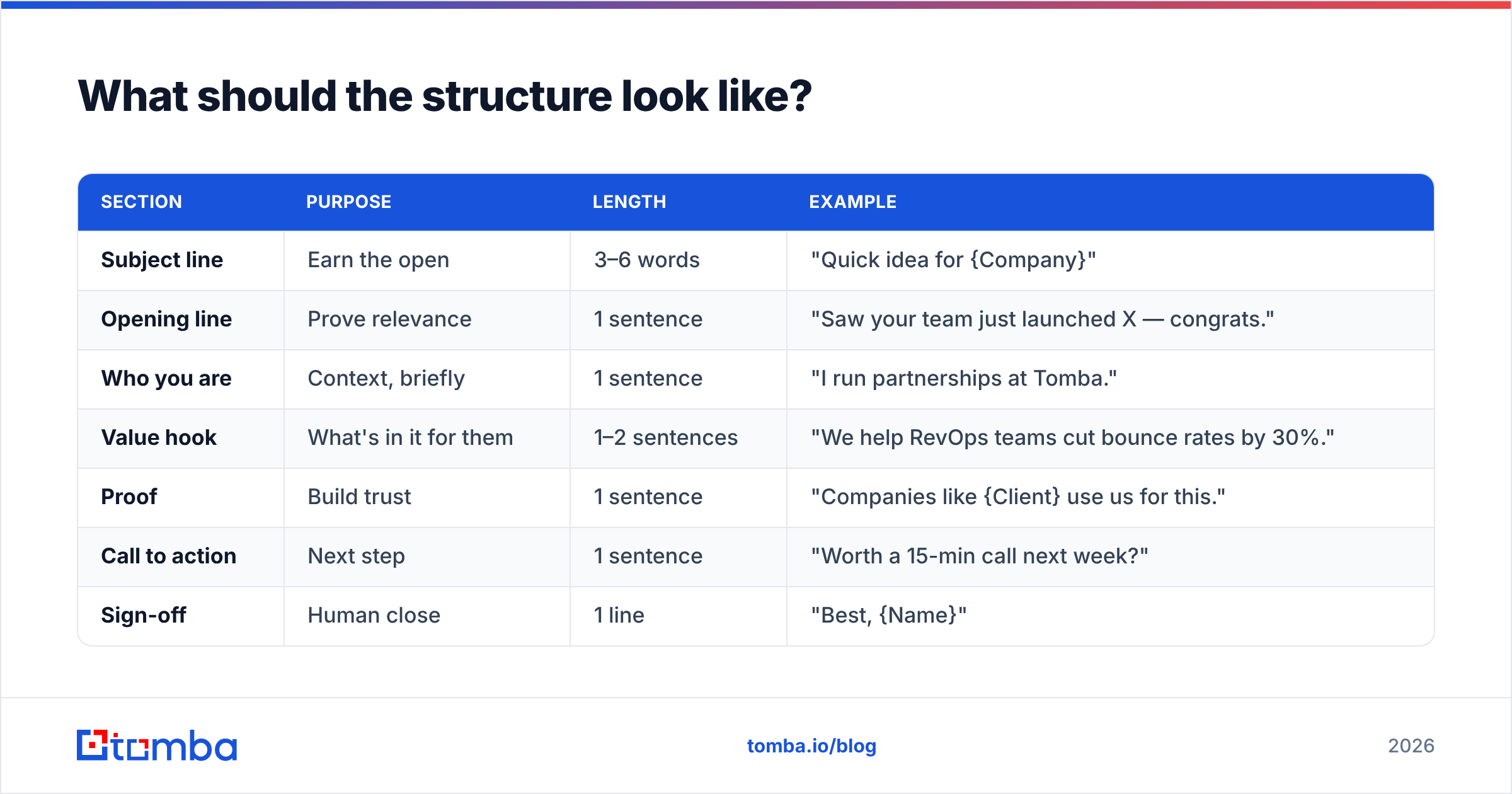
Every effective company introduction email follows the same skeleton. Fill in the blanks and you're 80% there.
| Section | Purpose | Length | Example |
|---|---|---|---|
| Subject line | Earn the open | 3–6 words | "Quick idea for {Company}" |
| Opening line | Prove relevance | 1 sentence | "Saw your team just launched X — congrats." |
| Who you are | Context, briefly | 1 sentence | "I run partnerships at Tomba." |
| Value hook | What's in it for them | 1–2 sentences | "We help RevOps teams cut bounce rates by 30%." |
| Proof | Build trust | 1 sentence | "Companies like {Client} use us for this." |
| Call to action | Next step | 1 sentence | "Worth a 15-min call next week?" |
| Sign-off | Human close | 1 line | "Best, {Name}" |
Notice the balance: only one line is about you. The rest is about them or the outcome. That ratio is the single biggest predictor of a reply.
7 company introduction email examples you can copy#
Below are seven templates for the situations you'll actually face. Swap the brackets, keep the structure.
1. Cold outbound to a prospect#
Subject: Cutting {Company}'s bounce rate
Hi {First Name},
Noticed {Company} is scaling its outbound team — nice growth on {specific signal}.
I'm {Your Name} from {Your Company}. We help B2B sales teams find and verify contact emails so their reps stop wasting sends on dead addresses. {Client} cut wasted sends by a third in the first month.
Open to a quick 15-minute walkthrough next Tuesday?
Best,
{Your Name}
2. Warm referral#
Subject: {Referrer} suggested I reach out
Hi {First Name},
{Referrer} mentioned you're rethinking how your team sources leads and thought we should talk.
I'm {Your Name} at {Your Company} — we handle exactly that problem for teams like {Client}. Happy to share what worked for them.
Do you have 15 minutes this week?
{Your Name}
3. New point of contact (account handoff)#
Subject: Your new contact at {Your Company}
Hi {First Name},
I'm taking over {Previous Rep}'s accounts and wanted to introduce myself directly — I'll be your main point of contact going forward.
Nothing changes on your end. I've reviewed your account and I'm here if anything comes up. Would a quick intro call this week be useful?
Best,
{Your Name}
4. Partnership / collaboration#
Subject: {Their Company} + {Your Company}?
Hi {First Name},
Our audiences overlap more than you'd think — you serve {segment}, and so do we, without competing.
I'm {Your Name} at {Your Company}. I have a specific co-marketing idea that could put your product in front of {number} qualified buyers. Worth 20 minutes to explore?
{Your Name}
5. Post-event follow-up#
Subject: Great chatting at {Event}
Hi {First Name},
Enjoyed our conversation about {topic} at {Event} yesterday. As promised, here's a bit more on how {Your Company} handles {problem you discussed}.
Want me to send over the case study, or would a quick call be easier?
{Your Name}
6. Investor / advisor intro#
Subject: {Your Company} — {one-line pitch}
Hi {First Name},
{Mutual Connection} pointed me your way given your focus on {thesis}.
{Your Company} is {one sentence on what you do and traction}. We're {stage} and I'd value 20 minutes of your perspective.
Are you open to a short call the week of {date}?
{Your Name}
7. Re-introduction (reviving a cold thread)#
Subject: Reviving this — better timing?
Hi {First Name},
We spoke back in {month} but the timing wasn't right. Since then we've added {new capability}, which directly addresses the {concern} you raised.
Worth another look now?
{Your Name}

Which subject lines get company introduction emails opened?#
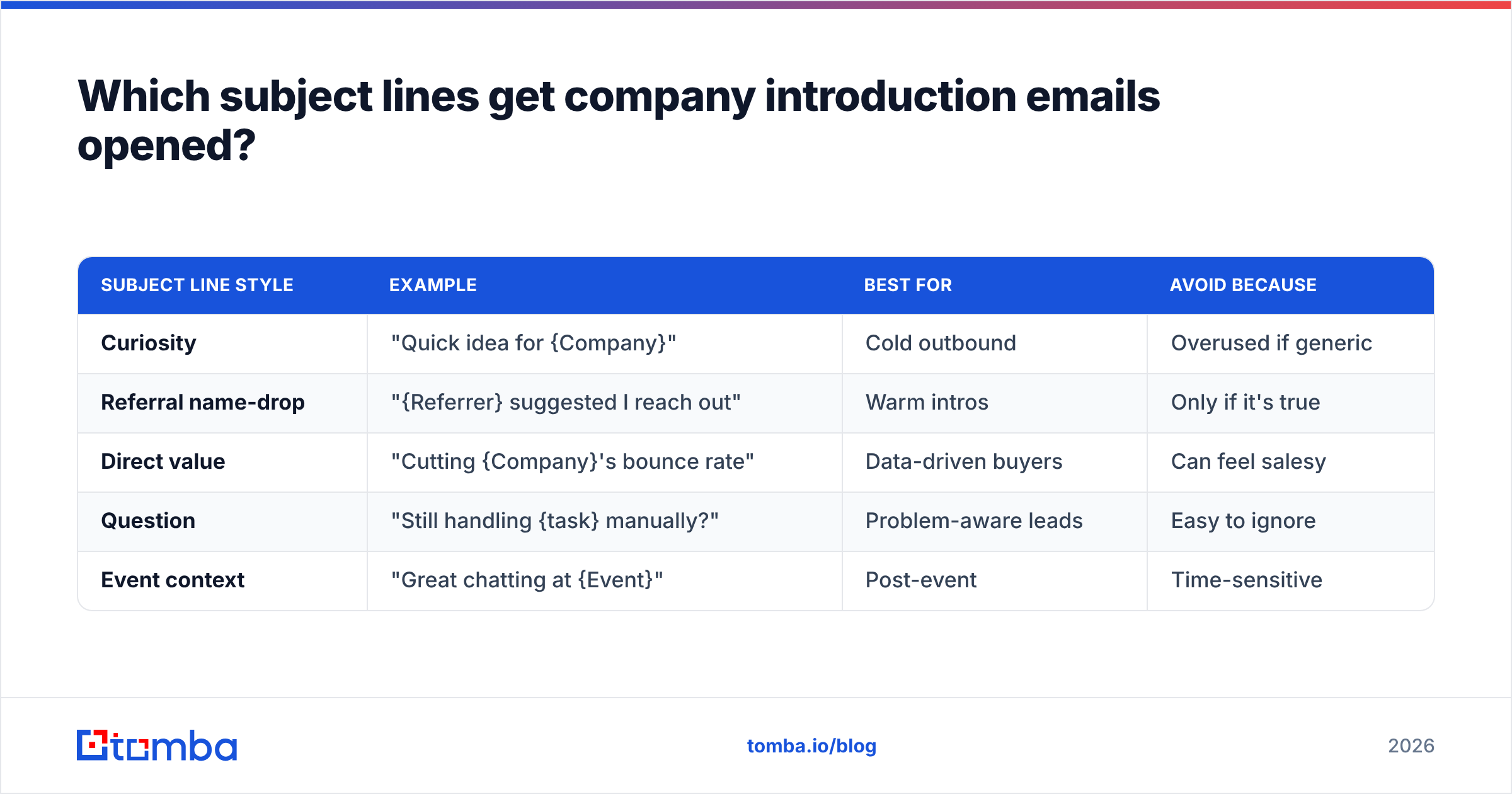
Your body copy is irrelevant if the email is never opened, and roughly half of that decision rests on the subject line and sender name. Keep subjects short, specific, and free of spam triggers.
| Subject line style | Example | Best for | Avoid because |
|---|---|---|---|
| Curiosity | "Quick idea for {Company}" | Cold outbound | Overused if generic |
| Referral name-drop | "{Referrer} suggested I reach out" | Warm intros | Only if it's true |
| Direct value | "Cutting {Company}'s bounce rate" | Data-driven buyers | Can feel salesy |
| Question | "Still handling {task} manually?" | Problem-aware leads | Easy to ignore |
| Event context | "Great chatting at {Event}" | Post-event | Time-sensitive |
Two rules: never use ALL CAPS or "Re:" fakery, and always test. Run candidates through a subject line tester before you commit a whole campaign to one line. Small wording changes routinely swing open rates by double digits.
Why does deliverability matter more than the copy?#
Because the average sales rep spends hours polishing an email that never reaches a human. If the address bounced, or your domain landed on a blacklist, your beautifully written company introduction email is invisible.
Deliverability comes down to three things you control:
- Valid recipients — verified, deliverable addresses. This is where a real email finder beats guessing "firstname@company.com."
- Authentication — properly configured SPF, DKIM, and DMARC records so inbox providers trust you. Check your setup with an SPF checker.
- Reputation — consistent sending volume, low bounce and complaint rates, and warmed-up domains.
Here's the cascade that kills teams: guessed addresses → high bounce rate → damaged email deliverability → even your good emails go to spam. The fix isn't better copy. It's a clean, verified list from the start. According to HubSpot's research on email engagement, list quality consistently outranks copy tweaks as a driver of reply rates.
How do you find the right person to email?#
A perfect introduction sent to the wrong person is wasted. You need the actual decision-maker's verified email, not the generic info@ inbox where messages go to die.
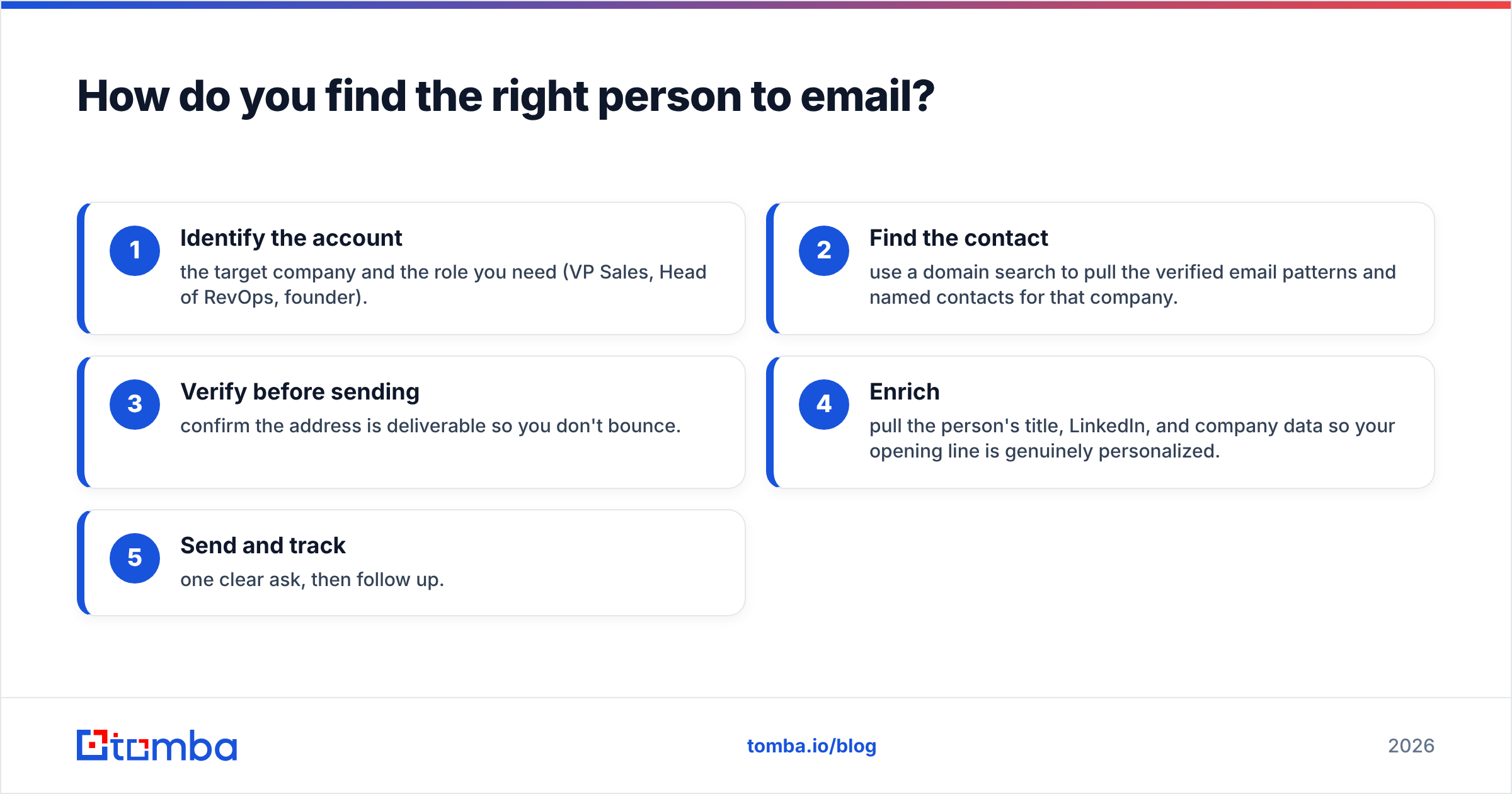
This is the practical workflow most high-performing outbound teams use:
- Identify the account — the target company and the role you need (VP Sales, Head of RevOps, founder).
- Find the contact — use a domain search to pull the verified email patterns and named contacts for that company.
- Verify before sending — confirm the address is deliverable so you don't bounce.
- Enrich — pull the person's title, LinkedIn, and company data so your opening line is genuinely personalized.
- Send and track — one clear ask, then follow up.
Tools like Apollo and Tomba automate steps two through four. Where Tomba stands out is verification-first accuracy: every email is checked before it reaches your list, which is exactly what protects the deliverability we just covered. You can compare approaches on independent review sites like G2 before deciding.
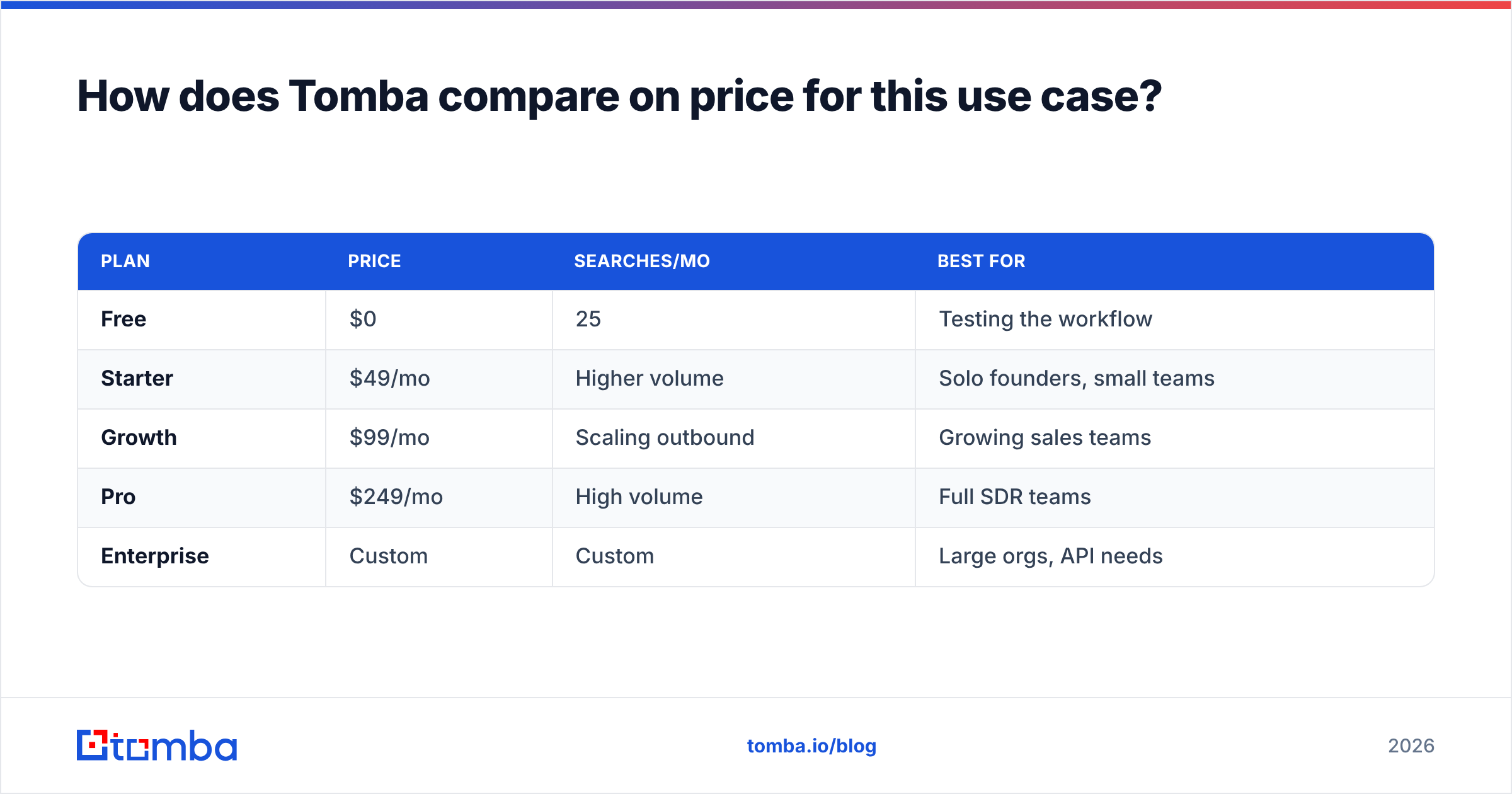
How does Tomba compare on price for this use case?#
If you're introducing your company at any real volume, cost per verified contact matters. Here's how Tomba's plans line up.
| Plan | Price | Searches/mo | Best for |
|---|---|---|---|
| Free | $0 | 25 | Testing the workflow |
| Starter | $49/mo | Higher volume | Solo founders, small teams |
| Growth | $99/mo | Scaling outbound | Growing sales teams |
| Pro | $249/mo | High volume | Full SDR teams |
| Enterprise | Custom | Custom | Large orgs, API needs |
You can see the full breakdown on the Tomba pricing page. The Free tier is enough to test the entire find-verify-introduce loop on a handful of real prospects before you spend a dollar.
What are the most common mistakes to avoid?#
- Writing a monologue. If the reader has to scroll, you've lost. Cut it in half, then cut again.
- Leading with your founding date. No one cares when you were founded. They care what you do for them, today.
- Vague CTAs. "Let me know if you're interested" puts the work on them. Propose a specific time instead.
- No personalization. A first line that could be sent to anyone gets treated like it was sent to everyone — deleted.
- Skipping verification. Sending to unverified addresses is the fastest way to wreck your domain reputation.
- Five proof points. One strong, relevant credibility signal beats a wall of logos.
Fix these six and you'll outperform the vast majority of introduction emails hitting your prospects' inboxes this week.
Frequently asked questions#
How long should a company introduction email be? 50 to 150 words. Short enough to read on a phone without scrolling, long enough to establish relevance, value, and a clear next step.
Should I introduce my company or myself first? Neither — introduce their relevance first. Open with why you're writing them specifically, then briefly say who you are.
What's the best time to send? Mid-morning on Tuesday through Thursday tends to perform best for B2B, but your audience's habits matter more than any universal rule. Test and track.
How many follow-ups are appropriate? Two to four, spaced several days apart, each adding new value rather than just "bumping" the thread.
Start with a list that actually lands#
The best company introduction email example in the world is useless if it bounces. Get the fundamentals right in order: find the right person, verify the address, then write copy worth reading. Reverse that order and you're polishing a message no one will ever see.
Start free with the Tomba Email Finder — find and verify the exact decision-maker's email by name or domain, so every introduction you send reaches a real, deliverable inbox. Twenty-five free searches is enough to launch your first campaign today.
Related guides#
Ready to find emails that actually work?
Join 150,000+ professionals who stopped guessing and started sending. Free credits on signup — no credit card required.
Get the Tomba newsletter
Practical outbound tactics and product updates — once every two weeks.
About the author