Competitive Intelligence Strategy: A 2026 Playbook for GTM Teams
A competitive intelligence strategy turns scattered rival research into deals your reps actually win. Here's the 2026 framework, tooling, and workflow.
Most teams "do" competitive intelligence the way they floss: sporadically, guiltily, and only when something hurts. A rep loses a deal to a rival, someone screenshots the competitor's new pricing page into Slack, everyone reacts for an afternoon, and then it's forgotten. That's not a strategy. That's a reflex.
A real competitive intelligence strategy is a repeatable system for collecting, analyzing, and distributing what you know about competitors — so your marketing, sales, and product teams make sharper decisions on purpose, not by accident. This guide shows you how to build one in 2026 without hiring a five-person analyst desk.
TL;DR#
- Competitive intelligence (CI) is the disciplined practice of gathering and acting on information about competitors, buyers, and market shifts — not one-off snooping.
- A working strategy has four parts: collection, analysis, activation, and measurement. Skip activation and you've built a very expensive scrapbook.
- The highest-ROI CI output is the battlecard — a one-page reference that helps reps handle "why you vs. them" in real time.
- Good CI runs on good data. Enrichment tools like Tomba's data enrichment and a clean B2B database keep your competitor and account intel accurate.
- Measure CI by win rate against named competitors, not by how many reports you produced.
What is a competitive intelligence strategy?#
A competitive intelligence strategy is your plan for answering one question consistently: "What do we need to know about our market to win, and how do we get that knowledge into the hands of the people making decisions?"
Think of it like a weather service for your business. Nobody wants raw barometric readings. They want "bring an umbrella." CI works the same way — the value isn't the data you collect about a rival's pricing or roadmap, it's the clear recommendation that reaches a rep thirty seconds before a discovery call.
The discipline is well-established; Wikipedia's overview of competitive intelligence traces it back decades as a formal function. What's changed in 2026 is the tooling. You no longer need a dedicated research team to monitor competitors — you need a defined process and a few sharp tools.
CI vs. market research vs. business intelligence#
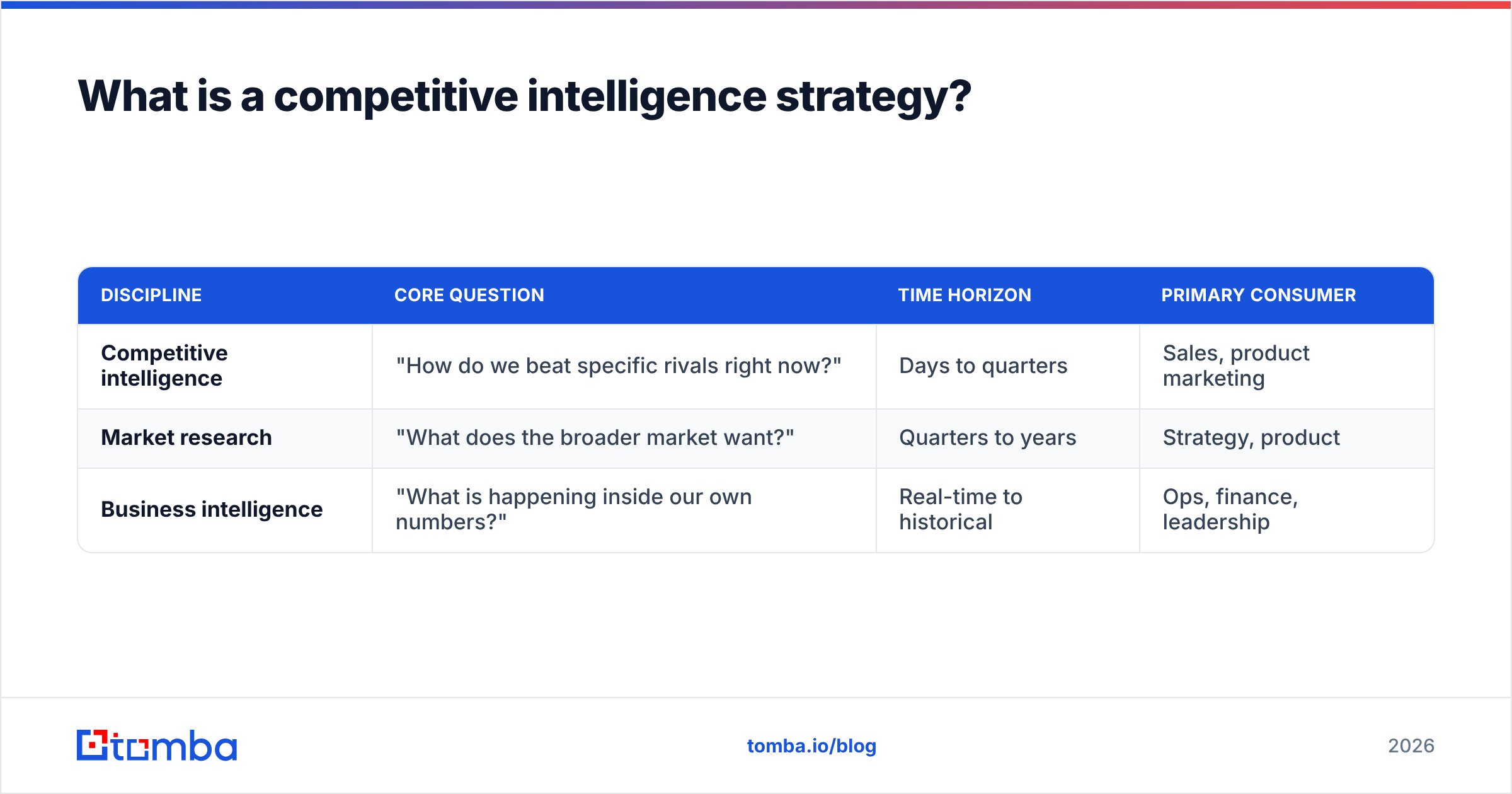
These three get blurred constantly. They're not the same thing, and treating them as interchangeable is why so many CI programs stall.
| Discipline | Core question | Time horizon | Primary consumer |
|---|---|---|---|
| Competitive intelligence | "How do we beat specific rivals right now?" | Days to quarters | Sales, product marketing |
| Market research | "What does the broader market want?" | Quarters to years | Strategy, product |
| Business intelligence | "What is happening inside our own numbers?" | Real-time to historical | Ops, finance, leadership |
Competitive intelligence is the most tactical of the three. It's built for the rep on a live call, not the exec on a five-year planning cycle.
Why does a competitive intelligence strategy matter in 2026?#
Because your buyers are already doing CI on you. The average B2B buyer runs a shortlist before a single vendor call, and review platforms like G2 put side-by-side comparisons one click away. If you don't understand how you stack up, your prospect does — and they'll control the framing.
Three concrete payoffs make CI worth the effort:
- Higher competitive win rate. When reps can name a rival's weakness and your matching strength without stalling, close rates on contested deals climb. This is the single most measurable outcome.
- Faster, less defensive positioning. Marketing stops guessing at messaging and starts writing against real objections buyers actually raise.
- Fewer roadmap surprises. Product sees where competitors are moving and decides — deliberately — whether to match, ignore, or leapfrog.
The teams that treat CI as a revenue operations function rather than a marketing side-project are the ones that see these gains. According to Gartner's research on B2B buying, buying groups now involve more stakeholders and more independent research than ever — which means every unmanaged competitive narrative is a gap you're leaving open.
What are the four pillars of a competitive intelligence strategy?#
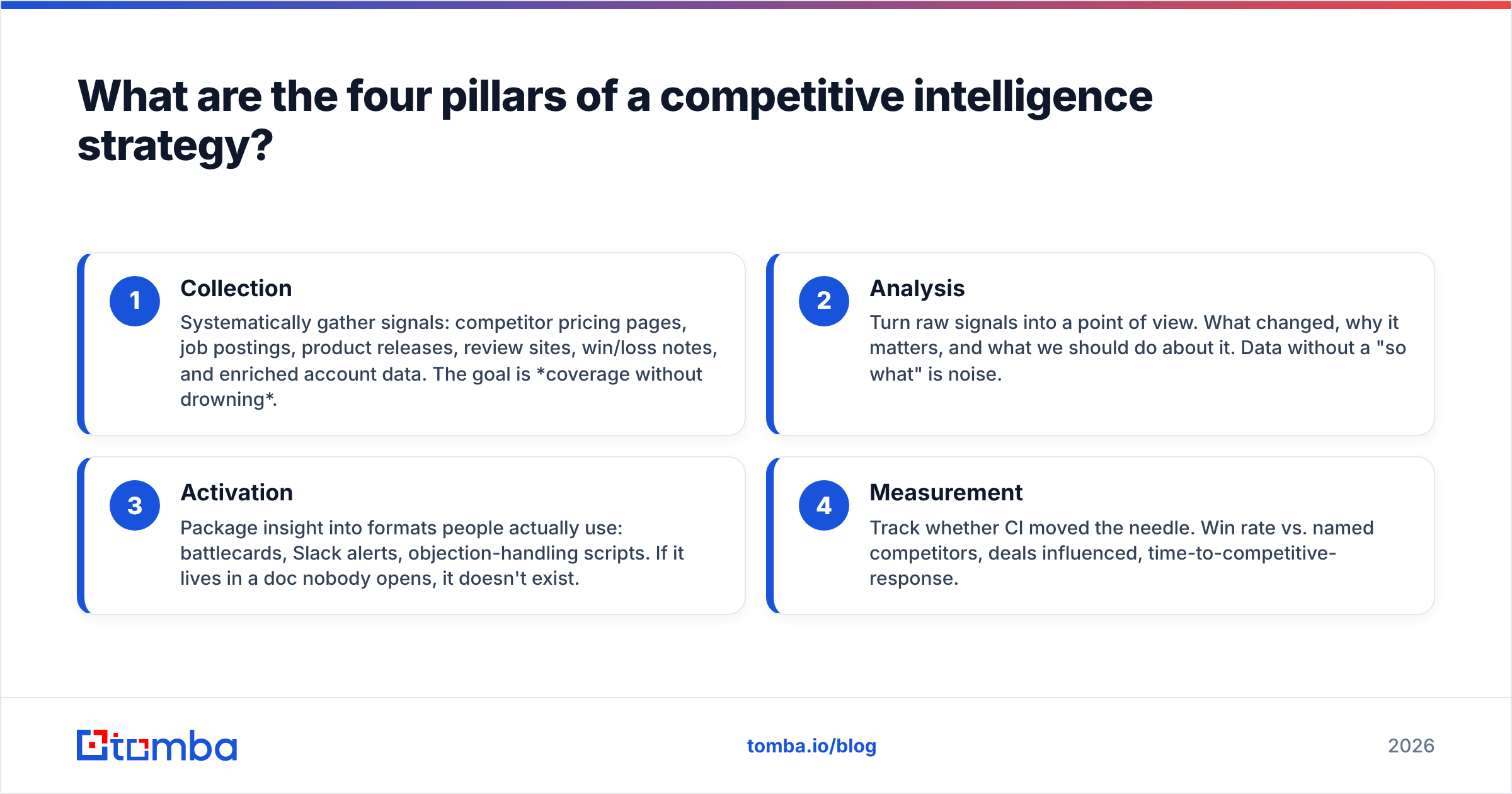
Every durable CI program rests on the same four pillars. Miss one and the whole thing wobbles.
- Collection — Systematically gather signals: competitor pricing pages, job postings, product releases, review sites, win/loss notes, and enriched account data. The goal is coverage without drowning.
- Analysis — Turn raw signals into a point of view. What changed, why it matters, and what we should do about it. Data without a "so what" is noise.
- Activation — Package insight into formats people actually use: battlecards, Slack alerts, objection-handling scripts. If it lives in a doc nobody opens, it doesn't exist.
- Measurement — Track whether CI moved the needle. Win rate vs. named competitors, deals influenced, time-to-competitive-response.
Most failed programs over-invest in collection and under-invest in activation. They build a beautiful library and forget to open a lending desk.
How do you actually collect competitive intelligence?#
Collection breaks into two buckets: passive monitoring (things you set up once and let run) and active gathering (things a human deliberately pursues).
Passive sources worth automating#
- Competitor websites — pricing, feature, and positioning changes. Tools that diff a page over time flag when a rival quietly drops a plan or changes language.
- Job boards — a competitor hiring ten enterprise AEs and a VP of Security is telling you exactly where they're going next.
- Review platforms — Capterra and G2 reviews are a goldmine of unfiltered strengths and complaints, straight from your shared buyers.
- Funding and news — raises, acquisitions, and leadership changes reshape the field overnight.
Active sources that need a human#
- Win/loss interviews — the single richest CI source. Ask lost prospects why the competitor won, in their words.
- Field intelligence — reps hear competitor claims on every call. Give them a two-click way to log it.
- Account and contact enrichment — knowing who sits in a target account, and which decision-makers a competitor already reached, sharpens every play. This is where accurate contact data earns its keep. A reliable email finder and clean enrichment feed keep your account maps current instead of six months stale.
The trap here is collecting everything and analyzing nothing. Pick the five sources that map to your competitive reality and monitor those deeply. Broad-but-shallow coverage feels productive and changes zero deals.
How do you turn competitive intelligence into battlecards?#
The battlecard is where CI stops being a report and starts being revenue. A battlecard is a one-page, competitor-specific reference a rep can scan mid-call.
A strong battlecard answers five things and nothing more:
- Who they are — one-line positioning, target buyer, pricing shape.
- Why we win — the two or three differentiators that hold up under scrutiny.
- Why we lose — honest gaps, plus how to reframe them. Reps trust cards that admit weakness.
- Landmines to set — questions that expose the competitor's soft spots ("Ask how their catch-all verification handles risky domains").
- Objection responses — the exact "yeah, but they said X" comebacks.
Keep it brutally short. A battlecard that reads like a whitepaper never gets used. The point is recall under pressure, not completeness.
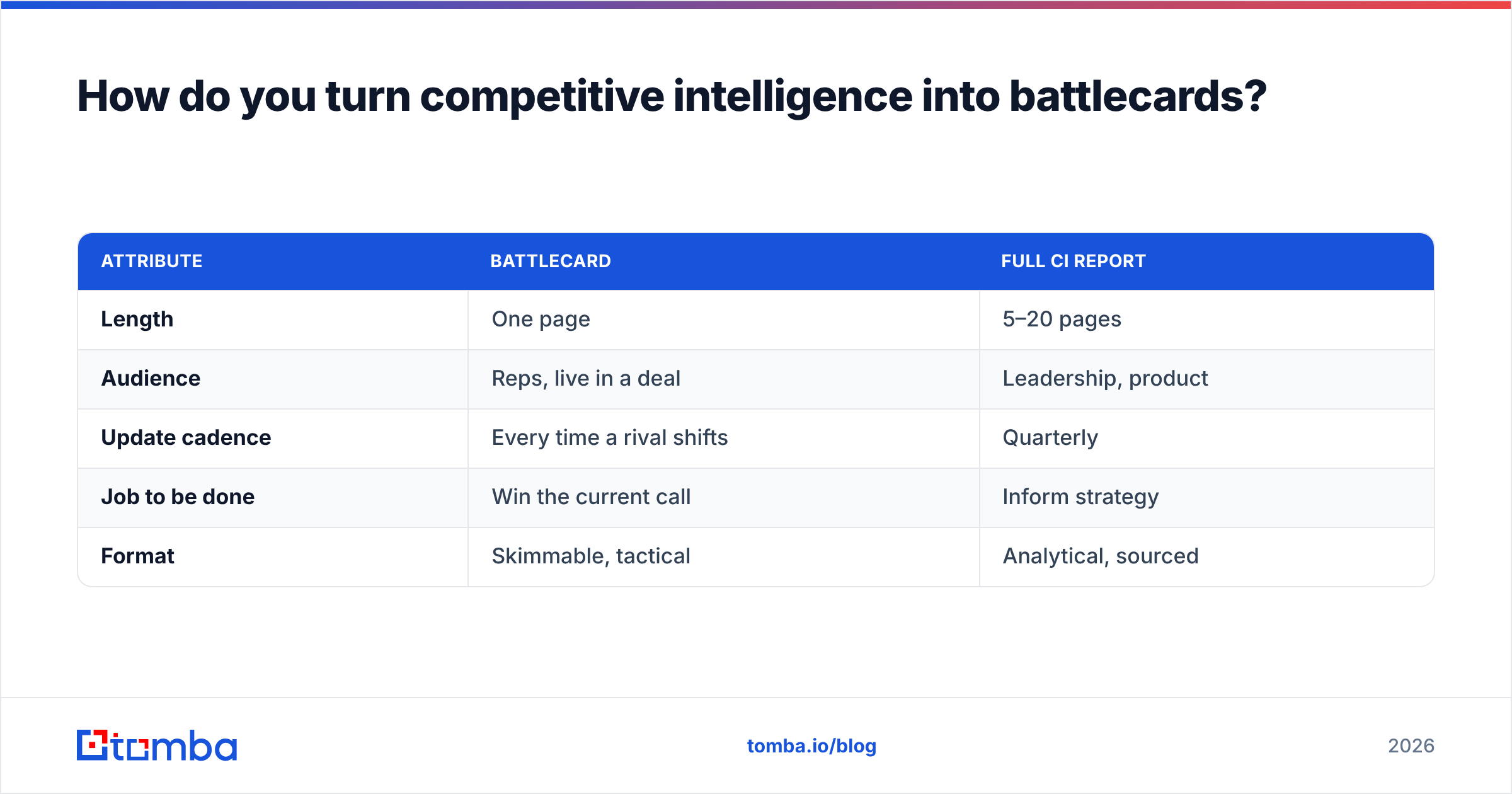
Battlecard vs. a full CI report#
| Attribute | Battlecard | Full CI report |
|---|---|---|
| Length | One page | 5–20 pages |
| Audience | Reps, live in a deal | Leadership, product |
| Update cadence | Every time a rival shifts | Quarterly |
| Job to be done | Win the current call | Inform strategy |
| Format | Skimmable, tactical | Analytical, sourced |
You need both. But if you can only build one thing this quarter, build battlecards for your top three competitors. That's where CI touches pipeline fastest.
What tools power a modern competitive intelligence strategy?#
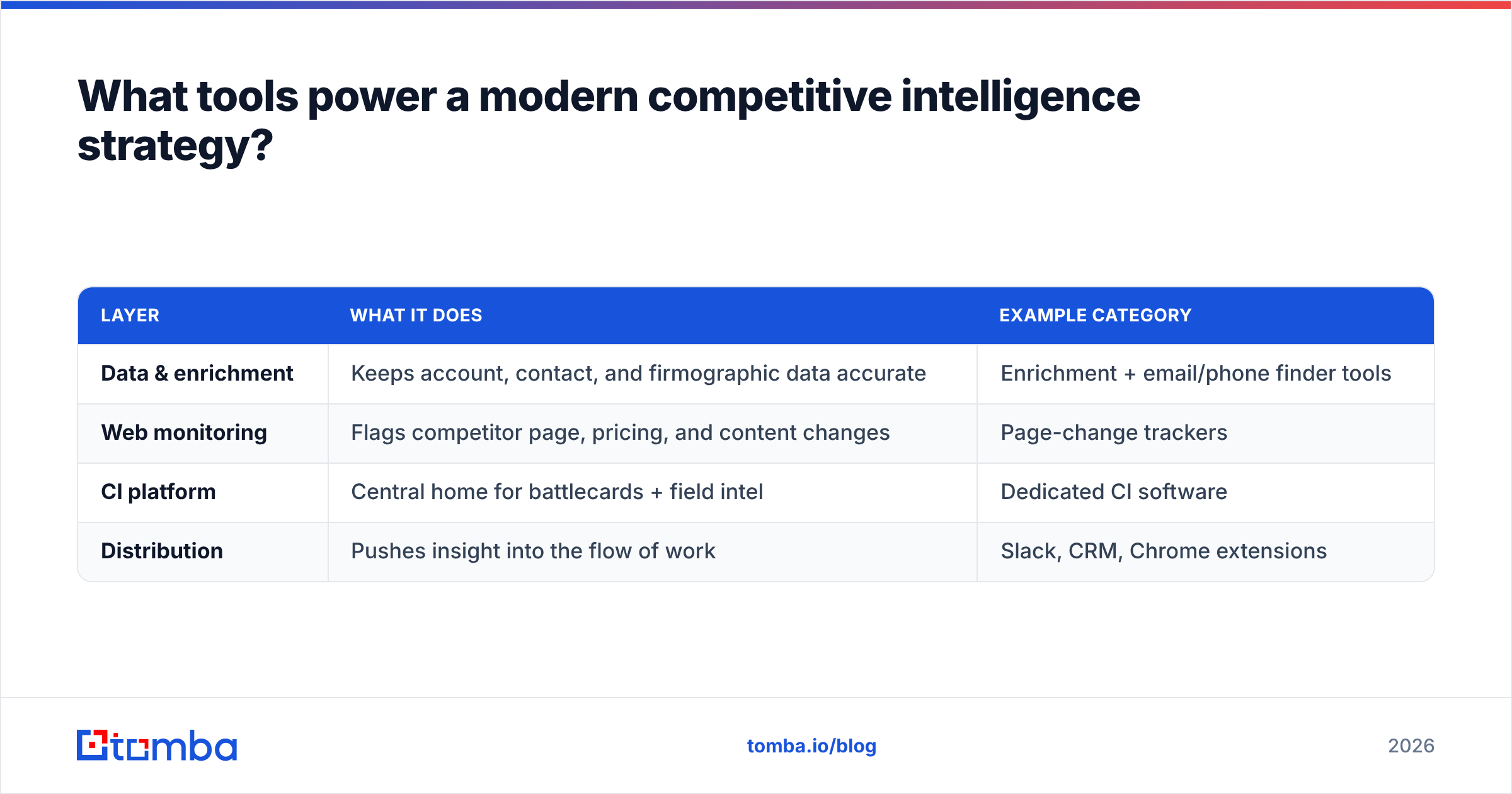
You can assemble a capable CI stack from four categories. You don't need all four on day one — start with data quality and monitoring, add the rest as the program earns its budget.
| Layer | What it does | Example category |
|---|---|---|
| Data & enrichment | Keeps account, contact, and firmographic data accurate | Enrichment + email/phone finder tools |
| Web monitoring | Flags competitor page, pricing, and content changes | Page-change trackers |
| CI platform | Central home for battlecards + field intel | Dedicated CI software |
| Distribution | Pushes insight into the flow of work | Slack, CRM, Chrome extensions |
Two honest notes on tooling:
Data quality is the foundation, not a nice-to-have. A CI program built on stale contact data produces confident, wrong conclusions. If your enrichment source guesses at emails and firmographics, your account maps rot quietly. This is why teams pair their CI platform with a verification layer — an email verifier and enrichment feed that keep the underlying data trustworthy. Garbage in, confident garbage out.
You'll likely consolidate. Many teams start by stitching together five point tools and later swap toward fewer, broader platforms. If you're already evaluating all-in-one prospecting suites, weigh a focused Apollo alternative that does data and finding well against a sprawling platform you'll only half-use.
How do you measure whether your CI strategy is working?#
Measure CI by decisions changed and deals won — never by output volume. "We shipped 40 competitor updates" is a vanity metric. Here's what actually signals a healthy program:
- Win rate vs. named competitors — the north star. Segment your win rate by which rival was in the deal. If CI works, contested-deal close rates rise.
- Battlecard engagement — are reps opening the cards? Low usage means bad format or bad distribution, not bad intel.
- Time-to-response — how fast you react when a competitor drops a new feature or price. Days, not months.
- Deals influenced — pipeline where a CI asset demonstrably shaped the conversation, tagged in your CRM.
Set a baseline before you launch. Without a "before" number, you can't prove the "after."
What are the most common competitive intelligence mistakes?#
- Building a library nobody borrows from. Beautiful reports, zero activation. Fix: lead with battlecards and Slack alerts.
- Obsessing over the wrong competitor. Teams fixate on the loud market leader while a nimble upstart quietly wins their mid-market deals. Fix: let win/loss data — not headlines — pick your targets.
- Running on stale data. Account maps from last year, unverified contacts, guessed firmographics. Fix: refresh enrichment on a schedule and verify before you act.
- Treating CI as a project, not a practice. A one-time competitor audit ages badly. Fix: assign an owner and a cadence, even if it's one person for two hours a week.
- Ignoring your own reps. The field hears competitor claims daily and it evaporates unlogged. Fix: make capture frictionless.
The through-line: CI fails from neglect and stale inputs far more often than from lack of sophistication. A simple, current program beats an elaborate, abandoned one every time.
Build your CI strategy on data you can trust#
A competitive intelligence strategy is only as good as the data underneath it. If your account maps are current, your contacts verified, and your enrichment accurate, every battlecard and every rep conversation gets sharper. If they're stale, you're just guessing with extra steps.
That's the layer Tomba's Email Finder and enrichment suite handle — finding and verifying the decision-makers inside your target and competitive accounts so your CI reflects reality, not last year's org chart. Start free with 25 searches a month, then scale on the Tomba pricing plan that fits your team ($49/mo Starter and up). Get the data right, and the intelligence follows.
Related guides#
Ready to find emails that actually work?
Join 150,000+ professionals who stopped guessing and started sending. Free credits on signup — no credit card required.
Get the Tomba newsletter
Practical outbound tactics and product updates — once every two weeks.
About the author