Competitive Sales Training: The 2026 Playbook That Works
Leaderboards and sales contests promise more revenue, but done wrong they crush morale. This guide breaks down competitive sales training that actually lifts win rates in 2026.
Competitive sales training turns the same skills drills your team already runs into ranked, scored, high-stakes reps — leaderboards, head-to-head roleplays, and contests tied to real pipeline. Done well, it compresses ramp time and lifts win rates. Done badly, it rewards sandbagging and torches your best people. This guide shows you the difference.
TL;DR#
- Competitive sales training is skills development structured as measured competition: ranked roleplays, live call scored against peers, and contests tied to real metrics — not just "who booked the most demos."
- It works when the scoreboard measures behaviors reps control (talk-track quality, discovery depth, follow-up speed), not just closed revenue that luck and territory distort.
- The biggest failure mode is morale collapse: when only the top 10% ever win, the other 90% disengage. Fix it with tiered brackets, personal-best tracking, and team-based scoring.
- Data quality is the silent variable. Reps competing on bad contact data lose to territory, not skill — so clean lists from a tool like Tomba Email Finder level the playing field.
- Budget realistically: expect 6–12 weeks to see a measurable win rate lift, and pair every contest with a coaching debrief or you're just gambling.
What is competitive sales training?#
Competitive sales training is any structured program that develops selling skills through ranked, scored competition between reps. Think of it like a boxing gym: you can shadowbox alone forever, but you only find out what your jab is worth when someone's swinging back. Sparring — controlled, coached, repeated — is where skill actually hardens.
In practice it takes a few forms:
- Ranked roleplay ladders — reps run the same objection-handling scenario, get scored by managers or peers on a rubric, and climb a ladder.
- Live-call leaderboards — real dials or demos scored on tracked behaviors (discovery questions asked, next-step secured), surfaced on a shared board.
- Pipeline contests — classic sales contests tied to booked meetings, opportunities created, or revenue, run in defined sprints.
- Certification gauntlets — new hires must "beat" a scenario bar to graduate onboarding, racing peers to certification.
The word that matters is structured. Slapping a leaderboard on your CRM and calling it training is how teams end up rewarding the rep with the best territory instead of the best skills.
Why does competitive sales training work when it works?#
Because measured competition does three things ordinary training can't: it creates urgency, exposes skill gaps under pressure, and generates repetition volume most coaching programs never reach.
A rep who knows their discovery call is being scored against a peer's will prepare differently than one filling a training checkbox. That pressure is the point — it's the closest safe simulation of a real deal on the line. Gartner's sales research has repeatedly found that reps forget the majority of training content within weeks unless it's reinforced through practice; competition is a reinforcement engine that runs itself once the culture takes hold. You can read Gartner's broader take on sales enablement effectiveness on gartner.com.
There's also a simple math argument. If a normal roleplay session gives each rep two reps of a scenario, a bracket-style tournament can give the same rep six to ten meaningful attempts in the same hour — each one sharpened by watching how peers handled it. Volume of deliberate practice is the single most reliable predictor of skill gain, and competition is the cheapest way to buy volume.
What separates good competitive sales training from morale-killing contests?#
The metric. Everything hinges on whether you're scoring things reps control or things luck controls.
When you rank reps on closed revenue alone, you're mostly ranking territory quality, inbound lead flow, and account inheritance. The rep who "wins" often didn't out-sell anyone — they out-inherited them. The rest of the team learns the game is rigged and checks out. That's the fastest way to turn a training tool into an attrition tool.
Good programs score leading, controllable behaviors:
- Discovery depth — number and quality of qualifying questions asked
- Follow-up speed — time from meeting to next-step confirmation
- Talk-track adherence — did the rep hit the value framing on the call
- Multithreading — number of stakeholders engaged per account
- Data hygiene — accuracy of contact records worked, which is where clean data enrichment quietly decides winners
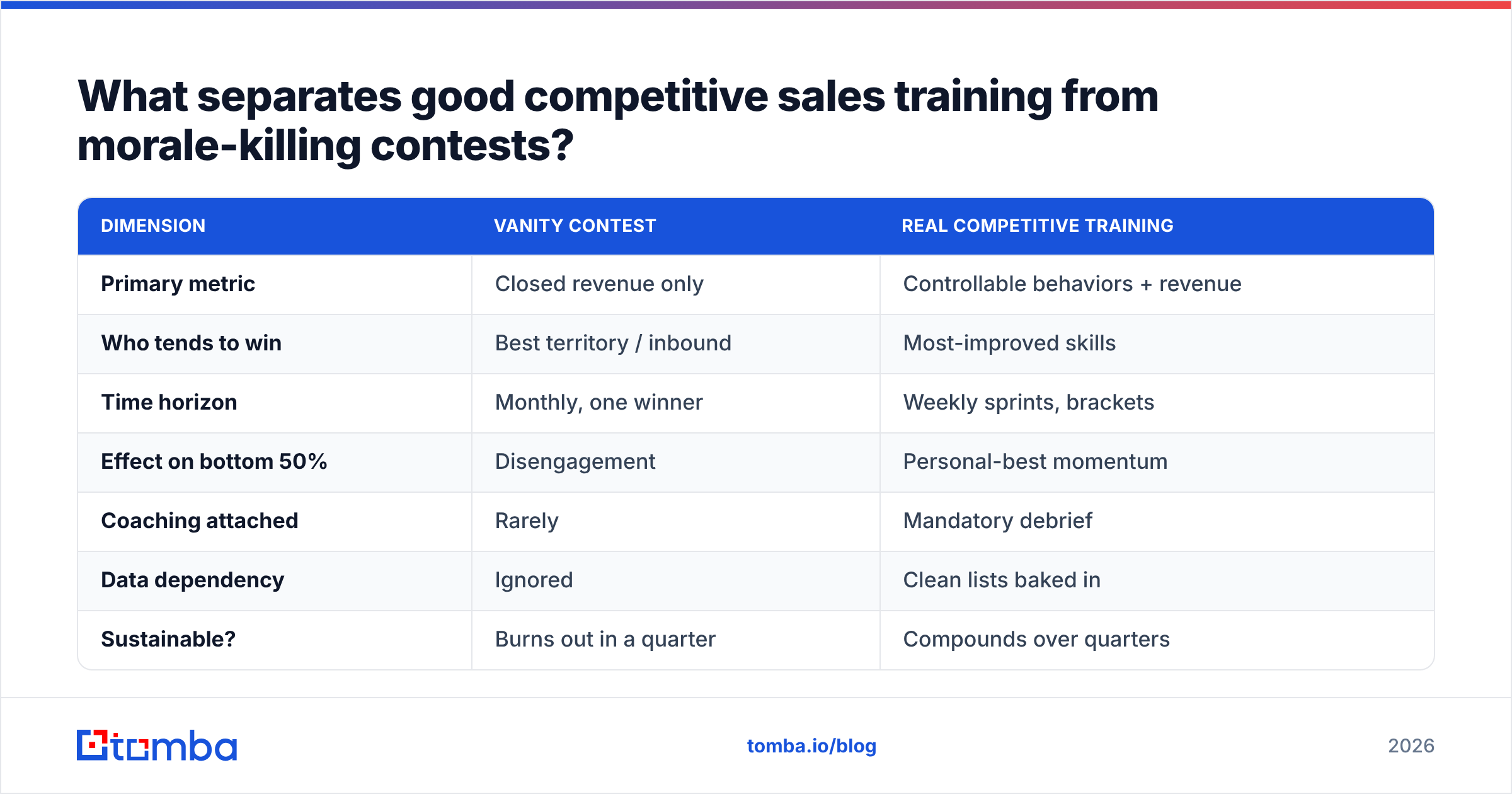
Here's a side-by-side of the two approaches so you can pressure-test your own program.
| Dimension | Vanity contest | Real competitive training |
|---|---|---|
| Primary metric | Closed revenue only | Controllable behaviors + revenue |
| Who tends to win | Best territory / inbound | Most-improved skills |
| Time horizon | Monthly, one winner | Weekly sprints, brackets |
| Effect on bottom 50% | Disengagement | Personal-best momentum |
| Coaching attached | Rarely | Mandatory debrief |
| Data dependency | Ignored | Clean lists baked in |
| Sustainable? | Burns out in a quarter | Compounds over quarters |
The right-hand column is what you're building toward. The left is what most teams accidentally ship.
How do you design a competitive sales training program in 2026?#
Start small, score what reps control, and attach coaching to every round. Here's the build order.
1. Pick one skill to sharpen first. Don't launch a mega-contest. Choose a single, measurable weakness — say, weak discovery — and build the first competition entirely around it. Narrow scope is what makes the debrief useful.
2. Write a scoring rubric before you write the rules. A rubric turns "good call" into points: 1 point per open-ended discovery question, 2 for a confirmed next step, deductions for talking past a buying signal. Reps need to see exactly how to earn points, or they'll optimize for the wrong thing.
3. Bracket by skill tier, not one open pool. Split reps into tiers so newer sellers compete against peers, not against your top closer. Tiered brackets keep the bottom half in the game — the whole reason the program survives past week three.
4. Feed the competition clean data. If reps are racing on real accounts, the contact data has to be even. One rep grinding through bounced emails while another works verified contacts isn't a fair fight. Standardize the inputs — pull contacts through the same email verifier and hand everyone the same quality of list — so the scoreboard reflects skill, not luck of the draw.
5. Debrief every round. The competition creates the reps; the debrief creates the learning. Watch the top-scored call together, name what worked, and let the whole tier steal it. Skip this and you've built a casino, not a classroom.
6. Rotate the metric. Once discovery improves, move the contest to follow-up speed, then multithreading. Rotating keeps the program fresh and builds a well-rounded team instead of one-trick specialists.
What metrics should the leaderboard actually track?#
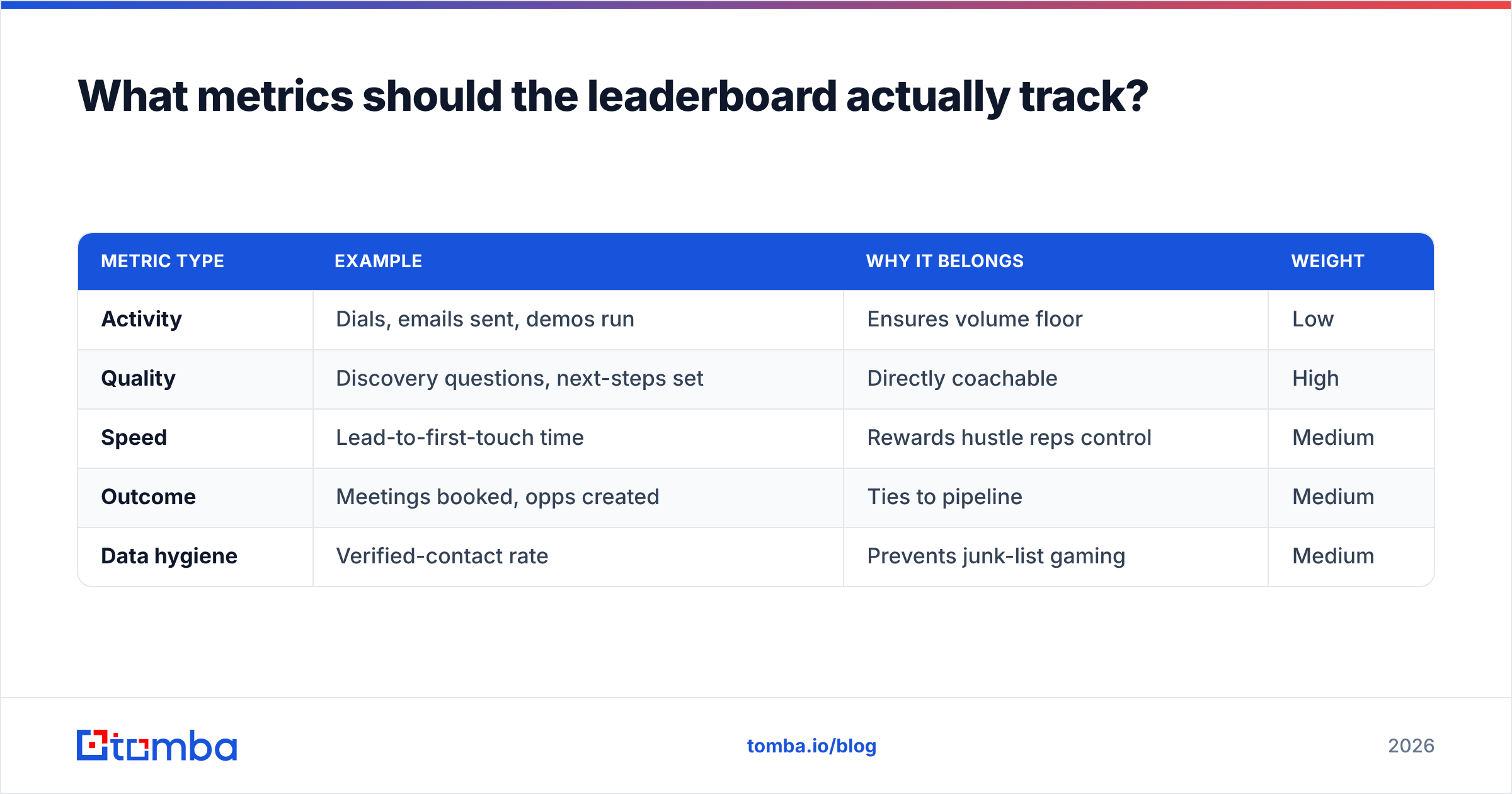
Track a blend of activity, quality, and outcome — weighted toward the middle. Activity alone rewards spray-and-pray; outcome alone rewards territory. Quality is where coaching bites.
| Metric type | Example | Why it belongs | Weight |
|---|---|---|---|
| Activity | Dials, emails sent, demos run | Ensures volume floor | Low |
| Quality | Discovery questions, next-steps set | Directly coachable | High |
| Speed | Lead-to-first-touch time | Rewards hustle reps control | Medium |
| Outcome | Meetings booked, opps created | Ties to pipeline | Medium |
| Data hygiene | Verified-contact rate | Prevents junk-list gaming | Medium |
Notice response rate sits under "quality/outcome" — it's one of the cleanest signals of whether a rep's messaging is landing, and it's far less territory-dependent than raw closed revenue. If you want a single tiebreaker metric that resists gaming, response rate on a standardized list is a strong candidate.
Competitive sales training vs. traditional coaching: which wins?#
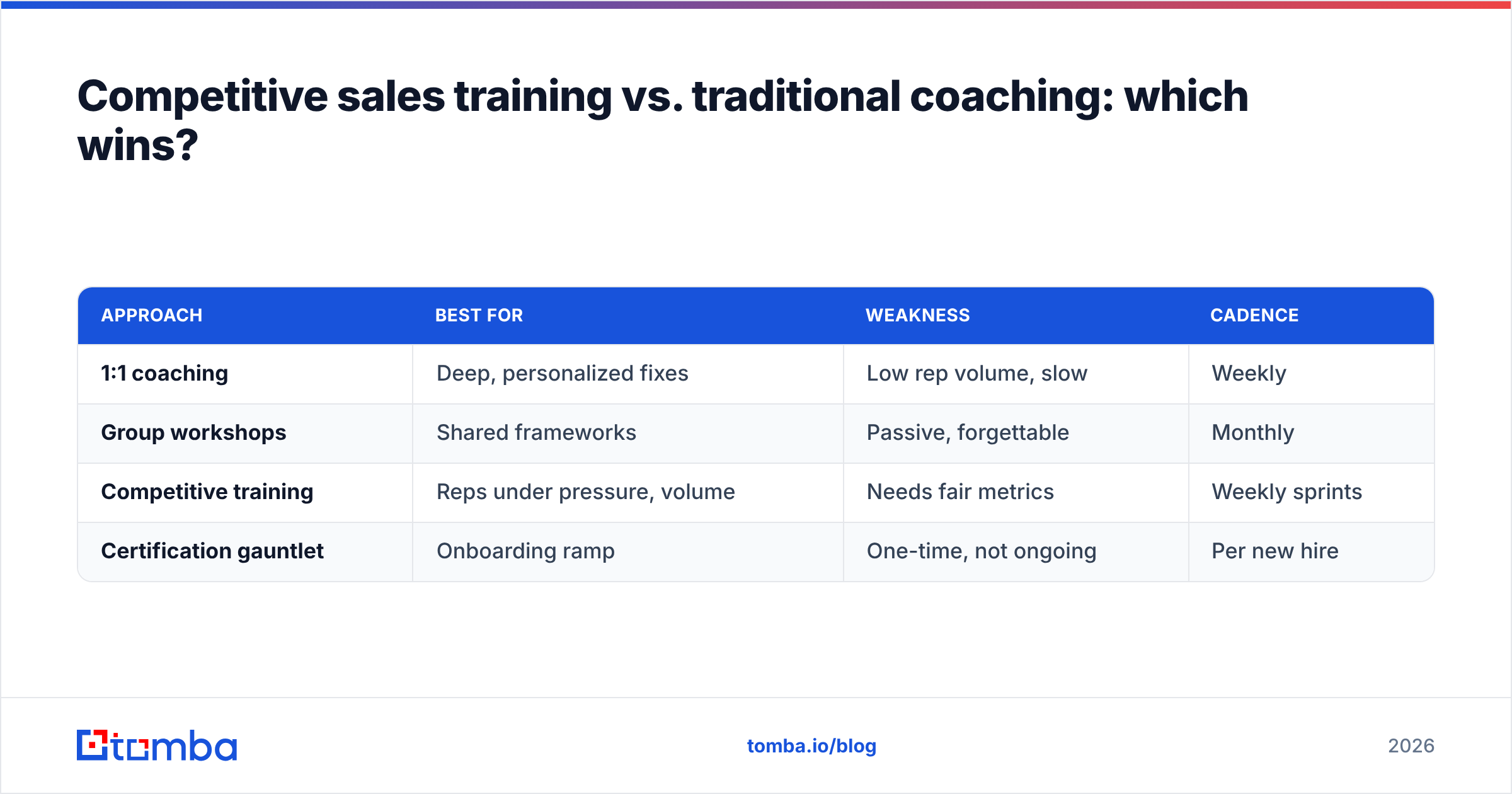
Neither wins alone — they're a matched pair. Traditional coaching is the film room; competitive training is the scrimmage. You need both, and the teams that treat them as either/or underperform the teams that sequence them.
| Approach | Best for | Weakness | Cadence |
|---|---|---|---|
| 1:1 coaching | Deep, personalized fixes | Low rep volume, slow | Weekly |
| Group workshops | Shared frameworks | Passive, forgettable | Monthly |
| Competitive training | Reps under pressure, volume | Needs fair metrics | Weekly sprints |
| Certification gauntlet | Onboarding ramp | One-time, not ongoing | Per new hire |
The pattern that works: teach the framework in a workshop, drill it in a bracketed competition, then use 1:1 coaching to fix the individual gaps the competition exposed. Competition is the diagnostic that tells your managers where to spend their scarce coaching hours.
What tools and data do you need to run it?#
You need three things: a place to score, a source of fair activity, and clean contact data underneath it all.
- Scoring surface — a CRM leaderboard, a gamification layer, or even a shared sheet to start. HubSpot's sales tools and G2's sales gamification category are good places to compare options if you're buying software rather than building a sheet.
- A fair activity engine — reps need enough qualified accounts to actually compete. That means a steady supply of targeted contacts, which is where a bulk email finder or domain search keeps every rep's queue full and comparable.
- Clean, verified data — the input that quietly decides fairness. A rep who spends the sprint fighting bounces and wrong numbers loses to data, not to a better seller. Standardizing on verified emails and validated B2B phone numbers removes that variable.
That last point is worth repeating because it's the one most managers miss. Your leaderboard is only as fair as your dirtiest list. If you're serious about scoring skill, you have to control the data inputs the same way a track meet controls the lane surface.
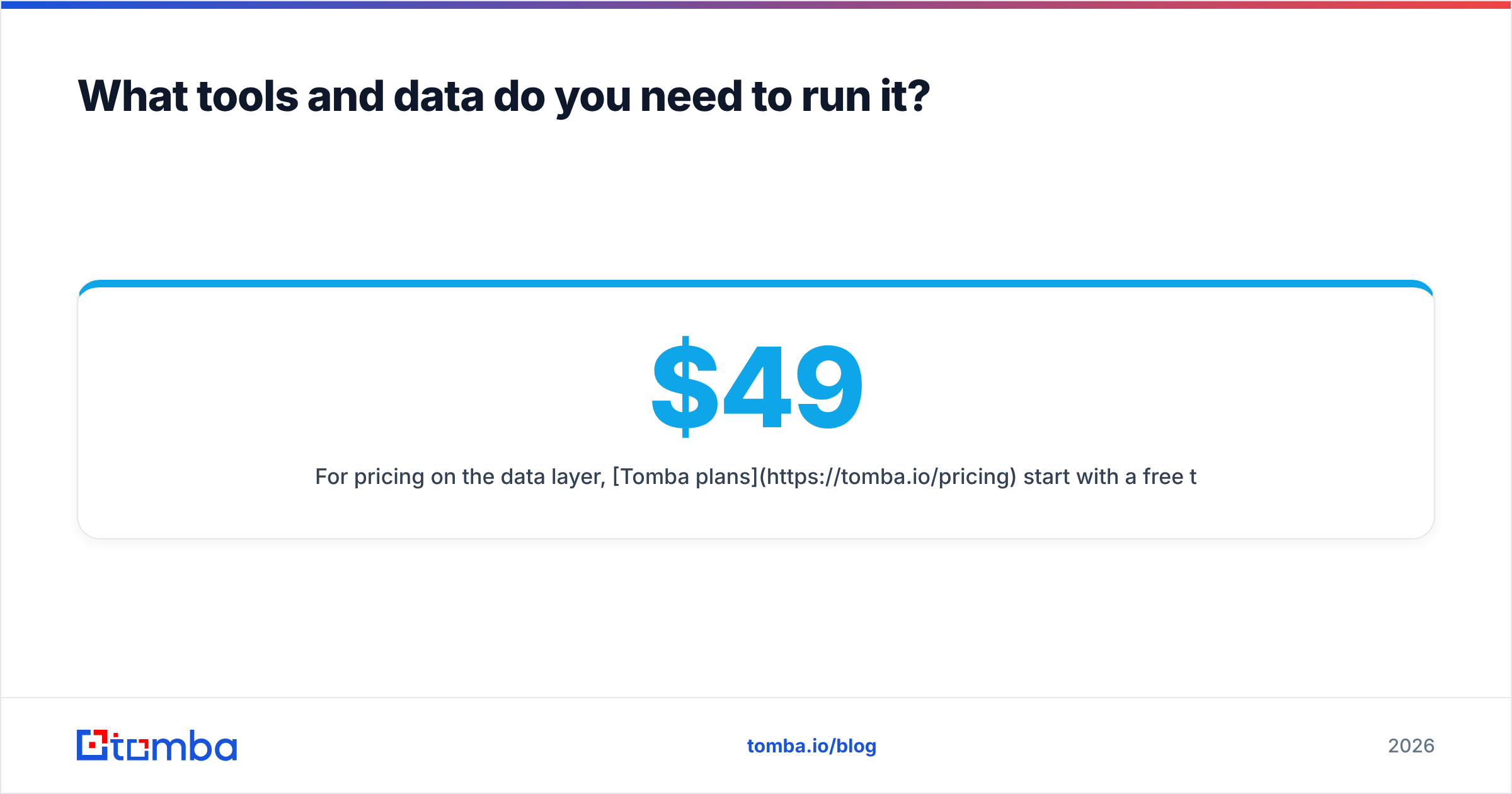
For pricing on the data layer, Tomba plans start with a free tier of 25 searches a month, then scale from $49/mo Starter to $99/mo Growth and $249/mo Pro — cheap insurance against a program that measures territory instead of talent.
How do you avoid the classic failure modes?#
Most competitive sales training dies from three predictable wounds. Here's the triage.
Sandbagging. When reps learn the contest resets, they hoard deals to win the next round. Fix: score leading behaviors that can't be stockpiled, and run overlapping short sprints so there's no "off week" to hide pipeline in.
Winner-takes-all disengagement. If the same three reps win every time, everyone else quits trying. Fix: reward most-improved and personal-bests alongside absolute rank, and bracket by tier so newer reps have a live shot.
Coaching vacuum. A contest with no debrief teaches reps to win the game, not to sell. Fix: make the debrief non-optional and tie a portion of the score to whether reps applied last round's lesson.
Data-driven unfairness. Covered above, but it's the sleeper. Fix: standardize the list quality every rep works from, using the same verification and enrichment pipeline for all.
Get those four right and competition compounds. Get them wrong and you'll spend Q3 backfilling the reps who quit.
How long until competitive sales training shows ROI?#
Expect 6–12 weeks for a measurable win-rate or ramp-time lift, assuming weekly sprints with debriefs. You'll feel the energy shift in week one — leaderboards are motivating on day one — but the actual skill gain that moves your number lags the behavior change by a sales cycle or two.
Set the expectation with leadership up front. If someone expects a revenue spike in two weeks, you'll get pressured into scoring closed deals (the vanity metric), and the program will decay into a territory contest. Protect the runway, measure the leading indicators, and let the outcome metrics follow.
The bottom line#
Competitive sales training is one of the highest-leverage things a sales manager can run — but only if the scoreboard measures skill, not luck. Score controllable behaviors, bracket by tier, debrief every round, and standardize the data every rep competes on. That last piece is where good intentions quietly fall apart: a contest run on dirty lists ranks territory, not talent.
If you're building a program in 2026, start by leveling the data playing field. Give every rep the same quality of verified contacts with Tomba Email Finder — find professional emails by domain, name, or company, verify them before they hit the leaderboard, and make sure the only variable your competition measures is how well your team actually sells. Spin up the free tier and hand your next sprint a fair fight.
Related guides#
Ready to find emails that actually work?
Join 150,000+ professionals who stopped guessing and started sending. Free credits on signup — no credit card required.
Get the Tomba newsletter
Practical outbound tactics and product updates — once every two weeks.
About the author