Competitor Analysis in 2026: A Practical Framework for B2B Teams
A no-fluff competitor analysis framework for 2026: what to track, how to build a battle card, and the data sources that turn guesswork into a repeatable GTM edge.
Most "competitor analysis" decks are graveyards. Someone builds a beautiful grid once, presents it, and nobody opens the file again until the next board meeting. Meanwhile your reps keep losing deals to the same three vendors and nobody can say exactly why.
This guide fixes that. It treats competitor analysis as a living operating system — something your sales, product, and marketing teams pull from every week — not a one-off research project. You will get a repeatable framework, a battle-card template, and a clear view of where the data actually comes from.
TL;DR#
- Competitor analysis is a workflow, not a document. The value is in keeping it current and putting it in front of reps at the moment of the deal.
- Segment your competitors into direct, indirect, and aspirational — each needs a different response.
- Track five dimensions: positioning, pricing, product, GTM motion, and customer sentiment.
- Battle cards win deals. A one-page "why we win / why we lose / traps to set" doc beats a 40-slide teardown every time.
- Data quality is the bottleneck. Enriched, verified contact and firmographic data is what separates a real analysis from a Wikipedia summary.
What is competitor analysis, really?#
Competitor analysis is the structured process of identifying who you compete with, understanding how they win and lose, and turning that understanding into decisions — pricing, messaging, product bets, and sales tactics.
Think of it like scouting in professional sports. A team doesn't scout an opponent to write a report; it scouts to change the game plan on Sunday. If your analysis never changes what a rep says on a call or what a PM builds next quarter, you scouted for nothing.
The technical version: you're building and maintaining a model of the market's supply side so your go-to-market team can make better bets faster than competitors make theirs. That model has to be fed continuously, because positioning, pricing, and personnel change constantly.
Which competitors should you actually analyze?#
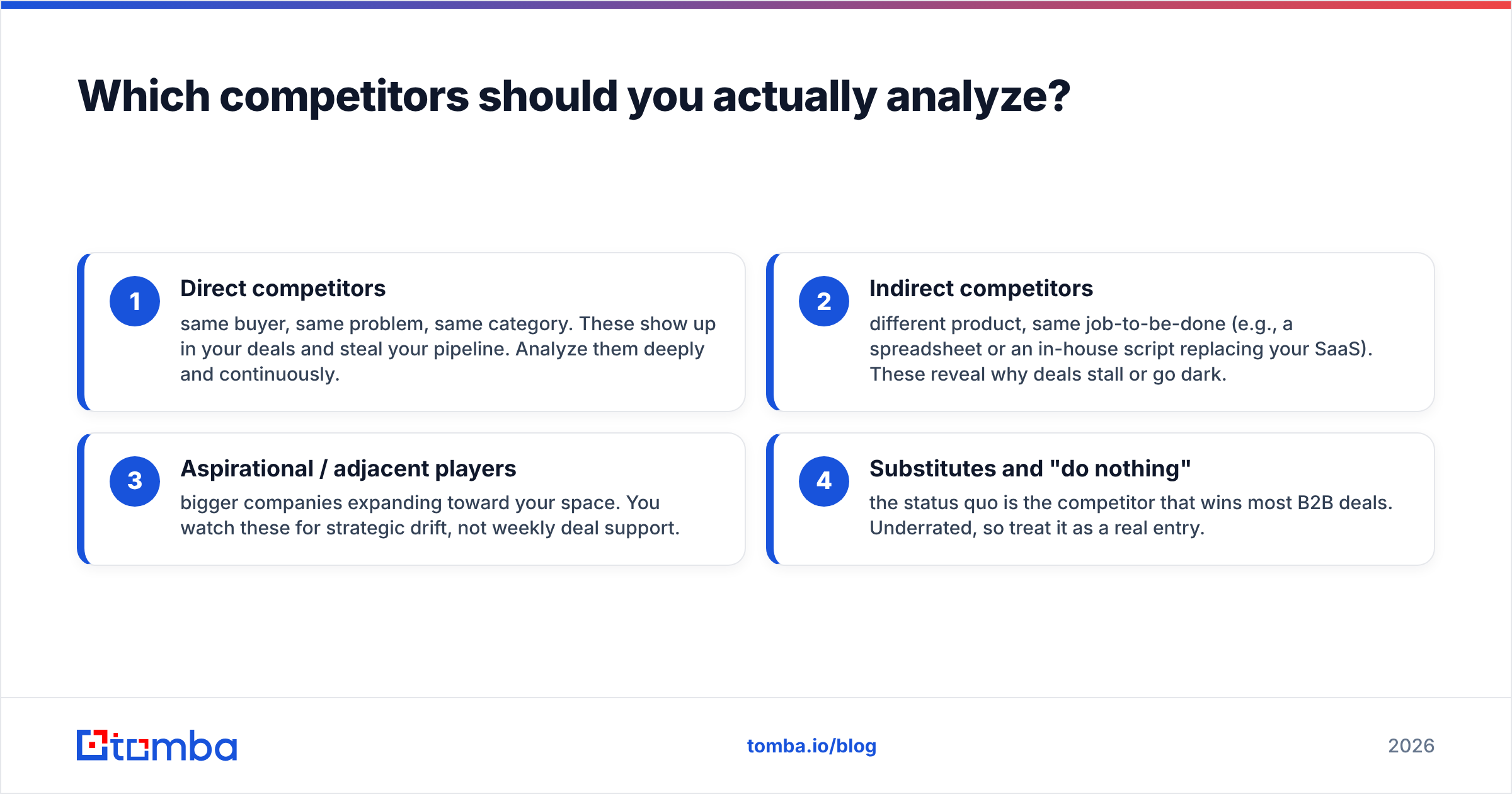
Not all competitors deserve equal attention. Spreading yourself across 30 "competitors" produces shallow noise. Segment them first:
- Direct competitors — same buyer, same problem, same category. These show up in your deals and steal your pipeline. Analyze them deeply and continuously.
- Indirect competitors — different product, same job-to-be-done (e.g., a spreadsheet or an in-house script replacing your SaaS). These reveal why deals stall or go dark.
- Aspirational / adjacent players — bigger companies expanding toward your space. You watch these for strategic drift, not weekly deal support.
- Substitutes and "do nothing" — the status quo is the competitor that wins most B2B deals. Underrated, so treat it as a real entry.
A practical rule: pick your top five direct competitors for deep, always-on coverage, and keep a lightweight watch list for the rest. Depth beats breadth.
What are the five dimensions to track?#
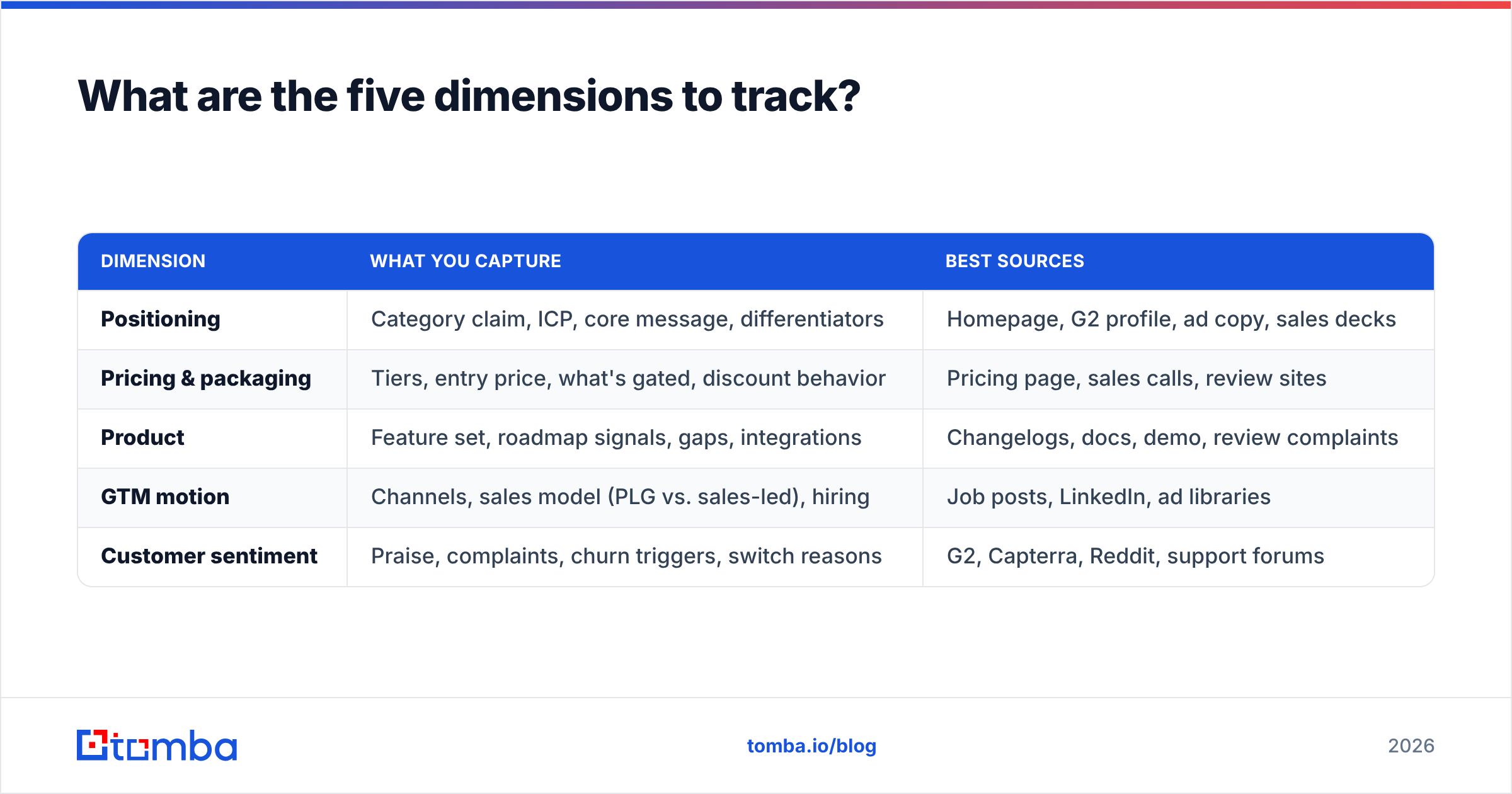
A useful competitor profile covers five dimensions. Track them consistently so profiles are comparable side by side.
| Dimension | What you capture | Best sources |
|---|---|---|
| Positioning | Category claim, ICP, core message, differentiators | Homepage, G2 profile, ad copy, sales decks |
| Pricing & packaging | Tiers, entry price, what's gated, discount behavior | Pricing page, sales calls, review sites |
| Product | Feature set, roadmap signals, gaps, integrations | Changelogs, docs, demo, review complaints |
| GTM motion | Channels, sales model (PLG vs. sales-led), hiring | Job posts, LinkedIn, ad libraries |
| Customer sentiment | Praise, complaints, churn triggers, switch reasons | G2, Capterra, Reddit, support forums |
The mistake teams make is capturing dimension one (positioning) beautifully and ignoring the other four. Positioning is what a competitor says; the other four are what they do. Deals are lost in the gap between the two — and that gap is exactly where your traps and objection handling live.
How do you run a competitor analysis in 2026? A 6-step framework#
Here is the repeatable loop. Run the full version quarterly and a lightweight refresh monthly.
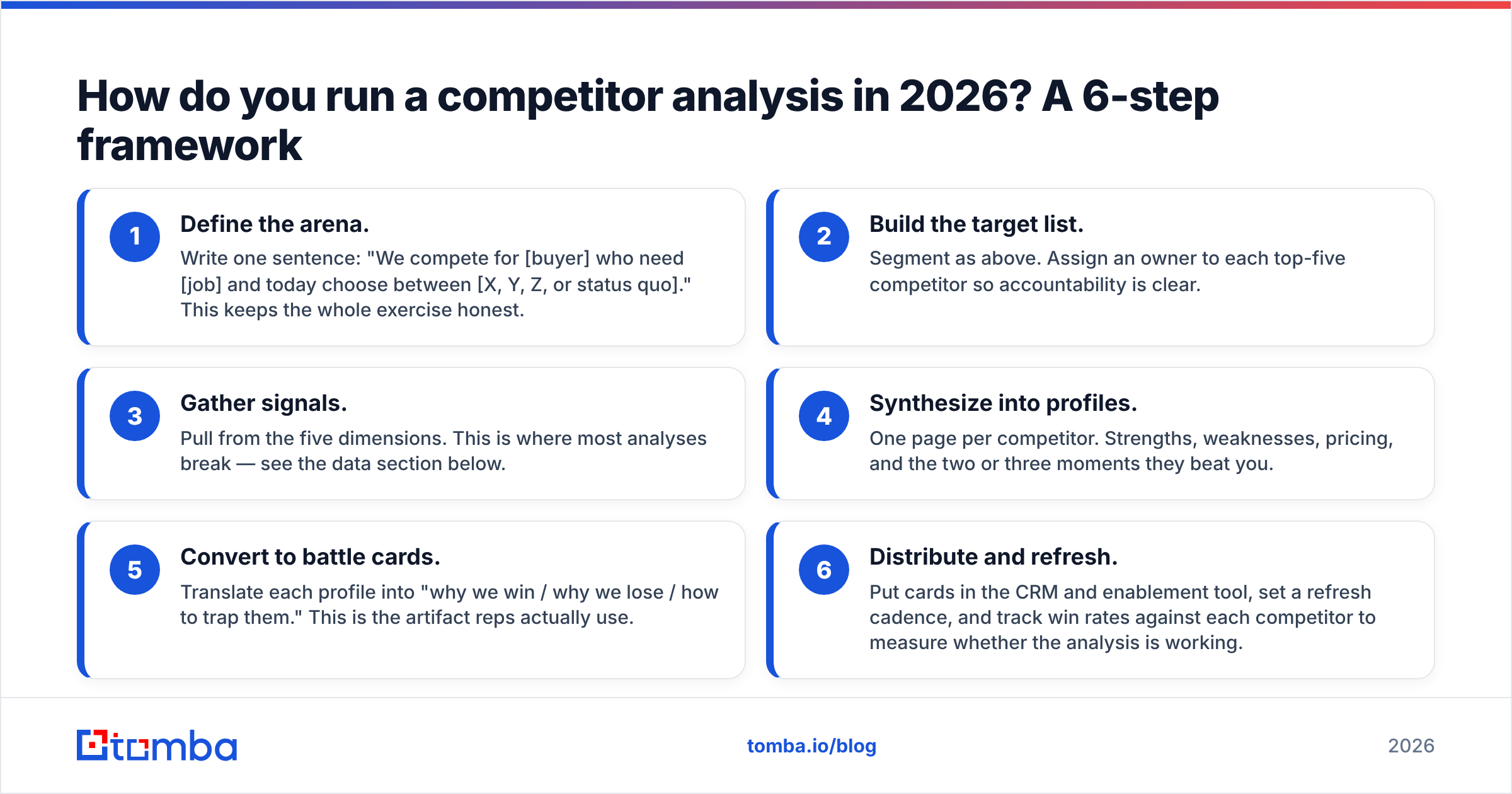
- Define the arena. Write one sentence: "We compete for [buyer] who need [job] and today choose between [X, Y, Z, or status quo]." This keeps the whole exercise honest.
- Build the target list. Segment as above. Assign an owner to each top-five competitor so accountability is clear.
- Gather signals. Pull from the five dimensions. This is where most analyses break — see the data section below.
- Synthesize into profiles. One page per competitor. Strengths, weaknesses, pricing, and the two or three moments they beat you.
- Convert to battle cards. Translate each profile into "why we win / why we lose / how to trap them." This is the artifact reps actually use.
- Distribute and refresh. Put cards in the CRM and enablement tool, set a refresh cadence, and track win rates against each competitor to measure whether the analysis is working.
Your win rate against a named competitor is the real scoreboard. If it doesn't move after you ship battle cards, your cards are wrong — not the framework.
What goes on a sales battle card?#
A battle card is a one-page answer to "I'm in a deal against [Competitor] — what do I do?" Keep it ruthlessly short. If a rep can't scan it in 30 seconds mid-call, it's a report, not a card.
A strong battle card has six sections:
- One-line positioning of the competitor (how they pitch themselves).
- Why we win — three to four proof-backed advantages, not adjectives.
- Why we lose — be honest; hidden weaknesses get reps blindsided.
- Landmines to set — questions that expose the competitor's weak spots ("Ask how their catch-all verification handles role accounts.").
- Objection handling — the two or three lines the competitor's reps use against you, and your rebuttals.
- Proof — a customer who switched, a benchmark, a G2 comparison link.
The best-known public framework for this comes from competitive-intelligence platforms like Klue and the community at Crayon; both publish solid templates worth borrowing before you reinvent one.
Why does data quality make or break competitor analysis?#
Because a competitor analysis is only as good as the signals feeding it — and most of those signals are people, companies, and contact data you have to source and verify.
Consider what you actually need to gather: who leads the competitor's sales team, which companies are hiring for roles that signal a new GTM motion, which of your churned accounts went to whom, and how to reach the decision-makers at accounts a competitor is targeting. That's not a Google search; that's a data pipeline.
This is where enrichment earns its keep. When you enrich an account list, you convert a flat list of company names into a live map: headcount trends, tech stack, hiring signals, and verified contacts. A tool like Tomba's data enrichment turns "we think Competitor X is moving upmarket" into "Competitor X posted six enterprise AE roles and three of our lost deals list them as the winner."
A few concrete plays where reliable data changes the analysis:
- Reverse-engineer their ICP. Use domain search to map which companies a competitor publicly references, then look for firmographic patterns.
- Reach switchers and champions. When a prospect is evaluating you against a rival, an accurate email finder gets you to the economic buyer instead of the gatekeeper who fields the competitor's demo.
- Keep your intel list clean. Stale contacts wreck outreach; running lists through an email verifier protects both your data and your sender reputation.
Guesswork feels faster. It isn't — it just moves the cost downstream to lost deals.
How does Tomba compare to other data sources for competitive intel?#
You have three broad options for sourcing the contact and firmographic layer of competitor analysis. Here's an honest comparison.
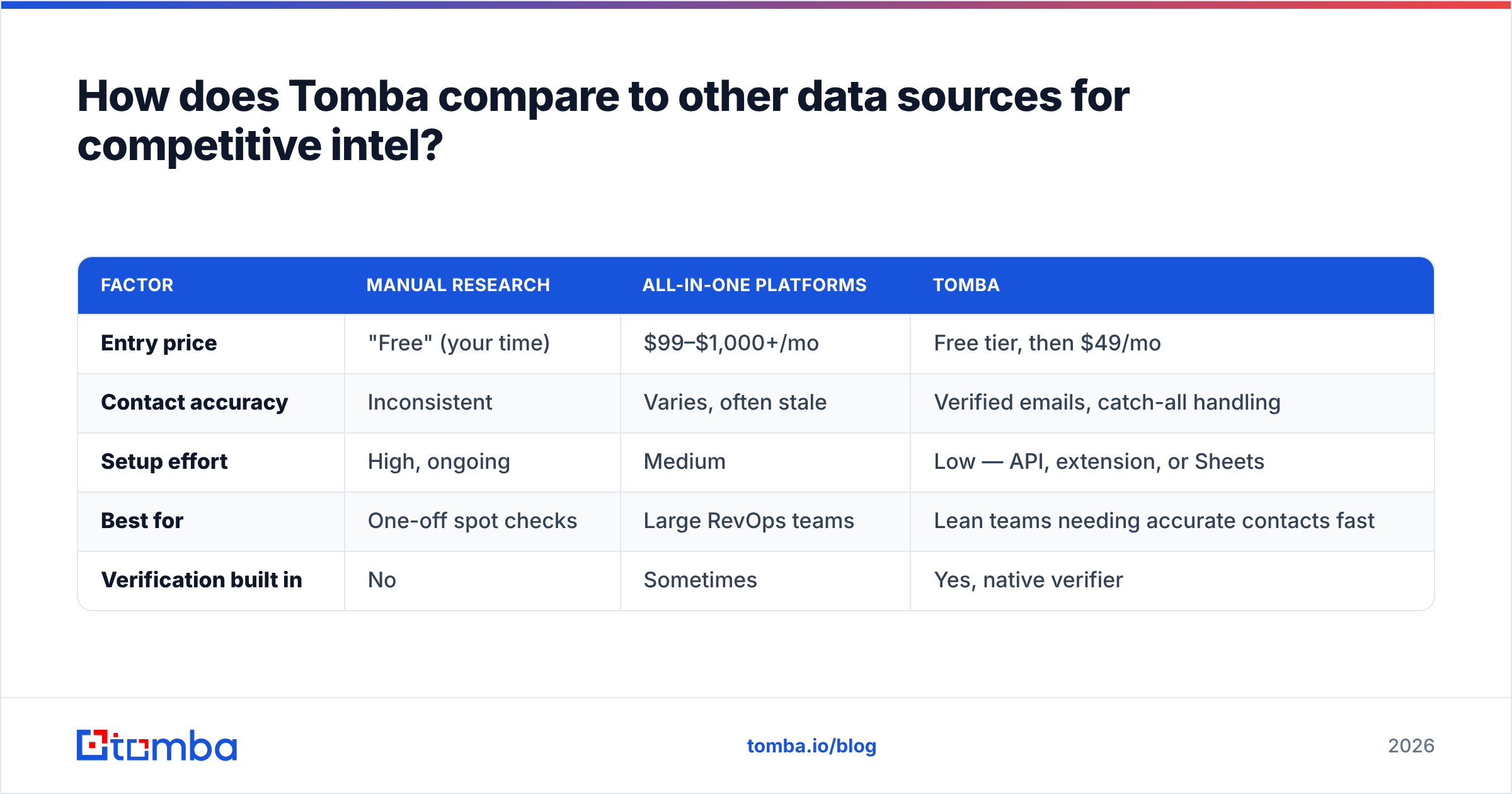
| Factor | Manual research | All-in-one platforms | Tomba |
|---|---|---|---|
| Entry price | "Free" (your time) | $99–$1,000+/mo | Free tier, then $49/mo |
| Contact accuracy | Inconsistent | Varies, often stale | Verified emails, catch-all handling |
| Setup effort | High, ongoing | Medium | Low — API, extension, or Sheets |
| Best for | One-off spot checks | Large RevOps teams | Lean teams needing accurate contacts fast |
| Verification built in | No | Sometimes | Yes, native verifier |
No single tool does everything. Dedicated competitive-intelligence platforms (Klue, Crayon) are excellent at aggregating win/loss and news signals; they are not contact-data providers. A verified data layer like Tomba fills the gap they leave — the people and company data underneath the narrative. Many teams run both. You can compare full Tomba pricing against whatever CI platform you already use and slot it in as the data source, not a replacement.
If you're weighing broader all-in-one prospecting suites, it's worth reading how a focused Apollo alternative approaches accuracy versus a database-first model — the same trade-offs apply to competitive intel sourcing.
What are the most common competitor analysis mistakes?#
- Building it once. A stale analysis is worse than none because it breeds false confidence. Set a refresh cadence and stick to it.
- Feature-listing instead of positioning. A 60-row feature grid tells reps nothing about why a buyer chooses. Lead with the buyer's job, not your spec sheet.
- Only studying who you fear. Your biggest competitor is often "do nothing." Analyze the status quo like a real vendor.
- Ignoring customer sentiment. Review sites and Reddit threads are the cheapest churn-signal source you have. Mine them.
- Hoarding the intel. If it lives in one analyst's Notion, it doesn't exist. Push cards into the CRM and enablement flow.
- No feedback loop. Track win rate by competitor. If cards don't move the number, iterate the cards.
How often should you refresh competitor analysis?#
Match cadence to volatility. In fast-moving categories — AI tooling, GTM software — a quarterly deep refresh plus a monthly signal sweep is the baseline. In slower, regulated markets, twice a year for the deep pass may be enough.
Trigger an off-cycle refresh whenever a competitor does something structural: a funding round, a pricing overhaul, a major launch, or a wave of hiring in a new function. Those hiring waves are visible early if you're watching job boards and enriching the companies behind them — which is exactly why a live data layer beats a static slide deck.
Turn your competitor analysis into pipeline#
The teams that win in 2026 don't have better opinions about competitors — they have better data, refreshed more often, delivered to reps at the moment of the deal. Framework and battle cards give you the structure; verified contact and company data give you the fuel.
If your competitive intel keeps stalling on "we're not sure who the real buyer is" or "half these contacts bounced," start there. The Tomba Email Finder gets you accurate, verified contacts by name, company, or domain — so your analysis reaches decision-makers instead of dead inboxes. Start free with 25 searches a month, map your top five competitors' accounts, and put the intel where it actually changes deals. Guesswork is expensive; verified data is a rounding error by comparison.
Related guides#
Ready to find emails that actually work?
Join 150,000+ professionals who stopped guessing and started sending. Free credits on signup — no credit card required.
Get the Tomba newsletter
Practical outbound tactics and product updates — once every two weeks.
About the author