The Competitor Battlecard Template That Actually Wins Deals
A competitor battlecard template turns scattered intel into a one-page cheat sheet your reps actually use on live calls. Here's the exact structure, plus a copy-ready layout for 2026.
Your rep is on a discovery call. The prospect says, "We're also looking at [Competitor]." There's a three-second pause. That pause is where deals are won or lost — and a good competitor battlecard template is what fills it with a confident, specific answer instead of an awkward "let me get back to you."
Battlecards are not a slide deck nobody opens. Done right, they're a one-page tactical reference reps glance at mid-call to reframe the conversation and neutralize a rival. This guide gives you the exact structure, a copy-ready template, and the workflow to keep it from going stale.
TL;DR#
- A competitor battlecard template is a one-page, scannable reference that arms reps with positioning, objection handling, and trap-setting questions against a specific competitor.
- The best cards are short, current, and organized for the moment of use — not exhaustive research dumps.
- Core sections: competitor snapshot, why-we-win, why-we-lose, landmines, objection rebuttals, and pricing traps.
- Build one card per major competitor, keep it under a page, and review it every quarter (or after any pricing/product change).
- Battlecards only work when the underlying prospect and competitor data is accurate — that's the difference between a rehearsed answer and a wrong one.
What is a competitor battlecard?#
A competitor battlecard is a condensed, sales-ready document that tells a rep exactly how to position your product against one named competitor during an active deal. Think of it like a boxer's corner between rounds: the coach doesn't recite the entire training manual — they give three crisp instructions that matter right now.
That's the whole point. A battlecard is not competitive intelligence for its own sake. It's the applied layer — the part a rep can absorb in ten seconds and act on before the prospect finishes their sentence.
Companies that run structured competitive enablement see it show up in win rates. According to Gartner and sales-enablement research from vendors like Gong, reps who can name a differentiator and immediately tie it to a buyer pain close competitive deals at a meaningfully higher clip than reps improvising from memory.
What goes into a competitor battlecard template?#
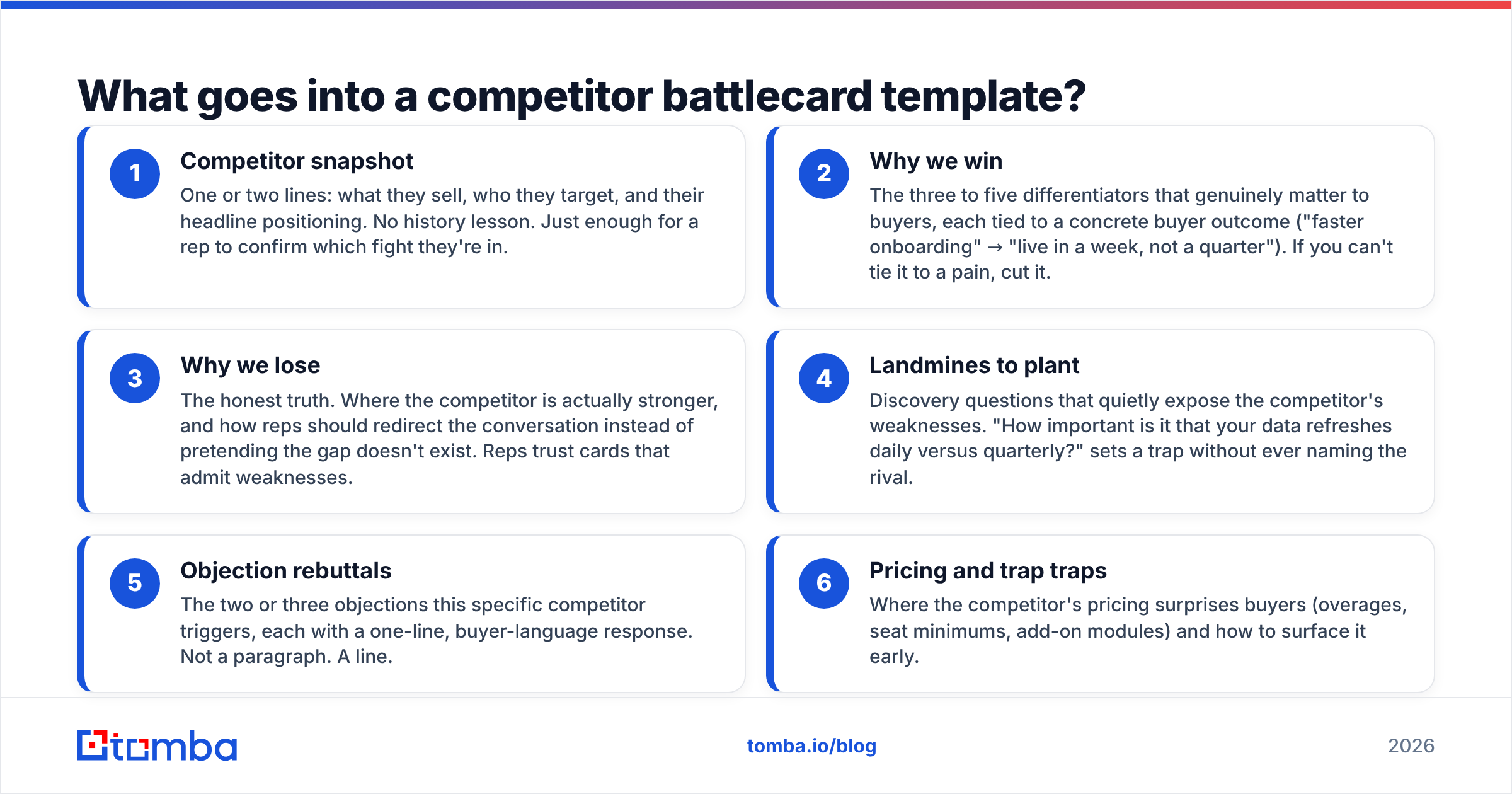
The strongest templates are built around the sequence a rep needs mid-conversation, not around internal org charts. Here are the six sections that earn their place on the page:
- Competitor snapshot — One or two lines: what they sell, who they target, and their headline positioning. No history lesson. Just enough for a rep to confirm which fight they're in.
- Why we win — The three to five differentiators that genuinely matter to buyers, each tied to a concrete buyer outcome ("faster onboarding" → "live in a week, not a quarter"). If you can't tie it to a pain, cut it.
- Why we lose — The honest truth. Where the competitor is actually stronger, and how reps should redirect the conversation instead of pretending the gap doesn't exist. Reps trust cards that admit weaknesses.
- Landmines to plant — Discovery questions that quietly expose the competitor's weaknesses. "How important is it that your data refreshes daily versus quarterly?" sets a trap without ever naming the rival.
- Objection rebuttals — The two or three objections this specific competitor triggers, each with a one-line, buyer-language response. Not a paragraph. A line.
- Pricing and trap traps — Where the competitor's pricing surprises buyers (overages, seat minimums, add-on modules) and how to surface it early.
Keep every section skimmable. If a rep has to read your battlecard, it's already too long.
What does a competitor battlecard template look like?#
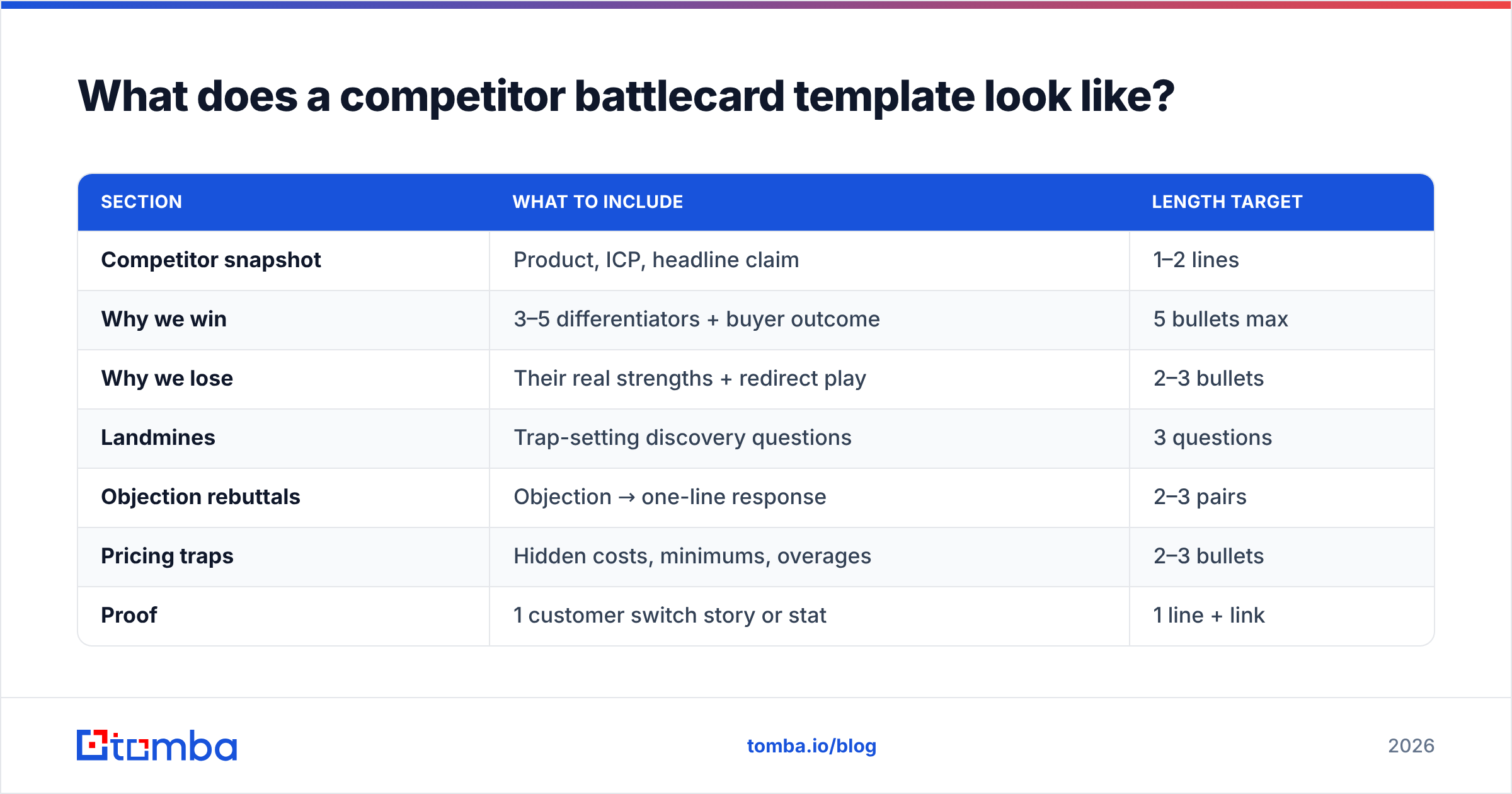
Here's a compact layout you can lift directly into Notion, a Google Doc, or your CRM. Fill one out per competitor.
| Section | What to include | Length target |
|---|---|---|
| Competitor snapshot | Product, ICP, headline claim | 1–2 lines |
| Why we win | 3–5 differentiators + buyer outcome | 5 bullets max |
| Why we lose | Their real strengths + redirect play | 2–3 bullets |
| Landmines | Trap-setting discovery questions | 3 questions |
| Objection rebuttals | Objection → one-line response | 2–3 pairs |
| Pricing traps | Hidden costs, minimums, overages | 2–3 bullets |
| Proof | 1 customer switch story or stat | 1 line + link |
The "Proof" row matters more than teams expect. A single verifiable stat or named switch story ("Acme moved off [Competitor] and cut prospecting time 40%") gives a rep a credibility anchor that a bare feature claim never will.
How is a battlecard different from a competitive analysis?#
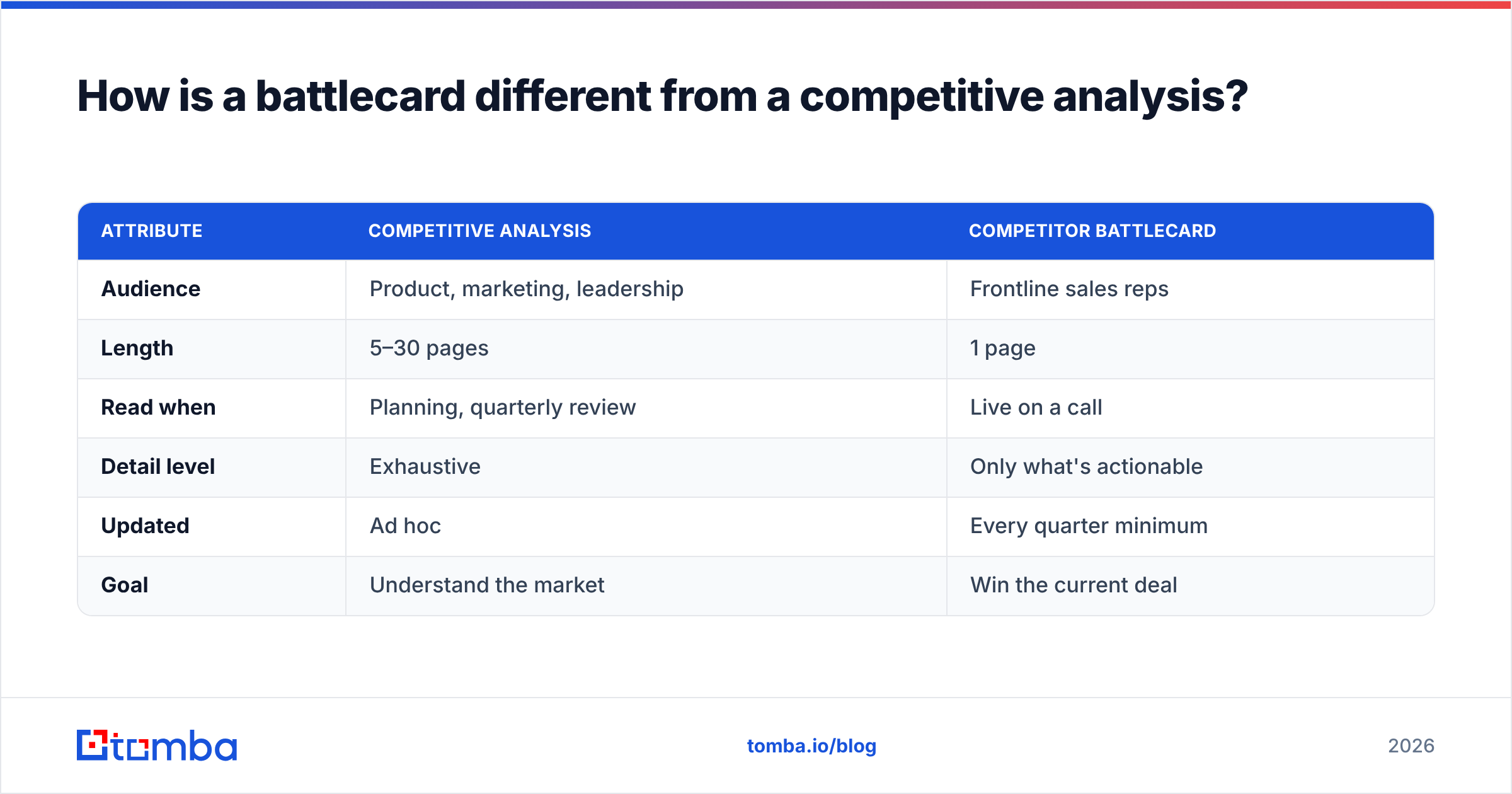
They're related but built for opposite audiences, and confusing the two is why so many battlecards fail. A competitive analysis is deep, internal, and read at a desk. A battlecard is shallow-by-design, external-facing, and read mid-call. One informs strategy; the other wins the next twenty minutes.
| Attribute | Competitive analysis | Competitor battlecard |
|---|---|---|
| Audience | Product, marketing, leadership | Frontline sales reps |
| Length | 5–30 pages | 1 page |
| Read when | Planning, quarterly review | Live on a call |
| Detail level | Exhaustive | Only what's actionable |
| Updated | Ad hoc | Every quarter minimum |
| Goal | Understand the market | Win the current deal |
If you only build one, build the battlecard. You can win deals without a 20-page analysis. You cannot win them with a document no rep opens.
What are the different types of battlecards?#
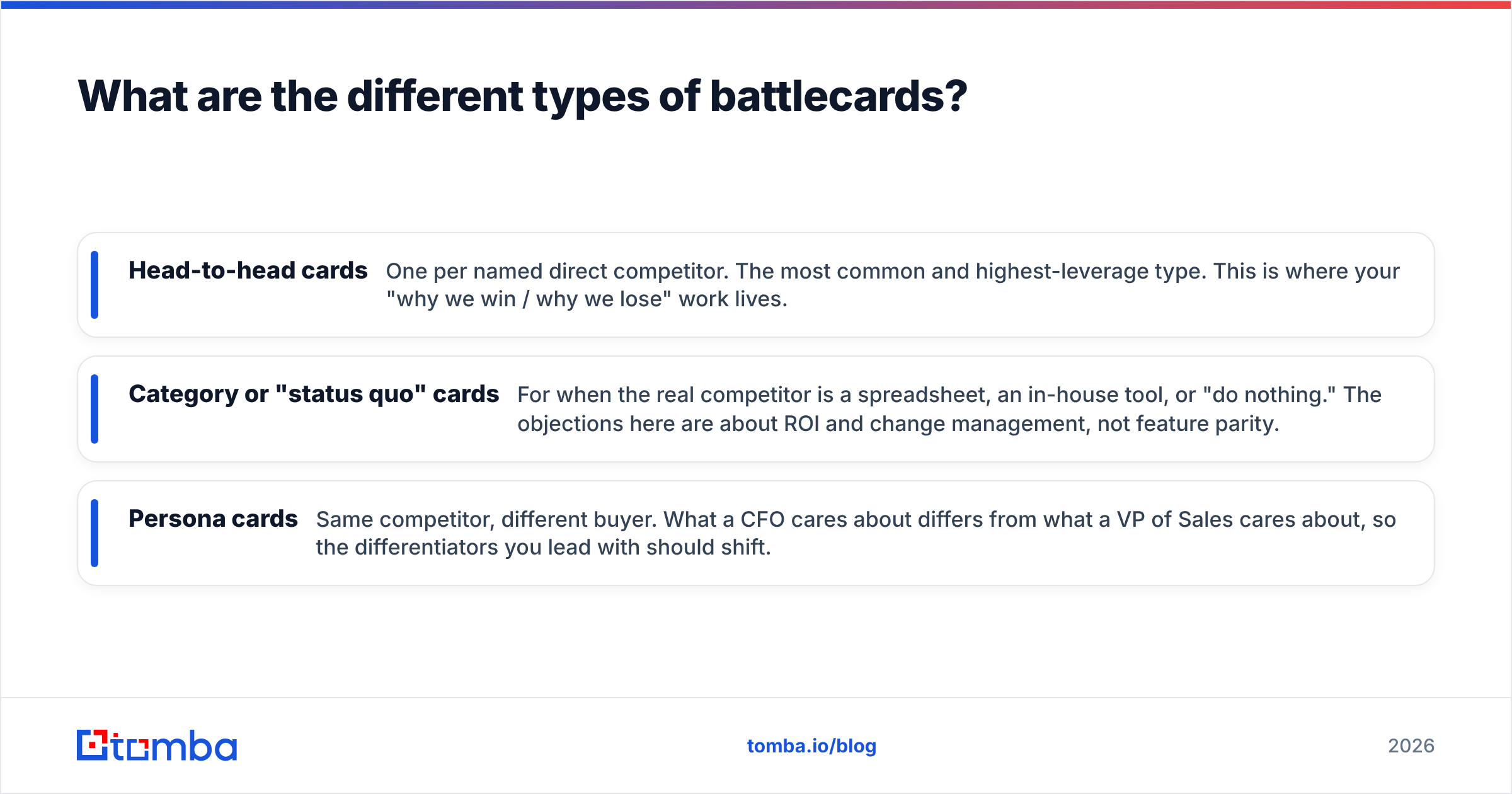
Not every competitive situation is the same, so a single template rarely covers everything. Most enablement teams maintain three variants:
- Head-to-head cards — One per named direct competitor. The most common and highest-leverage type. This is where your "why we win / why we lose" work lives.
- Category or "status quo" cards — For when the real competitor is a spreadsheet, an in-house tool, or "do nothing." The objections here are about ROI and change management, not feature parity.
- Persona cards — Same competitor, different buyer. What a CFO cares about differs from what a VP of Sales cares about, so the differentiators you lead with should shift.
A common mistake is writing one giant card that tries to serve all three. Split them. A rep selling to a CFO against a specific rival should not have to mentally filter out three paragraphs meant for a technical evaluator.

How do you build a battlecard reps actually use?#
The difference between a battlecard that lives on a call and one that dies in a shared drive comes down to a few disciplined habits.
Start from the deals, not the features. Pull your last ten losses against a competitor and read the closed-lost notes. The objections that actually killed those deals are your rebuttal section. Everything else is noise.
Interview your winning reps. The best competitive language is already being spoken by your top two or three reps — it's just not written down. Sit in on their calls or record them (with consent) and steal the exact phrasing that works.
Write in buyer language, not marketing language. "Best-in-class data coverage" is a slogan. "Our data refreshes daily, theirs quarterly — so your reps aren't emailing people who left six months ago" is a battlecard line.
Make it one page, period. If a section doesn't change what a rep says or does on the next call, delete it. Constraint is the feature.
Put it where reps already are. A card buried in a wiki loses to one that pops up inside the CRM or the dialer. If you use HubSpot, their playbooks feature surfaces cards inside the record. The best card in the world is worthless if it's three clicks away during a live call.
Where does accurate data fit into all this?#
Here's the part most battlecard guides skip: a battlecard is only as good as the data behind it — both the competitive intel and the prospect data that gets reps into the conversation in the first place.
Two failure modes waste great battlecards:
- Stale competitor intel. A pricing trap that was true last year but the competitor has since fixed makes your rep look uninformed. This is why the update cadence below matters.
- Bad prospect data upstream. You can't deploy a battlecard against a decision-maker you never reached. If your reps are emailing generic info@ addresses or contacts who left the company, the card never gets a chance to fire.
That second point is why competitive enablement and prospecting data are joined at the hip. Before a rep can position against a rival, they need to reach the right person with a valid, current email. A reliable email finder gets verified contacts for the actual buyers on an account, and data enrichment fills in the role, seniority, and company signals that tell a rep which battlecard persona they're even talking to. Running a domain search on a target account surfaces the full buying committee, so your battlecard isn't wasted on a single junior contact with no authority.
Put simply: battlecards win the conversation, but accurate contact data is what starts it.
How often should you update battlecards?#
Quarterly is the baseline. But treat these as immediate triggers regardless of the calendar:
- The competitor changes pricing or packaging.
- They ship or sunset a major feature.
- You lose two or more deals to the same new objection.
- A public G2 or Capterra review pattern shifts — reviews are a free, continuous feed of what buyers actually think.
Assign an owner. Battlecards without a named owner rot within a quarter, because "everyone's job" reliably becomes no one's. Product marketing usually owns the content; sales enablement owns adoption. When a card updates, announce it in the same channel reps live in — a silent edit to a doc nobody's watching changes nothing.
A lightweight rhythm that works: a 30-minute monthly review of win/loss notes, a quarterly rewrite, and an instant hotfix whenever a trigger above fires. That's it. Over-engineering the process is another way battlecards die.
What mistakes should you avoid?#
- Too long. The single most common failure. If it's over one page, reps won't use it live.
- All offense, no honesty. Cards that pretend you win everywhere destroy rep trust. The "why we lose" section is what makes reps believe the rest.
- Set and forget. An 18-month-old card is worse than none, because it's confidently wrong.
- Feature-dumping. Reps don't sell features; they sell outcomes. Translate every spec into a buyer consequence.
- No proof. A claim without a stat or story is just your opinion versus the competitor's.
Avoid those five and you're already ahead of most competitive programs.
Build the data foundation your battlecards stand on#
A polished competitor battlecard template is a force multiplier — but only when it fires against the right buyer, on a real conversation, backed by current data. That starts long before the objection-handling section: it starts with reaching the actual decision-maker.
Tomba's Email Finder gets your reps verified, current email addresses for the exact people your battlecards are written to win over, and the enrichment layer tells them which card to reach for. Start on the free tier (25 searches a month), or scale up as your pipeline grows — see full Tomba pricing for the Starter ($49/mo) and Growth ($99/mo) plans. Get the contact right, and your battlecard does the rest.
Related guides#
Ready to find emails that actually work?
Join 150,000+ professionals who stopped guessing and started sending. Free credits on signup — no credit card required.
Get the Tomba newsletter
Practical outbound tactics and product updates — once every two weeks.
About the author