Complex Sales Force Structure: How to Design One That Scales
A practical 2026 guide to designing a complex sales force structure that scales — models, trade-offs, a comparison table, and the data layer that keeps it from breaking.

TL;DR
- A complex sales force structure splits selling into specialized roles, segments, and territories so no single rep owns the entire deal — done right it lifts win rates, done wrong it buries revenue in handoffs.
- The four workhorse models are geographic, product, market-segment, and role-based (the "pod"). Most scaling teams end up with a hybrid.
- Complexity only pays off when routing rules, clean account data, and clear ownership are in place first. Structure without data is just a bigger org chart.
- Use the comparison table below to match a model to your motion, deal size, and headcount before you reorganize anyone.
- The hidden tax on every complex structure is data hygiene at the handoff. Feed each role verified contacts with a tool like the Tomba Email Finder so specialization speeds deals up instead of dropping them.
What is a complex sales force structure?#
A complex sales force structure is any go-to-market org where selling is divided across multiple specialized roles, segments, or territories instead of a single rep carrying a deal from cold outreach to signed contract.
Think of it like a hospital. A small clinic has one doctor who does everything — that is your early-stage generalist rep. A large hospital has triage nurses, specialists, surgeons, and discharge coordinators, each excellent at one stage and handing the patient forward. The complex sales force works the same way: an SDR triages, an account executive operates, a solutions engineer handles the technical surgery, and a customer success manager manages recovery and expansion.
The payoff is depth. Specialists close more of what they touch. The risk is the handoff — every boundary between roles is a place where context, data, and momentum can leak. That trade-off is the entire design problem.
When do you actually need one?#
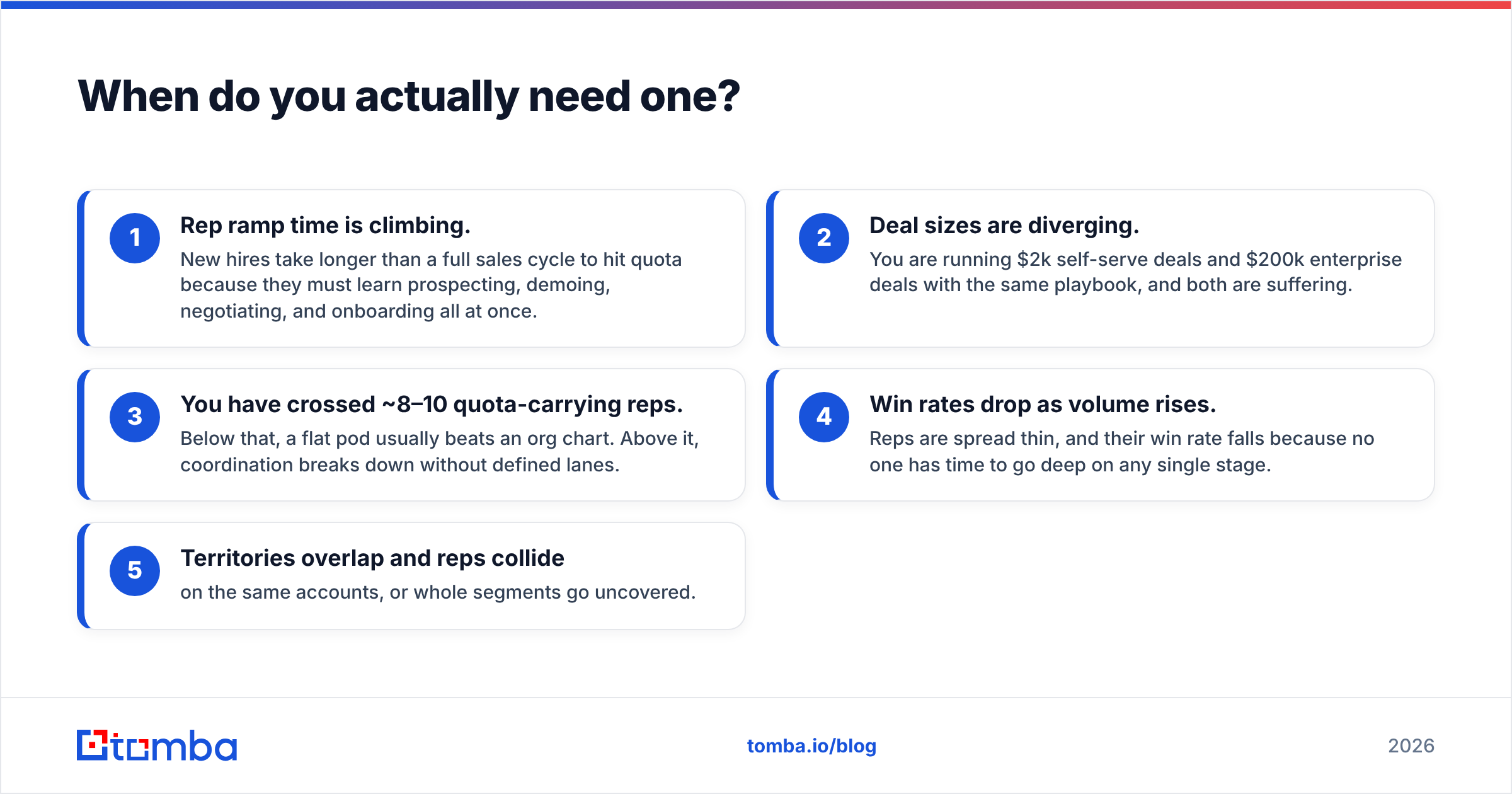
You need a more complex structure when the cost of a rep context-switching exceeds the cost of a handoff. Concrete triggers:
- Rep ramp time is climbing. New hires take longer than a full sales cycle to hit quota because they must learn prospecting, demoing, negotiating, and onboarding all at once.
- Deal sizes are diverging. You are running $2k self-serve deals and $200k enterprise deals with the same playbook, and both are suffering.
- You have crossed ~8–10 quota-carrying reps. Below that, a flat pod usually beats an org chart. Above it, coordination breaks down without defined lanes.
- Win rates drop as volume rises. Reps are spread thin, and their win rate falls because no one has time to go deep on any single stage.
- Territories overlap and reps collide on the same accounts, or whole segments go uncovered.
If none of these are true, do not add structure. Complexity you do not need is pure overhead — more managers, more meetings, more places for a deal to stall.
What are the main sales force structure models?#
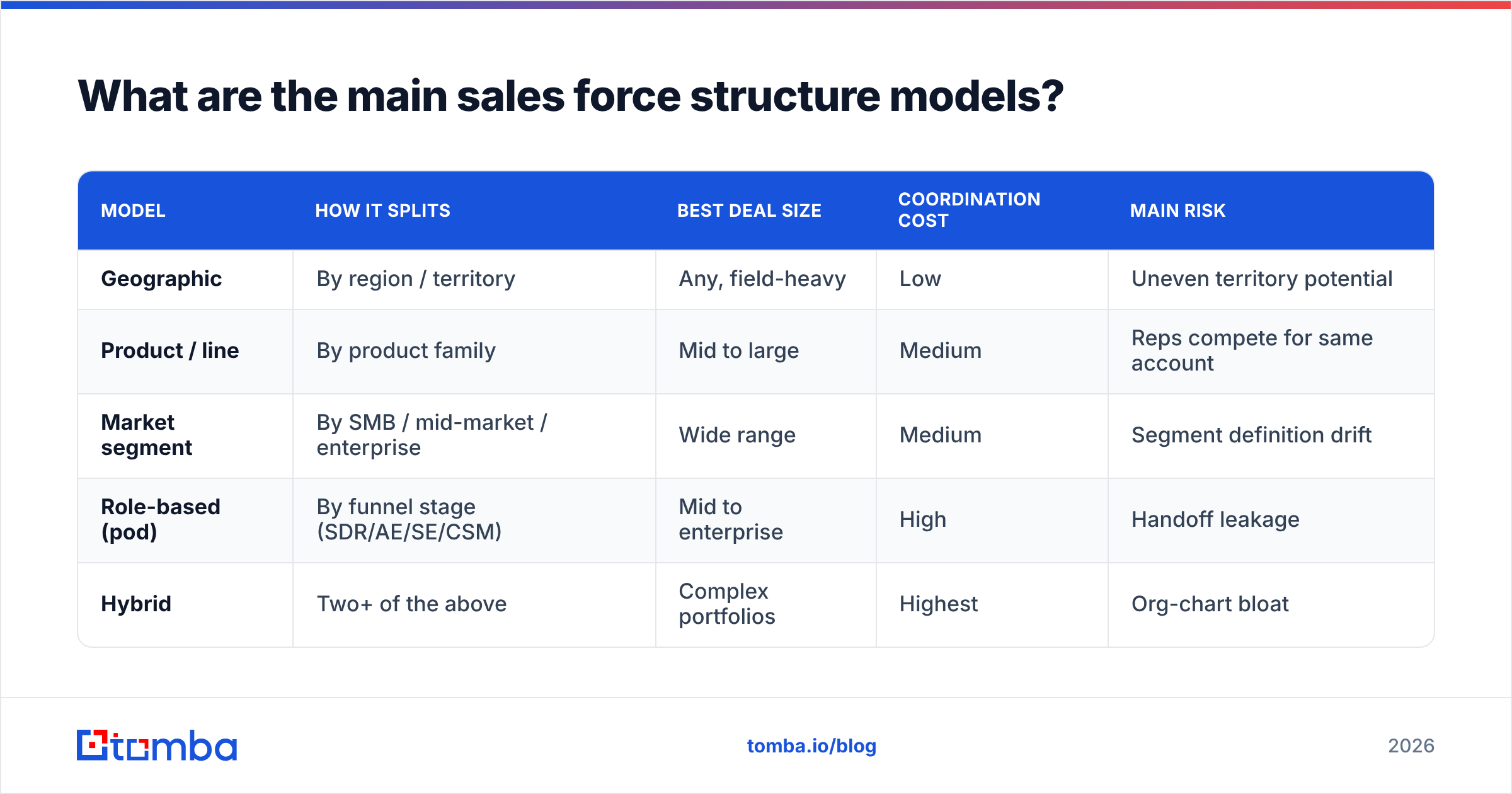
There are four canonical models, and almost every real org is a hybrid of two or three. Here is how they compare on the dimensions that actually decide the choice.
| Model | How it splits | Best deal size | Coordination cost | Main risk |
|---|---|---|---|---|
| Geographic | By region / territory | Any, field-heavy | Low | Uneven territory potential |
| Product / line | By product family | Mid to large | Medium | Reps compete for same account |
| Market segment | By SMB / mid-market / enterprise | Wide range | Medium | Segment definition drift |
| Role-based (pod) | By funnel stage (SDR/AE/SE/CSM) | Mid to enterprise | High | Handoff leakage |
| Hybrid | Two+ of the above | Complex portfolios | Highest | Org-chart bloat |
A few notes that the table can't hold:
- Geographic is the oldest model and still dominates field sales, because travel and local relationships are real constraints. Its weakness is that a rep in a dense metro and a rep covering three rural states carry wildly different opportunity.
- Product-based structures let reps master deep, technical catalogs — but two reps calling the same buyer about two products is a fast way to annoy a customer. It needs strict account rules.
- Market-segment is the most common scaling choice because buying behavior genuinely differs by company size. SMB wants speed; enterprise wants security reviews and procurement.
- Role-based pods produce the highest specialization and the highest coordination cost. This is the structure people usually mean by "complex."
How does the role-based pod work in practice?#
A pod is a small, cross-functional unit that owns a segment or territory end to end, with each member specialized by funnel stage. A typical B2B pod:
- SDR / BDR — sources and qualifies. Owns top-of-funnel prospecting and the first meeting. Lives or dies on contact data quality.
- Account Executive (AE) — runs discovery through close. Owns the pipeline and the number.
- Solutions Engineer (SE) — handles technical validation, security questions, and custom demos. Often shared across two or three pods.
- Customer Success Manager (CSM) — owns onboarding, retention, and expansion after the close.
The pod's advantage is that everyone shares the same accounts, so the "handoff" is more of a shoulder-tap than a cross-department transfer. The classic enterprise anti-pattern — SDRs in one building, AEs in another, CSMs reporting to a different VP — is what turns healthy specialization into a leaky relay race.
For a deeper look at how automation slots into these roles, the concept of sales automation covers the tooling layer that makes pods viable at scale.
What breaks when the structure gets complex?#
Three things break, and all three trace back to the same root cause: data does not travel cleanly across role boundaries.
1. The handoff drops context. When an SDR passes a lead to an AE, the AE often re-qualifies from scratch because notes are thin, the contact's email bounced, or the buying role was mislabeled. Every re-qualification is wasted cycle time.
2. Territories and segments collide. Without a single source of truth for "who owns this account," two reps work the same logo, or an account falls between an SMB and mid-market definition and nobody claims it. This is a data-ownership problem masquerading as an org problem.
3. Reporting lies. In a complex structure, a deal touches four people. If your attribution and pipeline data are messy, you cannot tell which role is the bottleneck — so you "fix" the wrong stage. Reliable revenue operations exists precisely to keep this honest.
Notice that none of these are solved by redrawing the org chart. They are solved by the data and routing layer underneath it.

What does a healthy complex structure need underneath it?#
A complex sales force structure is only as good as the data flowing through its handoffs. Before you specialize roles, get these four foundations in place.
- Clean, verified contact data at the top. If SDRs feed AEs bad emails and wrong titles, specialization just distributes the mess faster. Verifying contacts up front with an email verifier stops bounces from poisoning downstream stages.
- Deterministic routing rules. Every lead must have exactly one owner by a written rule — segment, geo, or round-robin — not by whoever grabs it first.
- Shared account records. One record per account, visible to the whole pod, so context survives the handoff instead of living in a rep's inbox.
- A refill engine for prospecting. Specialized SDRs burn through lists fast. A bulk email finder or domain search keeps the top of funnel stocked so specialists never idle.
Get these right and complexity compounds in your favor. Skip them and every new role you add is one more place for a deal to die.
How do you choose the right model?#
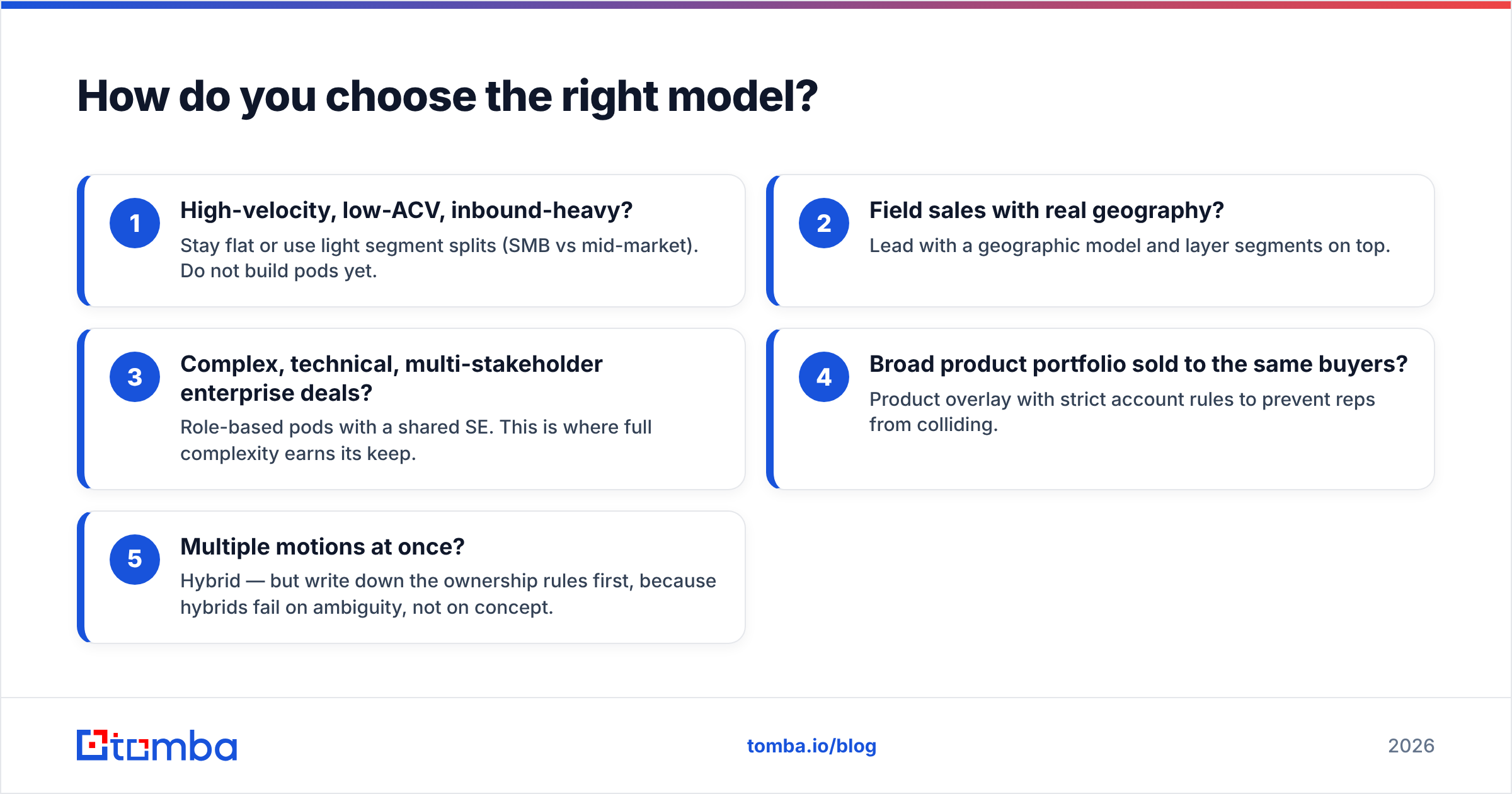
Match the structure to your motion, not to a competitor's org chart. A quick decision guide:
- High-velocity, low-ACV, inbound-heavy? Stay flat or use light segment splits (SMB vs mid-market). Do not build pods yet.
- Field sales with real geography? Lead with a geographic model and layer segments on top.
- Complex, technical, multi-stakeholder enterprise deals? Role-based pods with a shared SE. This is where full complexity earns its keep.
- Broad product portfolio sold to the same buyers? Product overlay with strict account rules to prevent reps from colliding.
- Multiple motions at once? Hybrid — but write down the ownership rules first, because hybrids fail on ambiguity, not on concept.
Whatever you pick, review it every two quarters. Structures ossify; markets don't. For an external framework on aligning structure with go-to-market strategy, HubSpot's sales org guidance and peer reviews on G2 are useful neutral references when you benchmark against how similar companies organize.
A worked example: scaling from flat to pods#
Say you run a 6-rep flat team, all generalists, at $30k average deals. Win rates are fine but ramp is 7 months and reps hate prospecting. You are hitting the "diverging deal size" and "climbing ramp" triggers.
The wrong move is to jump straight to four-role enterprise pods. The right move is staged:
- Stage 1: Peel prospecting into a dedicated SDR role. Reps stop context-switching; SDRs get sharp fast. Feed them verified data so AEs inherit clean pipeline.
- Stage 2: Split the AE team by segment once you cross ~10 reps — one line for velocity, one for larger, slower deals.
- Stage 3: Add a shared SE when technical deals start stalling in validation, and a CSM line when expansion revenue justifies it.
At each stage, the constraint is data, not headcount. Every new boundary you create is a new handoff, and every handoff needs verified contacts, a clear owner, and a shared record — or the structure you built to go faster will quietly slow you down.
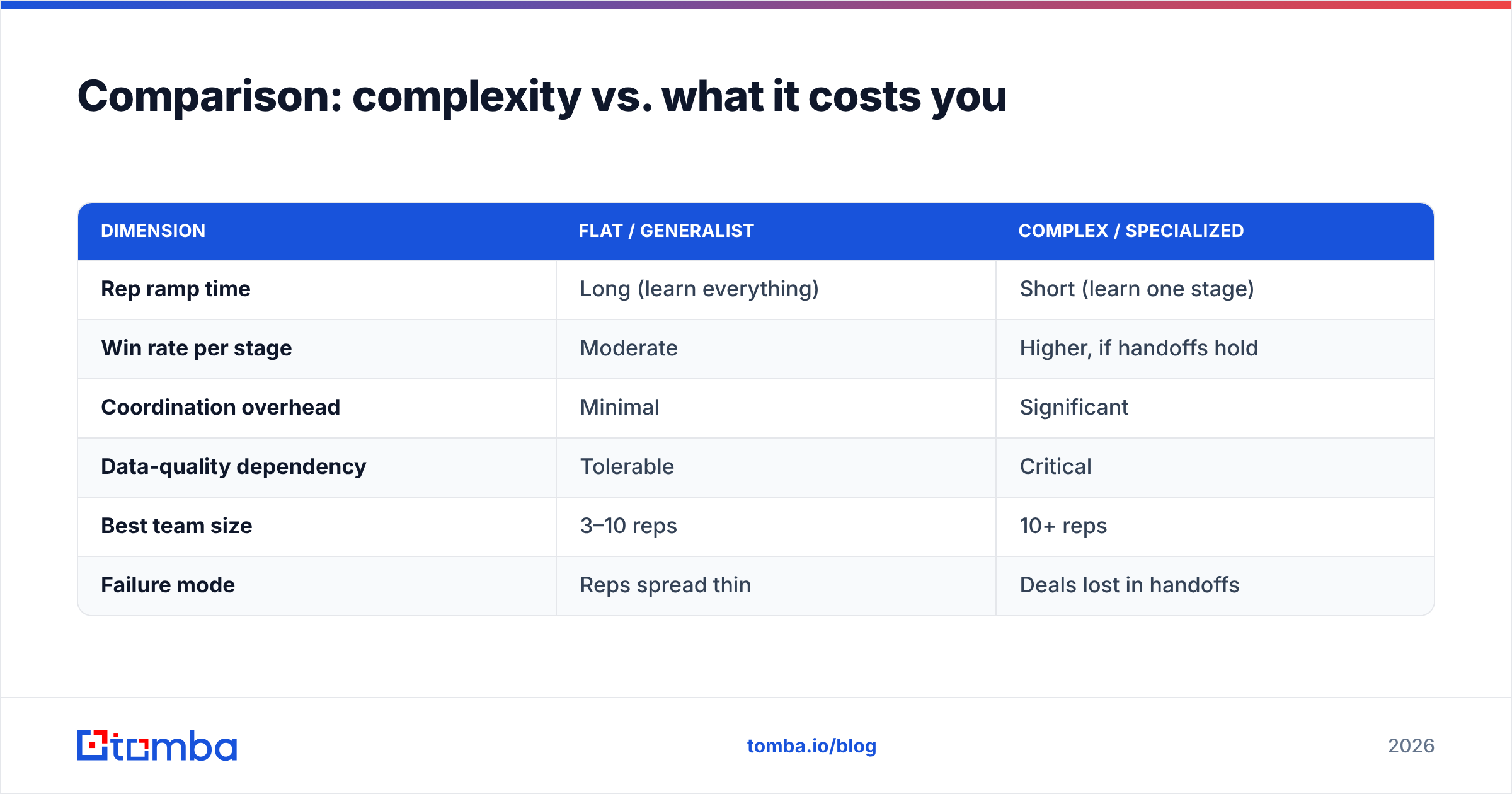
Comparison: complexity vs. what it costs you#
| Dimension | Flat / generalist | Complex / specialized |
|---|---|---|
| Rep ramp time | Long (learn everything) | Short (learn one stage) |
| Win rate per stage | Moderate | Higher, if handoffs hold |
| Coordination overhead | Minimal | Significant |
| Data-quality dependency | Tolerable | Critical |
| Best team size | 3–10 reps | 10+ reps |
| Failure mode | Reps spread thin | Deals lost in handoffs |
The table makes the core lesson concrete: complexity does not create performance, it concentrates it — and it concentrates your weaknesses just as fast as your strengths. A messy data layer that a flat team survives will sink a complex one.
The bottom line#
A complex sales force structure is a bet that specialization will outrun the cost of coordination. That bet only pays off when the plumbing underneath — verified contacts, deterministic routing, shared records — is solid. Structure is the visible half of the decision; data quality is the half that decides whether it works.
Before you reorganize a single rep, fix the layer every role depends on: the contact data flowing into the top of your funnel. Start your SDRs and AEs on clean, verified prospects with the Tomba Email Finder — find and confirm the right person at the right company by name, domain, or role, so every handoff in your new structure carries momentum instead of losing it. Check Tomba pricing to match a plan to your team size, from the free tier for a first pod to Growth and Pro as you scale the org chart.
Related guides#
Ready to find emails that actually work?
Join 150,000+ professionals who stopped guessing and started sending. Free credits on signup — no credit card required.
Get the Tomba newsletter
Practical outbound tactics and product updates — once every two weeks.
About the author