How to Build Real Confidence in Sales (Without Faking It)
Confidence in sales rarely comes from pep talks. It comes from preparation, process, and knowing your numbers. Here's how top reps build it — and keep it — in 2026.

Most advice about confidence in sales is useless. "Believe in yourself." "Fake it till you make it." "Walk in like you own the room." None of that survives contact with a prospect who asks a hard question you can't answer.
Real confidence in sales is not a mood. It's the byproduct of being prepared, following a process you trust, and knowing your own numbers well enough that no single call can rattle you. This guide breaks down what actually builds it, what quietly destroys it, and the specific habits top reps use to stay steady through a bad quarter.
TL;DR#
- Confidence in sales is earned, not summoned. It comes from preparation and repetition, not affirmations.
- The fastest confidence killer is bad data. Calling wrong contacts and bouncing emails makes even strong reps feel like frauds.
- Process beats personality. A repeatable pre-call routine removes the guesswork that fuels anxiety.
- Track leading indicators, not just closed deals. Activity you control builds durable confidence; outcomes you don't control destroy it.
- Competence and confidence compound. The reps who feel most sure are usually the ones who did the boring homework first.
What is confidence in sales, really?#
Confidence in sales is the calm belief that you can handle whatever the conversation throws at you — not the certainty that you'll win. That distinction matters. Reps who tie their confidence to outcomes ride a rollercoaster: a signed deal makes them invincible, a ghosted prospect makes them question their career. Reps who tie confidence to preparation and process stay level, because those things don't disappear when a deal slips.
Think of it like a pilot. A confident pilot isn't someone who "feels good" about the flight. It's someone who ran the pre-flight checklist, knows the aircraft, and has rehearsed the emergency procedures so many times that turbulence doesn't spike their heart rate. The calm is a result of the reps, not a personality trait they were born with.

That's the reframe most sellers miss. You don't need to become a more charismatic person. You need systems that make you competent, and competence is what your nervous system reads as safety.
Why do so many salespeople lack confidence?#
Because they're improvising. When you don't know who you're calling, whether the email is even valid, or what you'll say when they push back, your brain correctly flags the situation as risky — and floods you with anxiety. That's not weakness; it's your body responding accurately to being unprepared.
Here are the most common confidence killers, and what each one is really telling you:
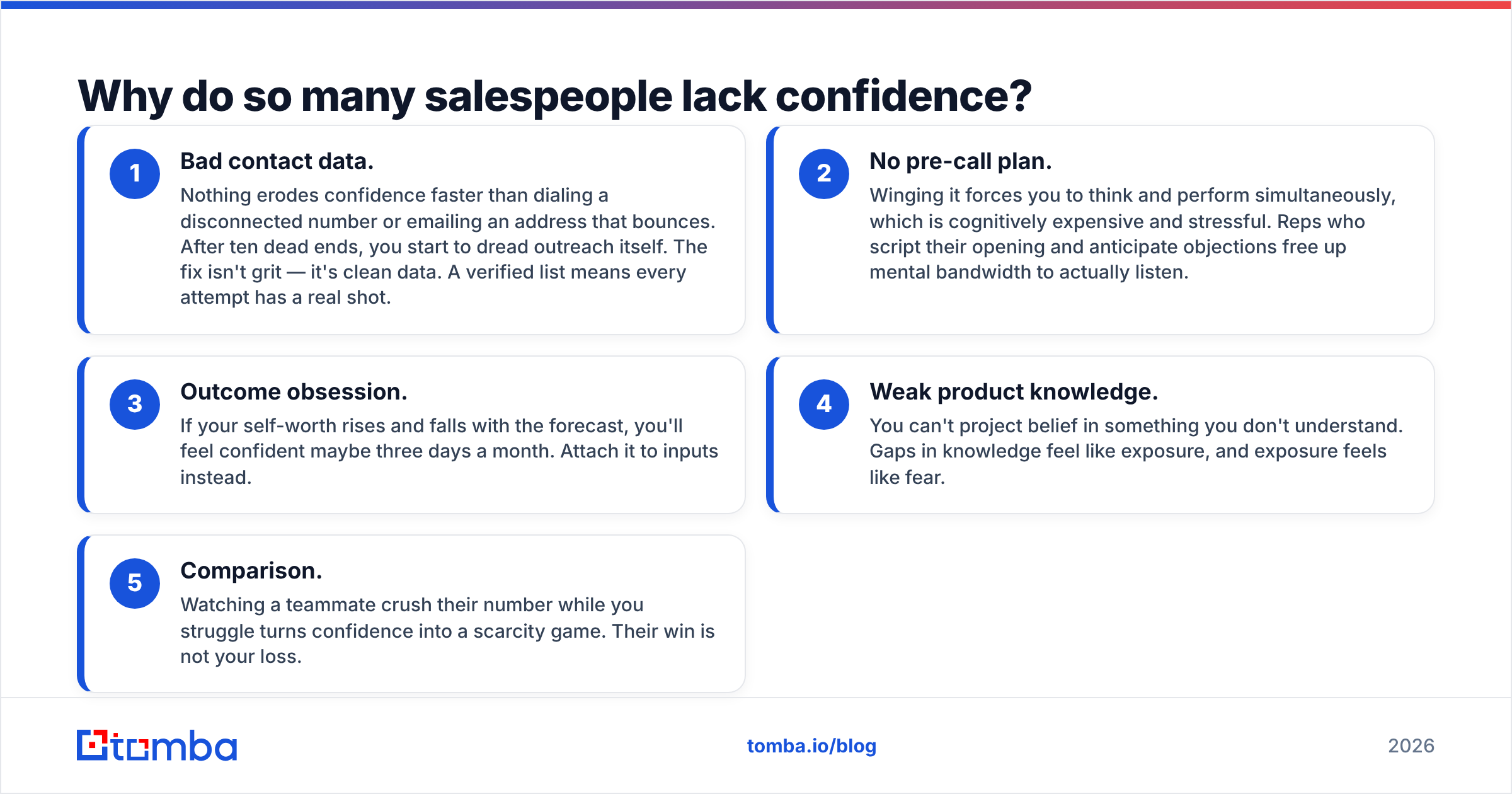
- Bad contact data. Nothing erodes confidence faster than dialing a disconnected number or emailing an address that bounces. After ten dead ends, you start to dread outreach itself. The fix isn't grit — it's clean data. A verified list means every attempt has a real shot.
- No pre-call plan. Winging it forces you to think and perform simultaneously, which is cognitively expensive and stressful. Reps who script their opening and anticipate objections free up mental bandwidth to actually listen.
- Outcome obsession. If your self-worth rises and falls with the forecast, you'll feel confident maybe three days a month. Attach it to inputs instead.
- Weak product knowledge. You can't project belief in something you don't understand. Gaps in knowledge feel like exposure, and exposure feels like fear.
- Comparison. Watching a teammate crush their number while you struggle turns confidence into a scarcity game. Their win is not your loss.
The pattern underneath all five: uncertainty. Remove the uncertainty and the confidence shows up on its own.
Does better data actually make you more confident?#
Yes, and it's the most underrated lever in the entire conversation. Confidence in sales is fragile when every touch is a coin flip. When you know the person you're contacting is the right decision-maker at the right company, and you know the email will land, you stop bracing for failure on every send.
Consider two reps working the same list. One is guessing at email formats and hoping. The other used an email finder to source verified addresses and ran them through an email verifier before the first send. By hour two, the guesser has a dozen bounces and a sinking feeling. The prepared rep has replies. Same effort, opposite emotional trajectory — and the difference was data quality, not talent.
This is why enablement leaders increasingly treat data hygiene as a confidence issue, not just an efficiency one. According to HubSpot's sales research, data decays fast — contacts change jobs, companies rebrand, inboxes get retired. A list that was accurate last quarter is quietly rotting right now. Reps working stale data don't just waste time; they slowly lose faith in the whole motion.
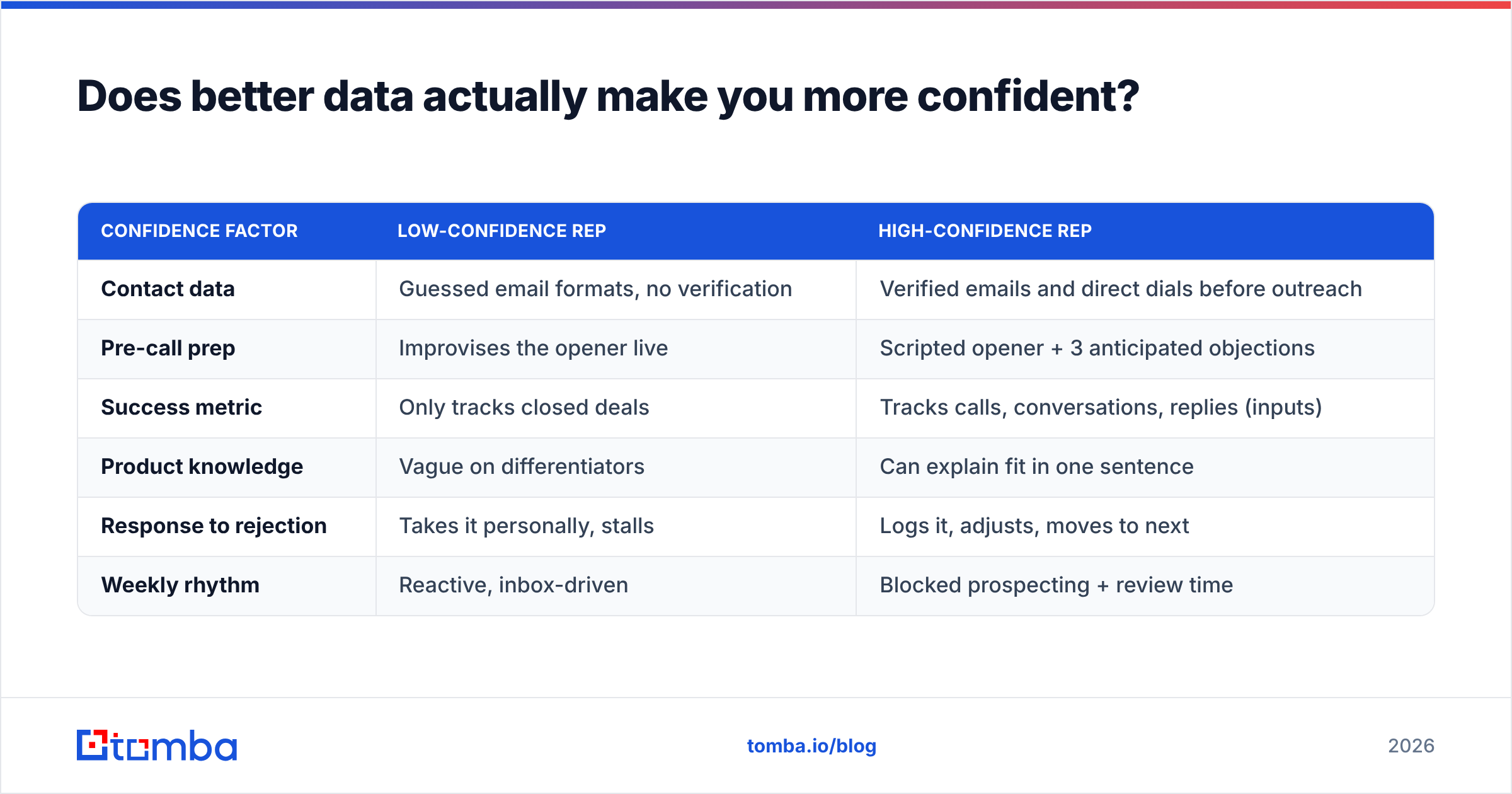
| Confidence factor | Low-confidence rep | High-confidence rep |
|---|---|---|
| Contact data | Guessed email formats, no verification | Verified emails and direct dials before outreach |
| Pre-call prep | Improvises the opener live | Scripted opener + 3 anticipated objections |
| Success metric | Only tracks closed deals | Tracks calls, conversations, replies (inputs) |
| Product knowledge | Vague on differentiators | Can explain fit in one sentence |
| Response to rejection | Takes it personally, stalls | Logs it, adjusts, moves to next |
| Weekly rhythm | Reactive, inbox-driven | Blocked prospecting + review time |
The right column isn't a different personality. It's a different setup.
What daily habits build confidence in sales?#
Confidence is built in the boring hours before the call, not in the call itself. These are the habits that reliably produce it:
- Run a pre-call checklist. Two minutes: Who is this person? What does their company do? What's my one-sentence reason for calling? What's the most likely objection? Answering these before you dial replaces dread with focus.
- Warm up with easy reps. Start your block with follow-ups to warm leads, not cold dials to your dream account. Momentum from small wins carries into harder calls.
- Rehearse objections out loud. The objections you fear are usually five or six recurring ones. Write them down, script a calm response to each, and say them out loud until they're automatic. Surprise is what kills composure; there's no surprise if you've heard it before.
- Verify before you send. Building outreach on a foundation of good contacts changes your baseline expectation from "this probably won't work" to "this should reach someone real." That baseline is confidence.
- Review your own recordings. Tools like Gong let you hear yourself the way prospects do. It's uncomfortable at first, but nothing builds confidence like closing the gap between how you think you sound and how you actually sound.
- Know your numbers. If you know it takes roughly 30 conversations to book 5 meetings to close 1 deal, a single "no" stops feeling like a verdict. It's just one of the 30. That math is armor.

Notice that none of these are about mindset tricks. They're mechanical. You do the work, and the feeling follows — reliably, every time.
How do you stay confident after rejection?#
Separate the rejection from your identity, and turn it into data. A "no" is information about fit, timing, or messaging — not a referendum on you as a person. The reps who last decades in this profession aren't the ones who never get rejected; they're the ones who've built a mental system for processing it fast.
A practical routine after a hard no:
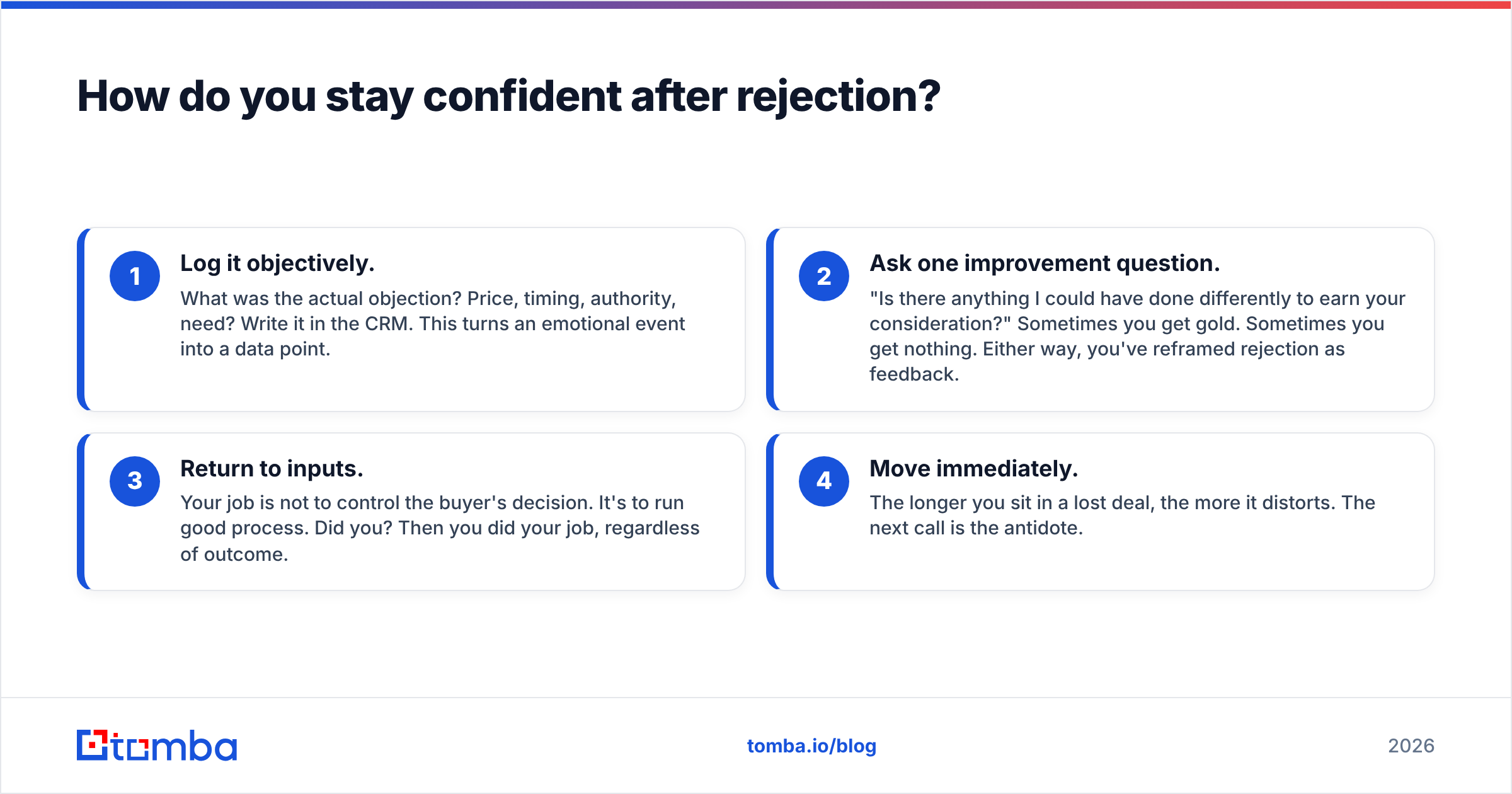
- Log it objectively. What was the actual objection? Price, timing, authority, need? Write it in the CRM. This turns an emotional event into a data point.
- Ask one improvement question. "Is there anything I could have done differently to earn your consideration?" Sometimes you get gold. Sometimes you get nothing. Either way, you've reframed rejection as feedback.
- Return to inputs. Your job is not to control the buyer's decision. It's to run good process. Did you? Then you did your job, regardless of outcome.
- Move immediately. The longer you sit in a lost deal, the more it distorts. The next call is the antidote.
Confidence isn't the absence of rejection. It's the speed at which you recover from it. Track your response rate and conversation counts, and you'll see that individual losses barely move the trend line — which is exactly why they shouldn't move your mood.
What tools support sales confidence in 2026?#
The right stack removes the uncertainty that anxiety feeds on. You don't need dozens of tools; you need a few that make your foundation solid. Analyst firms like Gartner note that reps increasingly cite tool sprawl as a drag on confidence — too many dashboards, not enough clarity. The goal is a lean setup where you trust every input.
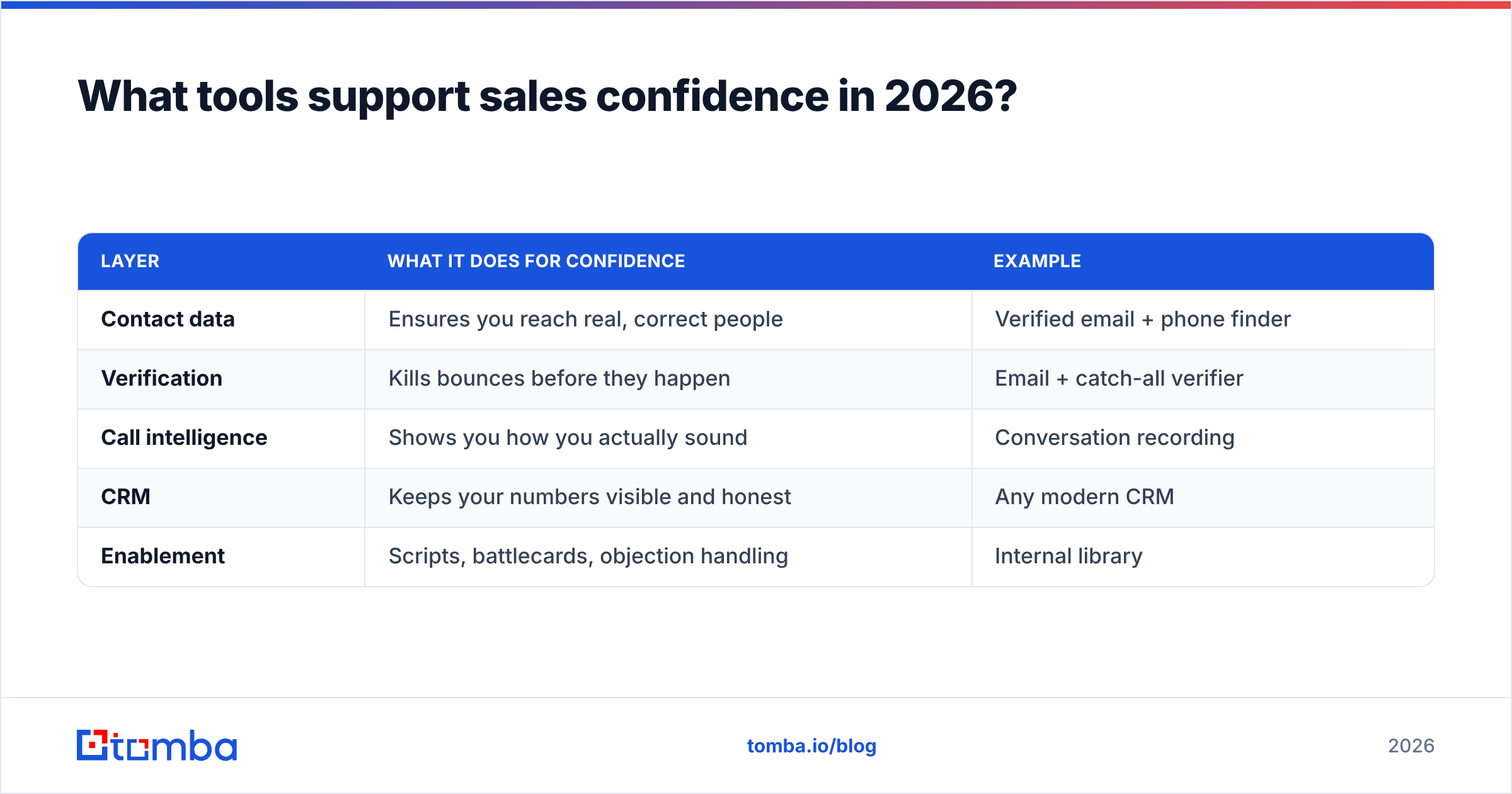
| Layer | What it does for confidence | Example |
|---|---|---|
| Contact data | Ensures you reach real, correct people | Verified email + phone finder |
| Verification | Kills bounces before they happen | Email + catch-all verifier |
| Call intelligence | Shows you how you actually sound | Conversation recording |
| CRM | Keeps your numbers visible and honest | Any modern CRM |
| Enablement | Scripts, battlecards, objection handling | Internal library |
The bottom two layers give you self-awareness. The top three give you a trustworthy foundation. When your data layer is clean, everything above it feels less like a gamble. Reps who invest here early spend the rest of their ramp building skill instead of fighting bad lists.
Cost matters too — a bloated stack drains budget without adding certainty. If you're evaluating where to spend, transparent Tomba pricing starts free (25 searches a month) and scales to $49/mo Starter, so you can validate that better data actually lifts your confidence before committing more.
How do managers build confidence across a team?#
Managers build team confidence by engineering competence, not by giving motivational speeches. A pep talk fades by lunch. A rep who just watched a peer handle the exact objection they've been dreading carries that forever.
The highest-leverage moves for sales leaders:
- Certify on data hygiene. Make verified contacts a standard, not a personal choice. When the whole team works clean lists, nobody starts their day demoralized by bounces.
- Run objection drills. Weekly role-play on the five most common objections. Repetition in a safe setting transfers directly to live calls.
- Celebrate inputs publicly. Recognize the rep who made the most quality conversations, not only the one who closed. It signals that effort you control is what earns respect.
- Share call recordings. Let the team learn from each other's best moments. Confidence spreads when reps see that great calls are learnable, not magic.
- Protect prospecting time. Reactive, interrupted days breed anxiety. Blocked, predictable rhythms breed calm.
A confident team is almost always a well-prepared team. Fix the preparation and the confidence takes care of itself.
The bottom line#
Confidence in sales is not something you talk yourself into. It's something you build — one verified contact, one rehearsed objection, one tracked input at a time. Stop trying to feel more confident and start being more prepared. The feeling is a reliable side effect of the work.
Everything downstream of your outreach — your tone, your composure, your recovery from rejection — rests on whether you trust your foundation. If that foundation is a pile of guessed email addresses and stale numbers, no mindset hack will save you.
Start where confidence actually begins: with data you can trust. Use the Tomba Email Finder to source verified, decision-maker contacts by domain, name, or company, so every call and every send starts from certainty instead of hope. Build the foundation first, and let the confidence follow.
Related guides#
Ready to find emails that actually work?
Join 150,000+ professionals who stopped guessing and started sending. Free credits on signup — no credit card required.
Get the Tomba newsletter
Practical outbound tactics and product updates — once every two weeks.
About the author