Consultative Sales Coaching: A 2026 Playbook for Sales Managers
Consultative sales coaching turns managers into diagnosticians instead of scorekeepers. Here's the framework, the metrics that matter, and where most programs quietly fail.
Most sales coaching fails for the same reason most cold calls fail: it leads with the answer instead of the question. A manager watches a call recording, spots ten things the rep "should" have done, and dumps all ten in a feedback session. The rep nods, changes nothing, and the pipeline looks identical next quarter.
Consultative sales coaching flips that. Instead of prescribing fixes, you diagnose the root cause of a rep's behavior the same way a great rep diagnoses a buyer's problem — with questions, evidence, and a plan the other person actually owns. This guide breaks down what it is, how to run it, the metrics that prove it's working, and the traps that kill most programs before they show results.
TL;DR#
- Consultative sales coaching trains managers to diagnose why a rep behaves a certain way before prescribing what to change — mirroring the consultative selling motion itself.
- It beats "directive" coaching on retention and long-term skill transfer, but it's slower and demands more manager discipline.
- The unit of work is a single, observable behavior per rep per cycle — not a laundry list.
- You need real call data, CRM signals, and a simple scorecard; gut feel is not a coaching input.
- Programs fail when managers skip the diagnosis step, coach to the deal instead of the rep, or never measure skill change over time.
What is consultative sales coaching?#
Consultative sales coaching is a management approach where the coach acts like a consultant to the rep: they ask diagnostic questions, gather evidence, and co-create an improvement plan, rather than issuing top-down instructions.
Think of it like a good physical therapist versus a drill sergeant. The drill sergeant yells "do it again, correctly." The therapist asks where it hurts, watches you move, figures out the compensation pattern causing the pain, and gives you one targeted exercise. Both want you stronger. Only one changes how you move when they're not in the room.
The name is deliberate. The best consultative sellers don't open with a pitch — they diagnose a buyer's situation before recommending anything. Consultative coaching applies that same discipline internally. If you want reps to stop feature-dumping on prospects, the fastest way is to stop feature-dumping on your reps.
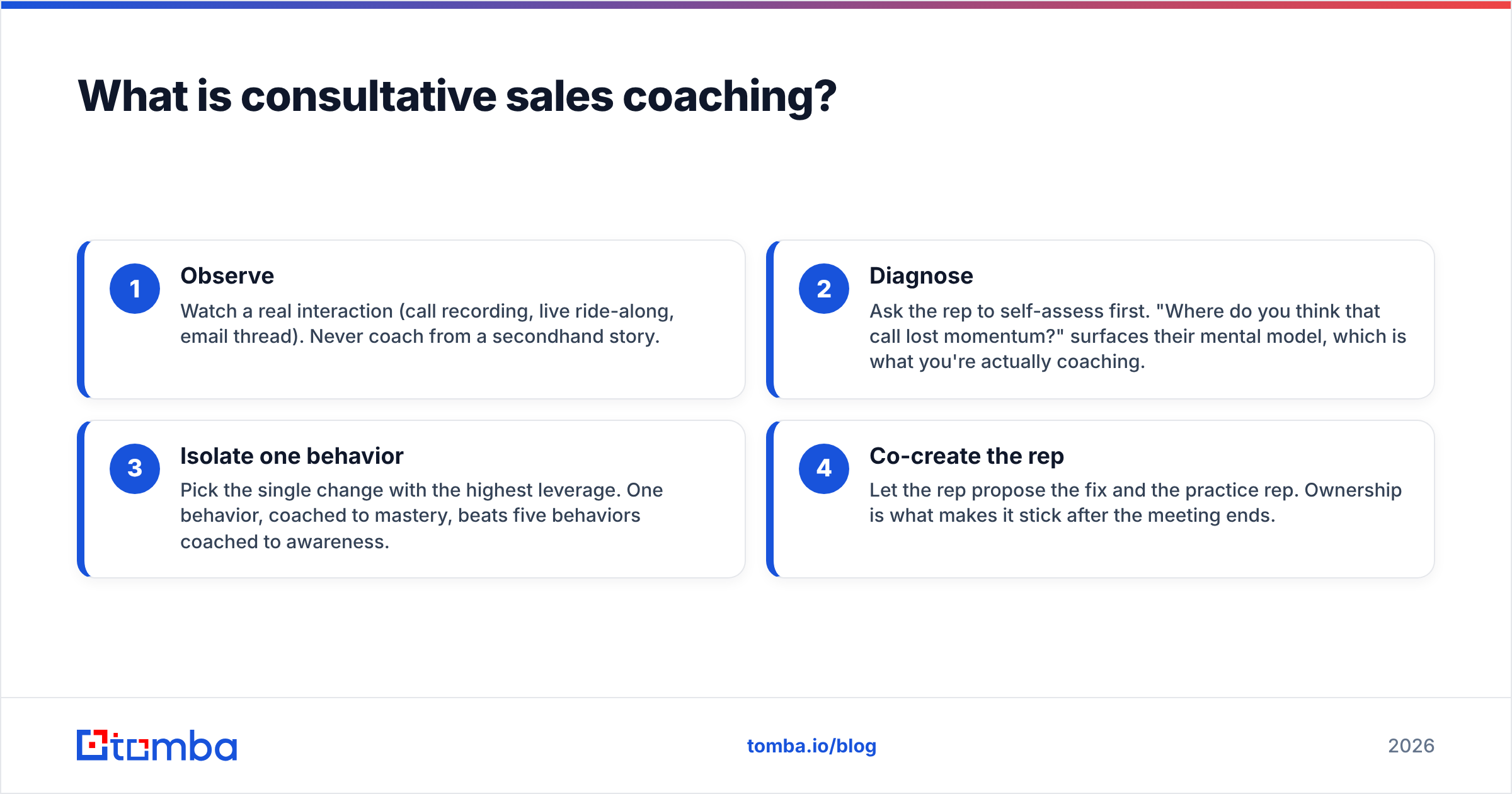
The four moves of a consultative coaching conversation#
- Observe — Watch a real interaction (call recording, live ride-along, email thread). Never coach from a secondhand story.
- Diagnose — Ask the rep to self-assess first. "Where do you think that call lost momentum?" surfaces their mental model, which is what you're actually coaching.
- Isolate one behavior — Pick the single change with the highest leverage. One behavior, coached to mastery, beats five behaviors coached to awareness.
- Co-create the rep — Let the rep propose the fix and the practice rep. Ownership is what makes it stick after the meeting ends.
How is it different from directive sales coaching?#
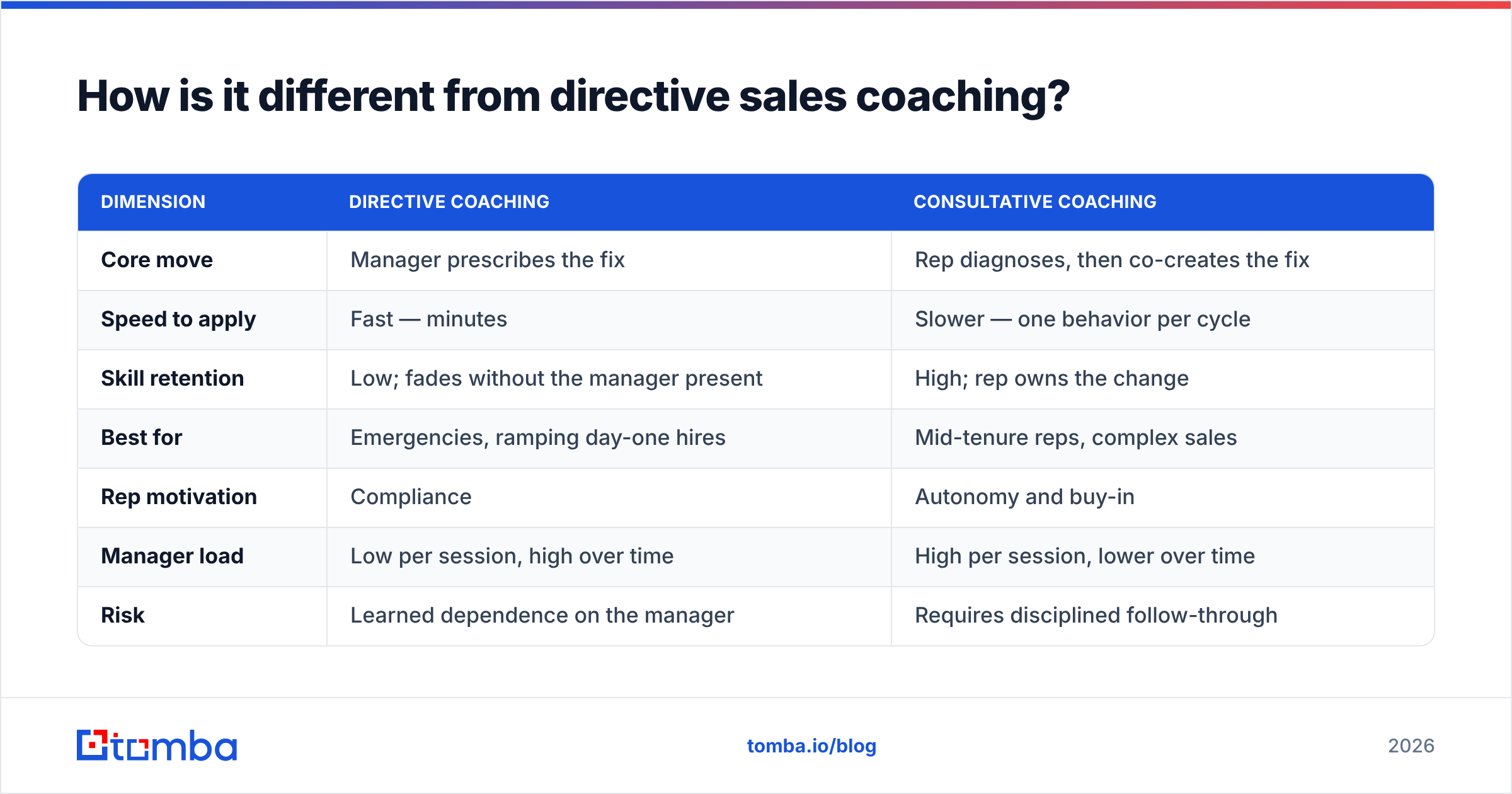
Directive coaching tells; consultative coaching asks. Both have a place, but they produce different results over different time horizons. Directive coaching is faster in the moment and right for genuine emergencies (a deal closing Friday, a compliance error). Consultative coaching is slower up front and far better for durable skill growth.
| Dimension | Directive Coaching | Consultative Coaching |
|---|---|---|
| Core move | Manager prescribes the fix | Rep diagnoses, then co-creates the fix |
| Speed to apply | Fast — minutes | Slower — one behavior per cycle |
| Skill retention | Low; fades without the manager present | High; rep owns the change |
| Best for | Emergencies, ramping day-one hires | Mid-tenure reps, complex sales |
| Rep motivation | Compliance | Autonomy and buy-in |
| Manager load | Low per session, high over time | High per session, lower over time |
| Risk | Learned dependence on the manager | Requires disciplined follow-through |
The research backs the split. Sales enablement analysts at firms like Gartner have repeatedly found that manager coaching quality is one of the strongest predictors of rep quota attainment — but only when it's consistent and behavior-focused, not sporadic and deal-focused. A one-off pep talk moves nothing.
Why does consultative coaching improve win rates?#
It improves win rates because it changes rep behavior at the source instead of patching individual deals. When you coach a deal, you win (maybe) that one deal. When you coach the behavior behind the deal, you influence every future deal where that behavior shows up.
Here's the mechanism in plain terms. Most win-rate problems trace back to a small number of repeated behaviors: talking more than listening, skipping discovery, pitching to the wrong stakeholder, or failing to quantify pain. Consultative coaching finds the pattern across a rep's deals — not just the one on this week's forecast call — and fixes the pattern. That's why programs that track skill change alongside deal outcomes tend to see win rate improvements compound over two or three quarters rather than spiking once and flattening.
There's a data dependency here that teams routinely underestimate. You can't diagnose a pattern you can't see. If your reps are working from stale or incomplete prospect data, half their "skill" problems are actually data problems — bad numbers, wrong contacts, no context on the account. Before you coach a rep for weak discovery, make sure they walked in with accurate contact and company data in the first place. Clean inputs from tools like an email finder and reliable contact enrichment remove an entire category of false coaching signals.
A simple behavior scorecard#
You don't need enterprise software to start. A five-row scorecard, scored on the same call every week, tells you more than a dashboard nobody reads:
- Discovery depth — Did the rep uncover a quantified business problem, or just a surface complaint?
- Talk-to-listen ratio — Roughly how much of the call did the rep talk? (Aim under 45%.)
- Multithreading — Did they identify or engage more than one stakeholder?
- Next-step clarity — Did the call end with a specific, calendared next step?
- Value framing — Did they tie the product to the buyer's stated outcome, not a feature list?
Score one dimension per rep per cycle. Trying to move all five at once is how you move none of them.
What does a consultative coaching cadence look like?#
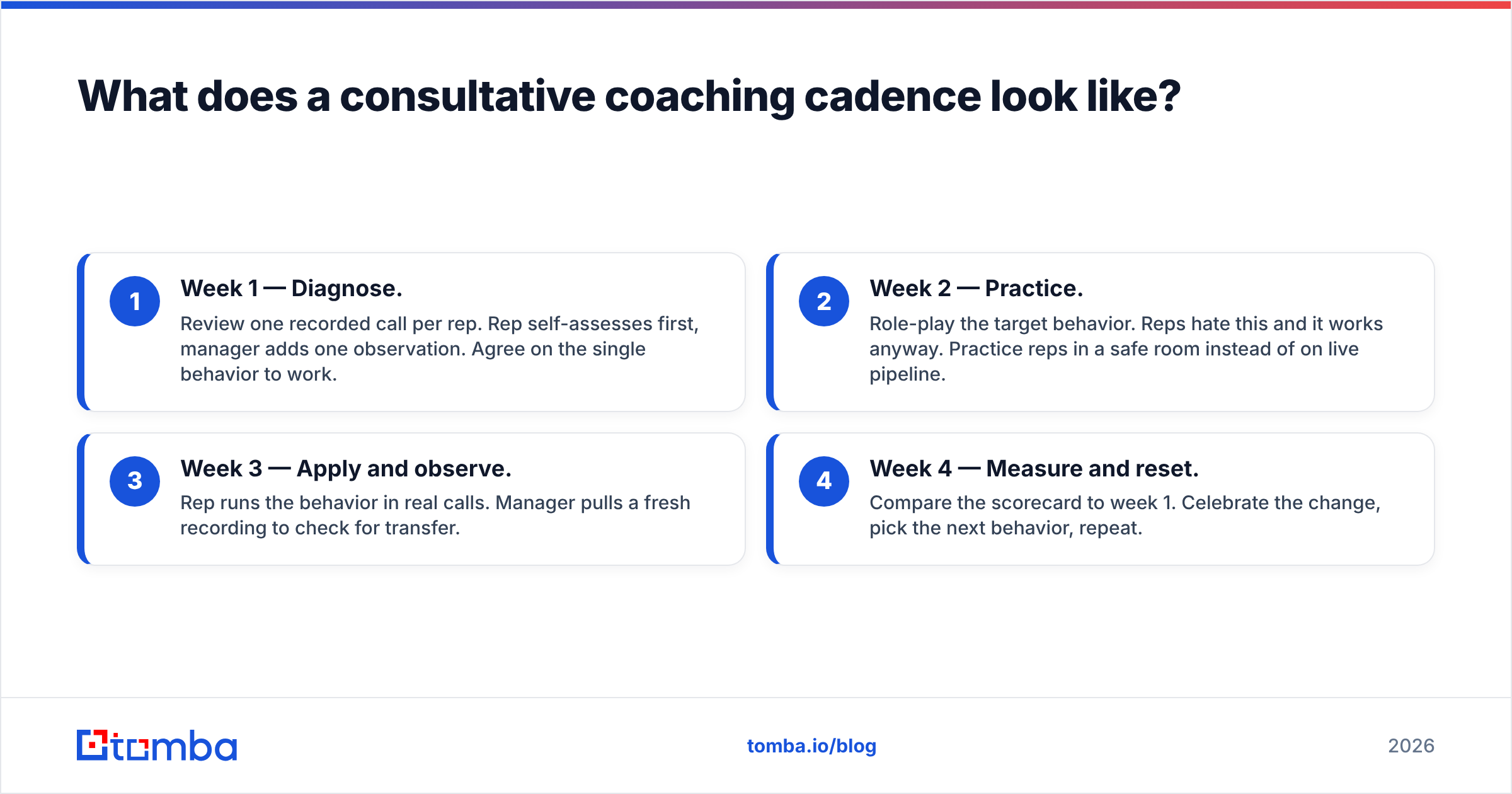
A working cadence is weekly, short, and evidence-based. The mistake is treating coaching as an annual review event. Skill change happens in small, frequent reps, the same way fitness does — an hour a week beats an eight-hour cram once a quarter.
A practical monthly rhythm looks like this:
- Week 1 — Diagnose. Review one recorded call per rep. Rep self-assesses first, manager adds one observation. Agree on the single behavior to work.
- Week 2 — Practice. Role-play the target behavior. Reps hate this and it works anyway. Practice reps in a safe room instead of on live pipeline.
- Week 3 — Apply and observe. Rep runs the behavior in real calls. Manager pulls a fresh recording to check for transfer.
- Week 4 — Measure and reset. Compare the scorecard to week 1. Celebrate the change, pick the next behavior, repeat.

The reason the cadence matters more than the content: a mediocre framework run every week beats a brilliant framework run twice a year. Consistency is the active ingredient. Platforms like HubSpot's sales tools and dedicated conversation-intelligence products can automate the recording and tagging, but the cadence is a management decision, not a software feature.
Which metrics prove consultative coaching is working?#
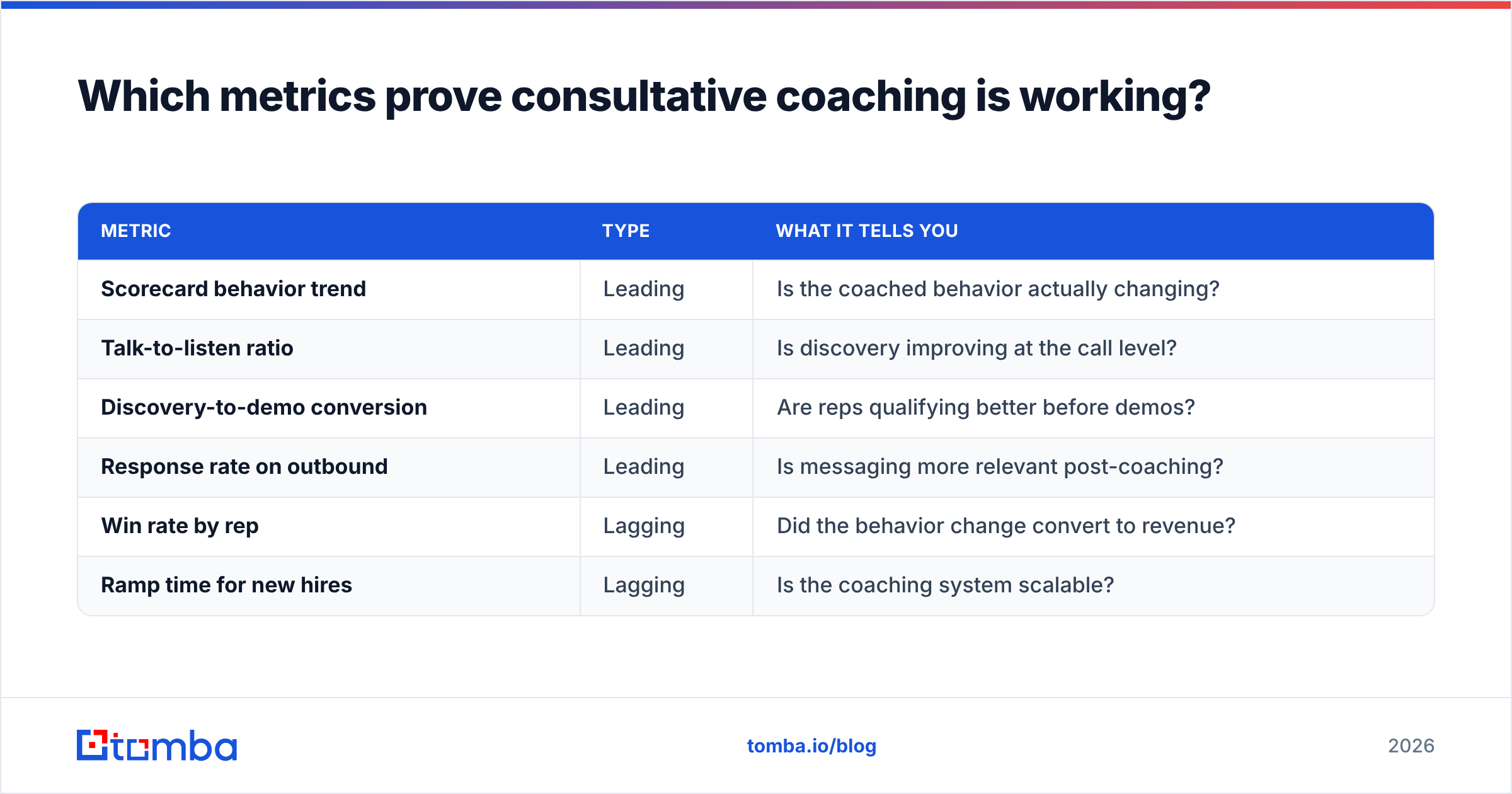
Track two layers: leading indicators (skill change) and lagging indicators (deal outcomes). Most teams only track the lagging ones, then wonder why they can't tell if coaching caused the result or the quarter just happened to be good.
| Metric | Type | What it tells you |
|---|---|---|
| Scorecard behavior trend | Leading | Is the coached behavior actually changing? |
| Talk-to-listen ratio | Leading | Is discovery improving at the call level? |
| Discovery-to-demo conversion | Leading | Are reps qualifying better before demos? |
| Response rate on outbound | Leading | Is messaging more relevant post-coaching? |
| Win rate by rep | Lagging | Did the behavior change convert to revenue? |
| Ramp time for new hires | Lagging | Is the coaching system scalable? |
The trick is to connect a specific coached behavior to a specific leading metric, then watch whether the lagging metric follows one or two quarters later. If you coached "deeper discovery" and discovery-to-demo conversion climbs but win rate doesn't, you've learned something precise: the problem isn't discovery, it's later in the cycle. That diagnostic clarity is impossible if you only look at revenue.
Peer-review sites such as G2 catalog dozens of coaching and conversation-intelligence tools, but tool selection should follow your metric model, not precede it. Decide what you're measuring first; buy the thing that measures it second.
Where do consultative coaching programs fail?#
They fail in four predictable ways, and every one of them is preventable.
- Skipping the diagnosis. Managers under time pressure revert to directive mode — "just do X" — and call it consultative because they phrased it as a question. Reps see through it. If the rep didn't self-assess, you didn't diagnose.
- Coaching the deal, not the rep. Forecast calls masquerade as coaching. Deal reviews are necessary, but they teach the manager about the pipeline, not the rep about their craft. Keep them separate.
- The laundry list. Ten pieces of feedback equal zero behavior change. Pick one. The discipline of choosing is the whole job.
- No measurement of skill change. Without a scorecard trend, coaching becomes vibes. You can't improve what you refuse to measure, and you can't defend the program's budget without evidence.
There's a fifth, quieter failure worth naming: coaching reps to compensate for bad data. If a rep's calls are weak because their prospect list is full of wrong titles and dead emails, no amount of role-play fixes that. Give reps a foundation of accurate contact and account data — through solid prospecting workflows and verified inputs — so your coaching targets skill, not garbage-in-garbage-out.
How do you start a consultative coaching program in 30 days?#
Start small, with one behavior, one cadence, and one scorecard. Trying to roll out a full system across the org in month one is the surest way to have it collapse by month three.
A realistic 30-day launch:
- Days 1–5: Pick three reps (not the whole team). Record one call each. Build the five-row scorecard above.
- Days 6–15: Run the first diagnose-and-isolate sessions. Reps self-assess. Agree on one behavior per rep.
- Days 16–25: Practice and apply. Pull fresh recordings mid-cycle to check for transfer.
- Days 26–30: Measure the scorecard delta, document what changed, and use those three reps as internal proof to expand.
Pilots beat mandates. Three reps improving on a visible scorecard will recruit the rest of the team for you.
The bottom line#
Consultative sales coaching works because it treats reps the way you want reps to treat buyers: diagnose before prescribing, isolate the real problem, and hand ownership of the fix to the person who has to live with it. It's slower than barking orders and far more durable. The programs that win aren't the ones with the fanciest software — they're the ones run every single week, against a scorecard, on real call data.
And that last part is non-negotiable. Coaching quality is capped by data quality. If your reps are diagnosing the wrong contacts or chasing dead inboxes, you'll spend your coaching hours fixing symptoms of a data problem. Start every rep with accurate, verified prospect data using the Tomba Email Finder — find the right people by name, company, or domain, so your coaching targets the skills that actually move win rates instead of cleaning up avoidable mistakes. Check the Tomba pricing plans, start on the free tier with 25 searches a month, and give your team a foundation worth coaching on.
Related guides#
Ready to find emails that actually work?
Join 150,000+ professionals who stopped guessing and started sending. Free credits on signup — no credit card required.
Get the Tomba newsletter
Practical outbound tactics and product updates — once every two weeks.
About the author