Consultative Sales Training: A Practical 2026 Playbook
Consultative sales training teaches reps to diagnose before they pitch. Here's what actually moves win rates in 2026 — the skills, the drills, and the data foundation that makes it stick.
Consultative sales training gets pitched as the fix for every stalled pipeline, but most programs teach a vocabulary shift and call it a day. Reps learn to say "discovery" instead of "demo" and nothing about their win rate changes. This guide is about the version that actually works: what to teach, how to drill it, and how to measure whether it stuck.
TL;DR#
- Consultative selling means diagnosing before prescribing — you earn the right to recommend by understanding the buyer's problem first, not by reciting features faster.
- Training fails when it's a one-day event. Skills stick through repeated live-deal coaching, call reviews, and manager reinforcement over 8–12 weeks.
- The five core skills are pre-call research, layered questioning, active listening, reframing, and mutual-action planning.
- It only pays off with clean data. Reps who walk into calls blind can't be consultative; accurate contact and account data is the unglamorous prerequisite.
- Measure it with leading indicators — talk-to-listen ratio, questions per call, multi-threading — not just quota attainment three quarters later.
What is consultative sales training?#
Consultative sales training teaches reps to act like advisors instead of vendors. The core idea is simple: you diagnose the buyer's situation thoroughly before you recommend anything, the same way a good doctor asks questions before writing a prescription. A rep who leads with "tell me where it hurts" closes more than one who leads with a feature tour.
The approach traces back to the 1970s and Mack Hanan's Consultative Selling, but the mechanics matter more than the history. In practice, consultative training rewires three habits: reps research before they dial, they ask more than they tell, and they tie every capability they mention back to a problem the buyer already admitted having.
Contrast that with transactional selling, where the goal is to move a known product to a buyer who already knows they want it. Both are legitimate. The mismatch — running a transactional playbook on a complex, multi-stakeholder deal — is what kills win rates.

How is consultative selling different from transactional selling?#
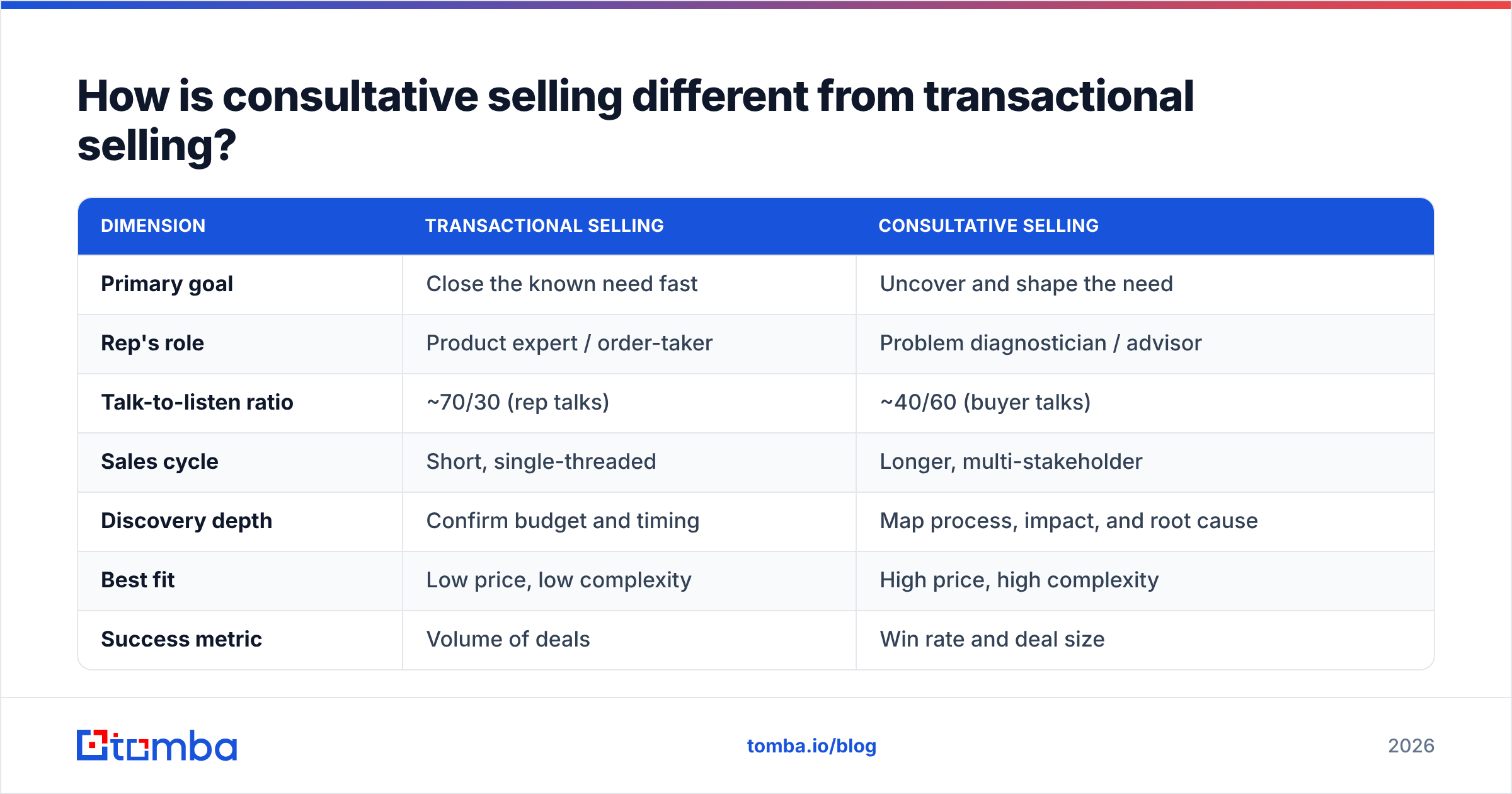
The difference isn't tone; it's where the value gets created. In a transactional motion, value lives in the product and the rep's job is efficient delivery. In a consultative motion, the rep adds value during the sale by helping the buyer understand their own problem better than they did before the call.
| Dimension | Transactional selling | Consultative selling |
|---|---|---|
| Primary goal | Close the known need fast | Uncover and shape the need |
| Rep's role | Product expert / order-taker | Problem diagnostician / advisor |
| Talk-to-listen ratio | ~70/30 (rep talks) | ~40/60 (buyer talks) |
| Sales cycle | Short, single-threaded | Longer, multi-stakeholder |
| Discovery depth | Confirm budget and timing | Map process, impact, and root cause |
| Best fit | Low price, low complexity | High price, high complexity |
| Success metric | Volume of deals | Win rate and deal size |
If your average deal involves three or more stakeholders and takes more than a month, the consultative model is not a nice-to-have. According to Gartner research on B2B buying, buying groups now involve six to ten decision-makers, each armed with their own information. A feature pitch aimed at one champion no longer carries the deal.
What skills does consultative sales training actually build?#
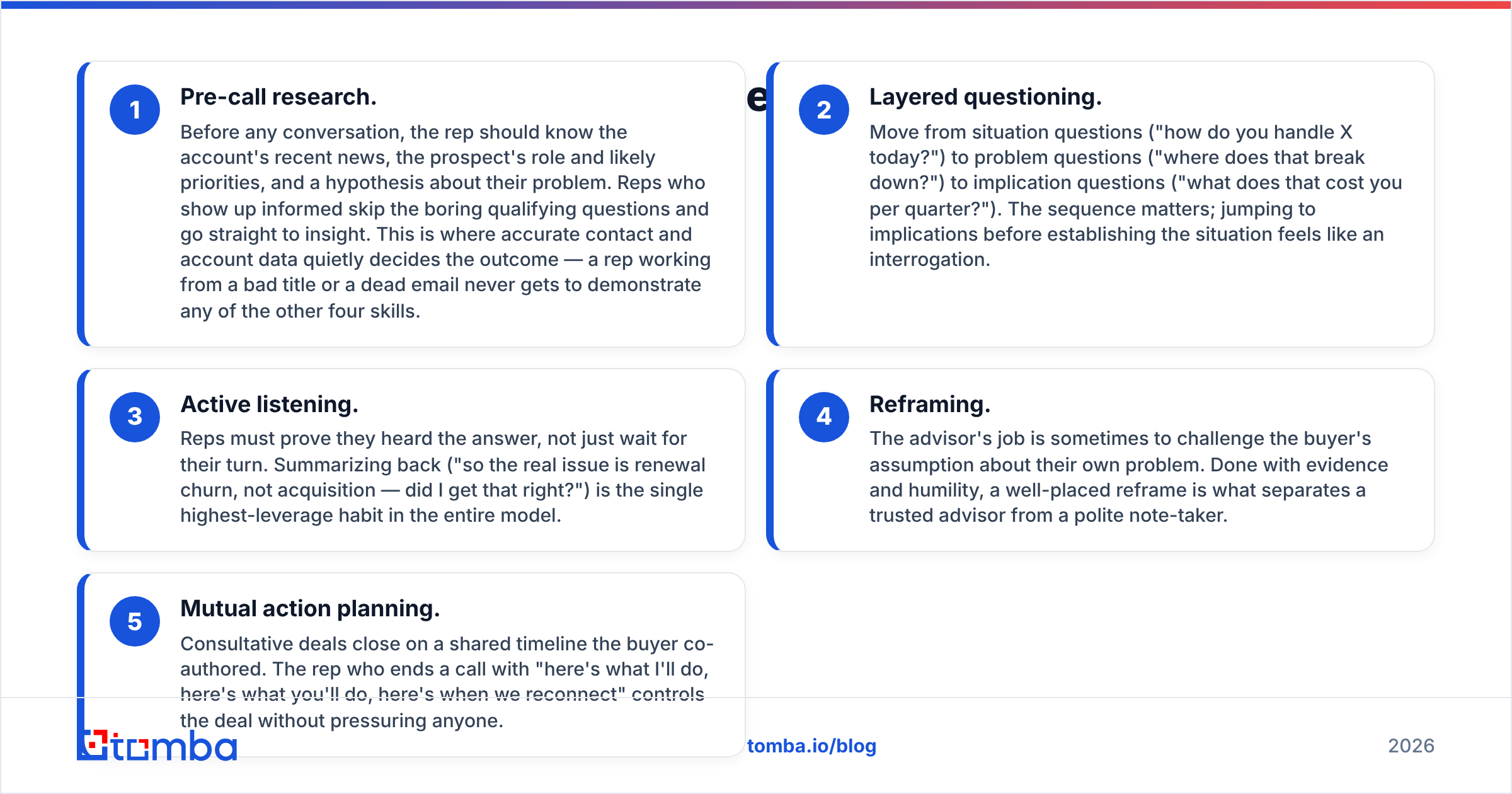
Good programs are concrete about the behaviors they're changing. Vague goals like "be more customer-centric" don't transfer to Monday's calls. These five skills do, and each one is drillable.
- Pre-call research. Before any conversation, the rep should know the account's recent news, the prospect's role and likely priorities, and a hypothesis about their problem. Reps who show up informed skip the boring qualifying questions and go straight to insight. This is where accurate contact and account data quietly decides the outcome — a rep working from a bad title or a dead email never gets to demonstrate any of the other four skills.
- Layered questioning. Move from situation questions ("how do you handle X today?") to problem questions ("where does that break down?") to implication questions ("what does that cost you per quarter?"). The sequence matters; jumping to implications before establishing the situation feels like an interrogation.
- Active listening. Reps must prove they heard the answer, not just wait for their turn. Summarizing back ("so the real issue is renewal churn, not acquisition — did I get that right?") is the single highest-leverage habit in the entire model.
- Reframing. The advisor's job is sometimes to challenge the buyer's assumption about their own problem. Done with evidence and humility, a well-placed reframe is what separates a trusted advisor from a polite note-taker.
- Mutual action planning. Consultative deals close on a shared timeline the buyer co-authored. The rep who ends a call with "here's what I'll do, here's what you'll do, here's when we reconnect" controls the deal without pressuring anyone.
Notice the progression baked into these skills — from pitching features at a stranger to genuinely diagnosing a problem. That shift in altitude is the whole game.

Why do most consultative sales training programs fail?#
They fail because they treat a behavior change like a knowledge transfer. A one-day workshop feels productive — everyone leaves energized — but energy is not a skill. Within two weeks, reps under quota pressure revert to the feature pitch because it's faster and it's what they know.
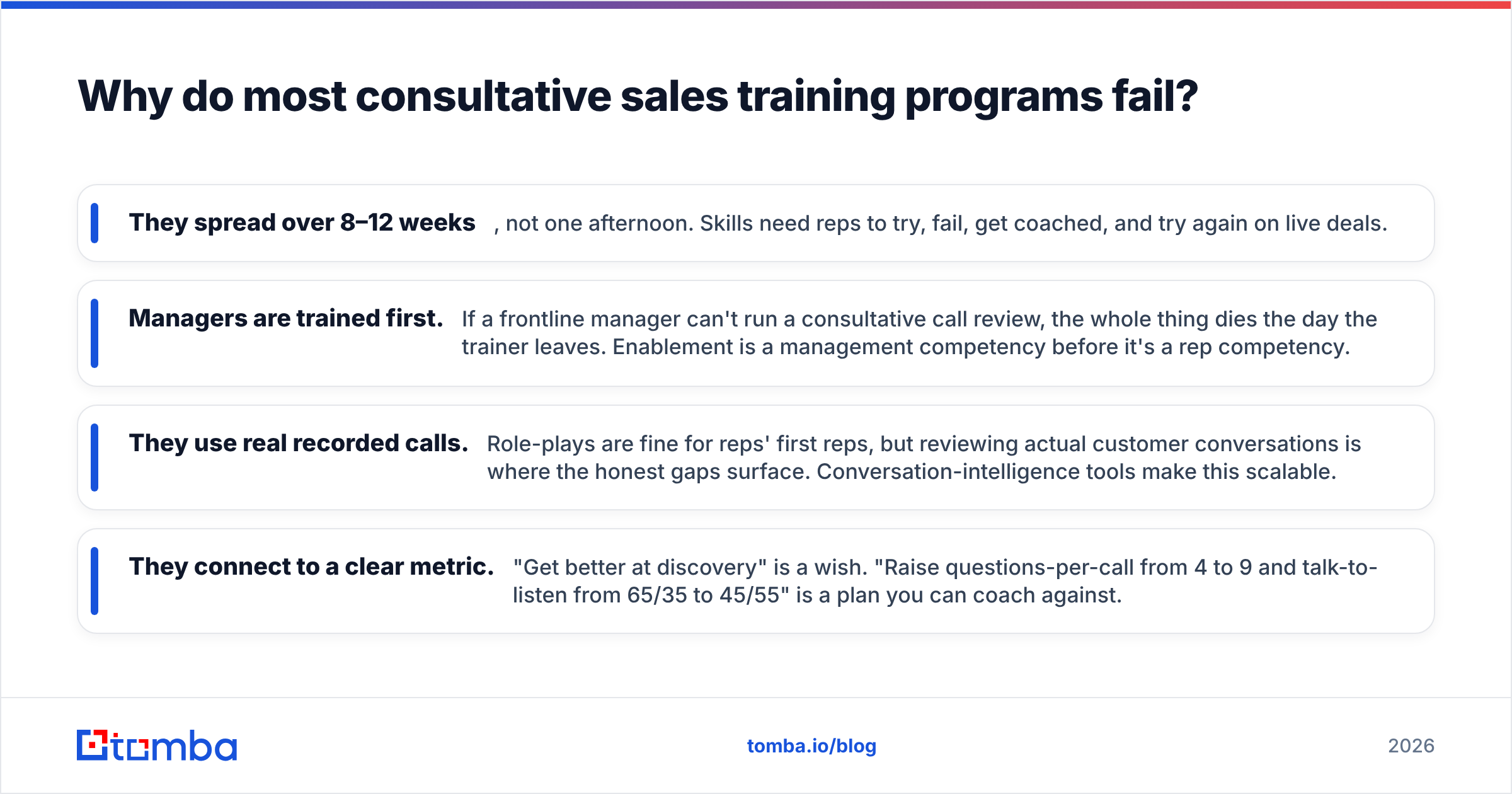
The programs that stick share four traits:
- They spread over 8–12 weeks, not one afternoon. Skills need reps to try, fail, get coached, and try again on live deals.
- Managers are trained first. If a frontline manager can't run a consultative call review, the whole thing dies the day the trainer leaves. Enablement is a management competency before it's a rep competency.
- They use real recorded calls. Role-plays are fine for reps' first reps, but reviewing actual customer conversations is where the honest gaps surface. Conversation-intelligence tools make this scalable.
- They connect to a clear metric. "Get better at discovery" is a wish. "Raise questions-per-call from 4 to 9 and talk-to-listen from 65/35 to 45/55" is a plan you can coach against.
There's a deeper prerequisite most programs skip entirely: the data reps work from. You cannot train someone to be consultative and then hand them a list of stale contacts and guessed-at email addresses. The whole model depends on reaching the right person with enough context to have a smart conversation. If your reps are burning the first ten minutes of every call confirming they're even talking to the right stakeholder, no amount of questioning technique saves them. Building a reliable B2B database and enriching leads before outreach is the unsexy foundation the training sits on.
How do you roll out consultative sales training that sticks?#
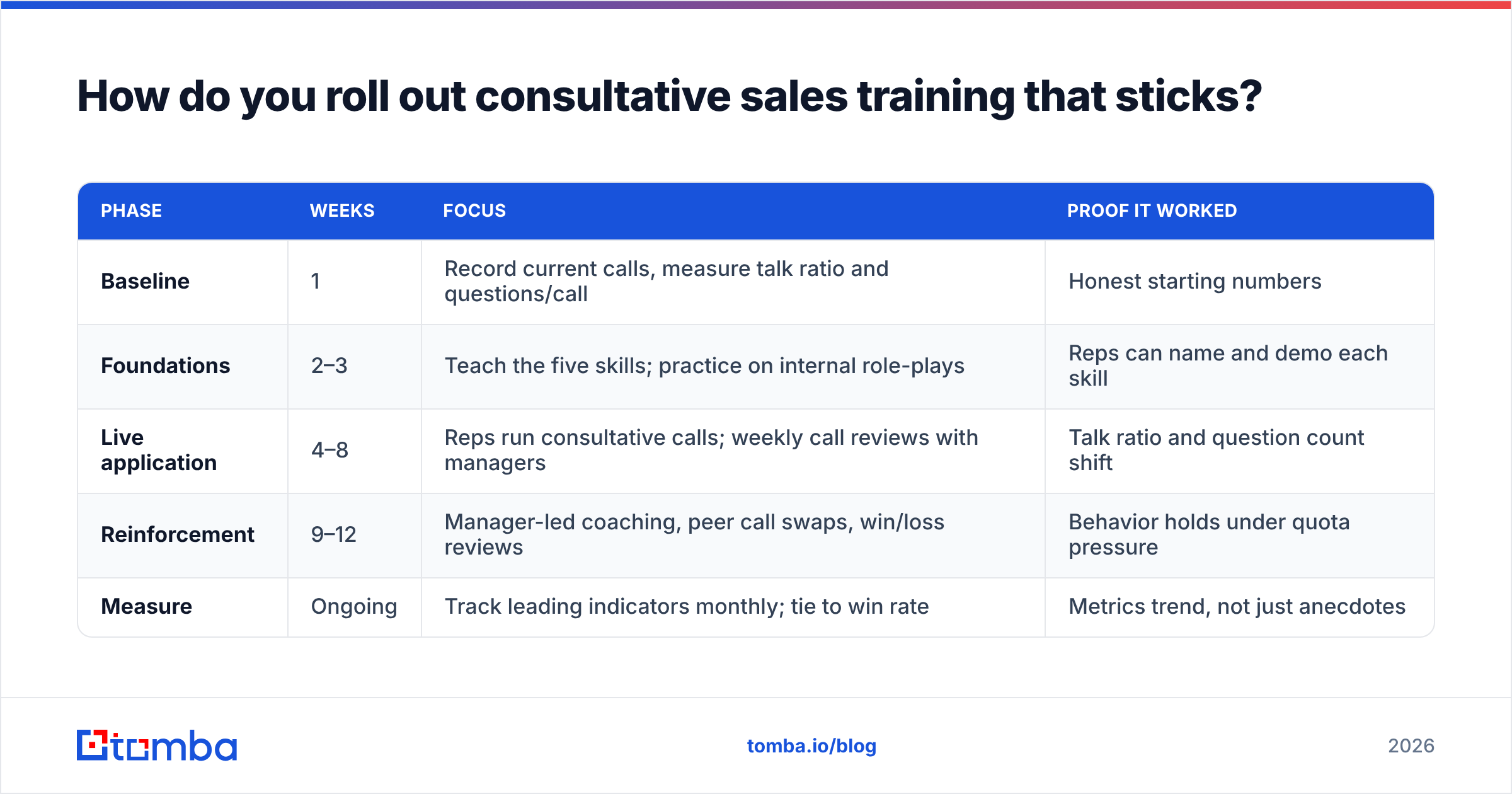
Here's a rollout that respects how adults actually learn a skill. It assumes a team of frontline reps and their managers, and roughly a quarter of runway.
| Phase | Weeks | Focus | Proof it worked |
|---|---|---|---|
| Baseline | 1 | Record current calls, measure talk ratio and questions/call | Honest starting numbers |
| Foundations | 2–3 | Teach the five skills; practice on internal role-plays | Reps can name and demo each skill |
| Live application | 4–8 | Reps run consultative calls; weekly call reviews with managers | Talk ratio and question count shift |
| Reinforcement | 9–12 | Manager-led coaching, peer call swaps, win/loss reviews | Behavior holds under quota pressure |
| Measure | Ongoing | Track leading indicators monthly; tie to win rate | Metrics trend, not just anecdotes |
Two things make or break this. First, the manager cadence. A weekly 30-minute call review per rep, using a real recording, is the engine. Skip it and you have a workshop, not a program. Second, the data readiness. Before week 4, make sure reps can actually reach the accounts you want them practicing on. Pull verified contacts, confirm titles, and enrich the account so reps walk in with a hypothesis instead of a blank page. HubSpot's sales research consistently shows that reps spend a huge share of their week on non-selling admin — much of it fixing bad data. Fix that first and your training has room to breathe.
What metrics prove consultative training is working?#
Quota attainment is a lagging indicator — it shows up two or three quarters after the behavior changed, tangled up with pricing, territory, and market noise. To know if the training worked, watch the leading indicators that map directly to the skills.
- Talk-to-listen ratio. Should move toward 45/55 in favor of the buyer. Conversation-intelligence platforms measure this automatically.
- Questions per call. A crude but honest proxy for discovery depth. More isn't infinitely better, but a jump from 4 to 9 is real.
- Multi-threading rate. The share of open deals with two or more engaged stakeholders. Consultative reps naturally expand the buying group.
- Discovery-to-demo ratio. Are reps still demoing on the first call? A healthy consultative motion delays the demo until the problem is mapped.
- Deal-stage conversion. Watch the early-stage-to-mid-stage conversion rate; better discovery should lift it before it lifts final win rate.
If you want to compare tools that surface these metrics, G2's conversation intelligence category is a reasonable neutral starting point. The tool matters less than the discipline of reviewing the numbers every week.
Where does data fit into a consultative motion?#
It fits at the front, before the first word of the first call. Consultative selling is research-dependent by design — the rep's credibility comes from knowing something about the buyer's world going in. That knowledge has to come from somewhere reliable.
In practice that means three data jobs the training assumes are already handled:
- Reaching the right person. A verified professional email or direct line is the difference between a coached conversation and a voicemail. Reps can't be advisors to people they never connect with — this is where a phone finder and accurate email data earn their keep.
- Knowing who else is in the deal. Multi-threading requires mapping the buying group, which starts with finding the other stakeholders' contact details, not guessing at them.
- Walking in with context. Enriched account and contact records give reps the firmographic and role detail that fuels a sharp opening hypothesis. Weak response rates usually trace back to generic outreach built on thin data, not bad scripts.
None of this replaces skill. But skill applied to bad data is wasted, and that's the trap most enablement teams don't see because data quality isn't their department. Make it someone's department before you spend the training budget.
Is consultative sales training worth it?#
For complex, high-value, multi-stakeholder deals: yes, clearly — provided you run it as a 90-day behavior program with manager coaching and a data foundation, not a one-day event. For simple, transactional, high-velocity sales: probably not, and forcing it can actually slow good reps down. The honest answer depends on your deal shape, and the table near the top of this guide is the fastest way to decide which side of that line you're on.
The failure mode to avoid is buying the training and skipping the prerequisites. A consultative rep with stale contact data is a race car with an empty tank. Get the data right, train the behaviors, coach them weekly, and measure the leading indicators. That sequence works. Any one piece alone doesn't.
If your reps are spending calls confirming they've even reached the right stakeholder, start there. Tomba's email finder turns a name and a company into a verified contact in seconds, so your reps walk into every consultative conversation already knowing who they're talking to and why it matters. Pair it with enrichment and your training budget stops leaking into fixable data problems. See Tomba pricing — the free tier gives you 25 searches a month to test the workflow before you commit.
Related guides#
Ready to find emails that actually work?
Join 150,000+ professionals who stopped guessing and started sending. Free credits on signup — no credit card required.
Get the Tomba newsletter
Practical outbound tactics and product updates — once every two weeks.
About the author