Consultative Selling Skills: The 2026 Playbook for Sales Reps
Consultative selling means diagnosing before you pitch. Here are the 7 skills that separate trusted advisors from pushy reps — plus how to build them fast.
Consultative selling is the difference between a rep who talks at buyers and one buyers actually invite back. In 2026, with buyers doing 70%+ of their research before they ever take a call, the pitch-first playbook is dead. The reps hitting quota are the ones who diagnose a problem before they prescribe a product.
This guide breaks down the seven consultative selling skills that matter most, how to build each one, and how to tell whether you're actually consulting — or just adding a friendly voice to the same old pitch.
TL;DR#
- Consultative selling skills are the diagnostic, listening, and framing abilities that let you understand a buyer's problem before proposing a solution.
- The seven that move the needle: discovery questioning, active listening, business acumen, problem framing, insight sharing, objection reframing, and mutual-plan building.
- The biggest mistake is "consultative theater" — asking a few questions, then launching the same pitch regardless of the answers.
- Consultative selling wins on larger deals, longer sales cycles, and considered B2B purchases — not transactional, self-serve buys.
- Skills compound only when you're talking to the right people. Clean targeting and accurate contact data (like a reliable email finder) put you in front of buyers worth consulting.
What are consultative selling skills?#
Consultative selling skills are the abilities a rep uses to act as a trusted advisor rather than a product pusher. Instead of leading with features, you lead with questions, uncover the buyer's real situation, and only then connect your solution to the problem you've diagnosed together.
Think of it like the difference between a pharmacy clerk and a doctor. The clerk points you to the shelf you asked for. The doctor asks where it hurts, runs a few checks, and prescribes something you didn't know you needed. Consultative sellers are doctors. They earn the right to recommend by understanding first.
The approach isn't new — it traces back to Mack Hanan's 1970 book Consultative Selling — but it has never mattered more. According to Gartner research, B2B buyers now spend only about 17% of their purchase journey talking to any supplier's reps. That tiny window is worthless if you spend it reciting a deck. It's gold if you spend it diagnosing.

Why does consultative selling beat the traditional pitch?#
The short answer: buyers trust people who understand them, and trust closes deals. A pitch-first rep is interchangeable with every other vendor's pitch-first rep. A consultative rep becomes the person the buyer calls when the problem gets urgent.
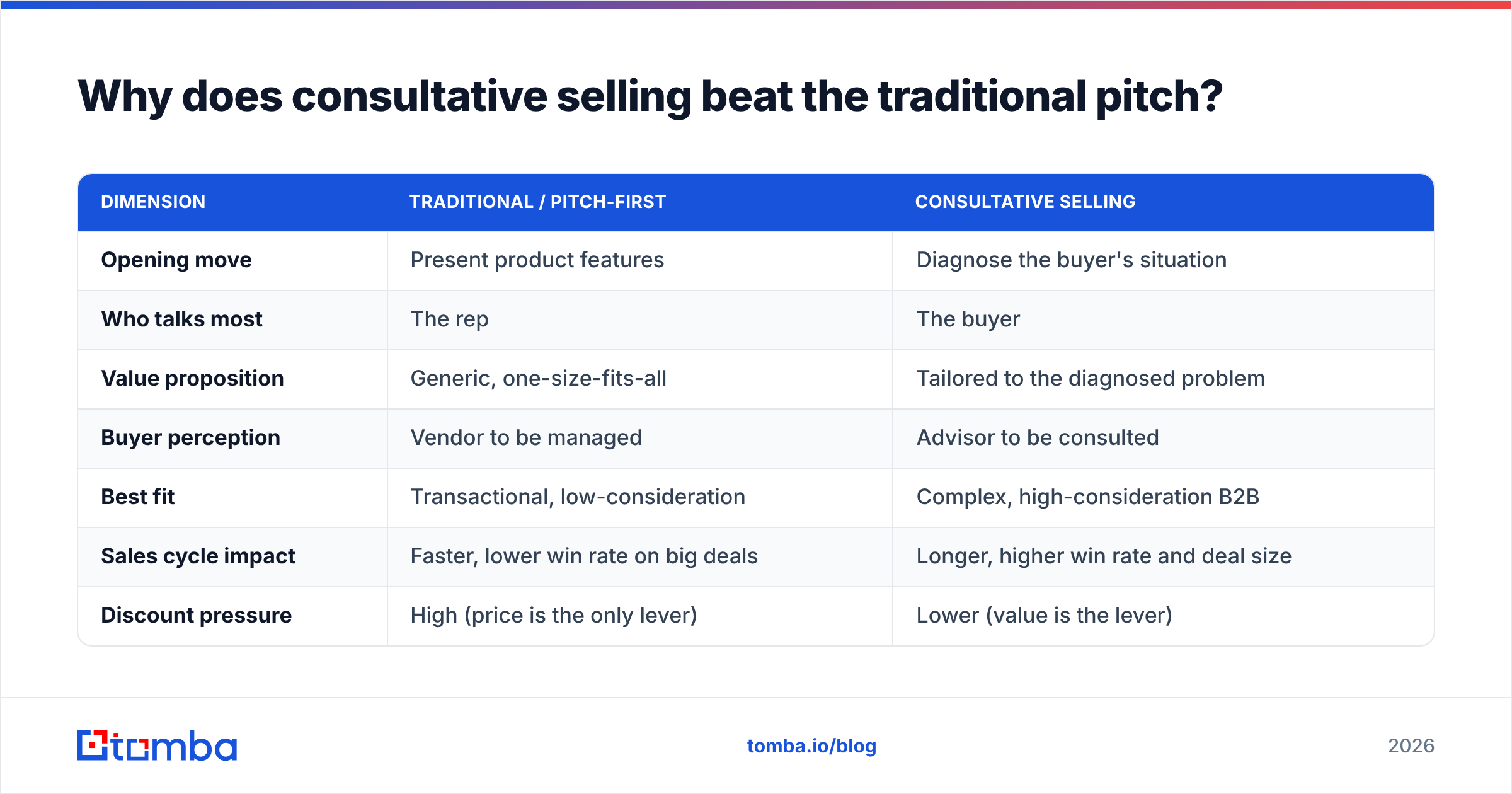
Here's how the two approaches stack up on the dimensions that decide B2B deals:
| Dimension | Traditional / pitch-first | Consultative selling |
|---|---|---|
| Opening move | Present product features | Diagnose the buyer's situation |
| Who talks most | The rep | The buyer |
| Value proposition | Generic, one-size-fits-all | Tailored to the diagnosed problem |
| Buyer perception | Vendor to be managed | Advisor to be consulted |
| Best fit | Transactional, low-consideration | Complex, high-consideration B2B |
| Sales cycle impact | Faster, lower win rate on big deals | Longer, higher win rate and deal size |
| Discount pressure | High (price is the only lever) | Lower (value is the lever) |
The trade-off is real: consultative selling is slower and demands more skill. On a $30 transactional sale, it's overkill. On a $50,000 platform decision with six stakeholders, it's the only thing that works. Match the method to the deal.
What are the 7 core consultative selling skills?#
1. Discovery questioning#
Discovery is the engine of consultative selling. The goal isn't to interrogate — it's to help the buyer articulate a problem they may not have fully framed themselves. Strong discovery questions move from the situation ("How does your team handle X today?") to the implications ("What does that cost you when it breaks?") to the vision ("What would 'solved' look like?").
Frameworks like SPIN (Situation, Problem, Implication, Need-payoff) and MEDDIC give you scaffolding, but the skill is in the follow-up. Every good answer should earn a "Tell me more about that" rather than a jump to your next scripted question.
Practice drill: After every discovery call, count the ratio of open questions you asked to statements you made. If you made more claims than you asked questions, you pitched — you didn't discover.
2. Active listening#
Active listening is discovery's other half. Asking a great question and then half-listening while you plan your pitch is worse than not asking at all — the buyer can tell. Real active listening means paraphrasing back what you heard ("So the core issue is that renewals slip through the cracks when a rep leaves — did I get that right?"), noticing what the buyer emphasized, and catching what they carefully avoided.
HubSpot's sales research consistently finds that talk-to-listen ratio correlates with close rates: top reps let the buyer talk more. Your job is to make them feel heard, not to fill silence.
3. Business acumen#
You can't consult on a problem you don't understand. Business acumen is knowing how your buyer's company makes money, what pressures their industry faces, and how the person across the table is measured. A rep who understands that a CFO cares about payback period — not feature count — speaks a different language than one reciting specs.
Build it by reading 10-Ks, earnings calls, and industry publications for your top accounts before you ever dial. Tools that surface company data and let you research prospects at scale help here; so does organizing your target accounts with proper data enrichment so you walk in already knowing the landscape.
4. Problem framing#
Framing is the art of restating the buyer's situation so the real problem — and its cost — becomes undeniable. Buyers often describe symptoms ("our data is messy"). The consultative seller reframes to the business impact ("so your reps waste six hours a week cleaning lists instead of selling, which is roughly one lost deal per rep per quarter").
Good framing does two things: it proves you understood, and it quantifies the pain so the buyer feels the urgency to act. Without framing, discovery is just a nice conversation that goes nowhere.
5. Insight sharing#
Modern consultative selling — sometimes called "insight selling" or the Challenger approach — adds a layer: bringing the buyer a perspective they didn't have. This isn't a product feature. It's a "here's what we see across 200 companies like yours, and here's the risk you might be missing." Insight positions you as a peer who teaches, not a vendor who takes orders.
The caveat: insight only lands after you've earned credibility through discovery. Leading with a hot take before you understand the buyer's world reads as arrogance.
6. Objection reframing#
Objections in consultative selling aren't roadblocks — they're information. "It's too expensive" usually means "I don't yet see enough value" or "I can't justify this to my boss." The skill is to stay curious instead of defensive: "Help me understand — too expensive compared to what?" Then you reframe around the cost of inaction, which you already quantified during framing.
Reps who argue with objections lose. Reps who diagnose them keep the conversation alive.
7. Mutual action planning#
The final skill is co-creating a path forward. Instead of "I'll send a proposal, let me know," a consultative seller builds a mutual action plan: agreed next steps, stakeholders to loop in, decision criteria, and dates. This keeps deals from stalling and signals that you're managing a shared project, not chasing a sale. It's the moment the buyer stops being a target and starts being a partner.
How do consultative selling skills fit into your sales process?#
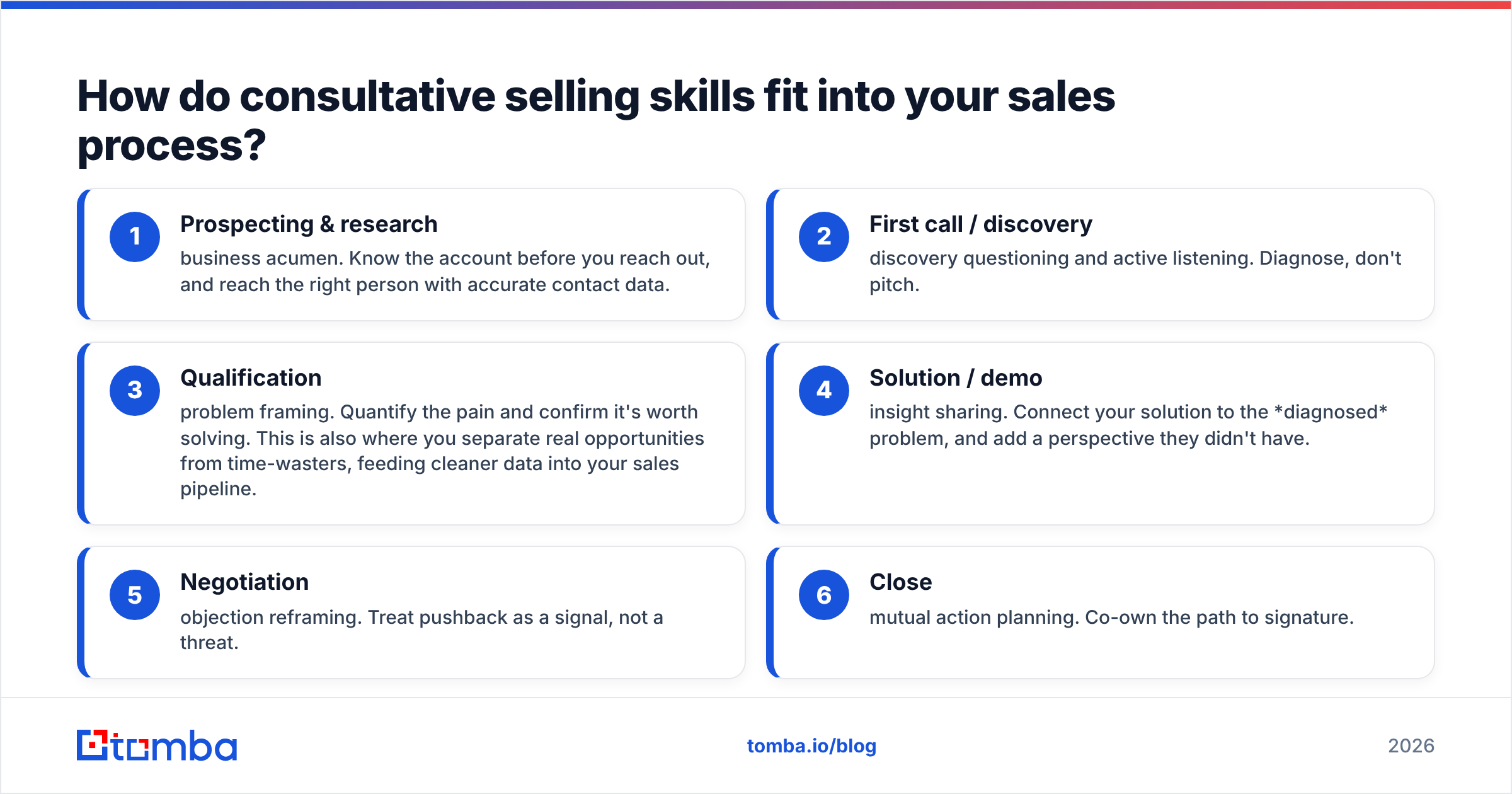
Skills don't float free — they attach to stages. Here's where each one does the most work:
- Prospecting & research — business acumen. Know the account before you reach out, and reach the right person with accurate contact data.
- First call / discovery — discovery questioning and active listening. Diagnose, don't pitch.
- Qualification — problem framing. Quantify the pain and confirm it's worth solving. This is also where you separate real opportunities from time-wasters, feeding cleaner data into your sales pipeline.
- Solution / demo — insight sharing. Connect your solution to the diagnosed problem, and add a perspective they didn't have.
- Negotiation — objection reframing. Treat pushback as a signal, not a threat.
- Close — mutual action planning. Co-own the path to signature.
Notice that pitching — the thing traditional reps do first — happens near the end, and only in the language of the problem you diagnosed together. That inversion is the whole game.
What tools support consultative selling in 2026?#
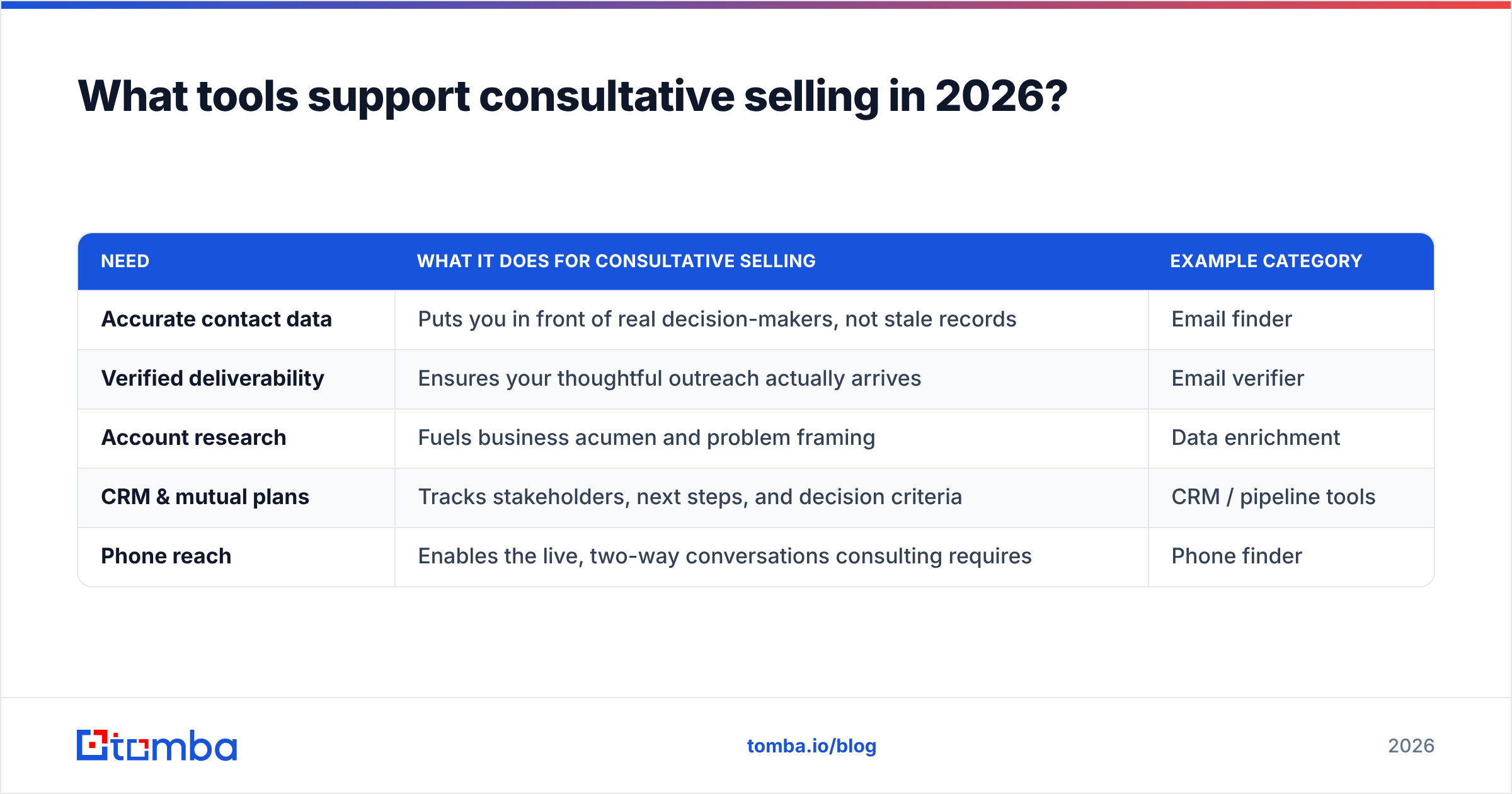
Consultative selling is a human skill, but the wrong data undermines it. If you're consulting with the wrong contact — a champion who left, a role that doesn't own the budget, a bounced email that never reached anyone — your skills are wasted on a dead end. The tooling layer's job is to make sure your consultative energy lands on real, reachable, relevant buyers.
| Need | What it does for consultative selling | Example category |
|---|---|---|
| Accurate contact data | Puts you in front of real decision-makers, not stale records | Email finder |
| Verified deliverability | Ensures your thoughtful outreach actually arrives | Email verifier |
| Account research | Fuels business acumen and problem framing | Data enrichment |
| CRM & mutual plans | Tracks stakeholders, next steps, and decision criteria | CRM / pipeline tools |
| Phone reach | Enables the live, two-way conversations consulting requires | Phone finder |
You'll find plenty of vendor comparisons on sites like G2 if you're building a stack. The principle to keep: buy tools that get you closer to the right human faster, so more of your time is spent consulting and less is spent hunting for who to consult.
How do you know if you're actually selling consultatively?#
Run this quick self-audit after your next five calls:
- Talk ratio: Did the buyer speak more than you did? If not, you pitched.
- New information: Did you learn something about their business you couldn't have Googled? If not, your discovery was shallow.
- Quantified pain: Can you state the cost of their problem in dollars or hours? If not, you skipped framing.
- Tailored recommendation: Would your proposal look different for a different buyer? If it's a copy-paste, you weren't consultative.
- Agreed next step: Did you leave with a mutual, dated action plan? If it's "I'll follow up," the deal is already drifting.
"Consultative theater" — a couple of warm-up questions before the same canned pitch — fails every one of these. Real consulting changes what you say next based on what you heard.
How do you build these skills fast?#
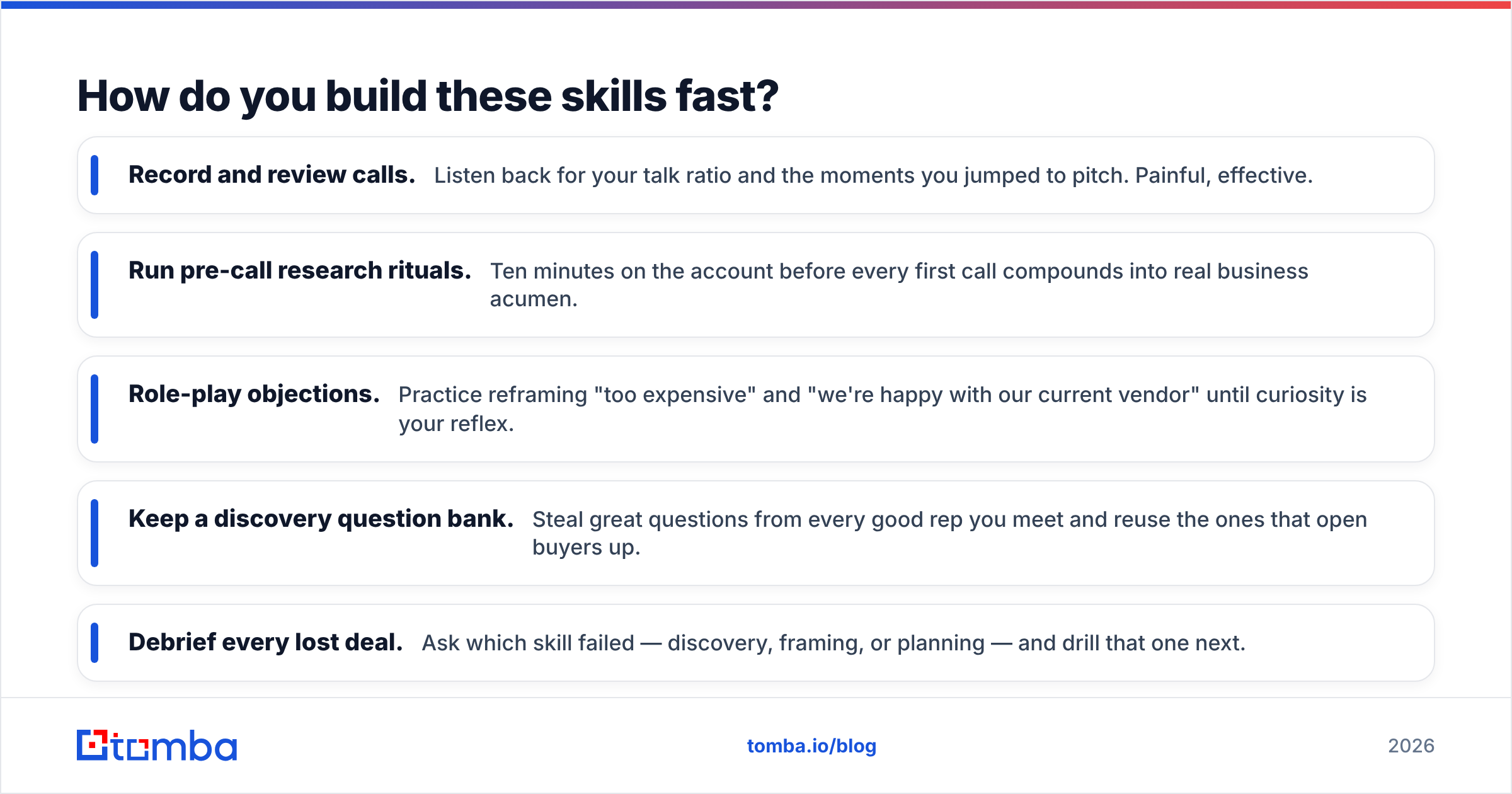
You don't learn consultative selling from a slide deck. You build it through reps and feedback:
- Record and review calls. Listen back for your talk ratio and the moments you jumped to pitch. Painful, effective.
- Run pre-call research rituals. Ten minutes on the account before every first call compounds into real business acumen.
- Role-play objections. Practice reframing "too expensive" and "we're happy with our current vendor" until curiosity is your reflex.
- Keep a discovery question bank. Steal great questions from every good rep you meet and reuse the ones that open buyers up.
- Debrief every lost deal. Ask which skill failed — discovery, framing, or planning — and drill that one next.
Managers accelerate this by coaching to specific skills, not vague "be more consultative" feedback. "Your framing was weak — you never quantified the cost" is coachable. "Build rapport" is not.
The bottom line#
Consultative selling skills — discovery, listening, business acumen, framing, insight, objection reframing, and mutual planning — turn reps into advisors buyers trust and pay a premium for. They're slower to build and slower to run than a pitch, and that's exactly why they're a durable advantage in complex B2B deals where trust, not talk, closes.
But great consulting only pays off when you're talking to buyers worth consulting. If your reps are burning their diagnostic skills on wrong contacts and bounced emails, the method never gets a chance. Start every consultative conversation on solid ground: use the Tomba Email Finder to reach verified, real decision-makers by name, domain, or company — so your team spends its time advising the right people instead of hunting for them. Check Tomba pricing to see which plan fits your outbound motion, and put your consultative skills where they'll actually convert.
Related guides#
Ready to find emails that actually work?
Join 150,000+ professionals who stopped guessing and started sending. Free credits on signup — no credit card required.
Get the Tomba newsletter
Practical outbound tactics and product updates — once every two weeks.
About the author