Content Syndication For Lead Generation: 2026 Playbook
Content syndication buys you MQLs at $40-$120 a pop — and a lot of them never asked to hear from you. Here's how the channel actually works, what it costs, and how to make the leads convert.

TL;DR
- Content syndication is paying a third-party media network to distribute your gated asset to their audience and hand you the contact records of everyone who downloaded it. You buy leads by the record, typically $40-$120 each.
- It works for volume and for reaching accounts that never visit your site. It fails when you treat the resulting records as buying signals — most downloaders never asked to be contacted.
- The channel's dirty secret is data quality: recycled contacts, role-based addresses, job titles from two employers ago, and outright fabricated records show up in nearly every vendor batch.
- The fix isn't dropping the channel — it's a hard verification and enrichment layer between the vendor CSV and your CRM, plus a follow-up sequence that references the specific asset within 48 hours.
- Budget realistically: expect 1-3% of syndicated leads to become opportunities. If your ACV is under ~$10k, the math gets tight fast.
What is content syndication for lead generation?#
Content syndication for lead generation is a media buy dressed up as a content play. You write a whitepaper, ebook, or research report. A publisher network — TechTarget, Demand Science, NetLine, Integrate, or a boutique reseller — puts it in front of their opted-in audience through newsletters, gated resource libraries, and paid placements. Anyone who downloads it fills out a form. You get the form data. You pay per record.
Think of it like renting a booth at someone else's trade show. You're not building the audience; you're borrowing it for an hour, and you pay a fixed price for every badge scanned. Some of those badges are real buyers. Most are people who wanted the free tote bag.
That analogy matters because it sets expectations correctly. Nobody expects every badge scan at a conference to convert. Yet marketing teams routinely push syndicated leads straight into a sales queue and then wonder why reps refuse to work them.
The three pricing models you'll see:
- Cost per lead (CPL) — the default. You pay a flat rate per record matching your filters. $40-$60 for loose targeting, $90-$150 for tight firmographic and title filters, $200+ for intent-qualified or "high-touch" leads.
- Cost per marketing-qualified lead (MQL) — the vendor applies your qualification criteria before billing. Higher unit price, fewer garbage records, but the vendor now controls the definition of a marketing qualified lead.
- Guaranteed-delivery campaigns — you commit to N leads over M weeks. Cheapest per unit, worst per quality, because the vendor has a quota to hit and will hit it.
Why do syndicated leads have such a bad reputation?#
Because the incentive structure is broken and everyone knows it.
The vendor gets paid per record delivered. Not per record that's accurate, not per record that converts, not per record that even wants to hear from you. Per record delivered. When a campaign is behind pace on day 25 of 30, the pressure to loosen filters, re-serve old contacts, or fill in gaps with modeled data is enormous.
Here's what actually lands in the CSV:
- Recycled contacts. The same VP of IT at the same mid-market manufacturer has downloaded eleven whitepapers across four of your competitors this year. He's not in-market. He's on a list.
- Stale titles and employers. B2B contact data decays at roughly 25-30% per year — people change jobs constantly. A record sourced 14 months ago is a coin flip.
- Role-based and catch-all addresses.
info@,marketing@, and addresses on catch-all domains that accept everything and deliver nothing. These inflate your bounce rate and wreck sender reputation. - Consent that doesn't survive scrutiny. The download form said "you may be contacted by our partners." That's a thin basis for a GDPR legitimate-interest claim, and it's a very thin basis for a cold call.
None of this means the channel is worthless. It means the channel produces raw material, not finished leads. The teams that win at syndication are the ones who built a processing step. The teams that hate it are the ones who pipe the vendor CSV directly into Salesforce and hope.
Wait — that image should be the meme placeholder:

How does content syndication compare to other lead sources?#
The honest comparison isn't "syndication vs. everything." It's "syndication vs. the other things you could do with $15,000 this quarter."
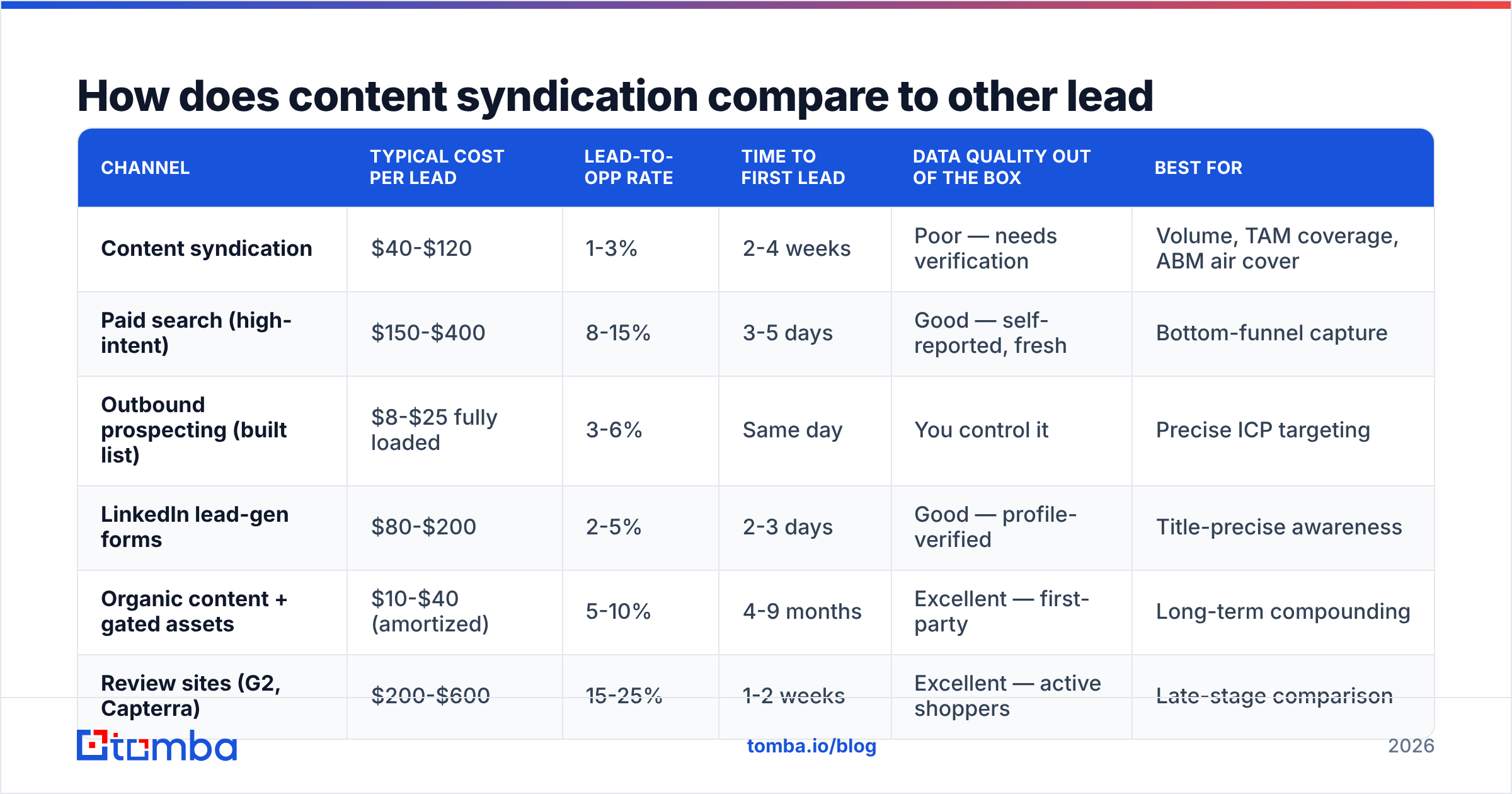
| Channel | Typical cost per lead | Lead-to-opp rate | Time to first lead | Data quality out of the box | Best for |
|---|---|---|---|---|---|
| Content syndication | $40-$120 | 1-3% | 2-4 weeks | Poor — needs verification | Volume, TAM coverage, ABM air cover |
| Paid search (high-intent) | $150-$400 | 8-15% | 3-5 days | Good — self-reported, fresh | Bottom-funnel capture |
| Outbound prospecting (built list) | $8-$25 fully loaded | 3-6% | Same day | You control it | Precise ICP targeting |
| LinkedIn lead-gen forms | $80-$200 | 2-5% | 2-3 days | Good — profile-verified | Title-precise awareness |
| Organic content + gated assets | $10-$40 (amortized) | 5-10% | 4-9 months | Excellent — first-party | Long-term compounding |
| Review sites (G2, Capterra) | $200-$600 | 15-25% | 1-2 weeks | Excellent — active shoppers | Late-stage comparison |
Read that table honestly and syndication looks mediocre on every column except one: TAM coverage. It's the only line item that reliably puts your brand in front of accounts that have never heard of you, at scale, without a two-year content flywheel. That's a real job. It's just not the job most people hire it for.
Where syndication genuinely earns its budget:
- ABM air cover. You have a 300-account target list. You need those specific accounts to have seen your point of view before your SDRs call. A tightly filtered syndication campaign delivers that.
- New-category education. Nobody is searching for your product because the category doesn't have a search volume yet. You have to interrupt.
- Sales-assist ammunition. "You downloaded our benchmark report last month — here's the section your peers are asking about." That's a legitimate opener when the download is real and recent.
What does a syndication campaign actually cost end to end?#
The CPL on the insertion order is the smallest number in the equation. Model the full stack.
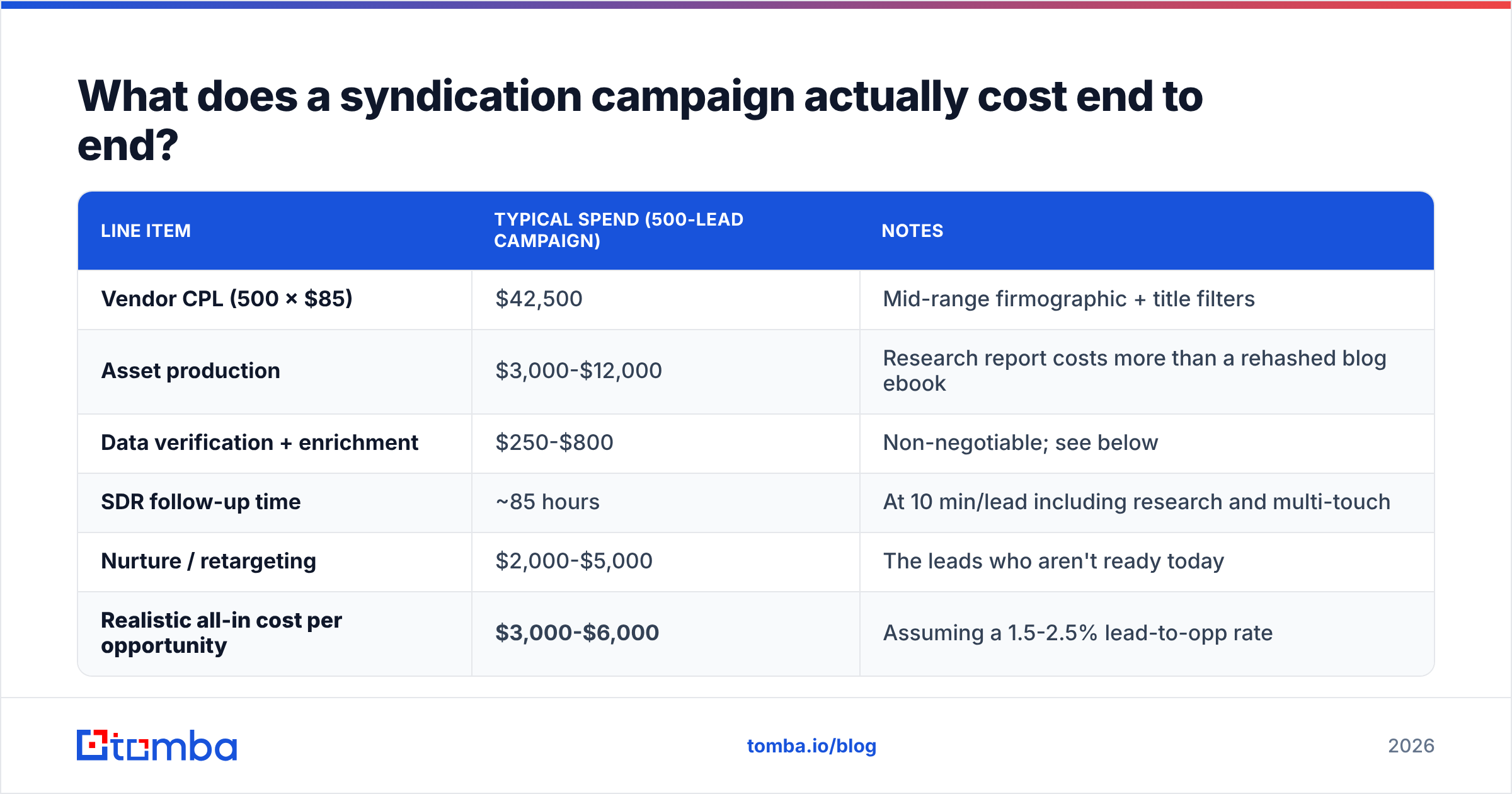
| Line item | Typical spend (500-lead campaign) | Notes |
|---|---|---|
| Vendor CPL (500 × $85) | $42,500 | Mid-range firmographic + title filters |
| Asset production | $3,000-$12,000 | Research report costs more than a rehashed blog ebook |
| Data verification + enrichment | $250-$800 | Non-negotiable; see below |
| SDR follow-up time | ~85 hours | At 10 min/lead including research and multi-touch |
| Nurture / retargeting | $2,000-$5,000 | The leads who aren't ready today |
| Realistic all-in cost per opportunity | $3,000-$6,000 | Assuming a 1.5-2.5% lead-to-opp rate |
If your average contract value is $8,000 and your all-in cost per opportunity is $4,500 with a 25% win rate, you're paying $18,000 to win $8,000. The channel is a loss.
If your ACV is $75,000, the same math is a clear win, and you should be buying more.
That single calculation kills more syndication debates than any vendor comparison ever will. Run it before you take the sales call.
How do you fix the data quality problem?#
You build a gate between the vendor and your CRM. Nothing enters the CRM until it clears the gate. This is the single highest-leverage change most teams can make to this channel.
The gate has four steps:
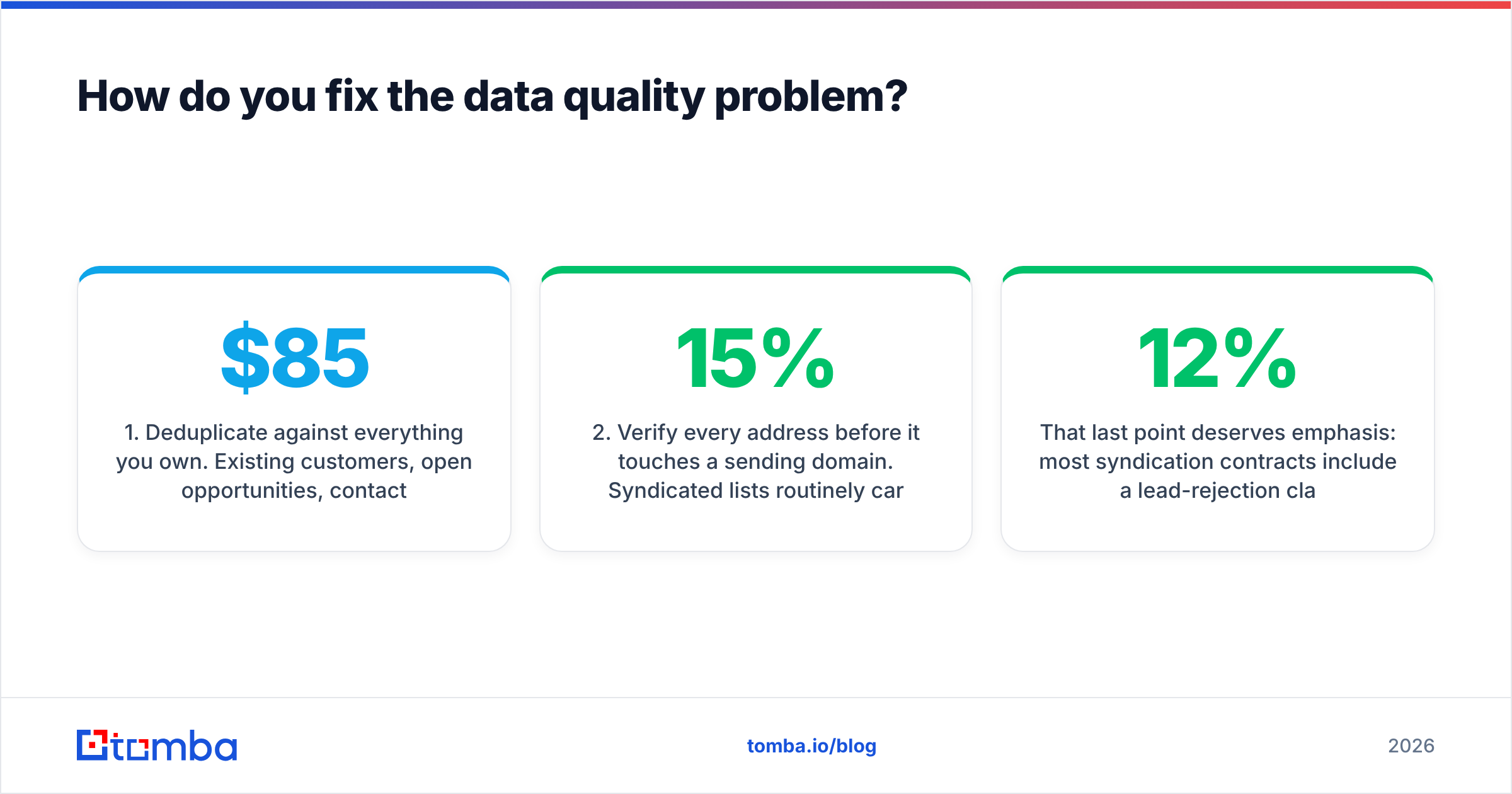
- Deduplicate against everything you own. Existing customers, open opportunities, contacts from the last 90 days, and prior syndication batches. It is extremely common to pay $85 for a record you already had. Run the vendor CSV through a deduplication pass before you look at anything else. Most teams find 10-20% overlap on the first batch and use it as a chargeback.
- Verify every address before it touches a sending domain. Syndicated lists routinely carry 8-15% invalid addresses. At that bounce rate you're not just wasting sends — you're actively damaging email deliverability for every other campaign on the domain. Run the batch through an email verifier, and handle catch-all domains explicitly with a catch-all verifier rather than guessing.
- Re-enrich the firmographics yourself. Don't trust the title, company size, or tech stack in the vendor file — those fields are where the fabrication happens. Independent data enrichment against a live source tells you whether "Director of Infrastructure at 500-person SaaS" is still true, or whether that person left for a 40-person startup eight months ago.
- Score, then route. Records that pass verification AND match your firmographic filter AND downloaded within the last 10 days go to an SDR. Everything else goes to nurture. Everything that fails verification gets logged and invoiced back to the vendor.
That last point deserves emphasis: most syndication contracts include a lead-rejection clause, and almost nobody uses it. You typically have 30 days to reject records that don't match the agreed criteria, and vendors are obligated to replace them. If 12% of your batch has invalid emails and 8% has titles outside your filter, that's a 20% replacement claim on a $42,500 order — $8,500 of leads you get back for free. Document it, submit it, every time. Vendors who know you audit will send you better data next campaign.

What does good follow-up on a syndicated lead look like?#
Fast, specific, and honest about how you got there.
The failure mode is a rep opening with "I saw you were interested in our solution" when the prospect downloaded a generic industry report from a publisher newsletter and has no memory of your brand. That opener destroys trust in one sentence, because it's transparently false and the prospect knows it.
The pattern that works:
- Touch within 48 hours. Download recency is the only real signal in the record. It decays fast. A lead worked on day 2 converts at multiples of the same lead worked on day 20.
- Name the asset, not the intent. "You picked up the 2026 Infrastructure Benchmark Report through [publisher]" is verifiable and disarming. "You expressed interest in our platform" is not.
- Lead with the asset's content, not your product. Pull one finding from the report that's relevant to their segment. Ask whether it matches what they're seeing. You're continuing a conversation the asset started, not starting a sales cycle.
- Multi-thread immediately. The downloader is often a researcher or an analyst, not the buyer. Use a domain search to map the rest of the buying committee at that account and run a coordinated sequence rather than betting everything on one record.
- Cap the sequence at 4-5 touches. These aren't inbound leads. Burning 12 touches on a cold downloader is how you get marked as spam.
- Recycle, don't discard. A no-reply syndicated lead is still an account that consumed your content. Push it to retargeting and to the nurture track. Some of the best pipeline from this channel arrives 6-9 months late.
For a deeper look at what response rates you should expect from these sequences, HubSpot's ongoing sales statistics research is a reasonable benchmark, and G2's category reviews are useful for vetting a specific syndication vendor's real-world reputation before you sign.
Should you build the list yourself instead?#
Often, yes — and the two approaches aren't mutually exclusive.
The uncomfortable comparison: a syndicated lead costs you $85 and arrives with unverified data, a stale title, and no buying intent. A self-built prospect costs a few cents in tooling, arrives with a verified address, a current title you sourced yourself, and exactly the same amount of buying intent — which is to say, none.
The syndicated lead has one advantage: the person raised their hand for something. That's not nothing. It's just worth far less than $85 minus a few cents.
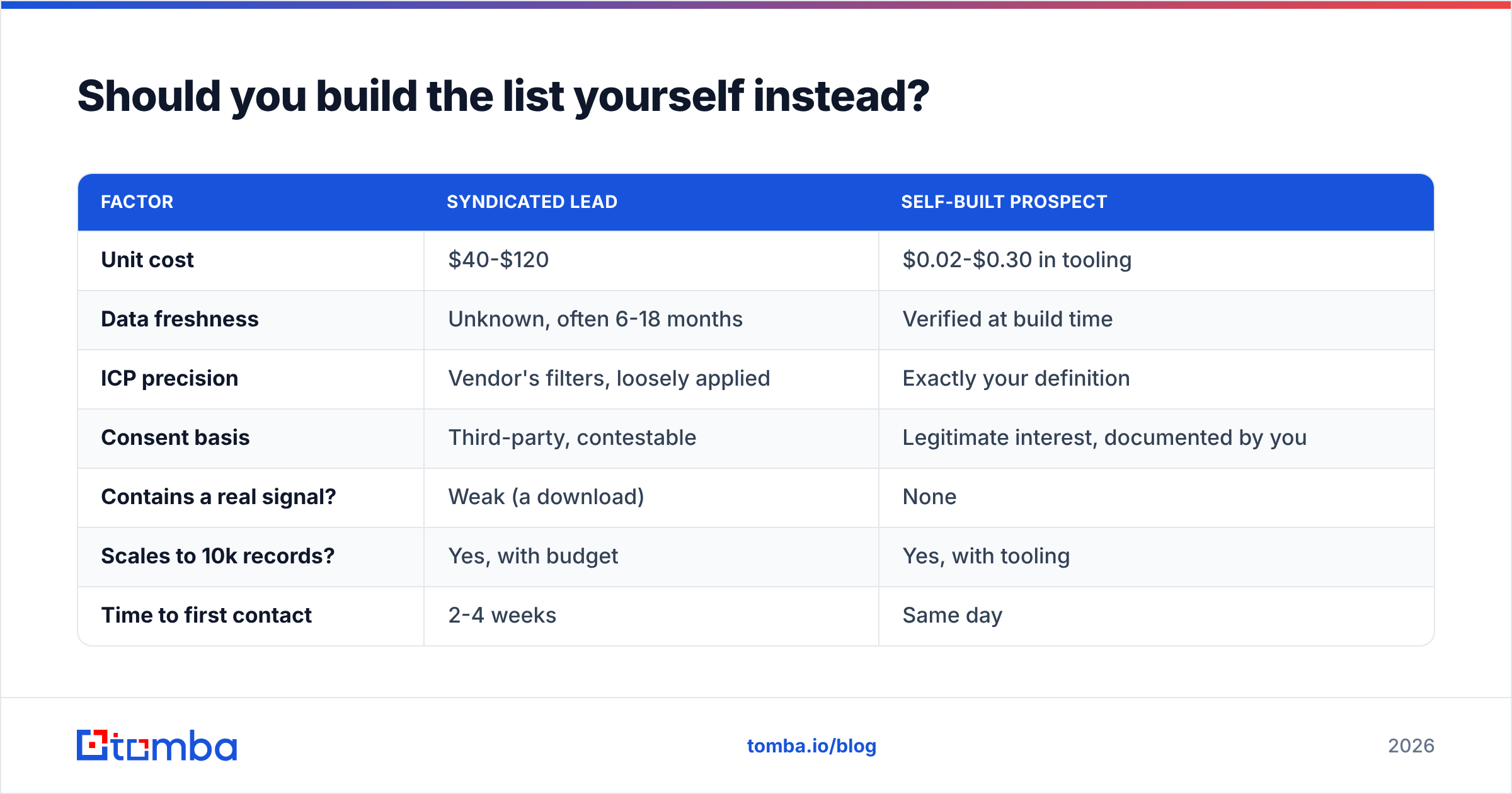
| Factor | Syndicated lead | Self-built prospect |
|---|---|---|
| Unit cost | $40-$120 | $0.02-$0.30 in tooling |
| Data freshness | Unknown, often 6-18 months | Verified at build time |
| ICP precision | Vendor's filters, loosely applied | Exactly your definition |
| Consent basis | Third-party, contestable | Legitimate interest, documented by you |
| Contains a real signal? | Weak (a download) | None |
| Scales to 10k records? | Yes, with budget | Yes, with tooling |
| Time to first contact | 2-4 weeks | Same day |
The teams getting the most out of this channel run both: syndication for air cover across the target account list, self-built prospecting for the precise people they actually need to reach inside those accounts. The syndicated download tells you an account is warm. Your own list-building tells you who to call.
That means your prospecting stack matters more than your vendor choice. If you're building lists directly, you'll want an email finder that returns a confidence score rather than a guess, plus bulk verification so a 3,000-row list doesn't take a week to clean.
How do you measure whether syndication is working?#
Not by MQL count. MQL count is the metric the vendor optimizes for, which is precisely why it's the wrong one for you.
Track these instead, per campaign and per vendor:
- Verified-record rate. What percentage of delivered records passed your email verification and firmographic re-check? Below 85% is a vendor problem, not a market problem.
- Contact rate. What percentage of verified records produced any human response? This isolates data quality from targeting quality.
- Lead-to-opportunity rate. The number that actually matters. Benchmark: 1-3% for standard syndication, up to 5% for tightly filtered intent-based programs. If a vendor is pitching 10%, ask for the raw campaign data.
- Cost per opportunity, fully loaded. Include SDR hours. Most teams don't, and it makes syndication look 3x better than it is.
- Vendor delta. Run two vendors against the same asset and the same filters, same month. The spread in verified-record rate between vendors is frequently 20+ points. That single test is worth more than any G2 grid.
Give a vendor one campaign and one honest audit. If the verified-record rate is under 80% and they push back on your replacement claim, walk. There are dozens of them and the switching cost is a week.
The bottom line#
Content syndication for lead generation is a legitimate channel with a well-earned bad reputation. It buys reach into accounts you can't otherwise touch, at a price that only makes sense above a certain ACV, and it delivers that reach in a format — a raw contact list of dubious quality — that punishes anyone who trusts it blindly.
Treat it as a media buy, not a lead source. Gate every record behind verification and enrichment. Invoice back what fails. Follow up within 48 hours, name the asset, and multi-thread the account. Measure cost per opportunity, not cost per MQL.
Do that, and the channel earns its place in the mix. Skip the gate, and you're paying $85 a record for the privilege of destroying your sending reputation.
Ready to fix the gate? The failure point in almost every syndication program is the gap between the vendor CSV and the CRM — invalid addresses, stale titles, and a downloader who isn't the buyer. Tomba's Email Finder closes it: verify every syndicated address before you send, re-enrich the firmographics against live sources, and map the rest of the buying committee at every account that downloaded your asset. Start free with 25 searches a month, or check Tomba pricing — Starter is $49/mo, which is less than the cost of a single wasted syndicated lead batch.
Related guides#
Ready to find emails that actually work?
Join 150,000+ professionals who stopped guessing and started sending. Free credits on signup — no credit card required.
Get the Tomba newsletter
Practical outbound tactics and product updates — once every two weeks.
About the author