Coresignal vs Apollo.io (2026): Which B2B Data Source Wins?
Coresignal sells raw firmographic and employee data by the record. Apollo.io sells a full prospecting suite. They rarely compete for the same buyer — here's how to tell which one you actually need.
TL;DR
- Coresignal is a data vendor, not a sales tool. It ships raw company, employee, and job-posting records via API or bulk delivery. There is no sequencer, no dialer, no Chrome extension for reps.
- Apollo.io is a full go-to-market suite. Contact database plus sequences, dialer, CRM sync, and enrichment — built for reps to use directly, not for engineers to pipe into a warehouse.
- They compete only in the middle. If your ask is "give me 200 verified emails for VPs of Engineering in fintech," Apollo wins. If it's "give me every job posting from 5M companies, refreshed weekly, into S3," Coresignal wins.
- Neither is a strong email-verification play. Coresignal doesn't verify at the mailbox level; Apollo's verified tier is decent but its bounce rates on cold segments still surprise people.
- The common ending: teams license Coresignal for signals and a dedicated email finder for deliverable contact data, because one tool rarely does both well.
What are Coresignal and Apollo.io, actually?#
They are not the same category of product, and most "Coresignal vs Apollo.io" comparisons blur that.
Coresignal is a B2B data-as-a-service company. Its business is scale and freshness of raw records: company profiles, employee profiles, job postings, funding events, and technographics, delivered as JSON via REST API or as bulk datasets you load into a warehouse. Coresignal's typical customer is a data engineer or a product team building something — an AI sales tool, an investment-screening model, a talent-intelligence platform. The company advertises hundreds of millions of employee records and millions of company records, refreshed on a rolling basis.
Apollo.io is a sales-execution platform with a contact database bolted to the front. Its typical customer is an SDR, an AE, or a small sales team. You search for people, pull their emails and phone numbers, drop them into a sequence, and Apollo sends the emails and logs the activity in your CRM. Apollo claims north of 200M contacts and 30M+ companies.
The mental model: Coresignal is the water utility. Apollo is the kitchen — pipes, faucet, sink, and dishwasher included. You do not compare a utility to a kitchen on "which is better." You compare them on what you're trying to build.

How do Coresignal and Apollo.io compare on the specs that matter?#
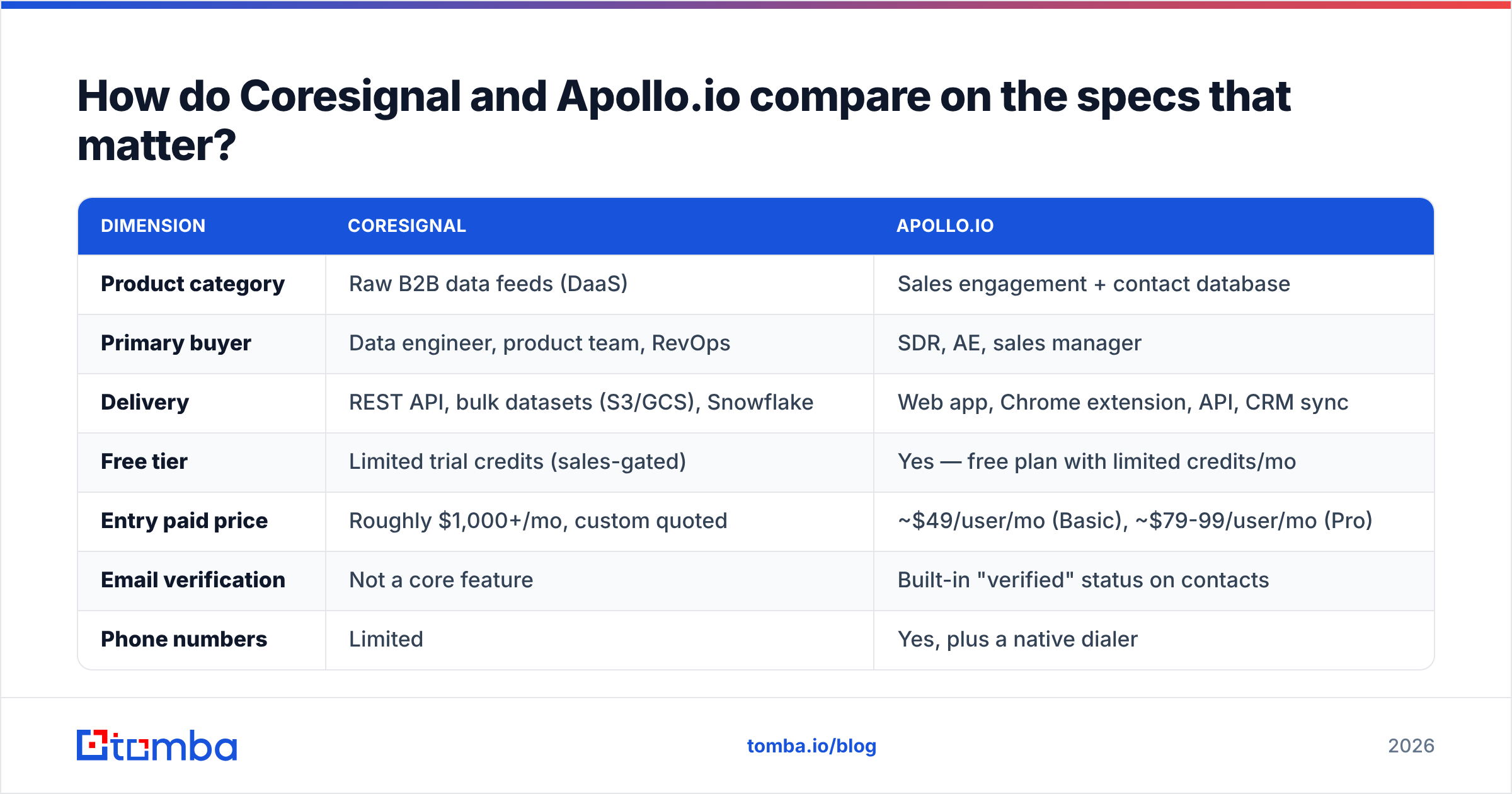
Here's the head-to-head on the dimensions buyers actually evaluate. Figures reflect publicly listed positioning as of 2026; both vendors quote custom pricing above their entry tiers, so treat the numbers as directional.
| Dimension | Coresignal | Apollo.io |
|---|---|---|
| Product category | Raw B2B data feeds (DaaS) | Sales engagement + contact database |
| Primary buyer | Data engineer, product team, RevOps | SDR, AE, sales manager |
| Delivery | REST API, bulk datasets (S3/GCS), Snowflake | Web app, Chrome extension, API, CRM sync |
| Free tier | Limited trial credits (sales-gated) | Yes — free plan with limited credits/mo |
| Entry paid price | Roughly $1,000+/mo, custom quoted | ~$49/user/mo (Basic), ~$79-99/user/mo (Pro) |
| Email verification | Not a core feature | Built-in "verified" status on contacts |
| Phone numbers | Limited | Yes, plus a native dialer |
| Sequences / outreach | None | Yes — core product |
| Job-posting data | Yes, a flagship dataset | Limited / signal-level only |
| Best for | Building a product or model on top of data | Running outbound today, no engineering |
The table makes the split obvious. Apollo has more surface area for a rep. Coresignal has more depth for a builder. Pick the axis you're optimizing for and the answer usually falls out.
Is Coresignal's data actually better than Apollo's?#
On breadth of raw signal, yes. On deliverable contact data, no — and that's the trap.
Coresignal's strength is observational data: where a person works, what their title is, when they changed jobs, what a company is hiring for, what tech it runs. That data is scraped and structured at scale, refreshed on a schedule, and useful for building scoring models or intent signals. If you want to know that a Series B fintech just posted three infrastructure-engineer roles, Coresignal will tell you. That is genuinely hard to get anywhere else at that volume.
What Coresignal does not do is tell you whether jane.doe@acme.com will bounce. It supplies contact fields in some datasets, but mailbox-level validation is not its product. If you take raw records and mail them cold, you will find out the hard way.
Apollo's contact data is the other shape. It is narrower — fewer exotic fields, less historical depth — but it is oriented toward usability: a "verified" flag, phone numbers, and a UI that lets a rep pull 50 leads before their first coffee. In practice, Apollo's verified-email accuracy is solid on well-covered segments (US mid-market SaaS, tech titles) and mediocre outside them (SMB, non-English markets, operations and trades roles). Independent user reviews on G2 repeatedly flag the same pattern: great coverage where everyone else also has coverage, thin where you actually needed the edge.
The upshot for most teams: use Coresignal (or Apollo) to find and prioritize accounts, then run the resulting contacts through a dedicated email verifier before they ever hit a sending domain. Treating either platform's export as pre-cleaned is how bounce rates climb past 5% and email deliverability starts to slide.
What does each one actually cost in 2026?#
Coresignal is an enterprise-shaped purchase. Apollo is a credit-card purchase.
Coresignal's pricing is quote-based and scales with record volume, dataset count, and refresh cadence. Realistic entry points land in the four-figure-per-month range once you're past a trial, and annual contracts are the norm. There's no meaningful path for a two-person team to "just try it" — the sales motion assumes you know your record volumes in advance.
Apollo is self-serve. A free plan exists with limited monthly credits. Paid tiers are per-seat, roughly $49/user/mo at the entry level and $79-99/user/mo for the tier where the useful export limits and sequence volume actually live. Costs balloon in two places people underestimate: per-seat pricing when the team grows, and credit consumption when reps bulk-export instead of targeting.
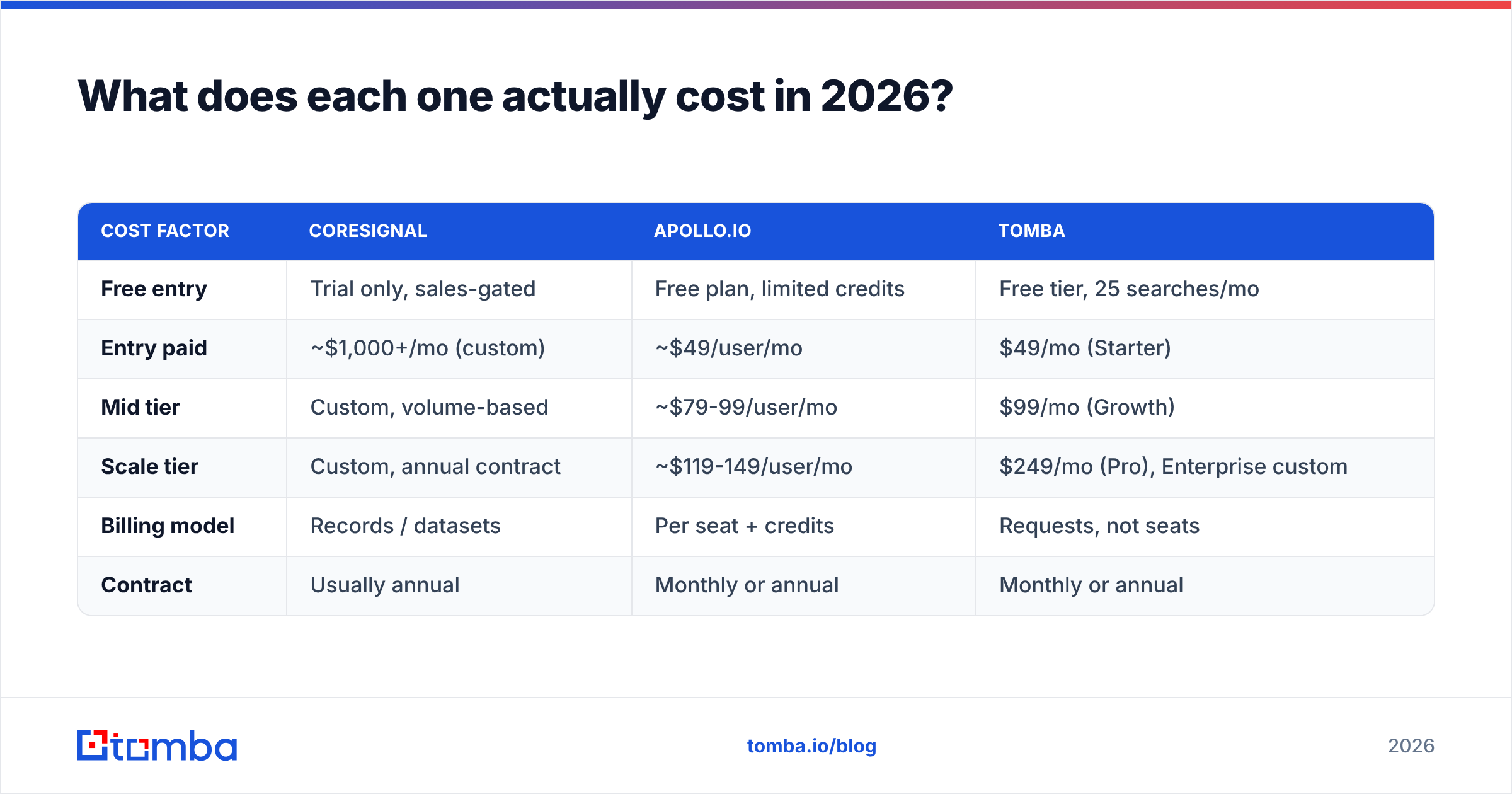
| Cost factor | Coresignal | Apollo.io | Tomba |
|---|---|---|---|
| Free entry | Trial only, sales-gated | Free plan, limited credits | Free tier, 25 searches/mo |
| Entry paid | ~$1,000+/mo (custom) | ~$49/user/mo | $49/mo (Starter) |
| Mid tier | Custom, volume-based | ~$79-99/user/mo | $99/mo (Growth) |
| Scale tier | Custom, annual contract | ~$119-149/user/mo | $249/mo (Pro), Enterprise custom |
| Billing model | Records / datasets | Per seat + credits | Requests, not seats |
| Contract | Usually annual | Monthly or annual | Monthly or annual |
The structural difference worth internalizing: Coresignal and Apollo both meter something that grows with your success. Coresignal meters records. Apollo meters seats and credits. If you're a five-person team that needs accurate emails and not much else, both models overcharge you relative to a request-metered email finder. See Tomba pricing for the comparison.
Which one should you choose for your use case?#
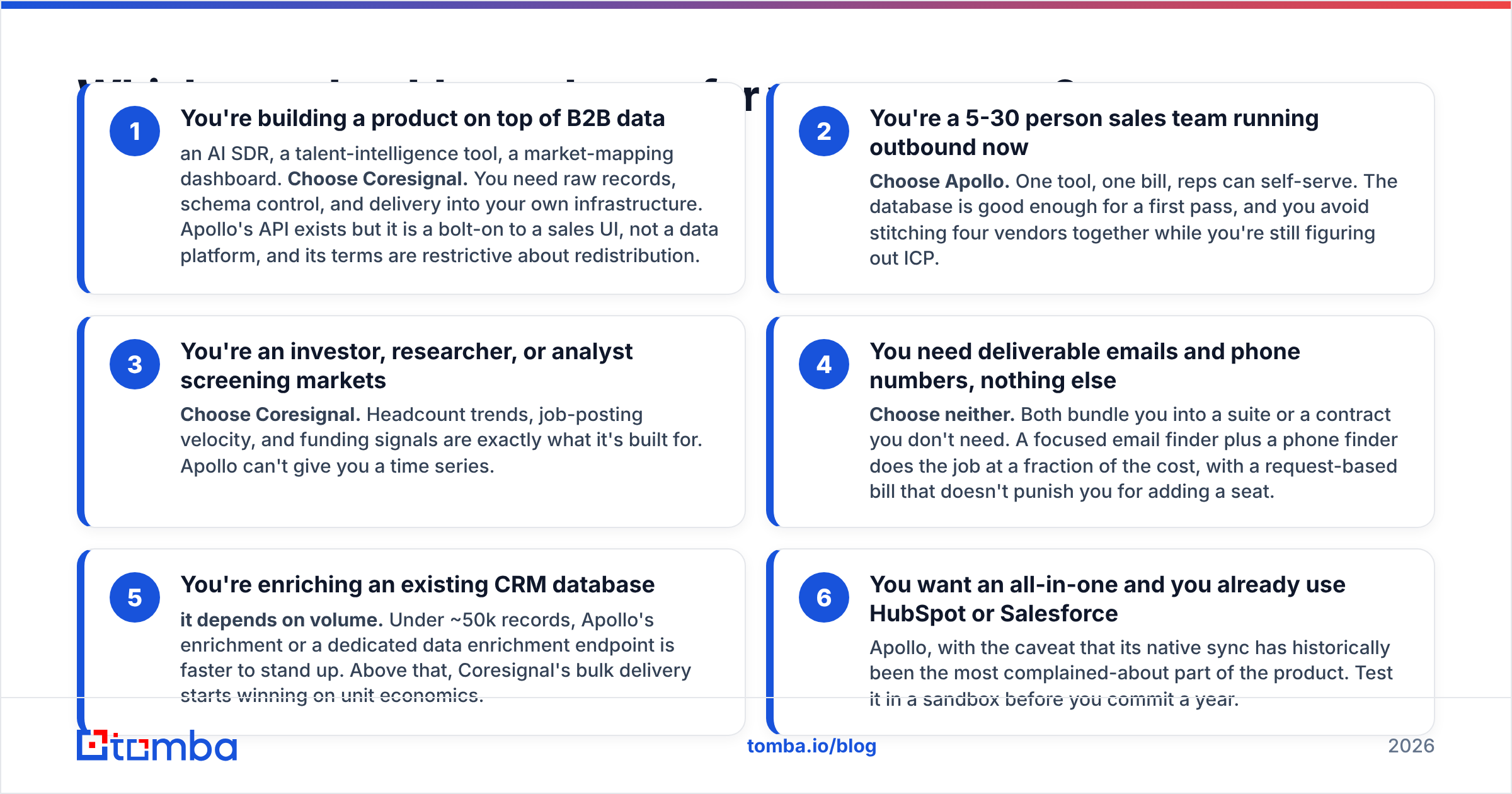
Skip the feature grid and answer one question: are you building something, or are you selling something today?
You're building a product on top of B2B data — an AI SDR, a talent-intelligence tool, a market-mapping dashboard. Choose Coresignal. You need raw records, schema control, and delivery into your own infrastructure. Apollo's API exists but it is a bolt-on to a sales UI, not a data platform, and its terms are restrictive about redistribution.
You're a 5-30 person sales team running outbound now — Choose Apollo. One tool, one bill, reps can self-serve. The database is good enough for a first pass, and you avoid stitching four vendors together while you're still figuring out ICP.
You're an investor, researcher, or analyst screening markets — Choose Coresignal. Headcount trends, job-posting velocity, and funding signals are exactly what it's built for. Apollo can't give you a time series.
You need deliverable emails and phone numbers, nothing else — Choose neither. Both bundle you into a suite or a contract you don't need. A focused email finder plus a phone finder does the job at a fraction of the cost, with a request-based bill that doesn't punish you for adding a seat.
You're enriching an existing CRM database — it depends on volume. Under ~50k records, Apollo's enrichment or a dedicated data enrichment endpoint is faster to stand up. Above that, Coresignal's bulk delivery starts winning on unit economics.
You want an all-in-one and you already use HubSpot or Salesforce — Apollo, with the caveat that its native sync has historically been the most complained-about part of the product. Test it in a sandbox before you commit a year.
Where does each tool actually fall down?#
Every honest comparison has this section. Here are the real complaints, not the marketing-adjacent ones.
Coresignal's weak points:
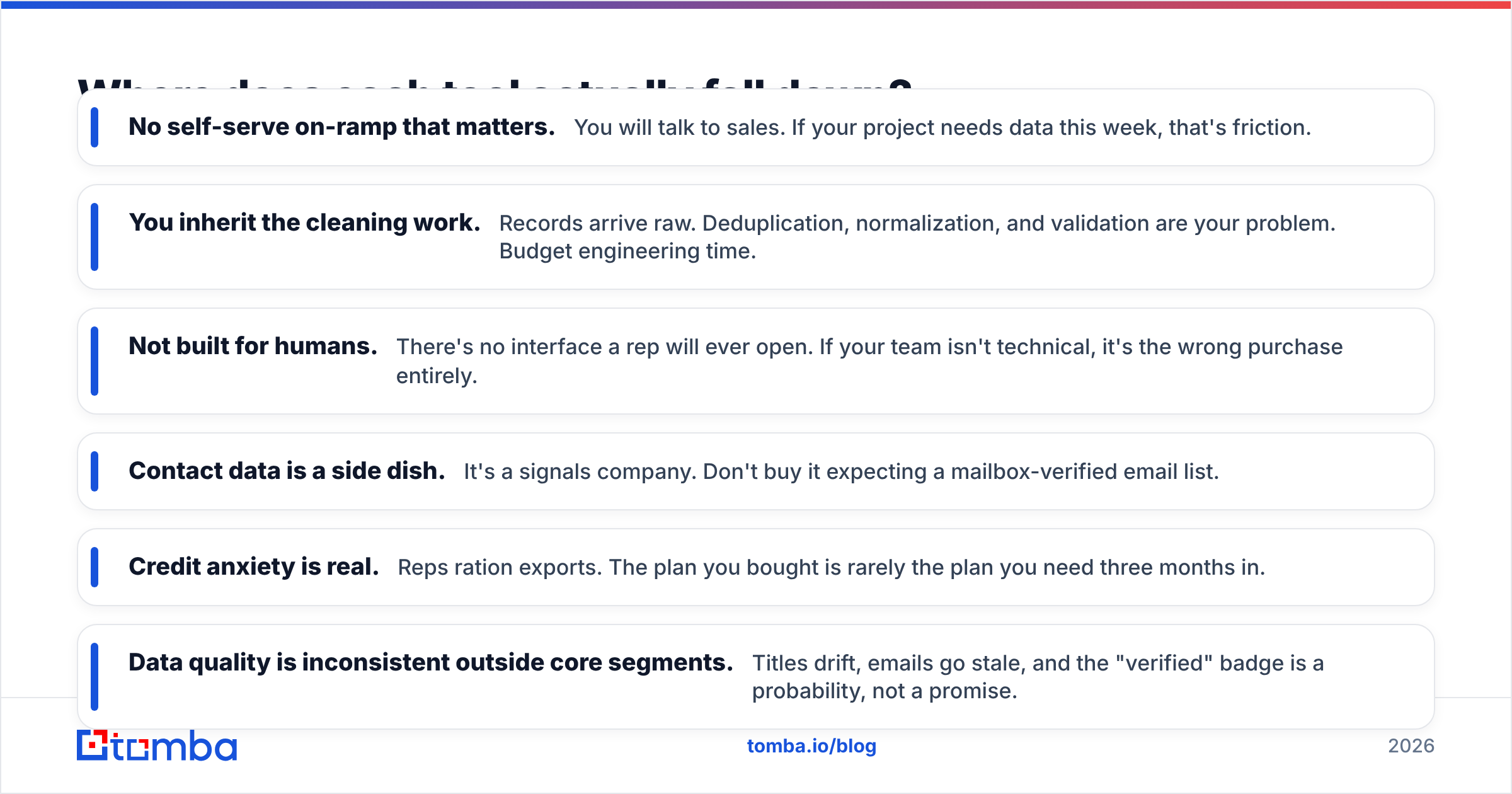
- No self-serve on-ramp that matters. You will talk to sales. If your project needs data this week, that's friction.
- You inherit the cleaning work. Records arrive raw. Deduplication, normalization, and validation are your problem. Budget engineering time.
- Not built for humans. There's no interface a rep will ever open. If your team isn't technical, it's the wrong purchase entirely.
- Contact data is a side dish. It's a signals company. Don't buy it expecting a mailbox-verified email list.
Apollo.io's weak points:
- Credit anxiety is real. Reps ration exports. The plan you bought is rarely the plan you need three months in.
- Data quality is inconsistent outside core segments. Titles drift, emails go stale, and the "verified" badge is a probability, not a promise.
- Deliverability from a shared sending stack. Sending through Apollo's infrastructure puts your sender reputation partly in a shared pool's hands. Many teams end up moving sending elsewhere.
- It wants to be everything. The sequencer is fine. The dialer is fine. Nothing is best-in-class, and that's the trade you're making.
If you're evaluating Apollo specifically because of the database and not the sequencer, it's worth reading through the Apollo alternative breakdown — the unbundled version is usually cheaper and more accurate.

Can you use both — and should you?#
Yes, and mature data teams often do. The pattern looks like this:
- Coresignal feeds the top of the funnel: which accounts are hiring, growing, raising, or changing tech. That's the trigger layer, sitting in your warehouse.
- A dedicated finder/verifier turns qualified accounts into deliverable contacts. Run domain search against the target company, pull the pattern, verify the mailbox.
- A sending tool (which may or may not be Apollo) executes.
The mistake is trying to make one vendor do all three. Coresignal will not give you clean, deliverable inboxes. Apollo will not give you a time-series of job postings across 5M companies. Buying either as a substitute for the other produces a system that half-works and a bill you can't justify at renewal.
For teams that don't need warehouse-scale signal data, the simpler stack is a focused finder plus a verifier plus whatever sequencer you already like. It's fewer moving parts and the data quality is under your control at each step.
What's the verdict on Coresignal vs Apollo.io?#
Coresignal wins if you're building. Apollo wins if you're selling. If you just need accurate contact data, neither is the efficient answer.
Coresignal is the better data company by a wide margin — depth, freshness, and delivery options that Apollo doesn't attempt. But it demands engineering, a sales cycle, and a budget that starts where Apollo's ends.
Apollo is the better product for a working sales team. It's fast to adopt, cheap to start, and covers the whole workflow. But you pay for it in credit limits, per-seat creep, and a database that's excellent in the middle of the market and shaky at the edges.
And if your honest requirement is "I need emails that land," you're buying a $1,000/mo data contract or a per-seat suite to solve a problem that a focused tool solves better. That's the third option most comparisons never mention.
Ready to stop paying for data you don't use?#
If what you actually need is deliverable B2B contact data — not a warehouse feed, not a sequencer you'll replace in six months — start with the Tomba Email Finder. Find emails by domain, name, or company; verify them before you send; pull them through the Tomba API, a Chrome extension, or Google Sheets. Pricing starts free (25 searches/mo) and scales at $49/mo, billed on requests rather than seats — so your bill doesn't grow just because your team did. Try it against your hardest 50 accounts and compare the bounce rate to whatever you're using now.
Related guides#
Ready to find emails that actually work?
Join 150,000+ professionals who stopped guessing and started sending. Free credits on signup — no credit card required.
Get the Tomba newsletter
Practical outbound tactics and product updates — once every two weeks.
About the author