21 Creative Sales Contest Ideas That Actually Drive Revenue
Most sales contests reward noise: more dials, more sends, more nothing. Here are 21 creative sales contest ideas built on metrics reps can actually control — plus the prize structures, rules, and data hygiene that keep them from being gamed.
Most sales contests fail for the same boring reason: they reward the metric that's easiest to count, not the behavior that's hardest to sustain. Run a "most dials this week" contest and you'll get more dials — 40% of them to disconnected numbers, half of them 8 seconds long. The leaderboard looks great. The pipeline doesn't move.
This guide covers 21 creative sales contest ideas that hold up under scrutiny, the prize structures that make them worth playing, and the rules that stop your best rep from quietly farming the scoreboard.
TL;DR#
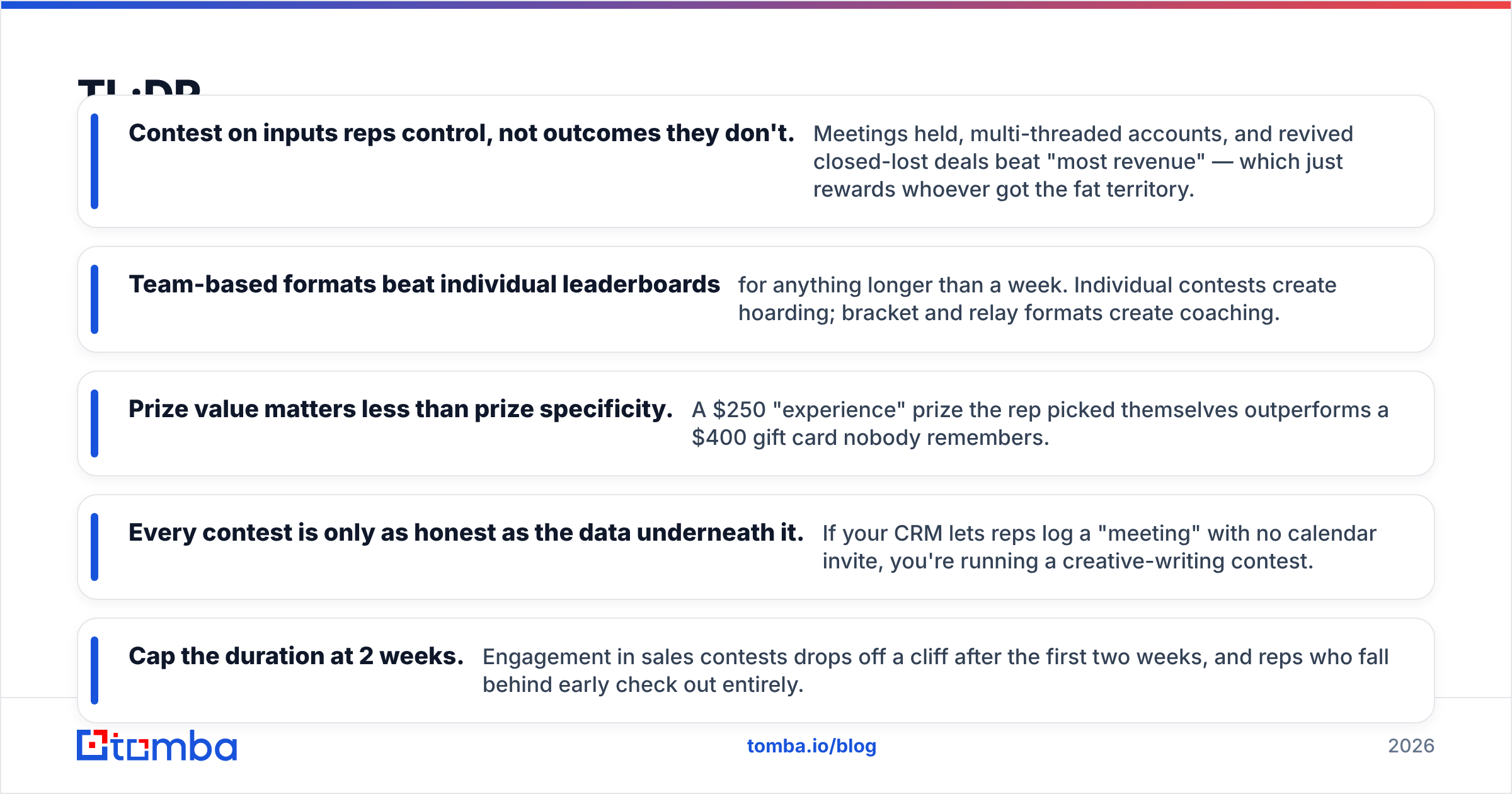
- Contest on inputs reps control, not outcomes they don't. Meetings held, multi-threaded accounts, and revived closed-lost deals beat "most revenue" — which just rewards whoever got the fat territory.
- Team-based formats beat individual leaderboards for anything longer than a week. Individual contests create hoarding; bracket and relay formats create coaching.
- Prize value matters less than prize specificity. A $250 "experience" prize the rep picked themselves outperforms a $400 gift card nobody remembers.
- Every contest is only as honest as the data underneath it. If your CRM lets reps log a "meeting" with no calendar invite, you're running a creative-writing contest.
- Cap the duration at 2 weeks. Engagement in sales contests drops off a cliff after the first two weeks, and reps who fall behind early check out entirely.
Why do most sales contests fail?#
Three failure modes, in order of frequency.
They measure the wrong thing. Revenue-based contests concentrate the prize with whoever has the biggest accounts or the luckiest renewal timing. Activity-based contests reward volume and punish judgment. Neither changes behavior — one rewards territory, the other rewards spam.
They're won too early. If your top performer builds an unassailable lead by day three, everyone else stops playing on day four. You've now paid a bonus to the rep who needed the motivation least, and demotivated the other eleven.
They're gameable. Any metric a rep can self-report is a metric a rep can inflate. This is not a character flaw; it's a system design flaw. Gartner's research on sales performance management consistently lands on the same point — incentives shape behavior far more reliably than intentions do, including the behaviors you didn't intend.
The fix for all three: pick metrics that are (a) inside the rep's control, (b) verified by a system, not a self-report, and (c) structured so a laggard on day 5 can still win on day 10.
What makes a sales contest metric worth using?#
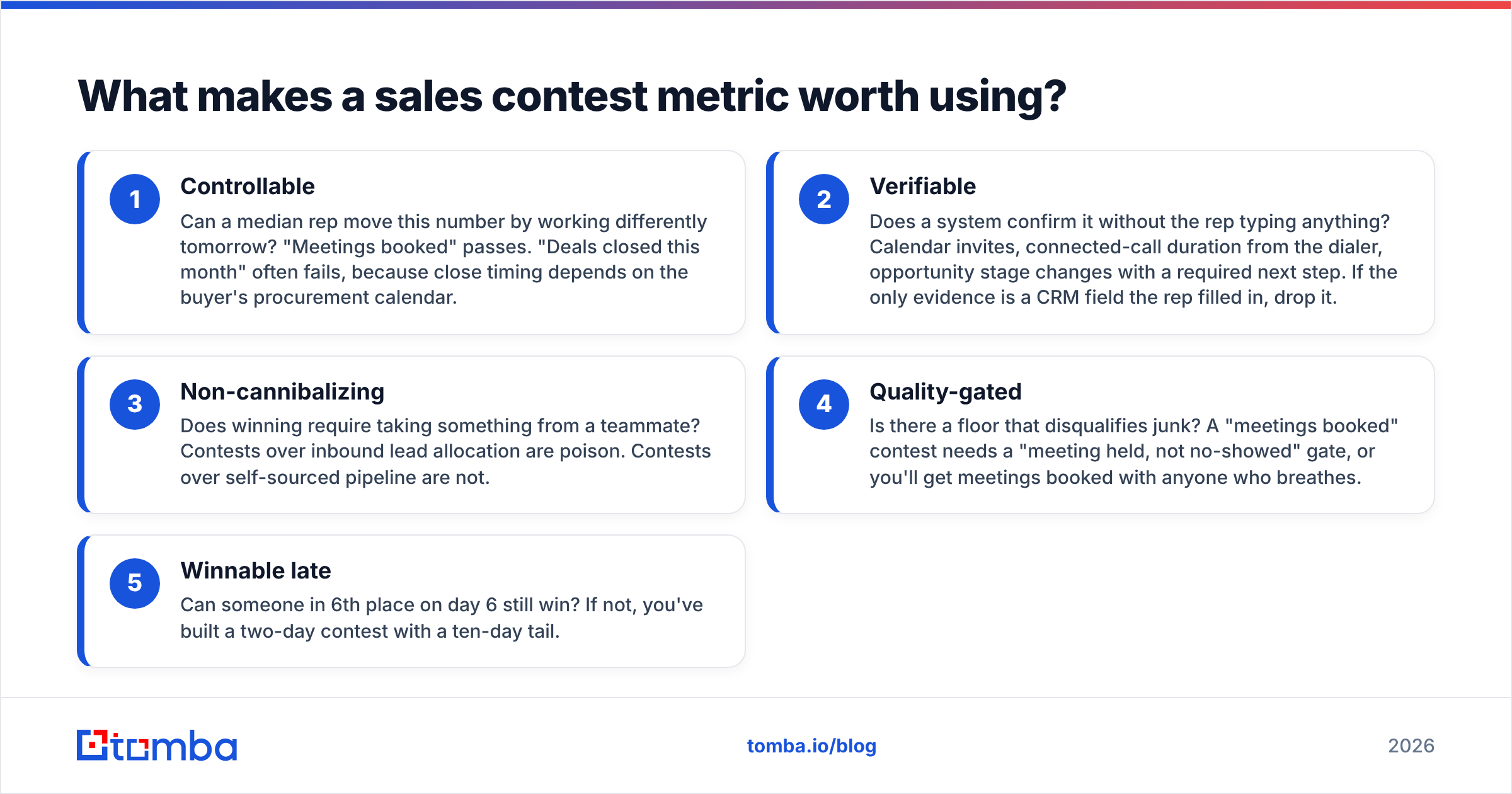
Run every candidate metric through these five checks before it goes on a leaderboard.
- Controllable — Can a median rep move this number by working differently tomorrow? "Meetings booked" passes. "Deals closed this month" often fails, because close timing depends on the buyer's procurement calendar.
- Verifiable — Does a system confirm it without the rep typing anything? Calendar invites, connected-call duration from the dialer, opportunity stage changes with a required next step. If the only evidence is a CRM field the rep filled in, drop it.
- Non-cannibalizing — Does winning require taking something from a teammate? Contests over inbound lead allocation are poison. Contests over self-sourced pipeline are not.
- Quality-gated — Is there a floor that disqualifies junk? A "meetings booked" contest needs a "meeting held, not no-showed" gate, or you'll get meetings booked with anyone who breathes.
- Winnable late — Can someone in 6th place on day 6 still win? If not, you've built a two-day contest with a ten-day tail.
Most vanity metrics die at check 2 or check 4. That's the whole point of running them through the list.
What are the best creative sales contest ideas?#
Grouped by what you're actually trying to fix.
Pipeline creation contests#
- The Ghost Hunt — Points for reviving a closed-lost or gone-dark opportunity into an active stage with a booked next step. Highest points for the deal that's been dead longest. This mines the value already sitting in your CRM instead of asking reps to generate net-new activity from nothing.
- Multi-Thread Bingo — A 5x5 card. Each square is a persona or department (VP Finance, Security reviewer, end-user champion, procurement, exec sponsor). Reps mark a square when they get a documented, two-way email or call with that persona inside a target account. Lines and blackouts win. Directly attacks single-threaded deals, which is the number-one cause of late-stage slippage.
- The Cold Start — Every rep gets the same set of 25 accounts with zero prior contact. Whoever books the most first meetings from the identical list wins. Because the input is standardized, this is the only format that tells you anything real about individual prospecting skill.
- Rip the Territory — Reps swap their five most-neglected accounts with a teammate. Points for anything the new owner unlocks. It reframes "my dead account" as "someone else's fresh look," and it usually exposes that the account wasn't dead — it was just unworked.
- Source Diversity Sprint — Points awarded per channel, with diminishing returns. First meeting from email = 3 points, from a call = 3, from LinkedIn = 3, from a referral = 5, from an event follow-up = 5 — but only the first two of each channel count at full value. Forces reps out of their single-channel comfort zone.
Conversation-quality contests#
- The Discovery Gauntlet — Managers score one recorded call per rep per week against a fixed rubric (pain quantified, budget authority mapped, next step agreed, competition identified). Highest average score wins, not highest volume. If you use a conversation-intelligence tool, the scoring is nearly free; if not, one manager-hour per week covers a team of eight.
- Best Objection Save — Reps nominate their own recorded moment where they turned a hard "no" into a next step. Team votes. The prize is small; the artifact — a library of real saves in your reps' voices — is the actual payoff.
- The Two-Minute Rule — Points for every discovery call where the rep talks less than 45% of the time, verified by call recording talk-ratio data. Nothing improves discovery faster than making silence competitive.
- Question of the Week — A single new discovery question is introduced Monday. Reps get a point every time they land it on a live call and log the buyer's answer. By Friday you've A/B tested a question across 200 conversations.
Follow-through and hygiene contests#
- Zero Inbox, Zero Excuses — Points for every inbound lead contacted within 5 minutes, verified by timestamp. Speed-to-lead is one of the most durable findings in B2B sales, and it's a metric no rep can argue with.
- The Next-Step Audit — At the end of each day, every open opportunity must have a scheduled, dated next step with a named attendee. Points for a clean board. Deduct points for stale ones. Boring. Enormously effective.
- Data Bounty — Points for every corrected or enriched contact record: a bounced email replaced with a verified one, a missing direct dial added, a title updated after a job change. Pair this with a proper email verifier so "corrected" means actually deliverable rather than freshly guessed.
Team and morale contests#
- The Bracket — March Madness format. Reps seeded, head-to-head weekly matchups on a rotating metric. Losers get eliminated but join the winners' "coaching corner," so nobody sits out.
- Relay Race — Team members must complete stages in sequence: rep A sources the account, rep B books the meeting, rep C runs discovery, rep D closes. The whole chain shares the prize. Painful to administer, unmatched for breaking down SDR/AE friction.
- Manager's Choice Wildcard — One prize per week, criteria undisclosed until Friday, awarded for something that isn't on any leaderboard: the hardest call someone made, the best-written follow-up, the rep who covered for a teammate. Keeps the culture from becoming purely mercenary.
- Fantasy Sales League — Reps draft each other. You score points when your drafted teammates hit their numbers. Instant peer coaching, because now everyone has skin in someone else's quarter.
Off-the-wall formats that actually work#
- The Pitch Slam — 90 seconds, no slides, live audience. Reps pitch a randomly assigned persona. Peer-voted.
- Bounty Board — A public list of named dream accounts, each with a bounty. Anyone can claim one, first meeting wins the bounty. Nobody owns the account until they crack it.
- The Reverse Contest — Points for the most instructive loss written up and shared. Kills the incentive to hide bad news, which is worth more than any prize you'll pay out.
- Snake Draft Prizes — Winners don't get a fixed prize; they pick from a prize pool in finishing order. Second place still gets to choose. Radically increases participation from the middle of the pack.
- The Comeback — Scored on improvement against the rep's own trailing 30-day average, not absolute output. The only format where your newest rep can beat your best one, and the only one that reliably lifts the bottom third.
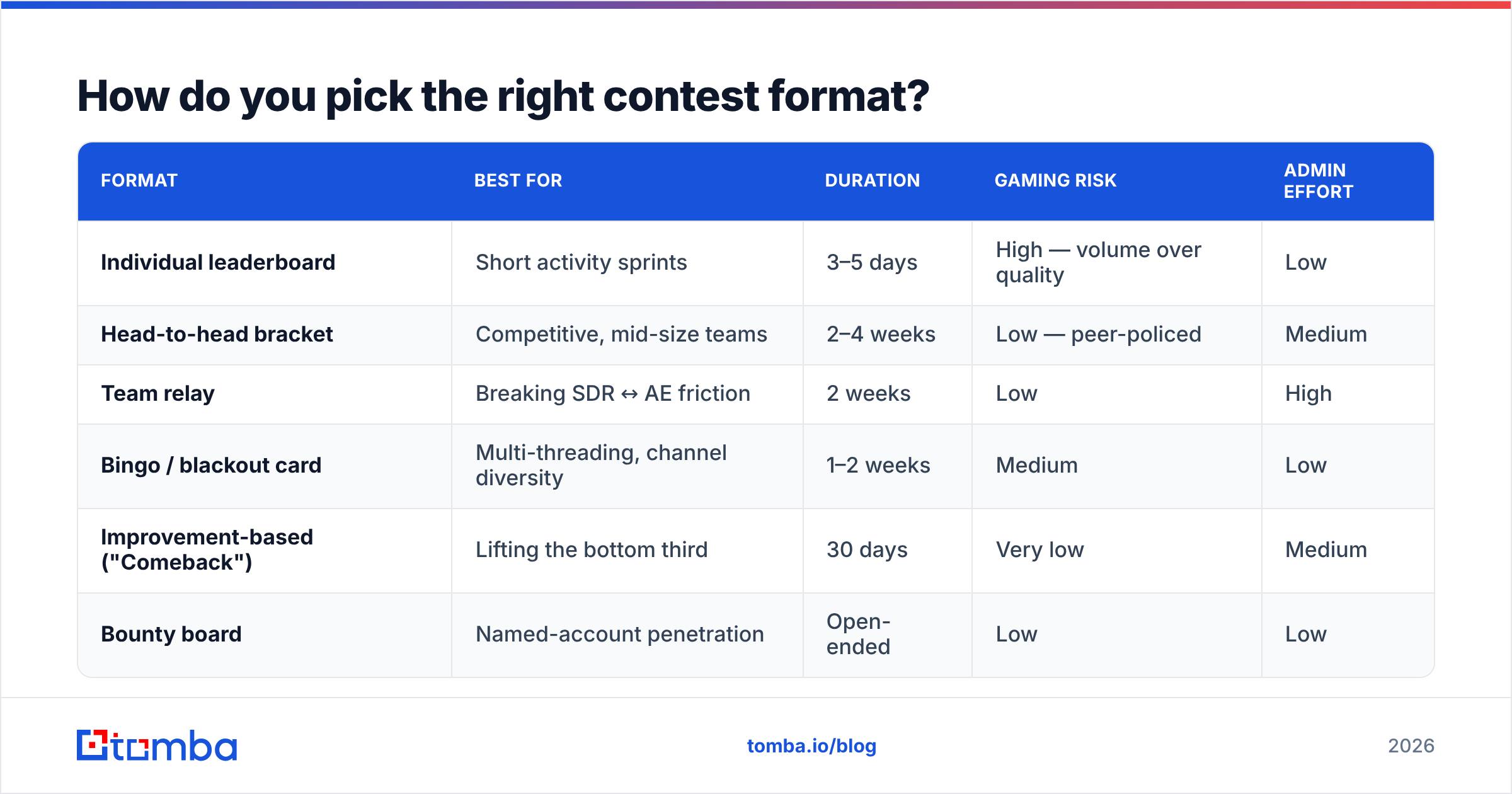
How do you pick the right contest format?#
| Format | Best for | Duration | Gaming risk | Admin effort |
|---|---|---|---|---|
| Individual leaderboard | Short activity sprints | 3–5 days | High — volume over quality | Low |
| Head-to-head bracket | Competitive, mid-size teams | 2–4 weeks | Low — peer-policed | Medium |
| Team relay | Breaking SDR ↔ AE friction | 2 weeks | Low | High |
| Bingo / blackout card | Multi-threading, channel diversity | 1–2 weeks | Medium | Low |
| Improvement-based ("Comeback") | Lifting the bottom third | 30 days | Very low | Medium |
| Bounty board | Named-account penetration | Open-ended | Low | Low |
The pattern: individual leaderboards are cheap to run and the easiest to abuse. Bracket and improvement formats cost more to administer and produce better behavior. If you only run one contest per quarter, run a bracket. If you run one per month, alternate formats so reps can't build a playbook for the same game.
What should you actually give away?#
Prize research from sales-management practitioners keeps landing on the same conclusion, and it's counterintuitive: specificity beats value. A $200 prize the rep chose beats a $350 prize the company chose, because a chosen prize is a story and a gift card is a rounding error on their paycheck.
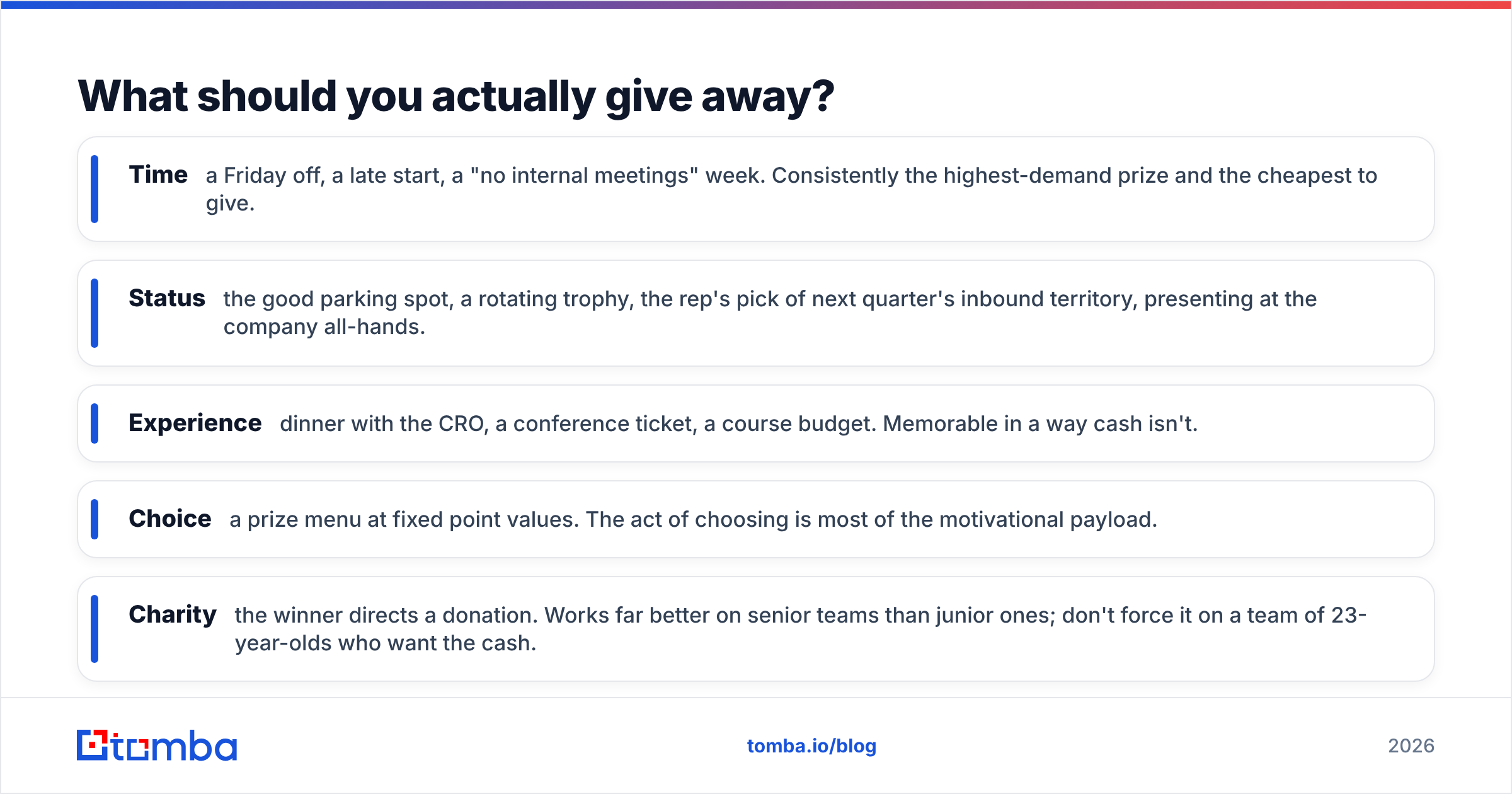
- Time — a Friday off, a late start, a "no internal meetings" week. Consistently the highest-demand prize and the cheapest to give.
- Status — the good parking spot, a rotating trophy, the rep's pick of next quarter's inbound territory, presenting at the company all-hands.
- Experience — dinner with the CRO, a conference ticket, a course budget. Memorable in a way cash isn't.
- Choice — a prize menu at fixed point values. The act of choosing is most of the motivational payload.
- Charity — the winner directs a donation. Works far better on senior teams than junior ones; don't force it on a team of 23-year-olds who want the cash.
Cash bonuses aren't wrong, they're just inefficient. Reps mentally file cash under compensation, not recognition, so the motivational half-life is roughly one pay cycle. HubSpot's sales team research has covered this ground repeatedly — recognition and autonomy outrank incremental cash for most quota-carrying roles.
How do you stop reps from gaming the contest?#
Assume they will. Design accordingly.
Gate on quality, not just quantity. "Meetings booked" becomes "meetings held with a qualified contact." A meeting with an intern at a 12-person company doesn't count.
Verify with systems, not self-reports. Calendar invite, call recording, opportunity stage change, email reply. If a rep can create the evidence by typing into a field, the metric is dead on arrival.
Publish the disqualification rules up front. "Any meeting that no-shows is subtracted, not neutral." Reps will respect a rule they knew about. They will resent one you invented after they were winning.
Clean the underlying data first. This is the part most managers skip. If a third of your contact list bounces, a "most emails sent" contest is measuring who's best at hitting a wall. Verify the list before the contest starts — run it through a bulk email finder and a verification pass so everyone competes on the same quality of data. Reputable B2B data sources — from purpose-built providers like BookYourData through to real-time lookup tools — all decay at roughly 2–3% per month, so "we bought this list last year" is not a defense.
Cap the ceiling. Diminishing returns after a threshold (full points for the first 10, half points after) prevents a single rep from running away with it and prevents a burnout sprint that costs you the next two weeks of output.
How long should a sales contest run?#
Two weeks, with a hard reset. Short enough that nobody checks out, long enough that a bad Monday isn't fatal.
If you want a quarter-long program, don't run a quarter-long contest — run six two-week contests with different formats and a season-long points total. Reps who fall out of contention in contest #2 come back for #3. Comparing sales-engagement platforms on G2 will show you a dozen tools that automate leaderboard tracking; none of them will save a contest with a bad metric or a twelve-week runtime.
Run the contest on data that can survive it#
Every idea on this list assumes one thing: the contacts your reps are competing over are real. Bounced emails, disconnected numbers, and prospects who changed jobs eight months ago will quietly wreck any leaderboard you build — and the rep who wins will be the one who happened to draw the cleanest slice of the list.
Fix the input before you incentivize the output. Use the Tomba Email Finder to source verified, deliverable contacts by domain, name, or company, so a "meetings booked" contest measures prospecting skill rather than list luck. The free tier gives you 25 searches a month to test the workflow; Tomba plans start at $49/mo for Starter and scale to Growth at $99/mo when the whole team is running on it. Clean list, honest contest, real pipeline — in that order.
Related guides#
Ready to find emails that actually work?
Join 150,000+ professionals who stopped guessing and started sending. Free credits on signup — no credit card required.
Get the Tomba newsletter
Practical outbound tactics and product updates — once every two weeks.
About the author