CRM Hygiene in 2026: The Complete Guide to Clean Sales Data
Dirty CRM data quietly drains pipeline, wastes rep hours, and skews your forecast. Here's a practical 2026 playbook for CRM hygiene: what to audit, which rules to enforce, and the tools that keep records clean.
Your CRM is only as valuable as the data inside it. When records are duplicated, contacts have bounced, and half the "closed-won" deals are missing a close date, every downstream decision — forecasting, routing, scoring, comp — inherits the mess. CRM hygiene is the ongoing practice of keeping that data accurate, complete, deduplicated, and current so your team can actually trust it.
This guide is a working playbook, not a lecture. You'll get a concrete audit checklist, the field-level rules worth enforcing, a comparison of cleanup approaches, and a maintenance cadence that stops rot before it spreads.
TL;DR#
- CRM hygiene is the recurring work of removing duplicates, fixing bad contact data, filling required fields, and archiving dead records so your CRM stays trustworthy.
- Dirty data is expensive: reps waste time on bad emails and numbers, forecasts drift, and automation misfires on garbage inputs.
- Start with an audit — measure duplicate rate, bounce rate, field completeness, and stale-record count before you touch anything.
- Automate the boring 80%: dedupe rules, email verification, and enrichment do more per hour than manual cleanup.
- Make it a cadence, not a project — validate at entry, sweep weekly, and run a deep audit quarterly.
What is CRM hygiene, and why does it matter?#
CRM hygiene is the set of processes that keep customer and prospect records clean: accurate, non-duplicated, complete, and up to date. Think of it like dental hygiene — skip it and nothing hurts today, but neglect compounds into a painful, expensive problem later.
The cost is real. Industry research consistently pegs B2B data decay at roughly 25–30% per year as people change jobs, companies rebrand, and phone numbers get reassigned. Gartner has estimated that poor data quality costs organizations millions annually in wasted effort and bad decisions. In a sales context, that shows up as:
- Emails to addresses that bounced months ago, quietly hurting your sender reputation.
- Two reps calling the same account because it exists as three records.
- A forecast built on deals with missing amounts and phantom close dates.
- Scoring and routing models trained on fields that are half-empty.
Clean data isn't a nice-to-have — it's the substrate every revenue process runs on.

What does "dirty" CRM data actually look like?#
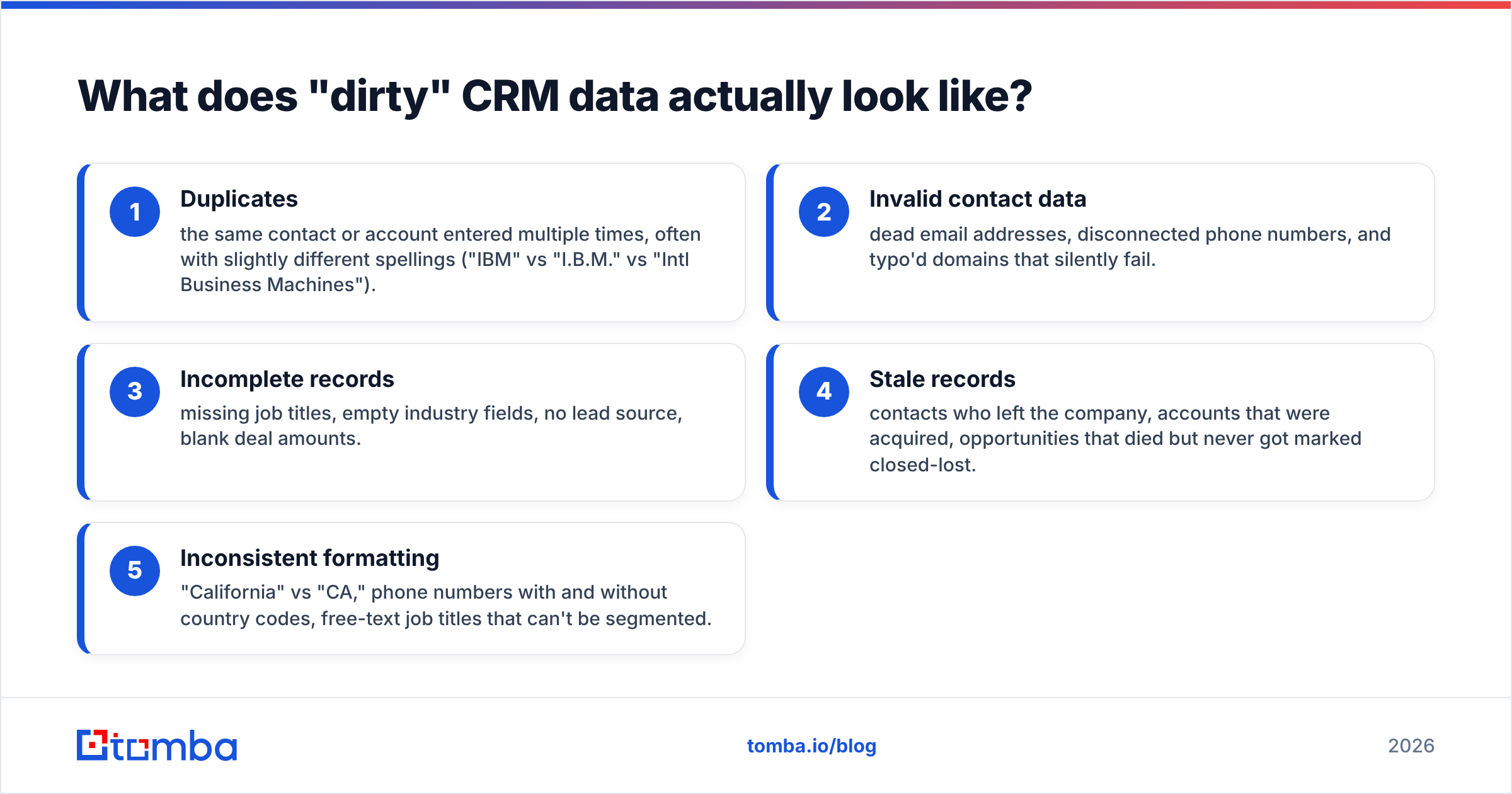
Before you fix anything, you need to name the failure modes. Most CRM decay falls into five buckets:
- Duplicates — the same contact or account entered multiple times, often with slightly different spellings ("IBM" vs "I.B.M." vs "Intl Business Machines").
- Invalid contact data — dead email addresses, disconnected phone numbers, and typo'd domains that silently fail.
- Incomplete records — missing job titles, empty industry fields, no lead source, blank deal amounts.
- Stale records — contacts who left the company, accounts that were acquired, opportunities that died but never got marked closed-lost.
- Inconsistent formatting — "California" vs "CA," phone numbers with and without country codes, free-text job titles that can't be segmented.
Each type needs a different remedy, which is why a blanket "let's clean the CRM" project usually stalls. Diagnose by category first.
How do you run a CRM data audit?#
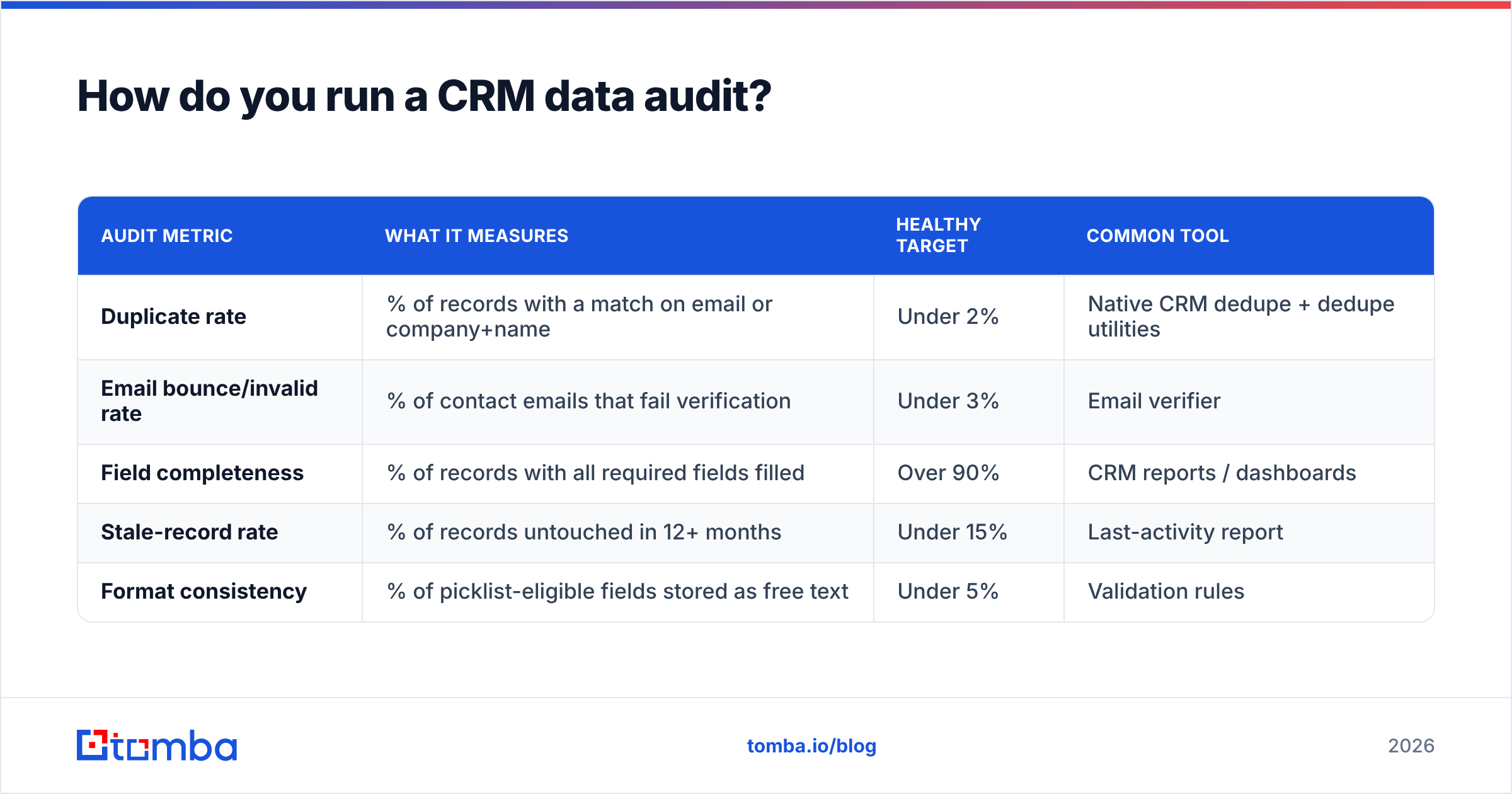
An audit turns "our data feels messy" into numbers you can act on. Run these five checks and record a baseline you can measure improvement against.
| Audit metric | What it measures | Healthy target | Common tool |
|---|---|---|---|
| Duplicate rate | % of records with a match on email or company+name | Under 2% | Native CRM dedupe + dedupe utilities |
| Email bounce/invalid rate | % of contact emails that fail verification | Under 3% | Email verifier |
| Field completeness | % of records with all required fields filled | Over 90% | CRM reports / dashboards |
| Stale-record rate | % of records untouched in 12+ months | Under 15% | Last-activity report |
| Format consistency | % of picklist-eligible fields stored as free text | Under 5% | Validation rules |
Pull each number, then rank your problems by impact. If 18% of your emails bounce, fixing deliverability beats reformatting state abbreviations. Let the data set your priorities instead of cleaning whatever you notice first.
Which fields should you enforce rules on?#
Not every field deserves a mandatory-entry rule — over-enforcement pushes reps to type junk just to save a record. Focus rules on the fields that drive routing, scoring, and reporting.
- Email — validate format at entry and verify deliverability on a schedule. This is the single highest-leverage field for outbound teams.
- Company / domain — normalize to a canonical domain so accounts merge cleanly and enrichment can attach firmographics.
- Lead source — a controlled picklist, never free text, so attribution actually works.
- Deal stage and amount — required before an opportunity can advance, so the forecast holds together.
- Owner — never blank; unowned records are records nobody cleans.
The principle: make the right entry the easy entry. Picklists over text fields, validation over hope, defaults over blanks.
Manual vs automated CRM cleanup: which wins?#
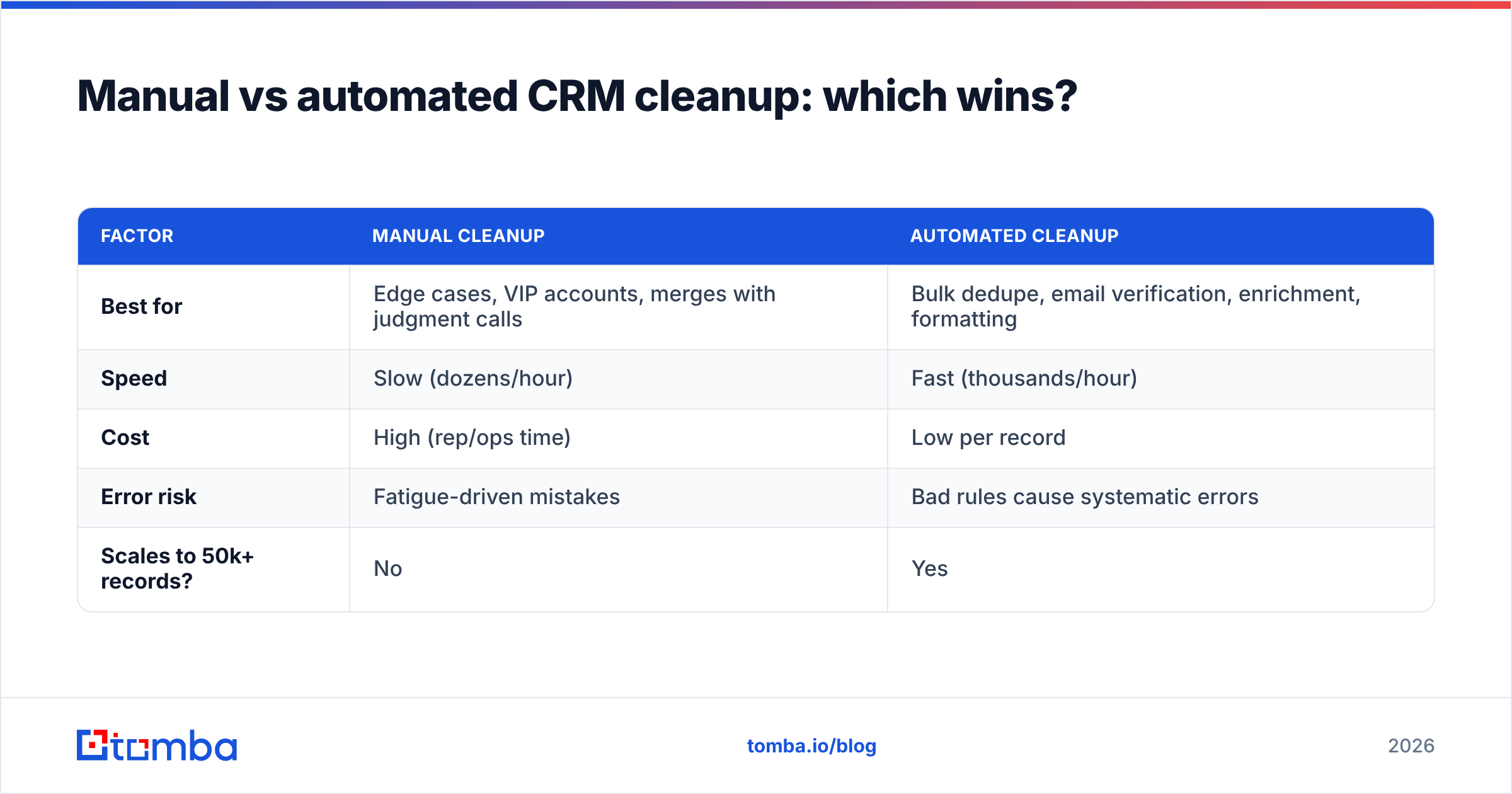
Both have a place, but the ratio matters. Manual review is precise and context-aware; it's also slow and doesn't scale past a few hundred records. Automation handles volume and repeatability but needs guardrails so it doesn't merge two genuinely different "John Smith" accounts.
| Factor | Manual cleanup | Automated cleanup |
|---|---|---|
| Best for | Edge cases, VIP accounts, merges with judgment calls | Bulk dedupe, email verification, enrichment, formatting |
| Speed | Slow (dozens/hour) | Fast (thousands/hour) |
| Cost | High (rep/ops time) | Low per record |
| Error risk | Fatigue-driven mistakes | Bad rules cause systematic errors |
| Scales to 50k+ records? | No | Yes |
The winning pattern is hybrid: automate the repetitive 80% — deduplication, bulk email verification, and data enrichment — and reserve human review for the ambiguous 20% where judgment beats a rule. As HubSpot's guidance on data quality notes, sustainable hygiene comes from process, not heroic one-off scrubs.

How do you keep contact data accurate over time?#
Cleaning once and walking away guarantees you'll be back at the same 25% decay a year later. Accuracy is a flow problem, not a stock problem — data enters, ages, and needs continuous correction.
Three mechanisms keep contact data fresh:
- Verify at capture. When a form fill or import lands, run the email through a verifier before it becomes a "real" lead. Catching a bad address at the door is far cheaper than a bounce later.
- Re-verify on a schedule. Emails that were valid six months ago decay. A quarterly re-verification sweep on active contacts catches job changes before your rep emails a dead inbox.
- Enrich to fill gaps. When a record is missing a title, phone, or company size, enrichment appends it from current sources instead of leaving reps to guess or dig.
For teams that source net-new contacts, the accuracy problem starts before the CRM: if you import unverified addresses in the first place, you're pouring dirty water into a clean tank. Using an accurate email finder with built-in verification means records arrive clean rather than needing a cleanup pass on day one.
What's a realistic CRM hygiene cadence?#
Hygiene fails when it's treated as an annual fire drill. Bake it into three rhythms instead:
- At entry (real-time): validation rules, required fields, email format checks, and duplicate warnings fire the moment a record is created or edited.
- Weekly (automated sweep): run dedupe rules, verify newly added emails in bulk, and flag records missing required fields for owner follow-up.
- Quarterly (deep audit): re-run the five audit metrics above, re-verify active contacts, archive records with no activity in 12+ months, and review whether your rules still match how the team sells.
This split means no single cleanup is ever huge, because you never let debt pile up. The weekly sweep should be mostly automated; the quarterly audit is where a human looks at trends and adjusts the rules.
Which tools support CRM hygiene?#
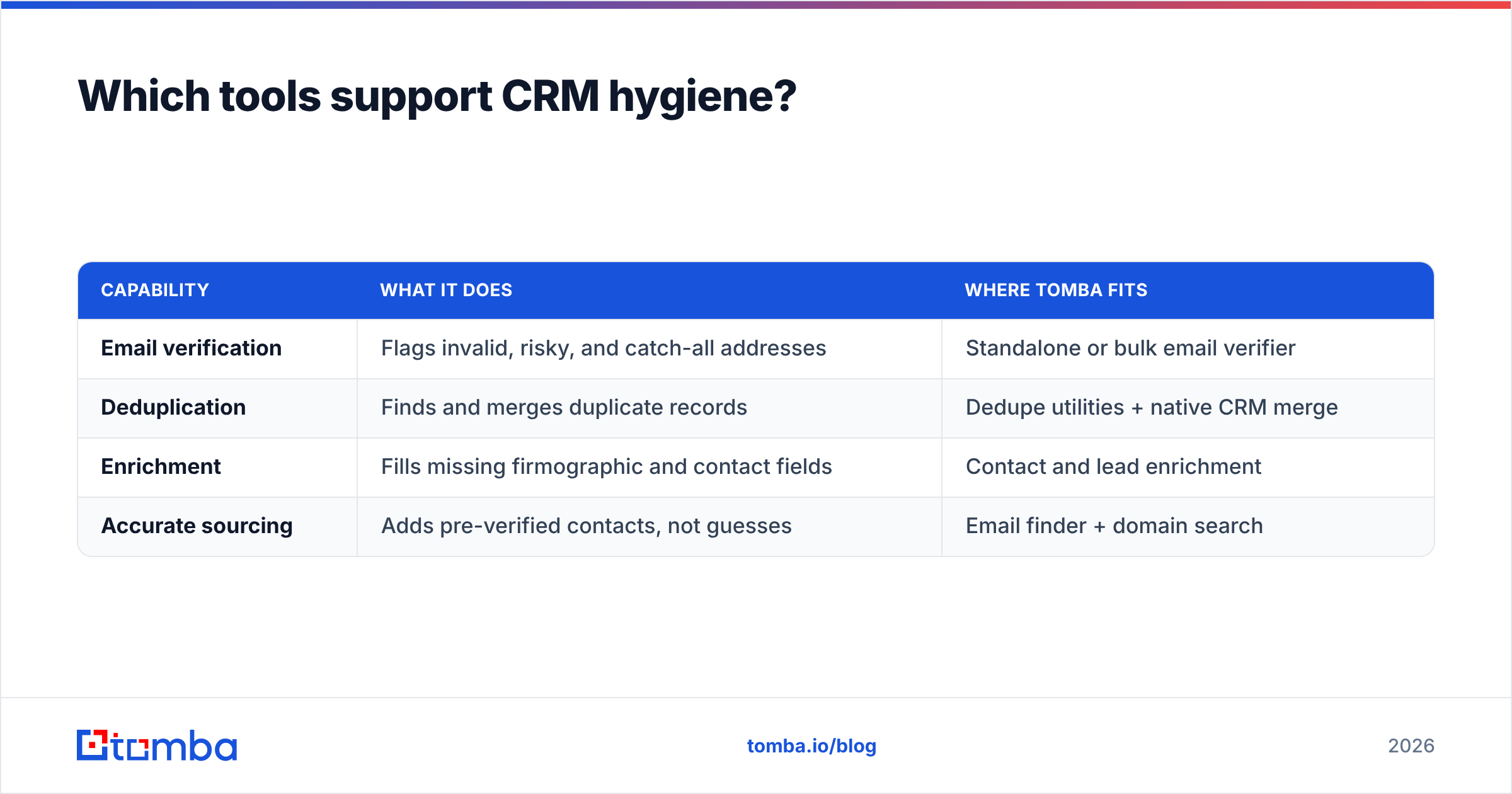
You don't need a 12-tool stack. Most hygiene needs map to four capabilities, and one platform can often cover several.
| Capability | What it does | Where Tomba fits |
|---|---|---|
| Email verification | Flags invalid, risky, and catch-all addresses | Standalone or bulk email verifier |
| Deduplication | Finds and merges duplicate records | Dedupe utilities + native CRM merge |
| Enrichment | Fills missing firmographic and contact fields | Contact and lead enrichment |
| Accurate sourcing | Adds pre-verified contacts, not guesses | Email finder + domain search |
The goal isn't tool sprawl — it's covering these four jobs reliably and connecting them to where your team already works. If your reps live in your CRM, the hygiene layer should feed it directly through integrations rather than living in a spreadsheet nobody opens. You can review Tomba pricing to see how verification, enrichment, and finding bundle together, starting free at 25 searches/month and scaling to Starter at $49/mo when volume grows.
What KPIs prove your CRM hygiene is working?#
Treat hygiene like any other program: measure it, or it drifts. Track a small set of trend lines rather than a vanity dashboard.
- Bounce rate on outbound — the clearest signal of contact-data health.
- Duplicate rate — should trend toward and stay under 2%.
- Field completeness on required fields — target 90%+ and hold it.
- Time-to-clean — how long a flagged record sits before an owner fixes it.
- Rep-reported trust — a quarterly one-question survey: "Do you trust the data in the CRM?" A rising "yes" is the outcome you're actually buying.
If bounce and duplicate rates fall while completeness and trust rise, your cadence is working. If any of them creep back up, that's your signal to tighten a rule or automate one more step.
Common CRM hygiene mistakes to avoid#
- Big-bang cleanups with no maintenance plan — you'll be back to square one within a year.
- Over-mandating fields — reps type "N/A" and "asdf" to escape required fields, which is worse than blank.
- Aggressive auto-merge without review thresholds — merging two real accounts is harder to undo than leaving a duplicate.
- Importing unverified lists — the fastest way to re-dirty a freshly cleaned CRM.
- No owner for hygiene — if it's everyone's job, it's no one's job. Assign it, usually to RevOps.
Where should you start this week?#
Pick the one metric that's clearly worst and fix its source. For most outbound teams that's the bounce rate, because it's both easy to measure and directly tied to revenue and deliverability. Verify your active contacts, stop unverified data from entering, and put a weekly automated sweep on the calendar. Everything else — dedupe rules, enrichment, formatting — layers on from there.
Clean data is the cheapest performance boost in your stack. You're not buying more leads; you're making the ones you already have usable.
Ready to stop pouring dirty data into a clean CRM? Start records off accurate with the Tomba Email Finder — find professional email addresses by domain, name, or company, with verification built in so what lands in your CRM is trustworthy from day one. Try it free with 25 searches a month, and keep your pipeline built on data your team actually believes.
Related guides#
Ready to find emails that actually work?
Join 150,000+ professionals who stopped guessing and started sending. Free credits on signup — no credit card required.
Get the Tomba newsletter
Practical outbound tactics and product updates — once every two weeks.
About the author