CRM User Adoption in 2026: The Playbook That Actually Sticks
Most CRM rollouts fail on adoption, not features. Here's a field-tested 2026 playbook to get reps logging deals, keeping data clean, and trusting the system.
You bought the CRM. You paid for the seats. And three months in, half your reps are still running their pipeline out of a spreadsheet and their own memory. The software works fine — the problem is nobody uses it the way you hoped.
CRM user adoption is the gap between "we have a CRM" and "our team runs on the CRM." Closing that gap is less about features and more about incentives, workflow design, and data quality. This playbook walks through why adoption stalls and exactly how to fix it in 2026.
TL;DR#
- Adoption fails for a reason, not out of laziness. Reps skip the CRM when it costs them time and gives nothing back. Fix the value exchange first.
- Dirty data kills trust faster than anything. If the CRM is full of stale, duplicate, or wrong contact info, reps stop believing it — and stop entering data.
- Reduce manual entry to the bare minimum. Automation, enrichment, and integrations do the typing so reps don't have to.
- Measure adoption like a metric, not a vibe. Track logins, logged activities, and pipeline hygiene weekly.
- Leadership has to live in the CRM too. If deals get approved in Slack and forecasts happen in spreadsheets, reps learn the CRM is optional.
Why do reps refuse to use the CRM?#
The blunt answer: because for most reps, the CRM is a reporting tool for their manager, not a selling tool for them. Every field they fill in feels like unpaid admin work that helps someone else.
Think of it like a gym membership you were forced to buy. You'll show up if the equipment is good, the place is close, and you can see results. You'll quietly stop going if it's a hassle and nothing changes. CRM adoption works the same way — the system has to give reps something back every time they open it.
The most common adoption killers:
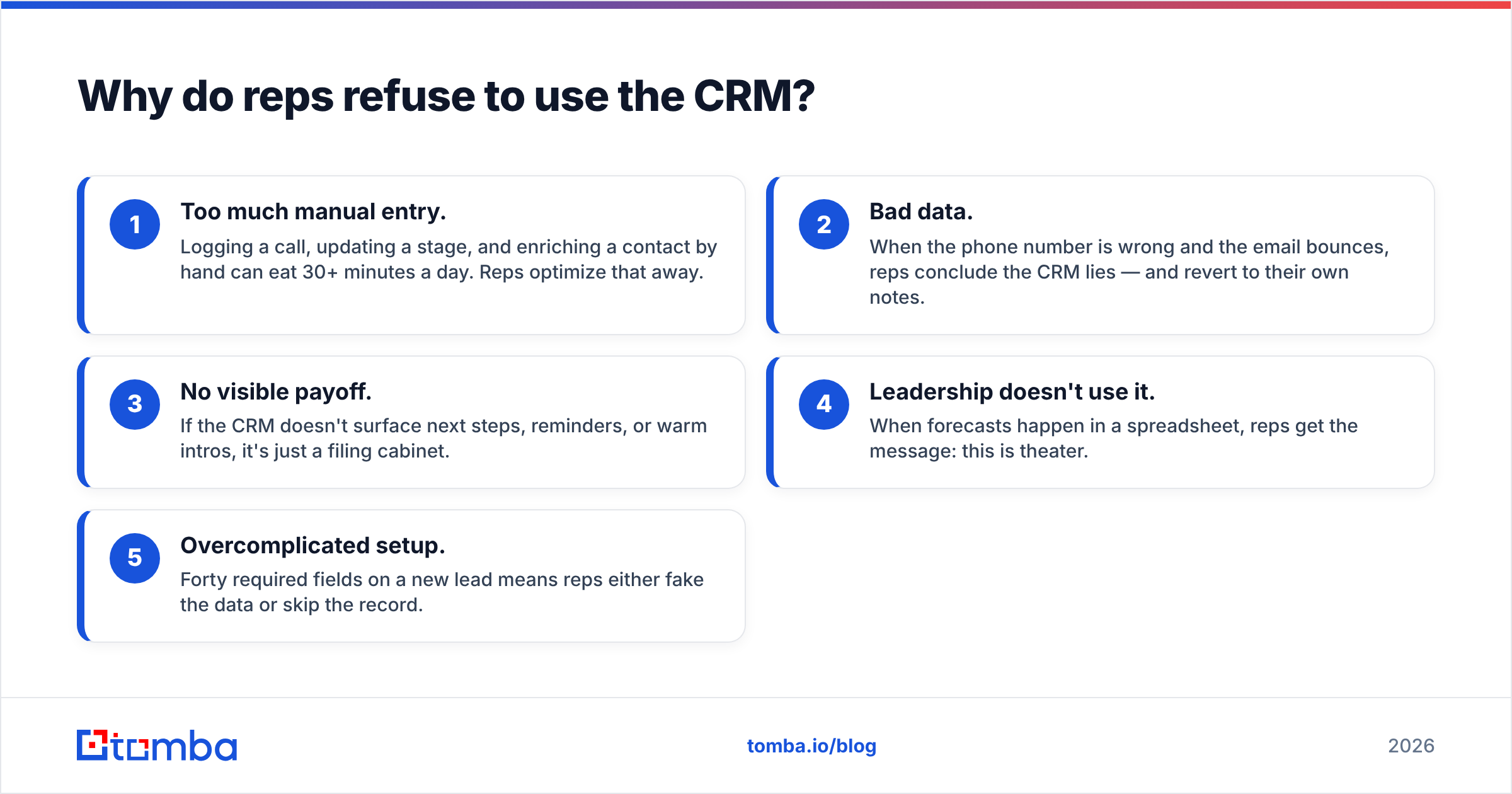
- Too much manual entry. Logging a call, updating a stage, and enriching a contact by hand can eat 30+ minutes a day. Reps optimize that away.
- Bad data. When the phone number is wrong and the email bounces, reps conclude the CRM lies — and revert to their own notes.
- No visible payoff. If the CRM doesn't surface next steps, reminders, or warm intros, it's just a filing cabinet.
- Leadership doesn't use it. When forecasts happen in a spreadsheet, reps get the message: this is theater.
- Overcomplicated setup. Forty required fields on a new lead means reps either fake the data or skip the record.

What does "good" CRM adoption actually look like?#
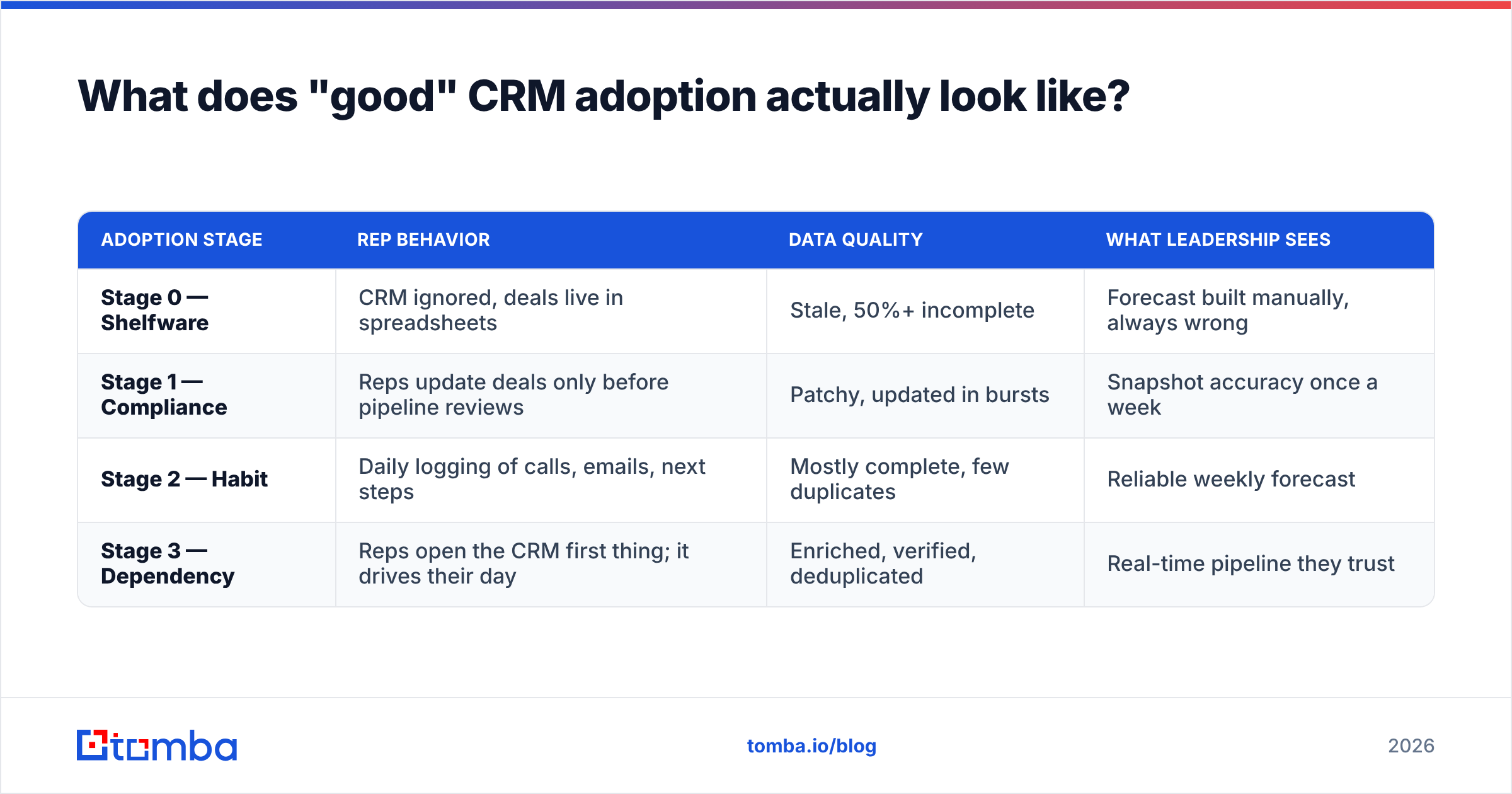
Adoption isn't "everyone logged in once." It's a set of behaviors that compound. Here's a realistic maturity scale you can benchmark your team against.
| Adoption stage | Rep behavior | Data quality | What leadership sees |
|---|---|---|---|
| Stage 0 — Shelfware | CRM ignored, deals live in spreadsheets | Stale, 50%+ incomplete | Forecast built manually, always wrong |
| Stage 1 — Compliance | Reps update deals only before pipeline reviews | Patchy, updated in bursts | Snapshot accuracy once a week |
| Stage 2 — Habit | Daily logging of calls, emails, next steps | Mostly complete, few duplicates | Reliable weekly forecast |
| Stage 3 — Dependency | Reps open the CRM first thing; it drives their day | Enriched, verified, deduplicated | Real-time pipeline they trust |
Most teams sit at Stage 1 and call it adoption. The real prize is Stage 3, where reps use the CRM because it makes them money, not because a manager nags them. Gartner has repeatedly flagged that poor adoption is the top reason CRM investments underdeliver — the tech is rarely the bottleneck.
How do you actually increase CRM user adoption?#
You engineer the value exchange so that using the CRM is the path of least resistance and the path of most reward. Here are the levers that move the needle, in priority order.
1. Clean the data before you ask for adoption#
This is the step teams skip, and it's the one that determines everything else. If a rep clicks into an account and finds a disconnected phone number and a bounced email, you've taught them the CRM is unreliable in one click. Clean, verified contact data is the foundation of trust.
Run every imported list through an email verifier before it lands in the CRM, and deduplicate aggressively. A smaller database of correct records beats a bloated one full of guesses every single time.
2. Kill manual data entry with enrichment and automation#
Every field a rep has to type by hand is a field they'll eventually skip. So don't make them type it. When a new contact enters the CRM with just a name and company, data enrichment can auto-fill the verified email, job title, phone number, and social profiles — no rep effort required.
The math is simple: if enrichment saves each rep 20 minutes a day, that's roughly a full selling week recovered per rep per quarter. Reps notice that, and they reward tools that give them time back with actual usage.
3. Integrate the CRM into the tools reps already live in#
Reps live in their inbox, on the phone, and on LinkedIn. Meet them there. Native Salesforce and HubSpot integrations that push verified contacts straight into the CRM mean reps never have to copy-paste between tabs. The less context-switching you demand, the higher adoption climbs.
4. Simplify the required fields#
Audit your new-lead and new-deal forms. If you're forcing 25 fields, you're guaranteeing junk data. Cut required fields to the five that actually drive routing and forecasting, and let enrichment handle the rest automatically.
5. Make leadership live in the CRM#
Adoption is top-down or it's nothing. If your VP asks "what's the forecast?" and a rep answers in Slack, the CRM just lost. Run every pipeline review, forecast call, and deal approval inside the CRM. When reps see that the only version of the truth leadership trusts is the CRM, they update it.
Which adoption tactics work — and which backfire?#
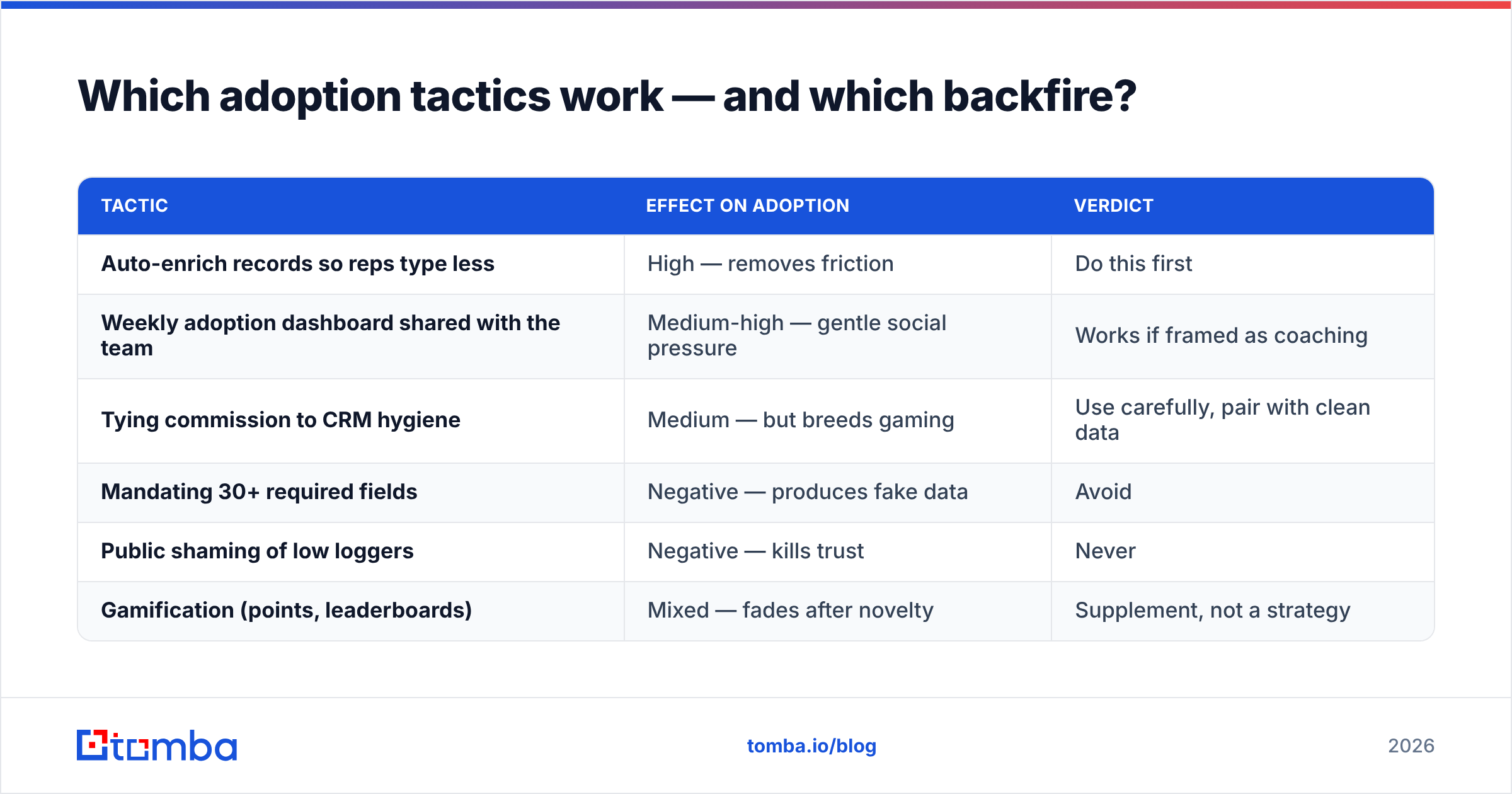
Not every adoption push helps. Some create resentment and quiet sabotage. Here's the honest breakdown.
| Tactic | Effect on adoption | Verdict |
|---|---|---|
| Auto-enrich records so reps type less | High — removes friction | Do this first |
| Weekly adoption dashboard shared with the team | Medium-high — gentle social pressure | Works if framed as coaching |
| Tying commission to CRM hygiene | Medium — but breeds gaming | Use carefully, pair with clean data |
| Mandating 30+ required fields | Negative — produces fake data | Avoid |
| Public shaming of low loggers | Negative — kills trust | Never |
| Gamification (points, leaderboards) | Mixed — fades after novelty | Supplement, not a strategy |
The pattern is clear: tactics that remove friction win, and tactics that add pressure without adding value lose. You cannot punish a team into loving a tool. You can make the tool so useful they'd complain if you took it away.
How do you measure CRM adoption in 2026?#
You measure it weekly, with a small set of leading indicators — not one vanity number at quarter-end. If you only look at adoption when the forecast is wrong, you're looking too late.
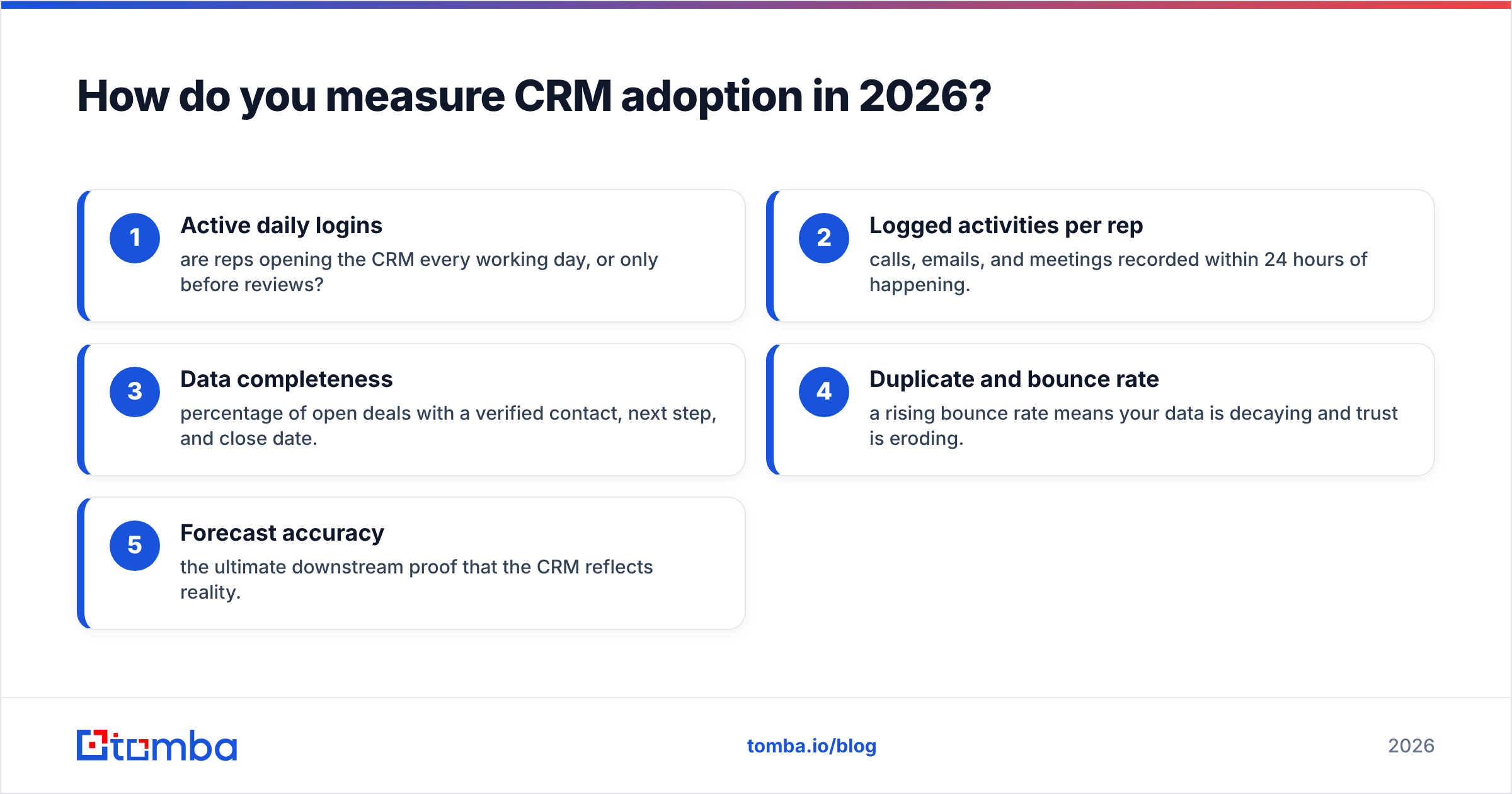
Track these five signals:
- Active daily logins — are reps opening the CRM every working day, or only before reviews?
- Logged activities per rep — calls, emails, and meetings recorded within 24 hours of happening.
- Data completeness — percentage of open deals with a verified contact, next step, and close date.
- Duplicate and bounce rate — a rising bounce rate means your data is decaying and trust is eroding.
- Forecast accuracy — the ultimate downstream proof that the CRM reflects reality.
A quick way to keep signal 4 healthy is to periodically re-run your contact base through verification and enrichment so decayed records get flagged before a rep wastes a call on them. You can learn more about how data sources and accuracy affect this in practice.
Does CRM choice affect adoption?#
Yes, but less than most buyers think. A cleaner UI helps at the margins, but the biggest CRM platforms — Salesforce, HubSpot, Pipedrive — all achieve high adoption when the data is clean and entry is automated, and all become shelfware when it isn't. The platform sets the ceiling; your data and workflow discipline decide whether you reach it.
In other words: don't rip out your CRM hoping a new logo fixes adoption. Fix the data pipeline feeding it first. Nine times out of ten, that's where the real problem lives. If you've already read up on what a CRM is supposed to do, you know the platform is only as good as the records inside it.
A 30-day adoption plan you can run this month#
- Week 1 — Audit and clean. Export your CRM, run it through verification, kill duplicates, and flag every stale record. Baseline your five adoption metrics.
- Week 2 — Automate entry. Turn on enrichment and integrations so new records self-populate. Cut required fields to five.
- Week 3 — Move leadership in. Run every pipeline review and forecast call inside the CRM. No spreadsheets allowed.
- Week 4 — Coach on data, not compliance. Share the adoption dashboard as coaching, celebrate reps whose clean pipeline closed faster, and iterate.
Do this and you'll feel the shift by week three: reps stop asking "why do I have to log this?" and start asking "why isn't this contact enriched yet?" That question is the sound of adoption.
The bottom line#
CRM user adoption is a data-quality and workflow problem wearing a behavior-change costume. Reps aren't lazy — they're rational. Give them a CRM full of clean, verified, auto-enriched data that saves them time and surfaces their next best action, and they'll use it without being asked. Give them a broken filing cabinet and no amount of mandates will help.
Start where the trust lives: the data. If your CRM is only as good as the contact records inside it, make those records the best in your market. Tomba's Email Finder finds and verifies professional email addresses so every contact that enters your CRM is real, current, and ready to sell to — the foundation adoption is built on. Pair it with enrichment, wire it into your Salesforce or HubSpot, and watch the "why bother" objections disappear. See Tomba pricing to start on the free tier and clean up your first 25 records today.
Related guides#
Ready to find emails that actually work?
Join 150,000+ professionals who stopped guessing and started sending. Free credits on signup — no credit card required.
Get the Tomba newsletter
Practical outbound tactics and product updates — once every two weeks.
About the author