CRO vs CSO: Roles, Responsibilities, and When You Need Each
CRO vs CSO explained: how the Chief Revenue Officer and Chief Sales Officer differ in scope, metrics, and pay — and which one your company should hire first.
The titles look almost interchangeable on an org chart, and plenty of companies use them as if they were. They are not. A Chief Revenue Officer (CRO) and a Chief Sales Officer (CSO) sit at different altitudes, own different numbers, and get hired at different moments in a company's life. Confuse them and you either strap a full-funnel mandate onto someone built to run a sales floor, or you pay CRO money for a job that is really VP of Sales with a fancier badge.
This guide breaks down CRO vs CSO in plain terms: what each role actually owns, how their metrics differ, what they cost, and — the part most articles skip — how to decide which one your company needs right now.
TL;DR#
- A CSO owns sales. Quota, pipeline, the sales team, and closing revenue. Deep, not wide.
- A CRO owns all revenue. Sales plus marketing, customer success, revenue operations, and pricing. Wide, and accountable for the whole number.
- Scope is the real difference. Every CRO could run sales; not every CSO is ready to run marketing, retention, and expansion.
- Stage decides the hire. Early and sales-led? A CSO or strong VP of Sales. Scaling, multi-channel, board-reporting on net revenue retention? A CRO.
- Titles ≠ scope. Read the mandate, not the business card. Many "CROs" are really CSOs, and vice versa.
What is a Chief Sales Officer (CSO)?#
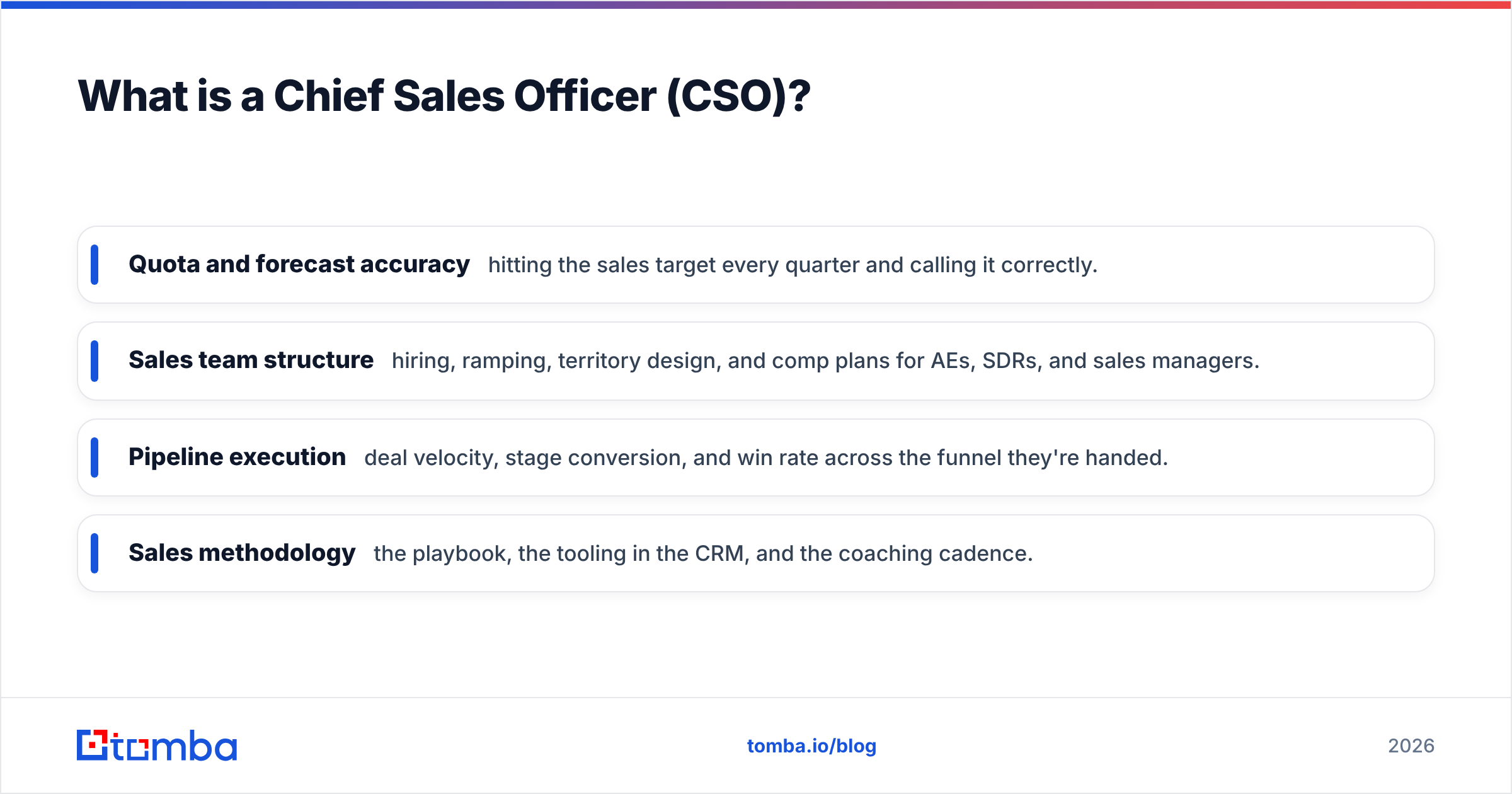
The Chief Sales Officer is the top of the sales org. Their job is to turn qualified opportunities into signed revenue, predictably and at scale. Think of a CSO like the head coach of a team: they don't sell the tickets or run the concessions, they win the games in front of them. Everything about the role is oriented toward the number the sales team is on the hook for.
Concretely, a CSO owns:
- Quota and forecast accuracy — hitting the sales target every quarter and calling it correctly.
- Sales team structure — hiring, ramping, territory design, and comp plans for AEs, SDRs, and sales managers.
- Pipeline execution — deal velocity, stage conversion, and win rate across the funnel they're handed.
- Sales methodology — the playbook, the tooling in the CRM, and the coaching cadence.
A CSO is measured on sales outcomes: bookings, quota attainment, average deal size, sales cycle length. What lands outside that scope is the tell — demand generation, product marketing, onboarding, renewals, and expansion typically belong to other leaders. The CSO consumes the pipeline; they don't own the whole engine that produces and retains it.

What is a Chief Revenue Officer (CRO)?#
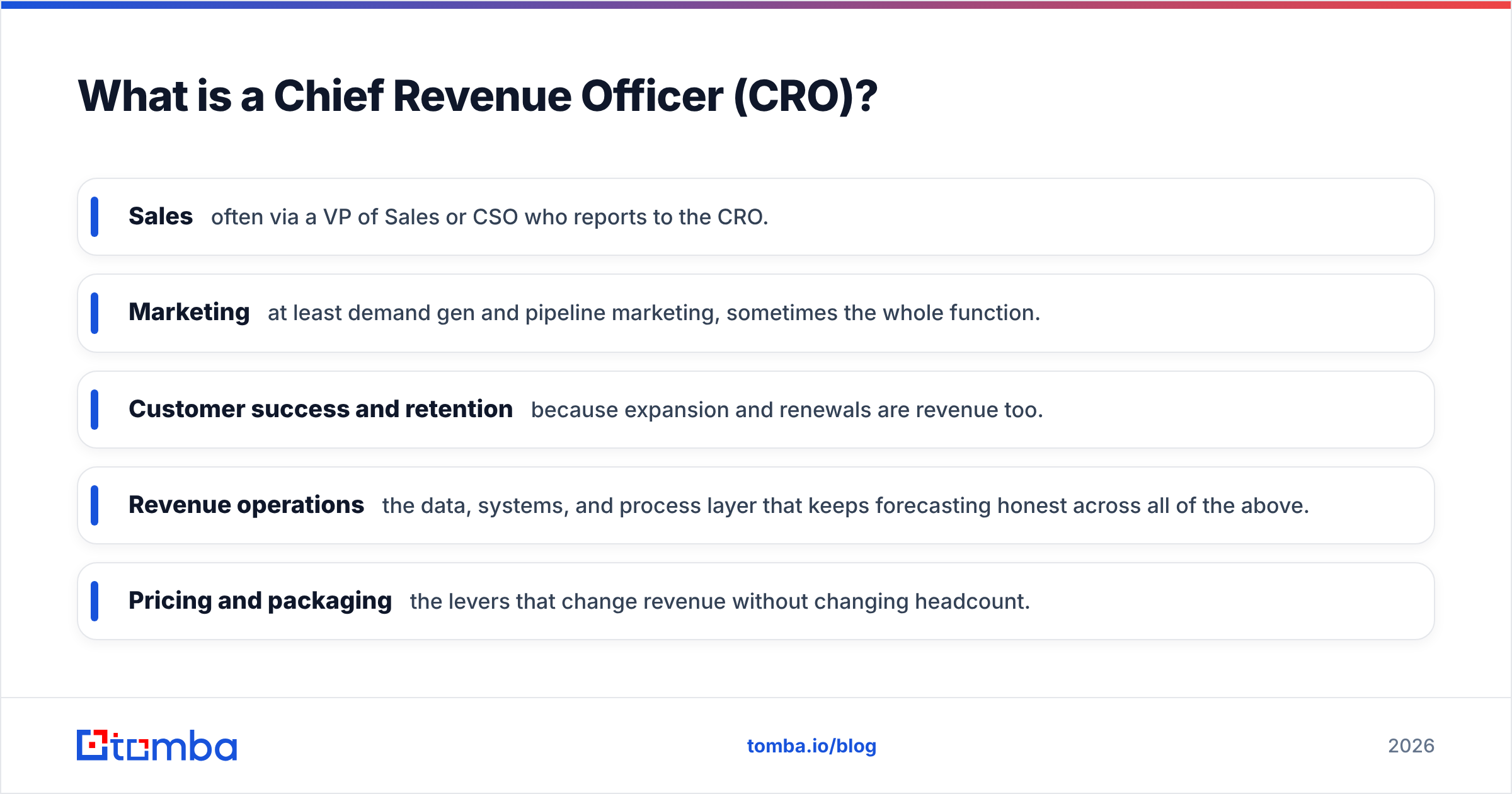
The Chief Revenue Officer owns every function that touches a dollar of revenue, from the first ad impression to the renewal invoice. If the CSO is the head coach, the CRO is the general manager: responsible for the roster, the budget, the pipeline of talent, and the win-loss record. The mandate is the entire revenue lifecycle, not one stage of it.
A CRO typically has these functions reporting up, directly or by dotted line:
- Sales — often via a VP of Sales or CSO who reports to the CRO.
- Marketing — at least demand gen and pipeline marketing, sometimes the whole function.
- Customer success and retention — because expansion and renewals are revenue too.
- Revenue operations — the data, systems, and process layer that keeps forecasting honest across all of the above.
- Pricing and packaging — the levers that change revenue without changing headcount.
The reason the CRO role exploded over the last decade is simple: in subscription and usage-based businesses, the initial sale is a fraction of lifetime value. Someone has to be accountable for net revenue retention, not just new logos. According to Gartner's research on revenue leadership, companies increasingly consolidate sales, marketing, and success under a single revenue owner precisely to kill the finger-pointing that happens when three separate VPs each optimize their own slice.
That accountability is the whole point. A CRO cannot blame marketing for weak pipeline or success for high churn — they own all of it. The number on their scorecard is total revenue and its durability.
CRO vs CSO: what's the core difference?#
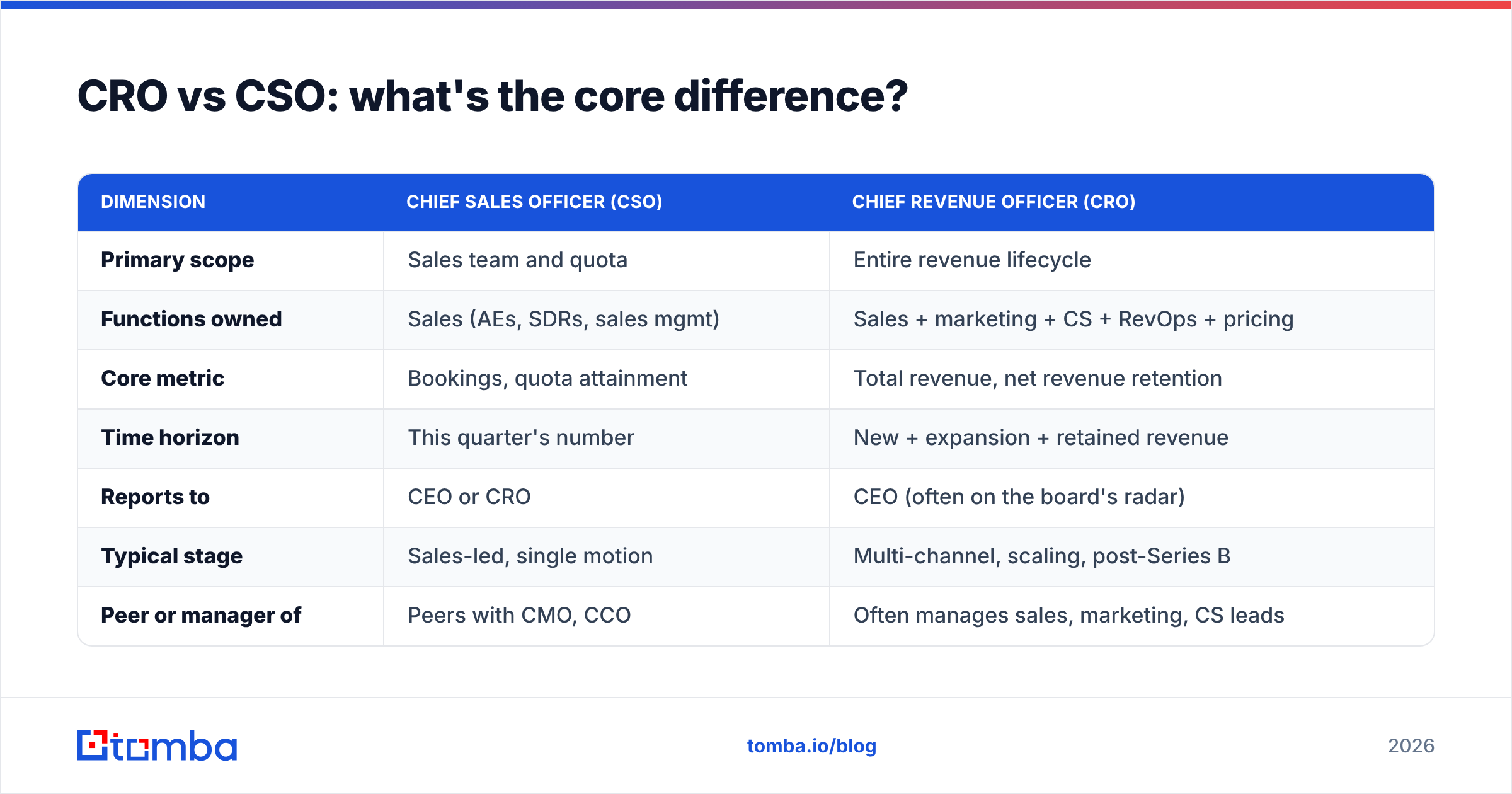
The one-line answer: a CSO owns sales; a CRO owns revenue, and sales is one department inside that. Scope is the axis everything else rotates around.
Here's the head-to-head.
| Dimension | Chief Sales Officer (CSO) | Chief Revenue Officer (CRO) |
|---|---|---|
| Primary scope | Sales team and quota | Entire revenue lifecycle |
| Functions owned | Sales (AEs, SDRs, sales mgmt) | Sales + marketing + CS + RevOps + pricing |
| Core metric | Bookings, quota attainment | Total revenue, net revenue retention |
| Time horizon | This quarter's number | New + expansion + retained revenue |
| Reports to | CEO or CRO | CEO (often on the board's radar) |
| Typical stage | Sales-led, single motion | Multi-channel, scaling, post-Series B |
| Peer or manager of | Peers with CMO, CCO | Often manages sales, marketing, CS leads |
| Failure looks like | Missed sales target | Missed revenue or rising churn |
Notice the last row. A CSO can have a great quarter on new bookings while churn quietly eats the base — and that's not technically their problem. For a CRO, it is the whole problem. The CRO can't celebrate a record sales month if retention is falling off a cliff, because their number is the net.
The reporting line is the other giveaway. In many orgs the CSO reports to the CRO. When that's the structure, arguing about which title is "higher" misses the point: they're layers of the same stack, not competitors for the same seat.
Do CRO and CSO responsibilities overlap?#
Yes — and the overlap is exactly where confusion (and title inflation) creeps in. Both roles care about pipeline, forecasting, and the sales team's performance. The difference is depth versus breadth.
A CSO goes deep on sales: they'll know the conversion rate at every pipeline stage, which rep is sandbagging, and why deals stall at procurement. A CRO goes wide: they care about the same pipeline, but as one input into a system that also includes lead quality from marketing, onboarding speed from success, and the pricing model that determines expansion revenue.
Think of it like a restaurant. The CSO is the executive chef — obsessed with what comes out of the kitchen. The CRO is the owner — they care about the kitchen, but also the marketing that fills the tables, the service that brings guests back, and whether the menu is priced to actually make money. Both want a full dining room; only one is accountable for the P&L.
Where they collide in practice:
- Forecasting. The CSO forecasts sales; the CRO rolls that into a company revenue forecast that includes renewals and expansion. If these two forecasts disagree, someone's RevOps data is broken.
- Data and enrichment. Both live or die on clean pipeline data. Whether it's targeting accounts or reporting on them, accurate contact and account data — the kind you get from data enrichment — is the shared foundation. Garbage in, garbage forecast.
- Comp philosophy. The CSO designs sales comp; the CRO has to make sure it doesn't reward behavior that torches retention (like over-promising to close a deal that churns in six months).
The healthy version: the CSO runs the sales machine at full depth, and the CRO makes sure that machine is fed good leads and connected to a retention engine on the back end.
CRO vs CSO salary: what does each cost?#
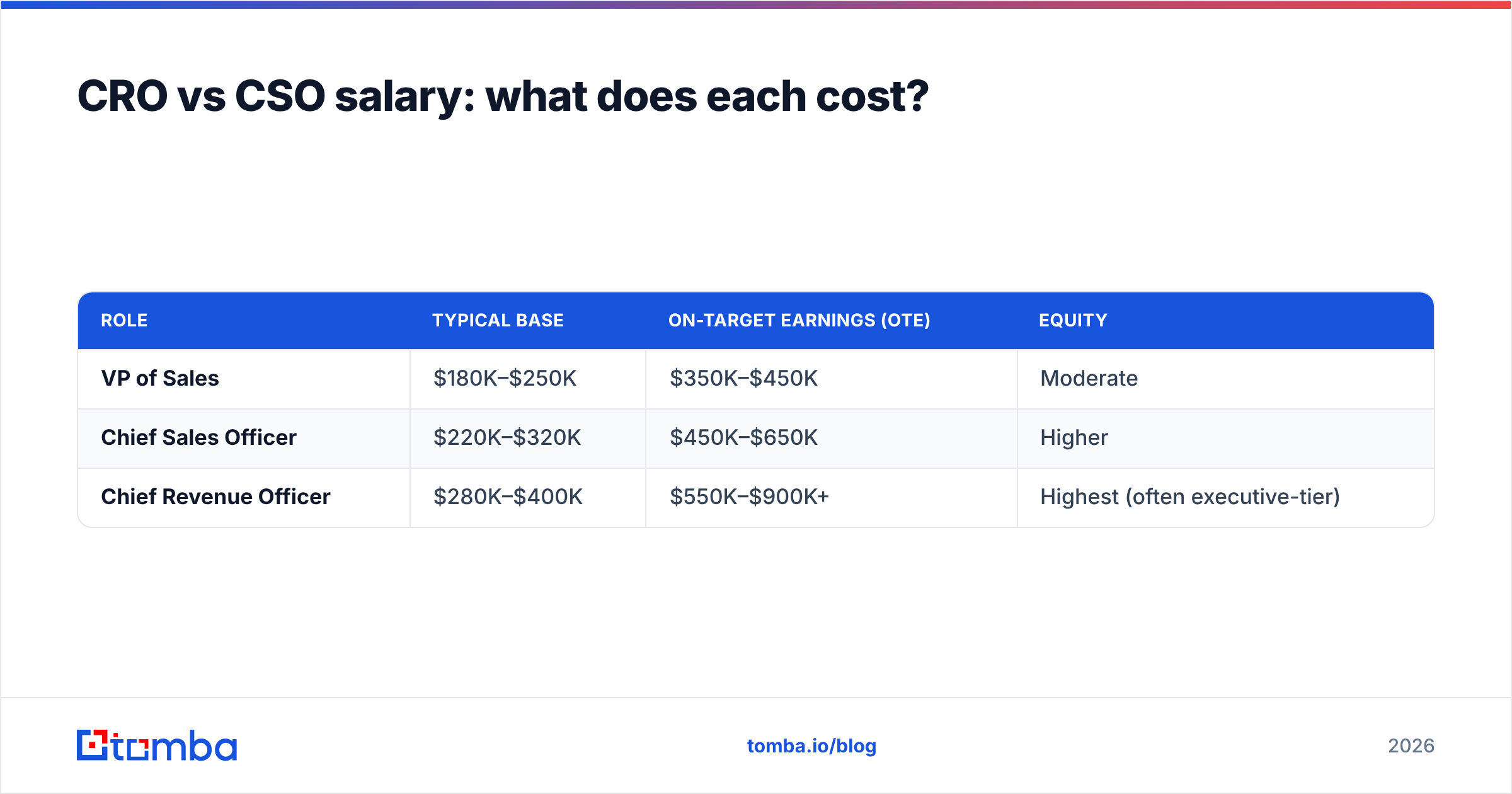
CROs generally out-earn CSOs, because scope drives comp. A leader accountable for total revenue across four functions commands more than one accountable for the sales number alone. Exact figures vary wildly by company stage, region, and equity, but the pattern is consistent across compensation data on sites like Glassdoor and G2's market research.
Rough US benchmarks for venture-backed and mid-market companies in 2026:
| Role | Typical base | On-target earnings (OTE) | Equity |
|---|---|---|---|
| VP of Sales | $180K–$250K | $350K–$450K | Moderate |
| Chief Sales Officer | $220K–$320K | $450K–$650K | Higher |
| Chief Revenue Officer | $280K–$400K | $550K–$900K+ | Highest (often executive-tier) |
Two caveats. First, at a small startup a "CRO" might make less than a "VP of Sales" at a hyperscaler — title doesn't set market rate, scope and company size do. Second, OTE assumes on-target performance; both roles carry heavy variable comp tied to the revenue they own, so a down year hits their take-home hard. That's by design — you're paying for accountability, not attendance.
When should you hire a CRO vs a CSO?#
Match the role to your stage and your revenue motion, not to the title that sounds most impressive to investors.
Hire a CSO (or strong VP of Sales) when:
- Your growth is sales-led and single-motion — outbound or inbound funneling into a sales team.
- Marketing and customer success already have capable leaders who report to the CEO.
- You need someone to professionalize the sales org: build the playbook, fix comp, install forecasting discipline.
- You're pre-Series B and don't yet have enough surface area across functions to justify a full revenue chief.
Hire a CRO when:
- You're running multiple revenue motions — self-serve plus sales-led, or land-and-expand across segments.
- Sales, marketing, and success keep pointing fingers, and no single person owns the net number.
- The board is asking about net revenue retention, CAC payback, and blended efficiency — questions no single-function leader can answer.
- You need one throat to choke for the entire revenue engine, and you have the scale to give that person real functions to run.
A useful gut check from HubSpot's scaling guidance: if your biggest revenue problem is closing, you need sales leadership. If your biggest problem is that closing, marketing, and retention are optimizing against each other, you need a revenue leader to align them. The first is a CSO problem; the second is a CRO problem.
One more trap to avoid: don't hire a CRO and then only let them run sales. You'll pay a premium for a mandate you've secretly shrunk to a CSO, frustrate the person, and get a VP-of-Sales outcome at a CRO price. Give the role the scope its title implies, or don't use the title.
Which revenue leader is right for you?#
Decide by scope, then stage, then title — in that order.
- If you need depth in one function, and marketing and success are already handled, a CSO is the sharper, more affordable hire.
- If you need one person accountable for the whole revenue number — new, expansion, and retained — across multiple teams, a CRO is the role. Just make sure you actually hand over the full scope.
- If you're small, skip the C-suite title inflation. A great VP of Sales often beats a nominal "CRO" who has nothing to run but a two-person sales team.
Whichever leader you bring in, they inherit the same non-negotiable: the revenue engine only performs when it's fed accurate, current contact and account data. Forecasts, territory plans, and outbound targeting all sit on top of your pipeline data — and stale data quietly breaks every one of them.
That's where Tomba fits into whatever org structure you choose. Use the Tomba Email Finder to build clean, verified prospect lists your CSO's team can actually work, and layer in enrichment so your CRO's forecast is built on real accounts, not guesswork. Plans start free with 25 searches a month, and paid tiers begin at $49/mo — see full Tomba pricing to match a plan to your team's volume. Give your revenue leader, whatever you call them, a data foundation worth building on.
Related guides#
Ready to find emails that actually work?
Join 150,000+ professionals who stopped guessing and started sending. Free credits on signup — no credit card required.
Get the Tomba newsletter
Practical outbound tactics and product updates — once every two weeks.
About the author