Crunchbase vs Apolloio: The Honest B2B Data Comparison
Crunchbase and Apollo.io both promise better B2B data, but they solve different problems. Here's an honest breakdown of pricing, accuracy, and which one your team actually needs in 2026.
The Crunchbase vs Apolloio choice feels like a head-to-head fight. Most of the time, it isn't. The two tools overlap on the surface. Both hold company data, and both serve go-to-market teams. But they were built for different jobs. Crunchbase started as a funding and company-intelligence database. Apollo.io is a full sales-engagement engine with a contact database bolted to a sequencer. Pick the wrong one and you waste money — either on research you never use or on outreach features that gather dust.
This guide breaks down where each tool is strong, where the marketing oversells, and what it really costs you in 2026.
TL;DR: Crunchbase vs Apolloio at a glance#
- Crunchbase wins for company research, funding signals, and market mapping. It answers "who are these companies and are they growing?"
- Apollo.io wins for finding contacts and running outbound at volume. It answers "who do I email and how do I sequence them?"
- Data accuracy favors Apollo for email/phone, but its 275M-contact figure hides a lot of stale and unverified records — always verify before you send.
- Pricing is closer than it looks: both start free, both jump fast once you need real export volume or seats.
- If your core need is accurate contact data at a fair price, a focused tool like Tomba Email Finder often beats bundling into a platform you'll half-use.

What is Crunchbase and who is it for?#
Crunchbase is a company-intelligence platform. Its roots are in tracking startups, funding rounds, acquisitions, and the people behind them. If you have ever read a "Company X raised a $40M Series B" headline, the underlying record probably lived in Crunchbase first.
The core value is signal, not volume. Crunchbase tells you when a company raised money, hired an executive, launched a product, or got acquired. For account-based teams, investors, recruiters, and market researchers, those triggers are gold — a fresh funding round often means fresh budget.
What Crunchbase is not is an outreach machine. It surfaces contacts, but its verified email and direct-dial coverage is thin compared to dedicated prospecting tools. You use Crunchbase to decide who to target, then you go elsewhere to get the contact details and actually reach them.
Typical Crunchbase users:
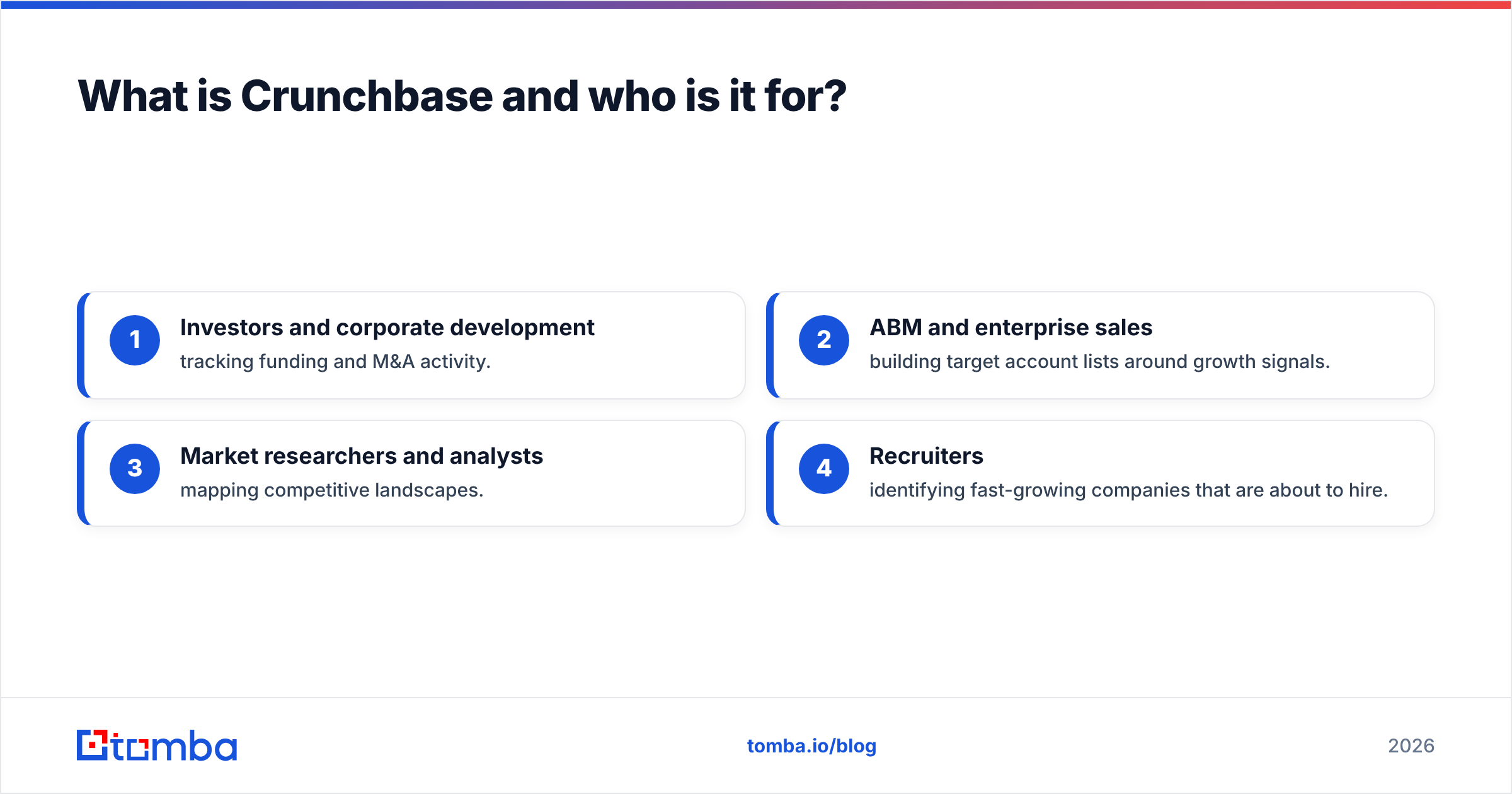
- Investors and corporate development tracking funding and M&A activity.
- ABM and enterprise sales building target account lists around growth signals.
- Market researchers and analysts mapping competitive landscapes.
- Recruiters identifying fast-growing companies that are about to hire.
What is Apollo.io and who is it for?#
Apollo.io is a sales-intelligence and engagement platform. At its center sits a contact database Apollo markets as 275M+ contacts and 73M+ companies, wrapped in prospecting filters, email sequencing, a dialer, and CRM enrichment.
The pitch is all-in-one outbound. Build a list from the database, verify emails, drop leads into a multi-step sequence, dial from the same tab, and sync everything to your CRM — without stitching five tools together. For a small SDR team that wants one login, that consolidation is real.
The tradeoff is that a platform trying to do everything rarely does each piece best-in-class. Apollo's sequencer is decent but not Outreach or Salesloft. Its data is broad but uneven — coverage is strong for US mid-market tech and much weaker outside it. And the "unlimited" email credits on paid tiers come with fair-use throttling that surprises heavy users.
Typical Apollo.io users:
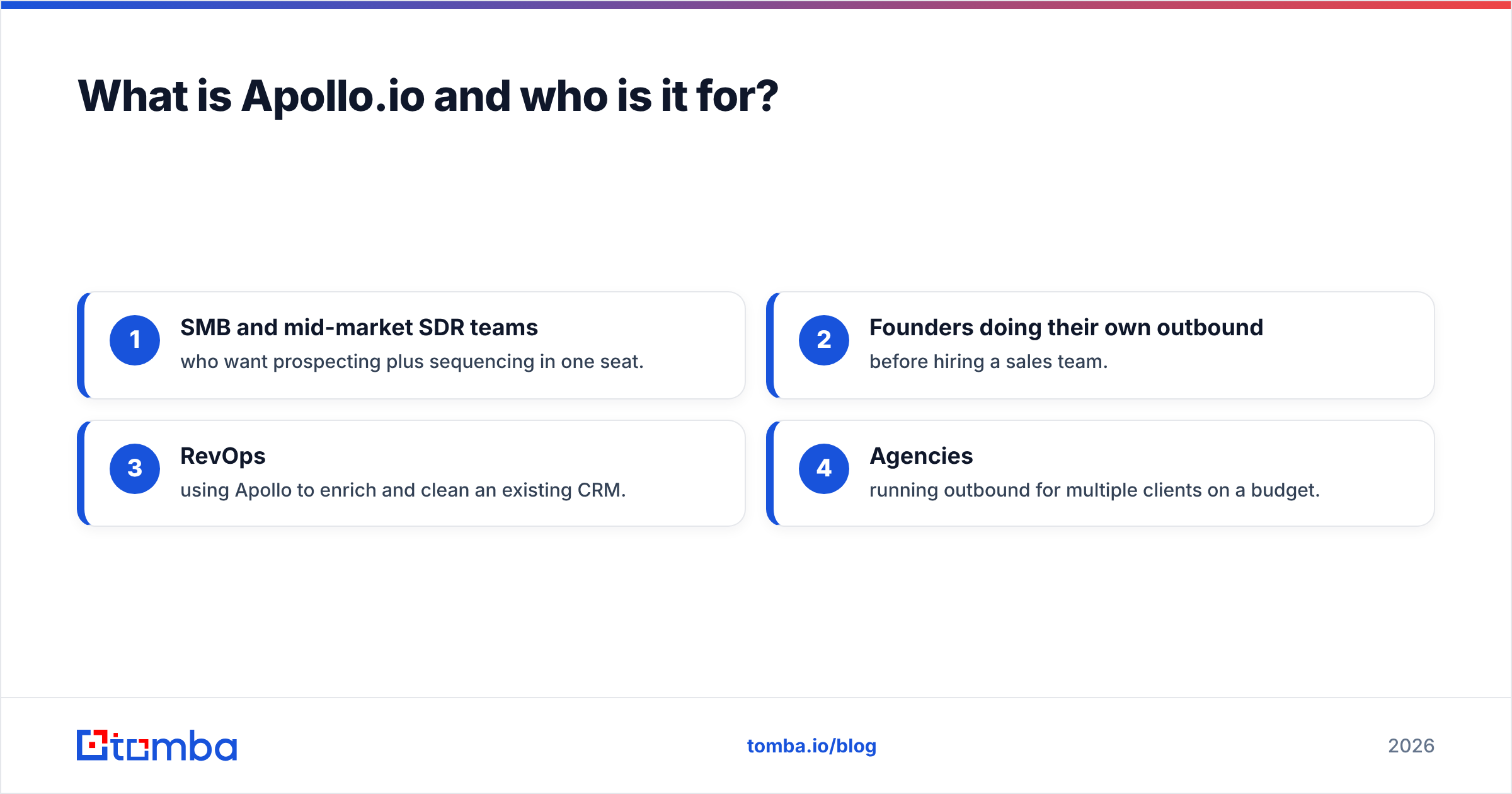
- SMB and mid-market SDR teams who want prospecting plus sequencing in one seat.
- Founders doing their own outbound before hiring a sales team.
- RevOps using Apollo to enrich and clean an existing CRM.
- Agencies running outbound for multiple clients on a budget.
Crunchbase vs Apolloio: the core comparison#
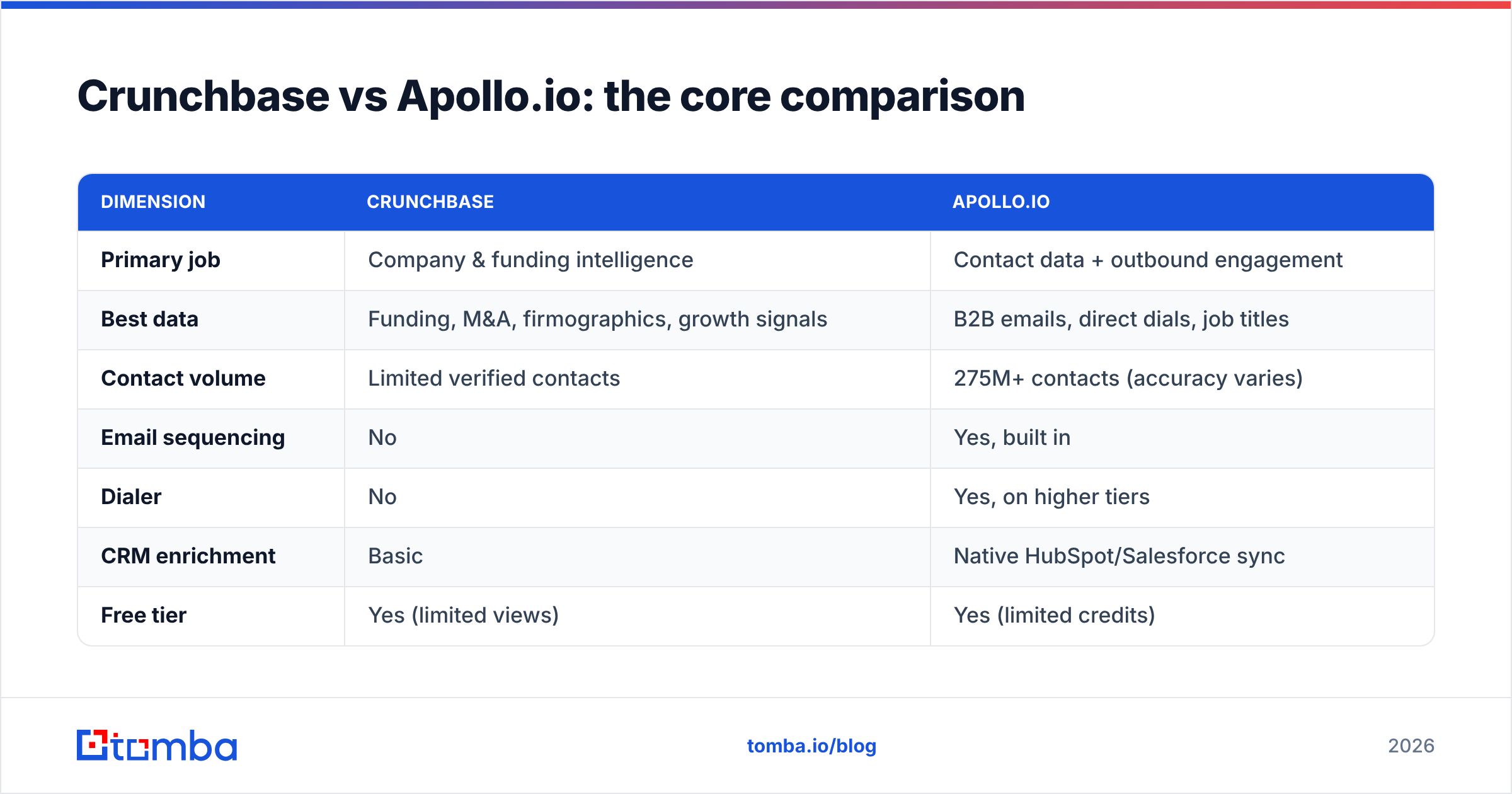
Here is the honest side-by-side. Notice how little the two tools actually compete on — the overlap is real but narrow.
| Dimension | Crunchbase | Apollo.io |
|---|---|---|
| Primary job | Company & funding intelligence | Contact data + outbound engagement |
| Best data | Funding, M&A, firmographics, growth signals | B2B emails, direct dials, job titles |
| Contact volume | Limited verified contacts | 275M+ contacts (accuracy varies) |
| Email sequencing | No | Yes, built in |
| Dialer | No | Yes, on higher tiers |
| CRM enrichment | Basic | Native HubSpot/Salesforce sync |
| Free tier | Yes (limited views) | Yes (limited credits) |
| Paid entry price | ~$49/user/mo (Starter) | ~$49/user/mo (Basic) |
| Real strength | Deciding who to target | Reaching contacts at volume |
| Weakness | Thin contact/outreach layer | Uneven data outside US tech |
The takeaway: Crunchbase answers targeting, Apollo answers execution. Many teams end up wanting both, which is exactly why cost control matters. You don't want to pay platform prices twice for overlapping firmographic data.
Which has better data accuracy?#
Apollo wins on contact-level data — but with a big asterisk. Its email and phone coverage for US-based mid-market and enterprise roles is genuinely strong. The built-in verification also catches a chunk of bad addresses before you send. That is more than Crunchbase offers on the contact side, where verified emails are sparse and often gated behind higher tiers.
But "275M contacts" is a volume claim, not an accuracy claim. Independent reviews on G2 consistently flag stale records, wrong titles after job changes, and outright bounces — especially for non-US regions and smaller companies. Crunchbase, meanwhile, is more accurate on company-level facts (funding amounts, headcount ranges, ownership) because that data is editorially maintained and partly sourced from filings.
The practical rule: neither tool's raw export is send-ready. Whatever list you pull, run it through a dedicated email verifier before your first send. A 10-15% bounce rate will wreck your sender reputation faster than any targeting mistake, and both platforms will happily hand you addresses that haven't been checked recently. If deliverability is the goal, treat verification as non-negotiable rather than optional.
For catch-all domains — common in enterprise — you also need a catch-all verifier, since standard SMTP checks return "unknown" and both Apollo and Crunchbase tend to pass those through unflagged.
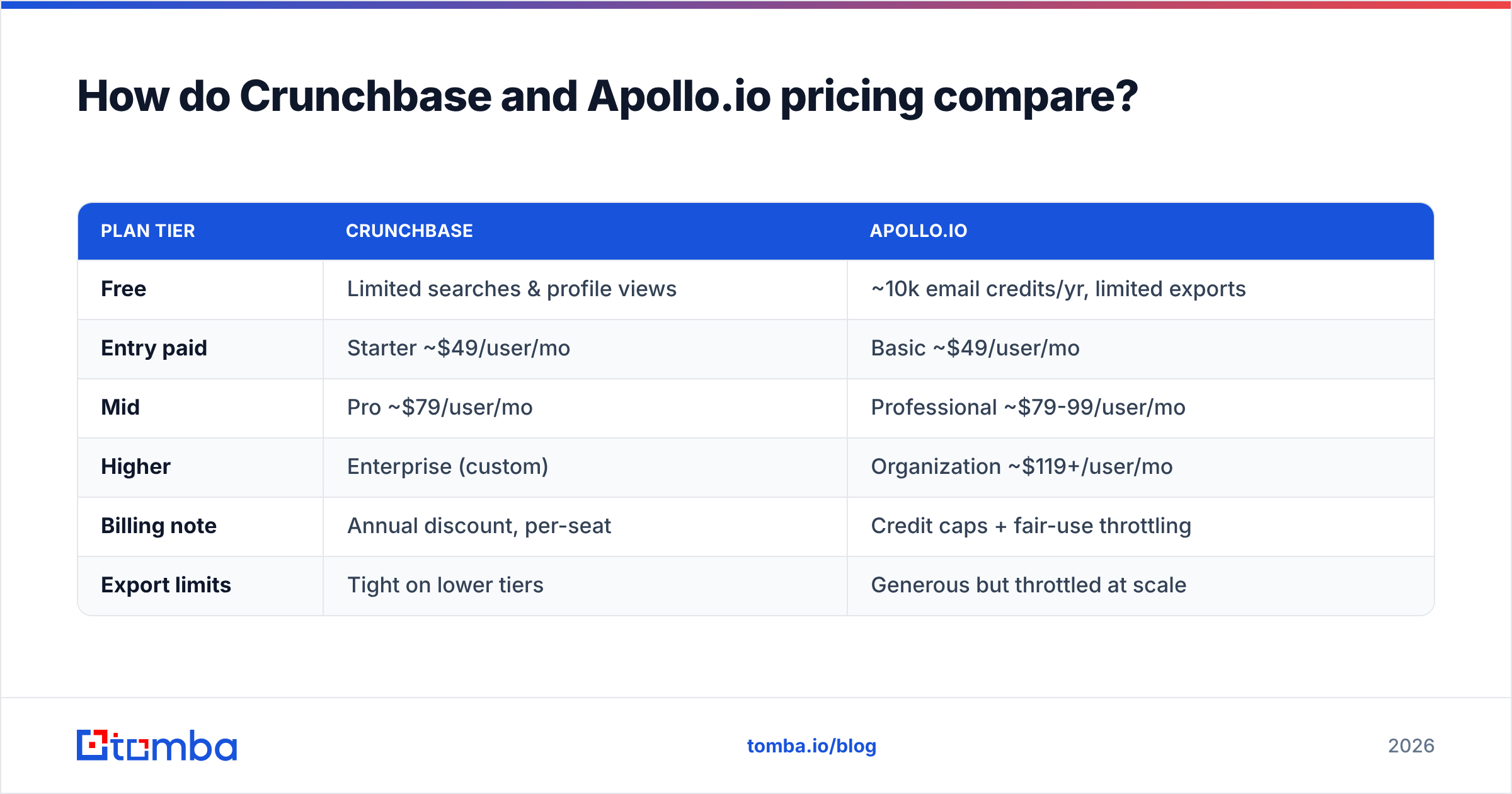
How do Crunchbase and Apollo.io pricing compare?#
Both start free and both climb once you need export volume, seats, or advanced features. Here's the shape of it in 2026 (list prices move, so confirm on each vendor's page before buying).
| Plan tier | Crunchbase | Apollo.io |
|---|---|---|
| Free | Limited searches & profile views | ~10k email credits/yr, limited exports |
| Entry paid | Starter ~$49/user/mo | Basic ~$49/user/mo |
| Mid | Pro ~$79/user/mo | Professional ~$79-99/user/mo |
| Higher | Enterprise (custom) | Organization ~$119+/user/mo |
| Billing note | Annual discount, per-seat | Credit caps + fair-use throttling |
| Export limits | Tight on lower tiers | Generous but throttled at scale |
Two traps to watch:
- Crunchbase gates the good stuff. Growth signals, advanced search, and bulk export live on higher tiers. The Starter plan is closer to a nicer public profile view than a research engine.
- Apollo's "unlimited" isn't. Email credits on paid plans carry fair-use limits, and mobile-number credits are metered separately and burn fast. Read the fine print on your specific tier.
If you are only after contact data and don't need Crunchbase's funding signals or Apollo's sequencer, both are overkill on price. Compare against Tomba pricing — Free (25 searches/mo), Starter $49/mo, Growth $99/mo — where you pay for accurate finding and verification without funding an outreach suite you already have elsewhere.

When should you choose Crunchbase?#
Choose Crunchbase when your bottleneck is knowing who to go after, not reaching them. It earns its price if you rely on timing signals.
- You run account-based marketing and build target lists around funding, hiring, or product events.
- You are in VC, PE, or corp dev and need reliable funding and M&A history.
- You do market and competitive research and want clean firmographics and relationships between companies.
- You want a trigger feed — get alerted when accounts raise money or change leadership so you can time outreach.
Crunchbase is a research and prioritization layer. Pair it with a contact tool and you have a strong ABM stack. Use it alone for outbound and you'll stall the moment you need a verified email.
When should you choose Apollo.io?#
Choose Apollo when your bottleneck is execution at volume and you want fewer tools.
- You are an SDR team or founder running high-volume outbound and want prospecting plus sequencing in one place.
- You need direct dials and a built-in dialer for a phone-heavy motion.
- You want native CRM enrichment for HubSpot or Salesforce without a separate vendor.
- Your ICP is US mid-market tech, where Apollo's data coverage is strongest.
Apollo is a fine default for teams that value consolidation over best-in-class depth. Just budget for the reality that you'll still verify data before sending, and coverage gaps outside US tech are real. If you're weighing it against a pure prospecting stack, our Apollo alternative breakdown covers where a focused finder pulls ahead.
Can you use both — or replace both?#
Plenty of teams run Crunchbase for signals and Apollo for outreach. That works, but it is expensive and redundant: you're paying two vendors for overlapping firmographics plus features you may not touch.
Before you commit to both, ask what you actually need:
- If you need company signals only → Crunchbase (or a lighter research tool).
- If you need contacts + sequencing in one seat → Apollo.io.
- If you need accurate contacts and verification without the platform tax → a focused finder like Tomba, plugged into the CRM and sequencer you already trust.
That third path is how a lot of lean teams cut cost in 2026. You keep your outreach tool, drop the redundant database subscription, and use an API-first email finder for the one thing that actually blocks pipeline: getting a correct, deliverable address. Tomba's domain search and bulk email finder cover the list-building side, and the email finder API drops enrichment straight into your workflow — no seat-based sequencer required.
For a broader landscape view, Gartner's sales intelligence category is a useful neutral reference on where these tools sit relative to each other.
The honest verdict#
There is no universal winner — the right answer depends on your bottleneck.
- Pick Crunchbase if you sell into a signal-driven, account-based motion and timing is your edge.
- Pick Apollo.io if you run volume outbound and want prospecting, email, and dialing under one login.
- Pick neither as a database if your real need is accurate, verified contact data at a sane price — a specialized finder does that one job better and cheaper than either platform's contact layer.
Whatever you choose, the constraint is the same across all three: an address that bounces is worthless, and a signal you can't act on is just trivia. Data accuracy and deliverability decide whether any of this turns into pipeline.
Get accurate contacts without the platform tax#
If your goal is simply to reach the right people, start with the tool built for exactly that. Tomba Email Finder finds professional email addresses by name, domain, or company, verifies them in the same flow, and hands them off through a clean API, Chrome extension, or Google Sheets add-on — so you can layer it on top of whatever research or sequencing stack you already run.
Try it free with 25 searches a month, and only pay when you're ready to scale. You'll spend less than a single seat on Crunchbase or Apollo and get the one thing that actually moves deals forward: contacts that land in the inbox.
Related guides#
Ready to find emails that actually work?
Join 150,000+ professionals who stopped guessing and started sending. Free credits on signup — no credit card required.
Get the Tomba newsletter
Practical outbound tactics and product updates — once every two weeks.
About the author