Crustdata vs Apollo.io: Full 2026 Comparison for B2B Data Teams
Crustdata is a developer-first data API; Apollo.io is an all-in-one prospecting suite. Here is how they compare on data, pricing, and fit—and where a leaner tool beats both.
Choosing between Crustdata and Apollo.io usually means you are solving two different problems and hoping one tool covers both. It rarely does. This comparison breaks down what each platform is actually built for, where the data holds up, what you pay, and when a focused email tool beats paying for a suite you only half-use.
TL;DR: Crustdata vs Apollo.io in 30 seconds#
- Crustdata is a developer-first data API. You buy structured company and people data, real-time signals, and enrichment through endpoints—not through a UI with sequences and dialers.
- Apollo.io is an all-in-one prospecting suite: a large contact database, filters, email sequencing, a dialer, and a Chrome extension aimed at SDRs and small sales teams.
- Pick Crustdata if you are a data or engineering team piping firmographic and signal data into your own product, model, or workflow.
- Pick Apollo.io if you are a rep who wants to search, build lists, and send outreach from one screen without writing code.
- Pick a focused finder (like Tomba) if your real need is accurate, verified email addresses at a sane price—not a second CRM.
What is Crustdata and who is it for?#
Crustdata sells B2B data as an API. Instead of logging into a dashboard to build a list, your engineers call endpoints to pull company firmographics, headcount trends, job postings, web traffic estimates, funding signals, and people-level attributes. The core promise is freshness and structure: data you can drop straight into a product feature, a lead-scoring model, or an internal enrichment pipeline.
That makes Crustdata a builder's tool. Its natural buyers are RevOps engineers, data teams, and startups building sales-intelligence or data enrichment features on top of someone else's plumbing. If you want "companies that just posted three sales-engineering roles and grew headcount 20% this quarter," Crustdata is designed to return that as JSON, not as a CSV you eyeball.
The tradeoff is obvious: there is no sequencer, no dialer, no inbox. Crustdata assumes you already have a place to send the data. If you are a single rep who wants to email 50 prospects today, an API contract is the wrong shape of tool.
What is Apollo.io and who is it for?#
Apollo.io is a sales-engagement platform wrapped around a contact database of hundreds of millions of records. You search with filters (title, industry, headcount, technology, intent), save contacts to lists, then run them through built-in email sequences and calls—all inside Apollo. Its Chrome extension pulls contact details on LinkedIn and company sites, which is how most reps first meet the product.
Apollo's buyer is the SDR, the founder doing their own outbound, or a small sales team that wants prospecting and sending in one subscription. You can read more about the platform on the official Apollo.io site and see how users rate it on G2.
The catch is that Apollo is a suite, and suites charge suite prices. Data accuracy varies by region and seniority, credit limits gate exports on lower tiers, and you inherit a full engagement platform even if you already use Outreach, Salesloft, or your CRM's native sequencing. If that describes you, you are paying for overlap.

Crustdata vs Apollo.io: side-by-side comparison#
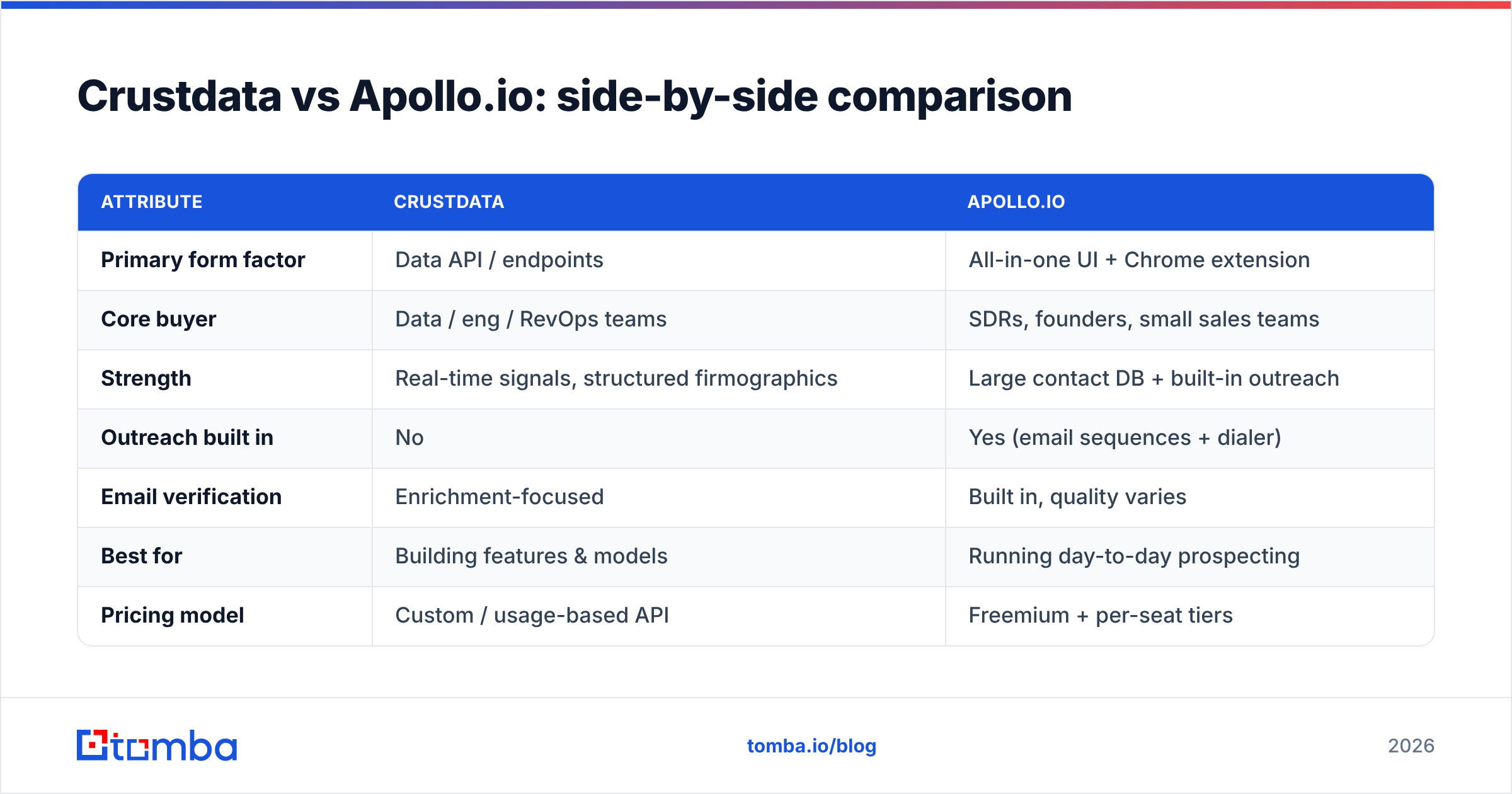
Here is the honest head-to-head. Neither tool is "better" in the abstract—they answer different questions.
| Attribute | Crustdata | Apollo.io |
|---|---|---|
| Primary form factor | Data API / endpoints | All-in-one UI + Chrome extension |
| Core buyer | Data / eng / RevOps teams | SDRs, founders, small sales teams |
| Strength | Real-time signals, structured firmographics | Large contact DB + built-in outreach |
| Outreach built in | No | Yes (email sequences + dialer) |
| Email verification | Enrichment-focused | Built in, quality varies |
| Best for | Building features & models | Running day-to-day prospecting |
| Pricing model | Custom / usage-based API | Freemium + per-seat tiers |
| Learning curve | Needs engineering | Rep-friendly, no code |
The pattern: Crustdata is upstream (raw, fresh, programmatic), Apollo is downstream (packaged, clickable, action-ready). Teams that try to force one to do the other's job end up frustrated.
Which one has better data accuracy?#
Neither wins outright, and the reason matters. Crustdata's edge is signal freshness—headcount changes, hiring bursts, funding events—because that data is refreshed and served through APIs where staleness shows up fast. Its people-level email coverage is less of a headline feature than its company intelligence.
Apollo's edge is raw contact volume. A huge database means you will almost always find a record. But volume and accuracy are not the same thing. Independent reviews and user reports consistently note that Apollo's email and direct-dial accuracy dips for senior titles, non-US regions, and smaller companies. That is normal for any large aggregated database, but it means you cannot skip verification before you send.
This is the gap most buyers underestimate. Whichever platform you choose, you should still run addresses through a dedicated email verifier before a campaign. A "found" email is not a "deliverable" email, and bounces above 3-4% start hurting your sender reputation regardless of which vendor sourced the address.
What do Crustdata and Apollo.io cost in 2026?#
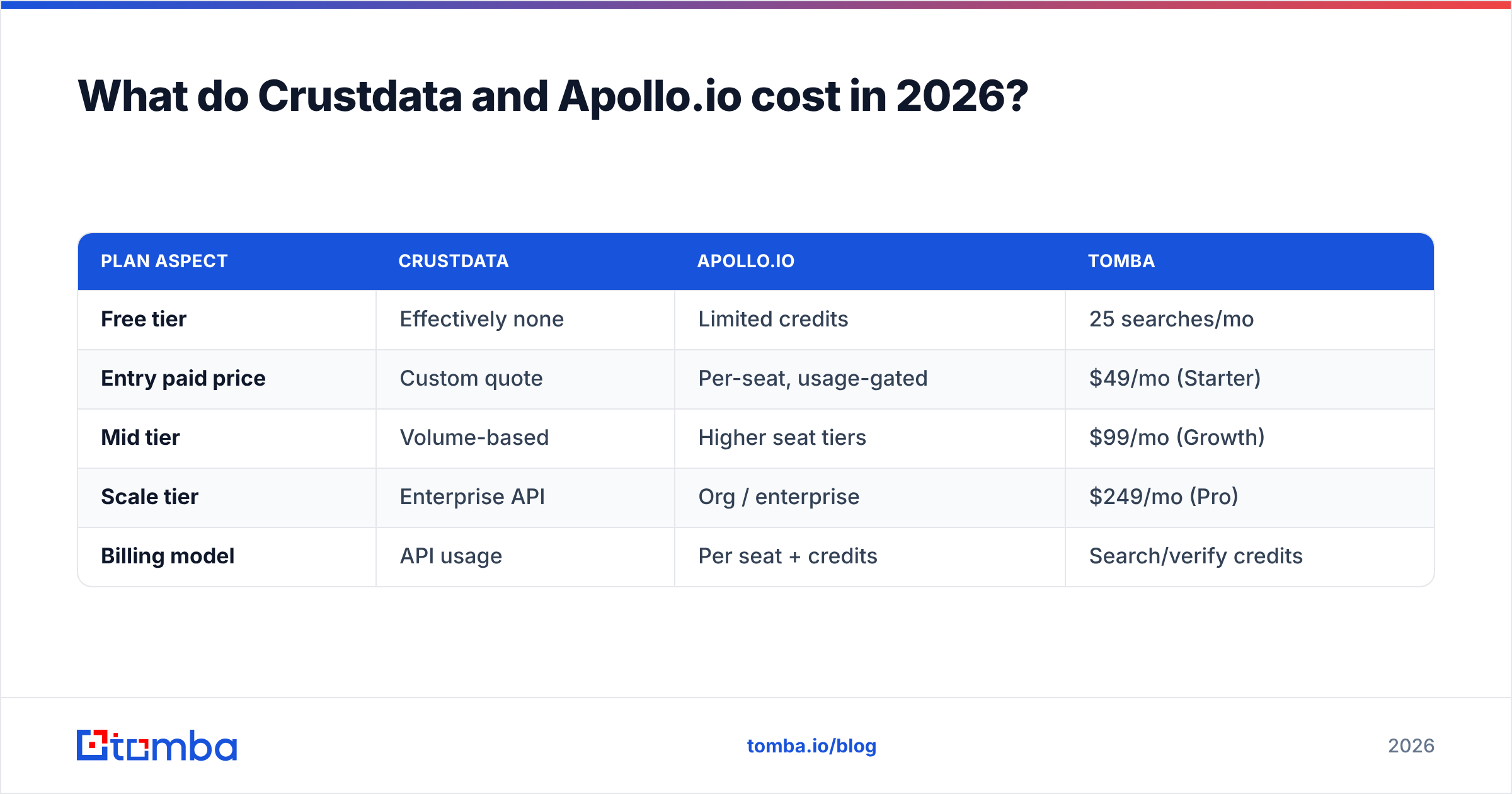
Pricing is where the two diverge hardest, because they are sold to different budgets.
Crustdata uses custom, usage-based pricing negotiated around API volume and the datasets you need. There is no meaningful free tier to self-serve; you talk to sales, scope your call volume, and pay for what you pull. That is standard for data-API vendors and fine if data is a line item in an engineering budget—less fine if you just want to try it tonight. Check current terms on crustdata.com.
Apollo.io is freemium with per-seat tiers. A free plan gets you limited credits; paid tiers unlock more exports, sequencing volume, and features. The friction shows up as credit caps and per-seat multiplication—costs climb as your team grows, and export limits can bite exactly when a campaign scales.
| Plan aspect | Crustdata | Apollo.io | Tomba |
|---|---|---|---|
| Free tier | Effectively none | Limited credits | 25 searches/mo |
| Entry paid price | Custom quote | Per-seat, usage-gated | $49/mo (Starter) |
| Mid tier | Volume-based | Higher seat tiers | $99/mo (Growth) |
| Scale tier | Enterprise API | Org / enterprise | $249/mo (Pro) |
| Billing model | API usage | Per seat + credits | Search/verify credits |
If your actual need is "get verified emails without a suite tax," the third column is worth a look. Tomba's transparent pricing skips both the per-seat multiplication and the enterprise sales call.
When should you skip both and use a focused email finder?#
Skip both when your problem is narrower than either tool assumes. A large share of teams evaluating Crustdata or Apollo do not need a signals API or a full engagement suite—they need accurate work emails for a list of people or companies, verified, exportable, and integrated with the tools they already run.
Signs you are over-buying with Crustdata or Apollo:
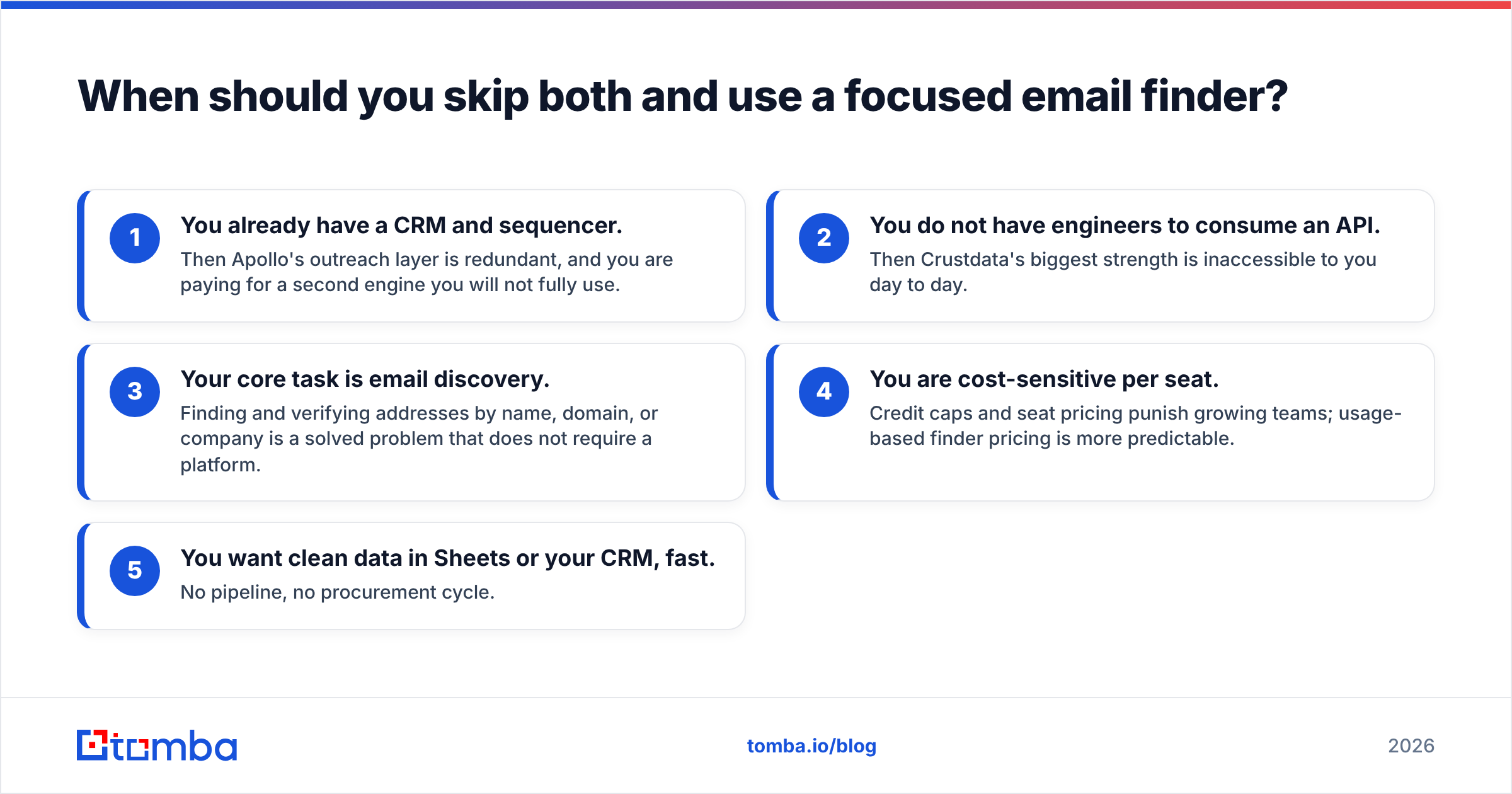
- You already have a CRM and sequencer. Then Apollo's outreach layer is redundant, and you are paying for a second engine you will not fully use.
- You do not have engineers to consume an API. Then Crustdata's biggest strength is inaccessible to you day to day.
- Your core task is email discovery. Finding and verifying addresses by name, domain, or company is a solved problem that does not require a platform.
- You are cost-sensitive per seat. Credit caps and seat pricing punish growing teams; usage-based finder pricing is more predictable.
- You want clean data in Sheets or your CRM, fast. No pipeline, no procurement cycle.
A dedicated tool covers this cleanly. Tomba's email finder locates professional addresses by name or company, its domain search returns every public email pattern for a company, and everything runs through verification so you are exporting deliverable contacts, not guesses. For teams replacing an oversized suite, the Apollo alternative breakdown maps the switch feature by feature.
How do Crustdata and Apollo.io fit into a real stack?#
The best setups rarely rely on a single vendor. Think in layers.
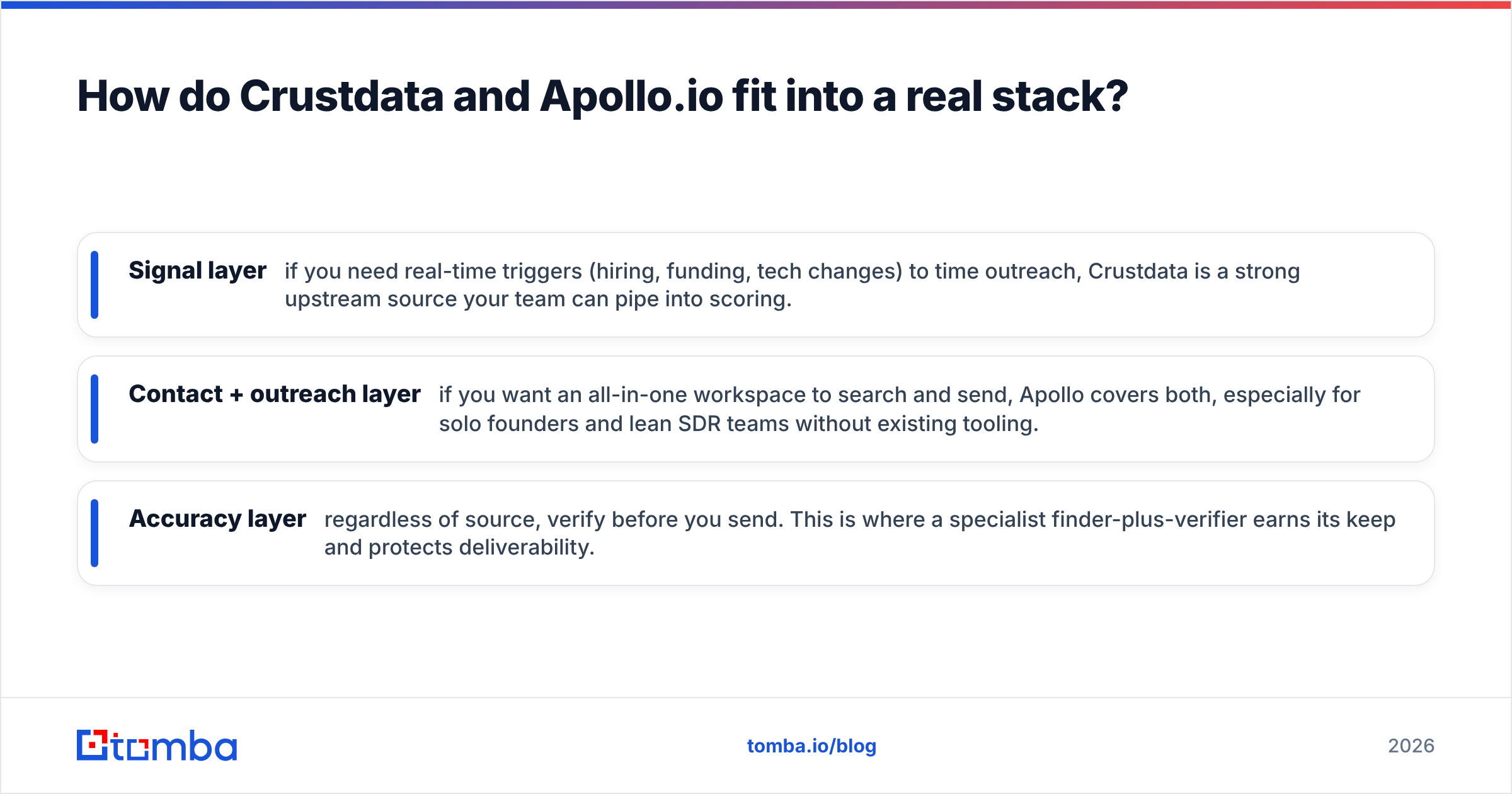
- Signal layer — if you need real-time triggers (hiring, funding, tech changes) to time outreach, Crustdata is a strong upstream source your team can pipe into scoring.
- Contact + outreach layer — if you want an all-in-one workspace to search and send, Apollo covers both, especially for solo founders and lean SDR teams without existing tooling.
- Accuracy layer — regardless of source, verify before you send. This is where a specialist finder-plus-verifier earns its keep and protects deliverability.
Most mid-market teams already own a CRM and a sequencer, which quietly removes half of Apollo's value and all of Crustdata's outreach relevance. What is left is a data question: who are the right people, what are their real emails, and are those emails safe to send to? Answer that with a focused tool and you avoid paying platform prices for a data problem.
Crustdata vs Apollo.io: the verdict#
Choose Crustdata if you are building. You have engineers, you want fresh structured signals in your own product or model, and a UI would only get in the way. It is a genuinely good API-first data source for that job.
Choose Apollo.io if you are a rep or a small team starting from zero tooling and you want search plus outreach in one login. It is the more approachable pick for hands-on prospecting, as long as you budget for credit limits and verify senior/international records before sending.
Choose a focused finder if, like most teams, your true need is accurate verified emails—not a signals pipeline and not a second CRM. That is the majority case, and it is the one both suites quietly overcharge for.
If your outbound lives or dies on email accuracy, start with the tool built for exactly that. Tomba's Email Finder gives you verified professional addresses by name, domain, or company—with a free tier to test it, plans from $49/mo, and no per-seat surprise. Point it at your target list, export deliverable contacts, and keep your Crustdata or Apollo spend for the jobs only they can do.
Related guides#
Ready to find emails that actually work?
Join 150,000+ professionals who stopped guessing and started sending. Free credits on signup — no credit card required.
Get the Tomba newsletter
Practical outbound tactics and product updates — once every two weeks.
About the author