CsvGo vs Apolloio (2026): Which B2B Data Tool Wins?
CsvGo sells cheap bulk CSV exports; Apollo.io sells an all-in-one sales platform. Here's an honest, side-by-side breakdown of accuracy, pricing, and export limits so you pick the right B2B data tool.
The csvgo vs apolloio choice comes down to one honest question: do you want cheap bulk records fast, or a full sales platform you'll grow into? They are not the same product. The marketing pages make them look more alike than they are.
This breakdown compares both on what actually costs you money later: data accuracy, export limits, per-seat pricing, and how much cleanup your list needs before it is safe to send. Where a third option makes more sense, we say so.
TL;DR — CsvGo vs Apollo.io at a glance#
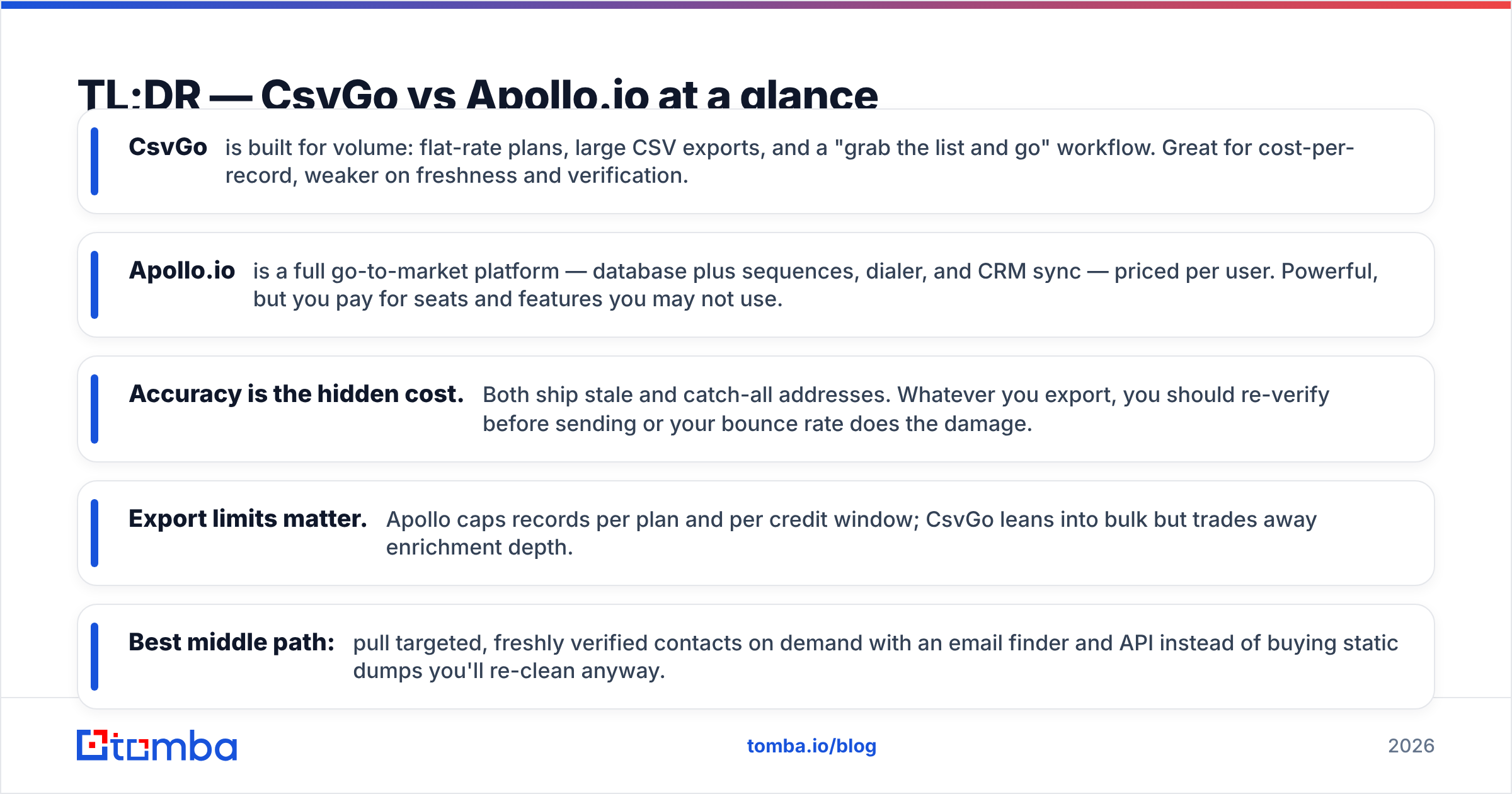
- CsvGo is built for volume: flat-rate plans, large CSV exports, and a "grab the list and go" workflow. Great for cost-per-record, weaker on freshness and verification.
- Apollo.io is a full go-to-market platform — database plus sequences, dialer, and CRM sync — priced per user. Powerful, but you pay for seats and features you may not use.
- Accuracy is the hidden cost. Both ship stale and catch-all addresses. Whatever you export, you should re-verify before sending or your bounce rate does the damage.
- Export limits matter. Apollo caps records per plan and per credit window; CsvGo leans into bulk but trades away enrichment depth.
- Best middle path: pull targeted, freshly verified contacts on demand with an email finder and API instead of buying static dumps you'll re-clean anyway.
What is CsvGo and who is it for?#
CsvGo is a B2B lead-export tool. The pitch is simple: pick a segment, export a CSV of company and contact records, and pay a flat or credit-based rate that undercuts the big platforms on cost-per-record. If your workflow is "give me 10,000 rows I can drop into a spreadsheet or a cold-email tool," CsvGo is aimed squarely at you.
That model has real advantages. You aren't paying per seat, the pricing is predictable, and the export step is fast. For agencies, solo founders, and lean outbound teams that just need raw volume to feed a sequencer, a flat bulk plan can look far cheaper than an enterprise contract.
The trade-off is depth and freshness. Bulk-export tools tend to serve from large, periodically-refreshed datasets. That means a meaningful slice of any big export will be role-based addresses, job-changers who've moved on, and catch-all domains that "accept" everything at the server and tell you nothing. None of that is unique to CsvGo — it's the nature of selling records by the thousand — but it's the part the landing page won't emphasize.

What is Apollo.io and who is it for?#
Apollo.io is a go-to-market platform, not just a data source. Alongside its contact and company database, you get sequences, an email sender, a dialer, LinkedIn tools, deal management, and native CRM sync. The database is large and the filtering is genuinely good — buying intent, technographics, headcount, funding, and dozens of firmographic filters.
Apollo is priced per user, with a free tier and paid plans (Basic, Professional, Organization) that unlock more credits, more advanced filters, and more automation. For a full sales team that lives inside one tool all day, that bundling is the appeal: prospect, enrich, sequence, and dial without leaving the tab.
The catch is the same one every all-in-one hits. You pay per seat, credit limits gate how much you can actually export, and "unlimited" claims usually carry fair-use and page-scrape restrictions in the fine print. And like every provider at this scale, Apollo's data still needs verification before you send — a big database is not a clean one. Independent reviews on G2 consistently praise the workflow while flagging data accuracy as the recurring complaint.
CsvGo vs Apolloio: the core comparison#
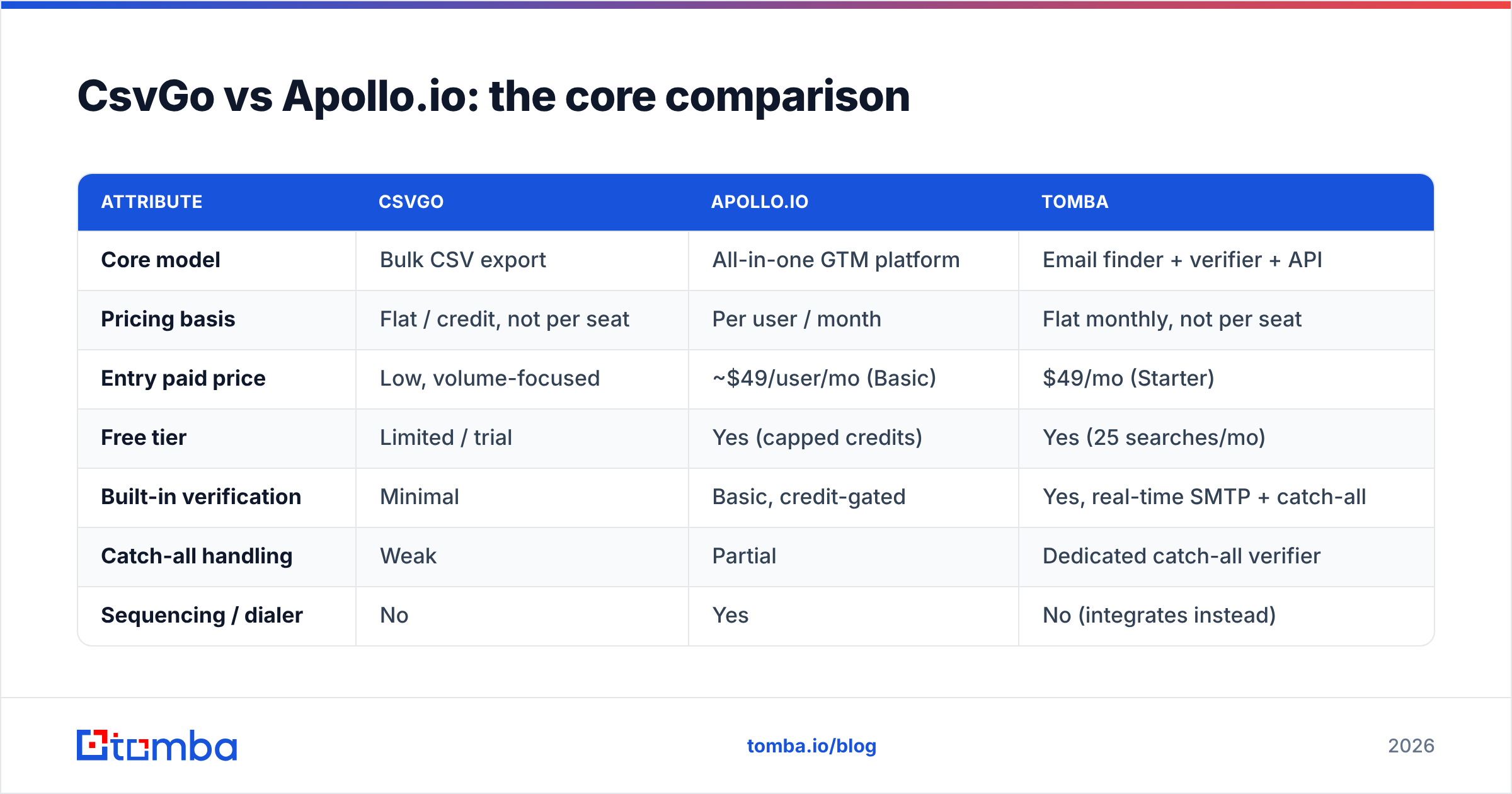
This csvgo vs apolloio comparison covers the attributes that change your results and your bill. Treat specific numbers as "check current pricing" — vendors move tiers often — but the shape of the trade-off is stable.
| Attribute | CsvGo | Apollo.io | Tomba |
|---|---|---|---|
| Core model | Bulk CSV export | All-in-one GTM platform | Email finder + verifier + API |
| Pricing basis | Flat / credit, not per seat | Per user / month | Flat monthly, not per seat |
| Entry paid price | Low, volume-focused | ~$49/user/mo (Basic) | $49/mo (Starter) |
| Free tier | Limited / trial | Yes (capped credits) | Yes (25 searches/mo) |
| Built-in verification | Minimal | Basic, credit-gated | Yes, real-time SMTP + catch-all |
| Catch-all handling | Weak | Partial | Dedicated catch-all verifier |
| Sequencing / dialer | No | Yes | No (integrates instead) |
| API access | Limited | Yes (higher tiers) | Yes on all paid plans |
| Best for | Cheap volume | Full sales teams | Targeted, verified contacts |
The pattern is clear. CsvGo wins on raw cost-per-record and simplicity. Apollo wins on breadth — one login for the whole outbound motion. Neither one leads on the thing that quietly wrecks campaigns: verified, deliverable data you can send without a cleanup step.
Is CsvGo or Apollo.io more accurate?#
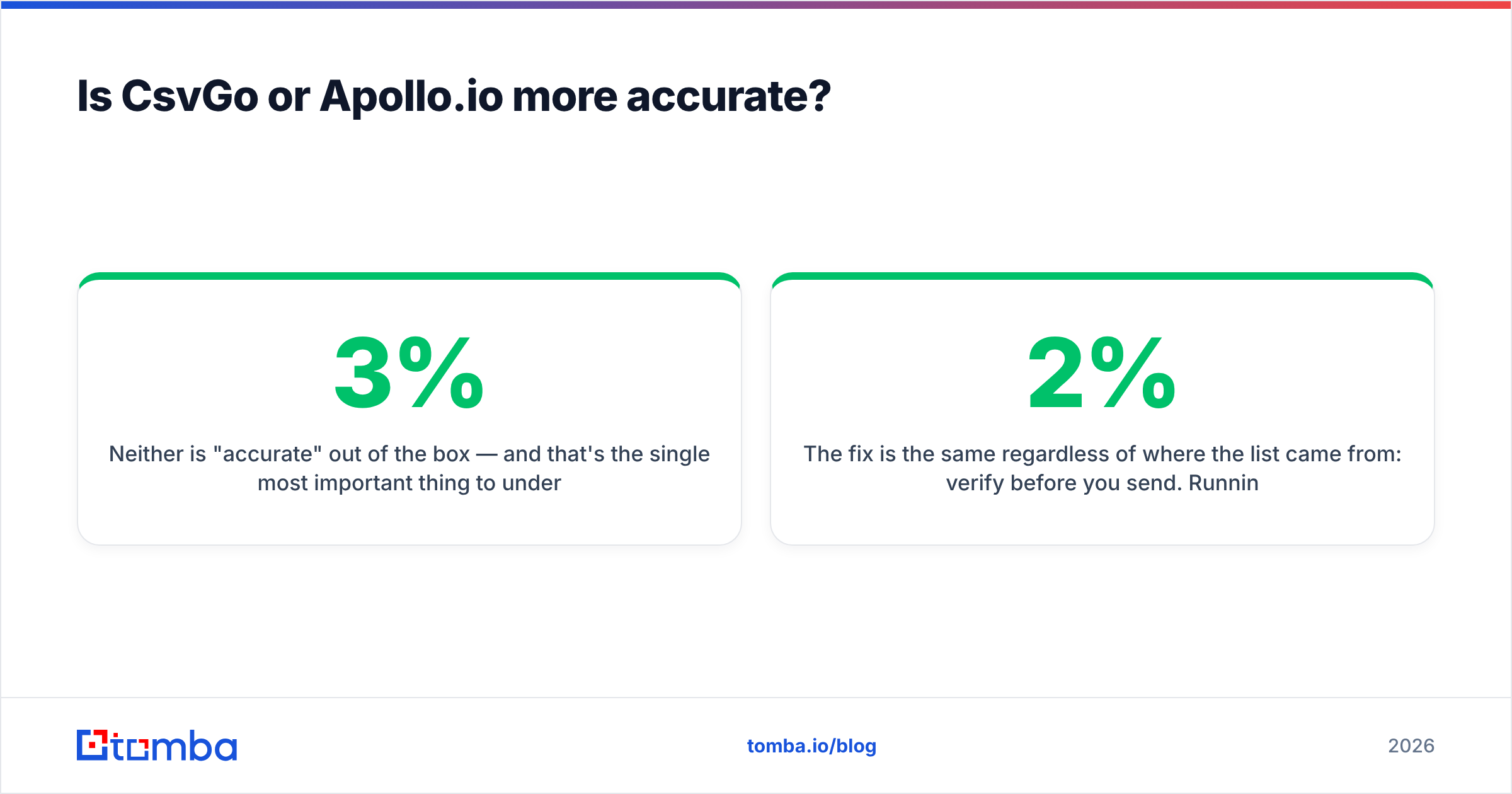
Neither is "accurate" out of the box — and that's the single most important thing to understand before you buy either. Any large B2B dataset decays roughly 2–3% per month as people change jobs, companies rebrand, and domains churn. A record that was correct at export can be dead within a quarter.
There are three failure modes to watch, and both tools share them:
- Job-changers — the person is real, the email is stale. High-volume exports magnify this because you're pulling more old rows at once.
- Role and generic addresses —
info@,sales@,contact@. They "exist" but rarely reach a decision-maker and often trip spam filters. - Catch-all domains — the mail server accepts everything, so a naive check returns "valid" for addresses that will still bounce. This is where most tools quietly inflate their accuracy claims.

The fix is the same regardless of where the list came from: verify before you send. Running any export through an email verifier with real SMTP checks and dedicated catch-all logic is what separates a 2% bounce rate from a 20% one. A 20% bounce rate doesn't just waste sends — it torches your sender reputation and pushes future mail to spam.
So the honest answer to "which is more accurate" is: whichever one you verify. Buying a bigger database doesn't buy you a cleaner one.
How do CsvGo and Apollo.io pricing compare?#
The pricing models are so different that "which is cheaper" depends entirely on your team size and volume.
CsvGo charges for records, not people. If you have one operator pulling large lists, flat bulk pricing crushes any per-seat tool on cost-per-record. There's no penalty for adding a teammate because you're paying for data, not seats.
Apollo.io charges per user per month, with credits capping exports inside each tier. A five-person team on the Professional plan is a materially bigger monthly commitment than a single CsvGo bulk plan — but you're also buying sequences, a dialer, and CRM sync, so the comparison isn't apples to apples. If your team would otherwise buy a separate sequencer and dialer, Apollo's bundle can be the cheaper total.
Watch the credit math on both. "Unlimited" exports usually aren't; they carry daily caps, page limits, or fair-use clauses. Model your real monthly volume, then divide by the plan price to get true cost-per-verified-contact — not cost-per-raw-record. Raw records you have to re-clean aren't the bargain they look like.
For comparison, a flat-rate finder like Tomba starts at $49/mo on Tomba pricing with verification built in, so the number you pay is closer to your number of usable contacts. If you're specifically weighing the all-in-one route, our Apollo alternative breakdown goes deeper on where the seat-based model stops making sense.
When should you pick a focused email finder instead?#
Pick a focused tool when your real problem is "I need verified contacts for a specific target list," not "I need software to run my entire sales org." That's most outbound teams, most of the time.
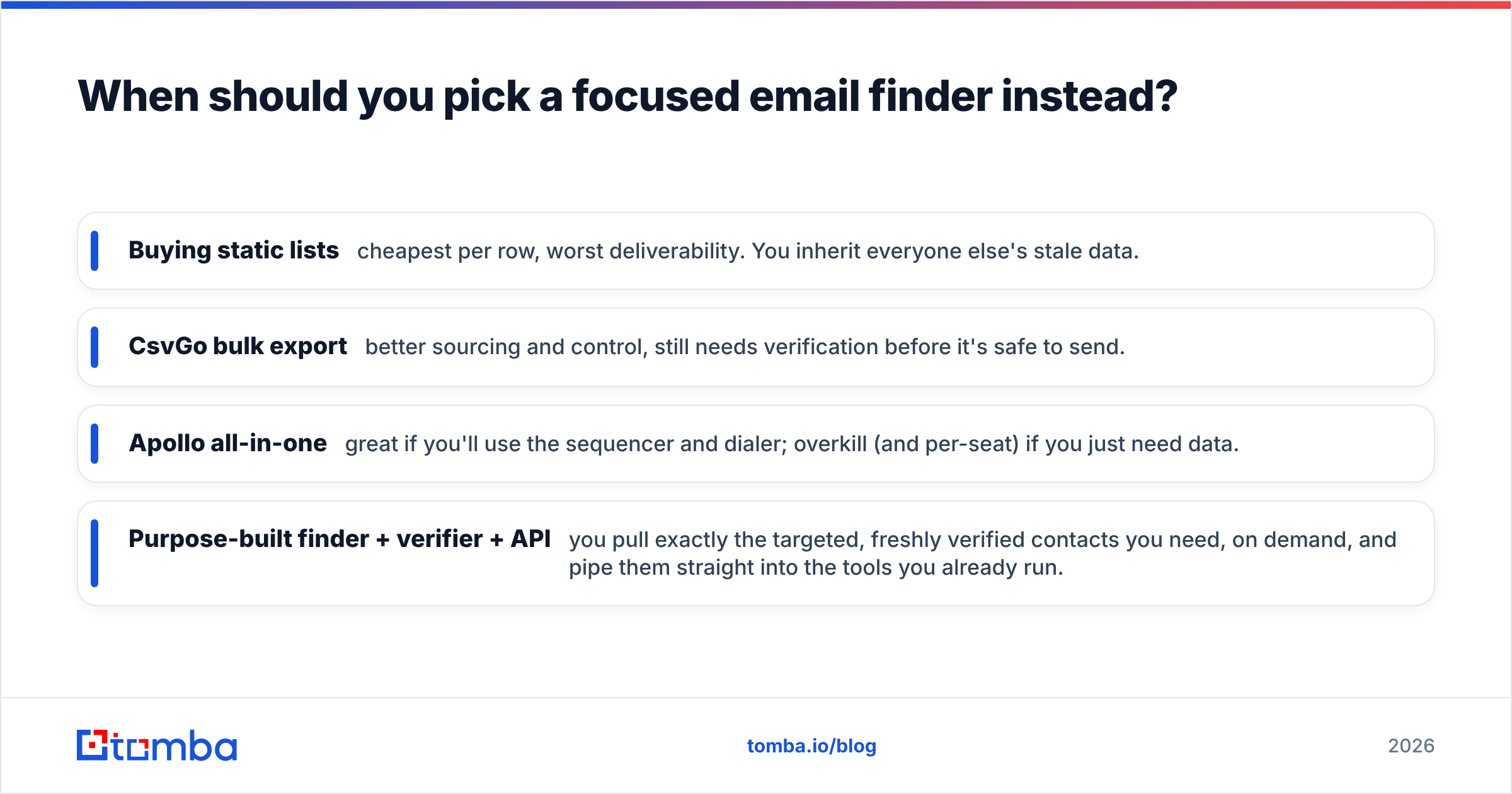
The escalation looks like this, and most people over-buy at least one rung:

- Buying static lists — cheapest per row, worst deliverability. You inherit everyone else's stale data.
- CsvGo bulk export — better sourcing and control, still needs verification before it's safe to send.
- Apollo all-in-one — great if you'll use the sequencer and dialer; overkill (and per-seat) if you just need data.
- Purpose-built finder + verifier + API — you pull exactly the targeted, freshly verified contacts you need, on demand, and pipe them straight into the tools you already run.
That last rung is where a tool like Tomba fits. Instead of buying a giant dump and re-cleaning it, you use domain search to pull every deliverable contact at a target company, verify in the same pass, and export or push via Tomba API. For high volume you run a bulk email finder job rather than paying for seats. You keep CsvGo's cost discipline and Apollo's data reach without the two big penalties — unverified rows and per-user billing.
None of this means CsvGo or Apollo is a bad product. If you genuinely need one login for prospecting, sequencing, and dialing, Apollo earns its price. If you're an agency shipping massive volume and you already have a rock-solid verification step, CsvGo's flat rate is hard to beat. The mistake is assuming either one hands you send-ready data. Neither does — no provider at scale does.
The bottom line: which should you choose?#
Choose Apollo.io if you want one platform to run the whole outbound motion and you'll actually use the sequencer, dialer, and CRM sync. Budget for verification on top.
Choose CsvGo if you're volume-first, cost-per-record obsessed, and you already run a disciplined verification pass on everything you export.
Choose a focused finder + verifier if your bottleneck is deliverable data for specific targets and you'd rather not pay per seat or re-clean a bulk dump. Start free — Tomba's email finder gives you 25 searches a month at no cost, real-time SMTP and catch-all verification are built in, and everything is reachable via API on every paid plan from $49/mo. Pull the exact contacts you need, verified in the same step, and send with a bounce rate you can actually stand behind. Try the Tomba Email Finder and skip the cleanup tax entirely.
Related guides#
Ready to find emails that actually work?
Join 150,000+ professionals who stopped guessing and started sending. Free credits on signup — no credit card required.
Get the Tomba newsletter
Practical outbound tactics and product updates — once every two weeks.
About the author