CSVGO vs DiscoverOrg: B2B Data Provider Comparison (2026)
CSVGO sells cheap bulk CSV lists; DiscoverOrg (now ZoomInfo) sells premium org charts and intent data. Here's which B2B data source actually fits your pipeline in 2026 — and the cheaper middle path most teams miss.
You are choosing a B2B data source and two very different names keep surfacing: CSVGO, a low-cost bulk list provider, and DiscoverOrg, the enterprise sales-intelligence platform now folded into ZoomInfo. They sit at opposite ends of the market, so "which is better" is the wrong question. The right question is which data model fits how your team actually prospects — and whether you're overpaying for either.
TL;DR — CSVGO vs DiscoverOrg in one glance#
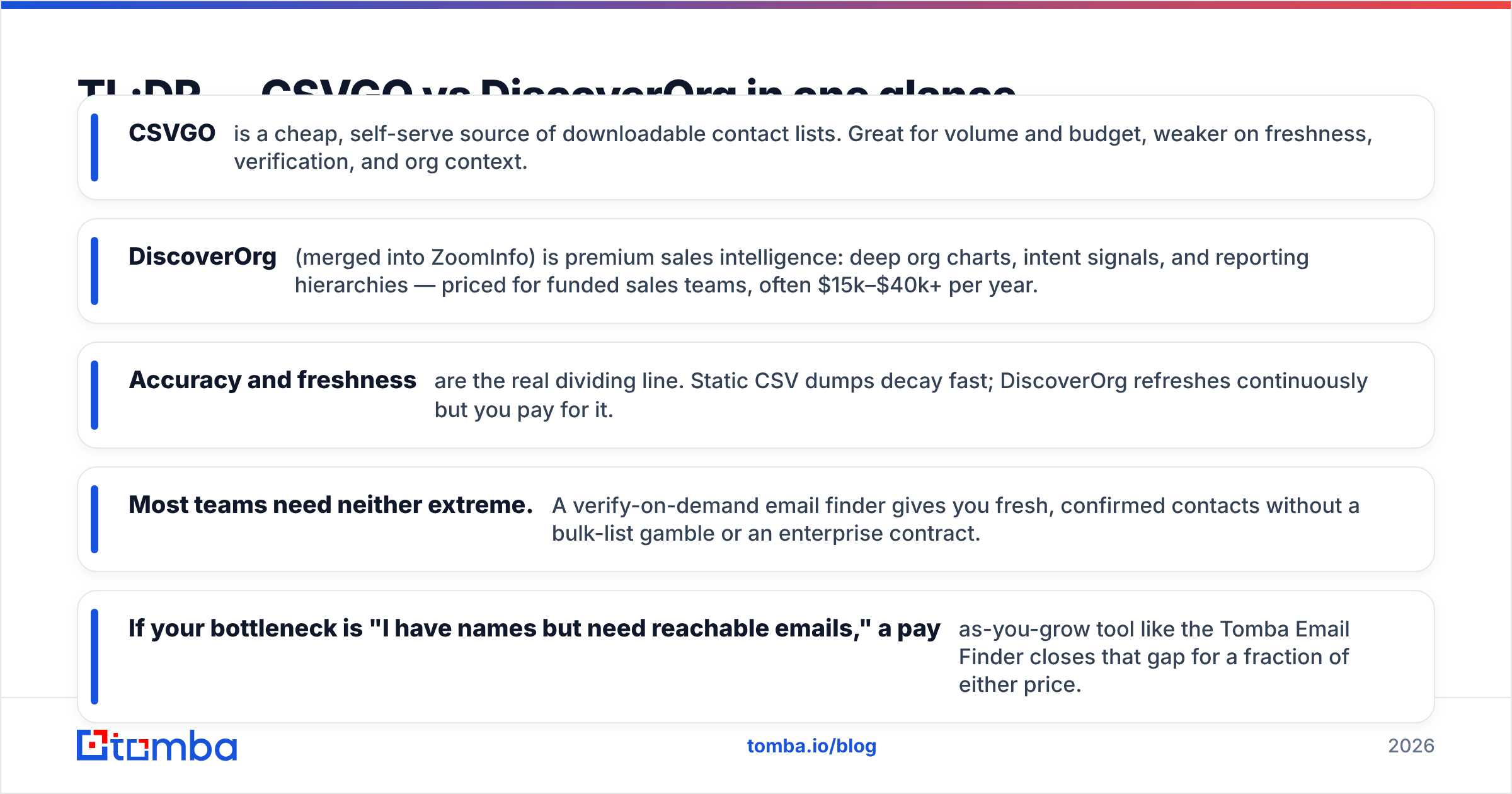
- CSVGO is a cheap, self-serve source of downloadable contact lists. Great for volume and budget, weaker on freshness, verification, and org context.
- DiscoverOrg (merged into ZoomInfo) is premium sales intelligence: deep org charts, intent signals, and reporting hierarchies — priced for funded sales teams, often $15k–$40k+ per year.
- Accuracy and freshness are the real dividing line. Static CSV dumps decay fast; DiscoverOrg refreshes continuously but you pay for it.
- Most teams need neither extreme. A verify-on-demand email finder gives you fresh, confirmed contacts without a bulk-list gamble or an enterprise contract.
- If your bottleneck is "I have names but need reachable emails," a pay-as-you-grow tool like the Tomba Email Finder closes that gap for a fraction of either price.

What is CSVGO and who is it for?#
CSVGO is a budget-oriented B2B data vendor. You pick a segment — industry, geography, job title, company size — and download a CSV of contacts, usually charged per record or per list. The appeal is obvious: low upfront cost, no annual contract, and instant volume you can drop straight into a sequencer.
The trade-off is the nature of static lists. A CSV is a snapshot. The moment it's exported, it starts decaying — people change jobs, companies rebrand, domains move. Industry research from vendors like HubSpot has long pegged B2B contact data decay at roughly 22–30% per year, and bulk-list data often starts older than that. Without a verification layer, a cheap list can quietly torch your sender reputation the first week you mail it.
CSVGO fits you if: you run high-volume top-of-funnel campaigns, you already own a strong email deliverability and warmup setup, and you treat list hygiene as your own job rather than the vendor's.
What is DiscoverOrg (now ZoomInfo)?#
DiscoverOrg built its reputation on human-verified organizational intelligence: detailed org charts, reporting lines, technographics, budget signals, and buying-committee mapping. In 2019 it merged with ZoomInfo, and the DiscoverOrg dataset now lives inside the broader ZoomInfo platform. You can read the corporate history on Wikipedia.
This is enterprise-grade data. Instead of a flat list, you get structured context — who reports to whom, which accounts show buying intent, and what tech a company runs. For a large sales org running account-based motions, that context is the product. It's why DiscoverOrg/ZoomInfo consistently rates well on G2 for data depth.
DiscoverOrg fits you if: you sell into mid-market or enterprise, you run ABM with named target accounts, you need intent and hierarchy data your reps will actually use, and you have the budget to justify a five-figure annual contract with seat-based pricing.
CSVGO vs DiscoverOrg: the core differences#
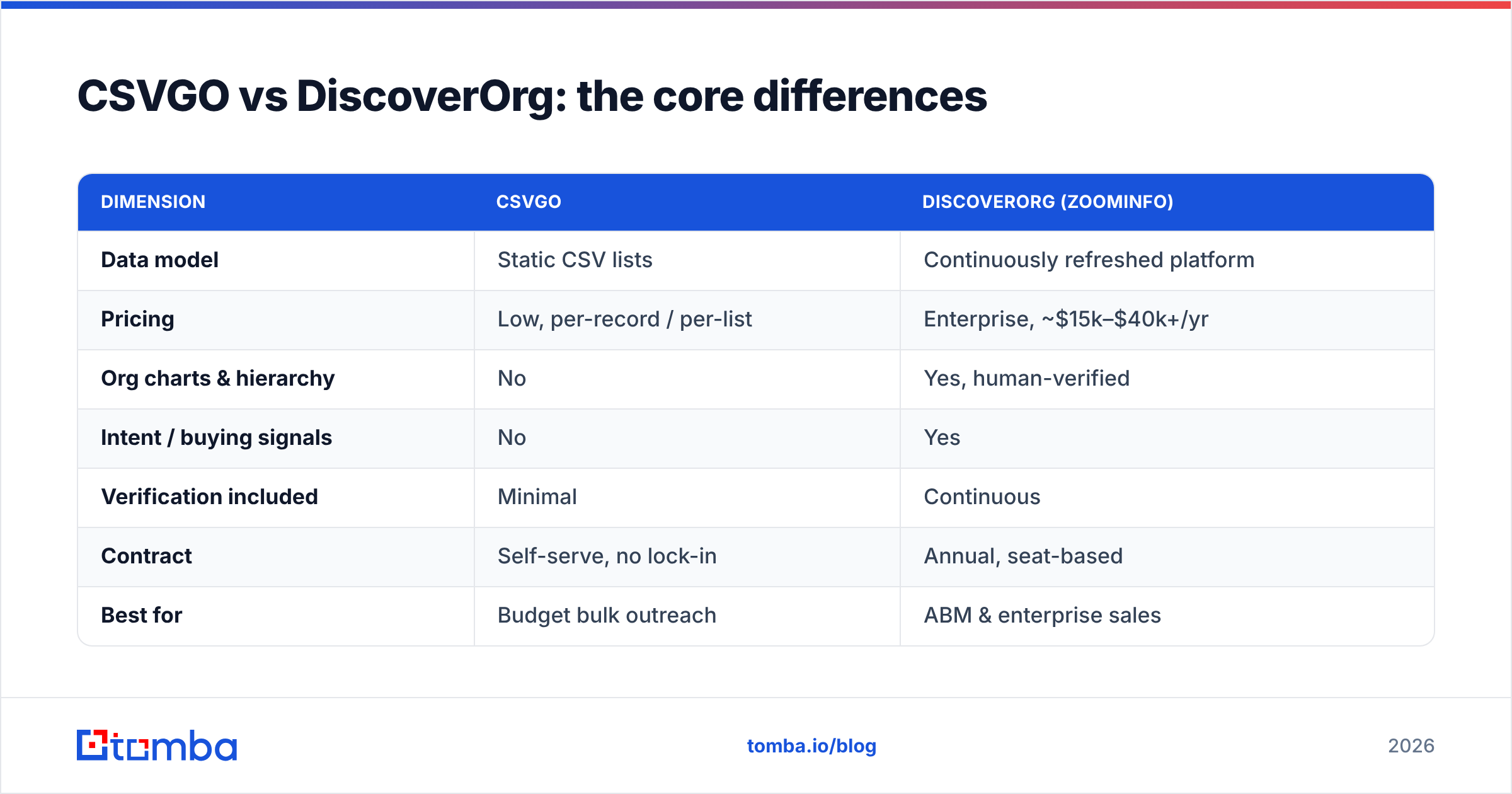
The two tools optimize for different things — price and volume versus depth and freshness. This is the fastest way to see where each one wins.
| Dimension | CSVGO | DiscoverOrg (ZoomInfo) |
|---|---|---|
| Data model | Static CSV lists | Continuously refreshed platform |
| Pricing | Low, per-record / per-list | Enterprise, ~$15k–$40k+/yr |
| Org charts & hierarchy | No | Yes, human-verified |
| Intent / buying signals | No | Yes |
| Verification included | Minimal | Continuous |
| Contract | Self-serve, no lock-in | Annual, seat-based |
| Best for | Budget bulk outreach | ABM & enterprise sales |
| Time to first list | Minutes | Onboarding + setup |
The pattern is clear: CSVGO wins on cost and speed-to-download, DiscoverOrg wins on depth and data quality. Neither wins on the metric most cold-outreach teams actually care about — landing verified emails in the inbox without overspending.
Is DiscoverOrg worth it over CSVGO?#
Short answer: only if you use the depth. DiscoverOrg is worth the premium when your reps genuinely work org charts and intent data every day — routing to the right buying-committee member, timing outreach to a spike in intent, personalizing around a known tech stack. That context lifts win rates in complex deals, and there's a real case for it in enterprise ABM.
But most teams buy the enterprise tier and use it like a glorified list. If your reps export contacts and blast a sequence, you're paying DiscoverOrg prices for CSVGO behavior. At that point the smart CSVGO angle — cheap volume you verify yourself — is the better economic choice.

The honest read: DiscoverOrg justifies its cost through workflow depth, not raw contact count. If you can't name three ways your reps will use org charts or intent this quarter, you don't need it yet.
How accurate is the data — and why it matters most#
Accuracy beats volume every time in outbound. A 10,000-row list at 60% deliverability is worse than a 3,000-row list at 95%, because the bad half doesn't just waste sends — it drags down your sender reputation and starts routing your good emails to spam.
Here's how the two approaches stack up on data quality:
- CSVGO — cost-efficient but variable. Freshness depends entirely on when the underlying list was built, and verification is largely on you. Budget a mandatory cleaning pass before you send anything.
- DiscoverOrg — high accuracy through continuous human-and-machine verification, which is a genuine strength and part of what you're paying for.
- The gap both leave open — neither is built to answer "is this specific person's email valid right now, before I hit send." Bulk data ages between refreshes; enterprise data is priced beyond what small teams can carry.
That last point is why a real-time verification layer matters more than the CSVGO-vs-DiscoverOrg debate itself. Whatever your source, run every address through an email verifier before a campaign, and use a catch-all verifier for the domains that don't return a clean SMTP response. That single habit protects deliverability regardless of where the contact came from.
The third option most comparisons skip#
You don't have to choose between a cheap decaying list and a five-figure contract. There's a middle path: find and verify contacts on demand, paying only for what you use.
Instead of buying 50,000 rows and hoping, you search by domain or by name and get a freshly confirmed email at the moment you need it. That model — used by tools like Tomba and peers such as BookYourData — gives you CSVGO-level economics with DiscoverOrg-level freshness on the contacts you actually work.
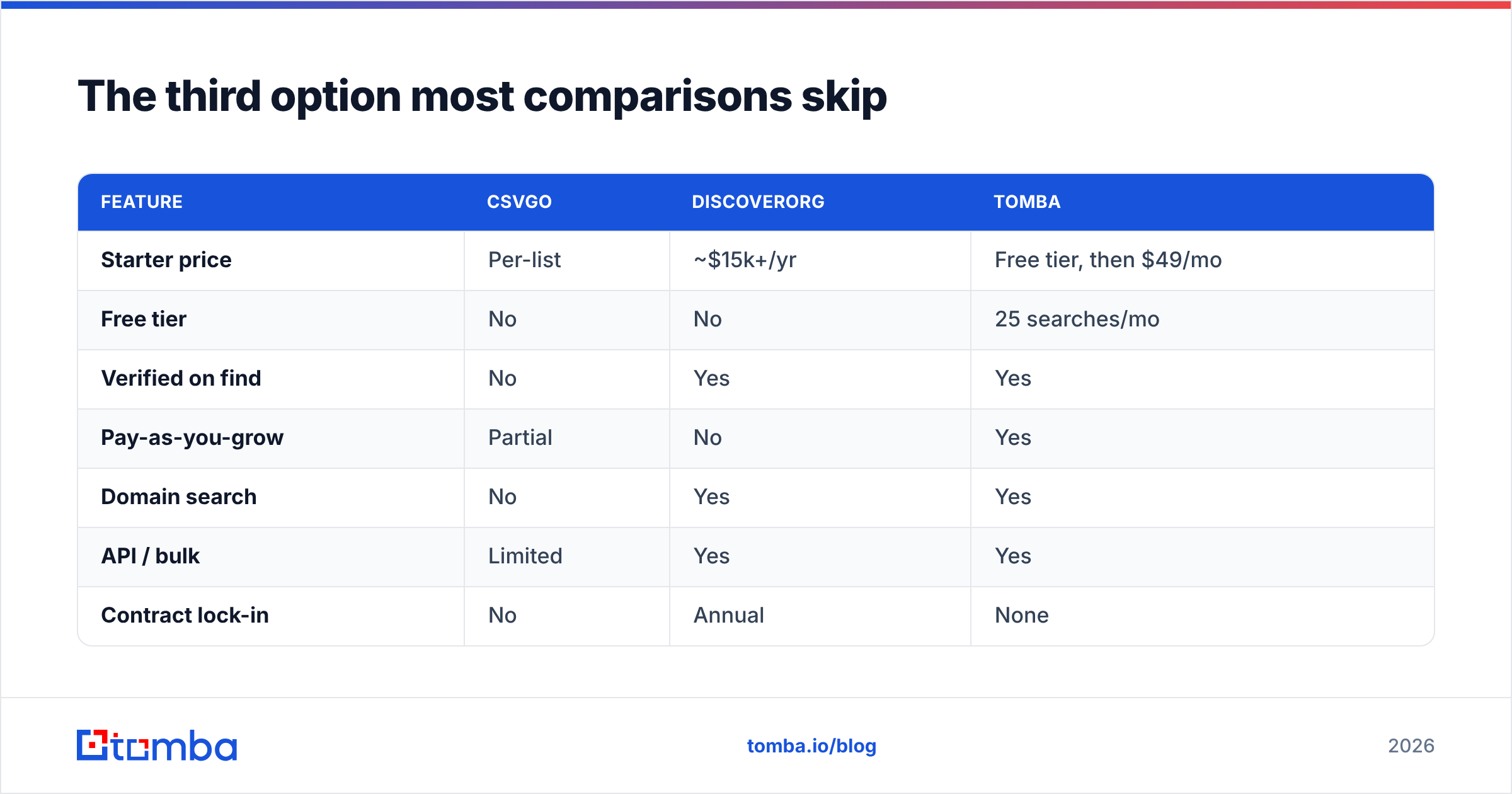
Here's how the on-demand approach compares to the two extremes:
| Feature | CSVGO | DiscoverOrg | Tomba |
|---|---|---|---|
| Starter price | Per-list | ~$15k+/yr | Free tier, then $49/mo |
| Free tier | No | No | 25 searches/mo |
| Verified on find | No | Yes | Yes |
| Pay-as-you-grow | Partial | No | Yes |
| Domain search | No | Yes | Yes |
| API / bulk | Limited | Yes | Yes |
| Contract lock-in | No | Annual | None |
With Tomba you can run a domain search to pull every reachable address at a target company, enrich records with data enrichment, or process a whole prospect file with the bulk email finder. See full Tomba pricing for the tier breakdown — the Starter plan is $49/mo, Growth is $99/mo, and Pro is $249/mo, with an Enterprise option for larger teams.
Which should you choose?#
Match the tool to your motion, not to the loudest sales pitch.
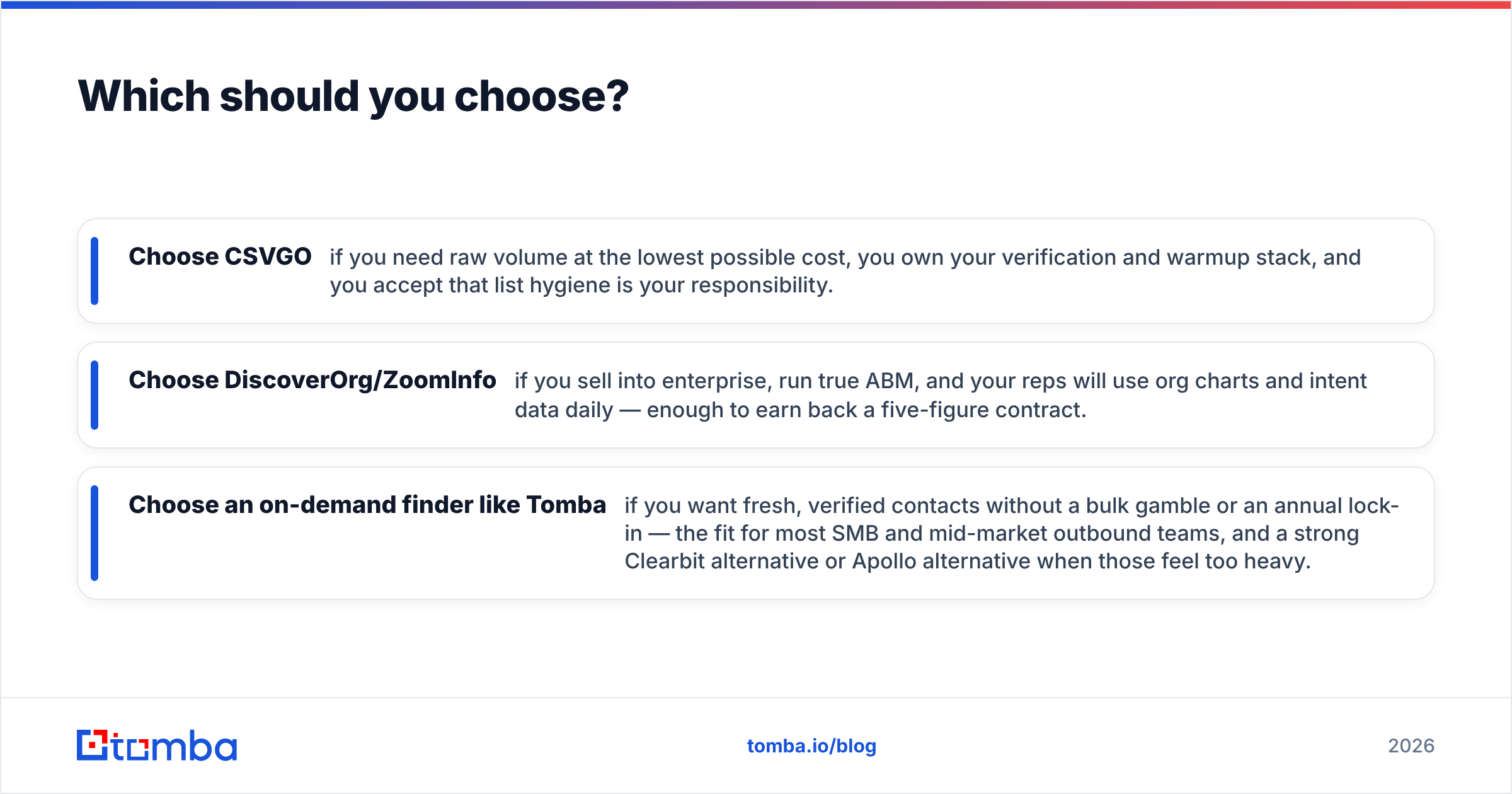
- Choose CSVGO if you need raw volume at the lowest possible cost, you own your verification and warmup stack, and you accept that list hygiene is your responsibility.
- Choose DiscoverOrg/ZoomInfo if you sell into enterprise, run true ABM, and your reps will use org charts and intent data daily — enough to earn back a five-figure contract.
- Choose an on-demand finder like Tomba if you want fresh, verified contacts without a bulk gamble or an annual lock-in — the fit for most SMB and mid-market outbound teams, and a strong Clearbit alternative or Apollo alternative when those feel too heavy.
The teams that win at outbound in 2026 aren't the ones with the biggest list or the priciest platform. They're the ones mailing the cleanest, freshest data — and protecting deliverability on every send.
Start with verified contacts, not a decaying CSV#
If your real problem is turning company and prospect names into reachable, confirmed emails, skip both extremes and start with the source of truth. The Tomba Email Finder verifies each address as it's found, runs on a free tier of 25 searches a month, and scales to bulk and API access when you're ready — no annual contract, no stale-list roulette. Test it against a page of your target accounts and compare the deliverability yourself before you commit a dollar to CSVGO or DiscoverOrg.
Related guides#
Ready to find emails that actually work?
Join 150,000+ professionals who stopped guessing and started sending. Free credits on signup — no credit card required.
Get the Tomba newsletter
Practical outbound tactics and product updates — once every two weeks.
About the author