Customer Data Enrichment in 2026: A Practical Playbook
Customer data enrichment turns thin CRM records into complete, actionable profiles. Here's how it works in 2026, what it costs, and how to avoid enriching garbage.
Your CRM is quietly rotting. Every quarter, contacts change jobs, companies rebrand, phone numbers get reassigned, and the email you captured at a webinar last year bounces on the first send. Customer data enrichment is how you fight that decay — and in 2026 it's less of a nice-to-have and more of a baseline requirement for any team that runs outbound, scoring, or routing off its records.
This guide is the practical version: what enrichment actually does, where the data comes from, what it costs, and the failure modes that quietly burn budget.
TL;DR#
- Customer data enrichment appends missing or fresh attributes (firmographics, contact details, technographics, intent) to records you already own.
- The biggest ROI isn't "more data" — it's fewer bad records reaching your reps, your scoring model, and your ad platforms.
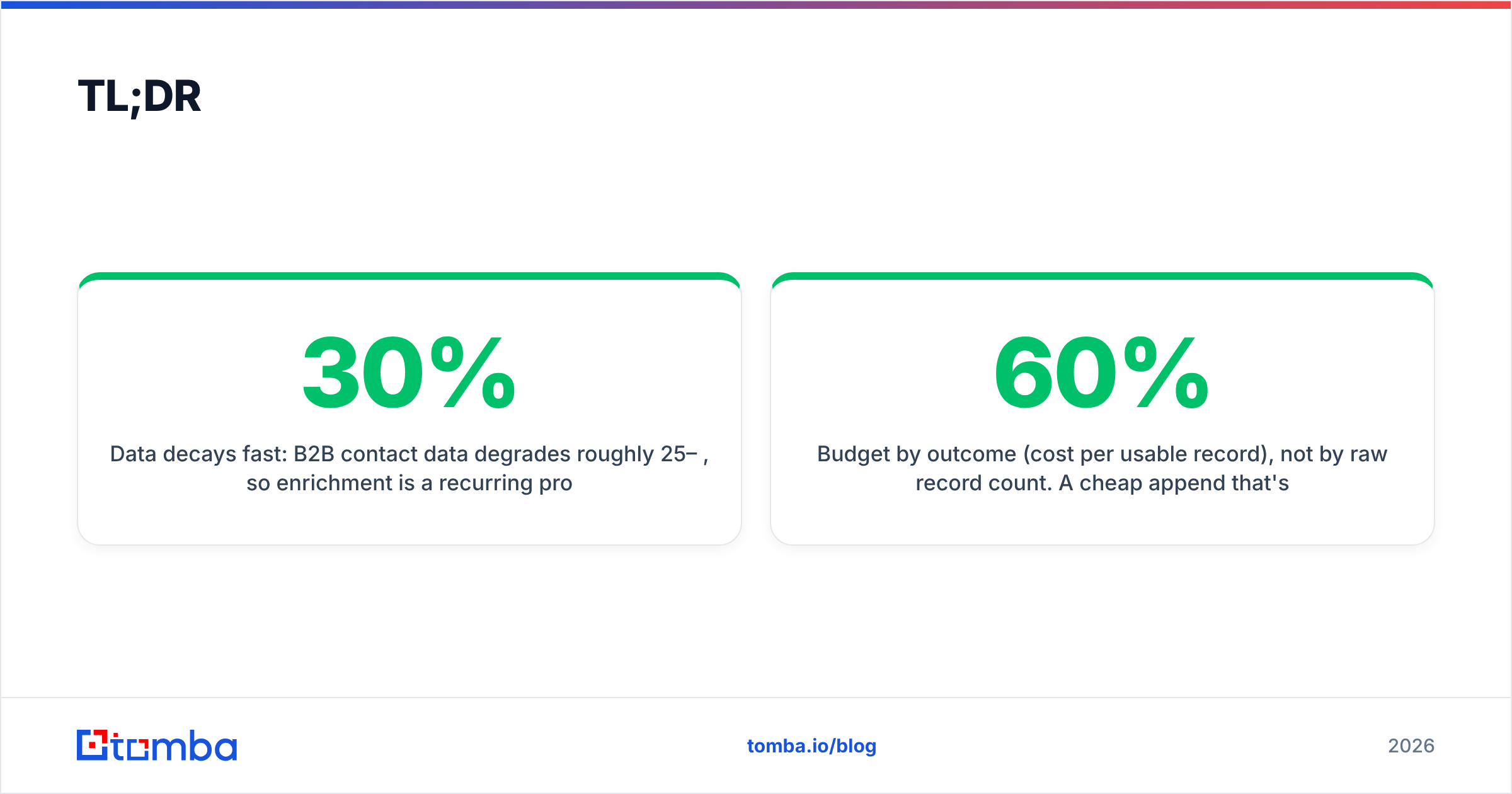
- Data decays fast: B2B contact data degrades roughly 25–30% per year, so enrichment is a recurring process, not a one-time cleanup.
- Verify before you enrich, and verify what you enrich. Appending an unverified email just moves the bounce downstream.
- Budget by outcome (cost per usable record), not by raw record count. A cheap append that's 60% accurate is more expensive than a $0.05 one that's 95% accurate.
What is customer data enrichment?#
Customer data enrichment is the process of taking a partial record — say, an email and a company name — and filling in the rest: job title, seniority, department, company size, industry, location, LinkedIn URL, direct phone, and the technologies that company runs.
Think of it like a passport photo versus a full dossier. The record you capture from a form or a list is the photo: enough to recognize someone, not enough to make a decision. Enrichment builds the dossier so your systems can route, score, and personalize without a human doing manual research.
There are two moments enrichment typically happens:
- On-entry (real-time): a lead fills a form, and an API call appends firmographics before the record ever hits a rep. This powers instant routing and lead scoring.
- In-batch (scheduled): you run your whole database against an enrichment source monthly or quarterly to refresh stale fields and fill gaps.
Most mature teams do both. Real-time keeps new records sharp; batch keeps the existing pile from rotting.
Wait — that image belongs inline. Here it is:

What types of data can you enrich?#
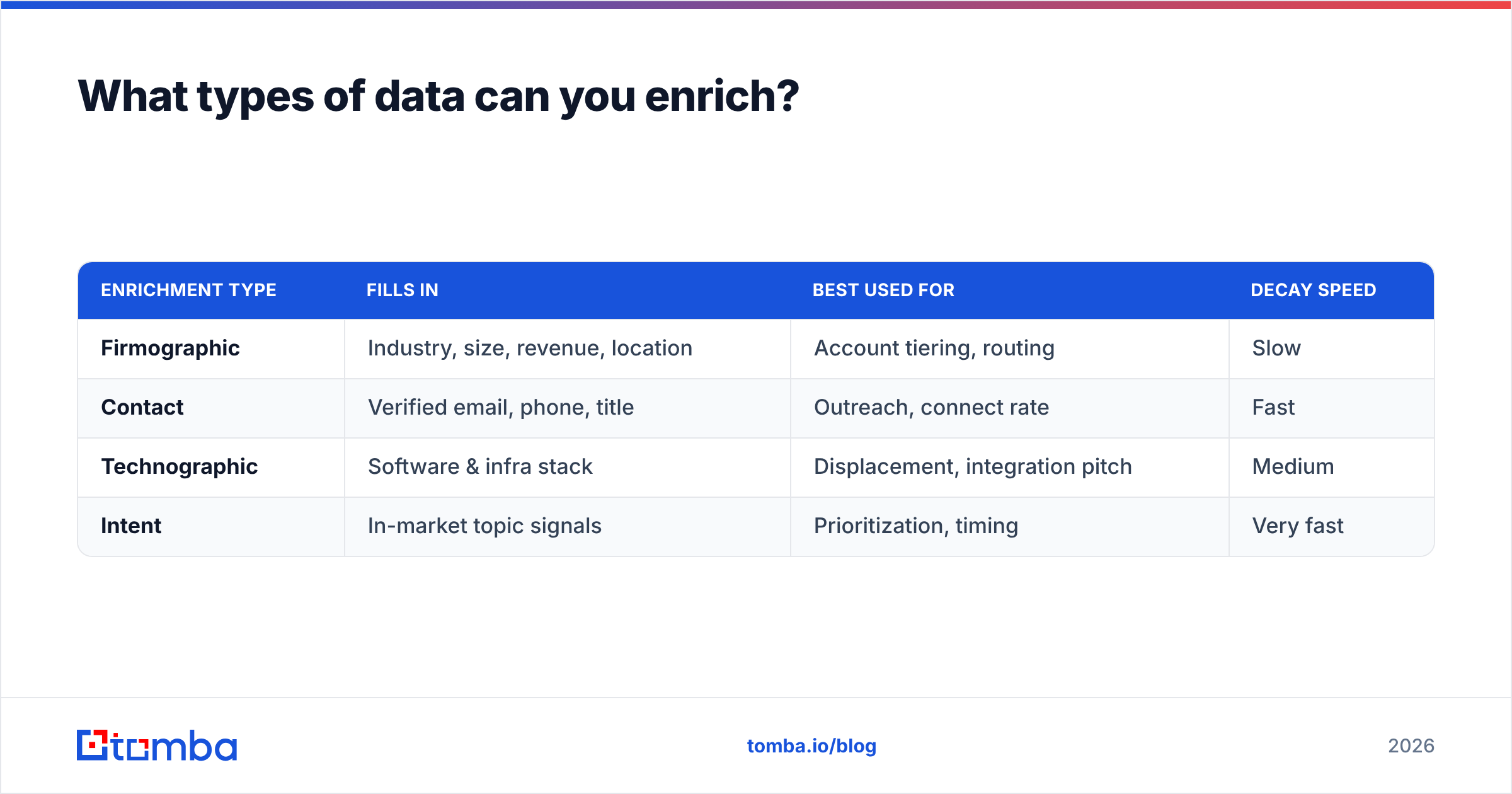
Not all enrichment is the same, and mixing the categories up is how teams end up paying for data they never use. The four workhorse categories:
- Firmographic — company-level attributes: industry, employee count, revenue band, HQ location, funding stage. This is what drives account tiering and territory routing.
- Contact / demographic — person-level attributes: verified work email, direct dial, job title, seniority, department, and social profiles. This is what makes outreach actually reach someone.
- Technographic — the tools a company runs (CRM, cloud provider, marketing stack). Gold for competitive displacement and integration-led pitches.
- Intent & behavioral — signals that an account is researching a topic or in-market. The most perishable and the most oversold; useful when paired with the three above, weak on its own.
A record enriched across all four is expensive. Be deliberate: match the enrichment depth to what the play actually needs. A cold-email SDR needs a verified email and a title. An ABM campaign needs firmographics plus technographics. Don't buy intent data to fix a bounce problem.
| Enrichment type | Fills in | Best used for | Decay speed |
|---|---|---|---|
| Firmographic | Industry, size, revenue, location | Account tiering, routing | Slow |
| Contact | Verified email, phone, title | Outreach, connect rate | Fast |
| Technographic | Software & infra stack | Displacement, integration pitch | Medium |
| Intent | In-market topic signals | Prioritization, timing | Very fast |
Why does customer data enrichment matter in 2026?#
Because bad data is a tax you pay in three places at once: wasted rep time, misfired automation, and skewed reporting.
- Deliverability. Sending to unverified, appended emails tanks your sender reputation. If enrichment adds an address, you should confirm it's deliverable — a topic worth reading up on via email deliverability fundamentals before you scale sends.
- Routing and scoring. A lead-scoring model is only as good as its inputs. If 30% of your "enterprise" leads are actually solo consultants with a gmail address, your model is learning noise.
- Ad efficiency. Uploading a clean, enriched customer list to a match-based audience gets you a higher match rate and cheaper acquisition. Garbage lists match poorly and waste spend.
- Rep trust. The fastest way to get reps to abandon your CRM is to fill it with contacts that bounce or ring the wrong desk. Once trust breaks, they go back to spreadsheets and the whole system loses visibility.
Analyst coverage backs this up: firms like Gartner have long estimated that poor data quality costs organizations millions annually in wasted effort and bad decisions. Enrichment done right is one of the cheapest levers you have against that cost.
How does the enrichment process actually work?#
At a mechanical level, enrichment is a matching-and-appending pipeline. Here's the honest version of the flow:
- Normalize your input. Standardize domains, strip free-mail addresses, dedupe. Enriching duplicates just multiplies your cost. A quick pass to remove duplicates before you spend a single credit is the highest-ROI step most teams skip.
- Match to a source. The provider matches your record against its database, usually keyed on domain + name or on an existing email.
- Append attributes. Missing fields get filled; stale fields get overwritten (if you allow it).
- Verify the volatile fields. Emails and phones should be validated at append time, not assumed correct because a database returned them.
- Write back with provenance. Store where each field came from and when. Provenance is what lets you trust — or distrust — a field six months later.
That fourth step is where most enrichment programs fall short. A database can return a syntactically valid email that has been dead for a year. Running appended addresses through an email verifier closes the loop, and for the ambiguous corporate domains that accept everything, a dedicated catch-all verifier keeps you from treating "unknown" as "valid."
Build vs. buy: where should enrichment data come from?#
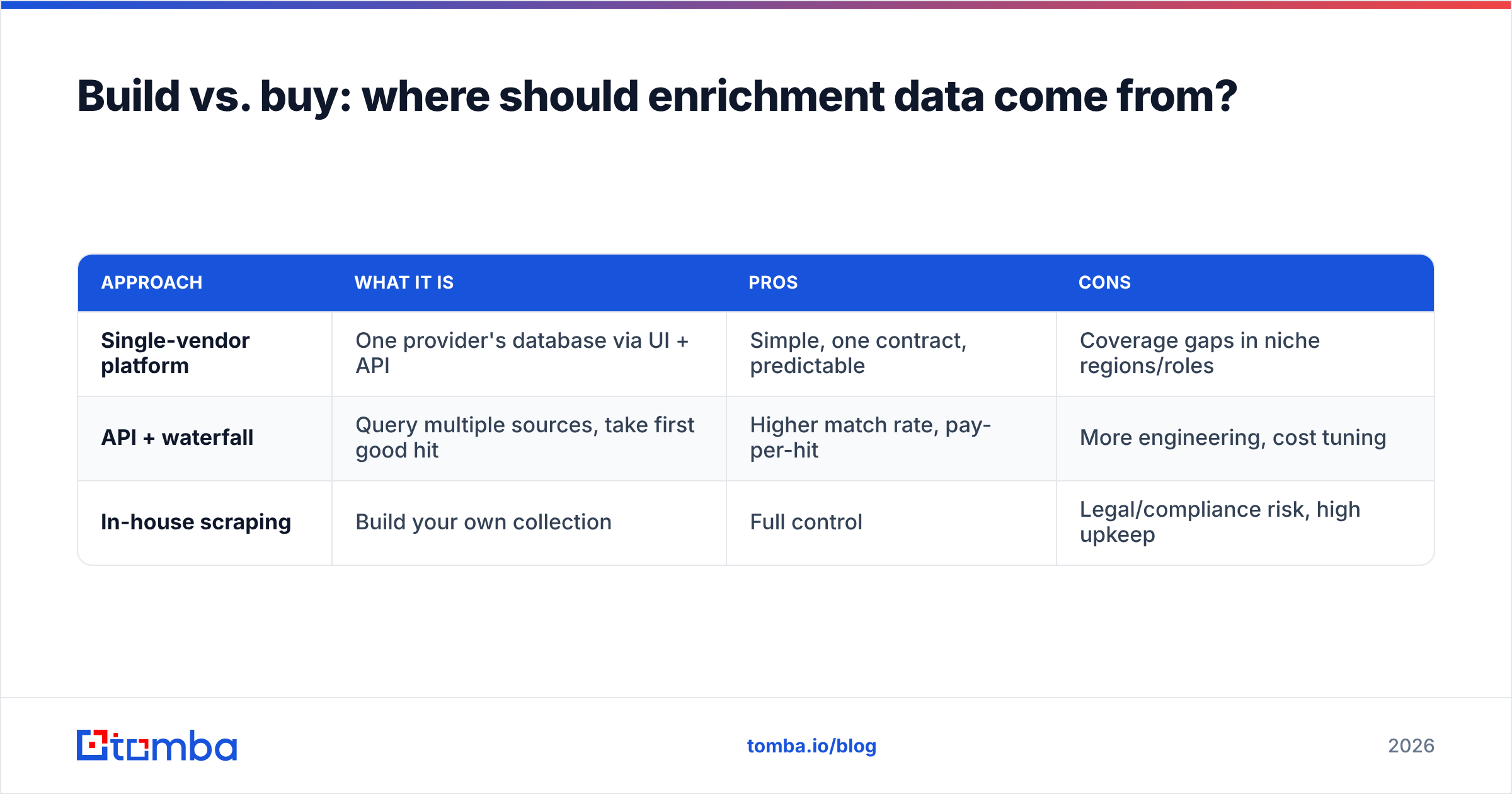
You have three broad options, and most teams end up blending them.
| Approach | What it is | Pros | Cons |
|---|---|---|---|
| Single-vendor platform | One provider's database via UI + API | Simple, one contract, predictable | Coverage gaps in niche regions/roles |
| API + waterfall | Query multiple sources, take first good hit | Higher match rate, pay-per-hit | More engineering, cost tuning |
| In-house scraping | Build your own collection | Full control | Legal/compliance risk, high upkeep |
For most B2B teams, an API-driven approach wins because coverage from any single database is never 100%. A data enrichment API you can call in a waterfall — try source A, fall back to source B — consistently beats betting everything on one vendor's coverage. Reputable list and data providers such as BookYourData also have a place in the mix for targeted, verified B2B lists when you need to seed a new segment rather than refresh an existing one.
Whichever you pick, scrutinize where the provider actually gets its data. Transparency here isn't a nicety — it's how you assess compliance and accuracy. It's worth checking a vendor's data sources before you commit volume.

How much does customer data enrichment cost?#
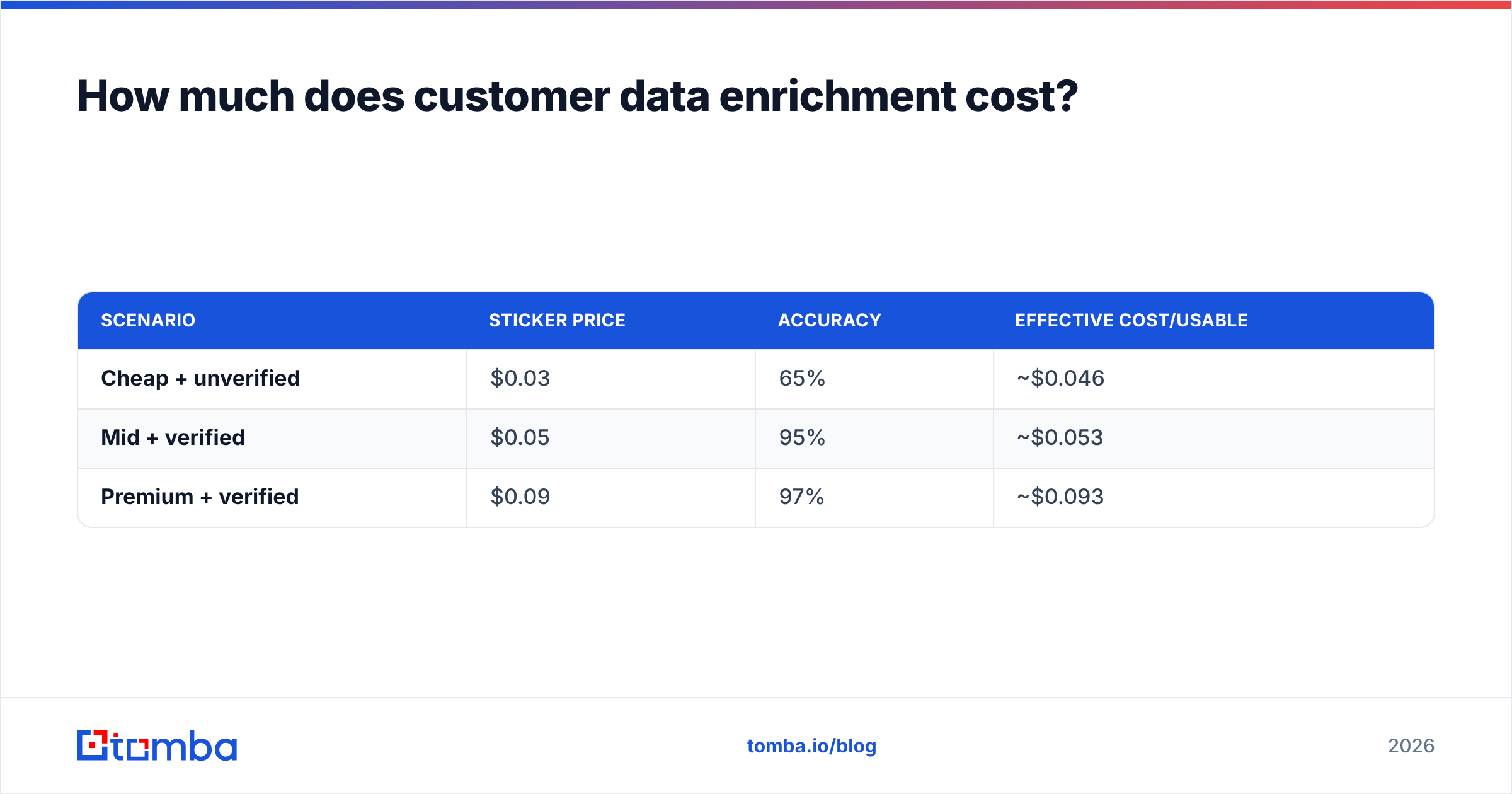
Pricing models vary, but they reduce to a few shapes: per-credit (one credit per enriched record or per field), per-seat with monthly caps, or custom enterprise contracts priced on volume. The trap is comparing sticker prices instead of cost per usable record.
Here's how to think about it. If Vendor A charges $0.03 per enriched record but only 65% of those records are accurate and verified, your real cost per usable record is roughly $0.046. If Vendor B charges $0.05 at 95% accuracy, your real cost is about $0.053 — barely more, for dramatically less downstream cleanup and fewer bounces.
For reference on the transparent end of the market, Tomba pricing runs a free tier at 25 searches/month, then Starter at $49/mo, Growth at $99/mo, Pro at $249/mo, and custom Enterprise — with the email finder, verifier, domain search, and enrichment sharing the same credit pool. When you evaluate any vendor, model three numbers: match rate, verified-accuracy rate, and the blended cost per record that survives verification. Neutral marketplaces like G2 are useful for pulling real accuracy complaints out of reviews before you sign.
A quick sanity table for budgeting a 50,000-record refresh:
| Scenario | Sticker price | Accuracy | Effective cost/usable |
|---|---|---|---|
| Cheap + unverified | $0.03 | 65% | ~$0.046 |
| Mid + verified | $0.05 | 95% | ~$0.053 |
| Premium + verified | $0.09 | 97% | ~$0.093 |
The "cheap" row almost never wins once you add the cost of bounced sends, damaged reputation, and rep time chasing dead contacts.
What are the biggest customer data enrichment mistakes?#
Five failure modes account for most wasted enrichment spend:
- Enriching before deduping. You pay to enrich the same account four times because your input wasn't normalized. Clean first, always.
- Trusting the append blindly. A returned field is a claim, not a fact. Verify emails and phones at write time.
- Overwriting good data with stale data. If your source's "last seen" date is older than your existing field, don't overwrite. Provenance and timestamps prevent this.
- Buying intent to solve an accuracy problem. Intent data is a prioritization layer. If your base contact data is wrong, no amount of intent signal fixes the bounce.
- Treating enrichment as one-and-done. With 25–30% annual decay, a database you enriched last January is meaningfully wrong by December. Schedule recurring refreshes for your high-value segments.
The through-line: enrichment quality is a discipline, not a purchase. The vendor matters, but your process — normalize, match, verify, write back with provenance, repeat — matters more.
How do you measure enrichment success?#
Track these four, and revisit them quarterly:
- Match rate — what percentage of your input records got any enrichment. Low match rate on a targeted list often means a coverage gap for your segment.
- Fill rate by field — email present isn't the same as title present. Measure the fields your plays actually depend on.
- Verified-accuracy rate — of the appended emails/phones, how many pass verification and reach a real inbox. This is the number that predicts deliverability outcomes.
- Downstream lift — connect rate, reply rate, and routing accuracy before vs. after enrichment. This is the only metric that ties enrichment to revenue.
If you can't measure verified accuracy, you're flying blind. Pair every enrichment run with a verification pass and log the pass rate as a first-class metric — it's the difference between a database that reps trust and one they abandon.
Which Tomba tool fits customer data enrichment?#
If you want to enrich records with verified, source-transparent contact and company data — and close the verification loop in the same workflow — start with the Tomba Email Finder. It finds professional email addresses by domain, name, or company, feeds the same credit pool as the verifier and enrichment endpoints, and plugs into your CRM or waterfall via a clean API. Spin up the free tier, run a sample of your worst records through it, and measure verified-accuracy before you commit to a paid plan. That's the honest way to buy enrichment: test on your own data, budget by usable record, and let the pass rate decide.
Clean records in, clean pipeline out. Everything else your revenue team does downstream depends on getting this layer right.
Related guides#
Ready to find emails that actually work?
Join 150,000+ professionals who stopped guessing and started sending. Free credits on signup — no credit card required.
Get the Tomba newsletter
Practical outbound tactics and product updates — once every two weeks.
About the author