Customers.ai Alternatives: 7 Better Lead Tools for 2026
Customers.ai is a solid visitor-ID and lead-capture tool, but the overage fees and data limits push many teams to look elsewhere. Here are 7 alternatives worth testing in 2026.
Customers.ai (the platform formerly known as MobileMonkey) turned anonymous website traffic into contactable leads before most teams knew that was possible. It still does that job well. But if you have landed on this page, you are probably weighing the trade-offs: per-lead pricing that climbs fast, data coverage that skews consumer, and a feature set that overlaps with three tools you may already pay for.
This guide breaks down seven Customers.ai alternatives, what each one is actually good at, and how to pick based on your motion — outbound, inbound, or pure data enrichment.
TL;DR — the short version#
- Best for turning traffic into B2B contacts: Tomba (visitor reveal plus verified work emails on one bill).
- Best pure visitor-ID for SMB: RB2B for US person-level identification, Warmly for intent-layered warm outreach.
- Best if you want an all-in-one GTM suite: Apollo, though you trade depth for breadth.
- Best for data accuracy on outbound: a dedicated email finder beats a bundled one almost every time.
- Watch the pricing model: most Customers.ai complaints trace back to per-resolution overage fees, not the core product.

What is Customers.ai and who is it for?#
Customers.ai is a website visitor identification and marketing-automation platform. You drop a pixel on your site, and it tries to de-anonymize the people browsing — matching them against its identity graph and handing you names, emails, and enough data to retarget or email them. It layers on audience-building, email capture, and ad-integration tooling on top.
That combination is genuinely useful for high-traffic ecommerce and consumer sites, which is where the identity graph is strongest. The friction shows up in three places:
- Pricing scales with resolved contacts. The more traffic you identify, the more you pay, and overage charges surprise teams that had a good month.
- Data skews consumer, not B2B. If you sell to businesses, the emails you get are often personal Gmail addresses rather than verified work accounts.
- Feature overlap. The email-sending and ad tooling duplicates what your ESP, CRM, and ad manager already do.
None of that makes it a bad tool. It makes it the wrong tool for a specific set of teams — mainly B2B outbound and RevOps groups who need verified business contact data more than they need another email sender. You can see how the vendor positions itself on the Customers.ai homepage and cross-check reviews on G2 before committing.
Why look for a Customers.ai alternative?#
Here is the honest framing: switch when your bottleneck is data quality and cost per usable lead, not visitor identification itself. A few concrete triggers:
- You sell B2B and need work emails. Personal-email matches are hard to sequence and worse for deliverability. You want verified, role-based business addresses.
- Your overage bill is unpredictable. Per-resolution billing punishes traffic spikes. A flat search-credit model is easier to forecast.
- You already own a CRM and ESP. You do not need Customers.ai's sending layer — you need clean data piped into the tools you have.
- You want coverage outside the US. Person-level identity graphs are strongest for US consumer traffic and thin elsewhere.
If two or more of those hit home, one of the tools below will fit better.
The 7 best Customers.ai alternatives in 2026#
1. Tomba — best for turning traffic into verified B2B contacts#
Tomba approaches the same problem from the data side. Its website visitor reveal identifies the companies and people hitting your site, then its core email finder and email verifier hand you verified work emails — not a personal address you have to guess at. For B2B teams, that single distinction is the whole ballgame: you get contacts you can actually sequence.
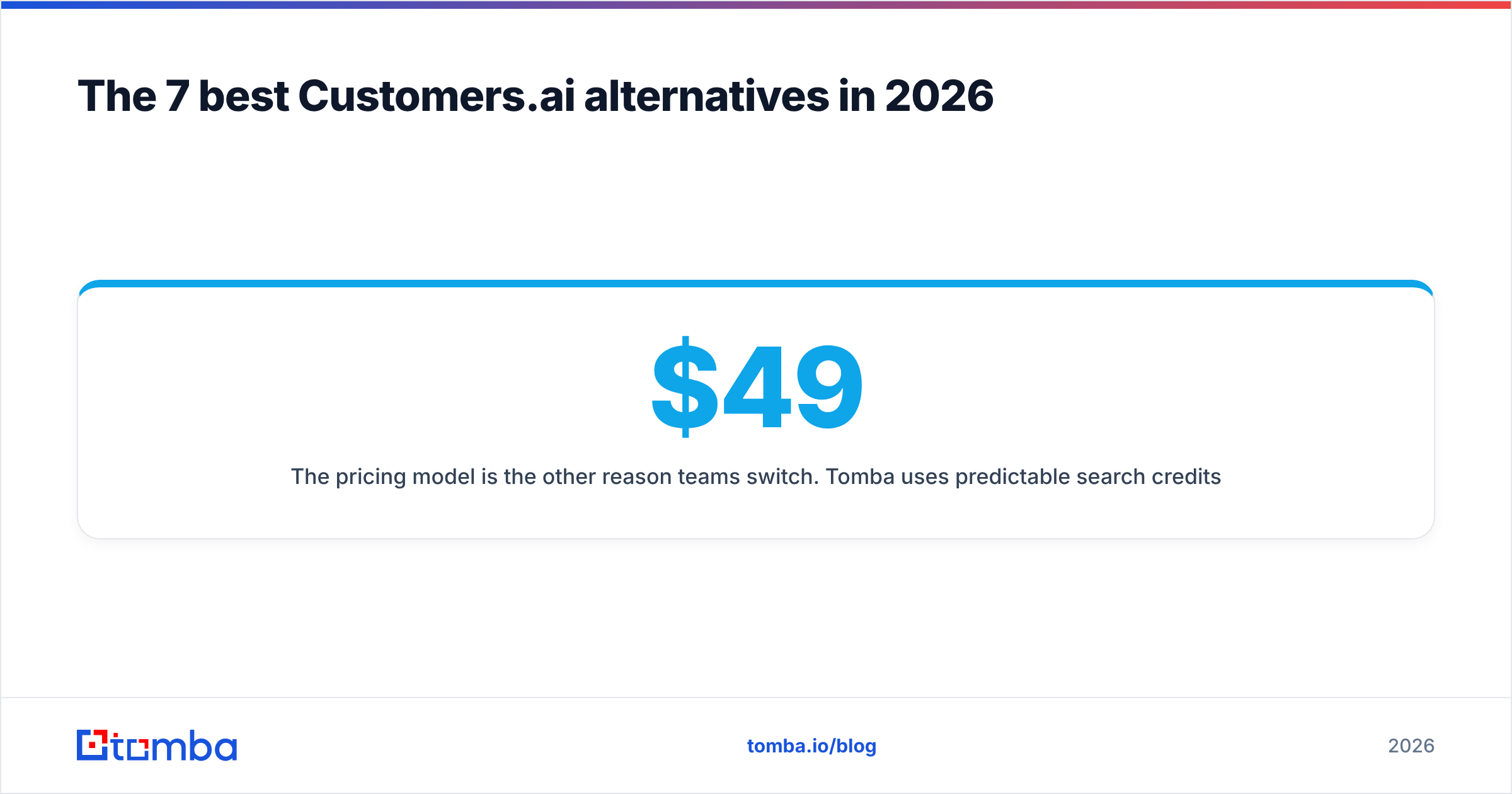
The pricing model is the other reason teams switch. Tomba uses predictable search credits rather than per-resolution overages, so a traffic spike does not blow up your invoice. The Free tier gives you 25 searches a month to test, then Starter runs $49/mo, Growth $99/mo, and Pro $249/mo.
Best for: B2B outbound, RevOps, and agencies that need verified emails plus enrichment on one bill.
2. RB2B — best free US person-level identification#
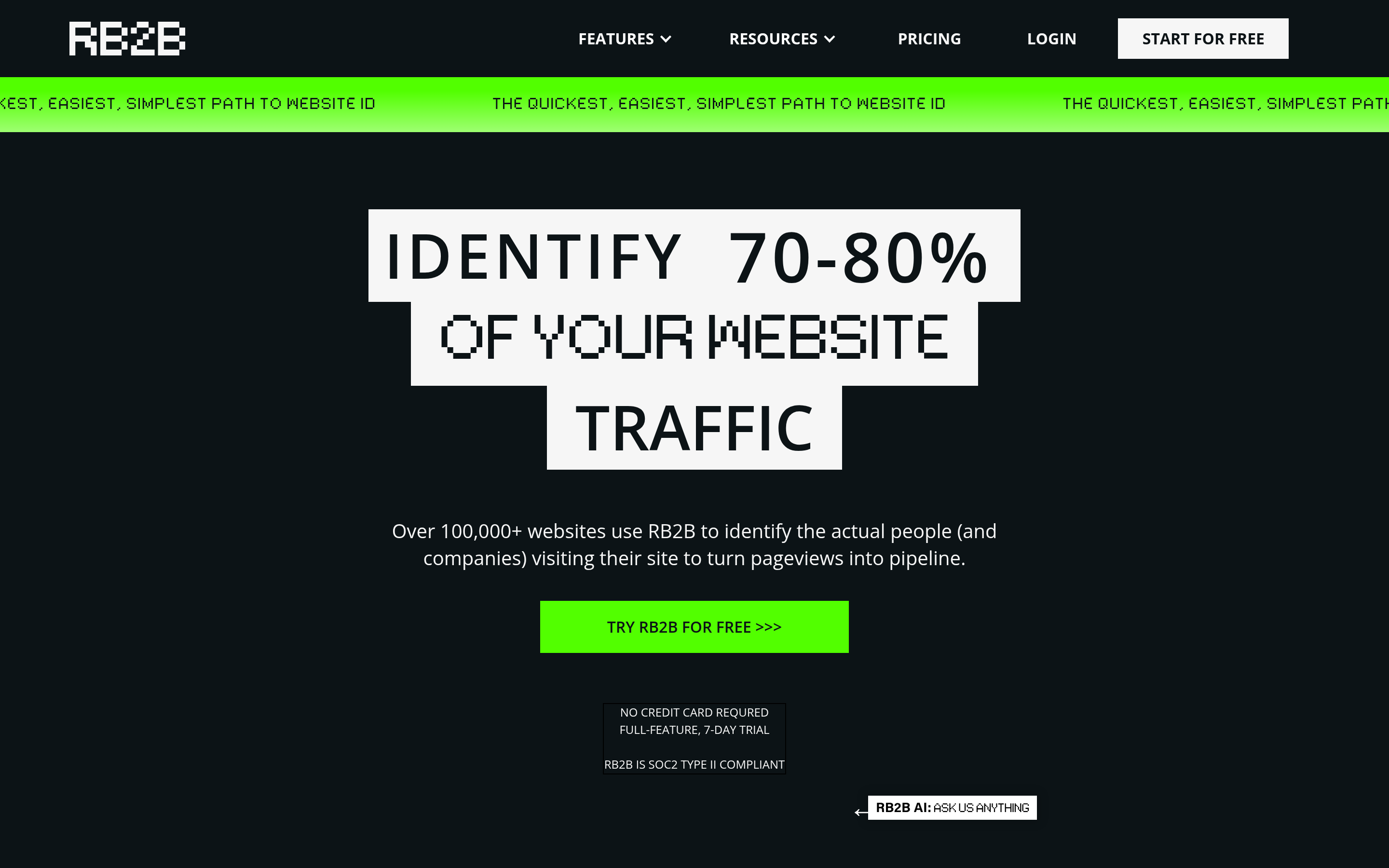
RB2B built a following by pushing identified US visitors straight into Slack, free, at a usable volume. It is narrowly focused: person-level ID for US traffic, and not much beyond that. If your entire need is "tell me which individuals visited and ping my sales channel," it is hard to beat on price.
Best for: SMB and startups that want person-level signals without a contract.
3. Warmly — best for intent-layered warm outreach#
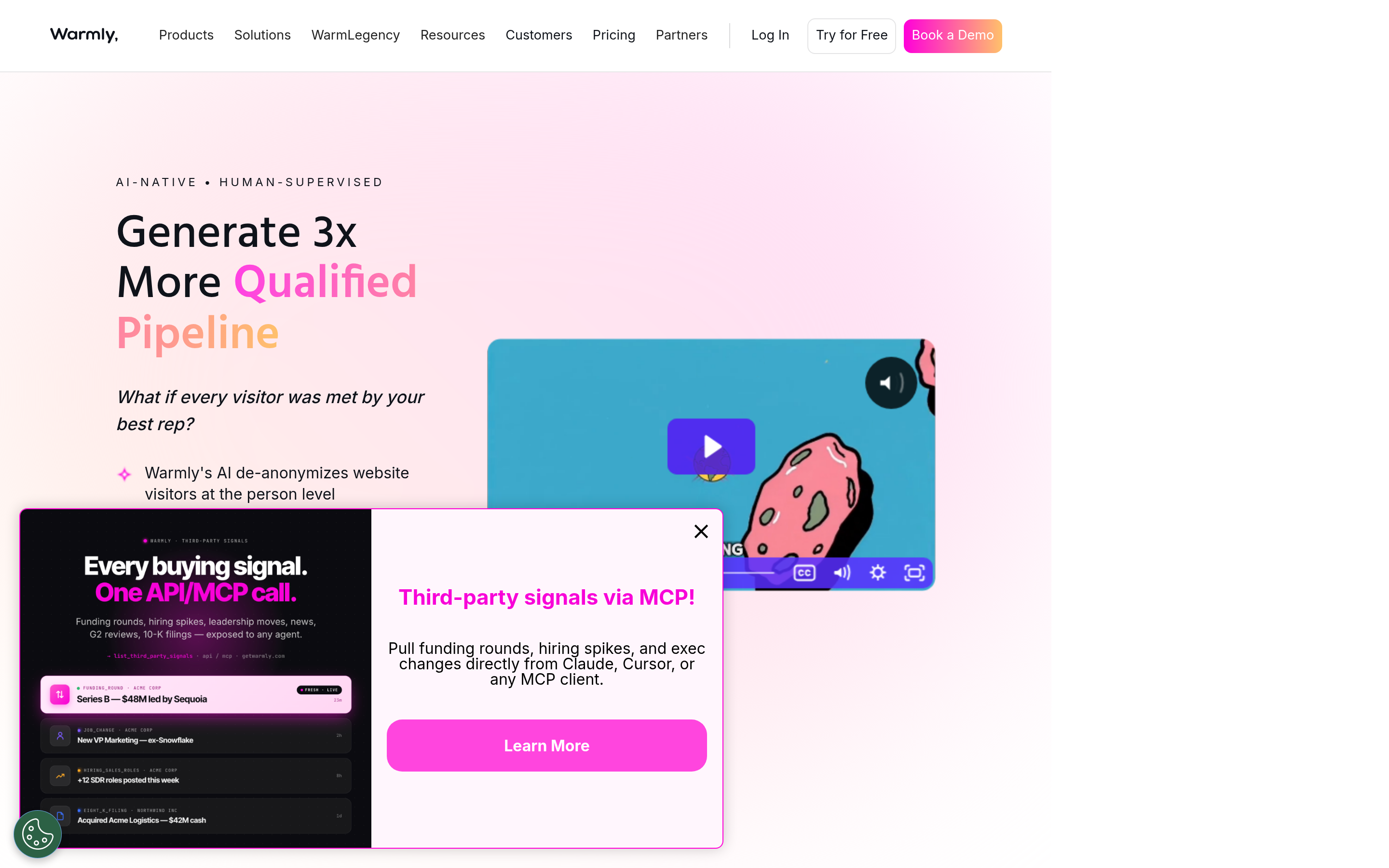
Warmly stitches visitor de-anonymization together with intent data and orchestration, so reps can act on warm accounts in real time. It is heavier and pricier than RB2B, but the automation around the signal — auto-enrollment, chat, alerting — is the selling point.
Best for: mid-market sales teams that want signal and the workflow to act on it.
4. Apollo — best all-in-one GTM suite#
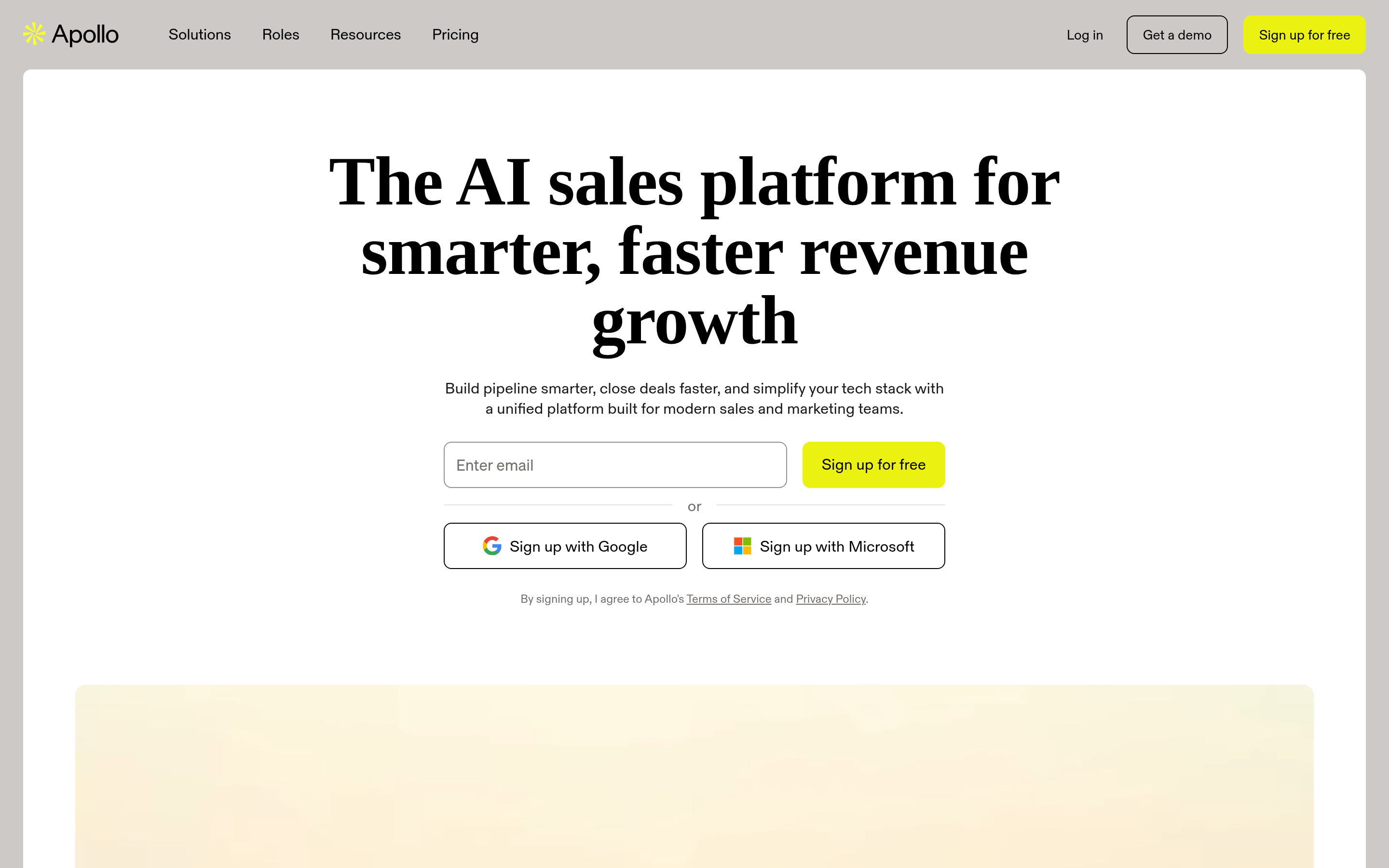
Apollo bundles a B2B database, sequencing, and some enrichment into one platform. If you want fewer tools and are comfortable trading best-in-class depth for convenience, it covers a lot of ground. The trade-off is data freshness and accuracy on niche segments, where specialists pull ahead. If Apollo itself is what you are trying to replace, the Apollo alternative breakdown is a useful companion read.
Best for: teams that want one login for prospecting and sending.
5. Clearbit (Breeze Intelligence) — best for enrichment inside HubSpot#
Now part of HubSpot's data layer, Clearbit shines when you live inside HubSpot and want reactive enrichment on form fills and records. Outside that ecosystem, the value drops and the cost is hard to justify. See how HubSpot frames the integration before betting on it.
Best for: HubSpot-native teams that want enrichment without leaving the CRM.
6. ZoomInfo — best for enterprise data depth#

ZoomInfo remains the enterprise default for firmographic and contact depth, plus intent. It is powerful and expensive, with annual contracts that do not fit smaller teams. You are buying breadth and org charts, not a lightweight visitor pixel.
Best for: enterprise sales orgs with the budget and volume to justify it.
7. Lead Forensics — best for account-level (not person-level) ID#
Lead Forensics identifies the companies visiting your site rather than individuals, which sidesteps some privacy friction and works better internationally. You then pair it with a tool that finds the actual contacts — which is exactly where an email finder plus data enrichment closes the loop.
Best for: teams comfortable working accounts first, then sourcing contacts.

How do the top Customers.ai alternatives compare?#
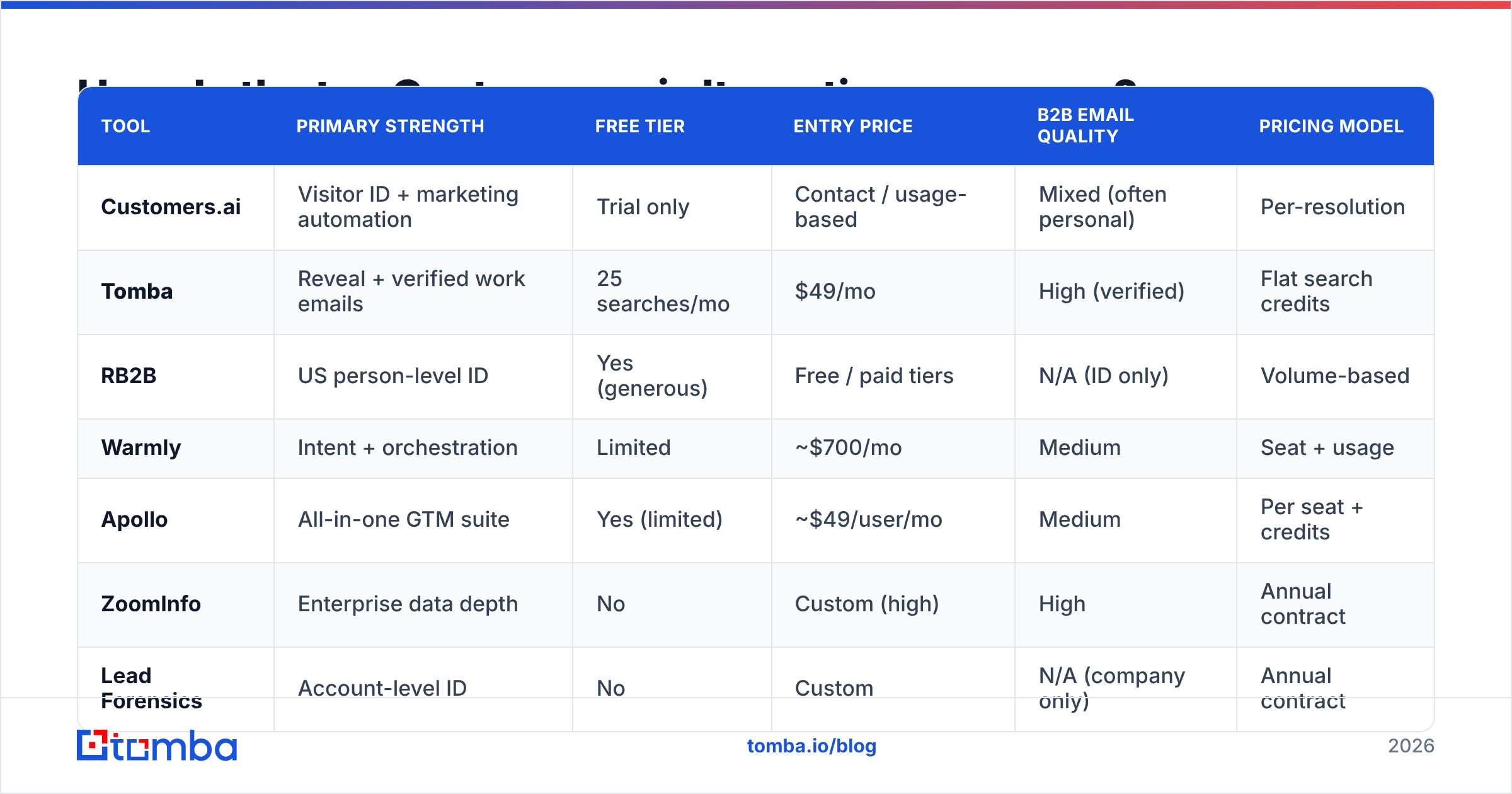
Here is the side-by-side. Prices reflect published entry tiers as of 2026 and shift often — confirm on each vendor's page before you buy.
| Tool | Primary strength | Free tier | Entry price | B2B email quality | Pricing model |
|---|---|---|---|---|---|
| Customers.ai | Visitor ID + marketing automation | Trial only | Contact / usage-based | Mixed (often personal) | Per-resolution |
| Tomba | Reveal + verified work emails | 25 searches/mo | $49/mo | High (verified) | Flat search credits |
| RB2B | US person-level ID | Yes (generous) | Free / paid tiers | N/A (ID only) | Volume-based |
| Warmly | Intent + orchestration | Limited | ~$700/mo | Medium | Seat + usage |
| Apollo | All-in-one GTM suite | Yes (limited) | ~$49/user/mo | Medium | Per seat + credits |
| ZoomInfo | Enterprise data depth | No | Custom (high) | High | Annual contract |
| Lead Forensics | Account-level ID | No | Custom | N/A (company only) | Annual contract |
The pattern is clear: visitor-ID specialists (RB2B, Warmly, Lead Forensics) tell you who showed up, and data specialists (Tomba, ZoomInfo) tell you how to reach them. Customers.ai tries to do both plus sending. Whether the bundle is worth it depends on how much of it you actually use.
Which alternative fits your use case?#
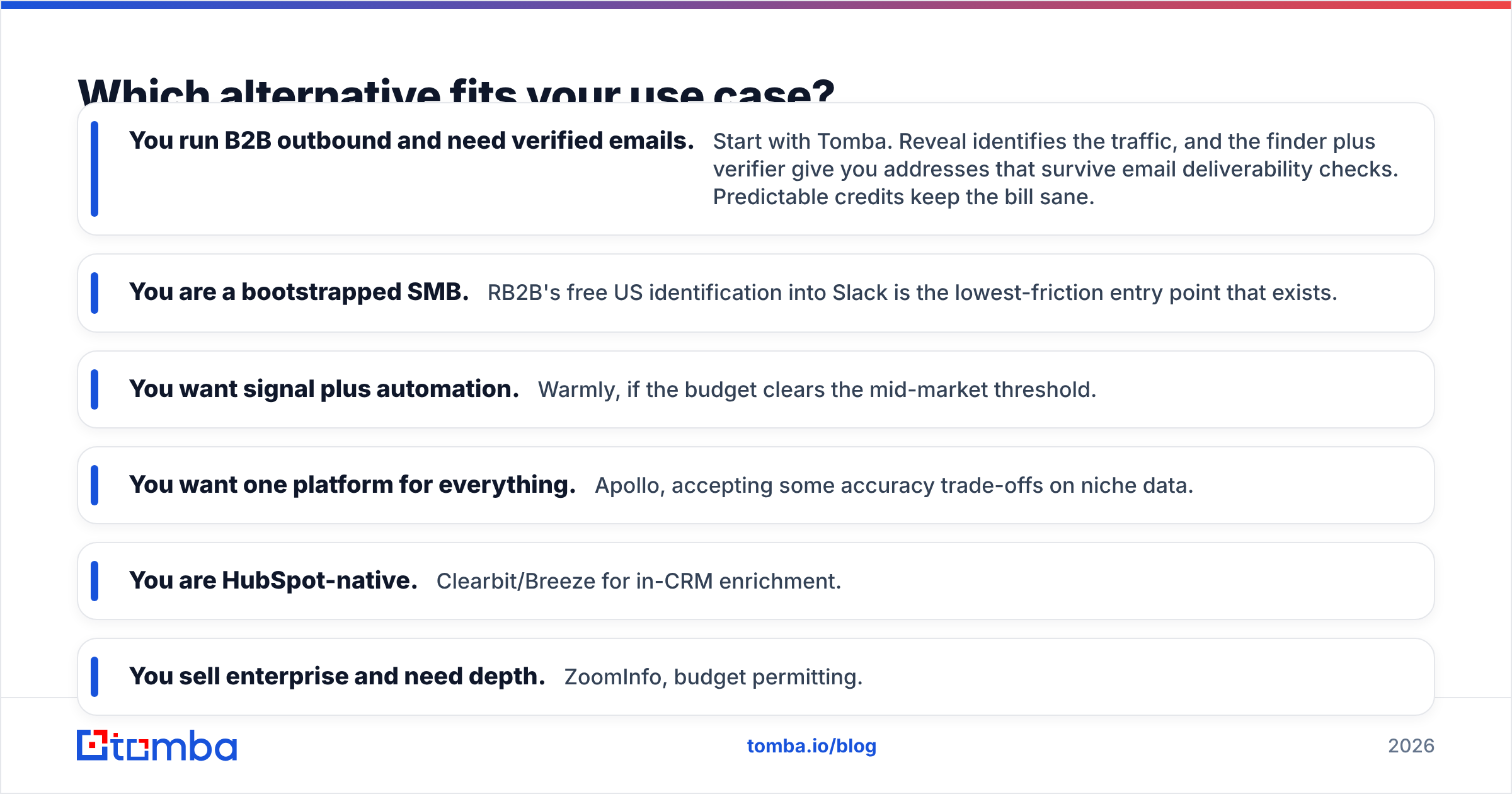
Rather than crown one winner, match the tool to your motion:
- You run B2B outbound and need verified emails. Start with Tomba. Reveal identifies the traffic, and the finder plus verifier give you addresses that survive email deliverability checks. Predictable credits keep the bill sane.
- You are a bootstrapped SMB. RB2B's free US identification into Slack is the lowest-friction entry point that exists.
- You want signal plus automation. Warmly, if the budget clears the mid-market threshold.
- You want one platform for everything. Apollo, accepting some accuracy trade-offs on niche data.
- You are HubSpot-native. Clearbit/Breeze for in-CRM enrichment.
- You sell enterprise and need depth. ZoomInfo, budget permitting.
- You work accounts first. Lead Forensics for company-level ID, paired with a finder for the contacts.
Most teams that leave Customers.ai are not leaving because visitor ID failed. They leave because the output — the contact record — was not clean enough or cheap enough to run outbound at scale. That is a data problem, and it is the one worth solving first.
What should you check before switching?#
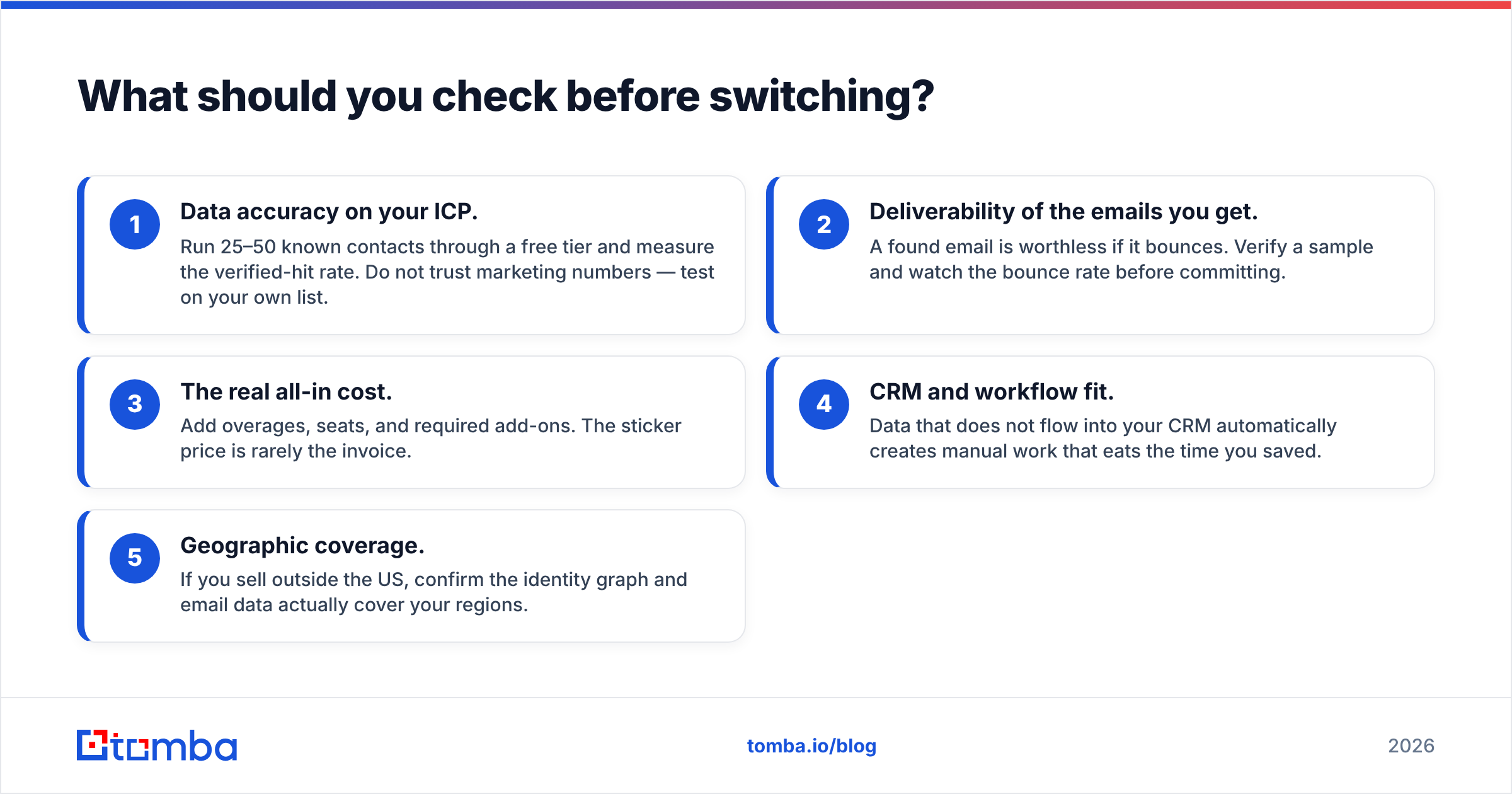
Before you move a dollar of budget, pressure-test any replacement against these:
- Data accuracy on your ICP. Run 25–50 known contacts through a free tier and measure the verified-hit rate. Do not trust marketing numbers — test on your own list.
- Deliverability of the emails you get. A found email is worthless if it bounces. Verify a sample and watch the bounce rate before committing.
- The real all-in cost. Add overages, seats, and required add-ons. The sticker price is rarely the invoice.
- CRM and workflow fit. Data that does not flow into your CRM automatically creates manual work that eats the time you saved.
- Geographic coverage. If you sell outside the US, confirm the identity graph and email data actually cover your regions.
A free trial that clears all five is a keeper. One that stumbles on accuracy or deliverability will cost you more in wasted sends than you save on subscription.
The bottom line#
Customers.ai is a capable visitor-identification and automation platform, and for consumer-heavy sites that want retargeting plus sending in one place, it earns its keep. But if you sell B2B, the friction points — personal-email matches, per-resolution overages, and feature overlap with tools you already own — are exactly the gaps the alternatives above close.
If your goal is turning site traffic and cold lists into verified, sequence-ready business contacts, start with a data-first stack. Tomba's website visitor reveal tells you who showed up, and its Email Finder turns those signals into verified work emails you can actually reach — on flat, predictable credits instead of surprise overage bills. Spin up the free 25-search tier, run it against your own list, and let the verified-hit rate make the decision for you.
Related guides#
Ready to find emails that actually work?
Join 150,000+ professionals who stopped guessing and started sending. Free credits on signup — no credit card required.
Get the Tomba newsletter
Practical outbound tactics and product updates — once every two weeks.
About the author