D7 Lead Finder Alternatives: 7 Better Lead Tools for 2026
D7 Lead Finder is cheap and fast, but the data ages quickly. Here are 7 D7 Lead Finder alternatives with better accuracy, verification, and pricing for 2026 outbound.

D7 Lead Finder Alternatives: 7 Better Lead Tools for 2026
D7 Lead Finder built its name on one promise: type a niche and a city, get a spreadsheet of local businesses with emails and phone numbers in minutes. It is fast, it is cheap, and for scraping directory listings it does the job. But the moment you try to run real outbound off those lists, the cracks show — scraped generic inboxes, no verification step, and data that ages the second it lands in your CSV.
If you have watched half your D7 exports bounce, this guide is for you. Below are seven D7 Lead Finder alternatives ranked by what actually matters for outbound: data accuracy, verification, coverage, and honest pricing.
TL;DR#
- D7 Lead Finder is a directory scraper, not a verified B2B data platform — great for volume, weak on deliverability.
- Best overall alternative: Tomba, for verified email discovery with a real API and a free tier to test first.
- Best for local-lead volume: the scraper-style tools still win on raw quantity, but you pay for it in bounces.
- Non-negotiable in 2026: any list you buy or build must be verified before send, or your domain reputation eats the cost.
- Skip to the comparison table for a side-by-side view.
What is D7 Lead Finder and why look for alternatives?#
D7 Lead Finder is a lead-generation tool that scrapes business listings from public directories, maps, and websites, then hands you a downloadable list of contacts filtered by industry and location. You can see its pitch on the official D7 Lead Finder site. It sells on speed and price, and for a freelancer building a local prospecting list on a budget, that is a legitimate fit.
The problem is what happens after the export. D7's model prioritizes quantity over confidence:
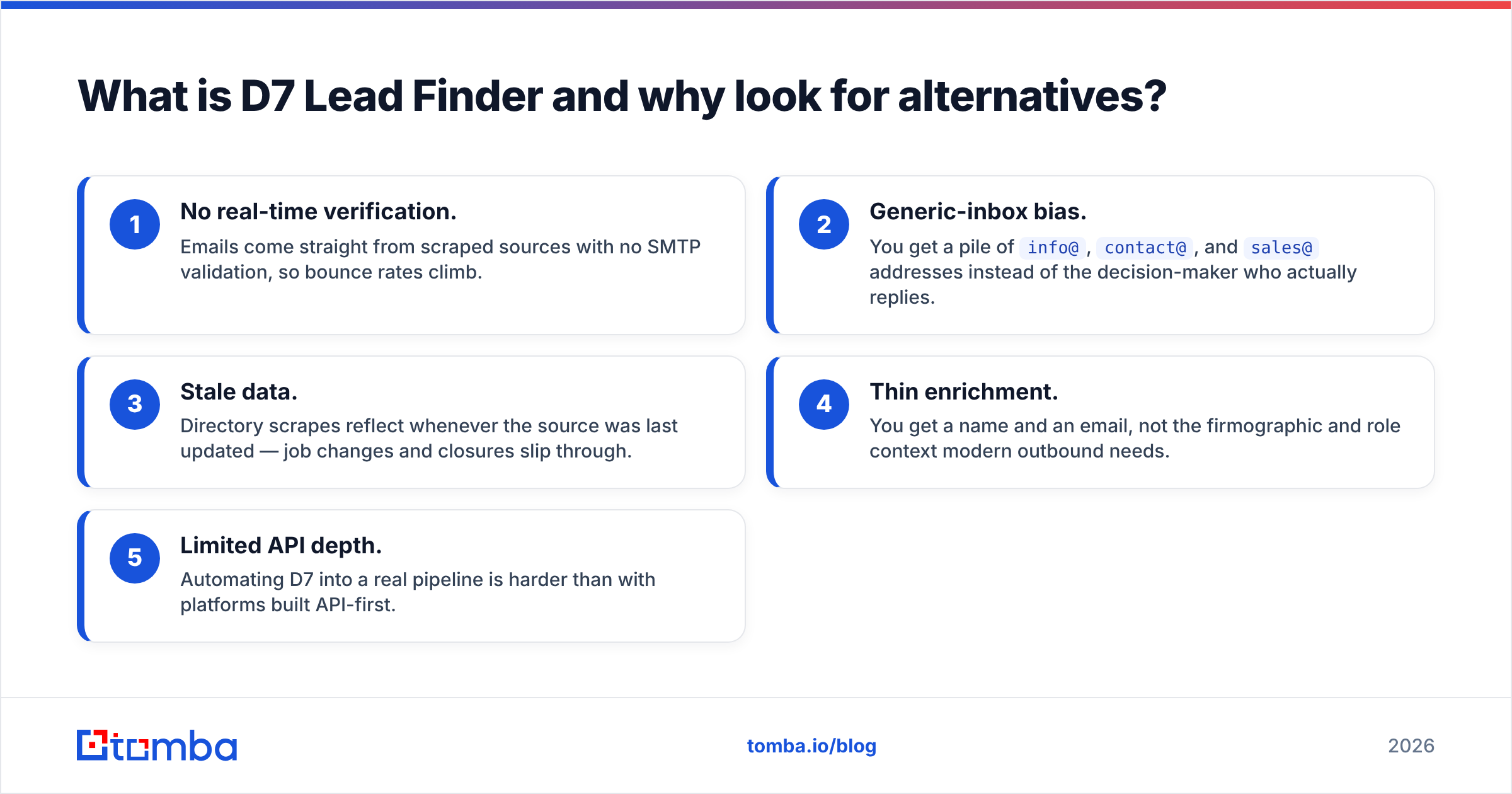
- No real-time verification. Emails come straight from scraped sources with no SMTP validation, so bounce rates climb.
- Generic-inbox bias. You get a pile of
info@,contact@, andsales@addresses instead of the decision-maker who actually replies. - Stale data. Directory scrapes reflect whenever the source was last updated — job changes and closures slip through.
- Thin enrichment. You get a name and an email, not the firmographic and role context modern outbound needs.
- Limited API depth. Automating D7 into a real pipeline is harder than with platforms built API-first.
None of that makes D7 useless. It makes it a starting point that most teams outgrow the moment deliverability starts costing them meetings.

What should a great D7 Lead Finder alternative do?#
Before the list, get clear on the bar. A tool worth switching to should beat D7 on the things D7 skips, not just match it on price.
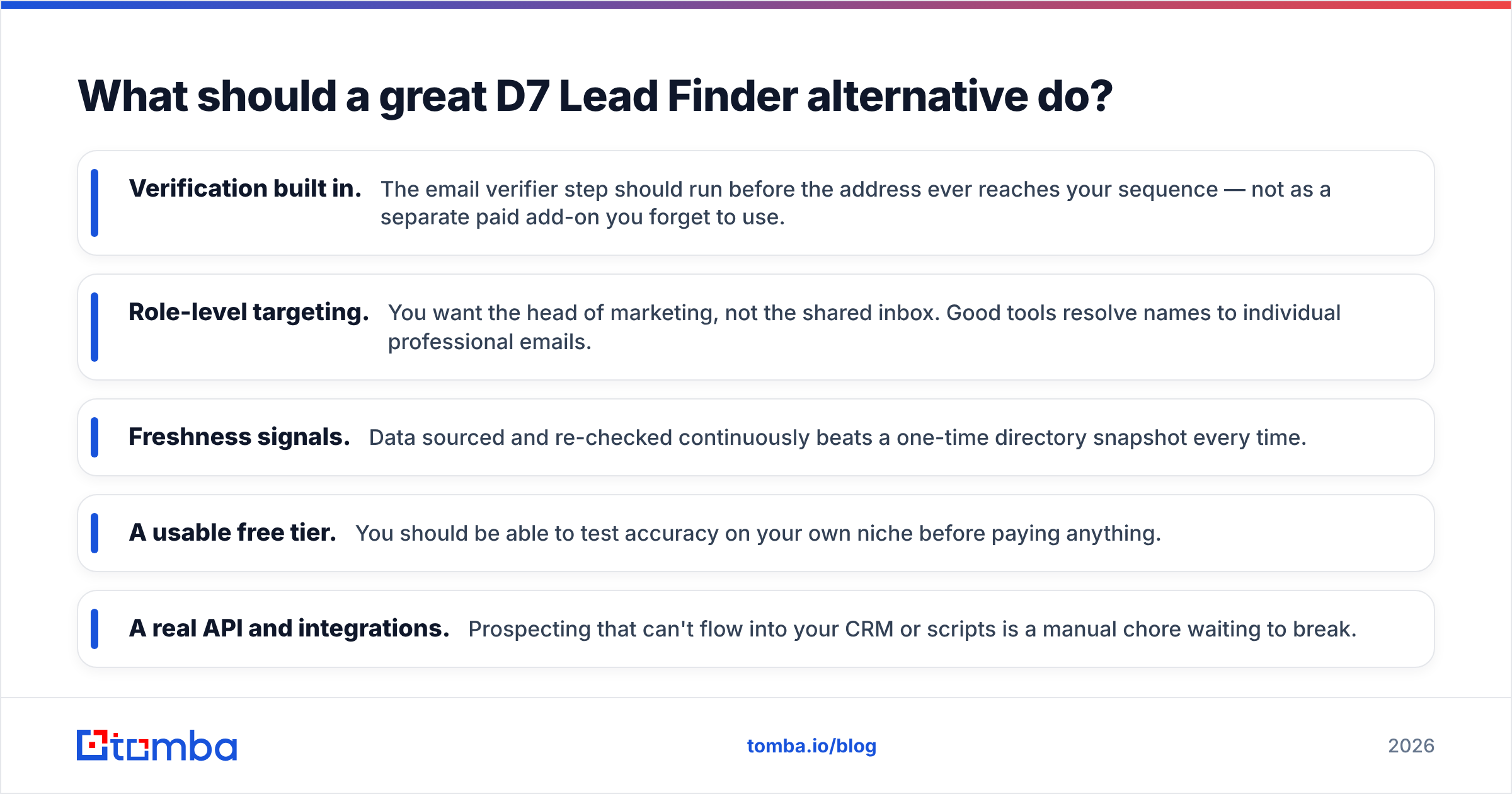
- Verification built in. The email verifier step should run before the address ever reaches your sequence — not as a separate paid add-on you forget to use.
- Role-level targeting. You want the head of marketing, not the shared inbox. Good tools resolve names to individual professional emails.
- Freshness signals. Data sourced and re-checked continuously beats a one-time directory snapshot every time.
- A usable free tier. You should be able to test accuracy on your own niche before paying anything.
- A real API and integrations. Prospecting that can't flow into your CRM or scripts is a manual chore waiting to break.
Judge every option below against those five points.
How do the top D7 Lead Finder alternatives compare?#
Here is the shortlist, scored on the attributes that decide whether a list turns into replies or bounces.
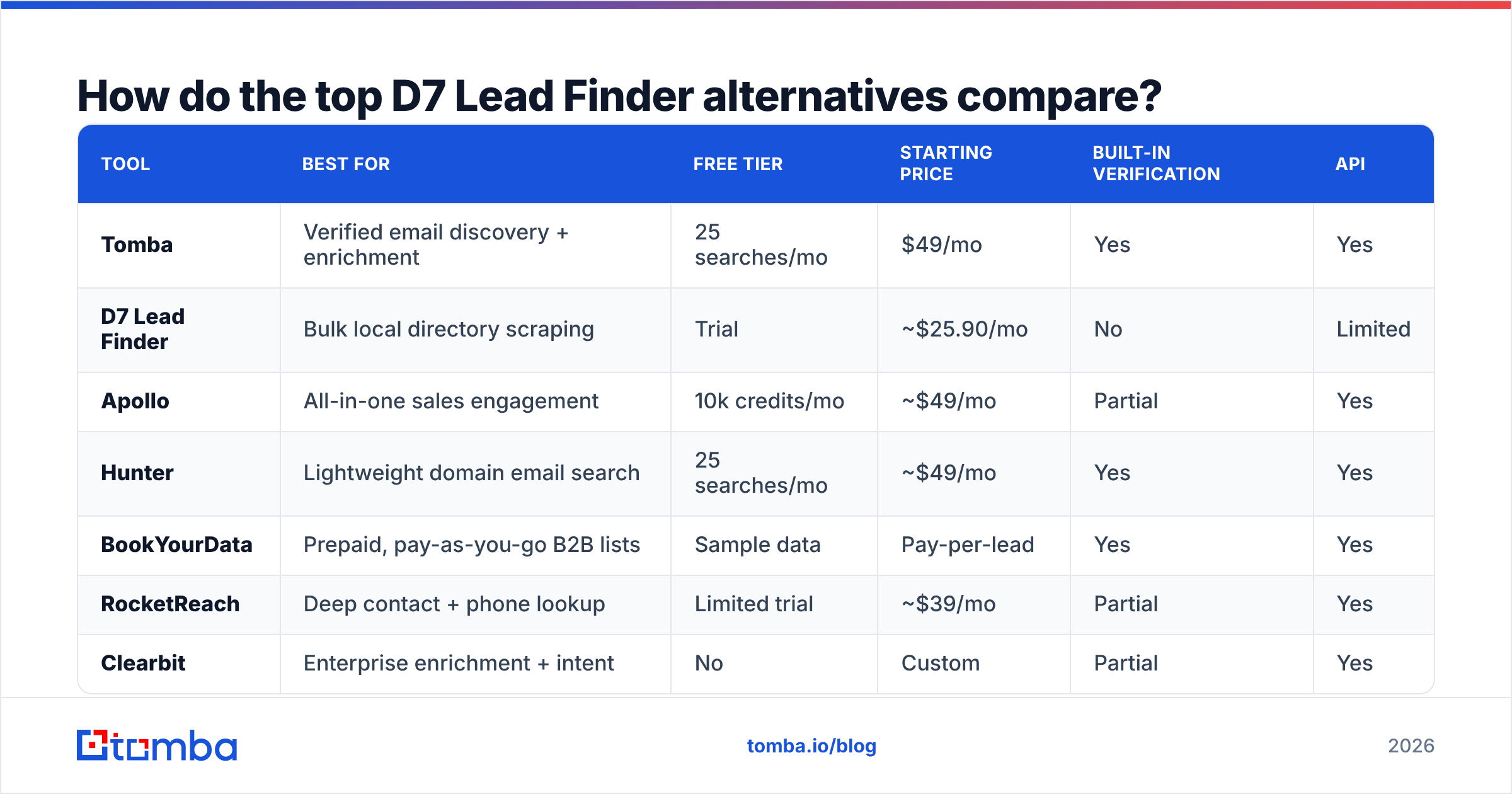
| Tool | Best for | Free tier | Starting price | Built-in verification | API |
|---|---|---|---|---|---|
| Tomba | Verified email discovery + enrichment | 25 searches/mo | $49/mo | Yes | Yes |
| D7 Lead Finder | Bulk local directory scraping | Trial | ~$25.90/mo | No | Limited |
| Apollo | All-in-one sales engagement | 10k credits/mo | ~$49/mo | Partial | Yes |
| Hunter | Lightweight domain email search | 25 searches/mo | ~$49/mo | Yes | Yes |
| BookYourData | Prepaid, pay-as-you-go B2B lists | Sample data | Pay-per-lead | Yes | Yes |
| RocketReach | Deep contact + phone lookup | Limited trial | ~$39/mo | Partial | Yes |
| Clearbit | Enterprise enrichment + intent | No | Custom | Partial | Yes |
Prices move; always confirm current Tomba pricing and each vendor's own page before you commit. Now the detail.
1. Tomba — best overall D7 Lead Finder alternative#
Tomba flips D7's model. Instead of scraping a directory and hoping the addresses work, it finds professional emails by name, company, or domain and verifies them in the same flow. That single difference — discovery plus verification — is what kills the bounce problem D7 hands you.
Where D7 gives you a dump of generic inboxes, Tomba's email finder resolves specific people at a company, and its domain search maps every reachable address behind a company domain with confidence scores. For anyone running lists at scale, the bulk email finder processes thousands of rows and drops the invalid ones before they ever reach your sequence.
Why it beats D7 for outbound:
- Real SMTP verification and catch-all handling, not just a scraped string
- Individual decision-maker emails instead of shared inboxes
- A genuine free tier (25 searches/month) so you can test your niche first
- A documented Tomba API plus Sheets, Excel, and CRM integrations
- Phone data available through the phone finder when email isn't enough
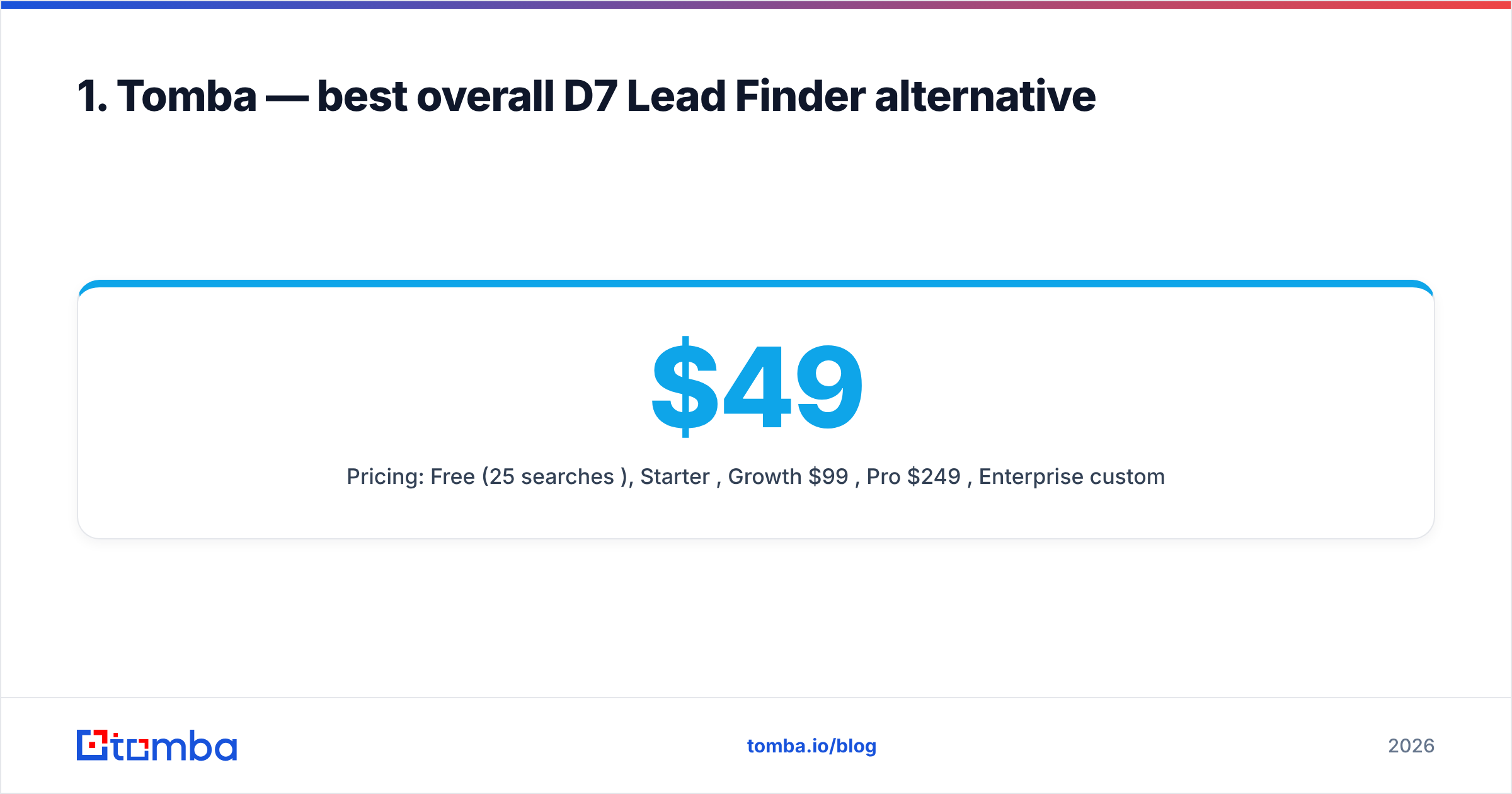
Pricing: Free (25 searches/mo), Starter $49/mo, Growth $99/mo, Pro $249/mo, Enterprise custom.
The trade-off: Tomba is built for verified precision, so if your only goal is a giant raw list of every pizzeria in a zip code regardless of deliverability, a pure scraper will hand you more rows. For lists you actually intend to email, precision wins.
2. Apollo — best if you want the whole sales stack#
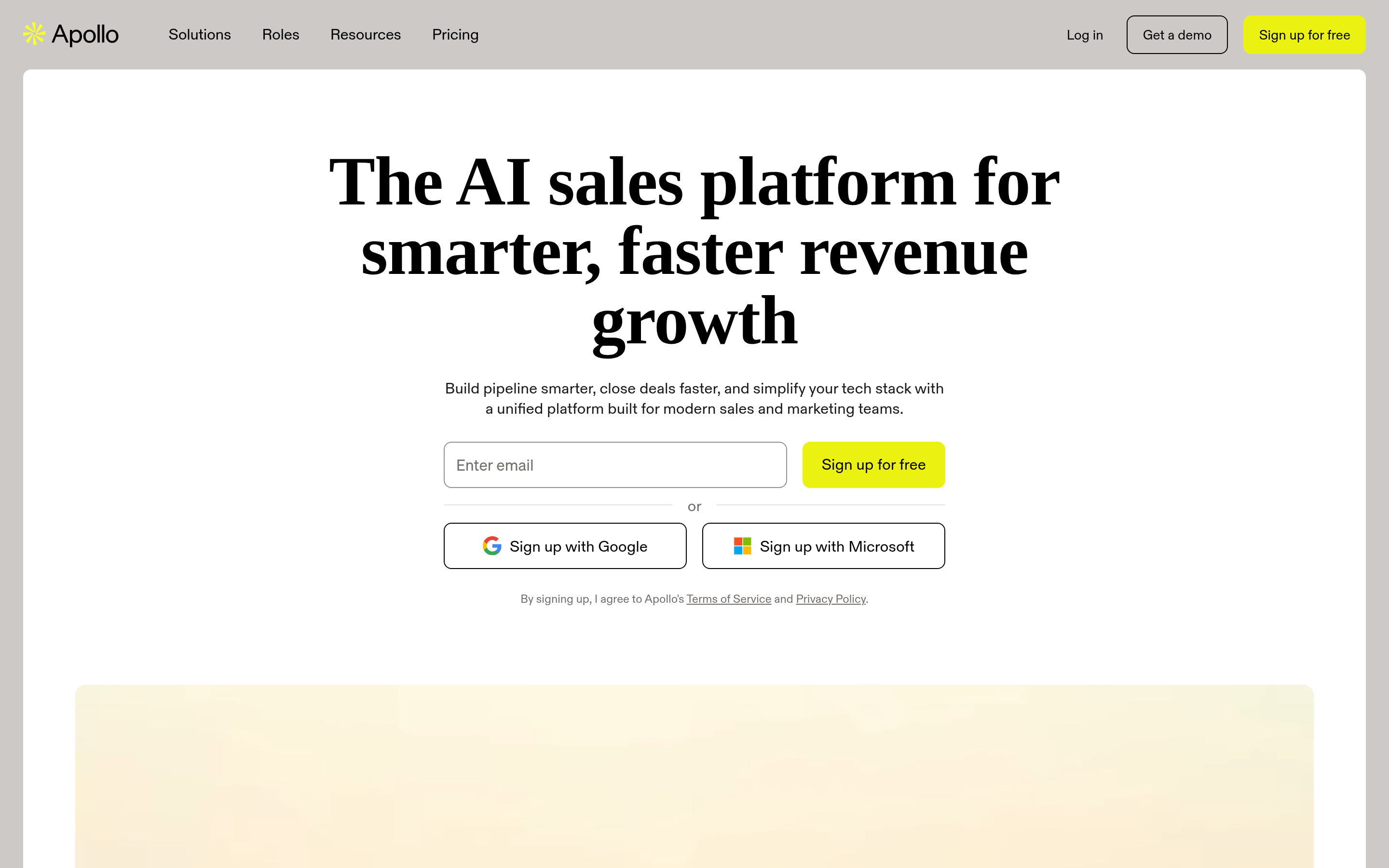
Apollo bundles a large B2B database with sequencing, dialer, and CRM features. If you want prospecting and outreach under one login, it's a strong D7 replacement, and its self-reported database size dwarfs a directory scrape.
The catch is that Apollo's breadth comes with complexity and credit math, and its email accuracy varies by region and seniority. It's a platform commitment, not a quick list tool. Teams that want Apollo's engagement layer but cleaner data often pair it with a dedicated finder — see this Apollo alternative breakdown for that combination.
3. Hunter — best lightweight domain search#
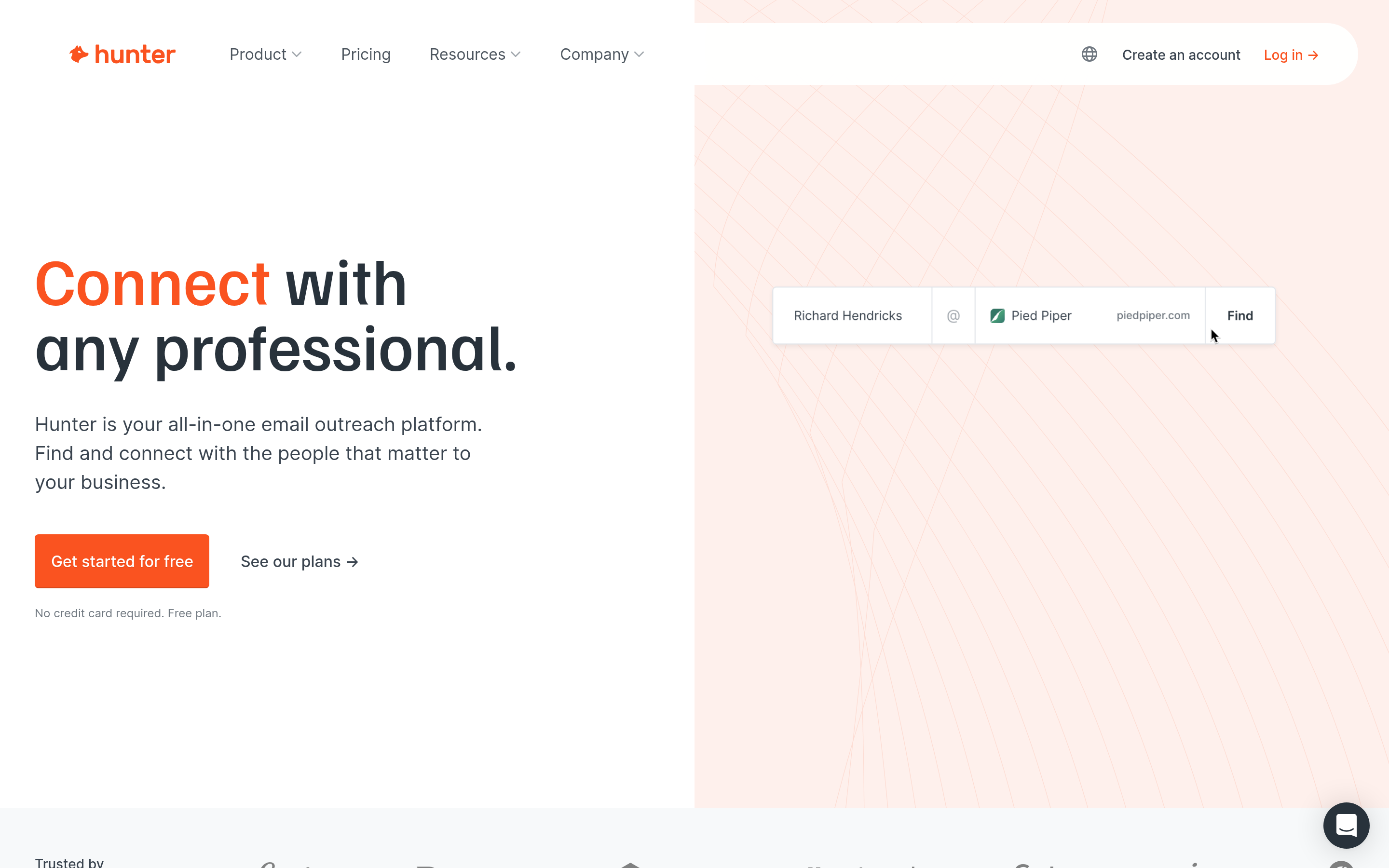
Hunter is the closest philosophical cousin to a clean email finder: give it a domain, get the addresses and patterns behind it. It's simple, reliable for straightforward lookups, and has a free tier that mirrors the "try before you buy" bar.
Compared to D7, Hunter trades local-directory breadth for email precision and verification. Where it lags heavier platforms is enrichment depth and phone coverage — it does email well and mostly stops there.
4. BookYourData — best for prepaid, pay-as-you-go lists#
BookYourData takes a different route: build a targeted B2B list with granular filters, pay per lead, and download verified contacts without a monthly subscription. For teams that buy lists in bursts rather than continuously, that prepaid model is genuinely convenient, and its accuracy guarantee is a real differentiator from raw scraping.
It's a solid, credible option in this space — particularly if you prefer owning a one-time export over maintaining a seat. The trade-off versus an API-first finder like Tomba is workflow: it's list-download-centric rather than something you weave into automated pipelines, so continuous enrichment is less natural.

5. RocketReach — best for deep contact and phone lookup#
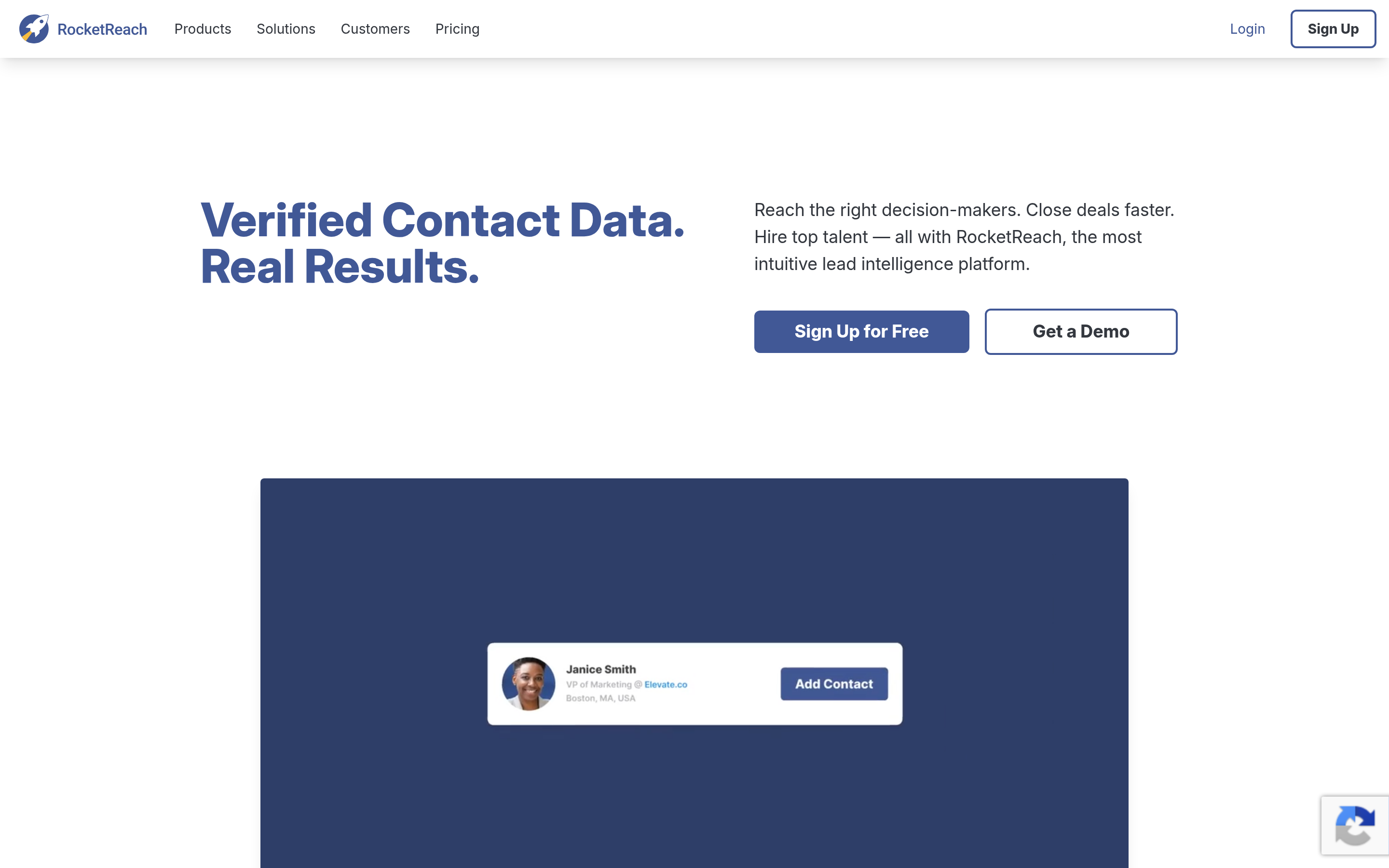
RocketReach shines when you need more than an email — direct dials, personal addresses, and cross-referenced profiles. Its coverage of hard-to-find contacts is a step up from directory scraping, and it's popular with recruiters and senior sales reps.
The downsides are cost per contact at volume and credit limits that add up fast on big campaigns. If phone-heavy outreach is your play, it's worth a look; if you mostly need verified email at scale, it's pricier than it needs to be. Compare notes in this RocketReach alternative overview.
6. Clearbit — best for enterprise enrichment#
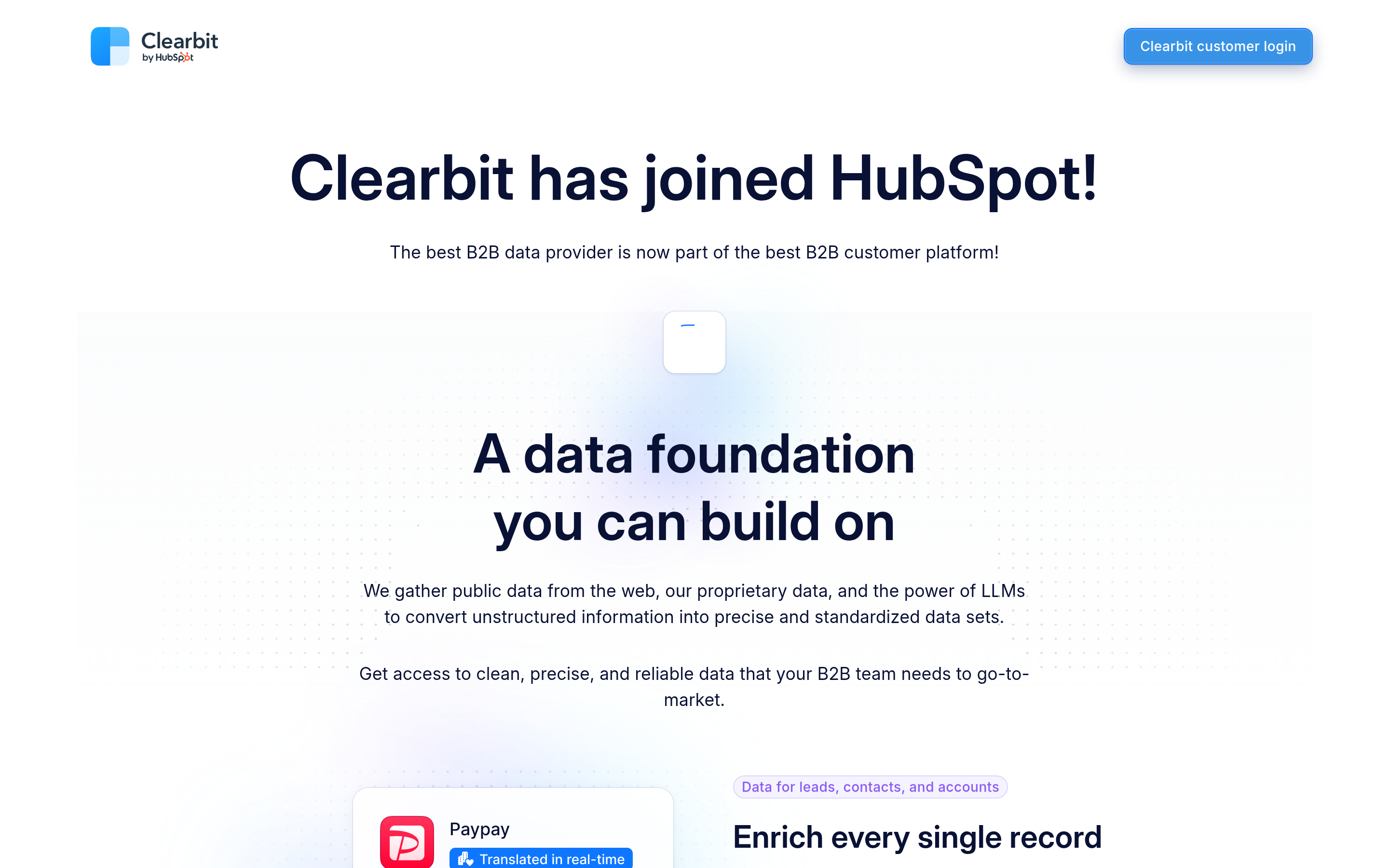
Clearbit (now part of HubSpot) is less a lead-list tool and more an enrichment and intent layer for teams already running a mature GTM motion. It's excellent at appending firmographic and technographic data to records you already have.
That also makes it the wrong tool if what you need is net-new lead discovery on a small budget — it's enterprise-priced and enrichment-first. For most teams leaving D7, it's overkill. Teams weighing it usually compare against a lighter Clearbit alternative first.
7. Keep D7 — but only for the right job#
Not every switch has to be total. If your workflow genuinely depends on scraping every local business in a category and you treat the output as raw material, D7 can stay in the toolbox. The fix is to stop emailing its exports directly. Run every D7 list through a verifier first — even a free email checker catches the worst offenders — before a single send. That one habit turns D7 from a deliverability liability into a usable top-of-funnel source.
Is a scraper or a verified finder better for cold outbound?#
A verified finder wins for outbound, and it isn't close. Here's the reasoning, not just the verdict.
Cold email lives and dies by sender reputation. Mailbox providers watch your bounce rate, spam complaints, and engagement. Send to a scraped list with a 20–30% invalid rate and you don't just lose those contacts — you signal to Gmail and Outlook that you're a spammer, and your good emails start landing in spam too. According to marketing-platform guidance from vendors like HubSpot, list quality is one of the biggest levers on deliverability precisely for this reason.
A scraper optimizes for the number of rows. A verified finder optimizes for the number of rows that will actually reach a human. For prospecting, the second number is the only one that pays your salary. That's why the tools above that verify by default — Tomba, Hunter, BookYourData — outperform a raw D7 export on reply rate even when they hand you a smaller list.
How do I switch from D7 Lead Finder without losing momentum?#
Move in three low-risk steps.
- Test accuracy on your own niche. Pull one target segment you know well and run it through a free tier — Tomba's 25 free searches or Hunter's free plan — before paying anything. Compare valid-address rates against your last D7 export.
- Verify your existing D7 lists. Don't throw them out; clean them. Run past exports through a bulk verifier so you keep the reachable contacts and drop the bounces.
- Wire the new tool into your stack. Connect via API or a native integration so enrichment happens automatically instead of as a manual CSV shuffle. Check independent reviews on G2 to confirm the integration you need is solid before committing.
Done in that order, you never go dark on pipeline — you just upgrade the quality of what's in it.
The bottom line#
D7 Lead Finder is a fast, affordable scraper, and for pure local-list volume it does what it says. But outbound in 2026 is won on deliverability, and deliverability is won on verified, role-level data — the exact thing directory scraping can't guarantee. Every alternative here beats D7 on that axis; which one fits depends on whether you want an all-in-one platform (Apollo), prepaid lists (BookYourData), deep phone data (RocketReach), or enterprise enrichment (Clearbit).
For most teams leaving D7, the cleanest upgrade is a verified email finder with a real API and a free tier to prove it first. Start with the Tomba Email Finder — run your toughest niche through the 25 free monthly searches, compare the valid-address rate against your last D7 export, and let the bounce numbers make the decision for you.
Related guides#
Ready to find emails that actually work?
Join 150,000+ professionals who stopped guessing and started sending. Free credits on signup — no credit card required.
Get the Tomba newsletter
Practical outbound tactics and product updates — once every two weeks.
About the author