D7 Lead Finder vs Apollo.io (2026): Which Lead Tool Wins?
D7 Lead Finder scrapes local business lists cheaply; Apollo.io sells verified B2B contacts at scale. Here's the honest 2026 breakdown of pricing, data accuracy, and which one fits your outbound.
Choosing between D7 Lead Finder vs Apollo.io usually comes down to one question: do you need a cheap pile of scraped local-business listings, or a verified B2B contact engine you can plug into a real outbound motion? They look similar on a pricing page, but they solve different problems.
TL;DR — Which One Should You Pick?#
- D7 Lead Finder is a bulk local-business scraper. It's cheapest for pulling phone numbers, websites, and generic inbox addresses from Google Maps-style listings by keyword and city.
- Apollo.io is a full sales-intelligence platform: a 275M+ contact database, verified emails, sequences, a dialer, and CRM sync.
- D7 wins on price for high-volume, low-precision local lists (agencies, SMB services). Apollo wins on data depth, verified work emails, and native outbound tooling.
- Both have an accuracy ceiling. D7 returns mostly generic
info@andcontact@addresses; Apollo's verified tier is stronger but still needs a second verification pass before you send. - If you mainly need accurate, person-level work emails, a dedicated finder like Tomba Email Finder often beats both on cost-per-valid-email — more on that below.
What Is D7 Lead Finder?#
D7 Lead Finder is a lead-scraping tool built for volume. You type a niche and a location — "dentists in Austin," "roofers in Manchester" — and it returns a spreadsheet of businesses with whatever public contact data it can scrape: website, phone, generic email, social profiles, and review counts.
Think of it like a fishing net dragged across public business directories. You get a lot of fish fast, but you don't get to pick the specific one you wanted, and plenty of what you haul in isn't usable. The addresses are almost always role-based (info@, office@, bookings@) rather than a named decision-maker.
That makes D7 a strong fit for local service prospecting — marketing agencies pitching SMBs, SEO resellers, or anyone doing high-volume, low-touch outreach where reaching any inbox at a business is good enough. It's a weak fit for enterprise or role-specific selling, where you need the VP of Marketing, not the front desk.
What Is Apollo.io?#
Apollo.io is a sales-intelligence and engagement platform. Instead of scraping listings on demand, it maintains a large contact database (275M+ contacts across 70M+ companies) enriched with job titles, seniority, technographics, and funding signals. You filter by persona and export verified contacts, then work them through Apollo's built-in sequences, dialer, and analytics.
Where D7 answers "which businesses exist in this city," Apollo answers "which people match my ideal customer profile, and how do I reach them." It's a heavier tool with a real learning curve, and its all-in-one design means you're often paying for a sequencer and dialer even if you only came for the data.

How Do D7 Lead Finder and Apollo.io Compare on Data Accuracy?#
This is where the two tools separate hardest, and where you should be skeptical of any vendor's headline number.
D7's data is broad but shallow. Because it scrapes public listings, it's excellent at coverage — it'll find businesses that never appear in a curated B2B database. But the emails are overwhelmingly generic, listings go stale, and there's no verification layer, so bounce rates on cold sends are high. You are buying reach, not precision.
Apollo's data is deeper but not infallible. Verified emails on Apollo's paid tiers test well, but "verified" status ages, catch-all domains slip through, and community-contributed records vary in freshness. Independent reviews on G2 consistently praise Apollo's coverage while flagging occasional stale or mismatched contacts — normal for any database this size.
The practical takeaway: treat both as a first pass, not a final list. Whatever you export, run it through an email verifier before your first send. A quick verification pass is the single cheapest way to protect your sender reputation, and it matters more than which scraper you started with. If a chunk of your list sits on catch-all domains, a dedicated catch-all verifier will tell you which of those are actually safe to email.

D7 Lead Finder vs Apollo.io: Side-by-Side Comparison#
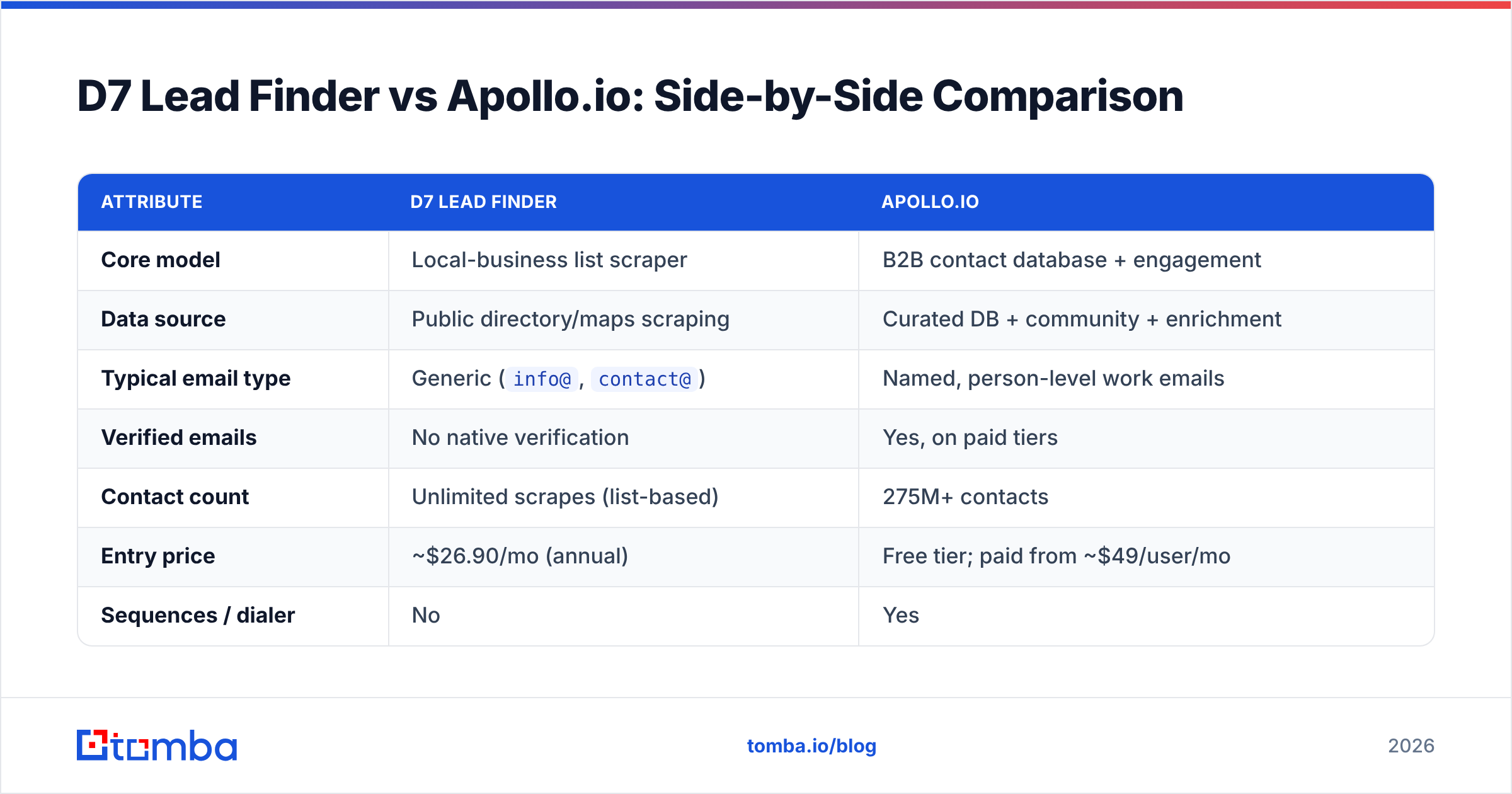
Here's the head-to-head on the attributes that actually change your outcome:
| Attribute | D7 Lead Finder | Apollo.io |
|---|---|---|
| Core model | Local-business list scraper | B2B contact database + engagement |
| Data source | Public directory/maps scraping | Curated DB + community + enrichment |
| Typical email type | Generic (info@, contact@) |
Named, person-level work emails |
| Verified emails | No native verification | Yes, on paid tiers |
| Contact count | Unlimited scrapes (list-based) | 275M+ contacts |
| Entry price | ~$26.90/mo (annual) | Free tier; paid from ~$49/user/mo |
| Sequences / dialer | No | Yes |
| CRM sync | Manual CSV export | Native (HubSpot, Salesforce) |
| Best for | High-volume local SMB outreach | Persona-based B2B prospecting |
| Weakness | Low precision, no verification | Cost per seat, data ages |
The short read of the table: D7 is a data faucet you point at a city; Apollo is a targeting-and-sending machine you point at a persona. Neither is "better" in the abstract — they're built for different buyers.
Which Is Cheaper — D7 Lead Finder or Apollo.io?#
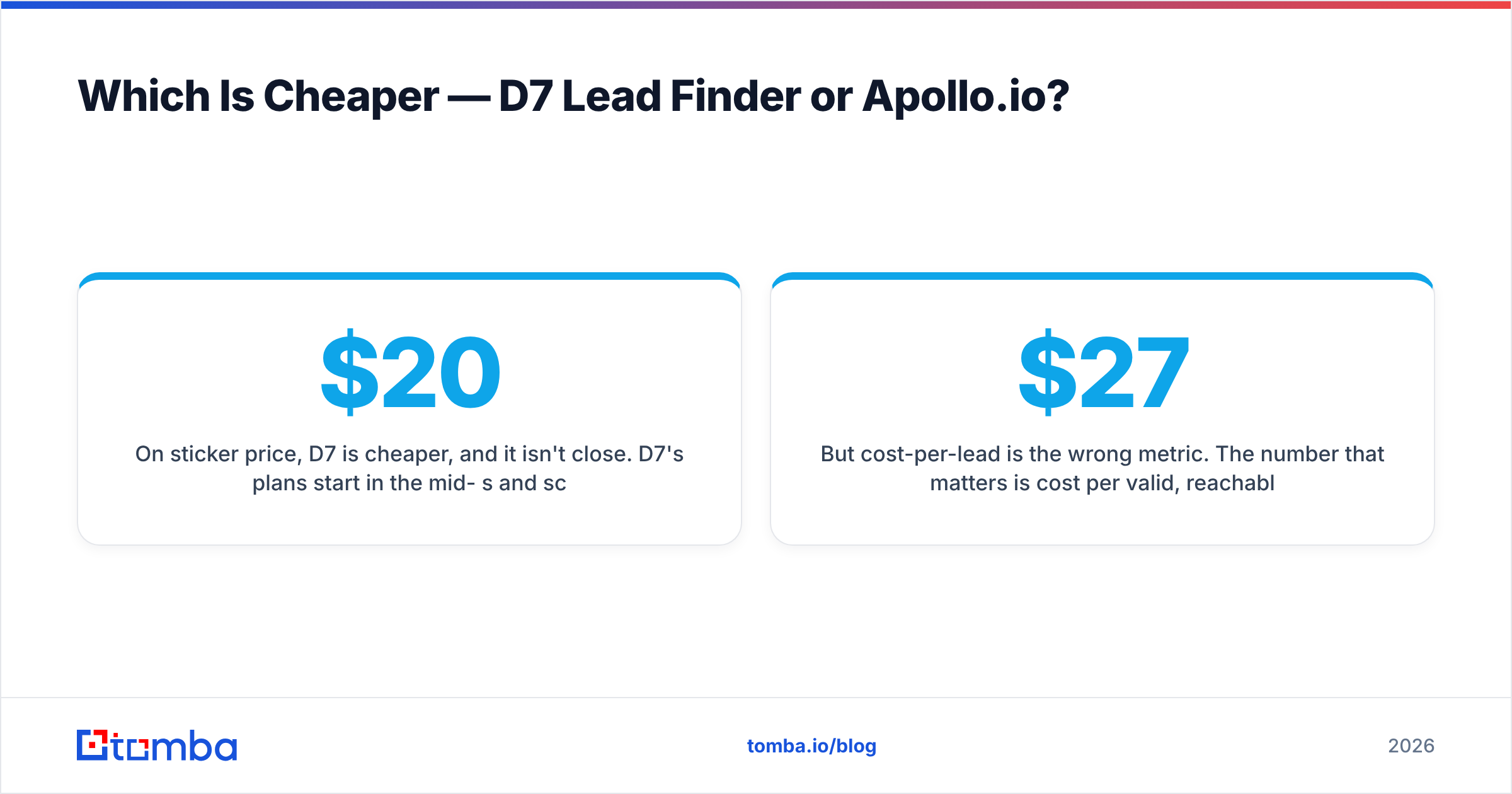
On sticker price, D7 is cheaper, and it isn't close. D7's plans start in the mid-$20s per month and scale by how many searches you run, with no per-seat cost. For an agency generating local lists in bulk, that's hard to beat.
Apollo is priced per user with credit limits on exports and enrichment. There's a genuinely useful free tier, but the plans that unlock verified-email exports and sequencing at volume add up fast across a team.
But cost-per-lead is the wrong metric. The number that matters is cost per valid, reachable, correctly-targeted contact. A $27 D7 list of 5,000 generic inboxes with a 40% bounce rate and no decision-maker names can be more expensive — in wasted send reputation and rep time — than a smaller, verified, persona-matched list. Always divide price by usable contacts, not raw rows.
When Should You Choose D7 Lead Finder?#
Pick D7 when your motion looks like this:
- You sell to local SMBs. Restaurants, contractors, clinics, retail — businesses that live in maps directories, not curated B2B databases.
- Any inbox at the business is fine. You're okay reaching a generic address because there's one owner-operator making decisions.
- Volume beats precision. You'd rather have 5,000 rough leads than 500 perfect ones.
- Budget is tight and per-seat pricing is a dealbreaker. D7's flat, search-based pricing suits solo operators and lean agencies.
If that's you, D7 does its one job well. Just pair it with verification so you aren't torching your domain on the dead addresses.
When Should You Choose Apollo.io?#
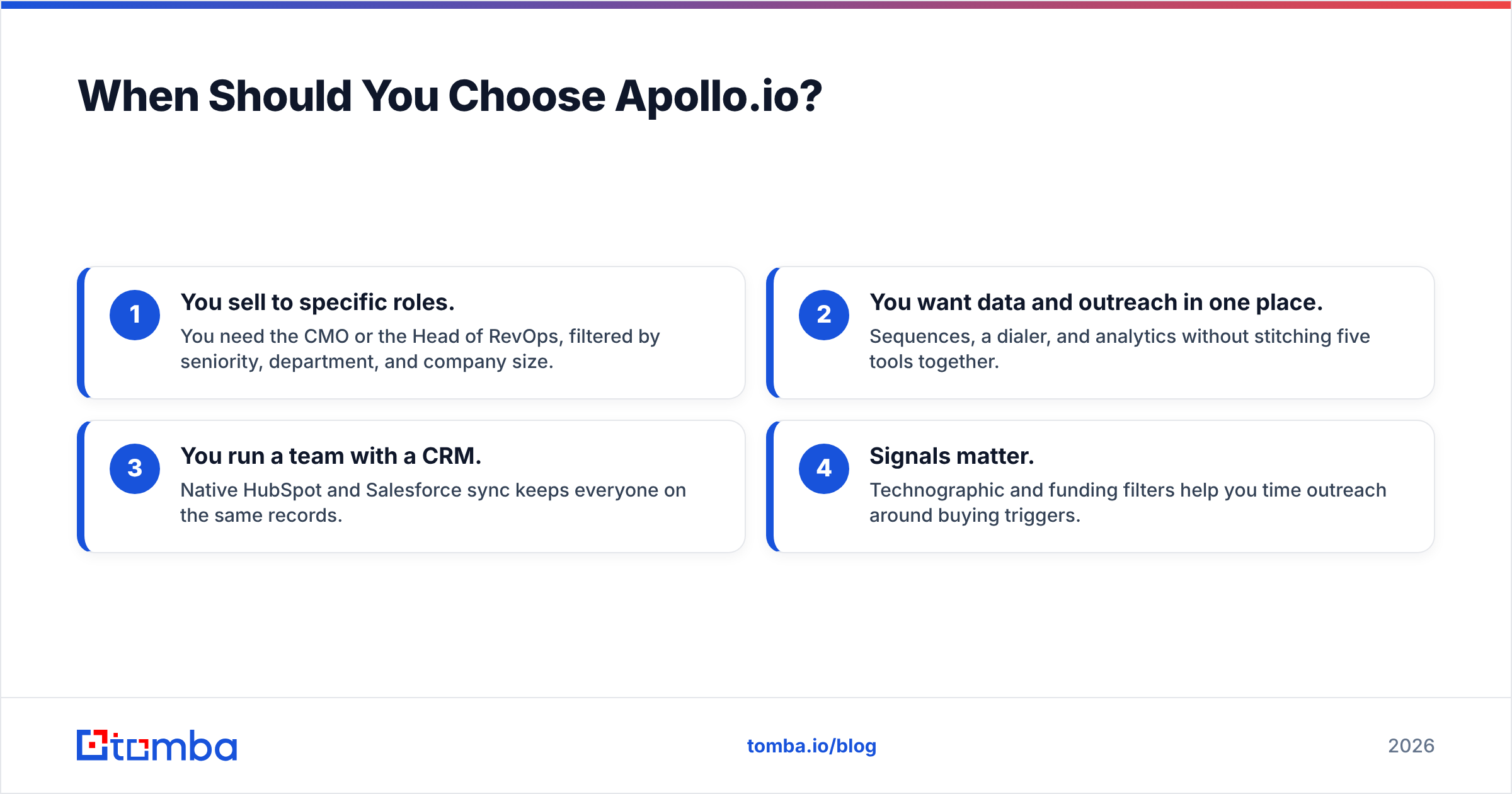
Pick Apollo when:
- You sell to specific roles. You need the CMO or the Head of RevOps, filtered by seniority, department, and company size.
- You want data and outreach in one place. Sequences, a dialer, and analytics without stitching five tools together.
- You run a team with a CRM. Native HubSpot and Salesforce sync keeps everyone on the same records.
- Signals matter. Technographic and funding filters help you time outreach around buying triggers.
Apollo is the more complete platform, and for persona-driven B2B teams the extra spend usually pays for itself. If you like the data but want to escape the per-seat sequencer bundle, an Apollo alternative focused purely on finding and verifying emails can cover the data half more cheaply.
Where Does a Dedicated Email Finder Fit?#
Here's the gap neither tool fully closes: accurate, person-level email discovery on demand.
D7 gives you businesses but rarely the right person's email. Apollo gives you the right person but bundles you into a platform you may not need. When your real need is "I have a name and a company — get me their verified work email," a purpose-built finder is the tighter tool.
That's the lane Tomba sits in. With domain search you pull every discoverable email at a company and see its most common address pattern; with the email finder you resolve a specific person from name plus domain; and every result runs through verification so bounce risk is scored before you export. For teams already using Apollo or D7, Tomba works well as the accuracy layer on top — enrich and re-verify the list before it hits your sequencer.
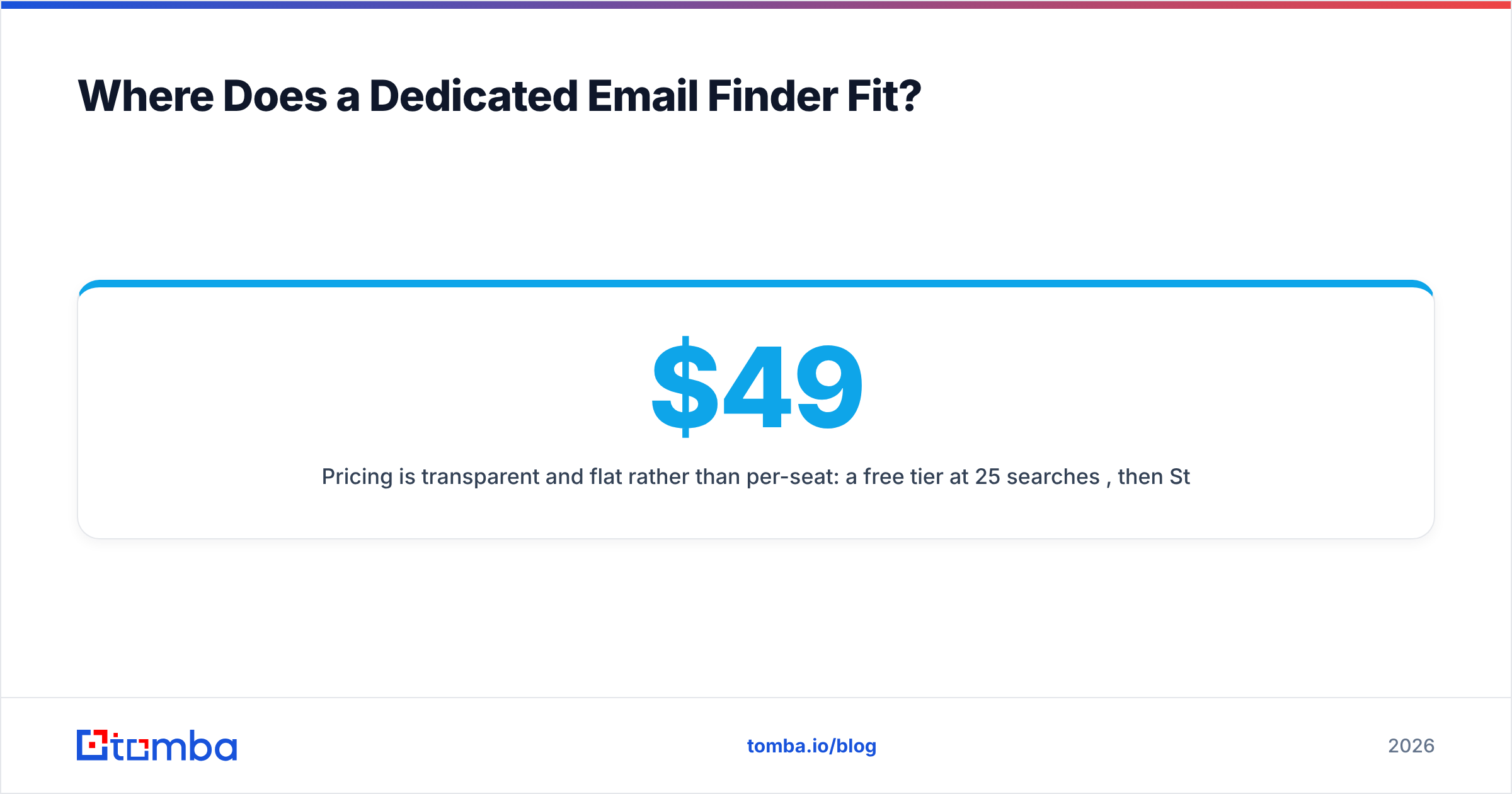
Pricing is transparent and flat rather than per-seat: a free tier at 25 searches/month, then Starter at $49/mo, Growth at $99/mo, and Pro at $249/mo. Full Tomba pricing is public, so you can model cost-per-valid-email before committing.
The Honest Verdict#
There's no single winner — there's a winner for your motion:
- Local SMB agency, high volume, tight budget → D7 Lead Finder, plus a verification pass.
- B2B team selling to specific personas, wants all-in-one → Apollo.io.
- Anyone whose bottleneck is accurate person-level emails → a dedicated finder like Tomba, standalone or layered on top of the other two.
The mistake to avoid is treating any scraped or database export as send-ready. Both D7 and Apollo produce lists that look clean and still bounce. Verification is not optional — it's the step that decides whether your domain lands in the inbox or the spam folder next quarter.
Ready to Stop Guessing on Deliverability?#
If your real problem is reaching the right person with an address that actually resolves, start with the Tomba Email Finder. Find named, verified work emails by domain, name, or company — with built-in verification so you know your bounce risk before you hit send. Run your next D7 or Apollo export through it and watch your bounce rate drop. Start free with 25 searches, no card required, and scale only when it's paying you back.
Related guides#
Ready to find emails that actually work?
Join 150,000+ professionals who stopped guessing and started sending. Free credits on signup — no credit card required.
Get the Tomba newsletter
Practical outbound tactics and product updates — once every two weeks.
About the author