Data Quality in B2B: The Complete 2026 Guide to Clean Data
Bad records quietly drain B2B pipelines through bounced emails, misrouted leads, and skewed reports. Here's how to measure data quality, find what's breaking it, and build a workflow that keeps your CRM clean.
Data quality is the single cheapest lever most B2B teams ignore. You can buy more contacts, hire more SDRs, and license another intent tool — but if 30% of your records are wrong, every downstream investment inherits that error. This guide breaks down what data quality actually means, how to measure it, and the practical workflow that keeps your pipeline clean without a six-month data-governance project.
TL;DR#
- Data quality is the degree to which your records are accurate, complete, consistent, timely, and unique — not just "how many contacts we have."
- B2B data decays roughly 2–2.5% per month (people change jobs, companies rebrand, domains lapse), so quality is a maintenance problem, not a one-time cleanup.
- Bad data has a measurable cost: bounced sends hurt sender reputation, misrouted leads slow follow-up, and dirty dashboards drive wrong decisions.
- The fix is a repeatable loop: profile → standardize → verify → enrich → deduplicate → monitor.
- Tools like an email verifier and data enrichment automate the expensive parts; the process discipline is what makes them stick.
What is data quality, really?#
Data quality is a fitness-for-purpose measure. Think of it like ingredients in a kitchen: it doesn't matter how many jars are on the shelf if half of them are expired, mislabeled, or duplicates of each other. A record is "high quality" only when it's good enough to do the job you need it for — route a lead, send a campaign, score an account, close the books.
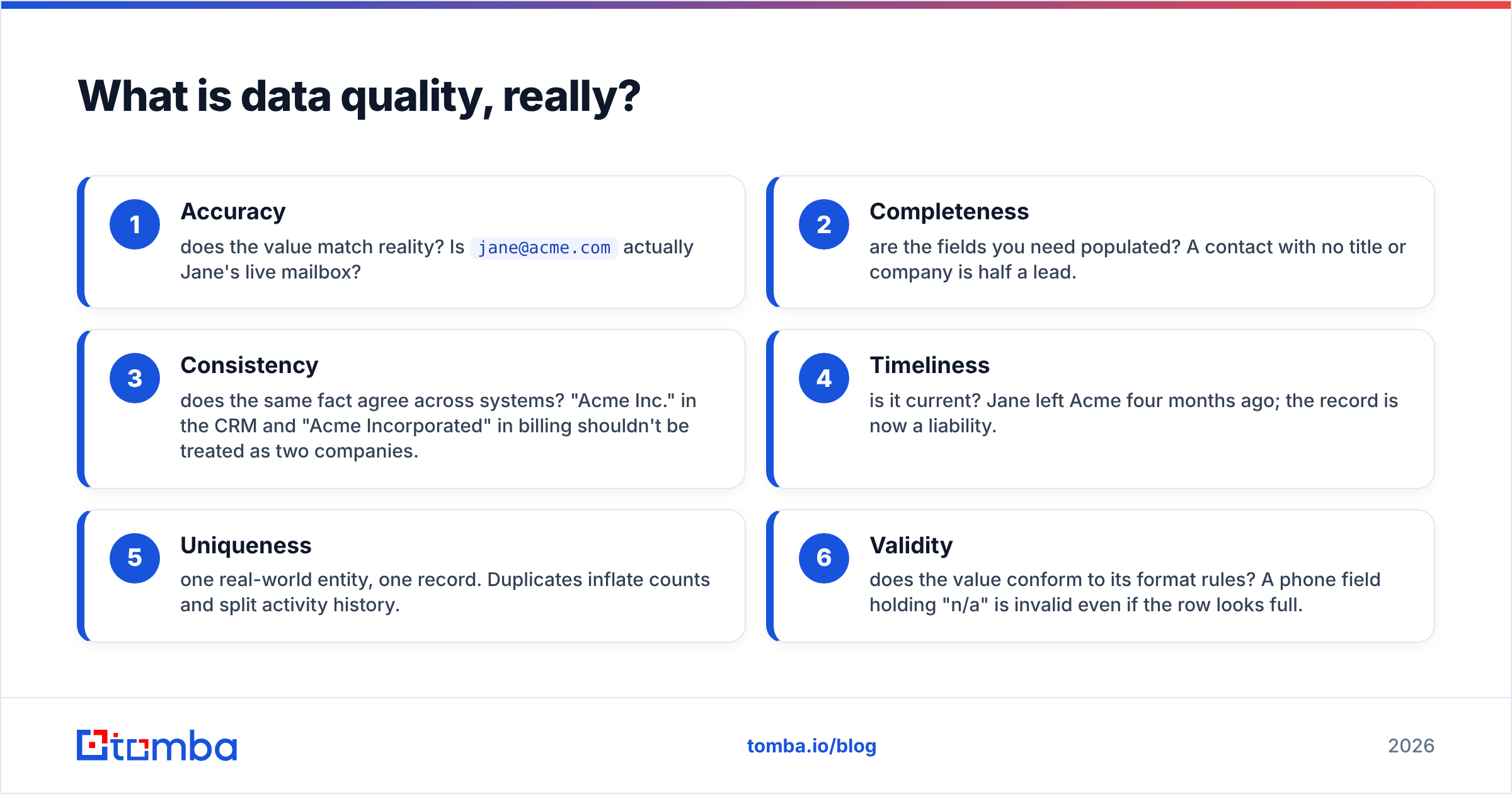
Analysts break this into a handful of dimensions. These are the ones that matter for revenue teams:
- Accuracy — does the value match reality? Is
jane@acme.comactually Jane's live mailbox? - Completeness — are the fields you need populated? A contact with no title or company is half a lead.
- Consistency — does the same fact agree across systems? "Acme Inc." in the CRM and "Acme Incorporated" in billing shouldn't be treated as two companies.
- Timeliness — is it current? Jane left Acme four months ago; the record is now a liability.
- Uniqueness — one real-world entity, one record. Duplicates inflate counts and split activity history.
- Validity — does the value conform to its format rules? A phone field holding "n/a" is invalid even if the row looks full.

Most teams obsess over completeness ("we have 40,000 contacts!") and ignore accuracy and timeliness, which are the dimensions that actually break campaigns. A smaller, verified list beats a bloated, unverified one every time.
Why does data quality matter for B2B revenue?#
Because every bad record taxes a real workflow, and the tax compounds. According to Gartner research, poor data quality costs organizations millions per year on average — but the number that lands with an SDR team is simpler: a 20% bounce rate can get your sending domain throttled or blacklisted, which then suppresses your good emails too.
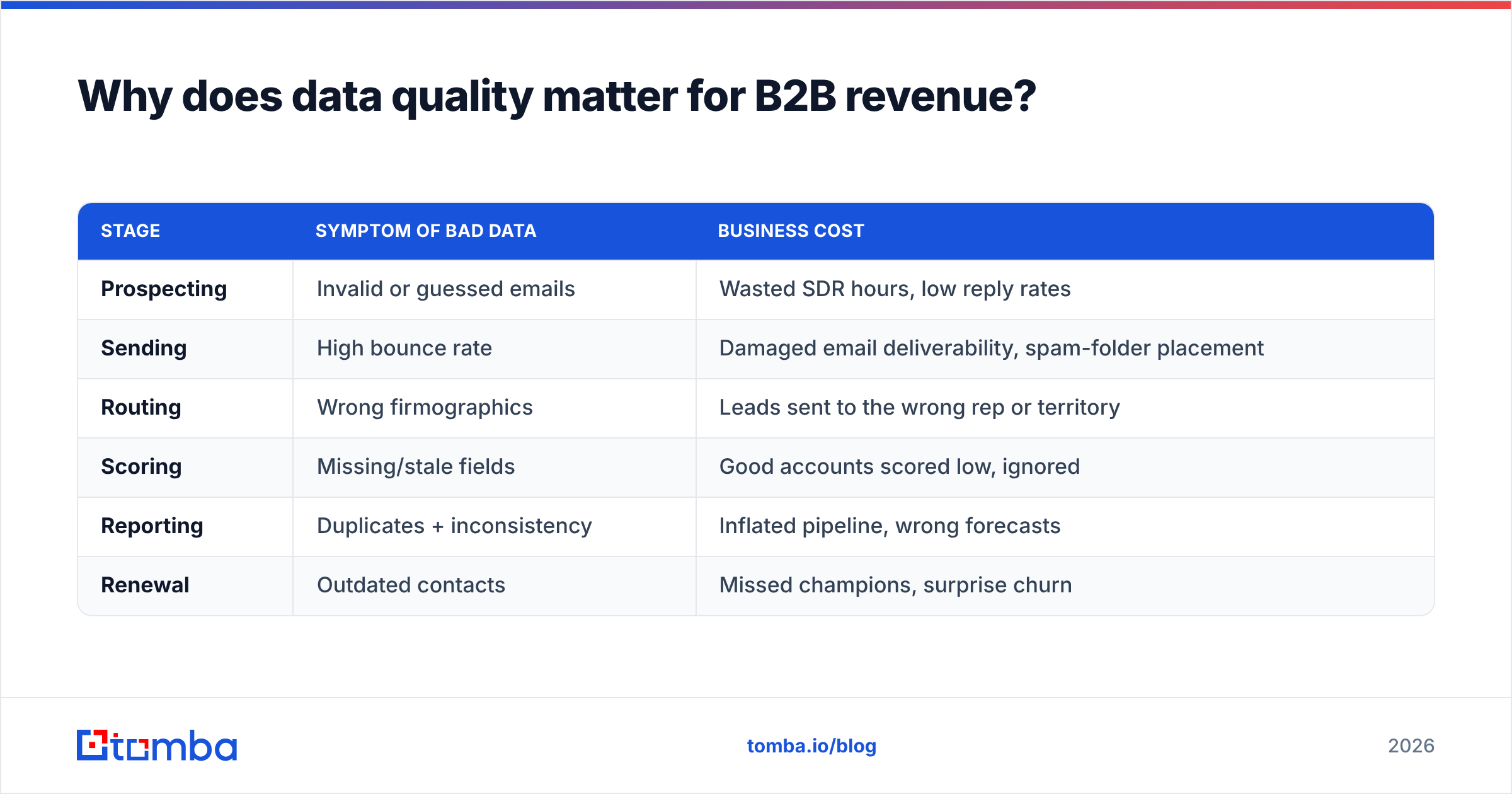
Here's how dirty data leaks value at each stage:
| Stage | Symptom of bad data | Business cost |
|---|---|---|
| Prospecting | Invalid or guessed emails | Wasted SDR hours, low reply rates |
| Sending | High bounce rate | Damaged email deliverability, spam-folder placement |
| Routing | Wrong firmographics | Leads sent to the wrong rep or territory |
| Scoring | Missing/stale fields | Good accounts scored low, ignored |
| Reporting | Duplicates + inconsistency | Inflated pipeline, wrong forecasts |
| Renewal | Outdated contacts | Missed champions, surprise churn |
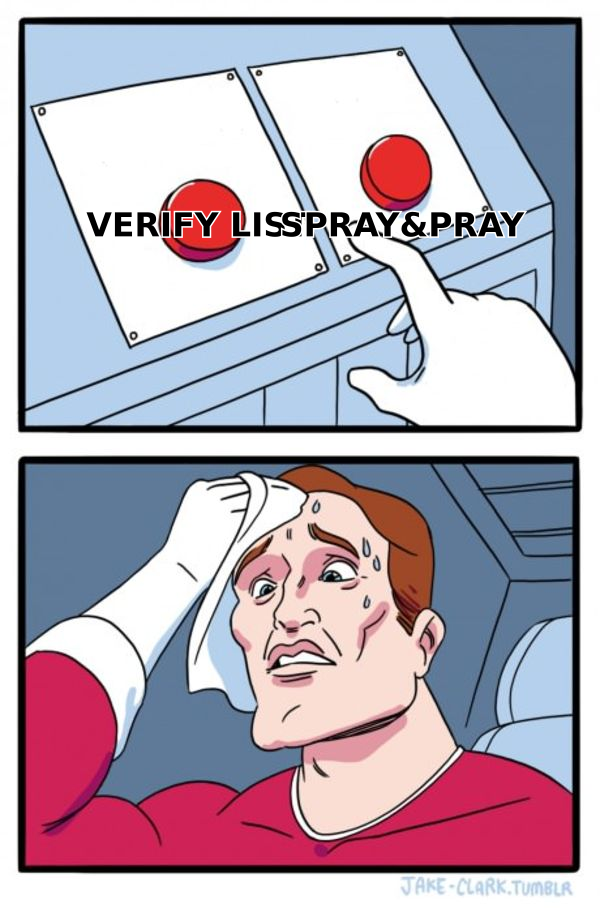
The compounding part is what makes this urgent. A bounced send doesn't just fail once — it lowers your sender reputation, which lowers inbox placement for the next campaign, which lowers reply rates, which pushes reps to "spray and pray" wider lists, which introduces more bad data. Clean data breaks that loop at the source.
How do you measure data quality?#
You can't fix what you don't score. Start by profiling a sample of your database and computing a few blunt but honest metrics. You don't need a data-science team for this — a spreadsheet export and a few formulas will expose the problem fast.
- Bounce rate — invalid emails ÷ total sent. Above 3% is a warning; above 5% is a fire.
- Completeness rate — populated required fields ÷ total required fields, across the table.
- Duplicate rate — duplicate records ÷ total records (match on email, then on company + name).
- Staleness — % of records not updated or verified in the last 6–12 months.
- Validity rate — % of fields that pass format rules (email regex, phone length, country codes).
Turn these into a single scorecard and re-run it monthly. The goal isn't a perfect 100 — it's a trend line that moves the right way. If your bounce rate drifts up quarter over quarter, your acquisition sources are dirty; if completeness drops, your intake forms or enrichment coverage are failing.
For a quick spot-check on individual addresses without exporting anything, a free email checker tells you whether a single address is deliverable before you trust it.
What causes B2B data to decay?#
Data quality is a moving target because the underlying reality moves. This is the part teams underestimate: even a database that was 98% clean on January 1 will drift measurably by spring. The main drivers:
- Job changes — professionals switch roles every few years; each move invalidates an email, a title, and sometimes a phone number.
- Company changes — mergers, rebrands, and domain migrations silently break
@oldname.comaddresses. - Typos and manual entry — reps and web forms introduce errors that no validation caught.
- Catch-all domains — servers that accept every address make verification ambiguous, so guessed emails "pass" and then bounce later.
- List buying without verification — the fastest way to import someone else's decay into your CRM.
The takeaway: data quality is a subscription, not a purchase. You re-verify on a cadence, or the decay wins. A quarterly bulk verify pass on your active segments is the minimum viable maintenance for most teams.
What's the workflow for fixing and maintaining data quality?#
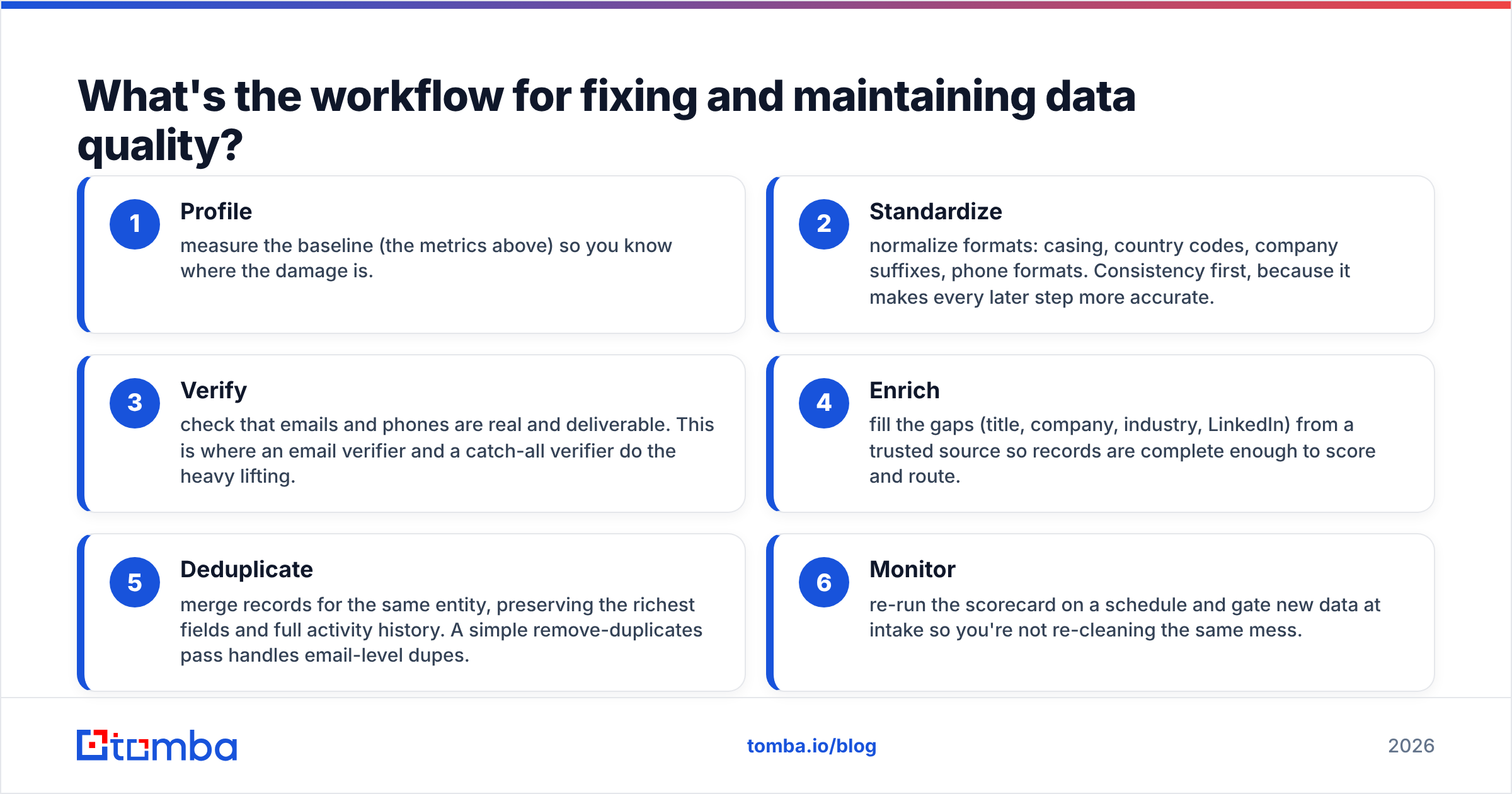
Six steps, run as a loop. Each one is automatable, and each removes a specific defect class.
- Profile — measure the baseline (the metrics above) so you know where the damage is.
- Standardize — normalize formats: casing, country codes, company suffixes, phone formats. Consistency first, because it makes every later step more accurate.
- Verify — check that emails and phones are real and deliverable. This is where an email verifier and a catch-all verifier do the heavy lifting.
- Enrich — fill the gaps (title, company, industry, LinkedIn) from a trusted source so records are complete enough to score and route.
- Deduplicate — merge records for the same entity, preserving the richest fields and full activity history. A simple remove-duplicates pass handles email-level dupes.
- Monitor — re-run the scorecard on a schedule and gate new data at intake so you're not re-cleaning the same mess.
The order matters. Standardizing before deduplicating catches "Acme Inc" vs "Acme Incorporated" collisions. Verifying before enriching means you don't pay to enrich dead records. And monitoring is what turns a one-time cleanup into a durable system — without it, you'll be running the exact same project again in a year.
How do data-quality approaches compare?#
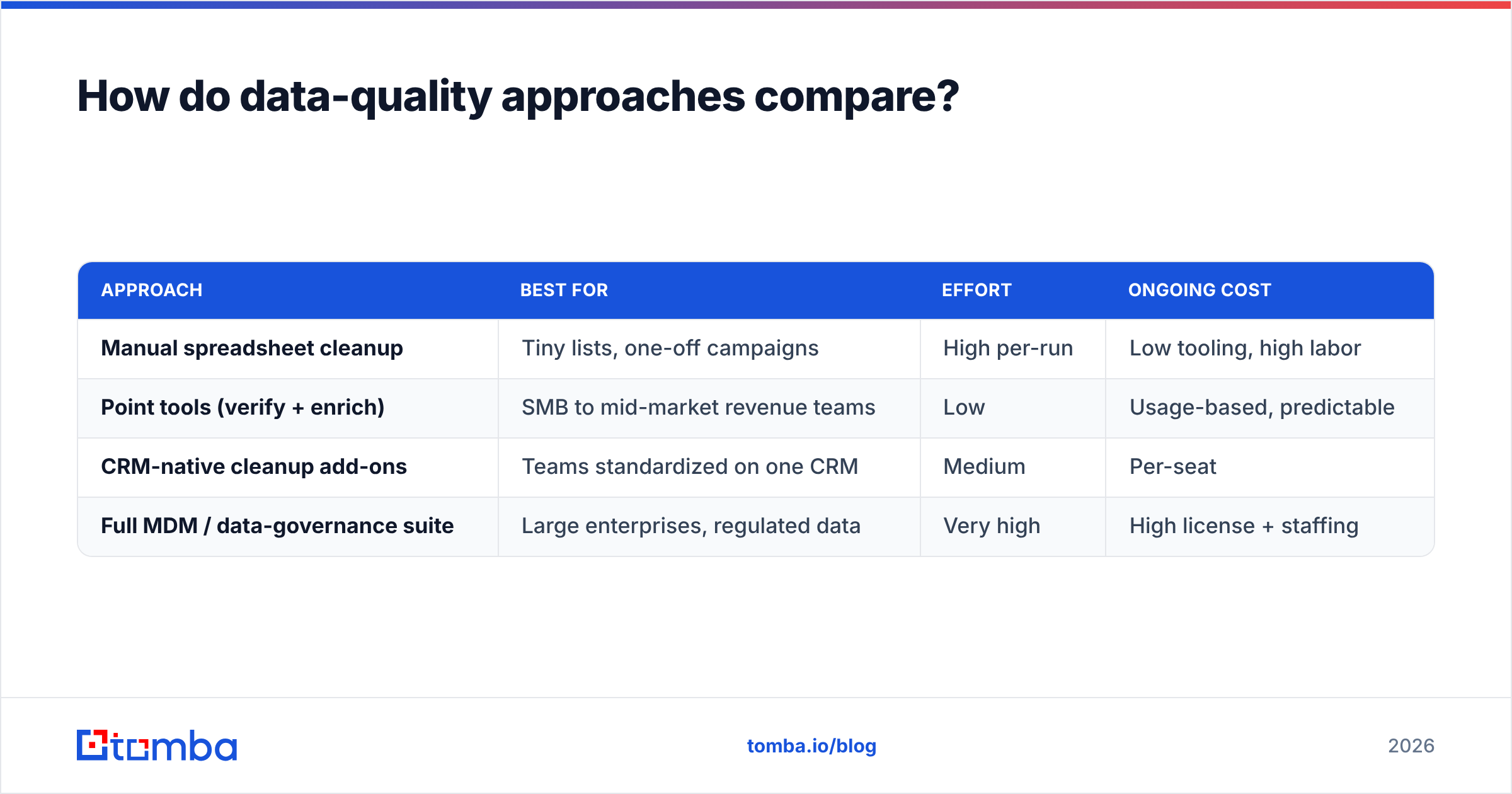
Not every team needs an enterprise MDM (master data management) platform. Match the approach to your stage and volume:
| Approach | Best for | Effort | Ongoing cost |
|---|---|---|---|
| Manual spreadsheet cleanup | Tiny lists, one-off campaigns | High per-run | Low tooling, high labor |
| Point tools (verify + enrich) | SMB to mid-market revenue teams | Low | Usage-based, predictable |
| CRM-native cleanup add-ons | Teams standardized on one CRM | Medium | Per-seat |
| Full MDM / data-governance suite | Large enterprises, regulated data | Very high | High license + staffing |
For most B2B teams under a few hundred thousand records, point tools plugged into a monitoring cadence hit the sweet spot: you get verification and enrichment on demand via an email finder API or a spreadsheet add-in, without standing up a governance program. Reputable data providers — including verification specialists and compliant B2B list vendors like BookYourData — can supplement your first-party data, but the same rule applies: verify anything you import before it touches a sending domain.
You can sanity-check any vendor's claims the way buyers do on G2 — look at accuracy benchmarks and how transparent they are about where the data comes from. Opaque sourcing is a quality red flag.
Where do email finding and verification fit in?#
They're the front door of data quality for revenue teams, because email is the field that decays fastest and costs the most when it's wrong. Two jobs sit here:
- Finding the right address in the first place — by name and domain, or across a whole company via domain search — so you start with real data instead of permutated guesses.
- Verifying that address is deliverable, and handling ambiguous catch-all domains so a "valid-looking" email doesn't bounce mid-campaign.
Getting this right at acquisition is 10x cheaper than cleaning it later. If every new contact enters your CRM already verified, your bounce rate stays low by default and your email deliverability stops being a monthly firefight. Platforms like HubSpot will happily store whatever you feed them — the quality gate has to live upstream, at the point of entry.
Common data-quality mistakes to avoid#
- Confusing volume with value. A 100k list at 60% deliverability is worse than a 40k list at 97%.
- Cleaning once and calling it done. Decay is continuous; your process has to be too.
- Skipping catch-all handling. Treating catch-all "accepts" as verified is how clean lists quietly rot.
- Enriching before verifying. You'll pay to complete records that were never real.
- No intake gate. If web forms and imports bypass validation, you re-import the mess you just cleaned.
- Ignoring consistency. Un-normalized company names wreck deduplication and account-level reporting.
The bottom line#
Data quality isn't a project you finish — it's a metric you defend. Score your database honestly, fix it with a repeatable profile→verify→enrich→dedupe→monitor loop, and gate new data at the door so decay never gets ahead of you. The teams that win aren't the ones with the most contacts; they're the ones whose contacts are actually reachable.
Start where the leverage is highest: the addresses you're about to email. Use the Tomba Email Finder to source real, professional emails by name or domain, then run them through Tomba's verifier before they ever hit your sending tool. It plugs into your CRM, spreadsheets, and pipelines, and the free tier (25 searches/month) is enough to test the workflow on a live segment. Clean data in, clean pipeline out — start today and stop paying the bad-data tax.
Related guides#
Ready to find emails that actually work?
Join 150,000+ professionals who stopped guessing and started sending. Free credits on signup — no credit card required.
Get the Tomba newsletter
Practical outbound tactics and product updates — once every two weeks.
About the author