Dealjourney Alternatives: 9 Better Tools to Try in 2026
Dealjourney bundles deal signals, contact data and outreach into one subscription — but most teams only need two of the three. Here are nine alternatives compared on accuracy, pricing model and workflow fit.
TL;DR
- Most teams evaluating Dealjourney alternatives are really solving one of three separate problems: contact data, buying signals, or sequencing. Bundled platforms charge you for all three.
- Per-seat pricing punishes small teams that need volume; credit-based pricing punishes large teams that need seats. Pick the model that matches your headcount-to-volume ratio, not the feature list.
- If you mainly need verified work emails at predictable cost, a focused finder-plus-verifier stack (Tomba, Findymail, BookYourData) beats an all-in-one on cost per usable contact.
- If you need intent data and a full sequencer under one login, Apollo, Cognism, or Clay are the realistic swaps — expect a materially higher floor.
- Always test on your own ICP list before signing. Vendor-published accuracy numbers are measured on their easiest segments, not your niche.
What is Dealjourney and who actually uses it?#
Dealjourney sits in the crowded "deal intelligence" category: a platform that tries to combine company signals, contact records, and outbound workflow into a single subscription. The pitch is familiar — stop paying four vendors, get one pipeline view, let the platform tell you which accounts are heating up.
Be careful with specifics here. Vendors in this category iterate their packaging aggressively, and Dealjourney's public pricing has not been consistently documented across review sites. Treat any number you read in a blog post — including this one — as a starting point for a quote conversation, not a quote. Verify current tiers on the vendor's own pricing page before you budget.
The users who get real value from a platform like this share a profile: mid-market sales teams with 5–25 reps, a defined account list, and enough deal volume that signal-based prioritization changes what reps do on Monday morning. The users who churn share an equally consistent profile: small teams who bought a signal engine but only ever used the contact database, and now pay platform pricing for a lookup tool.
That second group is why this article exists.
Why do teams look for Dealjourney alternatives?#
Five reasons come up repeatedly in G2 and Capterra reviews across this whole category — not just Dealjourney specifically:
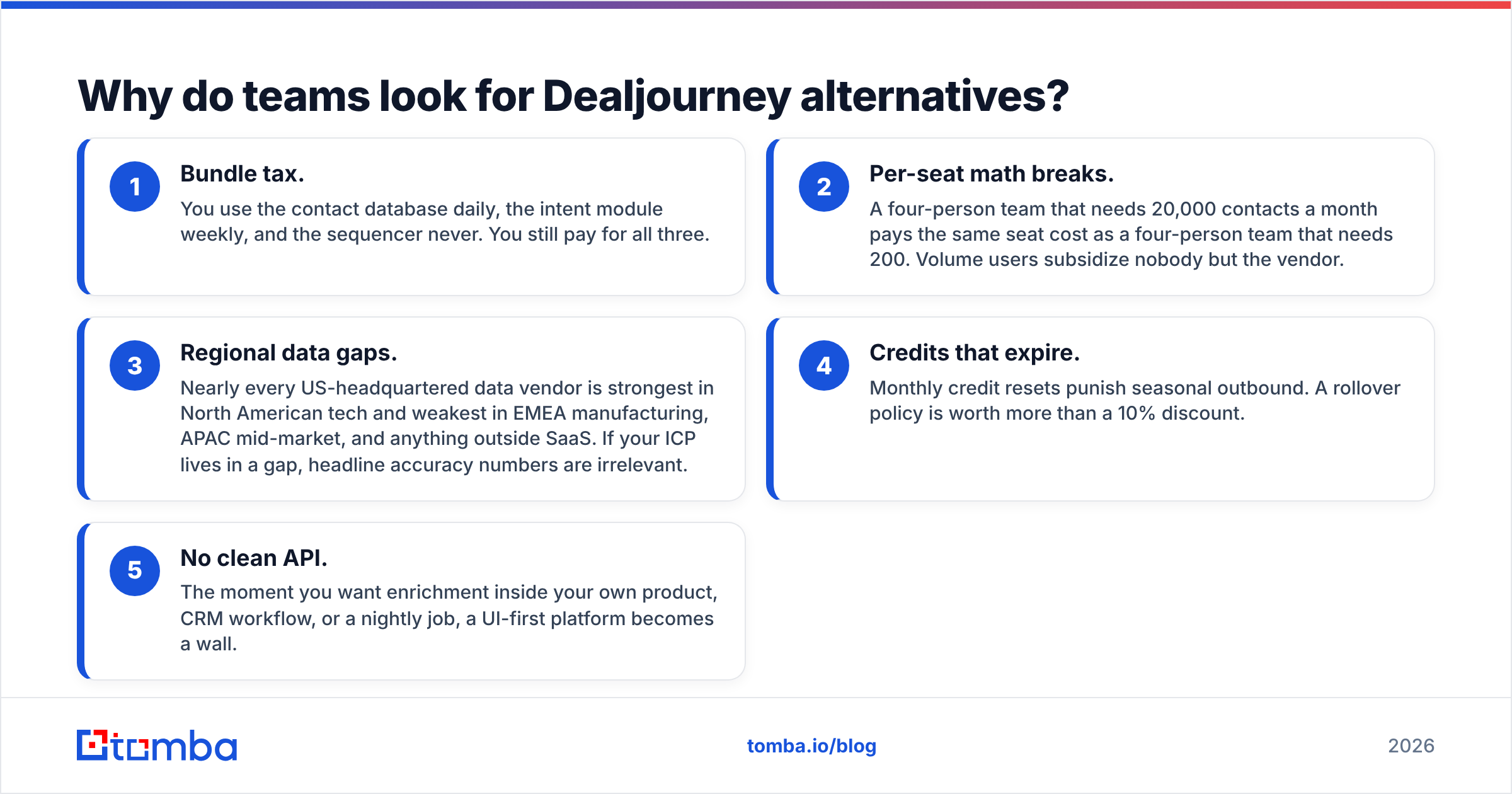
- Bundle tax. You use the contact database daily, the intent module weekly, and the sequencer never. You still pay for all three.
- Per-seat math breaks. A four-person team that needs 20,000 contacts a month pays the same seat cost as a four-person team that needs 200. Volume users subsidize nobody but the vendor.
- Regional data gaps. Nearly every US-headquartered data vendor is strongest in North American tech and weakest in EMEA manufacturing, APAC mid-market, and anything outside SaaS. If your ICP lives in a gap, headline accuracy numbers are irrelevant.
- Credits that expire. Monthly credit resets punish seasonal outbound. A rollover policy is worth more than a 10% discount.
- No clean API. The moment you want enrichment inside your own product, CRM workflow, or a nightly job, a UI-first platform becomes a wall.

What should you compare before switching?#
Before you look at a single logo, decide which of these five dimensions actually decides the purchase for you. Ranking them honestly kills 70% of the shortlist immediately.
- Pricing model, not price. Credit-based, per-seat, or pay-as-you-go. A $49/mo credit plan and a $49/user/mo seat plan are completely different products at 12 people.
- Verification depth. Does the tool return an email, or a verified email with a confidence score and catch-all handling? Unverified data is a deliverability bill you pay later.
- Coverage of your specific ICP. Test 100 real target contacts. Measure hit rate and bounce rate separately — a tool can have 90% hit rate and 20% bounces.
- Integration surface. REST API, Sheets add-on, Chrome extension, CRM sync, Zapier. If the data can't reach your system of record without a CSV, it will rot.
- Compliance posture. GDPR/CCPA documentation, opt-out handling, and a stated position on where data comes from. Ask for it in writing.
- Exit cost. Can you export what you've enriched? Some platforms make your enriched records hostage to the subscription.
Which Dealjourney alternatives are worth shortlisting in 2026?#
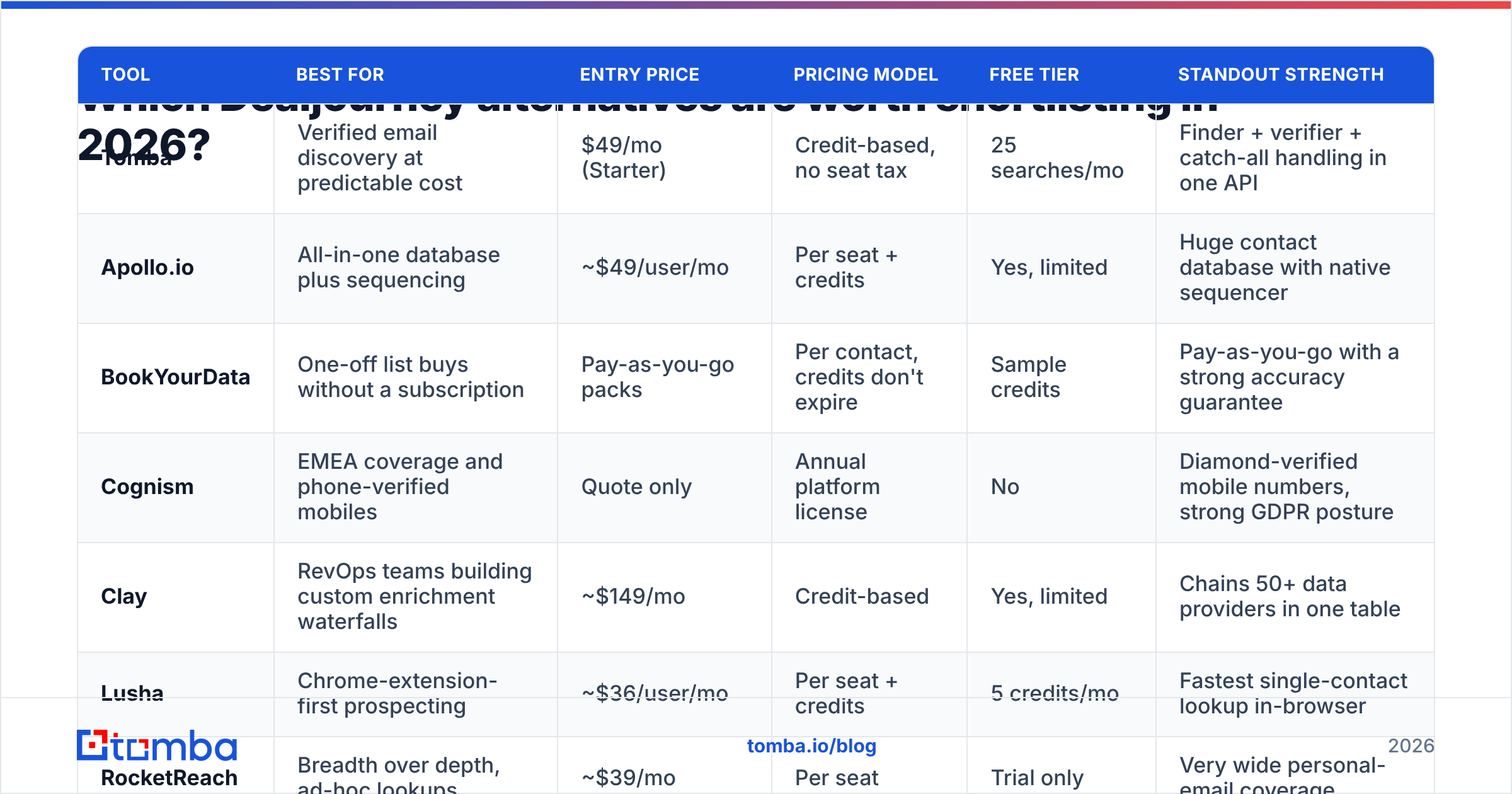
Here's the comparison table. Prices are entry-level published rates at time of writing and move frequently — confirm before you commit.
| Tool | Best for | Entry price | Pricing model | Free tier | Standout strength |
|---|---|---|---|---|---|
| Tomba | Verified email discovery at predictable cost | $49/mo (Starter) | Credit-based, no seat tax | 25 searches/mo | Finder + verifier + catch-all handling in one API |
| Apollo.io | All-in-one database plus sequencing | ~$49/user/mo | Per seat + credits | Yes, limited | Huge contact database with native sequencer |
| BookYourData | One-off list buys without a subscription | Pay-as-you-go packs | Per contact, credits don't expire | Sample credits | Pay-as-you-go with a strong accuracy guarantee |
| Cognism | EMEA coverage and phone-verified mobiles | Quote only | Annual platform license | No | Diamond-verified mobile numbers, strong GDPR posture |
| Clay | RevOps teams building custom enrichment waterfalls | ~$149/mo | Credit-based | Yes, limited | Chains 50+ data providers in one table |
| Lusha | Chrome-extension-first prospecting | ~$36/user/mo | Per seat + credits | 5 credits/mo | Fastest single-contact lookup in-browser |
| RocketReach | Breadth over depth, ad-hoc lookups | ~$39/mo | Per seat | Trial only | Very wide personal-email coverage |
| Findymail | Bounce-safe lists for cold email agencies | ~$49/mo | Credit-based | Trial | Aggressive built-in verification, low bounce rate |
| Clearbit (HubSpot) | Inbound enrichment inside HubSpot | Bundled/quote | Platform add-on | No | Native HubSpot form and record enrichment |
Tomba — best for verified emails without seat inflation#
Tomba is the narrow-and-deep option. It does not try to be your sequencer or your intent engine. It finds work email addresses by domain, name, or company, verifies them, and hands them to your stack via API, Chrome extension, Sheets, or CSV.
Where it wins against bundled platforms is the cost curve. The email finder and email verifier run on credits, not seats — so adding your third SDR doesn't triple the bill. Tomba pricing starts with a free tier at 25 searches per month, Starter at $49/mo, Growth at $99/mo, and Pro at $249/mo, with Enterprise quoted.
The other differentiator is catch-all handling. Most finders return catch-all domains as "unknown" and leave you to gamble; Tomba's catch-all verifier gives you a defensible call on whether to send. On lists heavy in enterprise domains, that single feature moves bounce rate more than any accuracy headline.
Weakness, stated plainly: no native sequencer, no intent scoring. If you replaced Dealjourney with Tomba alone, you'd still need a sending tool.
Apollo.io — best if you genuinely use the sequencer#
Apollo is the most common one-for-one swap because it covers the same three jobs. The database is enormous, filters are good, and the built-in sequencer means you can go from list to send without leaving the tab. See Apollo's own pricing page for current tiers.
The catch is the same one that pushes people out of any bundle: it's per-seat, export credits are capped by tier, and data quality is inconsistent outside US tech. If you want the database without the seat structure, an Apollo alternative comparison is worth reading before you renew.
BookYourData — best for no-subscription list buys#
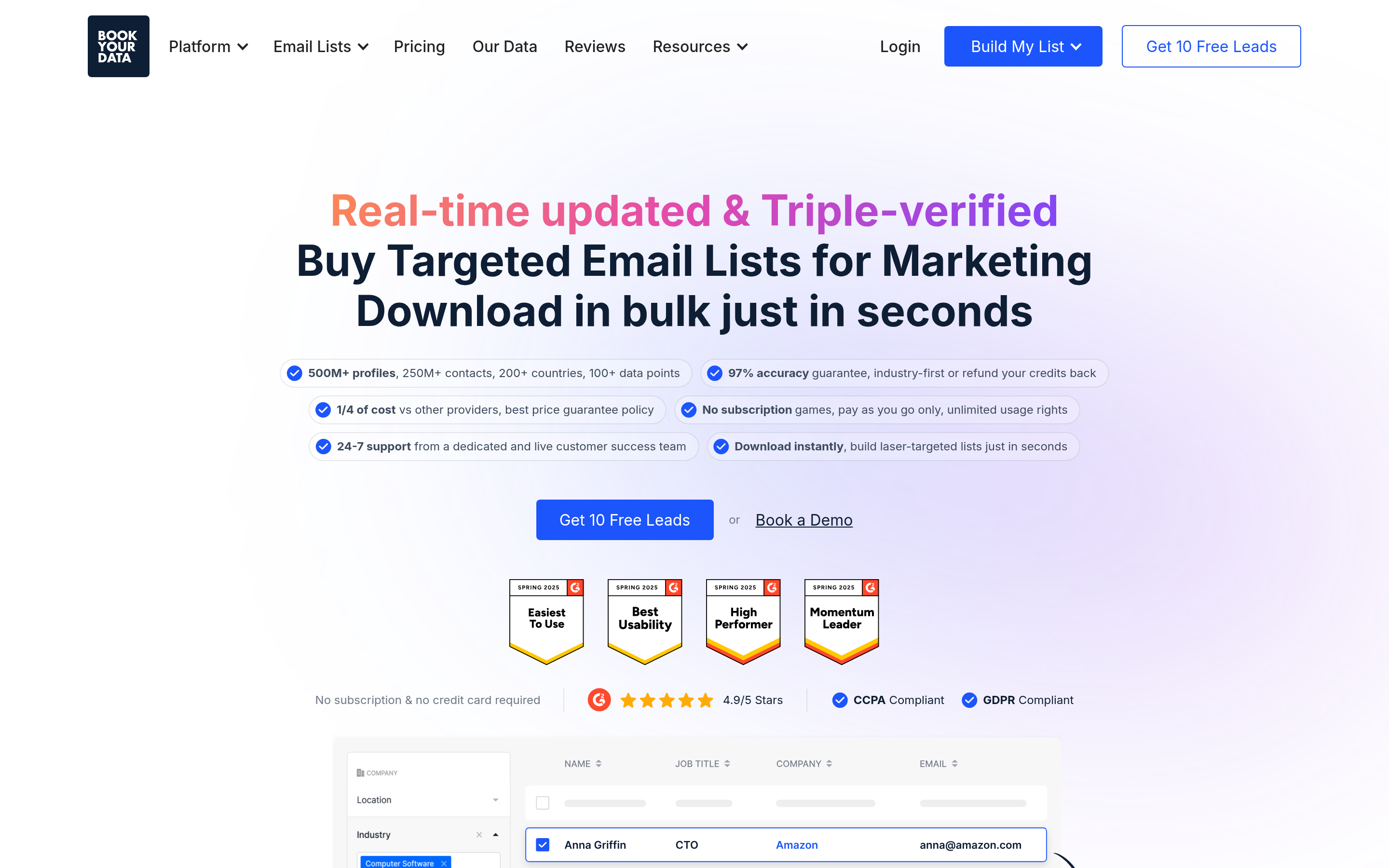
BookYourData takes a different and genuinely useful position: you buy contacts outright, credits don't expire, and there's a published accuracy guarantee with credit-back on bounces. For teams that run outbound in bursts — a quarterly campaign, a conference push, a new-market test — that model beats paying twelve monthly invoices for four months of use.
It's a well-regarded peer in this space, and honestly, for one-off list acquisition it's often the cleaner answer than any platform on this list. Where it fits less well is continuous, API-driven enrichment inside a product or CRM workflow, which is a different job.
Cognism — best for EMEA and phone-verified mobiles#
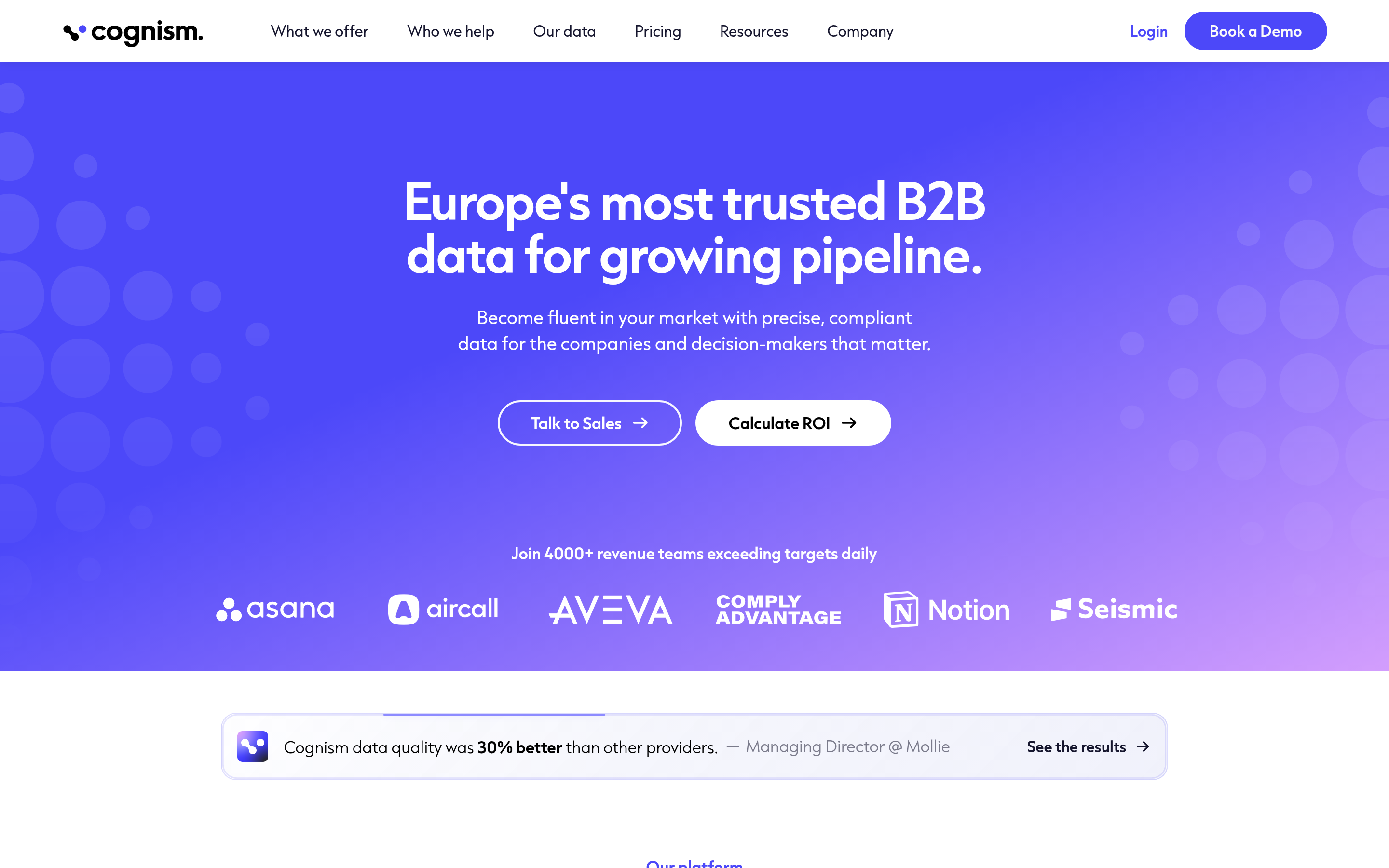
If your gap with Dealjourney is European coverage or dialable mobile numbers, Cognism is the serious answer. Phone-verified mobile data and a documented GDPR/notification posture are the reason enterprises pay quote-only annual pricing. Small teams generally can't clear the floor.
Clay — best for RevOps who want to build, not buy#
Clay isn't a data vendor; it's an orchestration layer that queries dozens of providers in sequence until one returns a hit. Powerful, and a real answer to "no single vendor covers my ICP." It also demands an owner who enjoys building waterfalls — treat it as a tool that consumes RevOps time, not one that saves it.
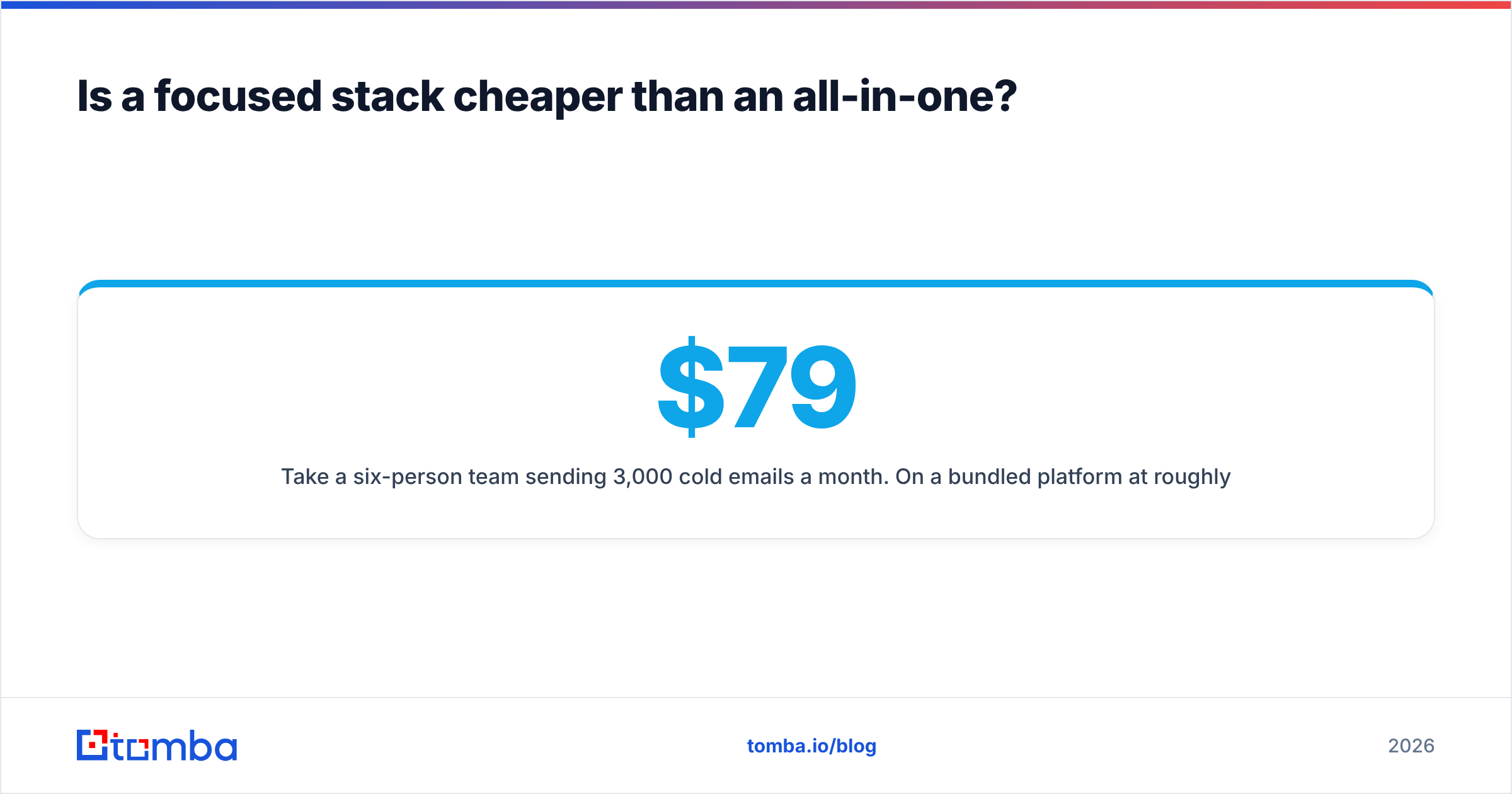
Is a focused stack cheaper than an all-in-one?#
Usually yes, and the math is straightforward. Run it for your own team before you decide.
Take a six-person team sending 3,000 cold emails a month. On a bundled platform at roughly $79/user/mo, that's about $474/mo whether you send 300 or 3,000. On a focused stack, you'd pay for a finder and verifier on credits — Tomba Growth at $99/mo covers a mid-volume workload — plus a dedicated sending tool at $37–$97/mo. Call it $136–$196/mo, with better deliverability because verification is a first-class step rather than a checkbox.
The all-in-one wins in the opposite scenario: two power users who live in the intent feed, need the sequencer, and would otherwise pay four vendors' minimums. Below roughly four seats with heavy module usage, bundles genuinely are cheaper. Above six seats with light module usage, they're rarely close.
One more variable: bulk enrichment and API access. If you plan to enrich inbound signups automatically, an API-first tool with per-call pricing is cheaper by an order of magnitude than buying platform seats for a machine.
How should you run the evaluation?#
Do not evaluate on demo data. Build a 100-row test file from your real pipeline — accounts you already know, ideally with a few contacts whose emails you can confirm independently — and run it through every finalist during trial.
Score four things: hit rate (rows returned), accuracy (rows that are actually right, checked against known-good records), bounce rate (send a small warm-up batch, measure hard bounces), and cost per usable contact (total spend divided by rows that survived all three). That last number is the only one that matters, and it almost never matches the vendor's headline pricing.
Cross-check what you find against real user reviews on G2 rather than curated case studies, and filter by company size so you're reading feedback from teams shaped like yours.
Budget two weeks. Trials are short; run them concurrently, not sequentially, so the same list hits every tool in the same week — data freshness varies enough month to month to distort a staggered test.
What's the right pick for your situation?#
- Small team, high volume, email-only: a credit-based finder plus verifier. Lowest cost per usable contact, no seat tax.
- Burst campaigns, no ongoing need: pay-as-you-go list purchase (BookYourData fits this cleanly).
- EMEA focus or phone-heavy motion: Cognism, and accept the annual commitment.
- You actually use intent + sequencing daily: stay bundled — Apollo or your incumbent.
- Engineering-led enrichment inside your product: an API-first provider, evaluated on latency and rate limits as much as accuracy.
The honest summary: most teams shopping for Dealjourney alternatives are not looking for a better platform. They're looking to stop paying platform prices for a lookup tool. Naming that out loud shortens the evaluation considerably.
Ready to test the data layer on your own list?#
Start with the piece that everything else depends on. Run 25 of your real target contacts through the Tomba Email Finder on the free tier, check the results against what you already know, and see what your actual hit rate looks like before you commit a dollar. If the numbers hold on your ICP, Starter at $49/mo scales with volume instead of headcount — and you can move up or down without renegotiating a contract.
Related guides#
Ready to find emails that actually work?
Join 150,000+ professionals who stopped guessing and started sending. Free credits on signup — no credit card required.
Get the Tomba newsletter
Practical outbound tactics and product updates — once every two weeks.
About the author