Dealroom vs Apollo.io: Which B2B Data Platform Wins in 2026?
Dealroom maps markets and funding. Apollo.io fills your sequences with contacts. They get confused constantly — here's the honest breakdown of coverage, pricing and export limits before you sign anything.
Dealroom vs Apollo.io is an odd match-up. One tool maps markets. The other fills your sequences. This guide covers what each one does, what it costs, and when you need neither.
TL;DR
- Dealroom vs Apollo.io is not a fair fight. The two tools do different jobs.
- Dealroom is a private-market database. It tracks companies, funding rounds, investors and ecosystems.
- Apollo.io is a contact database with a sales engine bolted on.
Here is the short version of how to pick:
- Pick Dealroom to answer "which companies exist in this market, who funded them, and how fast are they growing?"
- Pick Apollo.io to get 400 verified emails into a sequence by Thursday.
- Dealroom hides its pricing and sells annual contracts, priced per seat and per module. Apollo lists self-serve tiers from about $49/user/mo, plus a free plan you can actually use.
- Both datasets go stale. People change jobs. Verify every address before you send, whatever the source.
- Most teams weighing Dealroom vs Apollo.io need a third thing: a cheap email finder and verifier on top of the data they already trust.
Dealroom vs Apollo.io: what is each tool?#
Start here. Half the searches for "Dealroom vs Apollo.io" come from people who inherited a stack and don't know what either tool does.
Dealroom.co is an Amsterdam-based private-market intelligence platform. It tracks startups, scaleups, funding rounds, investors, acquisitions and whole ecosystems. Its buyers are venture funds, corporate development teams, economic development agencies and strategy consultancies. When a government publishes a "state of our tech ecosystem" report with a map of 4,000 companies, Dealroom is often underneath it. The unit of analysis is the company and the round, not the person.
One quick note. There is also a separate product called DealRoom for M&A deal management. Several CRMs ship a "deal room" feature too. This post is about Dealroom.co, the market-intelligence platform. That is the one people compare to Apollo.
Apollo.io is a go-to-market platform built on a large B2B contact database. It advertises hundreds of millions of contact records and tens of millions of company records. On top of that sit filters, an email sequencer, a dialer, a LinkedIn extension, CRM sync and AI writing tools. The unit of analysis is the person and the send.
So the honest framing is simple. Dealroom answers who should we target. Apollo answers how do we reach them at volume. If you are weighing the two against each other, one of your use cases is being served badly.

Dealroom vs Apollo.io: the head-to-head table#
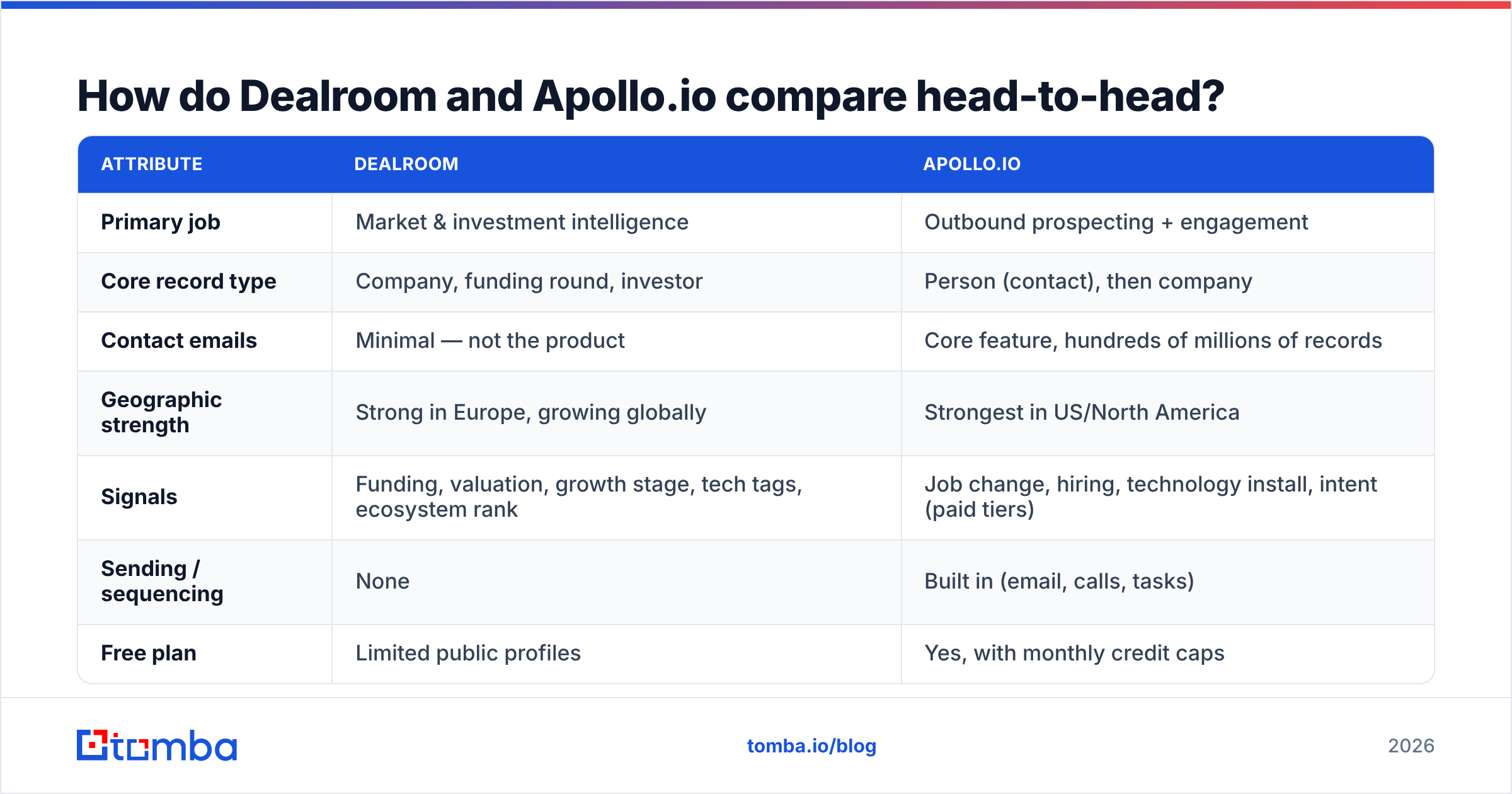
| Attribute | Dealroom | Apollo.io |
|---|---|---|
| Primary job | Market & investment intelligence | Outbound prospecting + engagement |
| Core record type | Company, funding round, investor | Person (contact), then company |
| Contact emails | Minimal — not the product | Core feature, hundreds of millions of records |
| Geographic strength | Strong in Europe, growing globally | Strongest in US/North America |
| Signals | Funding, valuation, growth stage, tech tags, ecosystem rank | Job change, hiring, technology install, intent (paid tiers) |
| Sending / sequencing | None | Built in (email, calls, tasks) |
| Free plan | Limited public profiles | Yes, with monthly credit caps |
| Pricing model | Custom annual contract, quote-only | Published per-user tiers, self-serve |
| Typical buyer | VC, corp dev, strategy, policy | SDR team, founder-led sales, agency |
| API | Yes, enterprise tier | Yes, higher tiers + credit costs |
Four rows in, the pattern is clear. These tools overlap on one word: "database."
What data does each platform give you?#
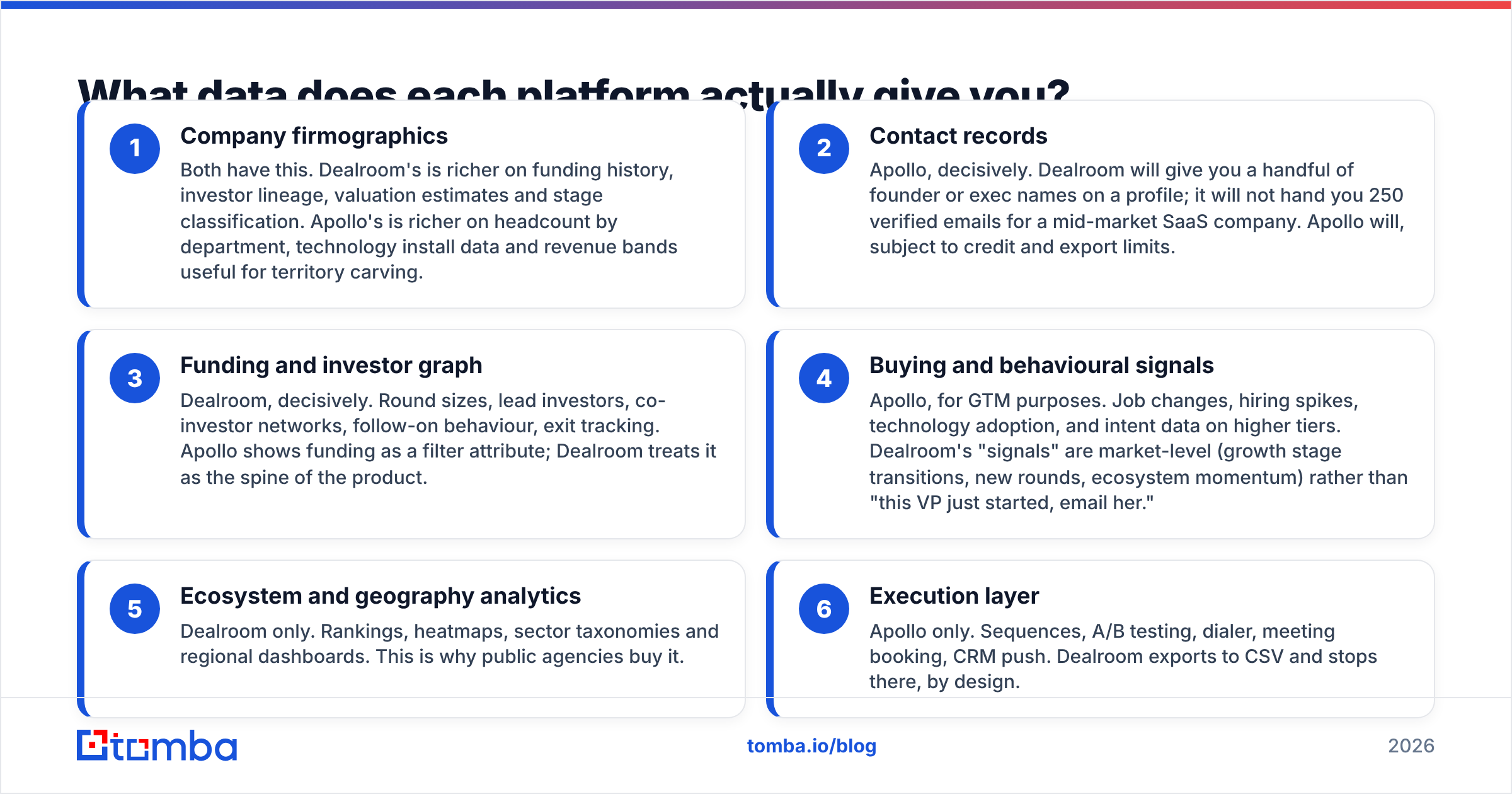
The Dealroom vs Apollo.io split shows up clearest in the data itself. Here is what you pay for, broken out by class.
Company firmographics. Both have this. Dealroom is richer on funding history, investor lineage, valuation estimates and stage. Apollo is richer on headcount by department, tech install data and revenue bands for territory carving.
Contact records. Apollo, by a mile. Dealroom lists a few founder or exec names on a profile. It will not hand you 250 verified emails for a mid-market SaaS company. Apollo will, within your credit and export limits.
Funding and investor graph. Dealroom, by a mile. Round sizes, lead investors, co-investor networks, follow-on behaviour, exits. Apollo treats funding as a filter attribute. Dealroom treats it as the spine of the product.
Buying signals. Apollo, for GTM work. Job changes, hiring spikes, tech adoption, and intent data on higher tiers. Dealroom's signals are market-level: new rounds, stage transitions, ecosystem momentum.
Ecosystem and geography analytics. Dealroom only. Rankings, heatmaps, sector taxonomies and regional dashboards. This is why public agencies buy it.
Execution layer. Apollo only. Sequences, A/B tests, dialer, meeting booking, CRM push. Dealroom exports to CSV and stops there, by design.
If your criteria don't map onto one of those six rows, stop. Write down the two that matter most to your team, then re-run the comparison. Most stalled evaluations stall because nobody did that.
Dealroom vs Apollo.io pricing in 2026#
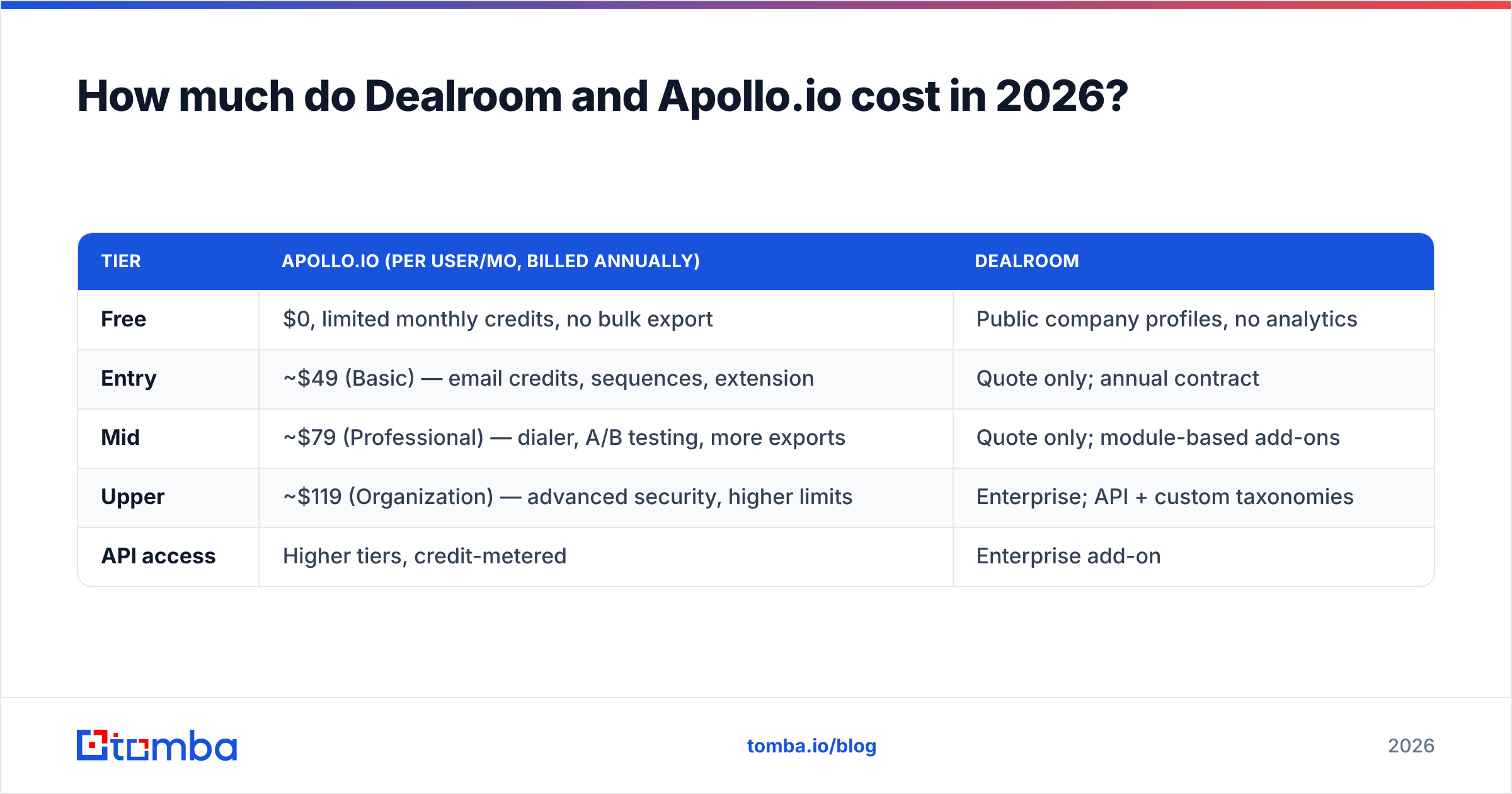
Apollo publishes its tiers. Dealroom does not. That gap tells you who each company sells to.
| Tier | Apollo.io (per user/mo, billed annually) | Dealroom |
|---|---|---|
| Free | $0, limited monthly credits, no bulk export | Public company profiles, no analytics |
| Entry | ~$49 (Basic) — email credits, sequences, extension | Quote only; annual contract |
| Mid | ~$79 (Professional) — dialer, A/B testing, more exports | Quote only; module-based add-ons |
| Upper | ~$119 (Organization) — advanced security, higher limits | Enterprise; API + custom taxonomies |
| API access | Higher tiers, credit-metered | Enterprise add-on |
Treat Apollo's numbers as directional. Check the current Apollo pricing page before you budget. Tier names, credit allowances and export caps have all moved more than once. The complaints on G2 are rarely about the sticker price. They are about the ceilings: monthly export limits, credits that reset in odd ways, and seat costs that stack up fast across an SDR pod.
Dealroom's price is negotiated. Buyers report a four- to five-figure annual commitment. The number moves with modules, seats, geography scope and API access. That is normal for market-intelligence tooling. It is priced like Pitchbook or Crunchbase Enterprise, not like a sales tool.
Here is the budgeting rule. Apollo's cost scales with headcount. Dealroom's scales with scope. Five more SDRs on Apollo means five more seats. Five more analysts on Dealroom may cost less per head, but a new region or dataset costs a lot.
Which platform is better for outbound prospecting?#
For outbound, the Dealroom vs Apollo.io answer is Apollo, and it isn't close. Two caveats matter more than the headline.
Caveat one: coverage is regional. Apollo's contact depth is best in North America. It thins out in parts of Europe, LATAM and APAC. Prospecting German Mittelstand or French scaleups? Run a sample test on 100 target accounts first. Pull the list, check the fill rate, then check whether those emails are deliverable.
Caveat two: fill rate is not accuracy. A database may return an email for 90% of your list. That means nothing if a third of them bounce. Run any list through an email verifier before it touches your sending domain. That goes for Apollo's data, Dealroom's, or a scraped file. Bounce rates above roughly 3% start dragging down inbox placement, and rebuilding sender reputation takes weeks you don't have.
Dealroom helps outbound upstream. Use it to build the account list. "Series A-B fintechs in the Nordics that raised in the last 9 months" is a query Dealroom answers well and Apollo answers roughly. Then find the humans separately.

Which platform is better for market research?#
For research, Dealroom vs Apollo.io is not a contest. Dealroom wins outright.
Say you are sizing a market, mapping a competitive set, tracking who funded whom, or writing a report for an investment committee. Apollo's data model won't get you there. Apollo knows a company has 340 employees and runs Snowflake. Dealroom knows it raised a €22M Series B, led by a named fund, at a stage graded against 4,000 peers. It also knows how that compares to the regional median.
Corporate development, VC sourcing, policy work, ecosystem benchmarking, competitive intelligence: all Dealroom territory. The taxonomy work alone is the hard part, and free alternatives get it wrong.
The failure mode is buying Dealroom and asking it to feed an SDR team. It won't. You will export company lists to CSV and hunt contacts by hand. That wastes analyst time, and it is why data enrichment exists as a category.
Where do both platforms fall short?#
Both sides of the Dealroom vs Apollo.io match-up share three weaknesses. Each also has one of its own.
Shared: contact data decays. A fifth to a quarter of B2B contact records go stale each year through job changes alone. No vendor is immune. Treat an export as durable truth and your bounce rate will creep up quietly.
Shared: catch-all domains. Many enterprise domains accept all mail at the SMTP layer. Naive checks then return "valid" for addresses that don't exist. If your list skews enterprise, use catch-all verification instead of a syntax check.
Shared: export ceilings. Apollo caps exports by tier. Dealroom caps them by contract. Both will frustrate you the first time you pull a 50,000-row list.
Apollo only: the all-in-one bundle. You pay for the sequencer whether you use it or not. Teams already on Instantly, Smartlead or Outreach pay twice. That is the main reason people look for an Apollo alternative. The data isn't bad; the bundle just doesn't fit.
Dealroom only: no execution layer, and quote-only pricing. You go through sales before you learn whether coverage in your niche is any good.
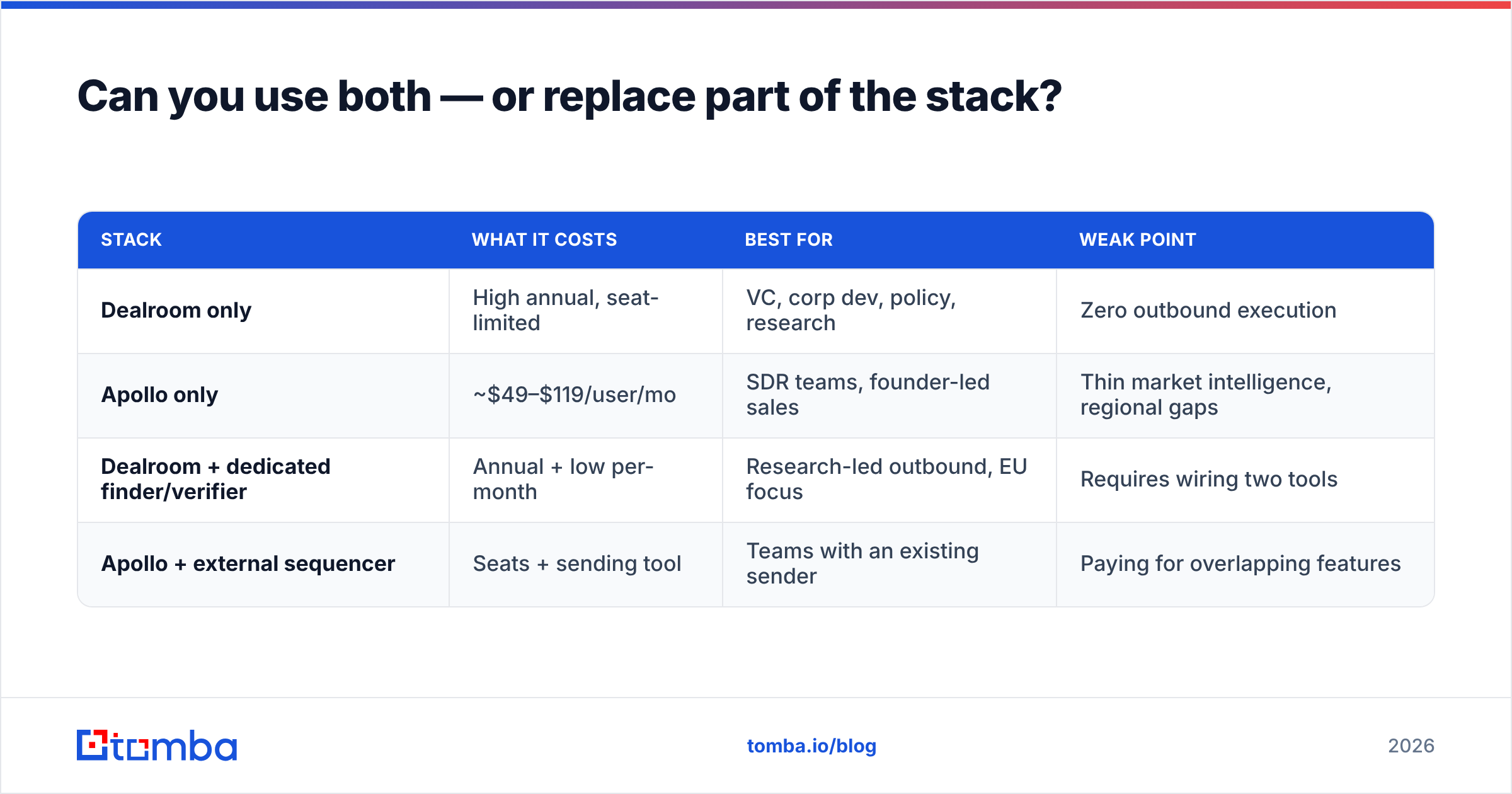
Can you use both — or replace part of the stack?#
The Dealroom vs Apollo.io debate usually ends here. These are the common stack shapes.
| Stack | What it costs | Best for | Weak point |
|---|---|---|---|
| Dealroom only | High annual, seat-limited | VC, corp dev, policy, research | Zero outbound execution |
| Apollo only | ~$49–$119/user/mo | SDR teams, founder-led sales | Thin market intelligence, regional gaps |
| Dealroom + dedicated finder/verifier | Annual + low per-month | Research-led outbound, EU focus | Requires wiring two tools |
| Apollo + external sequencer | Seats + sending tool | Teams with an existing sender | Paying for overlapping features |
Most teams overlook the third row. If Dealroom already gives you an account list you trust, you don't need Apollo's database. You need a way to turn 800 company domains into verified contacts. That is a domain search job, and it costs a fraction of a seat-based platform.
In practice: export the company list from Dealroom. Run domain search to pull email patterns and named contacts per domain. Verify them. Push them into the sending tool you already own. Two API calls, no second platform contract. The Tomba API handles that workflow, and pricing is credit-based rather than per seat. Adding three analysts doesn't triple your bill.
For a flat comparison: Tomba starts free at 25 searches a month, then Starter at $49/mo, Growth at $99/mo and Pro at $249/mo. See Tomba pricing for current limits. That is account-level pricing, not per user. Past two people, the difference is real.
Dealroom vs Apollo.io: which should you choose?#
Match the tool to the question you are being asked.
- "Which companies are worth targeting, and what's happening in this market?" → Dealroom. Budget for an annual contract. Confirm coverage in your geography and sector during the trial.
- "How do we get 500 qualified contacts into sequences this quarter?" → Apollo, on Basic or Professional. Sample-test the fill rate in your region first.
- "We have the account list. We just need reliable contact data." → Neither, on its own. A dedicated finder plus verifier is cheaper and more accurate than buying a platform for one feature.
- "We need both, on a startup budget." → Dealroom's free public profiles plus a credit-based finder gets you far before you sign anything.
Avoid one mistake: buying an all-in-one because the demo ticked every box. Apollo's contact data is good and its sequencer is fine. Neither is best in class, and you pay per seat for both. Dealroom's intelligence is excellent, and its execution layer does not exist. Buy the strength. Source the gap separately.
Ready to fill the gap between your list and your inbox?#
Maybe you have already picked your source of account intelligence — Dealroom, Apollo, Crunchbase, or a spreadsheet a founder keeps. The rest of the problem is turning those companies into contacts that don't bounce. That is the job of the Tomba Email Finder. Search by domain, name or company. Get the address with a confidence score and source attribution. Verify it in the same call. Start free at 25 searches a month, then move to $49/mo once the workflow proves itself. No per-seat math, and no annual contract just to find out whether the coverage works for your market.
Related guides#
Ready to find emails that actually work?
Join 150,000+ professionals who stopped guessing and started sending. Free credits on signup — no credit card required.
Get the Tomba newsletter
Practical outbound tactics and product updates — once every two weeks.
About the author