Dealroom vs DiscoverOrg: Which B2B Data Platform Wins in 2026?
One tracks startup funding rounds across Europe. The other became ZoomInfo and sells contact data on annual seat contracts. Here's what each actually gives you in 2026 — and where a cheaper third option beats both.
Compare dealroom vs discoverorg and one thing shows up fast. These two tools do different jobs. One tracks funding. The other tracks people. This guide shows which one fits your team in 2026.
TL;DR
- They are not rivals. Dealroom tracks companies and funding rounds. DiscoverOrg was a contact database. It merged with ZoomInfo in 2019, and the name was retired.
- Pick Dealroom for market maps, investor research, or fresh funding news. It will not hand you a verified work email.
- Pick ZoomInfo (ex-DiscoverOrg) for org charts, direct dials, and intent data. You need a five-figure budget and seat minimums.
- Neither fits if you just want one person's email at one company. That job costs $49/mo, not $15,000/yr.
- The 2026 stack most teams need: a signal source plus a pay-as-you-go finder and verifier.
Dealroom vs DiscoverOrg: what are they, actually?#
Start with the fact that changes the whole dealroom vs discoverorg debate: DiscoverOrg is not a live brand in 2026.
DiscoverOrg was a B2B contact database based in Vancouver, Washington. It was known for human-checked org charts and direct dial numbers, mostly in IT and marketing. In February 2019 it bought ZoomInfo. By 2020 the merged company had rebranded as ZoomInfo. So if you are looking at DiscoverOrg today, you are looking at ZoomInfo. Reps who still say DiscoverOrg usually mean the research-grade contact data from the old product.
Dealroom.co is a different animal. It started in Amsterdam in 2013. It tracks startups, scaleups, funding rounds, investors, and whole market ecosystems. European coverage is its strong suit. Governments, VCs, and corp dev teams use it to answer questions like this one: how many seed-stage climate tech startups launched in the Nordics last year? It is a company tool with light contact data on top. It is not a contact database.
So the honest way to frame dealroom vs discoverorg is not "which is better." It is "which problem are you solving?"
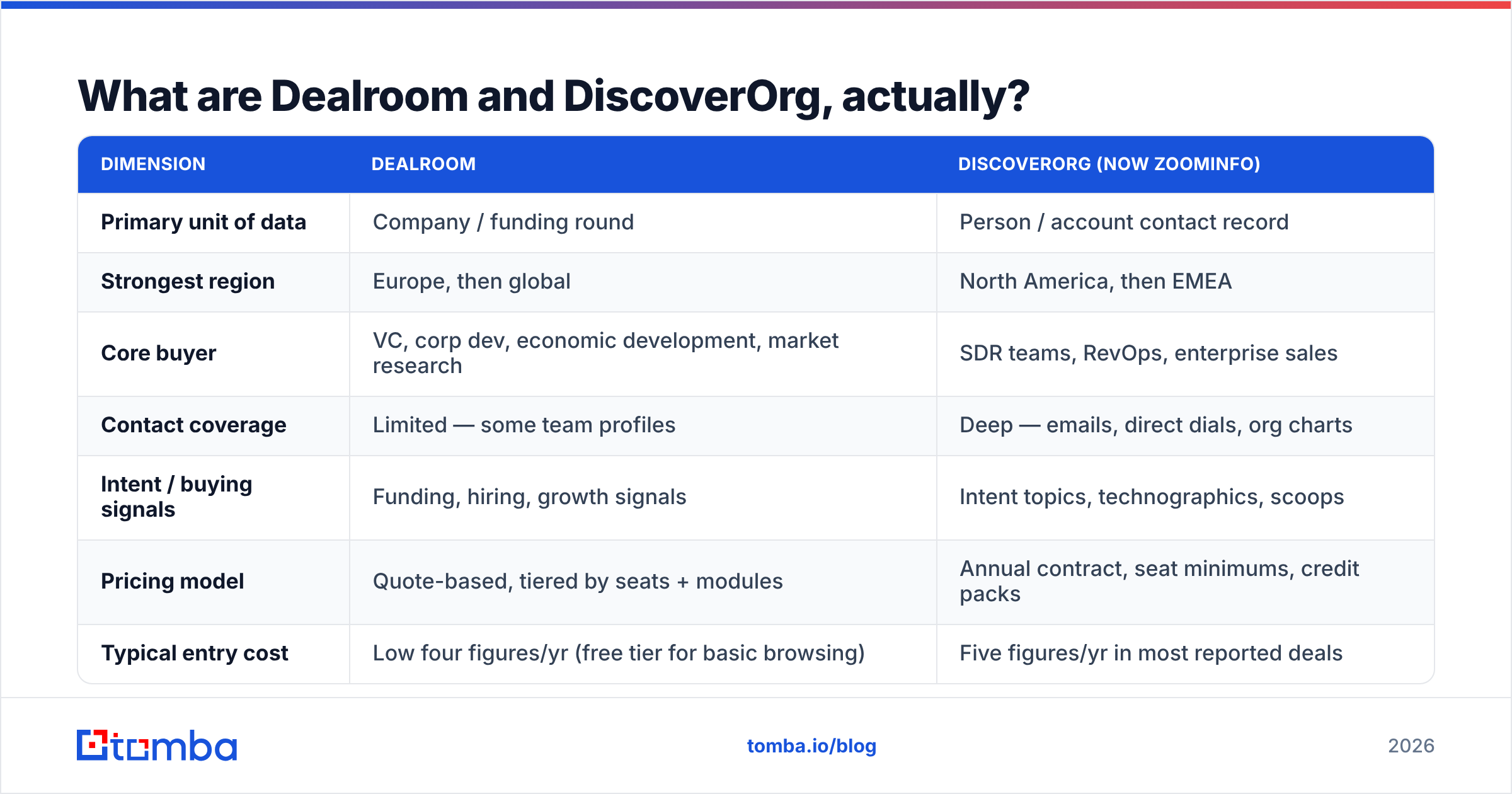
| Dimension | Dealroom | DiscoverOrg (now ZoomInfo) |
|---|---|---|
| Primary unit of data | Company / funding round | Person / account contact record |
| Strongest region | Europe, then global | North America, then EMEA |
| Core buyer | VC, corp dev, economic development, market research | SDR teams, RevOps, enterprise sales |
| Contact coverage | Limited — some team profiles | Deep — emails, direct dials, org charts |
| Intent / buying signals | Funding, hiring, growth signals | Intent topics, technographics, scoops |
| Pricing model | Quote-based, tiered by seats + modules | Annual contract, seat minimums, credit packs |
| Typical entry cost | Low four figures/yr (free tier for basic browsing) | Five figures/yr in most reported deals |
| Self-serve signup | Partial (free explore tier) | No — sales-led only |
Dealroom vs DiscoverOrg: which one has better data coverage?#
Both are strong. They are strong on different things. Neither one is complete.
Dealroom is deep on private companies. It pulls from funding news, registries, VC portfolios, job posts, patents, and partner networks. Say a Berlin fintech raised a €4M seed last month. Dealroom will likely have the round, the lead investor, a valuation estimate, and the founder profiles. Its European coverage beats the US-centric databases outright.
The catch: many valuation and revenue figures are estimates. Dealroom says so openly. Treat those numbers as a guide for targeting. Do not quote them in a board deck without a check.
ZoomInfo is deep on people. The DiscoverOrg side brought human-checked org charts, phone numbers, and reporting lines. ZoomInfo then added a large collection engine and intent signals from its data co-op. For a 5,000-person US enterprise, it will often name the security budget owner, their boss, and the tools they run.
The catch: big databases decay. Contact data goes stale by roughly 25–30% a year as people change jobs. Reviews on G2 flag old records and bounced emails across the whole category. ZoomInfo included. A big database is not the same as an accurate one. Run every export through an email verifier before you send.

Is DiscoverOrg better than Dealroom for outbound sales?#
Yes — if you can pay for it, and if you sell in North America.
A classic SDR motion needs three things. A list of accounts. The right person inside each one. A way to reach them. Dealroom gives you the first and half of the second. ZoomInfo gives you all three in one place, with CRM sync, sequencing hooks, and intent scores.
But "if you can pay for it" does real work in that sentence. ZoomInfo sells through a sales team on annual contracts. You buy seats, plus credit packs that meter your exports. Reviews and procurement threads often put entry deals at $15,000–$25,000 a year for a small team. Add intent, Copilot, and workflow modules and it climbs past six figures. There is no monthly plan and no self-serve signup. You go through a demo cycle.
Dealroom is also quote-based. It sits an order of magnitude lower for basic access. A free tier lets you browse company profiles and run a few searches. It is priced like a research subscription, because that is what it is.
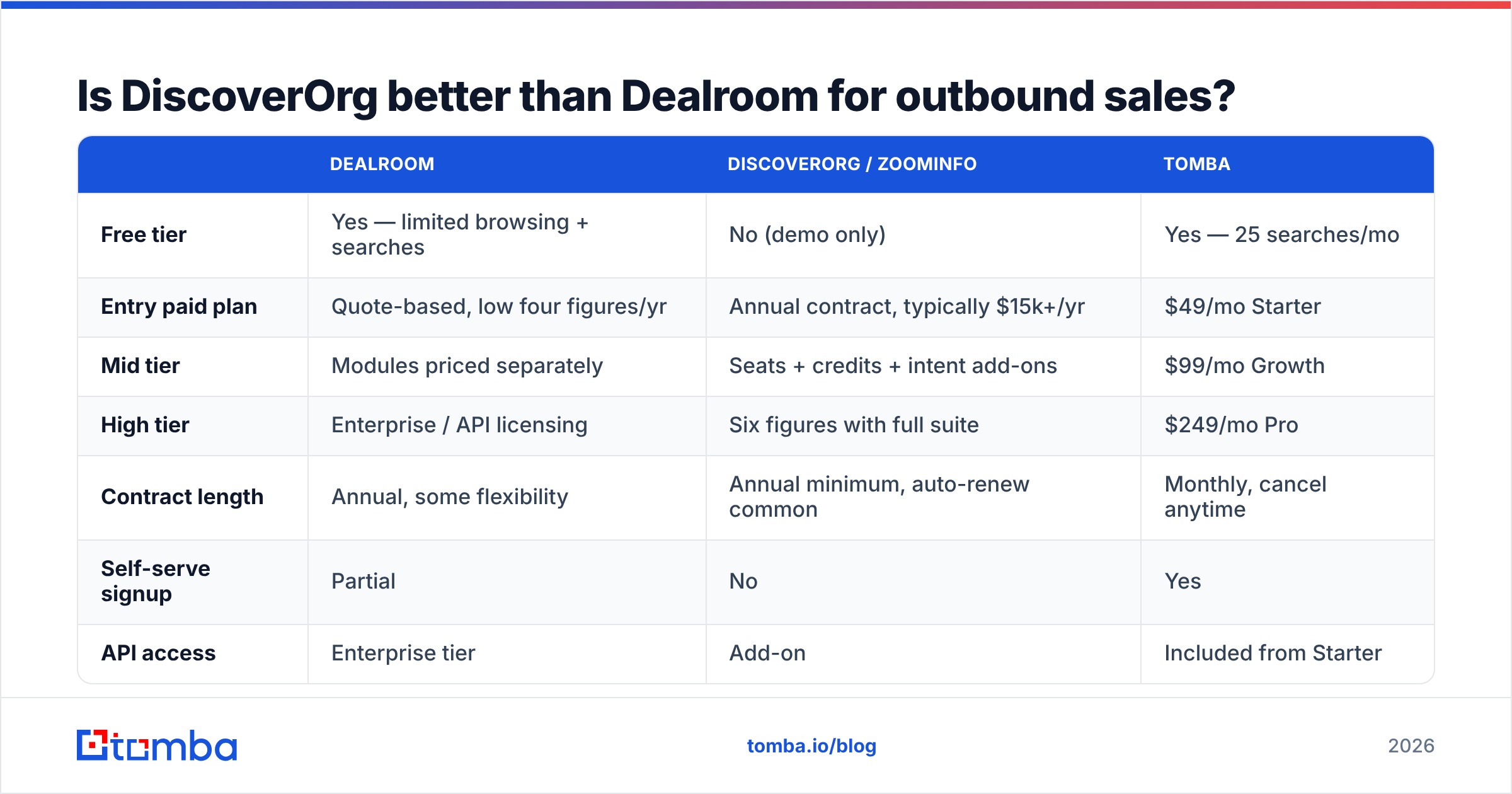
Here is the cost picture, with a pay-as-you-go finder shown for reference:
| Dealroom | DiscoverOrg / ZoomInfo | Tomba | |
|---|---|---|---|
| Free tier | Yes — limited browsing + searches | No (demo only) | Yes — 25 searches/mo |
| Entry paid plan | Quote-based, low four figures/yr | Annual contract, typically $15k+/yr | $49/mo Starter |
| Mid tier | Modules priced separately | Seats + credits + intent add-ons | $99/mo Growth |
| High tier | Enterprise / API licensing | Six figures with full suite | $249/mo Pro |
| Contract length | Annual, some flexibility | Annual minimum, auto-renew common | Monthly, cancel anytime |
| Self-serve signup | Partial | No | Yes |
| API access | Enterprise tier | Add-on | Included from Starter |
| Best at | Funding + market intelligence | Org charts + direct dials + intent | Verified work emails at volume |
Two things stand out. First, the price gap between "I need funding signals" and "I need enterprise contact data" is about 10x. Buy the wrong one and it hurts. Second, if the only gap in your stack is the email address, neither tool is the smart buy. That is a $49 problem, not a $15,000 one.
What does each platform cost you in workflow, not just dollars?#
Price is the visible cost. These hidden ones matter more over a year:
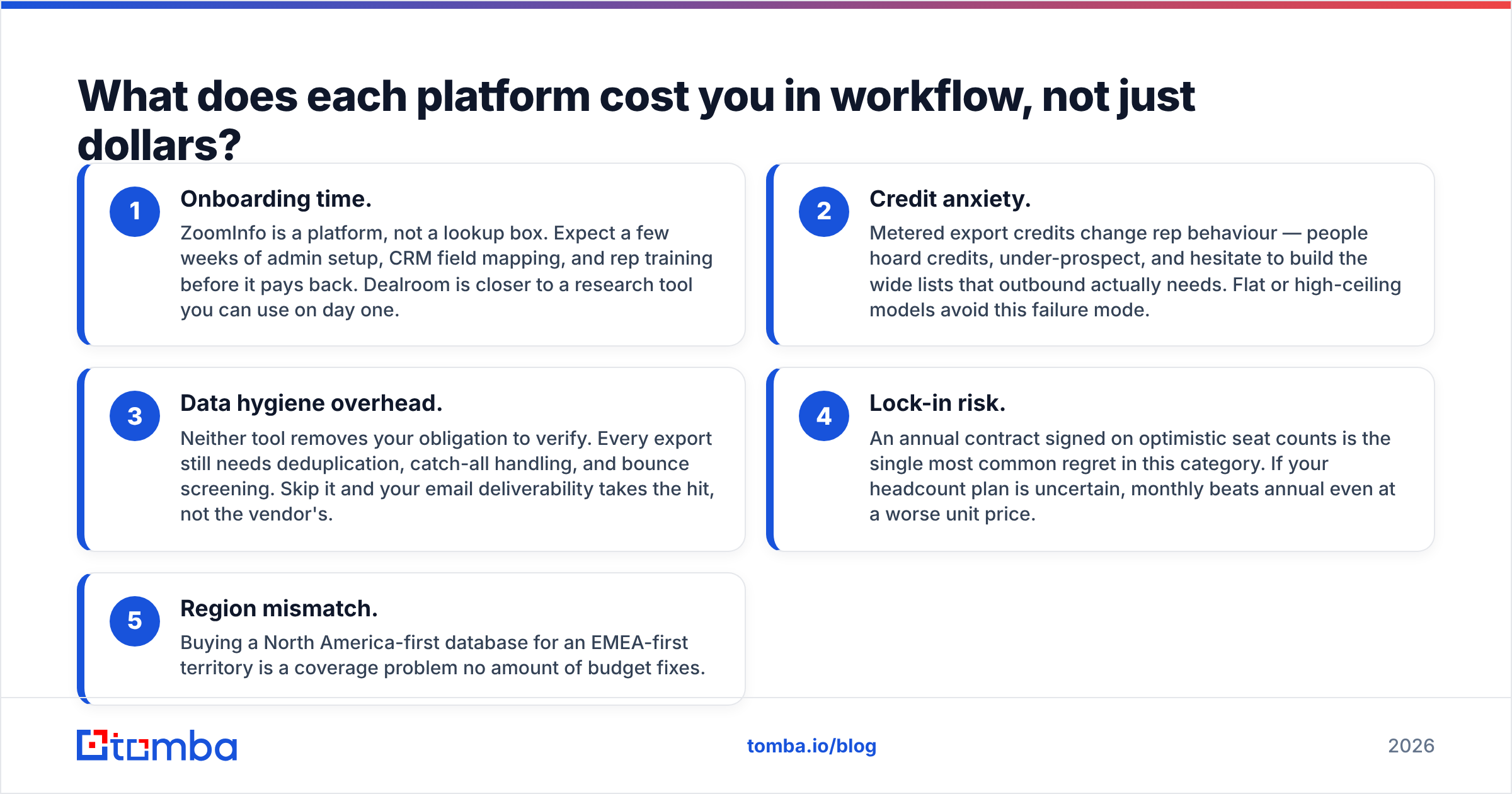
- Onboarding time. ZoomInfo is a platform, not a search box. Plan for a few weeks of setup, CRM field mapping, and rep training. Dealroom is closer to a research tool you can use on day one.
- Credit anxiety. Metered credits change how reps behave. People hoard credits and build smaller lists. Flat or high-ceiling plans avoid that trap.
- Data hygiene. Neither tool removes your duty to verify. Every export needs dedupe, catch-all handling, and bounce screening. Skip it and your email deliverability takes the hit, not the vendor's.
- Lock-in risk. Annual deals signed on hopeful seat counts are the top regret here. If your hiring plan is shaky, monthly beats annual.
- Region mismatch. A North America-first database will not fix EMEA coverage. No budget solves that.
Who should choose Dealroom in 2026?#
Choose Dealroom if one of these sounds like you:
- You are a VC or corp dev analyst. Deal sourcing, portfolio tracking, and landscape maps are the core use case.
- You sell to funded startups. A fresh Series A is a strong buying signal. Dealroom surfaces those rounds fast, above all in Europe.
- You need market-level data. Market sizing, regional startup counts, sector trends. Dealroom publishes all of it, and public-sector clients rely on it.
- Your ICP is private and European. This is where it beats the US incumbents outright.
Where it falls short: it will not give you the work email of a VP of Engineering at a 200-person firm. You get the company, sometimes the founders, rarely the buyer. That last mile needs an email finder or a domain search.
Who should choose DiscoverOrg / ZoomInfo?#
Choose ZoomInfo if:
- You run a large SDR team in North America. Org charts, direct dials, and intent in one UI is still the benchmark.
- Direct dials matter more than email. US phone coverage here is hard to match, thanks to the DiscoverOrg heritage.
- You need intent data. Knowing who is shopping this week pays off if you have reps to act on it.
- Procurement wants one vendor. One DPA, one security review, one renewal.
Skip it if you are a startup, a solo founder, an agency running lists for clients, or a team whose real gap is "4,000 target companies and no emails." The math does not work at that size. That is why focused options keep growing, including Apollo alternatives and per-lookup tools.
Is there a third option in the dealroom vs discoverorg gap?#
Usually yes. It is not one tool. It is a two-layer split.
Layer one: the signal. Something tells you which companies to chase. That could be Dealroom funding rounds, a job board scrape, technographics, or website visitors. Dealroom is genuinely great here if funding is your trigger.
Layer two: the contact. Something turns "Company X, role Y" into an email or a phone number. That is a commodity job. It should be priced per lookup, not per seat. Tomba does this. So does BookYourData, which sells verified B2B contacts pay-as-you-go. It suits people who prefer finished lists.
Splitting the layers has three clear wins over one big platform:
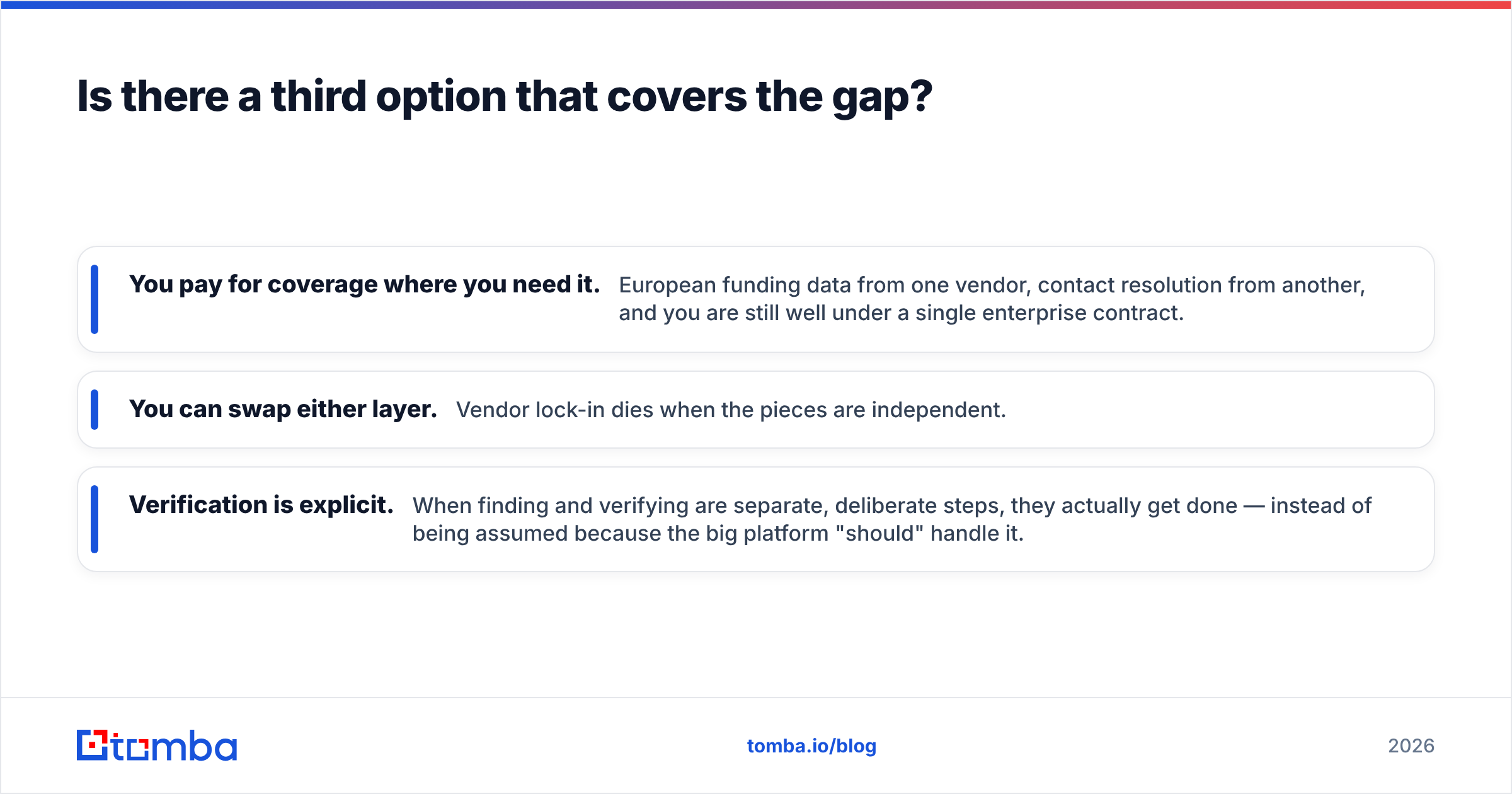
- You pay for coverage where you need it. European funding data from one vendor, contacts from another. Both still cost less than one enterprise deal.
- You can swap either layer. Lock-in dies when the parts are independent.
- Verification is explicit. When finding and verifying are separate steps, they actually get done.
A workable 2026 stack looks like this. Dealroom or a funding alert feed for triggers. A CSV or API handoff. A bulk email finder to resolve contacts. A verification pass. Then your sequencer. Total tooling cost for a small team is a few hundred a month, not tens of thousands a year. The Tomba API starts on the $49/mo Starter plan — see Tomba pricing for the full tiers.
What should you ask before you sign either contract?#
Get these answers in writing before the demo call ends:
- What is the coverage rate for my ICP? Ask them to run 100 accounts from your list, not their showcase list. A confident vendor will do it.
- What happens to unused credits at renewal? Rollover rules vary a lot and rarely appear on the pricing page.
- What is the accuracy rate, and how is it measured? "95% accurate" means nothing without a method and a bounce guarantee.
- Can I export, and what may I keep after cancelling? Some contracts limit what you retain.
- Can year one be quarterly instead of annual? Often yes, above all in Q4 when reps chase quota.
Dealroom vs DiscoverOrg: the verdict#
These two are not substitutes. Dealroom answers "which companies should I care about." It has the best private-company and funding coverage in Europe. DiscoverOrg, now ZoomInfo, answers "who works there and how do I reach them." It does that at enterprise scale and enterprise prices, with US strength.
If you need both jobs done and you are not an enterprise, buying either one in full is the wrong move. Take the signal layer that matches your trigger. Then add a light, verifiable contact layer under it.
That is the piece Tomba is built for. The Tomba Email Finder turns a name and a domain into a verified work email. You get a confidence score and the sources behind it. It starts free with 25 searches a month. Real volume costs $49/mo, with no annual contract to sign first. Run your next 50 target accounts through it. Compare the hit rate to the quote sitting in your inbox, and let the numbers decide.
Related guides#
Ready to find emails that actually work?
Join 150,000+ professionals who stopped guessing and started sending. Free credits on signup — no credit card required.
Get the Tomba newsletter
Practical outbound tactics and product updates — once every two weeks.
About the author