DealSignal vs Apollo.io: Which B2B Data Platform Wins?
DealSignal sells verified-on-demand data. Apollo sells a whole outbound stack. We break down accuracy, pricing, coverage, and workflow fit so you can pick the one your pipeline actually needs.
DealSignal vs Apollo.io comes down to one question: do you need better data, or a better workflow? DealSignal sells accuracy. Apollo sells the whole outbound stack. Here is how they differ, and when each one earns its price.
TL;DR
- DealSignal is a data vendor first. It sells on-demand verification, custom-built lists, and CRM enrichment. It fits RevOps and demand-gen teams that care more about record quality than tooling.
- Apollo.io is an all-in-one go-to-market platform. A large contact database sits next to sequences, a dialer, CRM sync, and AI writing. You pay per seat.
- Need clean records piped into HubSpot, Salesforce, or a marketing platform? DealSignal usually wins on data hygiene. Need one tool your SDRs live in all day? Apollo wins on breadth.
- Both get costly at scale, for opposite reasons. DealSignal charges per verified record. Apollo charges per seat, then caps your credits.
- A third pattern beats both for many teams. Keep a cheap, accurate email layer — like a dedicated email finder — and spend the savings on the sequencer you already like.
What are DealSignal and Apollo.io, actually?#
They get compared constantly, but they were built to solve different problems.
DealSignal is a B2B data platform. It verifies contact and account records at the moment you request them, instead of serving a row that was scraped eighteen months ago. The pitch is accuracy guarantees, custom data sourcing, and CRM enrichment. The typical buyer is a marketing ops or RevOps lead who is tired of 30% bounce rates on a bought list.
Apollo.io started as a contact database and grew into a full sales suite. You get search across a very large B2B contact graph. You also get sequences, a dialer, meeting scheduling, email tracking, AI-assisted copy, and a light CRM. The typical buyer is a sales leader who wants prospecting and outreach in one login and one invoice.
That difference explains almost every disagreement you'll read in reviews. DealSignal users complain about missing workflow features. Apollo users complain about data decay. Both complaints are true. Both follow from product strategy, not from bugs.
DealSignal vs Apollo.io: how do they compare head to head?#
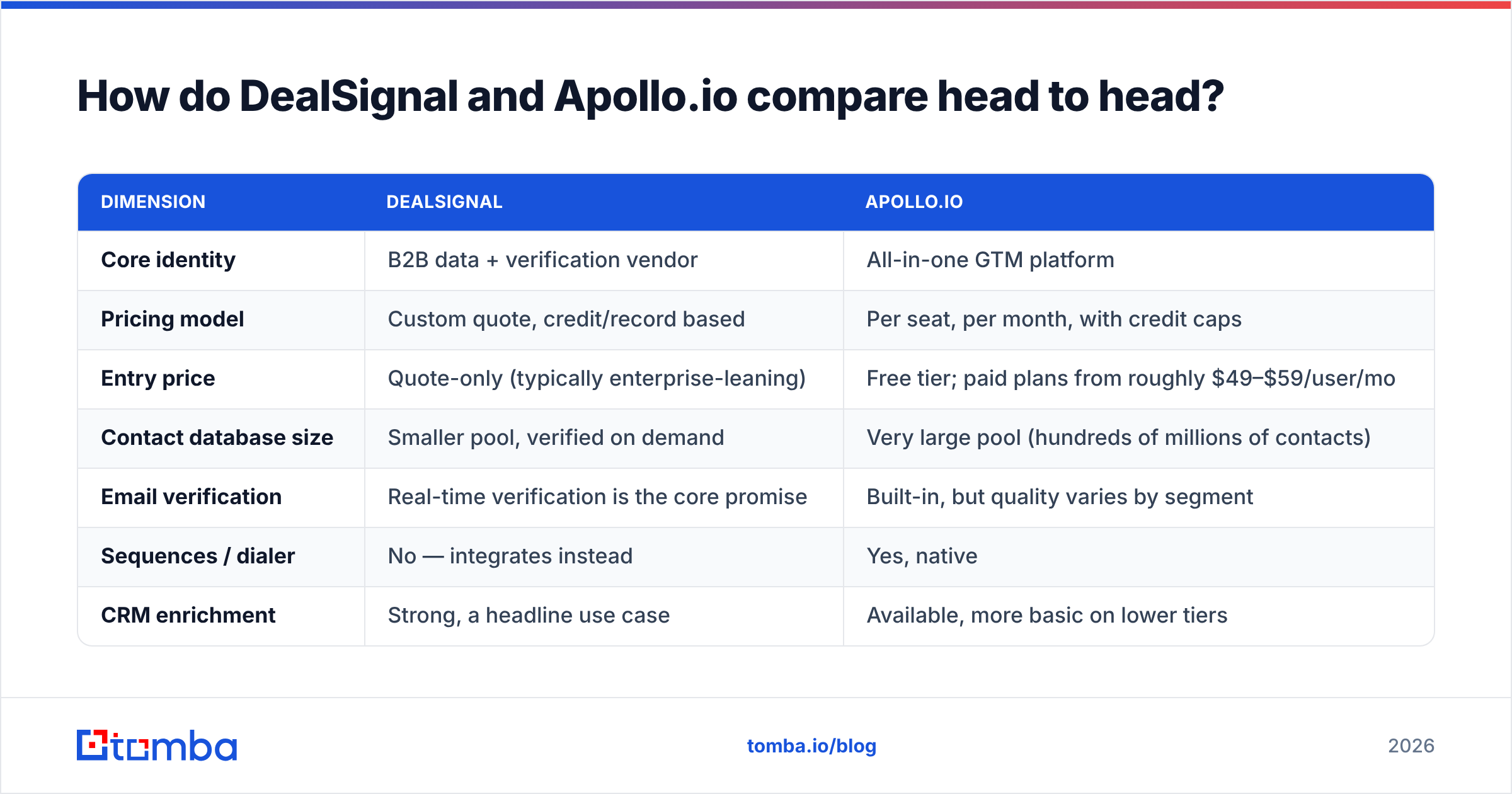
Here's the practical comparison. Pricing reflects publicly advertised tiers at the time of writing. DealSignal quotes are custom, and Apollo changes packaging often, so check the vendor pages before you sign anything.
| Dimension | DealSignal | Apollo.io |
|---|---|---|
| Core identity | B2B data + verification vendor | All-in-one GTM platform |
| Pricing model | Custom quote, credit/record based | Per seat, per month, with credit caps |
| Entry price | Quote-only (typically enterprise-leaning) | Free tier; paid plans from roughly $49–$59/user/mo |
| Contact database size | Smaller pool, verified on demand | Very large pool (hundreds of millions of contacts) |
| Email verification | Real-time verification is the core promise | Built-in, but quality varies by segment |
| Sequences / dialer | No — integrates instead | Yes, native |
| CRM enrichment | Strong, a headline use case | Available, more basic on lower tiers |
| Custom data fields | Yes — bespoke research on request | No, fixed schema |
| Best for | RevOps, demand gen, ABM list building | SDR teams, founder-led sales, SMB outbound |
| Weakest at | Day-to-day SDR workflow | Data freshness in narrow or non-US segments |
Read that table again with your own team in mind. Say nobody logs into a prospecting tool daily, because your motion is inbound-led or your campaigns run from a marketing platform. Then half of Apollo's value is dead weight, and you still pay for it seat by seat.
Which one has better data quality?#
The DealSignal vs Apollo.io data debate is really about two kinds of "better."
DealSignal's model favors precision. Records get verified when you pull them, and the company sells against a stated accuracy standard. In practice you see fewer bounces per thousand sends, better phone connect rates, and less SDR time lost on dead records. The tradeoff is speed. You can't click "export 50,000 contacts" and expect instant delivery on every niche segment. Custom sourcing takes time, and the pool is narrower than Apollo's.
Apollo's model favors recall. You will find someone at almost any company you search. That helps during territory planning, or when you build an account list from scratch. But crowd-sourced data ages, and it ages unevenly. US tech firms with busy LinkedIn profiles stay fresh. A 40-person manufacturer in Lyon does not. Check the Apollo reviews on G2 and you'll see the same split. Reviewers love the coverage. The recurring gripe is stale contacts and titles.
So here is the practical takeaway: your bounce rate is a function of segment, not brand. Whichever tool you pick, run exports through a dedicated email verifier before they hit your sending domain. That step costs a fraction of a cent per record. It also protects your domain reputation, which neither vendor will replace for you.
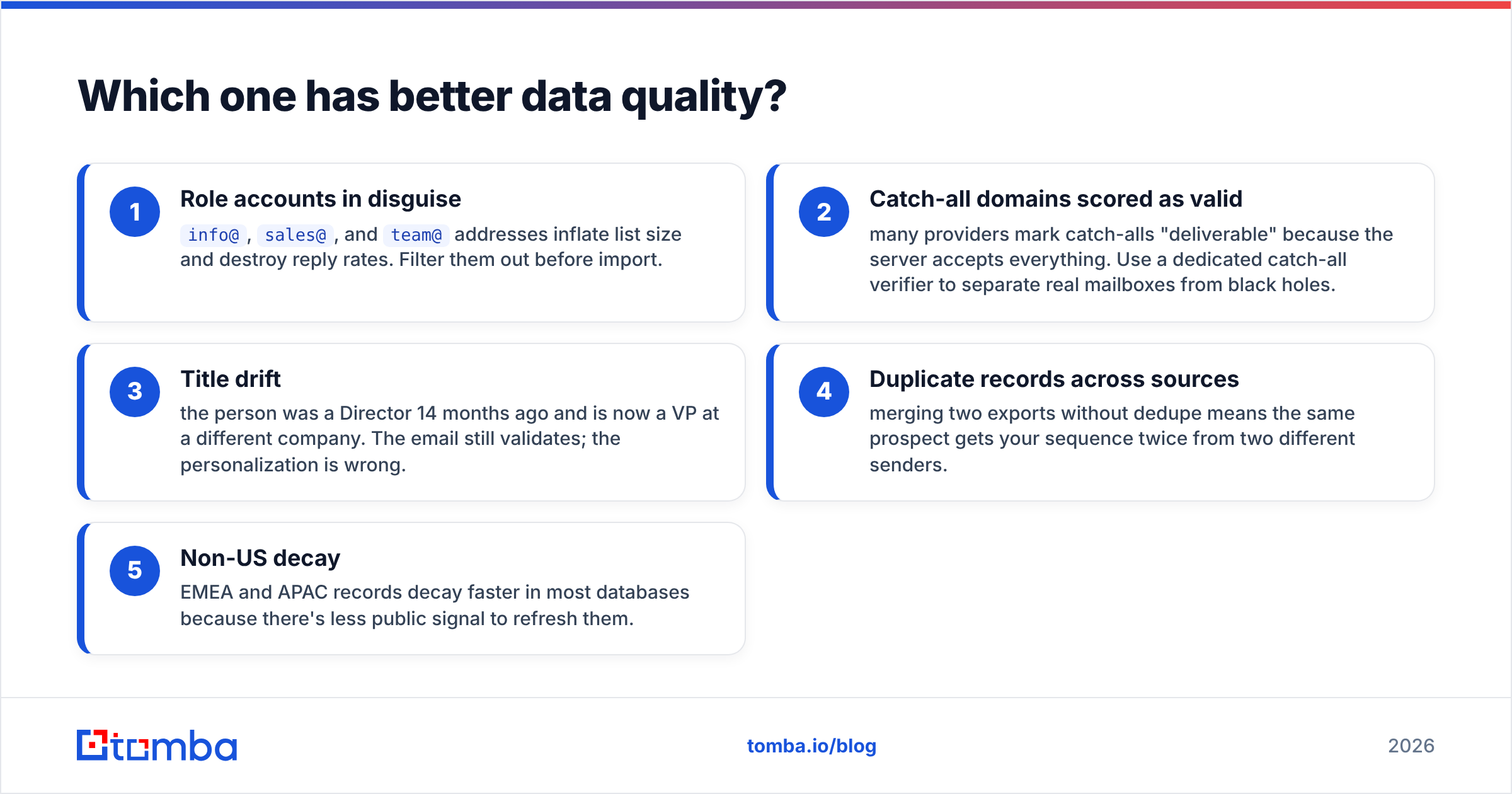
Five failure modes to watch for, whoever you buy from:
- Role accounts in disguise —
info@,sales@, andteam@addresses pad your list and kill reply rates. Filter them out before import. - Catch-all domains scored as valid — many providers mark catch-alls "deliverable" because the server accepts everything. Use a dedicated catch-all verifier to tell real mailboxes from black holes.
- Title drift — the person was a Director 14 months ago. Now they are a VP somewhere else. The email still validates, but the personalization is wrong.
- Duplicate records across sources — merge two exports without dedupe and the same prospect gets your sequence twice, from two senders.
- Non-US decay — EMEA and APAC records go stale faster, because there is less public signal to refresh them.
Is DealSignal or Apollo.io cheaper?#
Neither, consistently. They fail in opposite directions.
Apollo looks cheap at the top of the funnel. A free tier plus low per-seat pricing makes budget approval easy. The costs show up later: credit limits on exports, per-seat math as the team grows, and full seat price for people who only need the odd data pull. Ten SDRs on a mid-tier plan is a five-figure annual line item before anyone sends an email.
DealSignal looks expensive at the top and predictable after. Quote-based pricing tied to verified records means you pay for output, not headcount. Say your motion is "build 3,000 clean ABM contacts per quarter and push them to Marketo." That math often lands cheaper than seat licenses, and the records perform better.
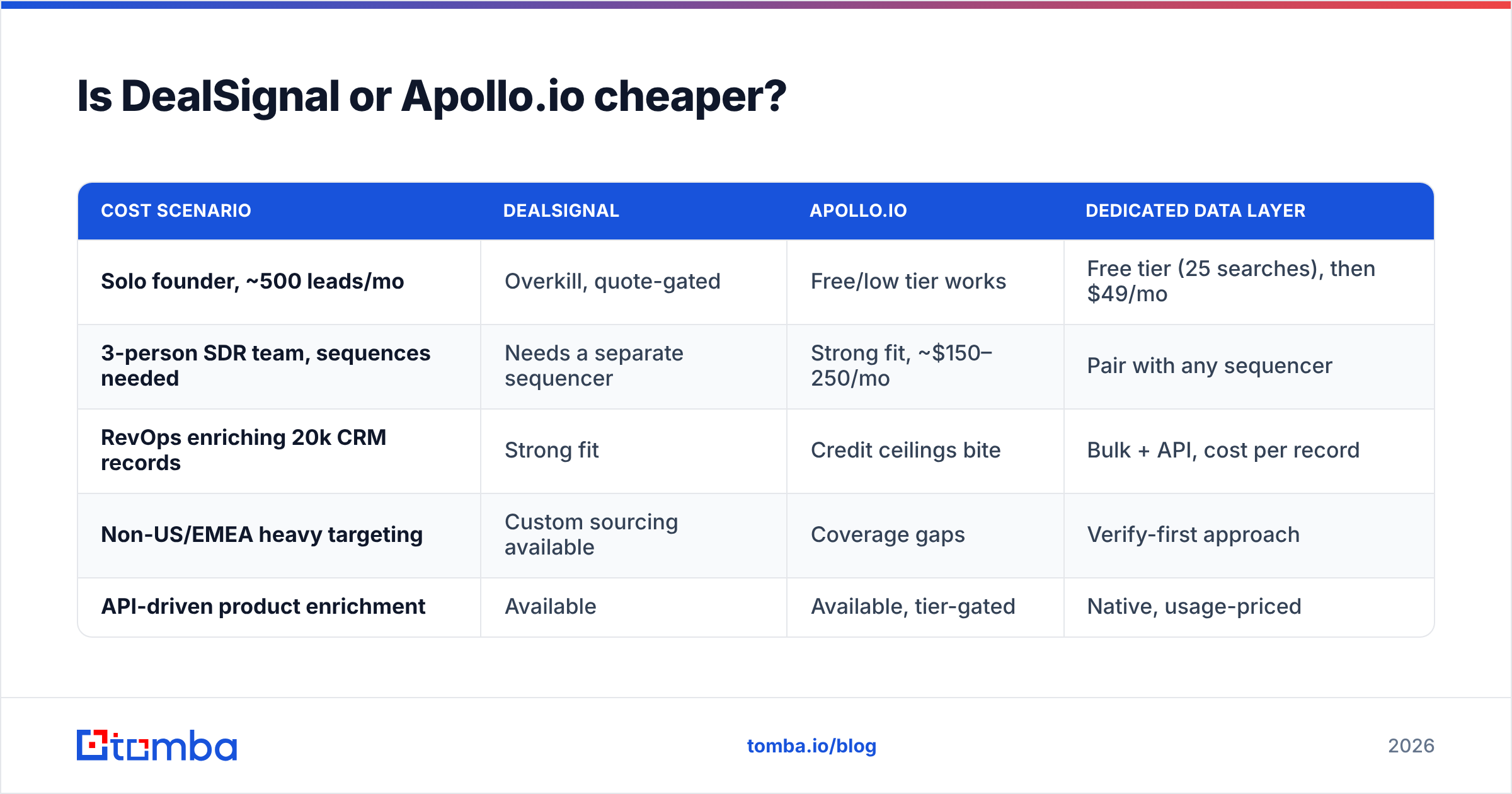
| Cost scenario | DealSignal | Apollo.io | Dedicated data layer |
|---|---|---|---|
| Solo founder, ~500 leads/mo | Overkill, quote-gated | Free/low tier works | Free tier (25 searches), then $49/mo |
| 3-person SDR team, sequences needed | Needs a separate sequencer | Strong fit, ~$150–250/mo | Pair with any sequencer |
| RevOps enriching 20k CRM records | Strong fit | Credit ceilings bite | Bulk + API, cost per record |
| Non-US/EMEA heavy targeting | Custom sourcing available | Coverage gaps | Verify-first approach |
| API-driven product enrichment | Available | Available, tier-gated | Native, usage-priced |
One note on that third column. Tomba pricing runs a free tier at 25 searches/month, Starter at $49/mo, Growth at $99/mo, and Pro at $249/mo, with Enterprise on request. It is not a sequencer and does not pretend to be. It is the data and verification layer under whatever sequencer you already like.
When should you pick DealSignal?#
Pick DealSignal when the bottleneck is record quality, not tooling.
Concretely, it is the better call if:
- You run ABM. Target account lists are small, high-value, and expensive to get wrong. Custom sourcing and verified titles matter more than a database of 250 million rows.
- Marketing owns the list. Contacts flow into Marketo, Pardot, or HubSpot rather than an SDR's daily queue. You want an enrichment vendor, not a sales cockpit.
- You need fields nobody else carries. DealSignal will research to spec: technographics, custom firmographics, specific org-chart links. Apollo's schema is fixed.
- Deliverability has already burned you. If a bad list once froze your domain, the verify-at-request model is worth the premium.
- You have compliance pressure. Questions about where data came from get easier to answer with a vendor whose whole pitch is sourcing and verification.
It is the wrong call if you are a two-person startup that needs to send 200 emails this week. The quote cycle alone will outlast your patience.
When should you pick Apollo.io?#
Pick Apollo when the bottleneck is workflow, not accuracy.
- You want one tool. Search, sequence, call, track, log to CRM. One login, one bill, one onboarding. For a small team, that consolidation is worth more than a feature spreadsheet suggests.
- You're prospecting US tech. This is where Apollo's data is strongest and the coverage lead is most real.
- You're testing a new motion. The free tier and low entry price make experiments cheap. Prove the segment works first, then decide whether to buy a premium data layer.
- You're not ready for a data stack. Running a finder, a verifier, an enricher, and a sequencer separately means more integration work. Apollo removes that decision.
If you outgrow it, the usual exit is to keep the sequencer and swap the data source. That is exactly why Apollo alternatives get searched as often as they do.
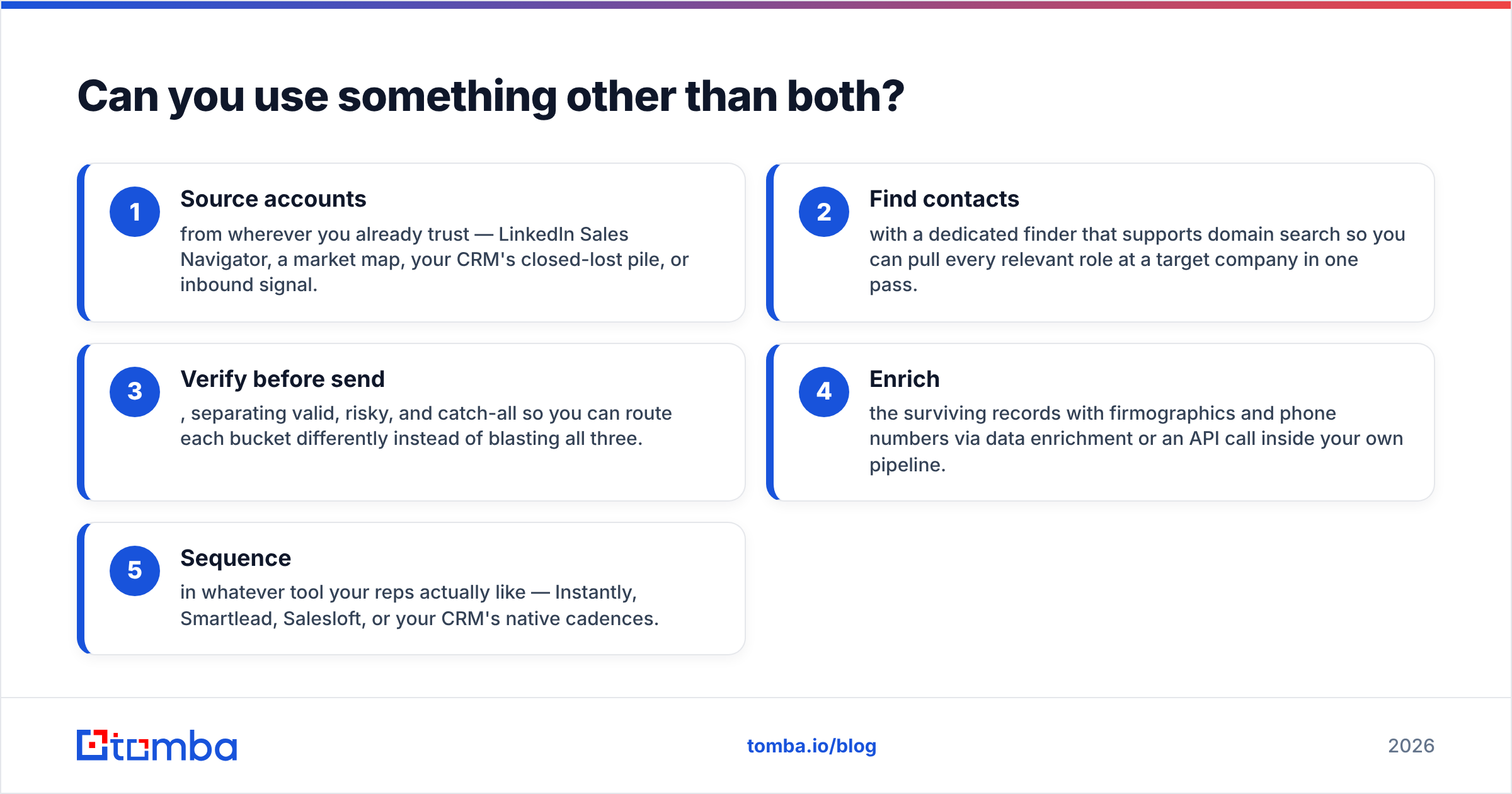
Can you use something other than both?#
Yes. For a lot of teams, the hybrid stack is the honest answer.
The unbundled pattern looks like this:
- Source accounts from wherever you already trust: LinkedIn Sales Navigator, a market map, your CRM's closed-lost pile, or inbound signal.
- Find contacts with a dedicated finder that supports domain search, so you can pull every relevant role at a target company in one pass.
- Verify before send. Split valid, risky, and catch-all so you can route each bucket differently instead of blasting all three.
- Enrich the surviving records with firmographics and phone numbers via data enrichment or an API call inside your own pipeline.
- Sequence in whatever tool your reps actually like: Instantly, Smartlead, Salesloft, or your CRM's native cadences.
This costs less than a full-seat GTM platform in most setups, and it fails gracefully. If the sequencer disappoints you, swap it without losing your data layer. The reverse holds too. Vendors like BookYourData fit this pattern as well, with pay-as-you-go verified lists for teams that want no subscription at all. That suits sporadic buying rather than continuous demand.
The argument against unbundling is real: more vendors, more integration surface, more people to email when something breaks. Weigh that against per-seat costs at the headcount you expect, not the headcount you have today.
How should you run the evaluation?#
Don't compare feature lists. Test DealSignal vs Apollo.io on your segment, and compare outcomes.
- Build one test list of 200 contacts in your exact ICP: same industry, same company size, same geography. Not a generic "SaaS companies" pull.
- Run both trials on that same list. Measure match rate, bounce rate on a small send, and title accuracy on a manual spot-check of 25 records.
- Time the workflow. How long does one rep need to go from account list to sequenced contacts? Minutes matter once you multiply by daily use.
- Price the two-year case. Model headcount growth. Per-seat pricing compounds; per-record pricing scales with volume. Know which curve you are buying.
- Test the exit. Can you export your data cleanly? Vendors that make export painful are pricing in switching costs.
Spot-checking 25 records by hand feels tedious. It is also the only step here that reliably predicts whether a database will embarrass you in front of a prospect.
The verdict#
The DealSignal vs Apollo.io verdict: DealSignal for data-led teams, Apollo for workflow-led teams. DealSignal earns its price when accuracy is the constraint and marketing ops owns the pipeline. Apollo earns its price when your reps need everything in one place and your targets sit in well-covered US markets. Neither is a scam, and neither is a universal answer. Reviews that call one "obviously better" are usually describing a motion, not a product.
If your real problem is narrower, start smaller. You need accurate work emails at a predictable cost, and you already have a sequencer you like. Try the Tomba Email Finder: a free tier at 25 searches to test your own segment, $49/mo when you are ready, with verification, domain search, and API access in the same account. Run it against whichever platform you are evaluating, on the same 200-contact list, and let the match rate settle the argument.
Related guides#
Ready to find emails that actually work?
Join 150,000+ professionals who stopped guessing and started sending. Free credits on signup — no credit card required.
Get the Tomba newsletter
Practical outbound tactics and product updates — once every two weeks.
About the author