DealSignal vs Power Almanac: Which B2B Data Tool Wins in 2026
DealSignal sells verified B2B contacts across every industry. Power Almanac sells one thing: US local government officials. Here's which one fits your pipeline — and when neither does.
DealSignal vs Power Almanac is an odd matchup. One sells B2B contacts in every industry. The other sells one list: US local government officials. This guide breaks down DealSignal vs Power Almanac on coverage, price, and data quality. It also covers when to buy neither.
TL;DR
- DealSignal is a broad B2B contact and account database. It builds lists on demand and verifies them with a mix of AI and human checks. Deals are annual, and usually start near $5,000–$12,000 a year.
- Power Almanac is a niche list of US local government officials. It covers about 250,000 people across roughly 40,000 cities, counties, townships, and districts. It fits anyone selling to city hall — and nobody else.
- These two tools barely compete. Power Almanac has no records for a "VP of Engineering." DealSignal is thin on "Public Works Director in Ohio."
- Both sell you a file. Neither checks an address at the moment you hit send. That moment is where bounce rates get decided.
- The 2026 play for most teams is simple. Pick one source for discovery. Then run a separate verification layer before every campaign. A per-credit tool like Tomba handles that layer.
DealSignal vs Power Almanac: what is each tool?#
They solve different problems. They just share the phrase "B2B contact data."
DealSignal is a data-on-demand platform. You define an ideal customer profile: industry, headcount, revenue, tech stack, job function, seniority, and location. DealSignal then builds a list to match. It verifies records near the time it hands them over, so you are not buying a pre-built file.
Their pitch is freshness. Contact data decays about 2.5% a month. So a file refreshed 18 months ago is much worse than one refreshed last week. DealSignal claims 95%+ accuracy, using machines plus human research. See their own product pages for current positioning.
Power Almanac is the opposite of broad. It covers one vertical: US local government. Mayors, city managers, council members, police and fire chiefs, public works directors, IT directors, finance officers, clerks, and planning directors.
That adds up to roughly 250,000 officials across about 40,000 local entities. Each record can include a title, phone number, mailing address, and email. Their site sells downloadable lists priced per record. Small orders need no annual contract.
So the honest way to frame DealSignal vs Power Almanac is not "which tool is better." Ask this instead: is your buyer a company or a government? Answer that and 80% of the choice is made.
DealSignal vs Power Almanac: how do they compare head to head?#
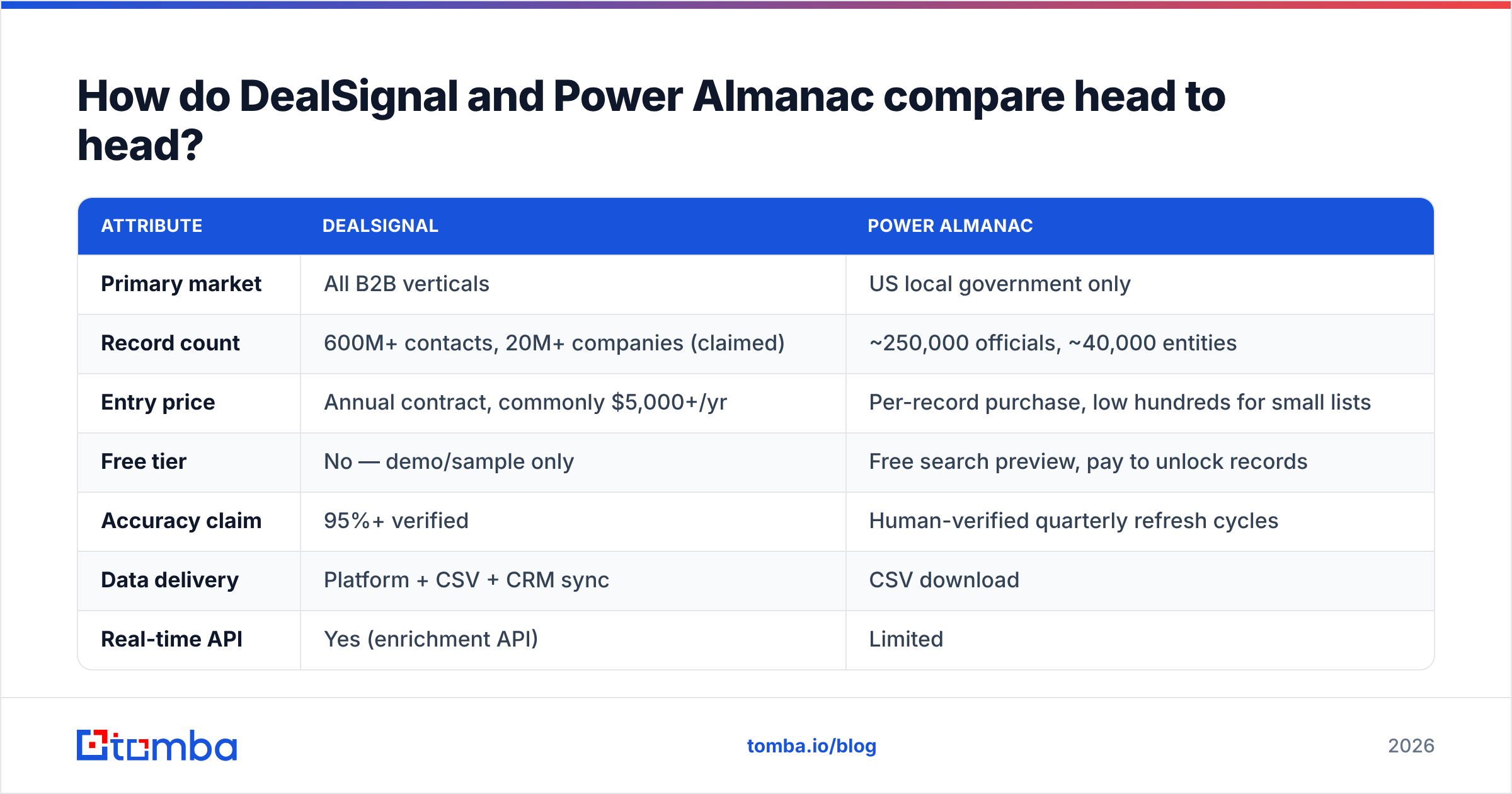
Here is the practical breakdown. Pricing moves with volume and negotiation. Treat these numbers as ranges, not quotes.
| Attribute | DealSignal | Power Almanac |
|---|---|---|
| Primary market | All B2B verticals | US local government only |
| Record count | 600M+ contacts, 20M+ companies (claimed) | ~250,000 officials, ~40,000 entities |
| Entry price | Annual contract, commonly $5,000+/yr | Per-record purchase, low hundreds for small lists |
| Free tier | No — demo/sample only | Free search preview, pay to unlock records |
| Accuracy claim | 95%+ verified | Human-verified quarterly refresh cycles |
| Data delivery | Platform + CSV + CRM sync | CSV download |
| Real-time API | Yes (enrichment API) | Limited |
| Phone data | Direct dials on higher tiers | Main office lines, some directs |
| Intent data | Yes (add-on) | No |
| Best for | Mid-market/enterprise ABM lists | GovTech, civic SaaS, public-sector sales |
| Worst for | Small teams needing 200 emails | Anyone selling to private companies |
The row that matters most for budget holders is the third one. DealSignal is an annual commitment. Power Almanac is closer to a one-time purchase. Say you need 400 contacts to test an idea this quarter. A $9,000 annual contract is not a rational buy — no matter how good the data is.
DealSignal vs Power Almanac: which has better data quality?#
Neither accuracy claim survives your real send list. You need a fresh check first.
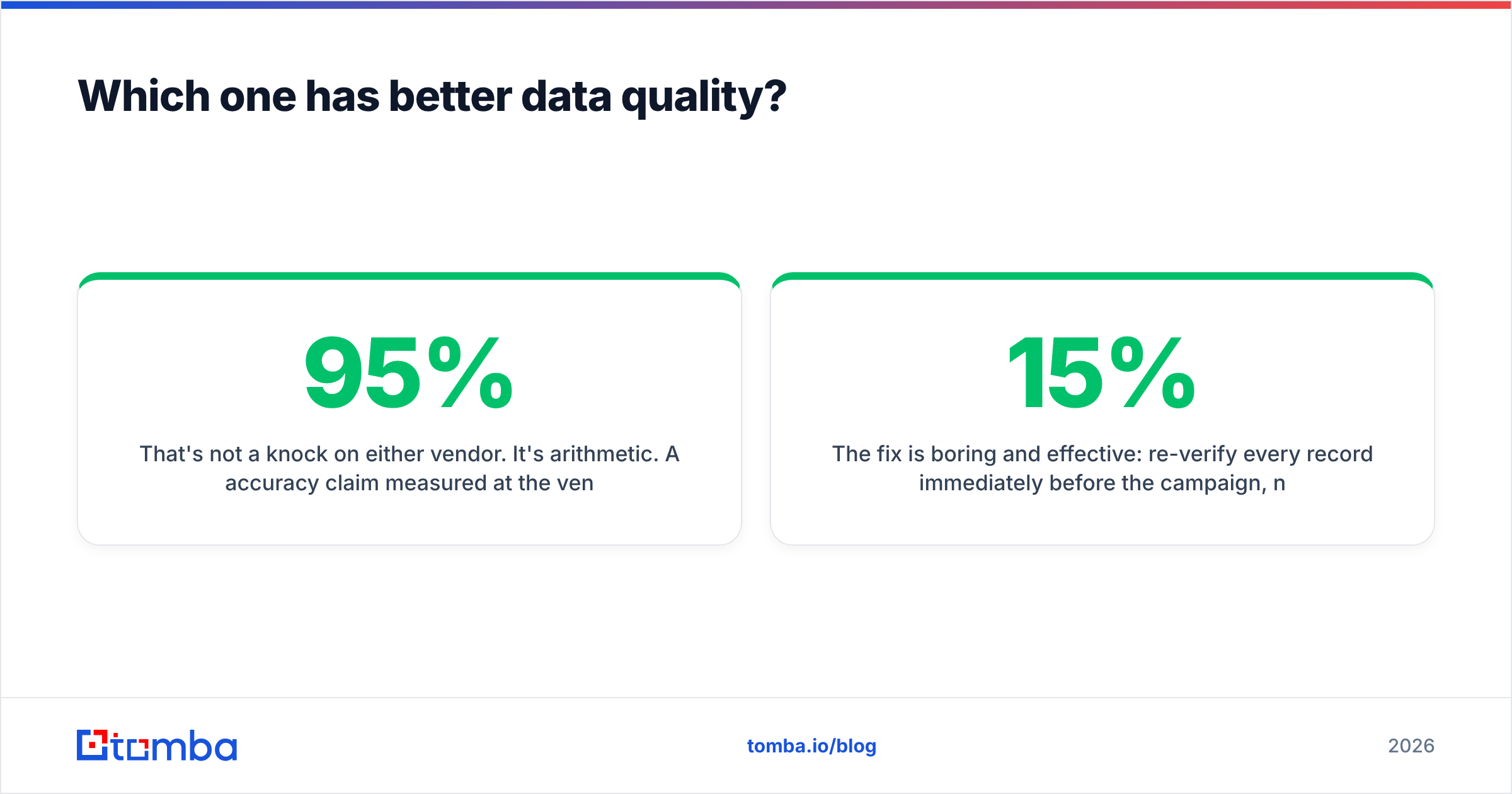
That is not a knock on either vendor. It is math. A 95% claim measured on the vendor's verify date still means 5% fail on day one. Then add 2–3% decay each month from job changes, domain moves, and cut roles. A list you bought in January is much weaker by April. Gartner has flagged poor data quality as a top cause of failed go-to-market programs. The reason is this exact one: teams treat a bought list as a fixed asset. It is a decaying one.
Where each vendor genuinely differs:
- DealSignal's edge is refresh on demand. Lists get built when you ask for them. So the average record is younger than a static database dump. Pull a list in March and it was checked near March.
- Power Almanac's edge is source authority. Local rosters are public. Clerks post council directories. Cities publish staff pages. So the source material can be checked. A "VP of Marketing's work email" often cannot. The catch: one election can wipe out a chunk of the list overnight.
Two more gaps apply to both vendors:
- Both are weak on catch-all domains. Many .gov and .us domains accept every address at the SMTP layer. A standard check returns "valid" for mailboxes that do not exist. A dedicated catch-all verifier is the only way to tell real from accept-all.
- Neither checks at send time. Both hand you a file. Two to six weeks often pass between download and first send. That gap is where bounces get created.
The fix is boring and it works. Re-verify every record right before the campaign, not when you buy. Run a bought list through an email verifier the week you send. It usually strips 5–15% of records that were fine at purchase and are not fine now.
DealSignal vs Power Almanac: what does each one cost?#
DealSignal does not publish prices. That is a signal in itself. The number is negotiated, and it moves with record volume, seat count, and intent add-ons. Buyer reviews on G2 point to $5,000 to $12,000 a year for mid-market packages. Enterprise deals run well above that. Expect several sales calls and an annual minimum.
Power Almanac posts per-record pricing with volume discounts and a small minimum order. Want every city manager in five states? That is a few hundred dollars, not a contract. Easy access is the whole point of the product. It is why GovTech startups with no data budget still buy it.
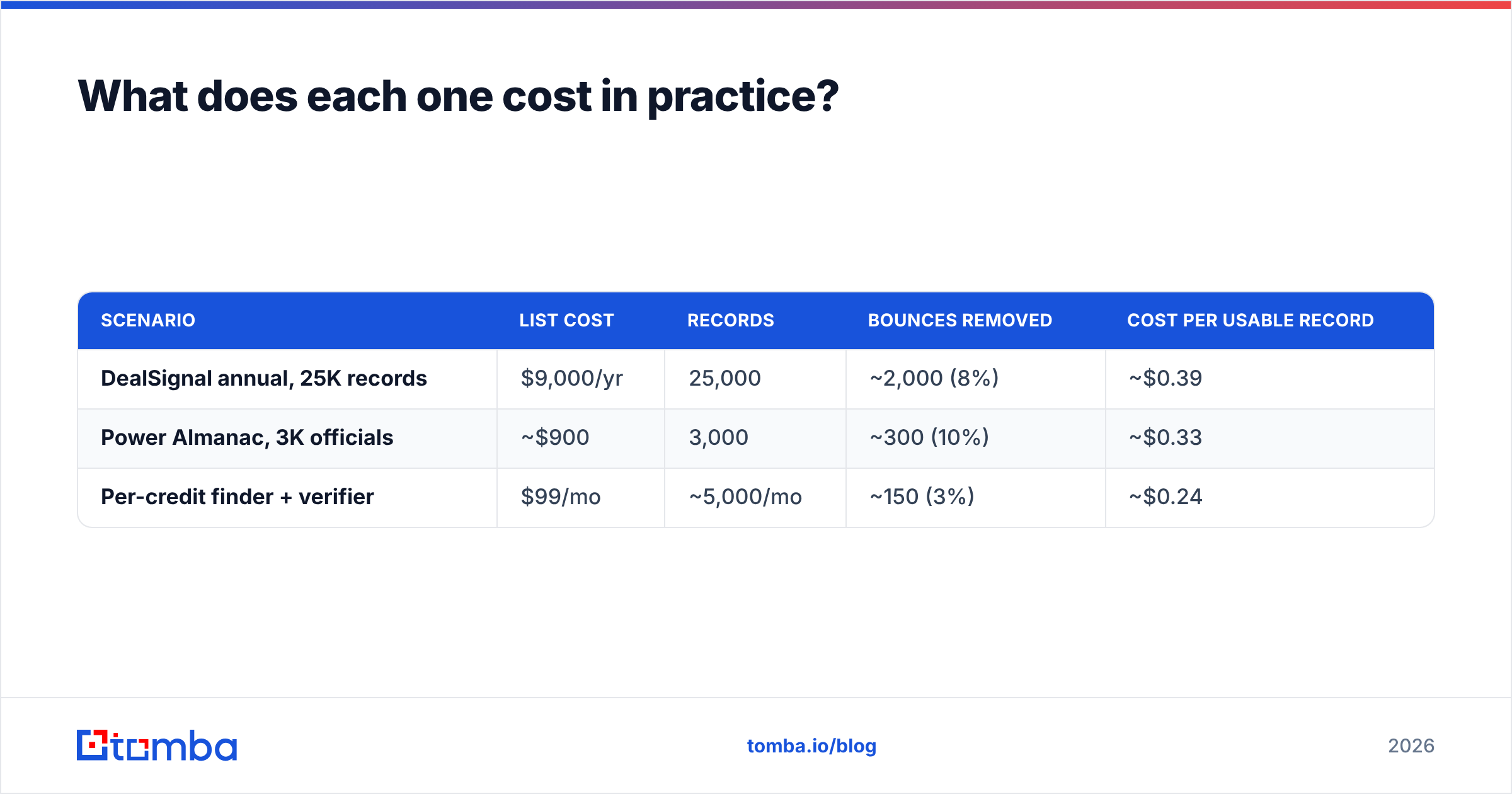
The number people miss is cost per usable record, not cost per record:
| Scenario | List cost | Records | Bounces removed | Cost per usable record |
|---|---|---|---|---|
| DealSignal annual, 25K records | $9,000/yr | 25,000 | ~2,000 (8%) | ~$0.39 |
| Power Almanac, 3K officials | ~$900 | 3,000 | ~300 (10%) | ~$0.33 |
| Per-credit finder + verifier | $99/mo | ~5,000/mo | ~150 (3%) | ~$0.24 |
Those bounce rates are illustrative, not vendor-published. The point is the direction. Annual data is only cheap per record if you use the whole allotment. Most teams do not. They buy 25,000 records, use 8,000, and renew anyway.
When should you choose DealSignal?#
Choose DealSignal when all of these are true:
- You sell to private companies, across more than one industry or region.
- You have a real data budget. Annual contracts do not fit a two-person team testing a channel.
- You need firmographic depth: headcount, revenue, tech stack, funding stage — not just name and email.
- You want intent signals on top of contact data, and an ABM motion that acts on them.
- You have CRM hygiene. Read HubSpot's data management docs before you turn on any bulk sync.
Skip DealSignal if you run founder-led sales at seed stage. The contract math does not work. At that stage, flexible per-credit tools beat firmographic depth.
When should you choose Power Almanac?#
Choose Power Almanac if you sell to local government. Full stop. Typical fits:
- Civic SaaS — permitting software, 311 systems, agenda and records management
- Public safety vendors — dispatch software, body cams, fleet telematics
- Infrastructure and services — engineering firms, waste management, paving, utility contractors
- Grant and funding consultancies aimed at municipal finance directors
The value is not the tech. Building this list yourself means scraping 40,000 city websites. Many still run 2011-era systems. Some post staff directories as PDFs.
Power Almanac already did that boring work. That is a real moat in a market full of giant horizontal databases.
The limit is just as clear: election cycles. One November election can void a large share of elected-official records. Bought a council list in October? Re-verify it in December.
What about a per-credit alternative to both?#
The structural problem with DealSignal vs Power Almanac is the same on both sides. You pay for records you may never contact.
The alternative is now the default for lean outbound teams in 2026. It splits discovery from contact resolution:
- Build the account list from a cheap or free source. For companies: LinkedIn Sales Navigator, Crunchbase, or an industry directory. For government: the state municipal league directory, which is usually public.
- Resolve contacts per account, on demand. Use a domain search to pull emails on a target domain. Use an email finder for a person you already named.
- Verify right before send, including catch-all handling. That matters most for .gov and .edu domains.
- Enrich only the records that engage. Adding firmographics or phone numbers to a person who replied beats enriching 25,000 people who never will.
This flips the economics. You skip the $9,000 upfront for a list you use a third of, and pay per lookup instead. Tomba's pricing shows the shape: a free tier with 25 searches a month, Starter at $49/mo, Growth at $99/mo, Pro at $249/mo, and custom Enterprise. There is no annual lock-in and no sunk contract.
One honest caveat. Per-credit tools do not replace what Power Almanac does. If you need every public works director in the Midwest, no email finder hands you that org chart. You need the roster first. For a GovTech team, the answer is often both: Power Almanac for the roster, plus a verification layer for the send list.
DealSignal's intent data has no per-credit equal either. If buying-signal timing drives your motion, that is a fair reason to pay for a platform.
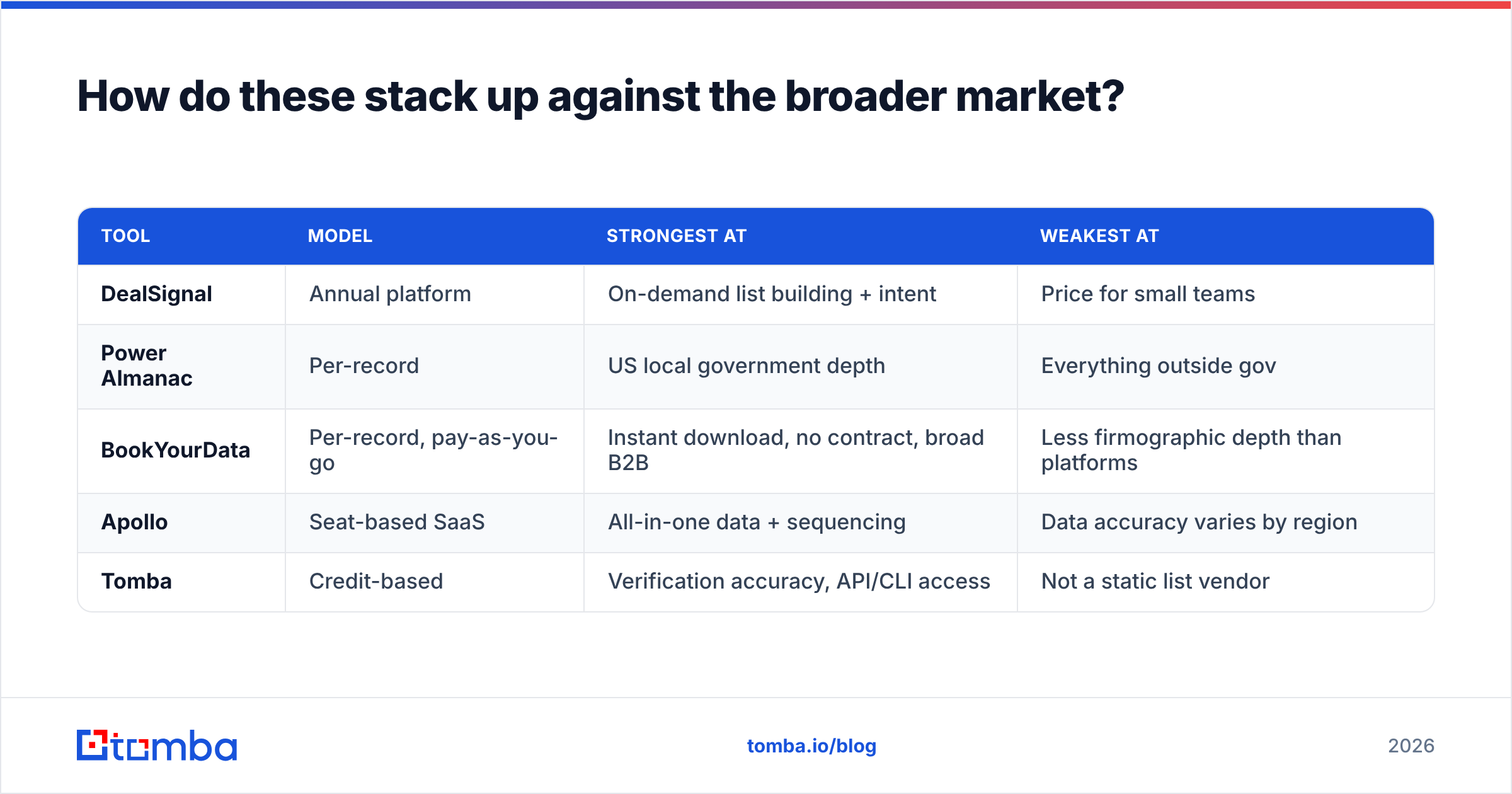
How does DealSignal vs Power Almanac compare to the broader market?#
Here are the alternatives you will meet in the same evaluation:
| Tool | Model | Strongest at | Weakest at |
|---|---|---|---|
| DealSignal | Annual platform | On-demand list building + intent | Price for small teams |
| Power Almanac | Per-record | US local government depth | Everything outside gov |
| BookYourData | Per-record, pay-as-you-go | Instant download, no contract, broad B2B | Less firmographic depth than platforms |
| Apollo | Seat-based SaaS | All-in-one data + sequencing | Data accuracy varies by region |
| Tomba | Credit-based | Verification accuracy, API/CLI access | Not a static list vendor |
BookYourData earns a mention. It sits in useful middle ground: pay-as-you-go pricing, no annual contract, instant CSV, and a bounce guarantee. That is close to Power Almanac's model, but with broad B2B coverage. If you just want to buy a list without a contract, it beats both headline vendors here.
Already looking at platform-scale options? Our writeups on Apollo alternatives and Clearbit alternatives cover horizontal enrichment in more depth.
DealSignal vs Power Almanac: what's the verdict?#
Choose Power Almanac if you sell to US municipalities. Nothing else covers that vertical as deeply. Per-record pricing makes it cheap to test.
Choose DealSignal if you are mid-market or enterprise. It fits teams selling across several private-sector verticals, who need intent on top of firmographics, and who will use a full annual contract.
Choose neither — go per-credit — if you are a small team, an agency, or a founder testing outbound. The annual model punishes the flexibility early teams need.
Whichever you pick, one rule holds: verify before you send, not when you buy. Moving verification from purchase time to send time is the highest-ROI change most outbound teams can make. It costs almost nothing. It is the difference between a 2% bounce rate and a 12% one. Past a certain point, that stops being a data problem. It becomes a deliverability problem that follows your domain for months.
Start with the layer that protects your domain. Your list may come from DealSignal, Power Almanac, a directory, or your own research. Run it through the Tomba Email Finder and verification stack before your first send. The free tier gives you 25 searches a month. That is enough to test a vendor's 95% claim against records you already know are good — before you sign anything annual.
Related guides#
Ready to find emails that actually work?
Join 150,000+ professionals who stopped guessing and started sending. Free credits on signup — no credit card required.
Get the Tomba newsletter
Practical outbound tactics and product updates — once every two weeks.
About the author