DealSignal vs SalesQL: Which B2B Data Tool Wins in 2026?
DealSignal sells verified-on-demand B2B records at enterprise prices. SalesQL scrapes contacts off LinkedIn for pocket change. We break down accuracy, pricing, and which one actually fits your motion.
DealSignal vs SalesQL is a choice between two very different tools. One builds and verifies a list for you. The other pulls a contact off the LinkedIn profile you are already viewing. Here is the short version, then the numbers.
TL;DR
- DealSignal is a verified-on-demand B2B database. You define an ICP, and it builds and re-verifies the list. Accuracy is the product. Pricing is quote-based, and most teams land in the low-to-mid five figures per year.
- SalesQL is a LinkedIn Chrome extension. It pulls emails and phone numbers off profiles you view. It starts free and tops out near $89/month.
- These tools barely compete. DealSignal feeds demand gen and RevOps. SalesQL is a per-rep prospecting utility.
- Want an API and verification you can audit? Neither is the obvious pick. A dedicated email finder with a real API usually costs less per verified contact.
- Buy DealSignal when list quality is a board-level problem. Buy SalesQL when one AE needs contacts today.
What are DealSignal and SalesQL, actually?#
G2 category pages list these two side by side, so buyers compare them. The pairing is mostly an artifact of tagging. Both sit under "sales intelligence." Under the hood, they solve different problems with different economics.
DealSignal is a B2B data platform built around on-demand verification. It does not ship a static database snapshot. Instead, you give it an ideal customer profile: industry, headcount, tech stack, job titles, intent signals. It then assembles the contact list at request time and runs verification passes before delivery. The company markets 97%+ accuracy and says it re-verifies records on a rolling cadence, not just at export. The buyer is a demand gen, marketing ops, or RevOps team. They feed a marketing automation platform, and they get blamed when bounce rates spike.
SalesQL is a browser extension. You install it in Chrome and browse LinkedIn or Sales Navigator. It then surfaces personal and work emails plus phone numbers for the profiles on screen. It also handles bulk extraction from search results and saved lists, and it exports to CSV or a handful of CRMs. It is an individual-contributor tool, priced like one.
The framing that matters: DealSignal answers "who should we be talking to?" SalesQL answers "how do I email this specific person I just found?"

DealSignal vs SalesQL: how do they compare head-to-head?#
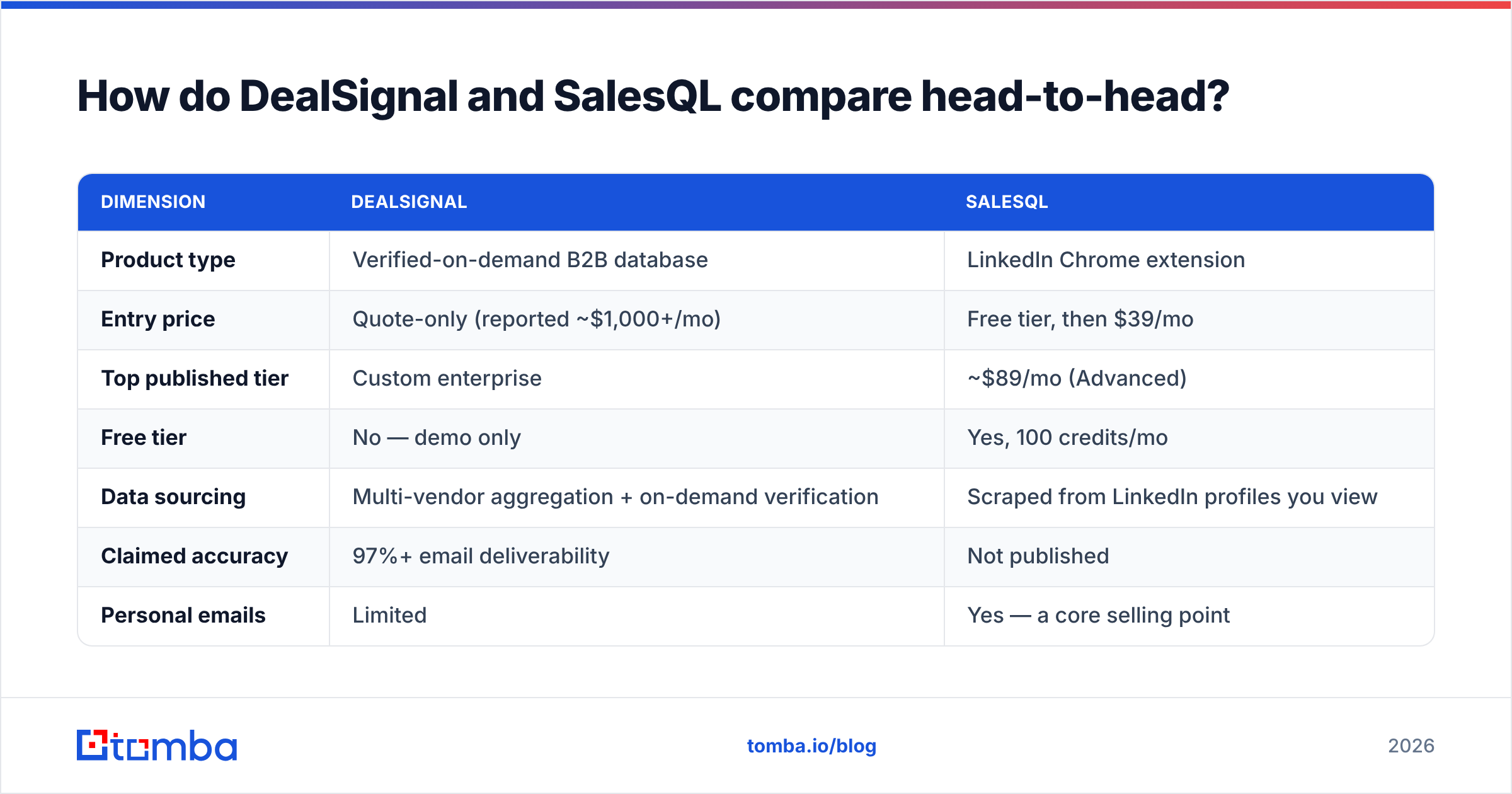
Here is the practical breakdown. Pricing reflects published rates and commonly reported quotes as of mid-2026. DealSignal does not publish list pricing, so treat those figures as directional.
| Dimension | DealSignal | SalesQL |
|---|---|---|
| Product type | Verified-on-demand B2B database | LinkedIn Chrome extension |
| Entry price | Quote-only (reported ~$1,000+/mo) | Free tier, then $39/mo |
| Top published tier | Custom enterprise | ~$89/mo (Advanced) |
| Free tier | No — demo only | Yes, 100 credits/mo |
| Data sourcing | Multi-vendor aggregation + on-demand verification | Scraped from LinkedIn profiles you view |
| Claimed accuracy | 97%+ email deliverability | Not published |
| Personal emails | Limited | Yes — a core selling point |
| Phone numbers | Yes, including direct dials | Yes, mobile + work |
| Bulk export | Yes, list-level delivery | Yes, from LinkedIn search results |
| Public API | Limited / enterprise only | Yes, on higher tiers |
| Intent data | Yes (Bombora integration) | No |
| Works without LinkedIn | Yes | No — LinkedIn is the entire input |
| Best fit | Demand gen, RevOps, ABM list builds | Individual AEs and recruiters |
| Contract | Annual, sales-led | Monthly, self-serve |
Read that table for the structural difference, not the feature count. SalesQL's dataset is a function of what you look at. Stop browsing LinkedIn, and SalesQL produces nothing. DealSignal's dataset exists on its own. You can ask it for "every VP of Engineering at 200-1000 person fintechs in DACH" and get an answer without opening a single profile.
Which one has better data accuracy?#
DealSignal wins on measurable accuracy. SalesQL wins on personal-email hit rate. Those are not the same thing. Conflating them is how teams end up disappointed.
DealSignal checks records close to delivery. That differs from vendors who ship a database refreshed each quarter. When a record leaves DealSignal, the SMTP-level check happened recently. It did not happen eighteen months ago, when the contact still worked there. Push 50,000 records into Marketo, and that gap shows up in your bounce rate and sender reputation.
SalesQL's accuracy is harder to pin down, because the company does not publish it. User reports on G2 put work-email accuracy in a reasonable but unremarkable band. Personal emails (Gmail, Outlook.com) hit more often than with most rivals, which fits the LinkedIn-adjacent sourcing. Personal emails cut both ways. They lift reply rates in recruiting. They also raise GDPR and CAN-SPAM exposure in B2B outbound.
Here is the failure mode nobody warns you about. Neither tool removes the need to verify at send time. Data decays about 2-3% per month as people change jobs. A list pulled in January and mailed in April has already rotted. Run any list through an email verifier before a campaign. It costs fractions of a cent per record, and it prevents the bounce spike that kills a domain.
Catch-all domains are where both tools get quiet. A catch-all server accepts every address, so a standard SMTP check returns "valid" for garbage. Does a real slice of your ICP sit behind catch-alls? That is common in enterprise and in European mid-market. If so, you need a dedicated catch-all verifier, or you are flying blind on part of your list.
What does each one actually cost?#
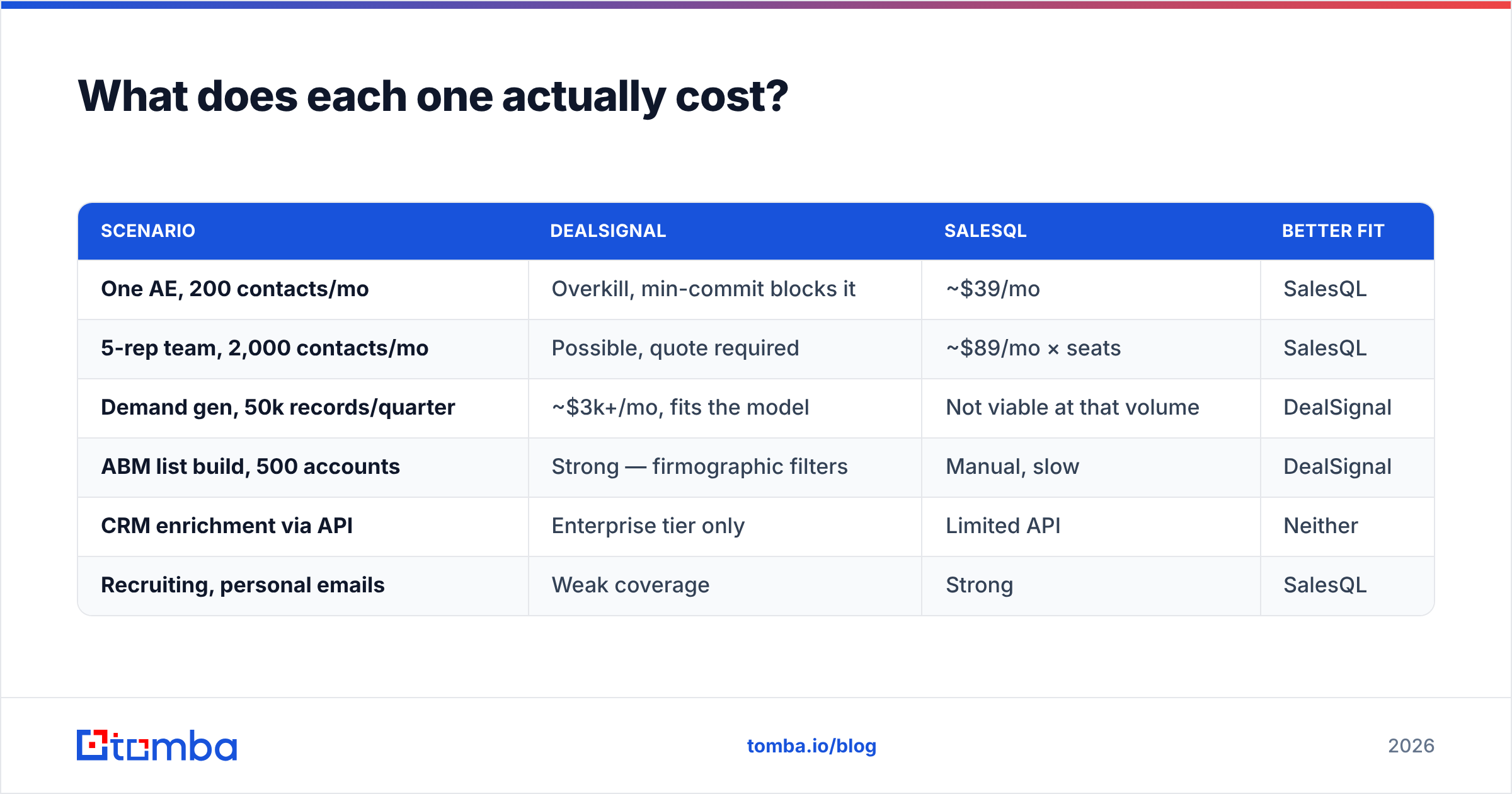
Cost per usable contact is the only number that matters. It is also the number neither vendor puts on a slide.
SalesQL is transparent. The free tier gives 100 credits a month. After that it is roughly $39/month for 1,500 credits, $59 for 4,000, and $89 for about 10,000 on the Advanced tier. Call it $0.009-$0.026 per credit. Credits burn on reveal, not on success. So your real cost per valid contact is higher. If 80% of reveals are usable, you are closer to $0.011-$0.033.
DealSignal does not publish rates. Reported deals cluster around $1,000-$3,000/month, depending on record volume and whether you add intent data. On a 100,000-record annual commitment, that is roughly $0.12-$0.36 per record. That is an order of magnitude above SalesQL. You are buying list construction and verification, though, not a reveal button.
| Scenario | DealSignal | SalesQL | Better fit |
|---|---|---|---|
| One AE, 200 contacts/mo | Overkill, min-commit blocks it | ~$39/mo | SalesQL |
| 5-rep team, 2,000 contacts/mo | Possible, quote required | ~$89/mo × seats | SalesQL |
| Demand gen, 50k records/quarter | ~$3k+/mo, fits the model | Not viable at that volume | DealSignal |
| ABM list build, 500 accounts | Strong — firmographic filters | Manual, slow | DealSignal |
| CRM enrichment via API | Enterprise tier only | Limited API | Neither |
| Recruiting, personal emails | Weak coverage | Strong | SalesQL |
The trap in the SalesQL column is per-seat pricing. It scales in a straight line. Ten reps at $89 is $890/month. Now you are in DealSignal's price band, without DealSignal's coverage, verification, or intent layer. Teams hit this wall at rep six or seven. Most do not notice, because the spend sits on individual credit cards.

When should you pick DealSignal over SalesQL?#
Pick DealSignal when the following are true:
- Your list is a marketing input, not a rep input. You load records into HubSpot or Marketo for nurture. You do not hand them to an SDR one at a time. See HubSpot's own guidance on list hygiene for why source quality compounds at scale.
- You need firmographic and technographic filtering. "Companies using Snowflake, 500-2000 employees, hiring data engineers" is a DealSignal query. It is not a SalesQL query.
- Bounce rate is a tracked KPI with a named owner. If someone gets a bad quarter review over deliverability, buy verification you can audit.
- Intent data matters to your motion. DealSignal's Bombora integration surfaces accounts researching your category. SalesQL has no equivalent.
- You have procurement patience. Sales-led, annual contract, security review. Budget four to eight weeks.
Pick SalesQL when:
- LinkedIn is where your prospecting already happens. If reps live in Sales Navigator, SalesQL removes a copy-paste step and nothing more. That is exactly the right amount of tool.
- You need personal emails. Recruiters and agency prospectors get real lift here.
- You want to start today with zero commitment. Install it, use the free tier, decide in a week.
- Volume stays under a few thousand contacts a month per rep. Above that, credits get expensive and LinkedIn rate limits bite.
What are the better alternatives to both?#
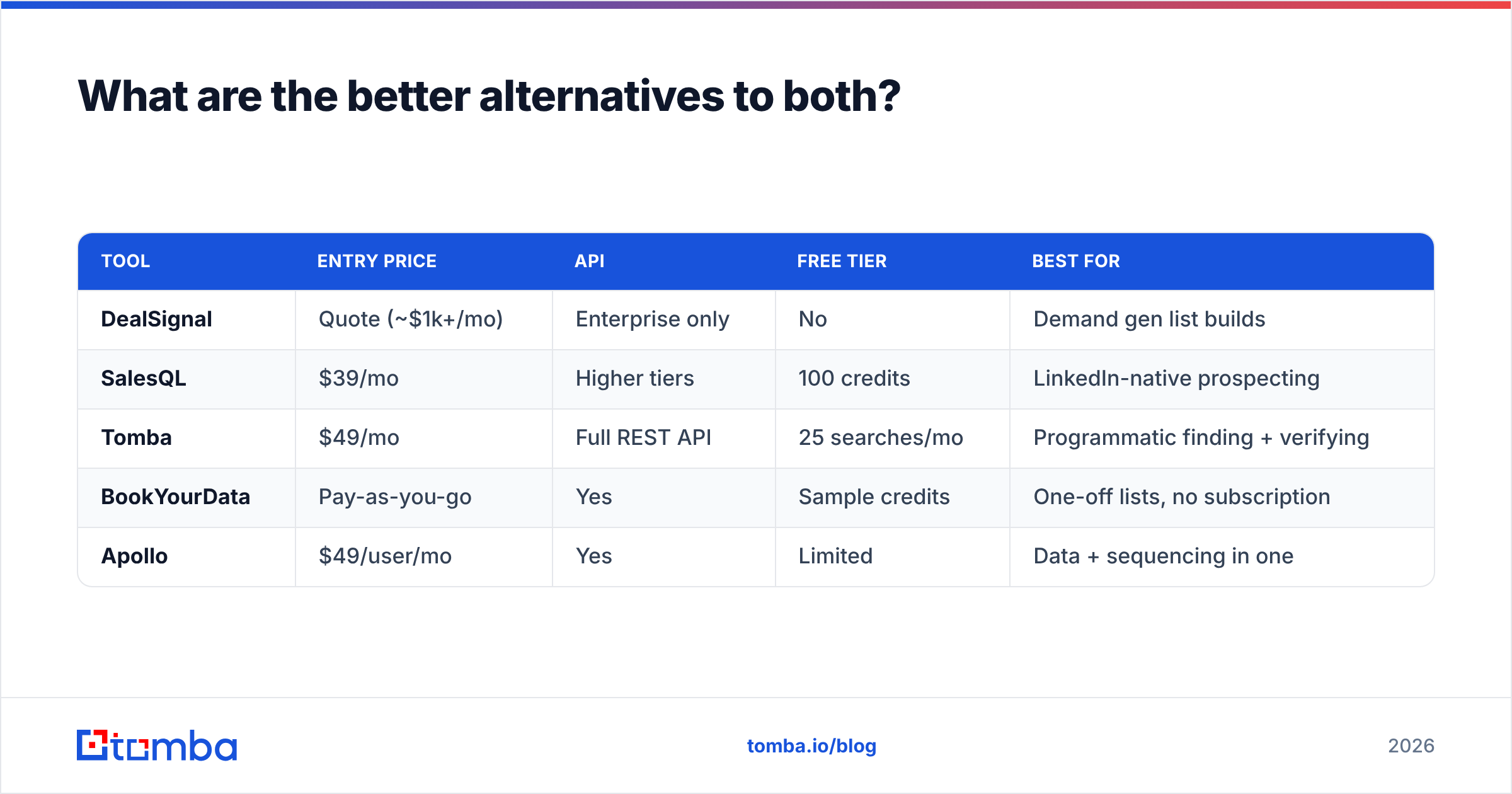
Both tools leave a gap in the middle. Neither fits well if you want programmatic, high-volume, verified contact data with no enterprise contract and no browser dependency.
Tomba sits in that gap. It is an email finder with a full REST API. The free tier covers 25 searches a month. Paid plans run $49/mo (Starter), $99/mo (Growth), and $249/mo (Pro), with a custom Enterprise tier. Domain search returns every address it can find at a company. The verifier and catch-all checks run inline. The whole thing works from a script, a Google Sheet, or a Chrome extension. See Tomba pricing for the full tier breakdown. In practice: no LinkedIn dependency, no annual commit, and a lower cost per contact than DealSignal at mid volumes.
BookYourData takes a third approach. It is pay-as-you-go, with prepaid credits, a 97% accuracy guarantee, and refunds on bounces. It is a strong option for a one-off list with no subscription at all. You also do not pay for months when you are not prospecting. Look at it if DealSignal's contract structure is the blocker, rather than its data.
Apollo, ZoomInfo, and Clay sit next door. Apollo bundles data with sequencing — see Apollo alternatives if the bundling is the problem. ZoomInfo owns the enterprise end at enterprise prices. Clay orchestrates several data vendors, including waterfall enrichment. That last one is the honest answer to "which single vendor has the best data": none of them, so use several.
| Tool | Entry price | API | Free tier | Best for |
|---|---|---|---|---|
| DealSignal | Quote (~$1k+/mo) | Enterprise only | No | Demand gen list builds |
| SalesQL | $39/mo | Higher tiers | 100 credits | LinkedIn-native prospecting |
| Tomba | $49/mo | Full REST API | 25 searches/mo | Programmatic finding + verifying |
| BookYourData | Pay-as-you-go | Yes | Sample credits | One-off lists, no subscription |
| Apollo | $49/user/mo | Yes | Limited | Data + sequencing in one |
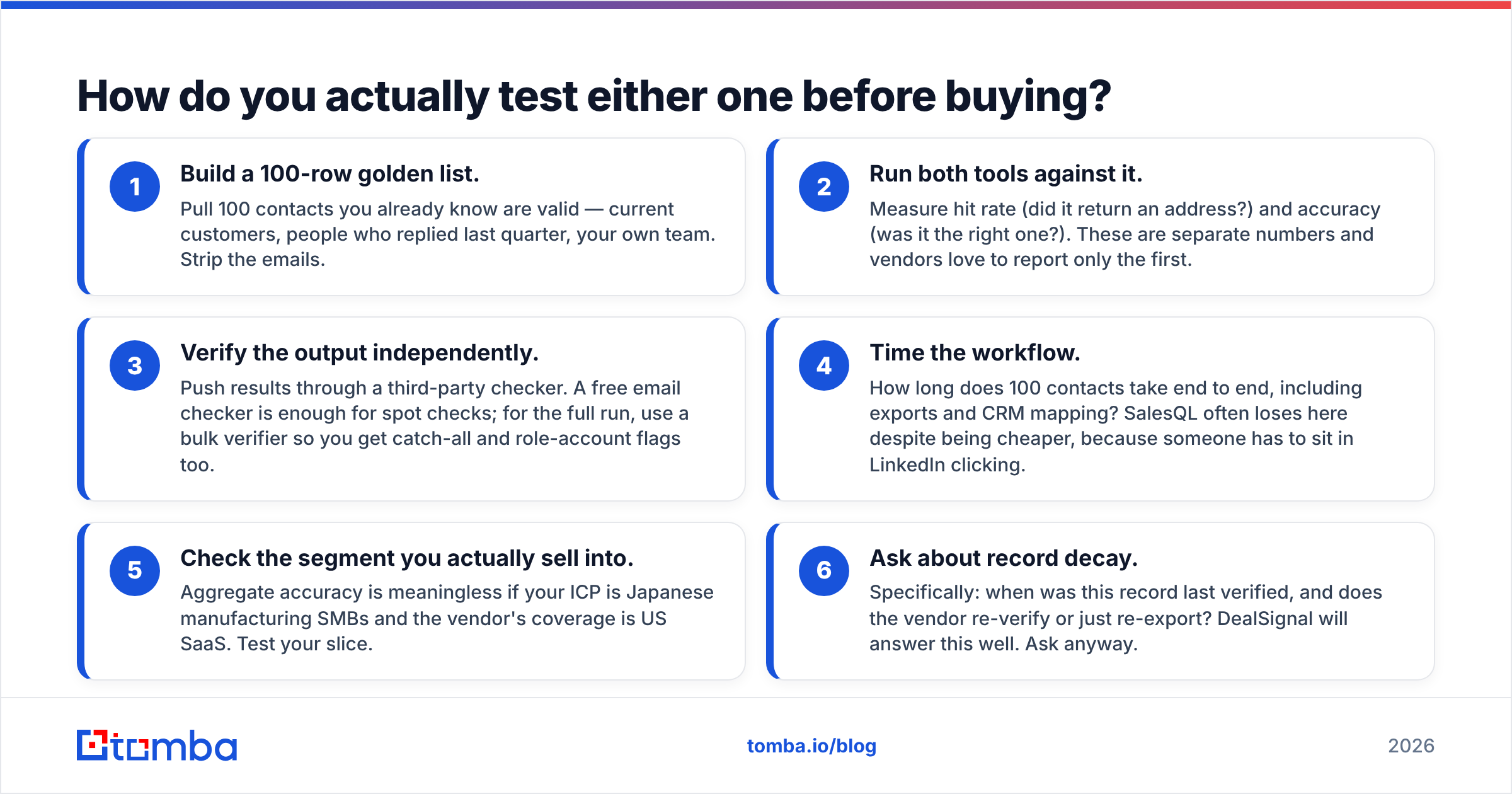
How do you actually test either one before buying?#
Run the same benchmark against both. Do not take a demo at face value.
- Build a 100-row golden list. Pull 100 contacts you know are valid: current customers, people who replied last quarter, your own team. Then strip the emails.
- Run both tools against it. Measure hit rate (did it return an address?) and accuracy (was it the right one?). These are separate numbers, and vendors love to report only the first.
- Verify the output independently. Push results through a third-party checker. A free email checker is enough for spot checks. For the full run, use a bulk verifier, so you get catch-all and role-account flags too.
- Time the workflow. How long does 100 contacts take end to end, including exports and CRM mapping? SalesQL often loses here despite being cheaper, because someone has to sit in LinkedIn clicking.
- Check the segment you actually sell into. Aggregate accuracy means nothing if your ICP is Japanese manufacturing SMBs and the vendor covers US SaaS. Test your slice.
- Ask about record decay. Ask when the record was last verified, and whether the vendor re-verifies or just re-exports. DealSignal will answer this well. Ask anyway.
Most teams skip step 5 and regret it within a quarter. Coverage is wildly uneven by geography and industry, and no vendor volunteers where they are thin.
What's the verdict?#
The DealSignal vs SalesQL verdict: DealSignal for programmatic demand gen at volume, SalesQL for a rep who lives in LinkedIn. They are not substitutes. The comparison only exists because category pages put them side by side.
There is an uncomfortable third answer. If you are comparing these two, there is a decent chance neither is right. DealSignal's contract friction is real. So is SalesQL's LinkedIn dependency. Plenty of teams end up wanting the middle: self-serve pricing, an API, verification built in, and no browser tab. That middle is well populated in 2026, and it costs less than it did two years ago.
Whatever you pick, verify at send time. Every list decays. Every vendor's accuracy claim is measured under conditions that do not match yours. And a bounce spike costs more than the data did.
Ready to test contact data that comes with an API and no annual contract? Tomba Email Finder finds professional email addresses by domain, name, or company, verifies them inline, and starts free at 25 searches per month — no demo call, no procurement cycle. Run your golden list through it alongside DealSignal and SalesQL and let the hit rate decide.
Related guides#
Ready to find emails that actually work?
Join 150,000+ professionals who stopped guessing and started sending. Free credits on signup — no credit card required.
Get the Tomba newsletter
Practical outbound tactics and product updates — once every two weeks.
About the author