Debounce vs Kaspr: Which Data Tool Wins in 2026?
Debounce verifies emails you already have. Kaspr finds phone numbers and emails on LinkedIn. They solve different halves of the same problem — here's which one your pipeline actually needs, and what it costs.
TL;DR
- Debounce is a verifier, not a finder. It cleans lists you already own. It will never hand you a new contact.
- Kaspr is a finder, not a verifier. It pulls emails and mobile numbers off LinkedIn profiles. Its verification layer is thin by comparison.
- Pricing models don't compare directly. Debounce charges per verified email (roughly $0.004–$0.01 depending on volume, credits never expire); Kaspr charges per seat per month (~€49–€99/user).
- Most teams comparing these two are actually asking the wrong question. You need discovery and verification. Buying one and skipping the other is why bounce rates creep past 5%.
- If you want both in one bill, a combined finder + verifier like Tomba ($49/mo Starter) removes the seat-tax and the two-vendor reconciliation problem.
What are Debounce and Kaspr, exactly?#
They aren't competitors. That's the first thing to get straight, because half the "Debounce vs Kaspr" searches come from people who assume both do the same job.
Debounce is an email validation service. You upload a CSV or hit the API with an address, and it tells you whether that mailbox exists, whether it's a role account (info@, sales@), whether it's a disposable domain, and whether the domain is catch-all. It has been around since 2017 and is one of the cheaper credit-based verifiers on the market. Nothing in Debounce generates a contact — it only grades the ones you bring.
Kaspr is a contact-data provider, acquired by Cognism in 2022. Its main surface is a Chrome extension that sits on LinkedIn: open a profile or a Sales Navigator list, click the widget, and Kaspr surfaces work emails and — its real selling point — direct mobile numbers. Coverage skews heavily European, particularly France, where the company originated.
So: one tool grades data, the other sources it. Comparing them head-to-head only makes sense if your real question is "where should my next $100/month go?" — which is a legitimate question, and the rest of this post answers it.

How do Debounce and Kaspr compare on features and price?#
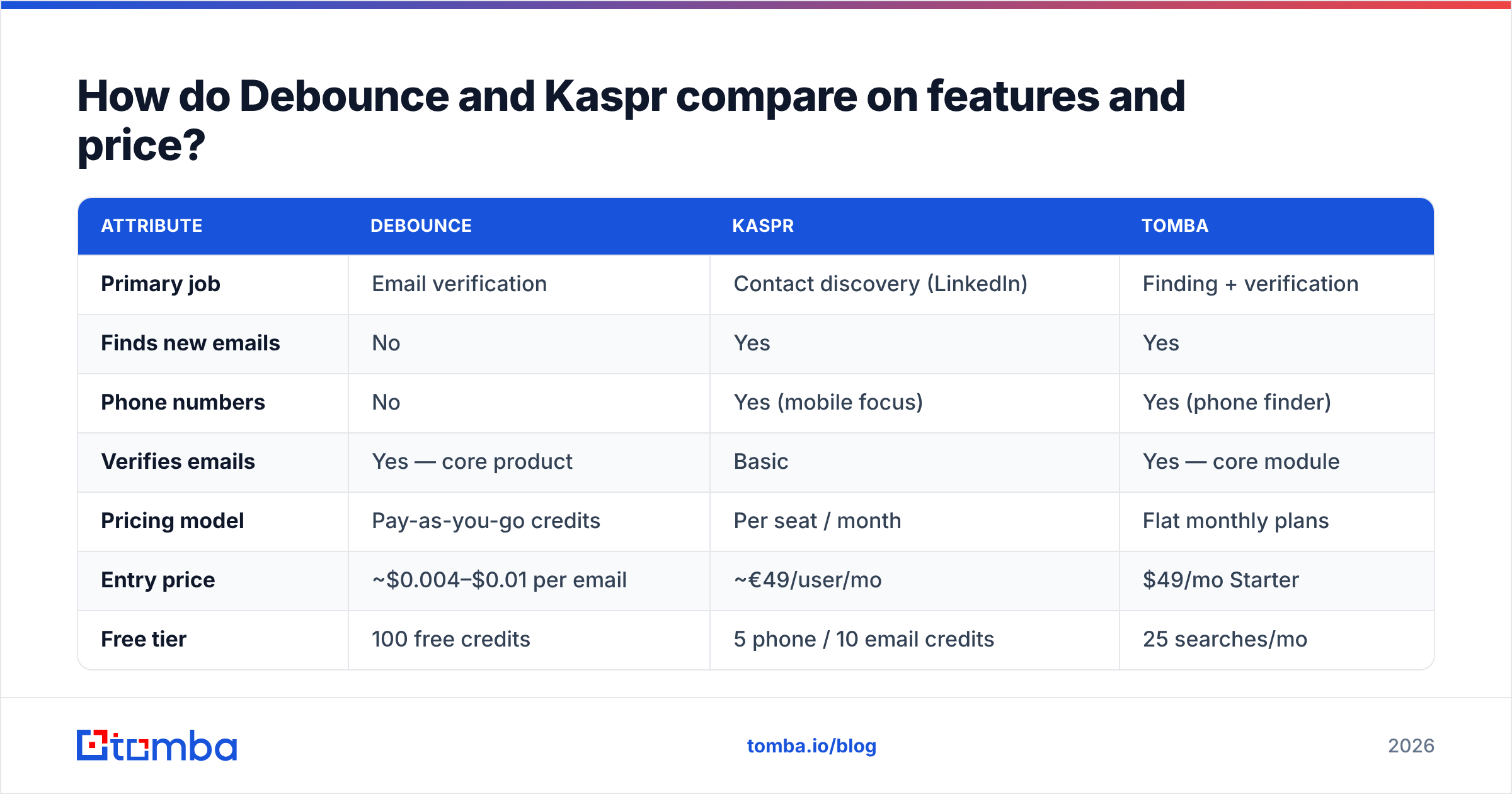
| Attribute | Debounce | Kaspr | Tomba |
|---|---|---|---|
| Primary job | Email verification | Contact discovery (LinkedIn) | Finding + verification |
| Finds new emails | No | Yes | Yes |
| Phone numbers | No | Yes (mobile focus) | Yes (phone finder) |
| Verifies emails | Yes — core product | Basic | Yes — core module |
| Pricing model | Pay-as-you-go credits | Per seat / month | Flat monthly plans |
| Entry price | ~$0.004–$0.01 per email | ~€49/user/mo | $49/mo Starter |
| Free tier | 100 free credits | 5 phone / 10 email credits | 25 searches/mo |
| Credits expire | No | Monthly reset | Monthly reset |
| Bulk CSV upload | Yes | Limited | Yes |
| API access | Yes | Yes (higher tiers) | Yes, all paid plans |
| Catch-all handling | Flags catch-all | Not a focus | Dedicated catch-all verifier |
| Geography strength | Global (verification is geo-neutral) | Strong EU/France | Global |
| CRM integrations | Zapier, major ESPs | HubSpot, Pipedrive, Salesforce, Lemlist | HubSpot, Salesforce, Pipedrive, Zapier, Make |
The pricing rows are where most evaluations go sideways. Debounce's per-credit model means a one-off 50,000-record cleanup might cost you $200 and then nothing for six months — credits sit in the account until used. Kaspr's seat model means a three-person SDR team pays three times, every month, whether or not anyone opens the extension in August.
Neither model is wrong. They're built for different consumption patterns: episodic (Debounce) vs continuous (Kaspr).
Which one should you buy first?#
Buy the one that fixes your current bottleneck. Here's how to diagnose it in about two minutes:
You have a big list and a bad bounce rate. Your last campaign bounced above 3%. You already have contacts — thousands of them, scraped, exported from an old CRM, or bought from a data broker. Buy the verifier. Debounce does this job competently and cheaply.
You have a clean process but no contacts. You know exactly who you want to reach — you've built the ICP, you've got the Sales Navigator search saved — you just can't get their email or number. Buy the finder. Kaspr is a solid choice if your targets are in Europe.
You need mobile numbers specifically. Cold calling is part of the motion, not an afterthought. Kaspr's mobile coverage in France, Benelux, and the UK is genuinely strong. Debounce is irrelevant here.
You're doing both, continuously, at volume. This is most outbound teams. Two vendors means two bills, two credit systems, two support queues, and a manual export-import loop between them. Look at consolidated platforms instead.
You're a solo founder or a two-person team. Seat-based pricing punishes you disproportionately. Flat-rate or credit-based wins.
You're routing everything through an API. Check the rate limits and the response schema before you check the price. Debounce's API is single-purpose and predictable. Kaspr's API is gated behind higher tiers.
How accurate is each tool, really?#
Accuracy means two different things here, and vendors exploit the ambiguity.
For Debounce, accuracy means: given an address, did we correctly predict whether it will bounce? Independent verifier tests generally put the good SMTP-based validators in the 95–98% range on non-catch-all domains. Debounce sits comfortably in that band. Where every verifier — including Debounce — gets shaky is catch-all domains, which accept all mail at the SMTP layer and reveal nothing. Roughly 20–25% of B2B domains are catch-all, and a plain verifier will mark them "unknown" or "accept-all" and leave you to guess. That's why a dedicated catch-all verifier matters more than a headline accuracy percentage.
For Kaspr, accuracy means: of the contacts we returned, how many were correct and current? This is a coverage-times-freshness question. Kaspr's user-contributed database model — extension users contribute contacts they surface — means density is high where its user base is dense (France, wider EU) and thinner in the US, APAC, and LATAM. Reviews on G2 consistently praise EU mobile coverage and note gaps outside it.
The practical implication: a high verifier score on a stale contact is still a wasted send. Verification tells you the mailbox exists. It does not tell you the person still works there. That's a data-freshness problem, and it's solved at the sourcing layer, not the validation layer. If you're relying on a verifier to catch job changes, you're using the wrong tool for the job.

What does the two-tool workflow actually cost?#
Say you're a 3-person SDR team building 2,000 new contacts a month.
Kaspr + Debounce:
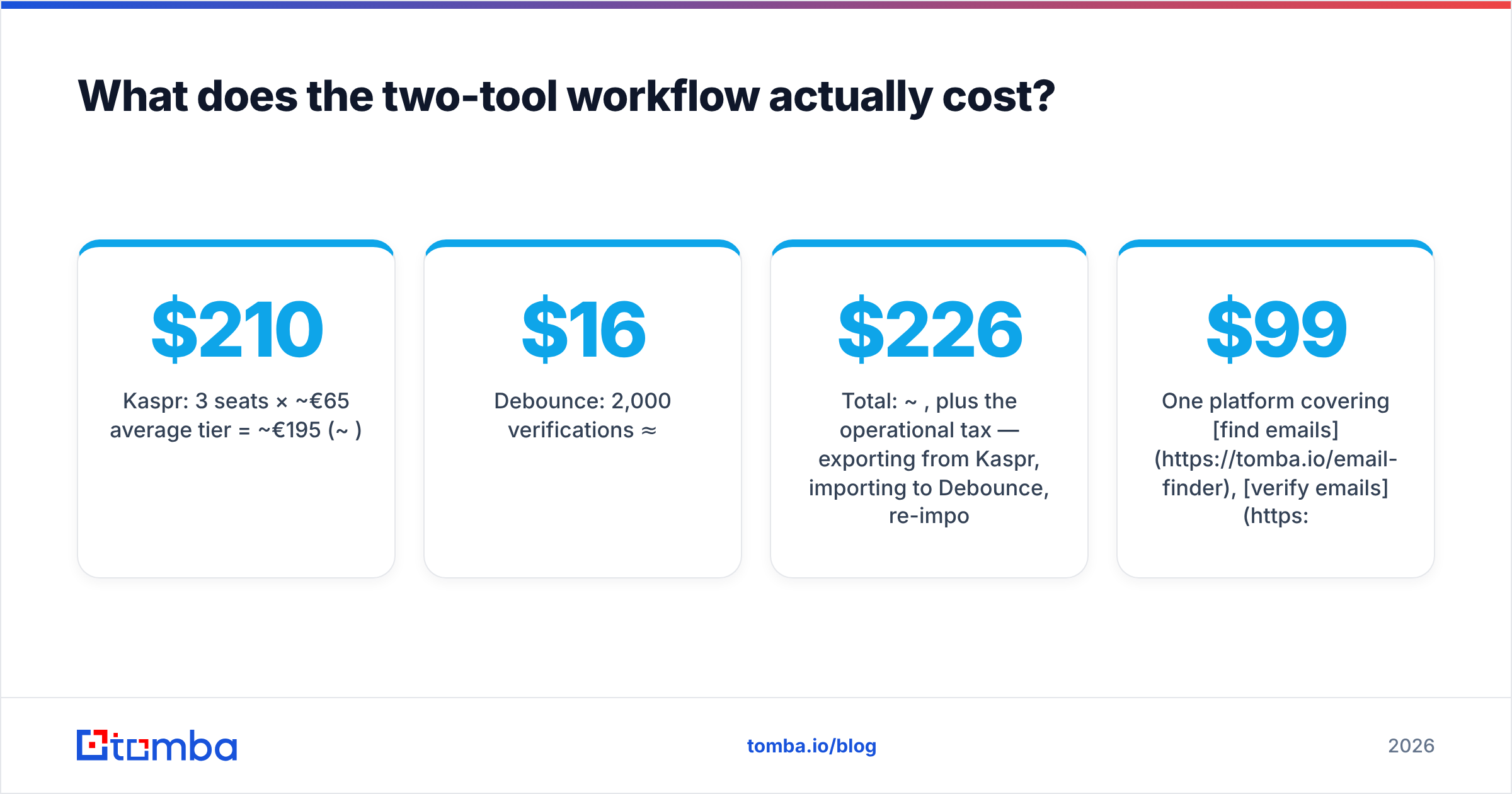
- Kaspr: 3 seats × ~€65/mo average tier =
€195/mo ($210) - Debounce: 2,000 verifications ≈ $16/mo
- Total: ~$226/mo, plus the operational tax — exporting from Kaspr, importing to Debounce, re-importing the clean file to your sequencer, and reconciling which records dropped out.
A consolidated stack:
- One platform covering find emails, verify emails, and phone lookup: $99/mo on Growth for most teams of that size.
- No export-import loop. No seat multiplication.
The dollar gap matters less than the workflow gap. Every manual handoff between two tools is a place where records silently disappear, where you re-verify contacts you already verified last month, and where nobody can answer "how many of our contacts are actually reachable?" without opening three tabs.
That said — if you already own Debounce credits that never expire, and Kaspr's EU mobile coverage is genuinely load-bearing for your motion, the two-tool stack is defensible. Don't consolidate for the sake of consolidating.

What are the credible alternatives to both?#
If you're evaluating these two, you should also price these:
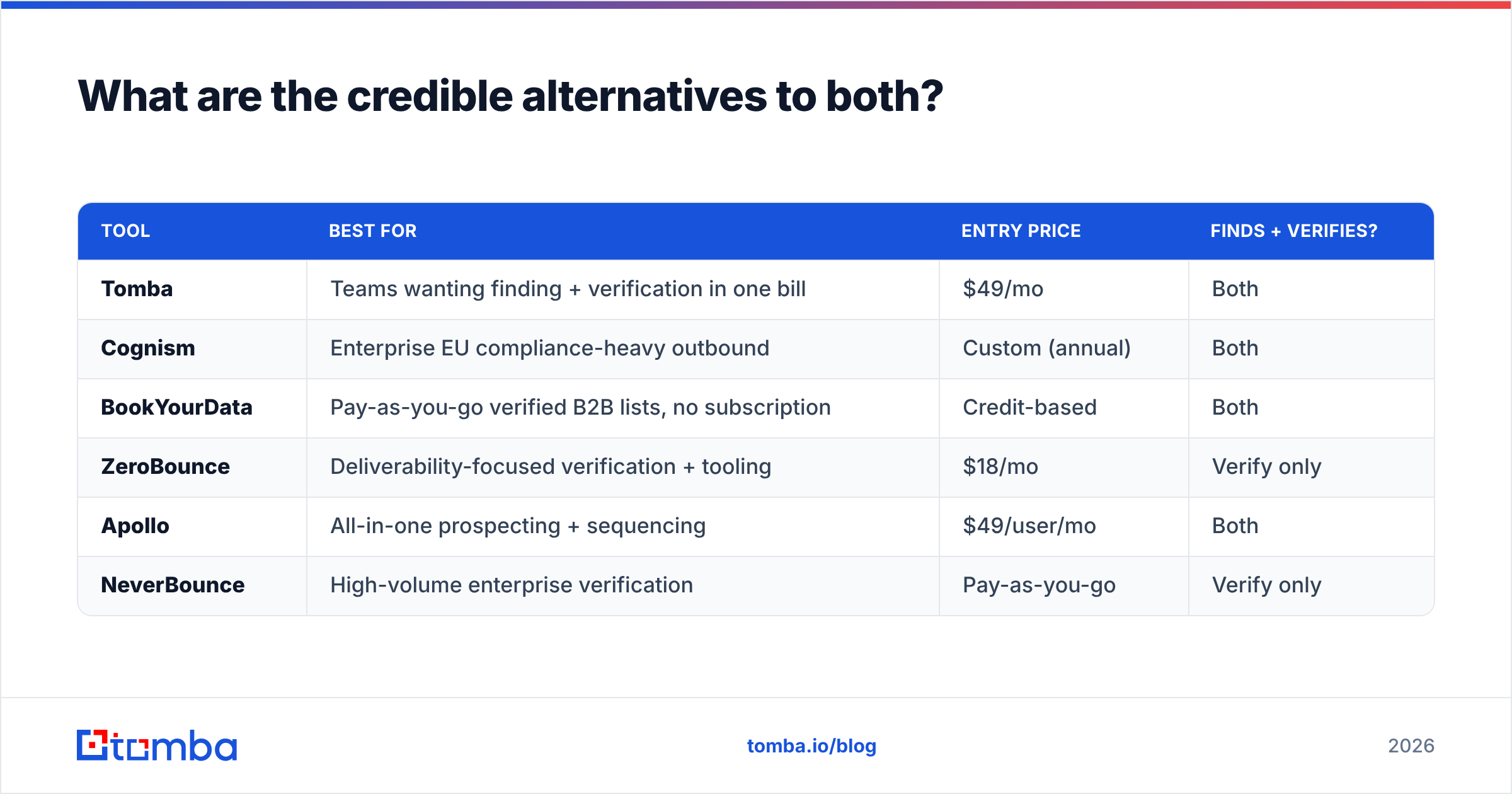
| Tool | Best for | Entry price | Finds + verifies? |
|---|---|---|---|
| Tomba | Teams wanting finding + verification in one bill | $49/mo | Both |
| Cognism | Enterprise EU compliance-heavy outbound | Custom (annual) | Both |
| BookYourData | Pay-as-you-go verified B2B lists, no subscription | Credit-based | Both |
| ZeroBounce | Deliverability-focused verification + tooling | $18/mo | Verify only |
| Apollo | All-in-one prospecting + sequencing | $49/user/mo | Both |
| NeverBounce | High-volume enterprise verification | Pay-as-you-go | Verify only |
A few notes on that table. BookYourData is worth a look if you dislike subscriptions entirely — you buy verified contact lists outright, no seats, no monthly floor, and the accuracy guarantee is unusually explicit. It's a genuinely different purchasing model from both Debounce and Kaspr. Cognism owns Kaspr, so evaluating both is really evaluating one company's two price points. And Apollo bundles sequencing, which either saves you a tool or forces you into a sequencer you didn't want.
For verification-only shoppers, the ZeroBounce alternative comparison covers the deliverability-tooling angle in more depth.

How do you get the most out of whichever you pick?#
Some hard-won operational rules, independent of vendor:
- Verify at the point of capture, not before the send. Running verification as a batch job the night before a campaign means you're verifying contacts that entered your CRM six months ago. Hook verification into the moment a record is created — via API or a workflow automation — and the problem disappears.
- Never mail an "unknown" result. Catch-all and unknown results are not soft yes's. Segment them into a separate, low-volume, high-warmth sequence, or route them to LinkedIn instead. Mixing them into your main send is how sender reputation erodes.
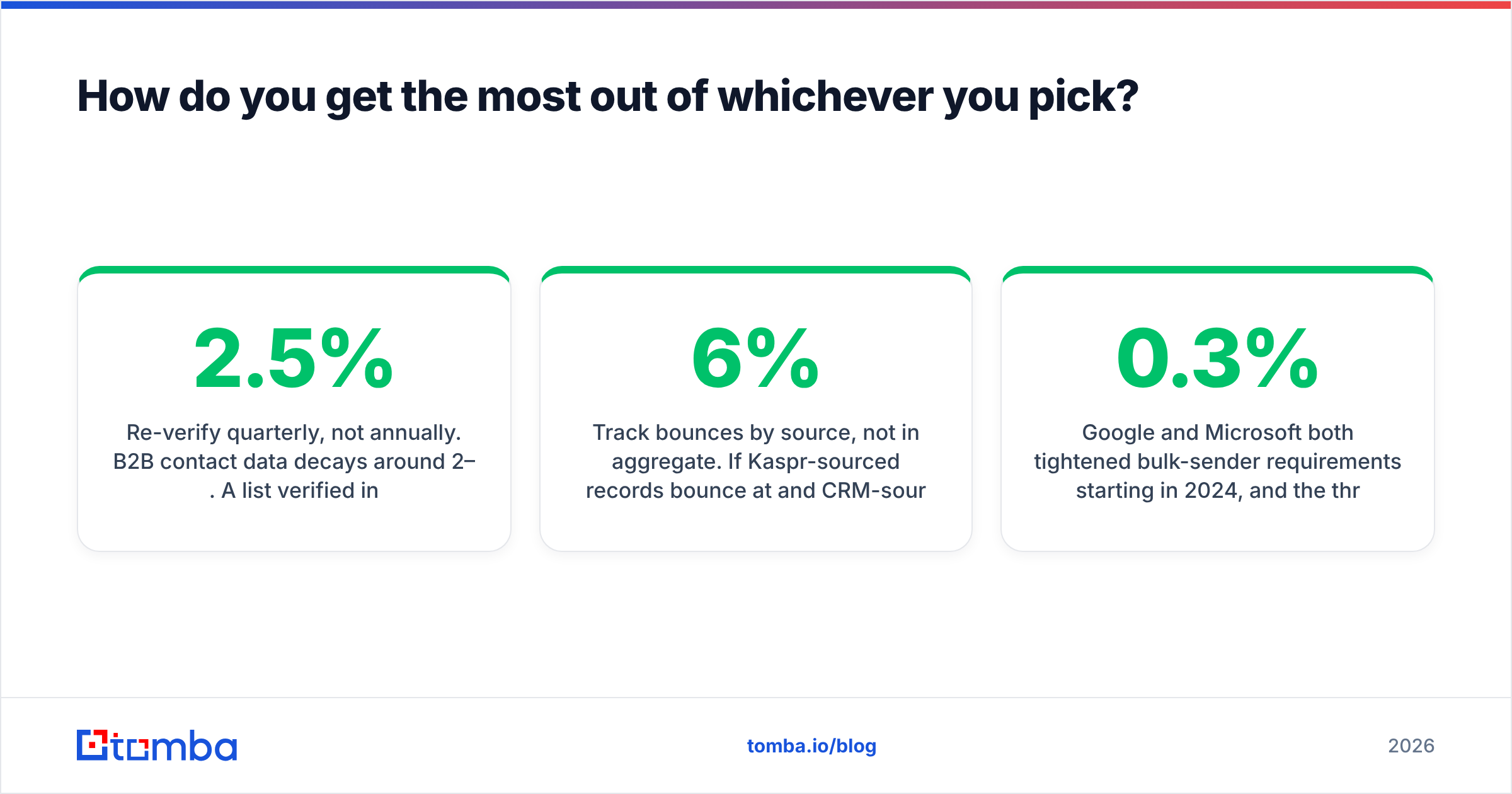
- Re-verify quarterly, not annually. B2B contact data decays around 2–2.5% per month. A list verified in January is materially worse by April.
- Track bounces by source, not in aggregate. If Kaspr-sourced records bounce at 6% and CRM-sourced at 1%, an aggregate 3% figure hides the actionable signal.
- Watch the seat count. Seat-based tools get renewed at the seat count you had at peak headcount. Audit before every renewal.
Google and Microsoft both tightened bulk-sender requirements starting in 2024, and the thresholds haven't loosened since. Google's bulk sender guidelines specify keeping spam complaint rates under 0.3% — which is only achievable if the list underneath is genuinely clean. Verification stopped being optional hygiene and became a delivery prerequisite.
So which wins — Debounce or Kaspr?#
Neither, on the merits of the matchup itself, because they aren't playing the same game.
Pick Debounce if you have contacts and a bounce problem, you buy data episodically, and you want credits that don't evaporate at month-end. It's a well-built, fairly priced, single-purpose tool. It does not pretend to be more than that, which is refreshing.
Pick Kaspr if your prospecting lives on LinkedIn, your ICP is European, and mobile numbers are load-bearing for your motion. The seat pricing only stings if your team is large or your usage is seasonal.
Pick neither — and consolidate — if you're doing continuous outbound and paying two vendors to solve two halves of one problem. That's the most common situation among teams running this comparison, and it's the one where the two-tool stack costs the most in operational drag rather than dollars.
The honest test: open your last campaign's bounce report and your last month's prospecting log side by side. Whichever number embarrasses you more tells you which tool to buy. If both do, you have a stack problem, not a vendor problem.
Ready to stop paying two vendors for one workflow? The Tomba Email Finder finds verified professional emails by domain, name, or company — with verification, catch-all detection, and phone lookup built into the same account. Start free with 25 searches a month, then scale on Tomba pricing from $49/mo when the pipeline justifies it. No seat multiplication, no export-import loop, no reconciling two credit balances at the end of the quarter.
Related guides#
Ready to find emails that actually work?
Join 150,000+ professionals who stopped guessing and started sending. Free credits on signup — no credit card required.
Get the Tomba newsletter
Practical outbound tactics and product updates — once every two weeks.
About the author