Dedicated IP Benefits: When It Helps and When It Hurts
A dedicated IP is sold as a deliverability upgrade, but below a certain send volume it quietly makes inboxing worse. Here is the volume math, the warmup schedule, and the honest decision rule.

TL;DR
- A dedicated IP only pays off if you send enough volume to build a reputation signal mailbox providers can actually read — roughly 100,000+ emails per month, sent consistently.
- Below that threshold, a dedicated IP is usually worse than a well-managed shared pool, because low, irregular volume looks like a dormant or hijacked sender.
- The real dedicated IP benefits are isolation from other senders, control over your own reputation curve, and predictable throughput — not a magic inbox boost.
- Every dedicated IP needs a 4–8 week warmup. Skipping it is the single most common way teams tank a domain they just paid to protect.
- IP reputation is now secondary to domain reputation and list quality. Clean your data first; a dedicated IP amplifies whatever behavior you already have, good or bad.
What is a dedicated IP, and what does it actually change?#
A dedicated IP address is a sending IP used by exactly one sender — you. A shared IP is a pool address used by dozens or thousands of customers of the same email platform.
Think of it like a delivery van. On a shared IP, you're one of forty businesses whose packages ride in the same van. If another business ships something that gets the van flagged at the border, your packages sit in the queue too. On a dedicated IP, you own the van. Nobody else can get it flagged — and nobody else's clean record can vouch for you either. You start with no history at all.
That last part is the piece most vendors skip in the upsell. A dedicated IP does not begin at "trusted." It begins at "unknown," which mailbox providers treat with more suspicion than "known and mediocre." You are trading other people's risk for your own blank slate.
What a dedicated IP changes:
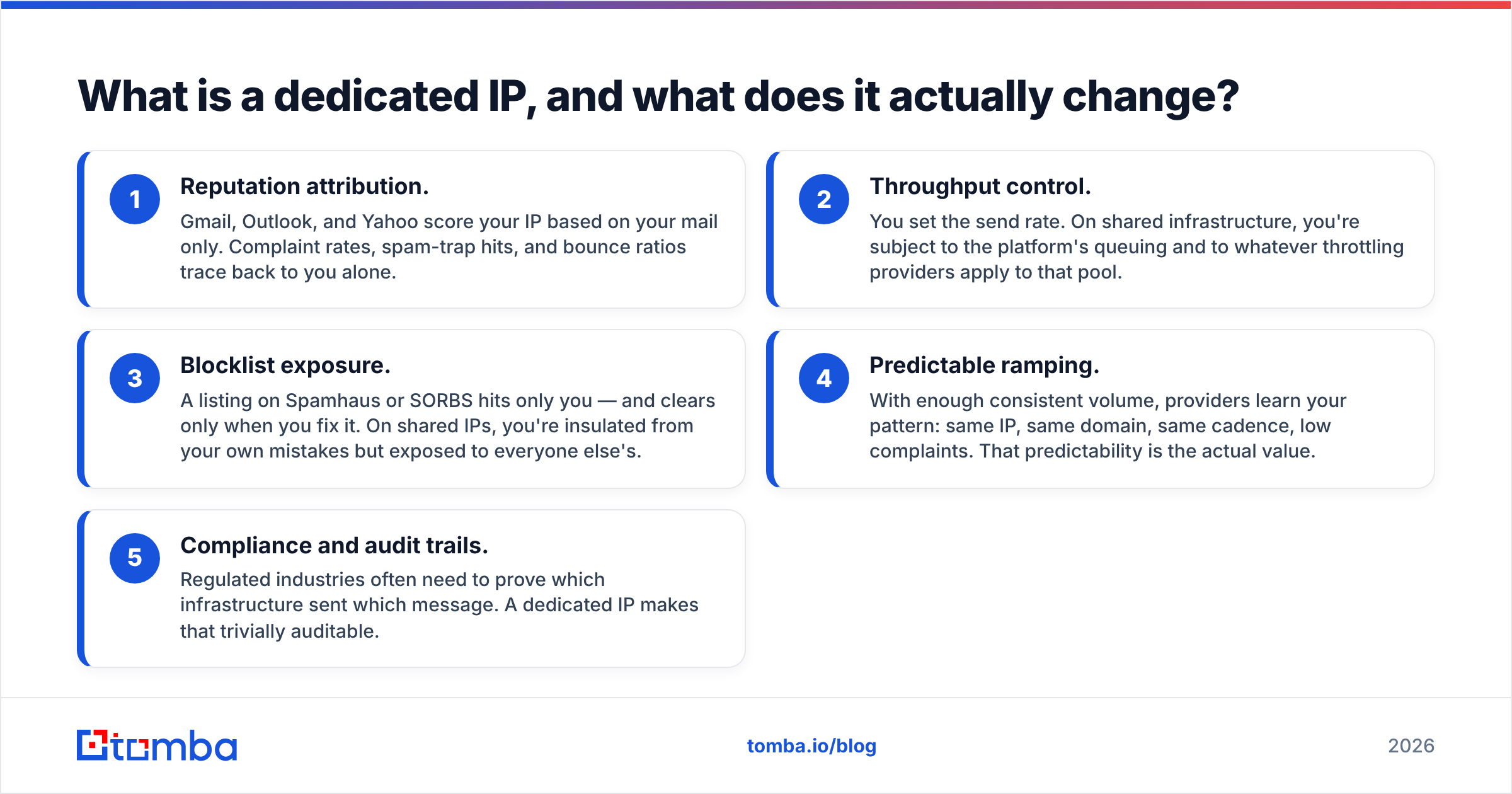
- Reputation attribution. Gmail, Outlook, and Yahoo score your IP based on your mail only. Complaint rates, spam-trap hits, and bounce ratios trace back to you alone.
- Throughput control. You set the send rate. On shared infrastructure, you're subject to the platform's queuing and to whatever throttling providers apply to that pool.
- Blocklist exposure. A listing on Spamhaus or SORBS hits only you — and clears only when you fix it. On shared IPs, you're insulated from your own mistakes but exposed to everyone else's.
- Predictable ramping. With enough consistent volume, providers learn your pattern: same IP, same domain, same cadence, low complaints. That predictability is the actual value.
- Compliance and audit trails. Regulated industries often need to prove which infrastructure sent which message. A dedicated IP makes that trivially auditable.

Is a dedicated IP better than a shared IP?#
Only above a volume floor. Below it, shared wins on almost every axis.
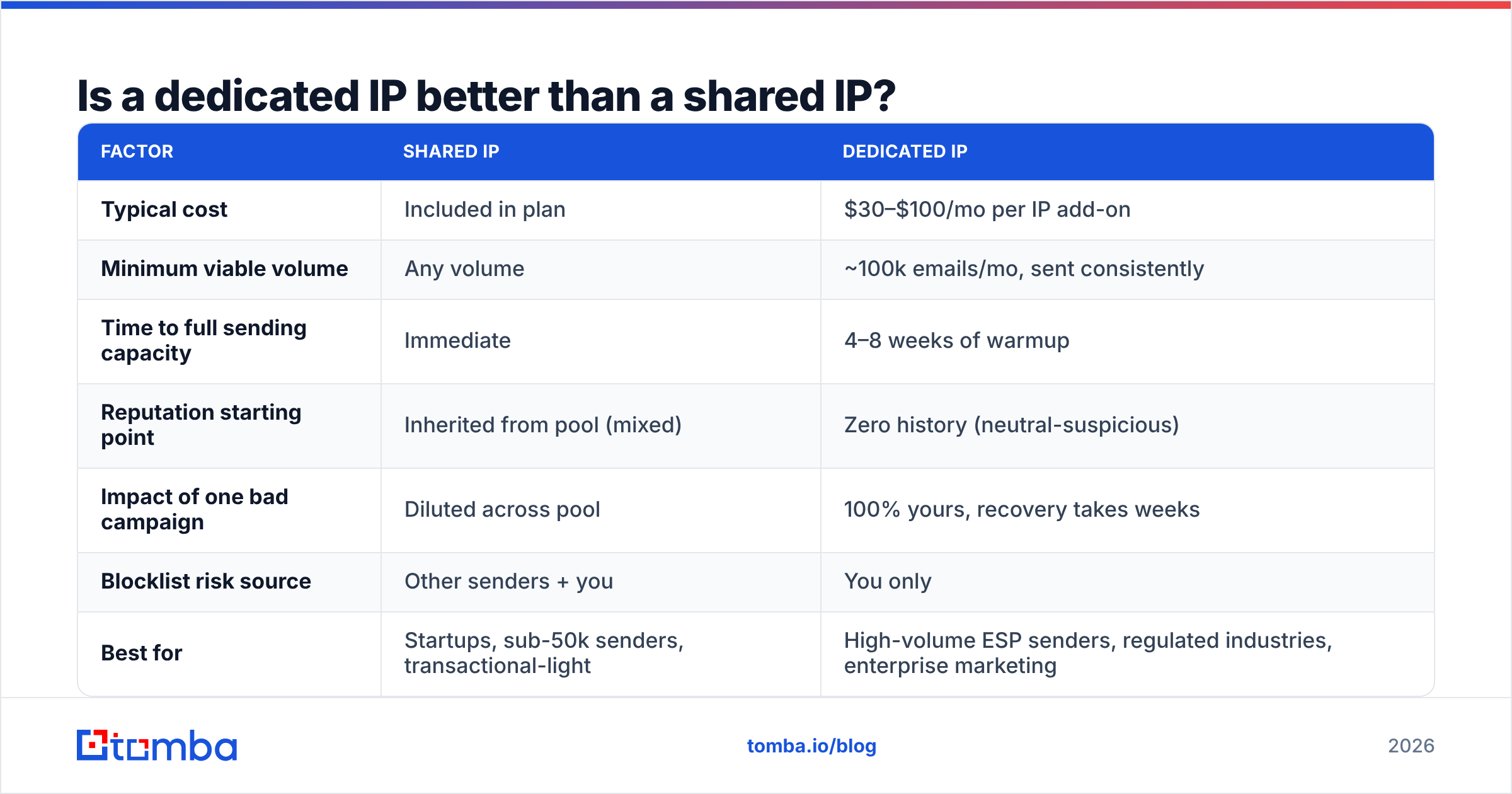
| Factor | Shared IP | Dedicated IP |
|---|---|---|
| Typical cost | Included in plan | $30–$100/mo per IP add-on |
| Minimum viable volume | Any volume | ~100k emails/mo, sent consistently |
| Time to full sending capacity | Immediate | 4–8 weeks of warmup |
| Reputation starting point | Inherited from pool (mixed) | Zero history (neutral-suspicious) |
| Impact of one bad campaign | Diluted across pool | 100% yours, recovery takes weeks |
| Blocklist risk source | Other senders + you | You only |
| Best for | Startups, sub-50k senders, transactional-light | High-volume ESP senders, regulated industries, enterprise marketing |
| Worst for | Brands needing audit-grade isolation | Sporadic senders, one-off campaigns, cold outbound at low volume |
The volume floor exists because mailbox providers need a statistically meaningful sample to score you. If you send 4,000 emails a month from a dedicated IP, Gmail sees a trickle from an address with no history. It has nothing to build a profile from, so it defaults to caution — and caution means Promotions tab, greylisting, or spam.
On a shared pool run by a competent provider, that same 4,000 emails ride alongside millions of well-behaved messages. You inherit the pool's earned trust. For small and mid-size senders, that inherited trust is worth more than isolation.
There is a middle path many teams miss: subdomain separation on a shared IP. Sending marketing mail from mail.yourdomain.com and transactional from notify.yourdomain.com gives you reputation isolation at the domain level — which now carries more weight than IP with Gmail and Yahoo — without the warmup cost. Understanding email deliverability as a domain-first discipline saves a lot of money on IP add-ons.
What is the real volume threshold for dedicated IP benefits?#
Use these bands as a decision rule, not gospel — your industry, list age, and engagement rates shift the lines.
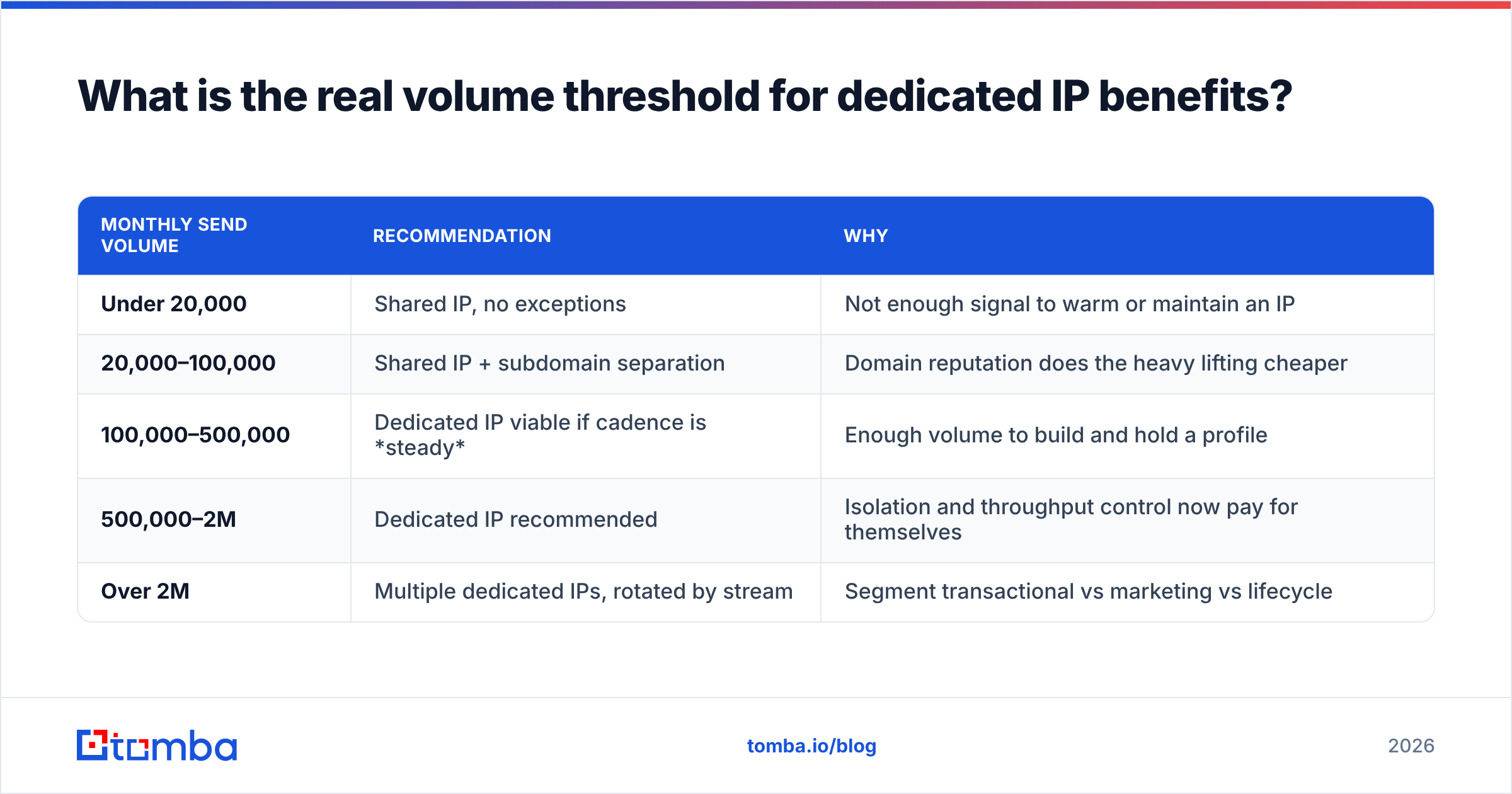
| Monthly send volume | Recommendation | Why |
|---|---|---|
| Under 20,000 | Shared IP, no exceptions | Not enough signal to warm or maintain an IP |
| 20,000–100,000 | Shared IP + subdomain separation | Domain reputation does the heavy lifting cheaper |
| 100,000–500,000 | Dedicated IP viable if cadence is steady | Enough volume to build and hold a profile |
| 500,000–2M | Dedicated IP recommended | Isolation and throughput control now pay for themselves |
| Over 2M | Multiple dedicated IPs, rotated by stream | Segment transactional vs marketing vs lifecycle |
The word doing the most work in that table is steady. A company sending 150,000 emails in one Black Friday blast and 3,000 the rest of the month is not a 150k-per-month sender. It's a 3k-per-month sender with a spike — the exact volume pattern that trips volume-anomaly filters. Consistency matters more than raw totals.
Two secondary conditions matter as much as volume:
- Complaint rate under 0.1%. Google's Postmaster Tools threshold. Above 0.3% you will be filtered regardless of which IP you use. A dedicated IP does not buy forgiveness.
- Bounce rate under 2%. High bounces on a dedicated IP compound fast, because there's no pool average to hide behind. This is why email verification is a prerequisite, not an optimization — you cannot warm an IP with a list full of dead addresses.
How do you warm up a dedicated IP without burning it?#
Warmup is the process of gradually increasing volume from a new IP so providers can build a reputation profile without triggering volume-spike defenses. Rushing it is the most expensive mistake in this entire topic.
The mechanics are simple and the discipline is hard:
- Week 1: 50–200 sends/day, exclusively to your most engaged segment — people who opened or clicked in the last 30 days.
- Week 2: Roughly double daily volume. Watch Gmail Postmaster Tools daily, not weekly.
- Weeks 3–4: Continue doubling while keeping the engaged-first ordering. Introduce your 90-day engaged segment.
- Weeks 5–8: Layer in colder segments. Any day where complaint rate exceeds 0.1% or spam-folder placement rises, hold volume flat for 48 hours instead of advancing.
- Ongoing: Never drop to zero. An IP that goes silent for 30 days loses much of its accumulated trust and needs partial re-warming.
Run the numbers before you start — a warmup calculator will tell you how many days it takes to reach your target daily volume from a cold start. Most teams are surprised that reaching 50,000/day responsibly takes closer to two months than two weeks.
Authentication has to be in place before day one, not bolted on midway. That means a valid SPF record, DKIM signing on the sending domain, and a DMARC policy at minimum p=none with reporting enabled. Since the 2024 Google and Yahoo bulk-sender requirements, DMARC alignment is table stakes for anyone sending over 5,000 messages a day — dedicated IP or not.
What are the hidden costs of a dedicated IP?#
The monthly add-on fee is the smallest line item. The real costs:
Operational overhead. Somebody has to watch Postmaster Tools, monitor blocklists, and make judgment calls when placement dips. On a shared pool, the provider's deliverability team does this. On a dedicated IP, it's your problem at 11pm before a launch. Budget for the headcount attention, not just the $50/month.
Recovery time. Damage a shared IP and the pool absorbs it. Damage a dedicated IP — one bad purchased list, one spam-trap cluster — and you're looking at 3–6 weeks of throttled sending, plus delisting requests, plus a re-warm. Run a blacklist checker weekly so you find out from your own monitoring rather than from a client asking why they stopped getting emails.
The multi-IP problem. Once you separate transactional from marketing from lifecycle mail, you own three IPs, each needing its own volume floor and its own warmup. Splitting 150,000 monthly sends across three dedicated IPs gives you three under-warmed IPs instead of one healthy one. Segment only when total volume supports it.
False confidence. This is the expensive one. Teams buy a dedicated IP, assume deliverability is solved, and stop cleaning lists. Reputation is behavioral. The IP is the address the behavior is recorded against — it does not change the behavior. Sending to unverified, scraped, or stale contacts will destroy a dedicated IP faster than a shared one, because there's no dilution.
Which senders should actually buy a dedicated IP?#
Buy one if you meet all of these:
- Volume: 100,000+ emails per month, sent on a consistent weekly cadence, with a credible path to growth.
- Data hygiene: Bounce rate already under 2% on your current infrastructure, with verification built into your list-building process.
- Ownership: A named person responsible for monitoring deliverability metrics at least weekly.
- Stream separation need: Transactional mail whose delivery cannot be affected by marketing performance — password resets, receipts, security alerts.
- Timeline tolerance: You can absorb 4–8 weeks of ramped-down sending before hitting full capacity.
Skip it — and invest the money in list quality and content instead — if you're doing cold outbound at 5,000–20,000 emails a month, running seasonal campaigns, or still fighting a bounce rate above 3%. In those cases a well-managed shared pool from a reputable provider (compare the field on G2's deliverability category) will outperform a cold dedicated IP every time.
Vendor documentation broadly agrees on the threshold. SendGrid and most large ESPs publish similar guidance around consistent high-volume sending as the qualifying condition. When the companies selling dedicated IPs tell you that you may not need one, that's a signal worth taking seriously.
How does list quality interact with IP reputation?#
It dominates it. Sender reputation is calculated from recipient behavior: opens, replies, complaints, deletions without reading, and — critically — hard bounces and spam-trap hits.
A dedicated IP changes who is scored. It does not change what is scored.
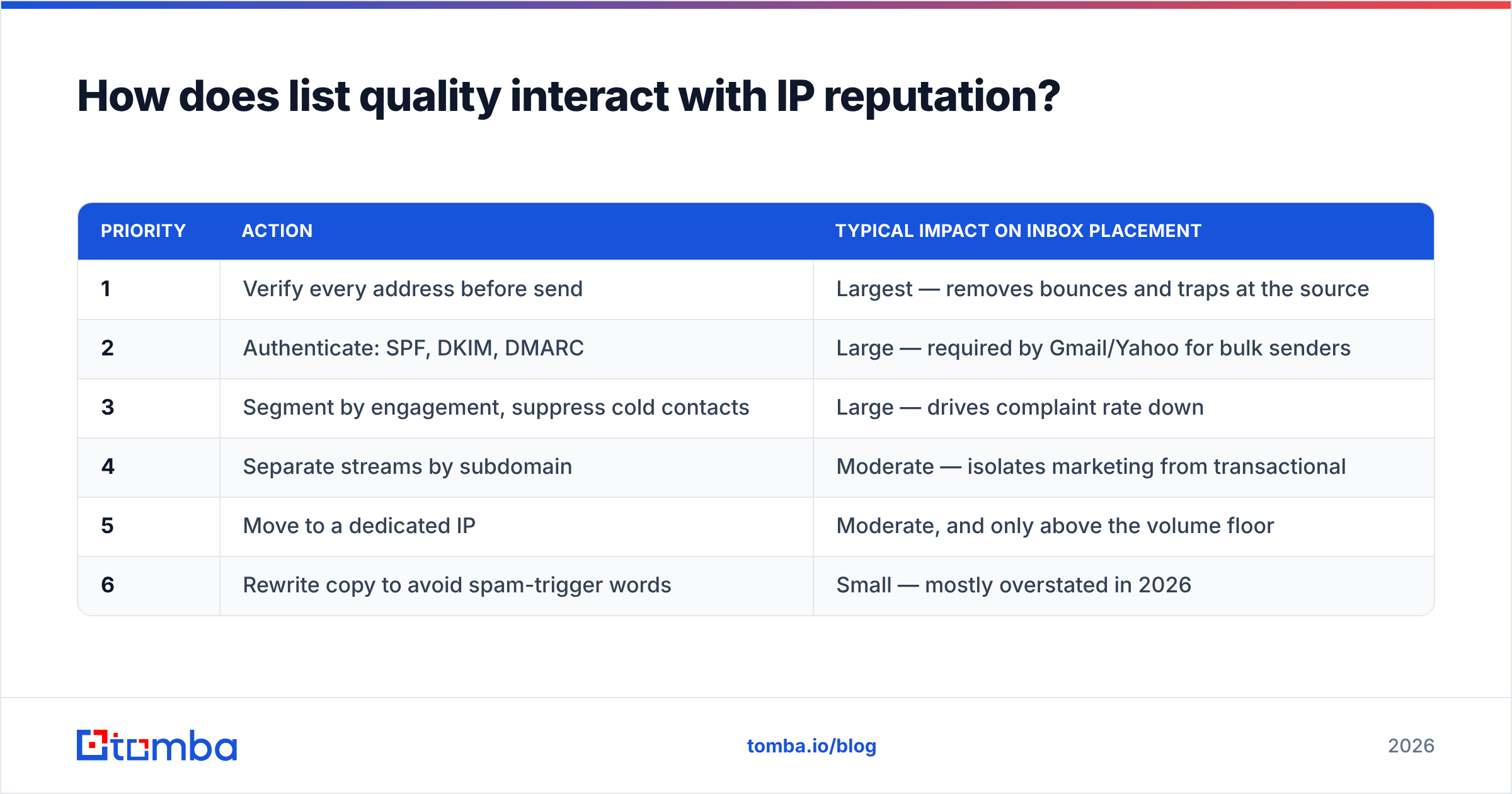
Here's the practical order of operations, ranked by impact per dollar:
| Priority | Action | Typical impact on inbox placement |
|---|---|---|
| 1 | Verify every address before send | Largest — removes bounces and traps at the source |
| 2 | Authenticate: SPF, DKIM, DMARC | Large — required by Gmail/Yahoo for bulk senders |
| 3 | Segment by engagement, suppress cold contacts | Large — drives complaint rate down |
| 4 | Separate streams by subdomain | Moderate — isolates marketing from transactional |
| 5 | Move to a dedicated IP | Moderate, and only above the volume floor |
| 6 | Rewrite copy to avoid spam-trigger words | Small — mostly overstated in 2026 |
Notice that the dedicated IP sits fifth. Teams routinely buy it first because it's the item you can purchase with a credit card in ninety seconds, while the four items above it require process changes.
The highest-leverage move is at the top of that list: don't acquire bad addresses in the first place. Sourcing contacts through a verified email finder with real-time SMTP validation means the addresses entering your CRM are deliverable before they ever reach a campaign. Cleaning a dirty list is remediation; building a clean one is prevention, and prevention is what keeps an expensive dedicated IP from becoming an expensive liability.
The honest verdict#
A dedicated IP is infrastructure, not a fix. Its benefits — isolation, control, predictability, auditability — are real and worth paying for once you send enough mail for those properties to matter. Below roughly 100,000 consistent monthly sends, it costs you money, adds two months of ramp, and hands you a reputation liability you previously shared with a thousand other senders who were, on average, behaving fine.
Decide by volume and cadence first, by data hygiene second, and by vendor pitch never.
Start where the leverage actually is. Before you pay for a dedicated IP, make sure every address you send to is real. Tomba Email Finder verifies addresses at the point of discovery — SMTP-checked, catch-all flagged, and enriched — so your bounce rate stays under 2% whether you're on shared infrastructure or your own IP. The free tier gives you 25 searches a month to test it against a list you already have; paid plans start at $49/mo. Check Tomba pricing to size a plan against your monthly send volume.
Related guides#
Ready to find emails that actually work?
Join 150,000+ professionals who stopped guessing and started sending. Free credits on signup — no credit card required.
Get the Tomba newsletter
Practical outbound tactics and product updates — once every two weeks.
About the author