Dedicated Sales Team: How to Build One That Actually Closes
A dedicated sales team is the most expensive bet most B2B companies make. Here is the real cost math, the in-house vs outsourced trade-off, and the four signals that tell you it's time.
TL;DR
- A dedicated sales team is a group of people whose only job is revenue — no support tickets, no product work, no "sales when I have time." The word that matters is dedicated, not sales.
- A minimum viable in-house team in 2026 (1 manager, 2 SDRs, 1 AE) runs roughly $52,000–$68,000/month fully loaded in the US. Outsourced equivalents start near $8,000–$15,000/month but you trade control and product depth.
- Do not build one until you have repeatable close data from a founder or first rep: at least 15–20 closed deals from a documented process. Hiring reps to discover your motion is how most teams burn a year.
- Contact data quality quietly decides whether the investment works. A rep at $8K/month wasting 30% of their week on bad emails is $2,400/month of pure loss — before you count deliverability damage.
- The realistic ramp is 4–7 months to full productivity. Budget for that before you sign the first offer letter.
What is a dedicated sales team?#
A dedicated sales team is a permanent group of specialists whose compensation, quota, and calendar are tied to one thing: pipeline and closed revenue. That's it. The distinction sounds obvious until you look at how most sub-$5M companies actually operate — a founder selling three days a week, a customer success person doing "light outbound," a marketer who occasionally sends a cold sequence.
That arrangement isn't a sales team. It's sales coverage. Coverage produces lumpy, unpredictable revenue because the moment something breaks in the product or a big customer escalates, selling stops entirely.
Dedicated means three things in practice:
- Single accountability. Every person on the team has a number. Not a soft goal — a quota with a comp plan attached.
- Protected time. Reps are not on-call for support, onboarding, or bug triage. Their calendar is calls, research, and follow-up.
- A defined motion. The team runs a documented process — ICP, qualification framework, sequence cadence, handoff rules — rather than improvising per deal.
Take away any one of those and you have expensive coverage, not a team.
What roles does a dedicated sales team actually need?#
The most common structural mistake is hiring one "salesperson" and expecting them to prospect, qualify, demo, negotiate, and expand. Those are five different skill sets, and the market pays differently for each. Here's the minimum functional split for a B2B team selling a $6K–$60K ACV product:
- SDR / BDR (Sales Development Rep). Owns top-of-funnel. Builds lists, runs outbound sequences, books qualified meetings. Measured on meetings held, not emails sent. Ratio: roughly 2 SDRs per AE for outbound-heavy motions, 1:1 if inbound carries half the pipeline.
- AE (Account Executive). Owns discovery through close. Runs demos, builds business cases, negotiates. Measured on closed-won ARR and win rate. A ramped mid-market AE should carry 4–6x their OTE in quota.
- Sales Manager / Head of Sales. Owns forecast accuracy, coaching cadence, and process. Not a super-rep — a manager who still carries a personal quota is a manager who will not coach. Below 4 reps, the founder often holds this seat; past 4, it needs to be real.
- Sales Ops / RevOps (fractional at first). Owns the CRM, routing rules, data hygiene, and reporting. Can be 10 hours a week from a contractor early on. Skipping it entirely means your pipeline numbers are fiction by month six.
- Solutions / Sales Engineer (only if technical). Handles security reviews, integrations questions, and technical proof. If your AEs are losing deals at the technical-validation stage, this is the gap.
You do not need all five on day one. You do need to know which one you're buying when you make each hire, and what number that person owns.
Should you build in-house or hire an outsourced dedicated sales team?#
"Dedicated sales team" is also the standard phrase agencies use for a rented pod — usually 1–3 reps who work your accounts under your brand but sit on the vendor's payroll. Both models are legitimate. They fail in different ways.
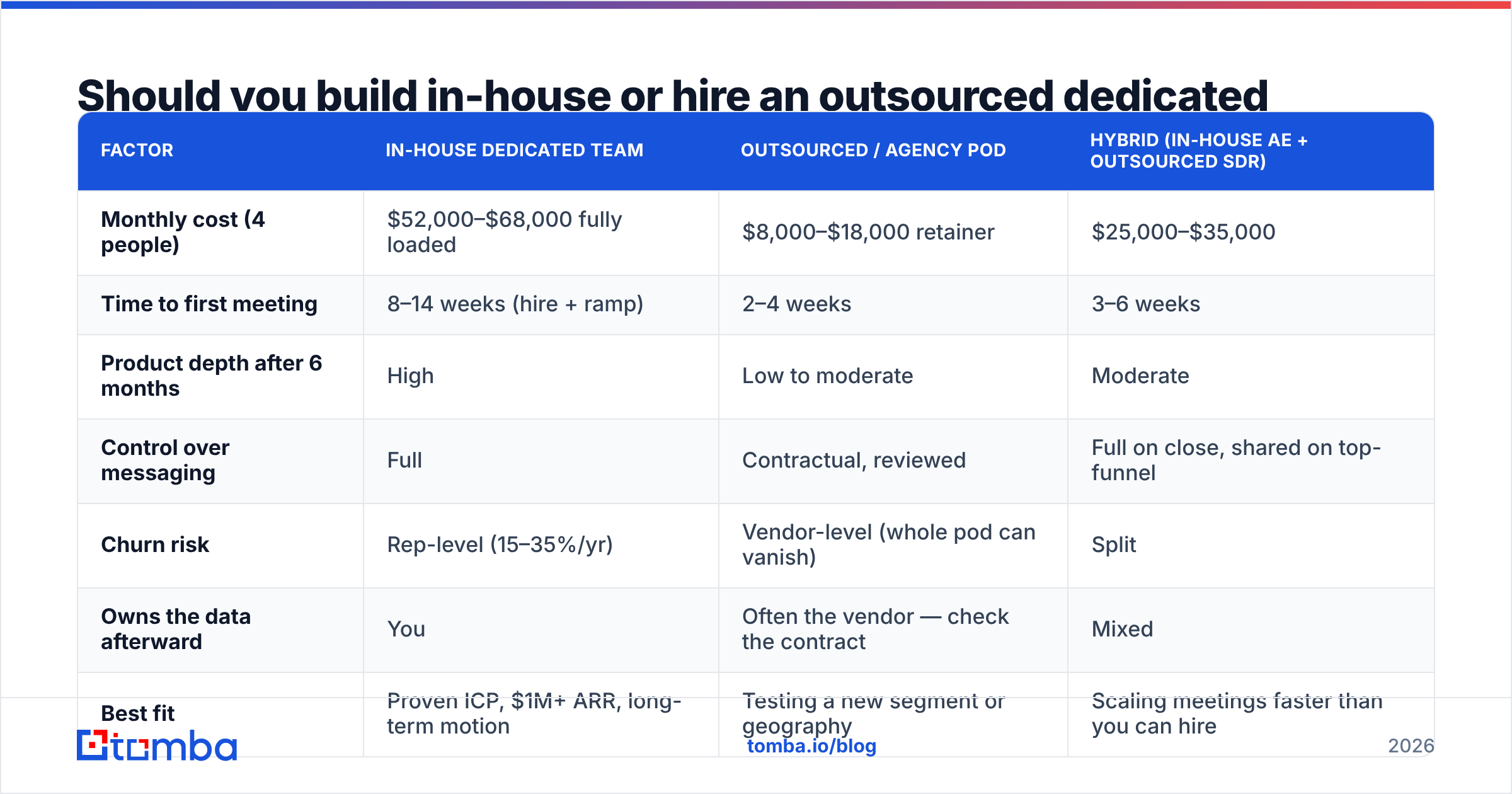
| Factor | In-house dedicated team | Outsourced / agency pod | Hybrid (in-house AE + outsourced SDR) |
|---|---|---|---|
| Monthly cost (4 people) | $52,000–$68,000 fully loaded | $8,000–$18,000 retainer | $25,000–$35,000 |
| Time to first meeting | 8–14 weeks (hire + ramp) | 2–4 weeks | 3–6 weeks |
| Product depth after 6 months | High | Low to moderate | Moderate |
| Control over messaging | Full | Contractual, reviewed | Full on close, shared on top-funnel |
| Churn risk | Rep-level (15–35%/yr) | Vendor-level (whole pod can vanish) | Split |
| Owns the data afterward | You | Often the vendor — check the contract | Mixed |
| Best fit | Proven ICP, $1M+ ARR, long-term motion | Testing a new segment or geography | Scaling meetings faster than you can hire |
| Biggest failure mode | Hiring before the motion is repeatable | Volume over relevance; brand damage | Handoff friction between pods |
The honest heuristic: outsource discovery, insource closing. Agencies are genuinely good at volume prospecting into a segment you want to test cheaply. They are rarely good at nuanced multi-stakeholder closing, because that requires product context they can't accumulate across five clients.
If you outsource, negotiate two things hard before signing: (1) you own the contact data and the sequences at termination, and (2) sending happens on subdomains you control, so a burned domain is a subdomain, not your primary.
What does a dedicated sales team really cost in 2026?#
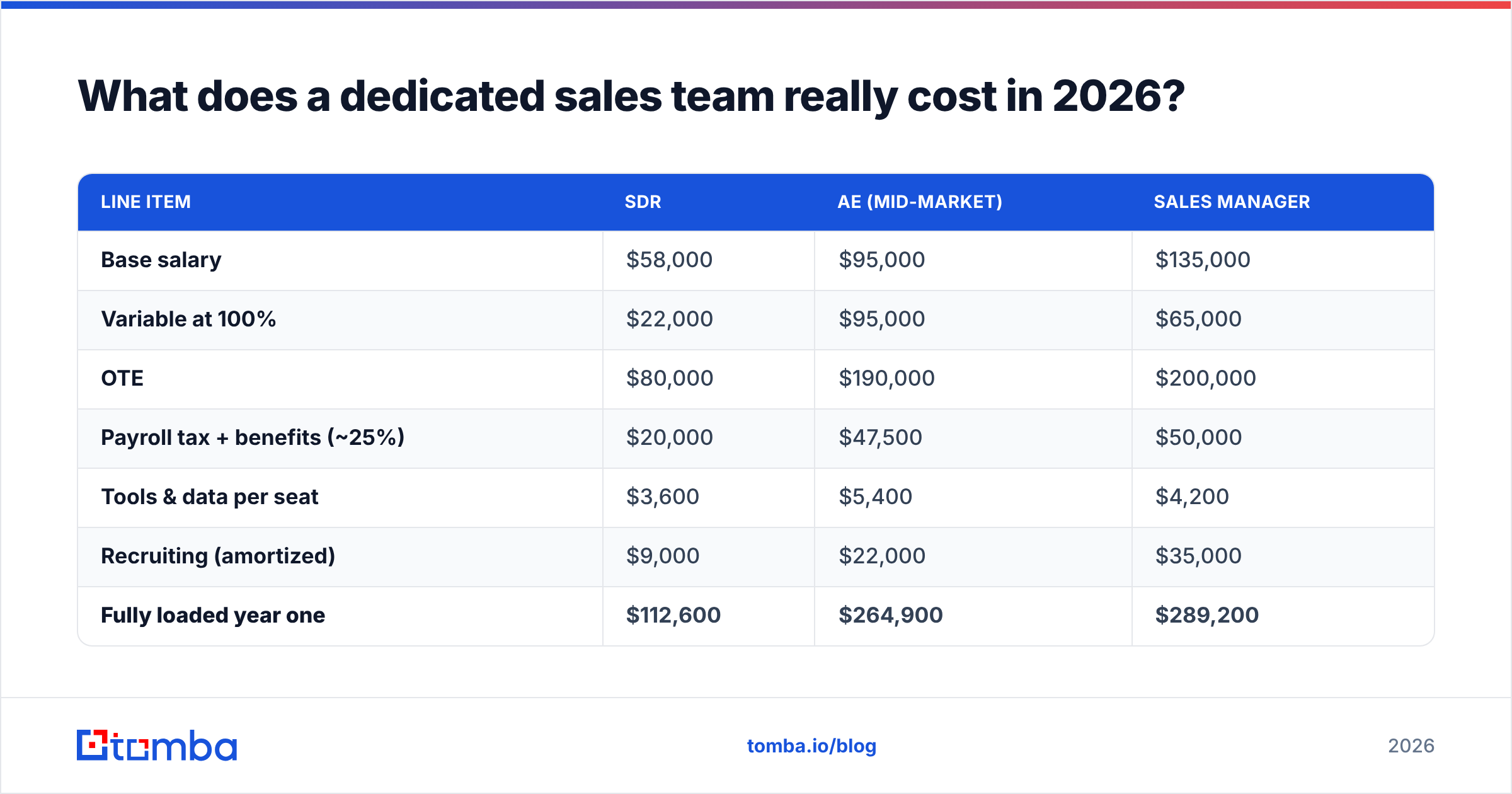
Base salary is the number people quote. Fully loaded cost is the number that hits your bank account. The gap is usually 1.5–1.8x.
| Line item | SDR | AE (mid-market) | Sales Manager |
|---|---|---|---|
| Base salary | $58,000 | $95,000 | $135,000 |
| Variable at 100% | $22,000 | $95,000 | $65,000 |
| OTE | $80,000 | $190,000 | $200,000 |
| Payroll tax + benefits (~25%) | $20,000 | $47,500 | $50,000 |
| Tools & data per seat | $3,600 | $5,400 | $4,200 |
| Recruiting (amortized) | $9,000 | $22,000 | $35,000 |
| Fully loaded year one | $112,600 | $264,900 | $289,200 |
A 2-SDR / 1-AE / 1-manager team therefore costs roughly $779,000 in year one — about $65,000/month — and produces close to nothing for the first quarter. That's not pessimism; industry ramp benchmarks consistently put full AE productivity at 4–7 months, and HubSpot's sales research has tracked similar ramp curves for years.
Run the payback math before you hire, not after:
- Team cost year one: $779,000
- Required gross profit to break even at 80% margin: ~$974,000 in new ARR
- At a $25,000 ACV: 39 new logos in a year, from a team that's only productive for eight months of it
- That means ~5 closes/month from a single AE — aggressive but achievable if meeting volume is there
If that math doesn't clear, the answer isn't a bigger team. It's a higher ACV, a shorter cycle, or a cheaper motion.
When is a company actually ready to build one?#
Four signals, and you want at least three of them:
1. You have 15–20 closed deals from a documented process. Not 15 deals from your network. Deals where you can name the trigger, the objection pattern, and the reason they signed. Reps execute a motion; they rarely invent one.
2. Your CAC payback is under 18 months on existing deals. If founder-led sales already has ugly unit economics, adding salaried reps makes them worse, not better.
3. Someone is turning away leads. The clearest signal in the world. If your founder is declining meetings for lack of hours, capacity is the constraint and headcount solves it directly.
4. You can fund 9 months of full burn. Not 4. Hiring a team you have to cut in month six costs more than not hiring at all — you lose the money, the ramp, and the market reputation.
Missing three of four? Hire one strong AE and a fractional RevOps contractor instead. Prove the motion, then scale it.

What does a dedicated sales team need to actually hit quota?#
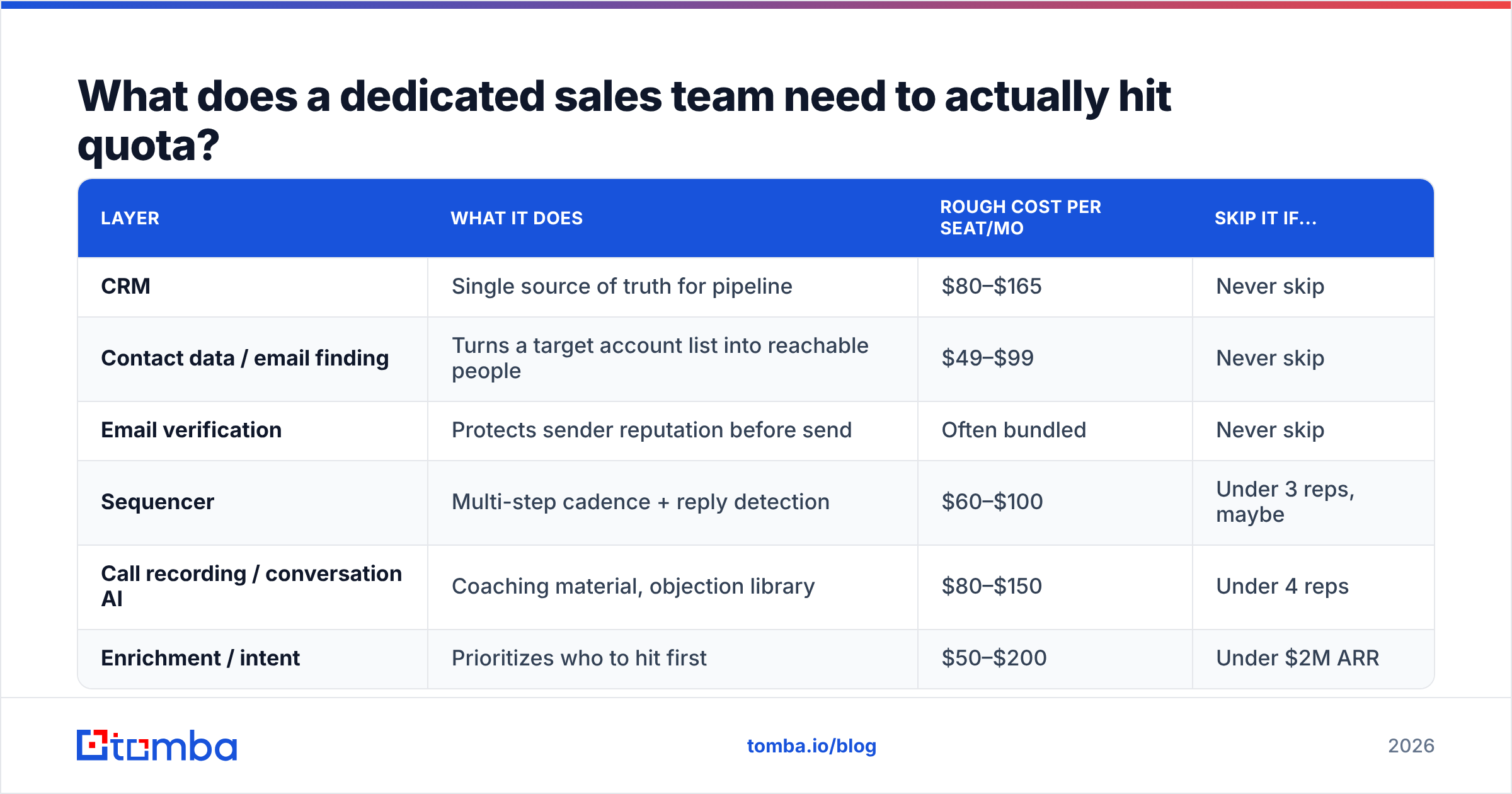
Reps fail for three reasons, in this order: no pipeline, bad data, no coaching. The first two are largely a tooling and process problem.
The stack, minimum viable version:
| Layer | What it does | Rough cost per seat/mo | Skip it if... |
|---|---|---|---|
| CRM | Single source of truth for pipeline | $80–$165 | Never skip |
| Contact data / email finding | Turns a target account list into reachable people | $49–$99 | Never skip |
| Email verification | Protects sender reputation before send | Often bundled | Never skip |
| Sequencer | Multi-step cadence + reply detection | $60–$100 | Under 3 reps, maybe |
| Call recording / conversation AI | Coaching material, objection library | $80–$150 | Under 4 reps |
| Enrichment / intent | Prioritizes who to hit first | $50–$200 | Under $2M ARR |
The line most teams underfund is contact data — and it's the one with the fastest failure loop. An SDR sending into a list with 22% invalid addresses doesn't just waste 22% of sends. Bounce rates above roughly 3% start degrading sender reputation, which suppresses inbox placement for the valid 78% too. One bad list can cost a team a full month of pipeline.
Concretely: build target account lists first, then find the people. A domain search across your ICP accounts returns the people and patterns at each company; a bulk email finder run gets you from a 400-account list to a working contact set in an afternoon rather than a week of manual LinkedIn scraping. Then verify before the first send — email verification is the cheapest insurance in the entire stack.
The rule: your reps should never be the bottleneck on list building. Every hour an $80K-OTE SDR spends hunting an email address is an hour not spent on a conversation. At 8 hours a week, that's roughly $16,000 a year of misallocated time per rep.
How do you measure whether the team is working?#
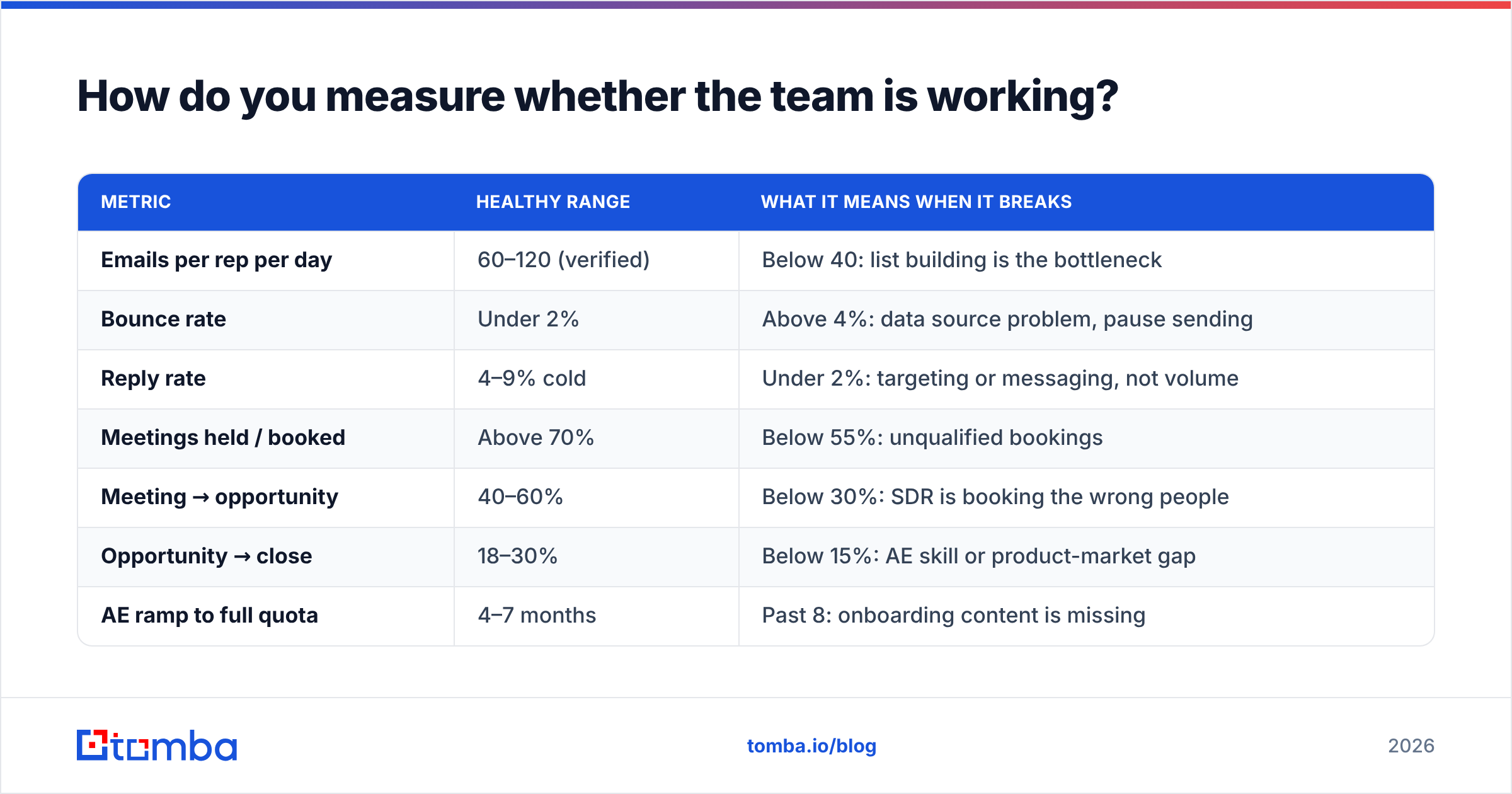
Leading indicators, in order of how early they tell you something is broken:
| Metric | Healthy range | What it means when it breaks |
|---|---|---|
| Emails per rep per day | 60–120 (verified) | Below 40: list building is the bottleneck |
| Bounce rate | Under 2% | Above 4%: data source problem, pause sending |
| Reply rate | 4–9% cold | Under 2%: targeting or messaging, not volume |
| Meetings held / booked | Above 70% | Below 55%: unqualified bookings |
| Meeting → opportunity | 40–60% | Below 30%: SDR is booking the wrong people |
| Opportunity → close | 18–30% | Below 15%: AE skill or product-market gap |
| AE ramp to full quota | 4–7 months | Past 8: onboarding content is missing |
Review these weekly for the first two quarters, monthly after. Track response rate by segment, not just in aggregate — a 6% blended reply rate can hide a 12% segment carrying a 1% segment, and that's the single most actionable insight most teams never surface.
For benchmarking against peers, G2's sales software category data and Gartner's sales research both publish credible ranges that beat whatever number a vendor quotes you in a demo.
What are the most common ways this fails?#
Hiring reps to figure out the motion. Reps optimize an existing process. They do not invent one. If the founder can't articulate why people buy, no AE will discover it for $190K.
Under-resourcing data while over-resourcing headcount. A team of four with a $200/month data budget will underperform a team of two with a $600/month budget. The math is not close.
No coaching cadence. A weekly 1:1 reviewing two recorded calls beats any sales methodology purchase. Managers who only inspect the forecast are inspecting a lagging indicator.
Comp plans that reward the wrong thing. Pay SDRs on meetings held and qualified, never on meetings booked. The moment you pay on booked, you get no-shows.
Cutting too early or too late. Set the kill criteria before you hire: "If we haven't hit X qualified opportunities by month 7, we restructure." Written down, in advance, when you're not emotionally invested.
Where should you start?#
If you're building the team: hire the AE first if you have inbound demand, the SDR first if you don't. Give whoever you hire a documented ICP, a verified contact list on day one, and a manager who reviews calls weekly.
If you're testing a segment: rent a pod for two quarters, own the data contractually, and insource the closing.
Either way, the input that determines whether the whole investment pays back is the quality of the contact list your reps work from. Get that wrong and you're paying senior salaries for bounced emails.
That's the piece worth solving before the first hire. Tomba's email finder turns a target account list into verified, reachable contacts — by domain, by name, or in bulk — so your reps spend their week in conversations instead of in a browser tab hunting for addresses. The free tier covers 25 searches a month if you want to test the accuracy on your own ICP first, and Tomba pricing starts at $49/month for a full outbound workload. Feed your dedicated sales team good data, and the expensive part of the bet starts paying for itself a lot faster.
Related guides#
Ready to find emails that actually work?
Join 150,000+ professionals who stopped guessing and started sending. Free credits on signup — no credit card required.
Get the Tomba newsletter
Practical outbound tactics and product updates — once every two weeks.
About the author