Define Outreach: What It Means in B2B Sales in 2026
Outreach is the deliberate act of contacting a person who did not ask to hear from you. Here is what that actually means in 2026 — the definition, the channels, the metrics, and where most teams get it wrong.
TL;DR
- Outreach is the deliberate, one-to-one act of contacting a prospect who has not raised a hand — it is the opposite of inbound, and the opposite of broadcast marketing.
- The word covers three distinct things people confuse: the activity (sending messages), the function (a role or team), and the product category (sequencing platforms like Outreach.io).
- Modern outreach is multi-channel by default: email, phone, LinkedIn, and increasingly video or physical mail — but email still carries roughly 70-80% of first-touch volume in most B2B teams.
- The single biggest determinant of outreach performance is not copy or cadence. It is data quality: a bad address means the best email ever written scores a zero.
- Measure outreach on reply rate and meetings-booked-per-100-contacts, not on send volume. Volume metrics reward the exact behavior that gets domains blacklisted.
What does "define outreach" actually mean?#
Outreach is the practice of initiating contact with someone who has not asked to hear from you, with a specific business outcome in mind.
That's the whole definition. Everything else — channels, sequences, personalization tokens, AI copy assistants — is implementation detail layered on top of that one sentence.
Three properties separate outreach from adjacent activities:
- It is initiated by the seller. If the prospect filled out a form, downloaded a whitepaper, or replied to an ad, that's inbound. Outreach starts cold or lukewarm.
- It is targeted at an individual, not a segment. A display ad hits a segment. An outreach email hits Sarah Chen, VP of Engineering at a 200-person fintech. The distinction matters because it changes what "good" looks like — a 0.4% CTR is fine for a banner ad and catastrophic for an email sequence.
- It has a defined next step. Outreach that doesn't ask for something specific is just noise. "Let me know if you're interested" is not a next step. "Are you free Thursday at 2pm for 15 minutes?" is.
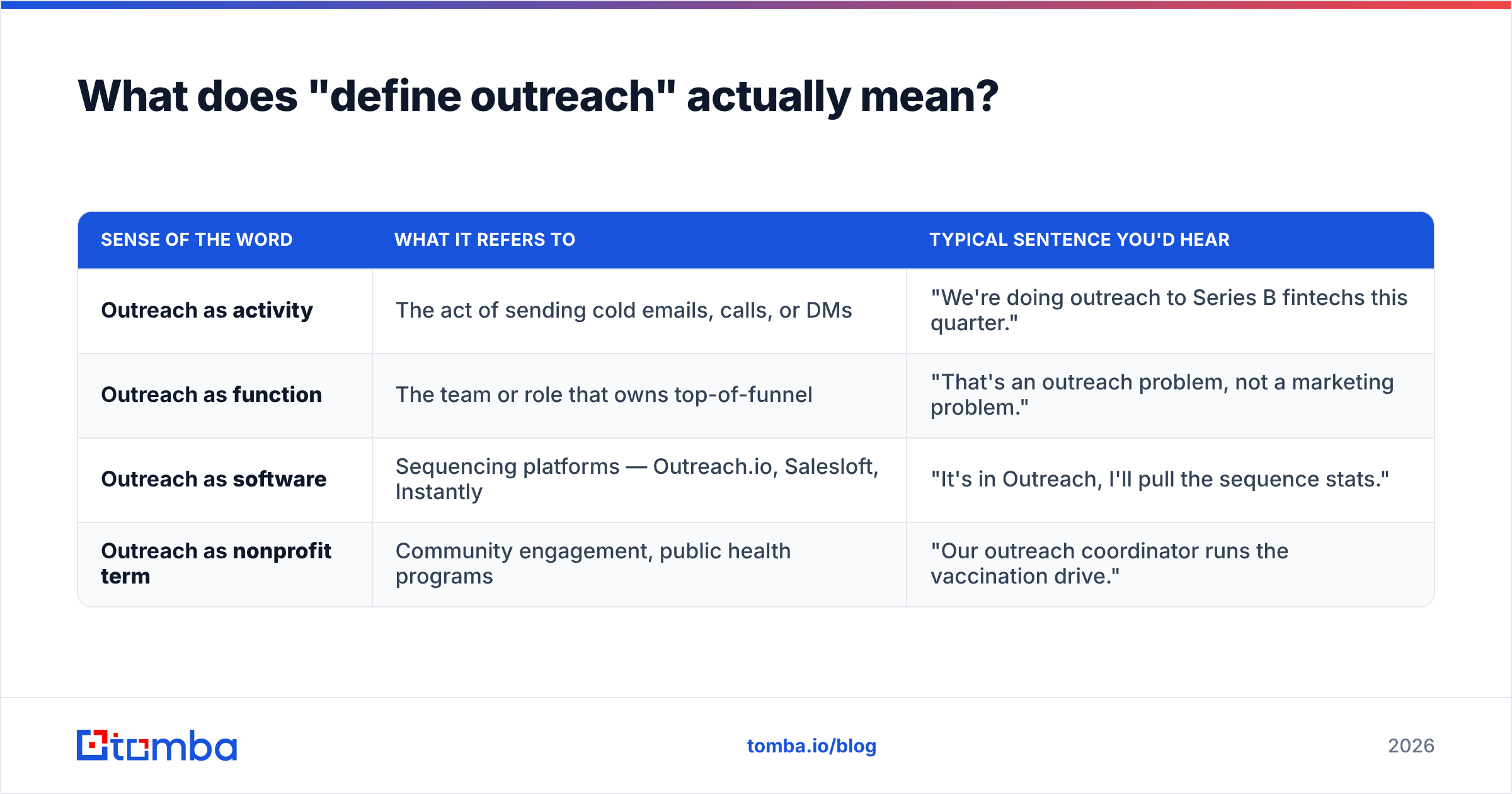
Confusion usually comes from the word being overloaded. In practice, people use "outreach" to mean one of three things:
| Sense of the word | What it refers to | Typical sentence you'd hear |
|---|---|---|
| Outreach as activity | The act of sending cold emails, calls, or DMs | "We're doing outreach to Series B fintechs this quarter." |
| Outreach as function | The team or role that owns top-of-funnel | "That's an outreach problem, not a marketing problem." |
| Outreach as software | Sequencing platforms — Outreach.io, Salesloft, Instantly | "It's in Outreach, I'll pull the sequence stats." |
| Outreach as nonprofit term | Community engagement, public health programs | "Our outreach coordinator runs the vaccination drive." |
When someone in B2B says "outreach," they almost always mean the first sense, occasionally the second. If you're writing docs or a job description, say which one you mean.
How is outreach different from prospecting, lead gen, and cold email?#
These four terms get used interchangeably in job posts and blog posts, which is why nobody can agree on who owns what. Here is the clean split:
- Lead generation is the umbrella. Any activity that produces a named, contactable person with some indication of fit. Includes inbound forms, events, referrals, and outbound.
- Prospecting is the research half of outbound. Building the account list, identifying the right personas, finding the contact details, checking for buying signals. No messages are sent during prospecting.
- Outreach is the contact half. Taking that researched list and actually reaching people across channels.
- Cold email is one channel inside outreach. Important, but not synonymous.
A useful mental model: prospecting is loading the magazine, outreach is pulling the trigger. Teams that treat them as one job usually under-invest in the first and then blame the second when reply rates crater.

Placeholder for the meme below — actual image inserted by the pipeline.

What channels count as outreach in 2026?#
Anything where you can address a specific human directly. In rough order of B2B volume:
Email. Still the backbone. Asynchronous, forwardable, searchable, and the only channel where a prospect can loop in three colleagues without leaving the thread. Also the channel most vulnerable to bad data — one hard bounce costs you more than one bad sentence.
Phone. Lower volume, dramatically higher conversion per touch. A connected call converts several times better than an email reply in most reported benchmarks, but connect rates hover in the low single digits, so the math only works when you have accurate direct dials rather than switchboard numbers.
LinkedIn. Connection requests, InMail, and comment-led engagement. Effective for personas who ignore email but live in the feed — founders, designers, most of marketing. Constrained by weekly invite limits, which caps scale.
Video. A 45-second Loom referencing something specific on the prospect's site. High effort, high reply rate, does not scale past ~20/day per rep.
Physical mail and gifting. Reserved for named enterprise accounts. Expensive per touch, memorable, and effectively unblockable.
Community and events. Slack groups, industry Discords, conference floors. Slow, but produces the warmest conversations of any channel.
The strongest teams don't pick one. They sequence two or three so that a prospect who ignores email #1 gets a LinkedIn view before email #2 lands, which lifts recognition and reply rate without adding send volume.
What does a real outreach sequence look like?#
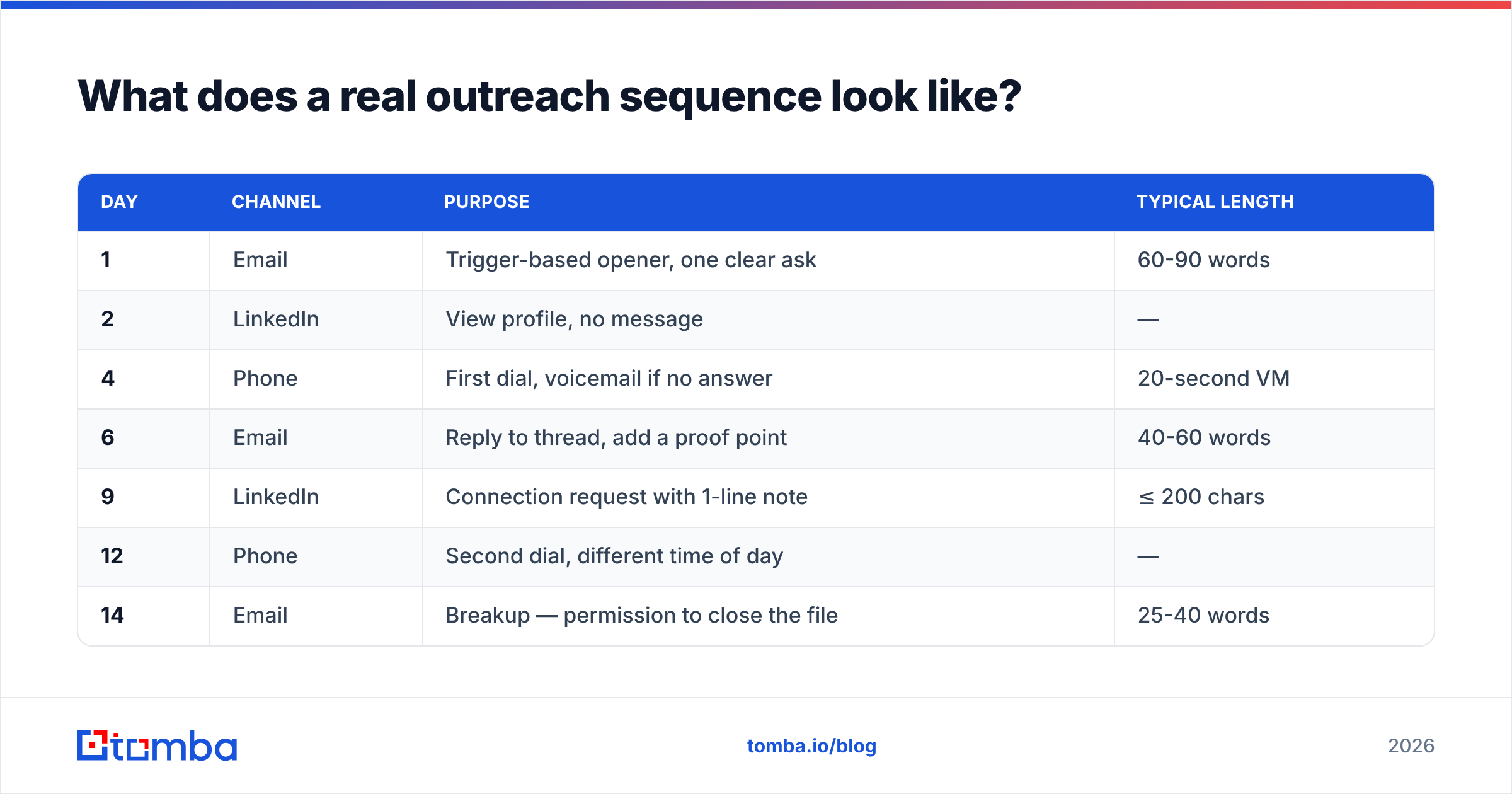
A sequence is an ordered set of touches across channels with defined timing. Here's a realistic 14-day, multi-channel structure for a mid-market SaaS motion:
| Day | Channel | Purpose | Typical length |
|---|---|---|---|
| 1 | Trigger-based opener, one clear ask | 60-90 words | |
| 2 | View profile, no message | — | |
| 4 | Phone | First dial, voicemail if no answer | 20-second VM |
| 6 | Reply to thread, add a proof point | 40-60 words | |
| 9 | Connection request with 1-line note | ≤ 200 chars | |
| 12 | Phone | Second dial, different time of day | — |
| 14 | Breakup — permission to close the file | 25-40 words |
Two rules that matter more than the exact schedule:
- Every touch must add information. "Just bumping this to the top of your inbox" adds nothing and trains the prospect to ignore you. Each follow-up should carry a new angle, proof point, or question.
- Stop at seven. Reply rates on touches 8-15 approach zero and bounce complaints climb. The breakup email is not a formality — it recovers a meaningful share of replies precisely because it removes pressure.
Why does data quality decide outreach performance?#
Because every downstream metric multiplies through deliverability, and deliverability starts with the address.
Run the arithmetic. You send 1,000 emails from a list with a 12% invalid rate. That's 120 hard bounces. Mailbox providers read a bounce rate above roughly 2-3% as a sign you're sending to a purchased or scraped list, and they start routing your mail to spam — including the mail to the 880 valid addresses. Your beautifully written, deeply personalized campaign now reaches maybe 500 inboxes, and you'll spend three weeks repairing sender reputation you could have protected with a verification pass costing a fraction of a cent per record.
This is why the sequencing of tools matters:
- Build the account list from firmographic filters — headcount, funding stage, tech stack, geography.
- Identify the personas at each account by title and function.
- Find the addresses using a domain search to pull every known pattern at the company, then resolve individual names against it.
- Verify before sending — run the list through an email verifier and drop anything not marked deliverable.
- Handle catch-all domains separately. Catch-all servers accept everything at SMTP level, so standard verification returns "unknown." A dedicated catch-all verifier is the only way to score these without guessing, and catch-alls are common enough at enterprise accounts that ignoring them means writing off a chunk of your ICP.
- Enrich with role, seniority, and recent job changes so your opener has something true to say.
Skipping step 4 is the most common self-inflicted wound in outbound. It is also the cheapest one to avoid.
How do you measure outreach — and what should you ignore?#
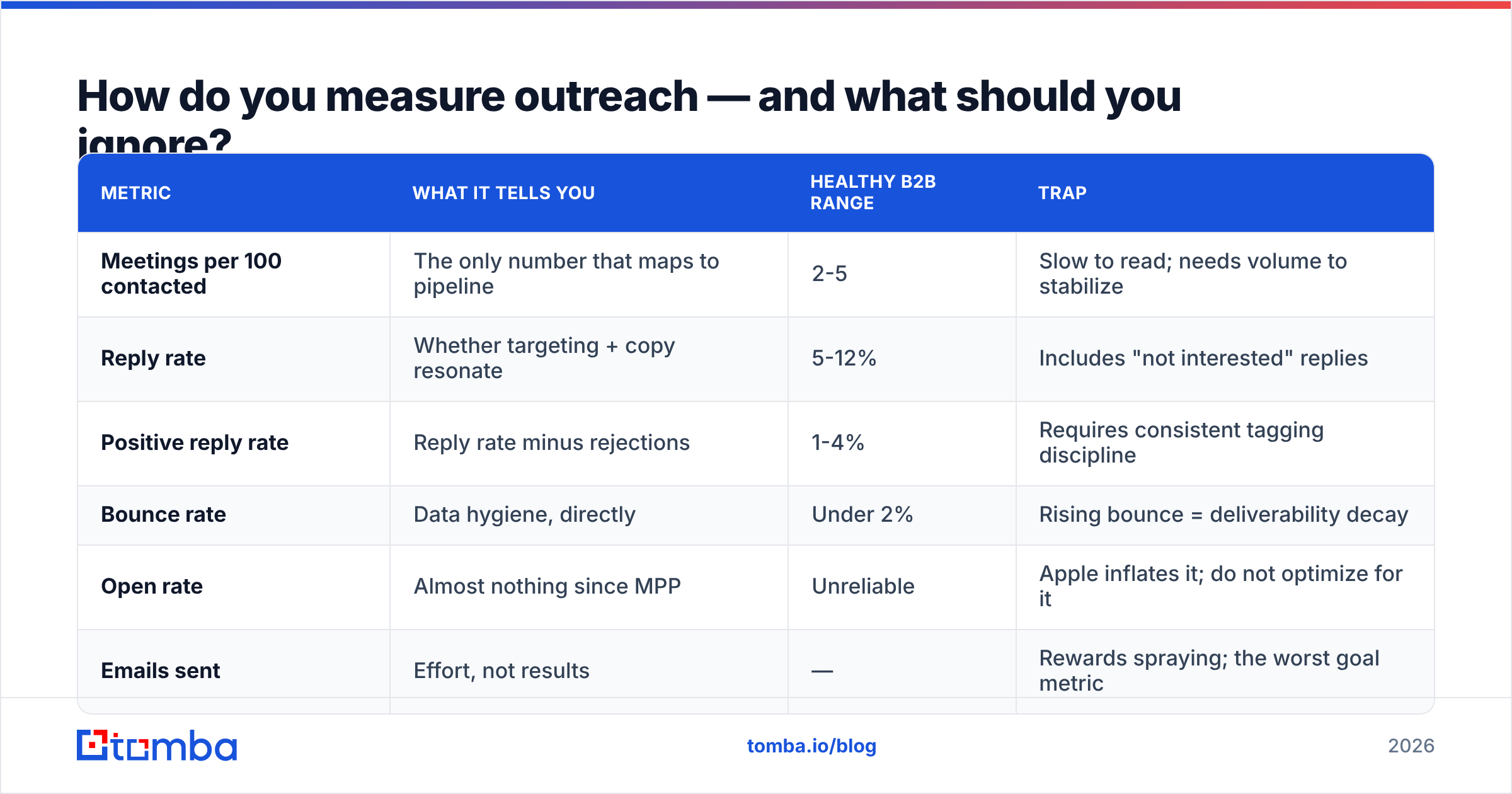
Measure outcomes per hundred contacts, not raw activity. Here's the hierarchy, from most to least useful:
| Metric | What it tells you | Healthy B2B range | Trap |
|---|---|---|---|
| Meetings per 100 contacted | The only number that maps to pipeline | 2-5 | Slow to read; needs volume to stabilize |
| Reply rate | Whether targeting + copy resonate | 5-12% | Includes "not interested" replies |
| Positive reply rate | Reply rate minus rejections | 1-4% | Requires consistent tagging discipline |
| Bounce rate | Data hygiene, directly | Under 2% | Rising bounce = deliverability decay |
| Open rate | Almost nothing since MPP | Unreliable | Apple inflates it; do not optimize for it |
| Emails sent | Effort, not results | — | Rewards spraying; the worst goal metric |
Open rate deserves a specific warning. Apple's Mail Privacy Protection pre-fetches images for a large share of consumer and mixed-use inboxes, which registers as an open regardless of whether a human looked at the message. Any A/B test decided on open rate alone is measuring Apple's proxy servers, not your subject line. Use a subject line tester for directional feedback, then judge the winner on replies.
For a deeper breakdown of what constitutes a good response rate by segment and deal size, benchmarks from G2 and HubSpot's sales research are more current than most vendor-published numbers, which tend to cherry-pick their best-performing cohorts.
What are the three mistakes that kill outreach programs?#
Mistake one: treating volume as the lever. When reply rates drop, the instinct is to send more. That accelerates the decline — more sends to a stale list means more bounces, more spam complaints, worse placement, fewer replies. The correct response to a falling reply rate is to shrink the list and improve targeting. A 200-contact campaign at 9% reply beats a 2,000-contact campaign at 0.8%, and it doesn't torch your domain.
Mistake two: personalization theater. Inserting {{first_name}} and the company name is not personalization; every recipient knows what a merge field looks like. Real personalization references something only true of that account — a recent hire, a product launch, a specific page on their site, a job posting that implies the pain you solve. If you can't produce one true, specific sentence about the account, that account doesn't belong in the campaign.
Mistake three: no infrastructure hygiene. SPF, DKIM, and DMARC configured correctly, a separate sending domain from your primary, warmed mailboxes, and sending caps per inbox. Google and Yahoo's bulk sender requirements made authentication non-negotiable rather than best-practice. Run an SPF checker before your first campaign, not after your first deliverability incident.
What tools do you actually need to run outreach?#
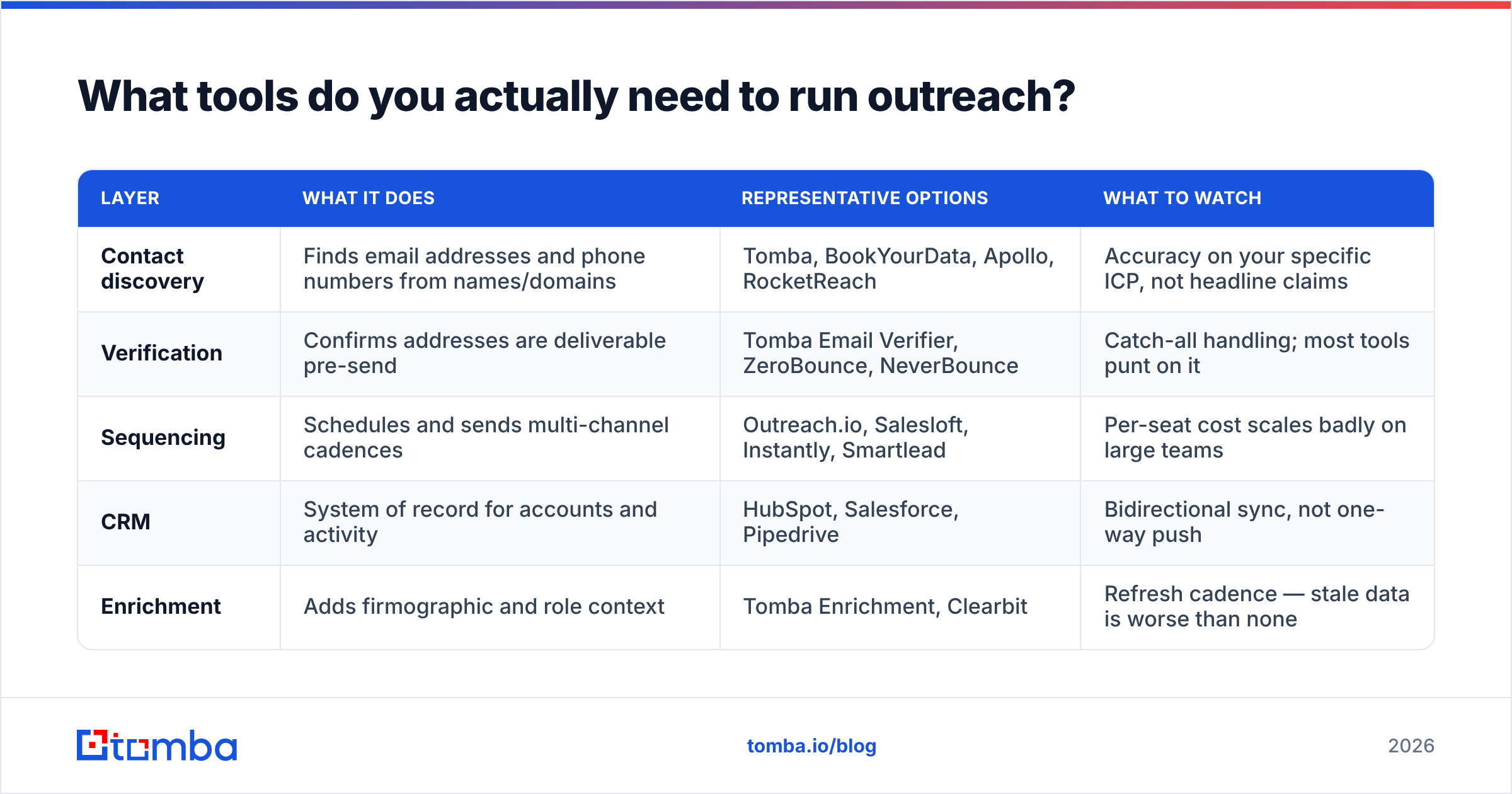
Fewer than most stacks contain. The functional requirements are: find contacts, verify contacts, send sequences, log to CRM. Everything else is optimization.
| Layer | What it does | Representative options | What to watch |
|---|---|---|---|
| Contact discovery | Finds email addresses and phone numbers from names/domains | Tomba, BookYourData, Apollo, RocketReach | Accuracy on your specific ICP, not headline claims |
| Verification | Confirms addresses are deliverable pre-send | Tomba Email Verifier, ZeroBounce, NeverBounce | Catch-all handling; most tools punt on it |
| Sequencing | Schedules and sends multi-channel cadences | Outreach.io, Salesloft, Instantly, Smartlead | Per-seat cost scales badly on large teams |
| CRM | System of record for accounts and activity | HubSpot, Salesforce, Pipedrive | Bidirectional sync, not one-way push |
| Enrichment | Adds firmographic and role context | Tomba Enrichment, Clearbit | Refresh cadence — stale data is worse than none |
On the discovery layer specifically, the honest comparison is about fit rather than a single winner. BookYourData leans toward pre-built, pay-as-you-go lists and is a strong pick if you want a downloadable file with no subscription commitment. Tomba pricing starts with a free tier at 25 searches/month, then $49/mo Starter, $99/mo Growth, and $249/mo Pro — which suits teams doing continuous, API-driven discovery rather than periodic list buys. Apollo bundles discovery and sequencing in one platform, which is convenient until you want to swap either component.
Pick based on how you actually work. If your motion is "pull 500 contacts a week, verify, push to a sequencer," an API-first finder with native verification removes two integration points. If your motion is "buy a 10,000-row list twice a year," a list vendor is the simpler purchase.
How do you start an outreach program from zero?#
A workable first 30 days:
- Week 1 — define the ICP narrowly. One industry, one company-size band, one persona. Resist the urge to widen; a narrow ICP is what makes specific personalization possible at all.
- Week 1 — set up sending infrastructure. New domain, SPF/DKIM/DMARC, 2-3 mailboxes, warmup started. Warmup takes 2-3 weeks, so this must start on day one.
- Week 2 — build and verify the first 250 contacts. Find them, verify them, drop anything questionable. 250 good contacts beats 2,500 unverified ones for a first campaign.
- Week 3 — write three sequence variants. Same offer, three different angles. Ship them to roughly 80 contacts each.
- Week 4 — read replies, not opens. Kill the two losing variants, double the volume on the winner, and write two new challengers against it.
Then repeat. Outreach is not a campaign you launch; it's a loop you tune. The teams that compound are the ones running this cycle every month rather than rebuilding from scratch each quarter.
Ready to build a list worth sending to?#
Every part of outreach that you can control — copy, timing, channel mix, cadence — sits downstream of one thing you have to get right first: reaching a real person at a real address. That's where programs quietly fail, and it's the cheapest failure to prevent.
Start with the Tomba Email Finder. Find verified professional addresses by name, domain, or company, with verification built into the same workflow so nothing untested reaches your sequencer. The free tier gives you 25 searches a month to test accuracy against accounts you already know — run it on ten companies in your ICP and check the results yourself before you commit to anything.
Related guides#
Ready to find emails that actually work?
Join 150,000+ professionals who stopped guessing and started sending. Free credits on signup — no credit card required.
Get the Tomba newsletter
Practical outbound tactics and product updates — once every two weeks.
About the author