Definitive Healthcare vs Oceanio: Which Wins in 2026?
Definitive Healthcare owns provider-level clinical intelligence. Ocean.io owns lookalike-based ICP expansion. Here's how the two compare on data depth, pricing, contact quality, and which one your GTM team should actually buy.
Definitive Healthcare vs Oceanio is an odd matchup. One tool maps US healthcare in depth. The other finds companies that look like your best customers. Most teams only need one of them. Here is how to tell which.
TL;DR
- Definitive Healthcare covers US healthcare only: hospitals, health systems, doctors, claims volumes, and installed tech. It is not a general prospecting tool, and it prices like enterprise software.
- Ocean.io works the other way around. You upload your best accounts. It scans ~200M company websites and finds close matches, instead of relying on rigid industry codes.
- The two barely overlap. Sell to health systems? Definitive wins on depth. Need "more accounts like these"? Ocean.io wins on breadth and cost.
- Both are weak in the same spot: verified, deliverable email at the contact level. Most teams add an email finder to make the account list usable.
- Budget: Definitive usually runs five figures a year. Ocean.io runs low four figures for a small team. Neither posts full pricing.
What is Definitive Healthcare?#
Definitive Healthcare sells commercial intelligence for US healthcare. It launched in 2011 and went public in 2021 (NASDAQ: DH). It tracks 9,000+ US hospitals and 1.9M+ physicians. It also covers surgery centers, imaging centers, long-term care sites, and physician groups.
The value sits inside each record. A hospital profile is not just name and size. It carries procedure volumes drawn from claims, payer mix, referral patterns between providers, installed EHR and imaging systems, parent health system, quality scores, and named executives.
That data is hard to build. Say you sell a surgical robot, billing software, or a diagnostic test. Knowing that a hospital performs 1,400 of one procedure a year — and runs Epic — turns a guess into a territory plan.
The trade-off is scope. Definitive covers US healthcare and little else. Ask it about a fintech in Berlin and it has nothing to say.
What is Ocean.io?#
Ocean.io is a Copenhagen-based B2B data platform built on lookalike modeling. Most tools ask you to set filters: "SaaS, 50–200 staff, Series B, US." Ocean.io asks for a list of accounts you already won. It then reads company websites and surfaces firms that describe a similar business.
That matters more than it sounds. Industry codes are blunt. A warehouse robotics startup and a forklift insurer can share a NAICS code. Ocean.io reads the site copy and tells them apart.
Coverage runs to 200M+ companies worldwide. European data is strong — noticeably better than most US-first vendors. You also get contact records, tech stack signals, headcount trends, and sync into HubSpot and Salesforce.
The weakness is depth per record. You get a sharp account list. You do not get claims data, procedure volumes, or any deep vertical detail.

Definitive Healthcare vs Oceanio: how do the two compare?#
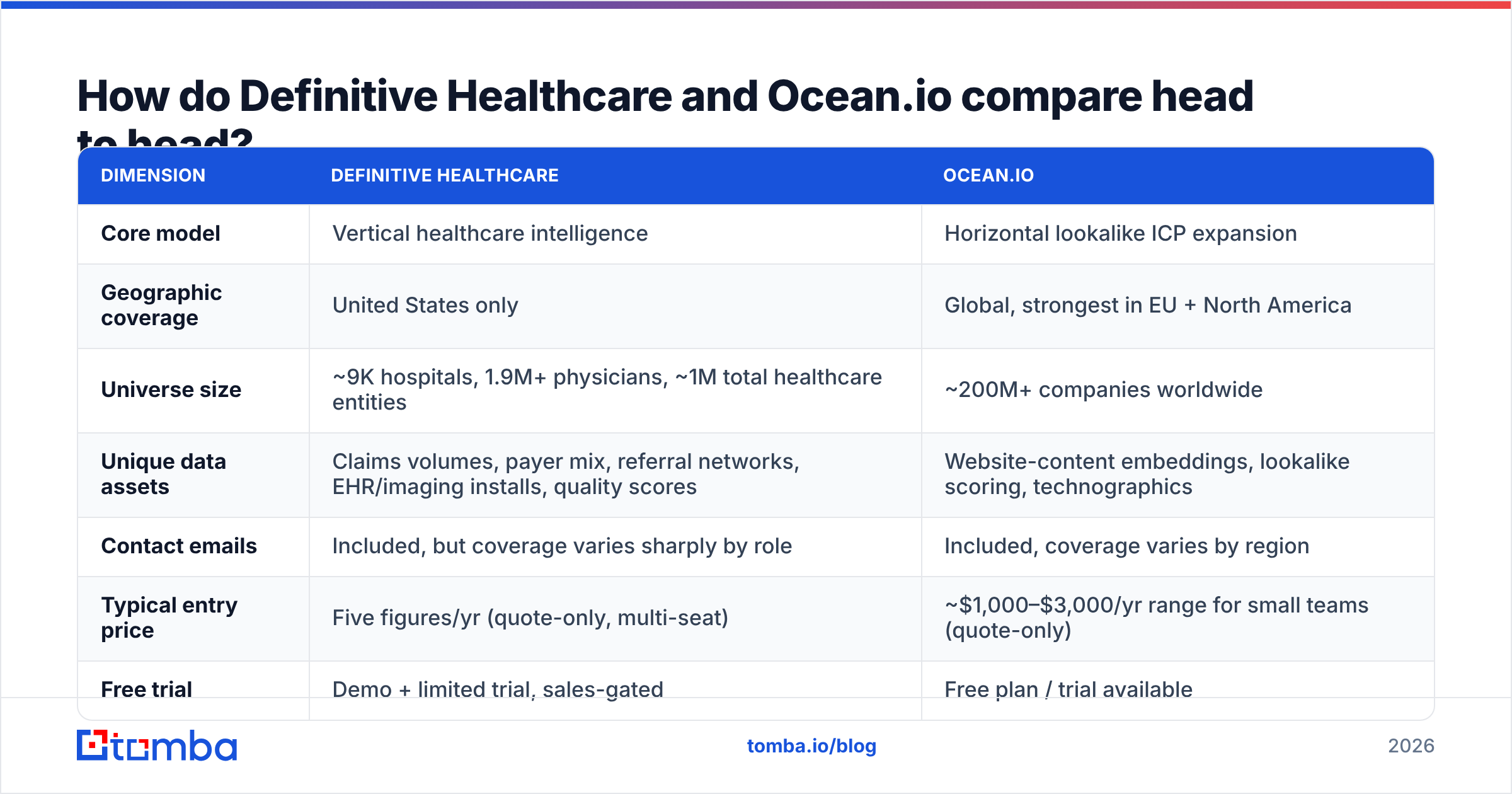
Here is the head-to-head on the points that actually change a buying decision.
| Dimension | Definitive Healthcare | Ocean.io |
|---|---|---|
| Core model | Vertical healthcare intelligence | Horizontal lookalike ICP expansion |
| Geographic coverage | United States only | Global, strongest in EU + North America |
| Universe size | ~9K hospitals, 1.9M+ physicians, ~1M total healthcare entities | ~200M+ companies worldwide |
| Unique data assets | Claims volumes, payer mix, referral networks, EHR/imaging installs, quality scores | Website-content embeddings, lookalike scoring, technographics |
| Contact emails | Included, but coverage varies sharply by role | Included, coverage varies by region |
| Typical entry price | Five figures/yr (quote-only, multi-seat) | ~$1,000–$3,000/yr range for small teams (quote-only) |
| Free trial | Demo + limited trial, sales-gated | Free plan / trial available |
| Best buyer | Medtech, pharma, healthcare IT, RCM vendors | SaaS, agencies, any team scaling outbound to new segments |
| Contract friction | Annual, negotiated, procurement-heavy | Self-serve-ish, lower commitment |
| Learning curve | Steep — it's an analytics product | Shallow — upload seeds, get accounts |
Read that table as two product categories that happen to share a label. Definitive is close to a market research subscription. Ocean.io is close to a targeting engine.
Which one fits your go-to-market motion?#
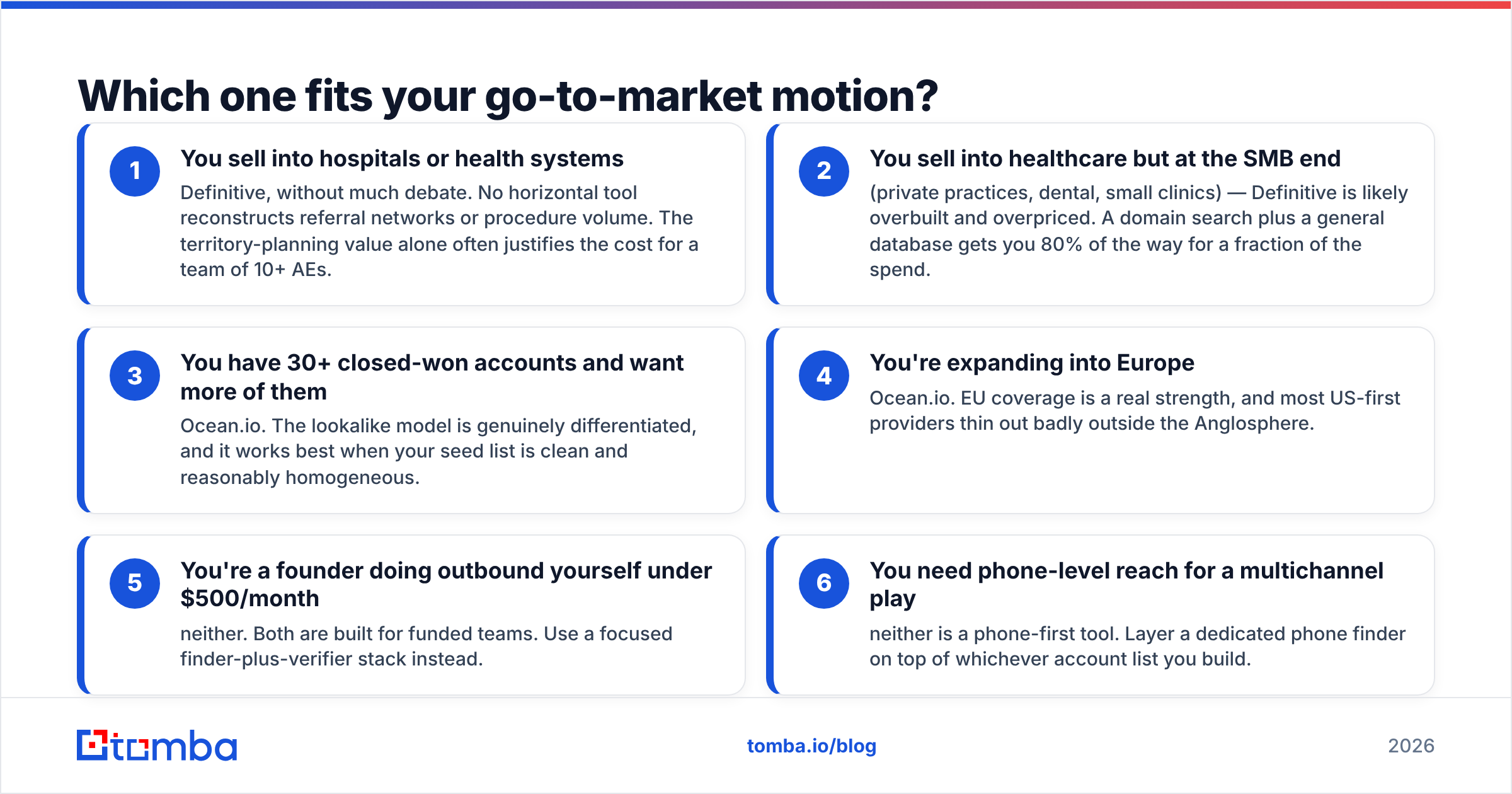
The Definitive Healthcare vs Oceanio choice comes down to what your rep needs to know before the first call.
- You sell into hospitals or health systems — Definitive, easily. No horizontal tool rebuilds referral networks or procedure volumes. For a team of 10+ AEs, the territory-planning value alone often covers the cost.
- You sell into healthcare at the small end (private practices, dental, small clinics) — Definitive is overbuilt here. A domain search plus a general database gets you most of the way for far less.
- You have 30+ closed-won accounts and want more of them — Ocean.io. The lookalike model is the real draw. It works best when your seed list is clean and fairly consistent.
- You're expanding into Europe — Ocean.io. EU coverage is a genuine strength. Most US-first vendors thin out fast outside the Anglosphere.
- You're a founder doing outbound yourself under $500 a month — neither. Both are built for funded teams. Use a focused finder-plus-verifier stack instead.
- You need phone numbers for a multichannel play — neither tool is phone-first. Add a phone finder on top of whichever account list you build.
Is the data accurate enough to run outbound on?#
This is where both platforms get uncomfortable. Buyers underrate the question.
Account-level data holds up in both. Definitive pulls facility and claims data from Medicare and Medicaid filings, license records, and its own research team. You can audit it. Ocean.io builds firmographics from web crawling. That keeps the data fresh, but headcount and revenue estimates can be noisy.
Contact-level data is another story. Both bundle emails. In both, coverage and deliverability swing by seniority, region, and industry. Healthcare is the hardest case. Clinicians move often. Email formats differ across affiliated sites. Many provider domains are catch-alls, so the server never returns a clean verdict.
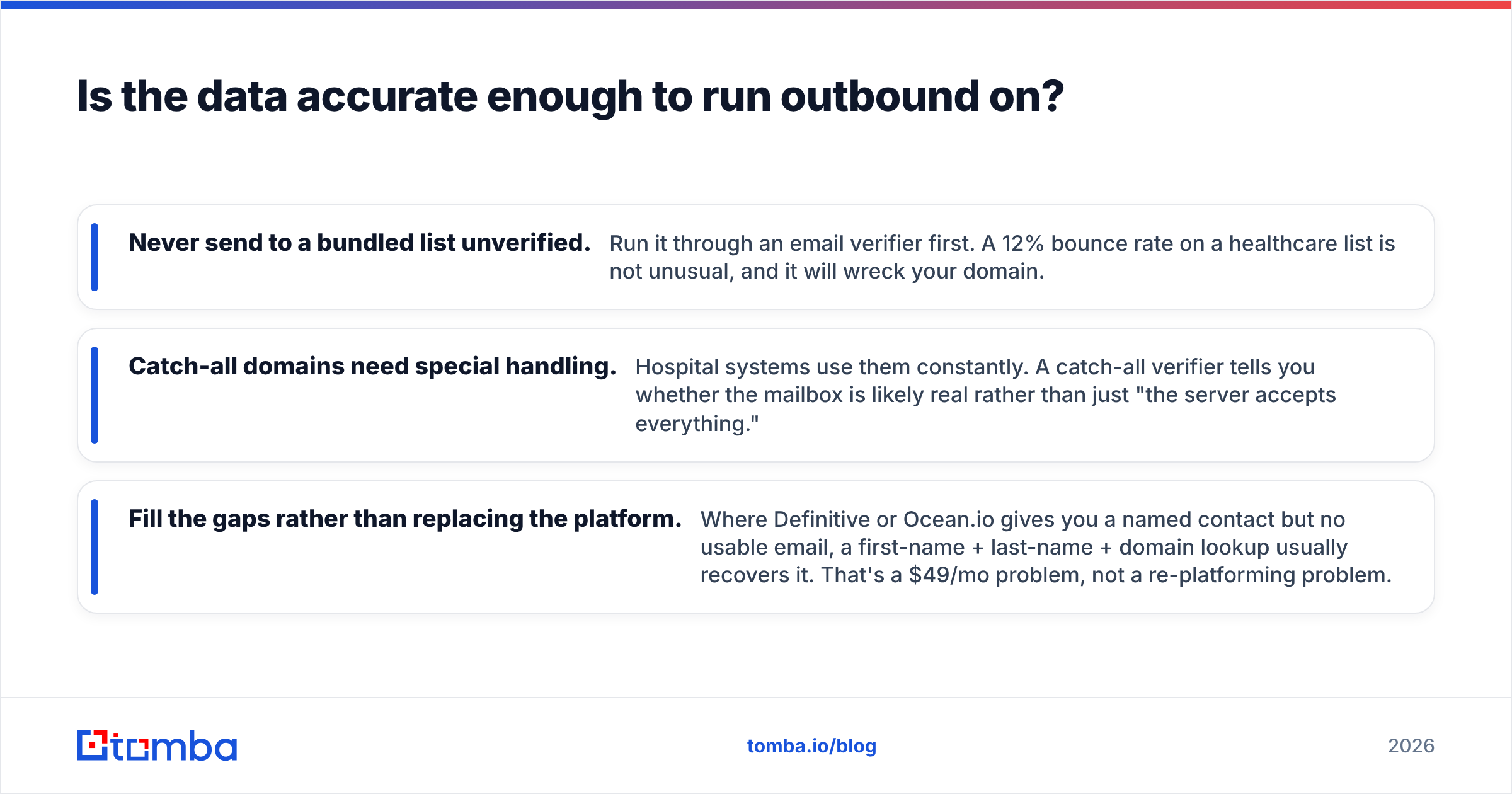
Three practical consequences:
- Never mail a bundled list unverified. Run it through an email verifier first. A 12% bounce rate on a healthcare list is common, and it will wreck your domain.
- Catch-all domains need special handling. Hospital systems use them constantly. A catch-all verifier tells you whether the mailbox is likely real, rather than just "the server accepts everything."
- Fill the gaps instead of switching tools. When either platform names a contact but has no usable email, a first name + last name + domain lookup usually recovers it. That is a $49/mo problem, not a re-platforming problem.
Independent review data backs up the nuance. Both vendors sit in the 4.2–4.5 star band on G2. Reviewers praise Definitive's account data and fault its contacts. Ocean.io users love the lookalikes and want more contacts per account.

What does each platform actually cost?#
Neither vendor posts a full price list. That alone tells you how they sell.
Definitive Healthcare is quote-only and sold by the year. Public procurement records and user reports put entry packages in the low five figures. Large multi-module, multi-seat deals run well past $100K. Modules are priced apart: physician data, claims analytics, technology installs, and the Atlas All-Access tiers. Expect a buying cycle of several weeks. Seat count drives the number more than data volume does.
Ocean.io is more open about tiers and offers a free entry point. Real contracts for a small GTM team usually land between $1,000 and $3,000 a year. Credits cap enrichment and export. It feels like buying a tool, not a platform.
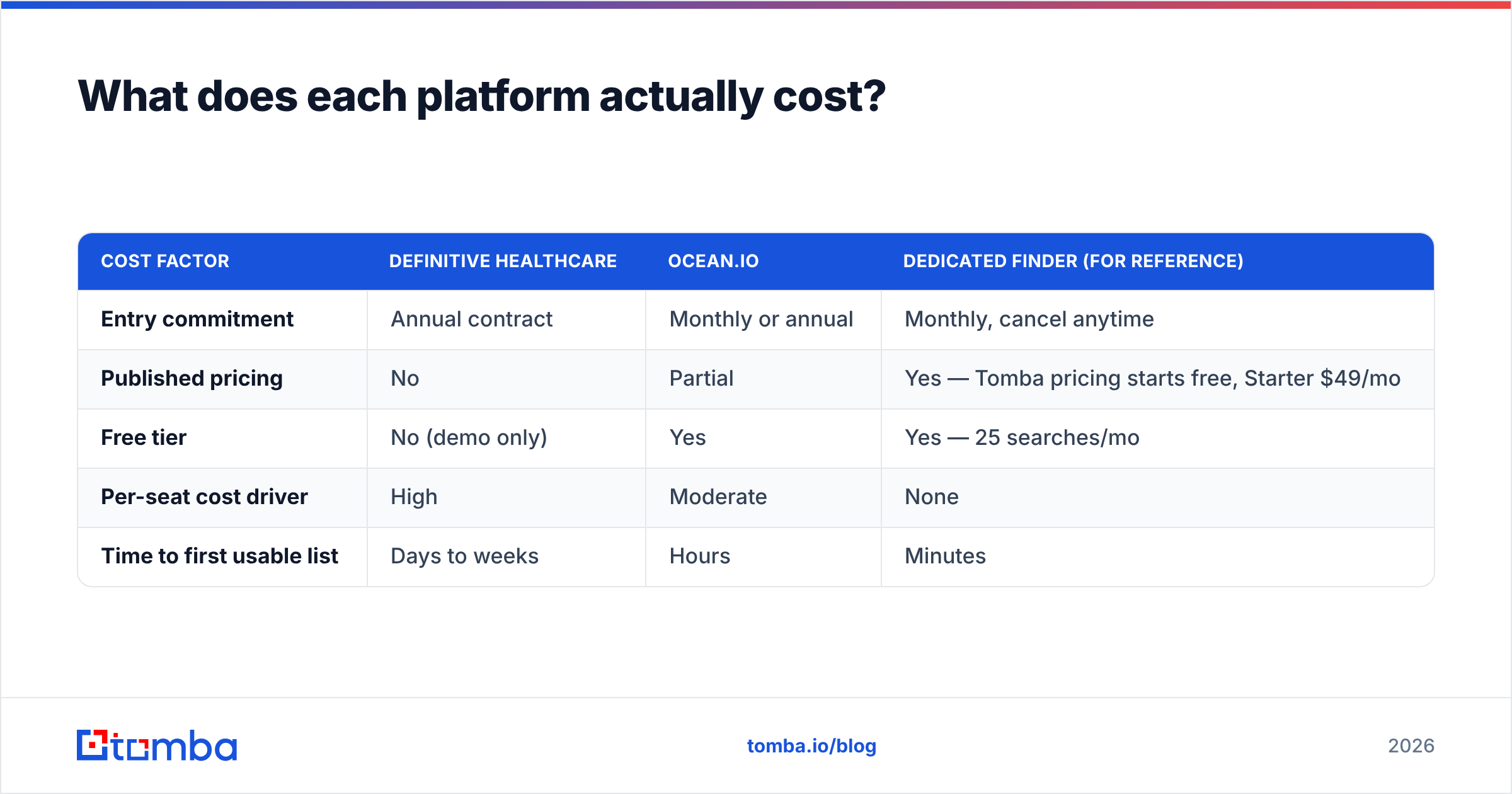
| Cost factor | Definitive Healthcare | Ocean.io | Dedicated finder (for reference) |
|---|---|---|---|
| Entry commitment | Annual contract | Monthly or annual | Monthly, cancel anytime |
| Published pricing | No | Partial | Yes — Tomba pricing starts free, Starter $49/mo |
| Free tier | No (demo only) | Yes | Yes — 25 searches/mo |
| Per-seat cost driver | High | Moderate | None |
| Time to first usable list | Days to weeks | Hours | Minutes |
That last column is not a claim that a finder replaces either platform. It shows what the contact-resolution layer costs when you buy it on its own. It is usually far less than the extra module either vendor will quote you.
Are there better alternatives depending on your use case?#
Yes. The honest answer depends on what you are optimizing for.
For healthcare-specific intelligence: Definitive's main rivals are IQVIA (deeper pharma data, far pricier), H1, and Doximity's advertising products. If claims data is the core need, no horizontal tool competes.
For lookalike ICP expansion: Ocean.io competes with Clay's enrichment waterfalls, Common Room, and to a lesser degree Apollo's smart lists. Want Ocean.io's targeting logic with a bigger contact database attached? Read an Apollo alternative comparison before you commit.
For verified B2B email at volume: Neither platform should be your primary tool. Purpose-built finders and verifiers win on deliverability per dollar. That includes respected peers like BookYourData, which sells pre-verified list data with an accuracy guarantee.
For European coverage: Ocean.io is genuinely strong here, and that is not marketing. Test it against your own known-good EU account list first.
One structural point is worth noting. The "all-in-one data platform" pitch has weakened across the market. Most high-performing GTM teams in 2026 run a thin stack: one source of account intelligence, one contact-resolution layer, one sequencer. They no longer pay enterprise rates for a bundle where two of the three parts are mediocre. Gartner's coverage of the revenue technology stack has tracked this unbundling for several cycles.
How should you run a fair evaluation?#
Don't take either demo at face value. Run the same test on both.
- Build a 50-account gold-standard list from your CRM. Include accounts you closed, plus accounts you know are perfect fits but haven't touched.
- Hide 25 of them. Feed the other 25 to Ocean.io as seeds. Count how many of the hidden 25 it finds on its own. That is a real recall score, not a vibe.
- For Definitive, pick five accounts you know well. Audit each profile field by field. Are the procedure volumes right? Is the EHR install current? Is the CFO still the CFO?
- Export 100 contacts from each and verify them independently. Record the valid, catch-all, and invalid split. Ask each vendor to explain any result below 80% valid.
- Price the gap. Whatever share of contacts came back unusable is the volume your contact layer has to cover. Do that math before you sign.
Teams that run this test tend to reach the same conclusion. The account intelligence is worth paying for. The bundled contact data is worth about what a standalone tool costs — which is much less than the bundle implies. Checking a vendor's data sources page before the first call saves a lot of that discovery time.
The verdict#
Definitive Healthcare vs Oceanio is not a true head-to-head. The two tools do different jobs. If you are still comparing them, one of two things is true. Either you sell into healthcare and are weighing vertical depth against enterprise pricing. Or you are early in your data buying and comparing everything to everything.
For the first case: buy Definitive if you sell to health systems and your deal sizes support it. Skip it if your healthcare buyers are small practices.
For the second case: start with Ocean.io. It is cheaper, faster to value, and it teaches you what your ICP really looks like before you commit five figures to a vertical dataset.
Whichever account layer you land on, the contact layer is a separate purchase. Treating it that way saves most teams real money. Start with the Tomba Email Finder — free for 25 searches a month, $49/mo on Starter. It turns either platform's account list into verified, deliverable contacts, without paying enterprise rates for a contact module you will re-verify anyway.
Related guides#
Ready to find emails that actually work?
Join 150,000+ professionals who stopped guessing and started sending. Free credits on signup — no credit card required.
Get the Tomba newsletter
Practical outbound tactics and product updates — once every two weeks.
About the author