Definitive Healthcare vs ZoomInfo: Full 2026 Comparison
Definitive Healthcare sells depth in one vertical. ZoomInfo sells breadth across every vertical. Here is how the two compare on coverage, contact accuracy, contracts, and cost — and when neither is worth the spend.
TL;DR
- Definitive Healthcare is a vertical intelligence platform: hospitals, IDNs, physician groups, claims-derived procedure volumes, technology installs, and affiliations. It is the better choice if your entire pipeline lives inside US healthcare.
- ZoomInfo is a horizontal B2B database: ~100M+ company and contact records across every industry, plus intent data, conversation intelligence, and a sales engagement layer.
- Neither is cheap. Real-world contracts for both typically land in the five-figure annual range, are annual-commit only, and are seat- and credit-gated.
- If what you actually need is verified contact email addresses — not claims analytics or intent scores — a dedicated finder like Tomba Email Finder covers that job for a fraction of the price.
- Best combo for most healthcare GTM teams: keep one intelligence source for account selection, then handle contact discovery and verification with a cheap, API-first tool.
What is Definitive Healthcare?#
Definitive Healthcare is a healthcare commercial intelligence platform. Think of it as a very detailed map of the US healthcare system — not a phone book, but a survey map showing which buildings exist, who owns them, how much traffic runs through each one, and what equipment is inside.
Its dataset is built around provider-side entities rather than generic companies:
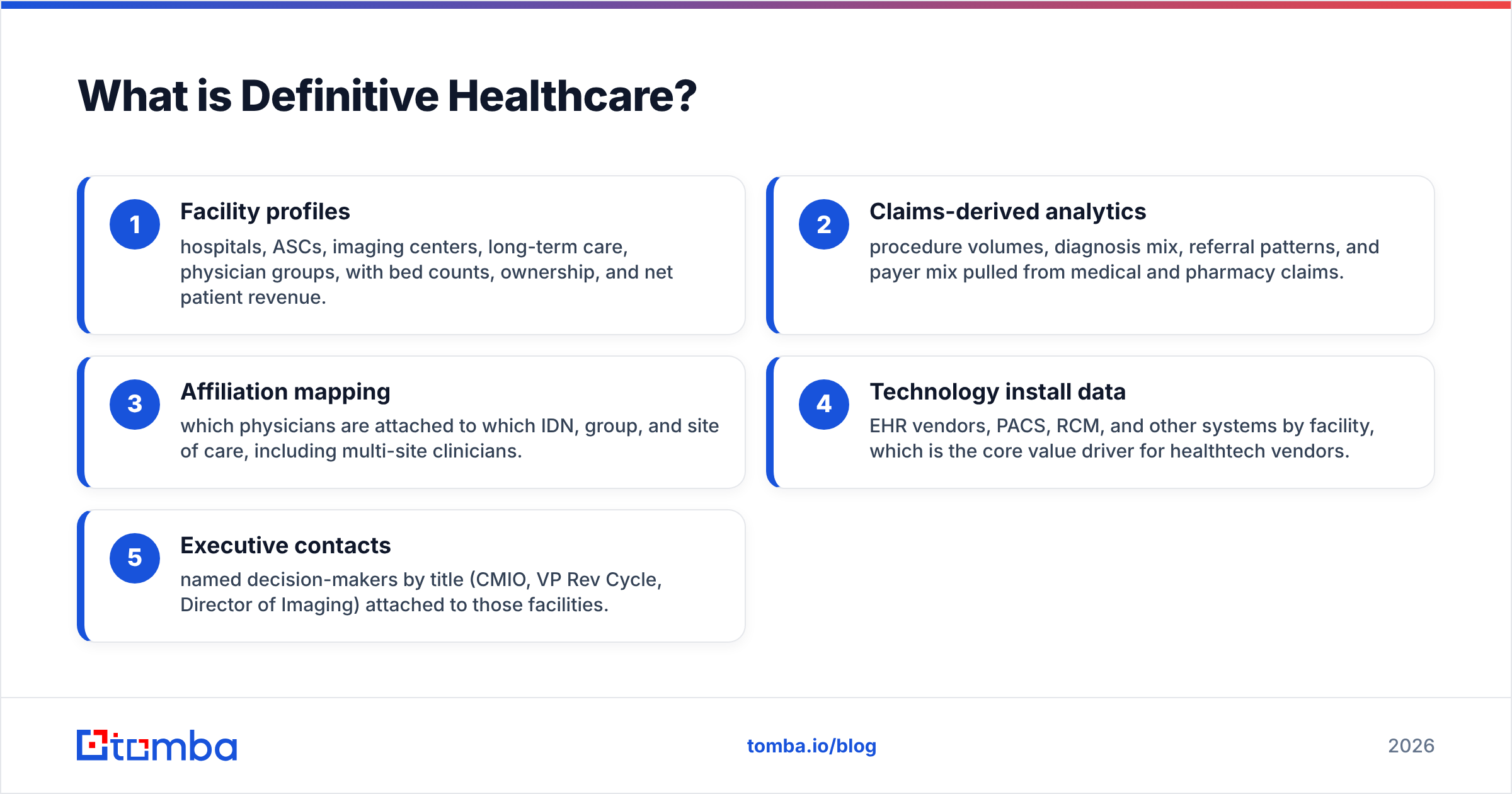
- Facility profiles — hospitals, ASCs, imaging centers, long-term care, physician groups, with bed counts, ownership, and net patient revenue.
- Claims-derived analytics — procedure volumes, diagnosis mix, referral patterns, and payer mix pulled from medical and pharmacy claims.
- Affiliation mapping — which physicians are attached to which IDN, group, and site of care, including multi-site clinicians.
- Technology install data — EHR vendors, PACS, RCM, and other systems by facility, which is the core value driver for healthtech vendors.
- Executive contacts — named decision-makers by title (CMIO, VP Rev Cycle, Director of Imaging) attached to those facilities.
The strength is depth per record. If you sell an imaging workflow product, being able to filter for hospitals running a specific PACS vendor with above-median MRI volume is a targeting capability no horizontal database gives you. You can verify the product scope on the official Definitive Healthcare site.
The weakness is scope. Sell to healthcare payers, life sciences manufacturers, or — worse — anything outside healthcare, and large chunks of the platform stop earning their keep.

What is ZoomInfo, and how is it different?#
ZoomInfo is the generalist. It aggregates company and contact records across every industry from web crawling, contributory data from installed extensions and email integrations, public filings, and a research operation. Its healthcare coverage exists, but it is a slice of the whole rather than the whole product.
Where Definitive Healthcare goes deep on one vertical, ZoomInfo goes wide and then layers workflow on top: ZoomInfo sells Copilot for AI account prioritization, intent signals from its Bidstream and content network, a sequencing layer, website visitor identification, and CRM enrichment jobs.
The practical distinction for a buyer:
- Definitive Healthcare answers "which healthcare accounts should I target and why?" — with volume, install, and affiliation evidence.
- ZoomInfo answers "who works at this account, what is their contact info, and are they showing buying signals right now?" — across any account, any industry.
Those are different jobs. Teams that buy both are usually not being wasteful; they are covering two genuinely separate needs. Teams that buy one and expect it to do both are the ones who churn at renewal.
Definitive Healthcare vs ZoomInfo: how do they compare head-to-head?#
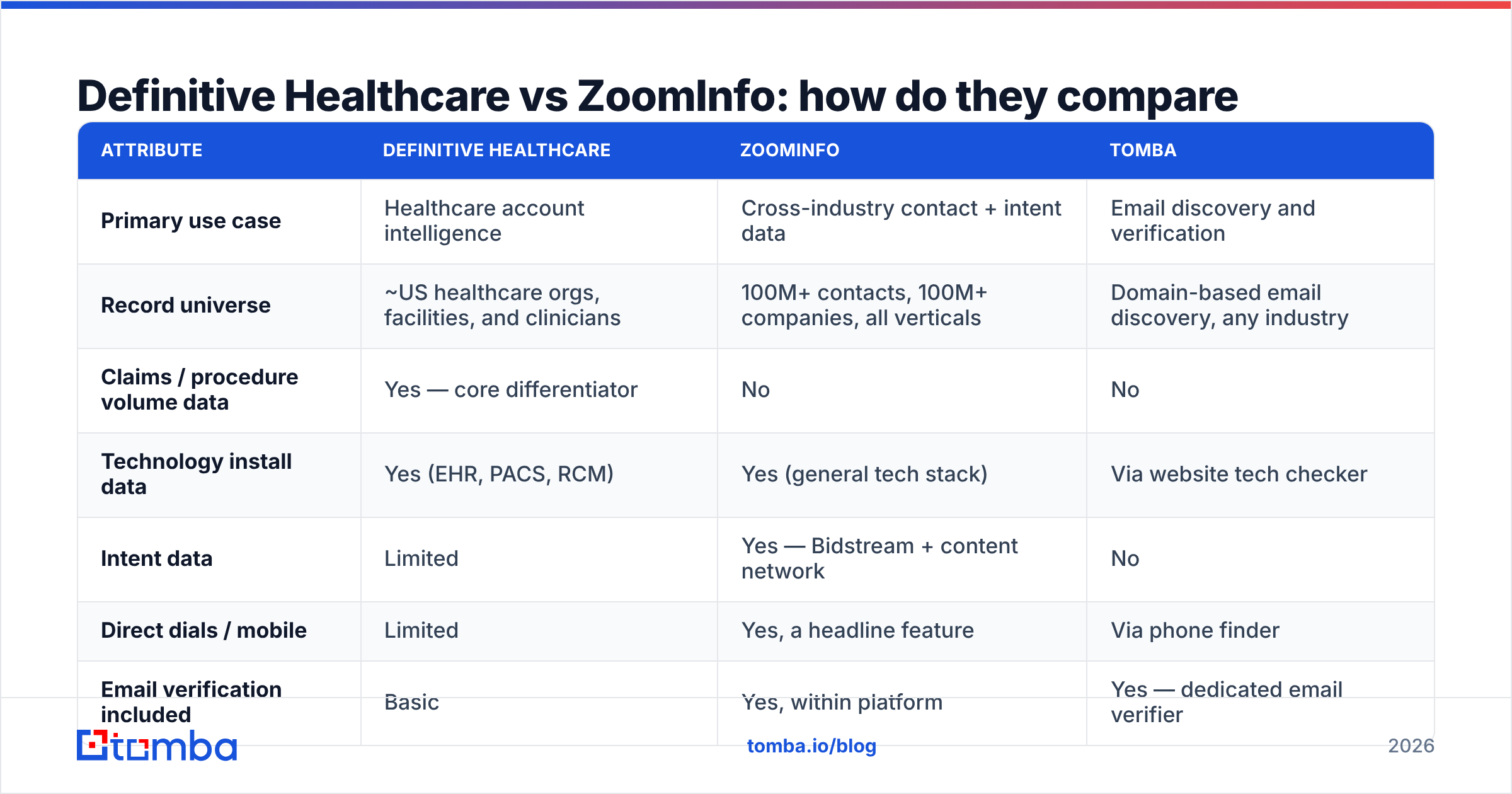
| Attribute | Definitive Healthcare | ZoomInfo | Tomba |
|---|---|---|---|
| Primary use case | Healthcare account intelligence | Cross-industry contact + intent data | Email discovery and verification |
| Record universe | ~US healthcare orgs, facilities, and clinicians | 100M+ contacts, 100M+ companies, all verticals | Domain-based email discovery, any industry |
| Claims / procedure volume data | Yes — core differentiator | No | No |
| Technology install data | Yes (EHR, PACS, RCM) | Yes (general tech stack) | Via website tech checker |
| Intent data | Limited | Yes — Bidstream + content network | No |
| Direct dials / mobile | Limited | Yes, a headline feature | Via phone finder |
| Email verification included | Basic | Yes, within platform | Yes — dedicated email verifier |
| Entry price | Five figures/yr (quote only) | Five figures/yr (quote only) | Free tier, then $49/mo |
| Contract length | Annual, multi-year common | Annual, multi-year common | Monthly, cancel anytime |
| Self-serve signup | No | No | Yes |
| API access | Add-on, enterprise tiers | Add-on, credit-metered | Included on paid plans |
The table makes the overlap obvious: the two platforms only genuinely compete on contact records at healthcare organizations. Everything else is complementary.
Which platform has better healthcare data?#
Definitive Healthcare wins on institutional depth. ZoomInfo wins on people coverage outside clinical roles.
Break it down by who you are selling to:
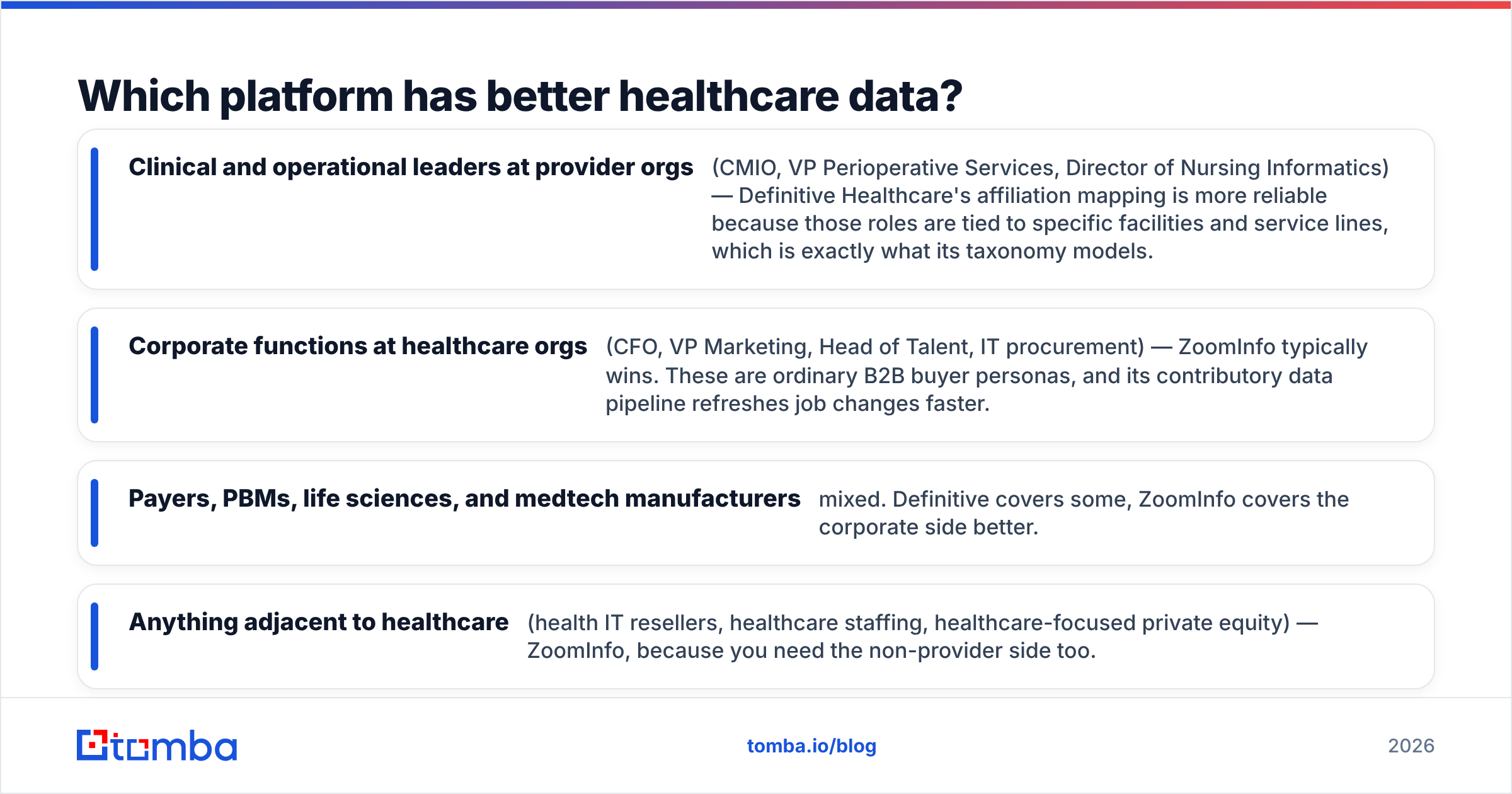
- Clinical and operational leaders at provider orgs (CMIO, VP Perioperative Services, Director of Nursing Informatics) — Definitive Healthcare's affiliation mapping is more reliable because those roles are tied to specific facilities and service lines, which is exactly what its taxonomy models.
- Corporate functions at healthcare orgs (CFO, VP Marketing, Head of Talent, IT procurement) — ZoomInfo typically wins. These are ordinary B2B buyer personas, and its contributory data pipeline refreshes job changes faster.
- Payers, PBMs, life sciences, and medtech manufacturers — mixed. Definitive covers some, ZoomInfo covers the corporate side better.
- Anything adjacent to healthcare (health IT resellers, healthcare staffing, healthcare-focused private equity) — ZoomInfo, because you need the non-provider side too.
One caveat that applies to both: healthcare has brutal contact decay. Clinician turnover, system consolidation, and the sheer number of practitioners with multiple affiliations mean any static database goes stale fast. Independent reviews on G2 for both vendors repeat the same theme — the account-level data holds up better than the person-level data.
That is why verification at send time matters more than the database's marketing claims. Whatever source you buy, run the addresses through an email verifier before they hit a sequence. A record that was accurate at contract signing in January is not automatically accurate in July.
How does Definitive Healthcare vs ZoomInfo pricing compare?#
Neither publishes rate cards, and both use the same commercial playbook: quote-only pricing, annual commitment, seat-based licensing, and credit caps on exports.
What buyers consistently report:
- ZoomInfo — entry packages commonly start in the low-to-mid five figures per year for a small team, scaling sharply with seats, credits, and add-on modules (intent, Copilot, engagement, websights). Credit overages and module upsells are the two most common budget surprises.
- Definitive Healthcare — similar five-figure floor, often higher once you add claims modules or multiple product lines. Pricing is tiered by which datasets you unlock rather than purely by seat count.
- Both — expect a multi-year discount pitch, auto-renewal clauses, and export limits that make "we'll just pull the whole database" impossible by design.
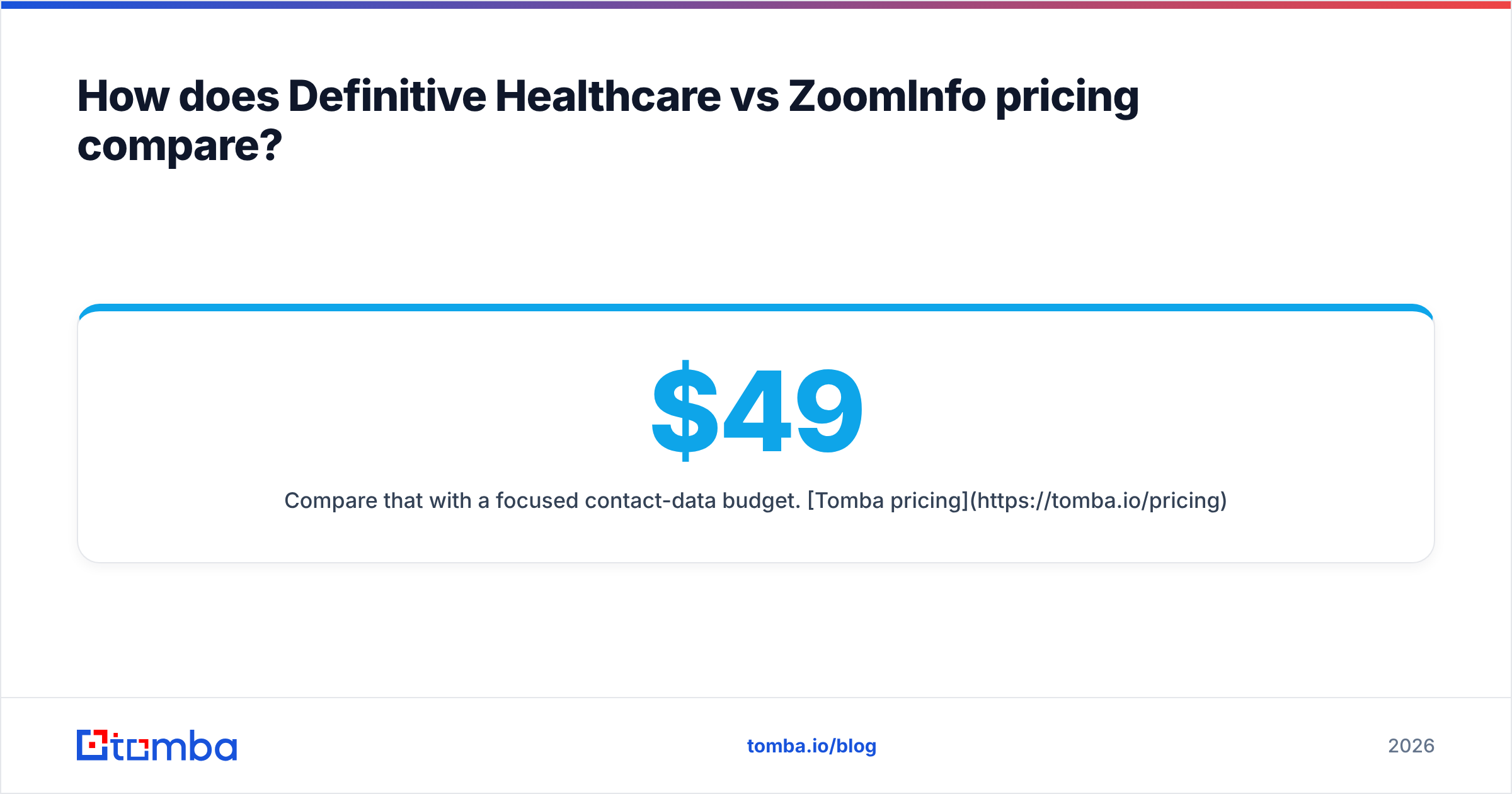
Compare that with a focused contact-data budget. Tomba pricing starts free at 25 searches/month, moves to $49/mo on Starter, $99/mo on Growth, and $249/mo on Pro — monthly, no sales call, no annual lock-in. That will not replace claims analytics. It will absolutely replace the "we need emails for these 4,000 accounts" line item that both enterprise platforms charge a premium for.

Where does each platform fall short?#
Honest weaknesses, because both vendors' own sites will not list them.
Definitive Healthcare limitations
- Useless the moment your ICP extends outside US healthcare providers.
- Claims data has an inherent lag; recent procedure trends are not real-time.
- Direct-dial and mobile coverage is thinner than ZoomInfo's.
- Sales-engagement workflow is minimal — you will still need a separate sequencer.
ZoomInfo limitations
- No claims, procedure volume, or clinical affiliation depth. For provider-side targeting, that is a hard ceiling.
- Contact accuracy varies widely by segment; the strongest coverage is tech and mid-market corporate roles, not clinical staff.
- Credit model creates friction on high-volume list building.
- Contract and renewal experience is the most common complaint in public reviews.
Both
- No monthly plans. You are committing budget before you can validate match rates against your own list.
- Data you export is a snapshot. Neither replaces ongoing verification.
- Onboarding and admin overhead is real — expect weeks, not days, before the seat pays for itself.
Do you actually need an enterprise data platform?#
Ask what job you are hiring the tool for. Most healthcare GTM teams are really buying three separate things and paying enterprise rates for all three.
- Account selection — which hospitals, groups, or systems fit my ICP? This is where Definitive Healthcare genuinely earns a five-figure contract if you sell to providers. Nothing else models the vertical as well.
- Signal timing — which accounts are in-market right now? This is ZoomInfo's intent layer, or a competitor like 6sense or Demandbase. Value depends entirely on whether your team acts on signals within days.
- Contact discovery — I know the account and the role; get me a working email and phone. This is the commodity layer, and it is where enterprise platforms extract the most margin relative to what the work costs.
Split job three out and the math changes fast. A domain search returns the email pattern and known addresses for a target organization, bulk email finder runs it across a full account list, and verification runs before send instead of after bounce. For teams already running a general-purpose stack, that is often the difference between a $30K renewal and a $99/mo line item plus a smaller, better-scoped intelligence contract.
A note on alternatives worth pricing: if your objection to ZoomInfo is cost rather than capability, look at focused providers before you look at another all-in-one. Healthcare-specialist list vendors such as BookYourData maintain strong verified-contact coverage in the vertical and sell on a pay-as-you-go basis, which suits teams that need a defined list rather than a perpetual seat. Comparing a specialist against a platform is usually more useful than comparing two platforms.
Which should you choose in 2026?#
Choose Definitive Healthcare if:
- 80%+ of your pipeline is US healthcare providers.
- Your targeting depends on procedure volume, EHR install, or IDN affiliation.
- You have a defined ICP and need evidence to prioritize within it.
- You can absorb an annual five-figure commitment and dedicate an admin to it.
Choose ZoomInfo if:
- You sell across multiple industries, healthcare among them.
- Direct dials and mobile numbers materially change your conversion rate.
- You want intent signals and engagement workflow in one contract.
- Your CRM enrichment is a recurring, org-wide need — see how it stacks up against alternatives like Apollo and Clearbit before signing.
Choose neither — or a much smaller version of both — if:
- Your real gap is contact data, not intelligence.
- You are a team of 1–10 and cannot justify a seat model.
- You need coverage outside the US, where both platforms thin out.
- You want to validate match rates before committing budget.
The honest reading of Definitive Healthcare vs ZoomInfo: they are not substitutes. Definitive Healthcare is an analytics product with contacts attached. ZoomInfo is a contact database with analytics attached. Buy the one that matches the question your team actually gets stuck on, and stop paying enterprise rates for the part that is commoditized.
Run a real test before you sign anything#
Before either renewal conversation, do this: take 200 target accounts, pull contacts from your current source, and measure the actual bounce rate. Then pull the same 200 with a dedicated finder and compare. Match rate and deliverability on your own ICP beats any vendor benchmark slide.
Start that test with Tomba Email Finder — the free tier gives you 25 searches a month with no card, Starter is $49/mo, and every plan includes API access so you can wire it straight into your CRM or enrichment job. If the match rate holds on your list, you have just found the cheapest line item in your GTM stack.
Related guides#
Ready to find emails that actually work?
Join 150,000+ professionals who stopped guessing and started sending. Free credits on signup — no credit card required.
Get the Tomba newsletter
Practical outbound tactics and product updates — once every two weeks.
About the author