Demo Coaching: How to Turn More Product Demos Into Deals
Most demos lose the deal in the first five minutes. This is the demo coaching playbook that fixes discovery, structure, and follow-through so your reps close more.
Most product demos are lost in the first five minutes — long before the pricing slide. Your rep opens with a feature tour, the buyer nods politely, and the "we'll circle back internally" email arrives two days later. Demo coaching is how you stop that pattern at scale.
This guide breaks down what demo coaching actually is, how to run it without turning your team into robots, and the scorecard, cadence, and metrics that separate teams who coach from teams who just hope.
TL;DR#
- Demo coaching is the repeatable practice of reviewing, scoring, and improving how reps run product demos — not just watching calls and saying "nice job."
- The biggest demo killer is weak discovery, not weak presenting. Coach the questions, not the pitch.
- Use a demo scorecard with 6–8 objective criteria so feedback is consistent across managers.
- Blend live ride-alongs with async call reviews (Gong, Chorus, or recorded Zooms) to scale without burning calendar time.
- Tie coaching to one metric that matters: demo-to-close rate. If it doesn't move, the coaching isn't working.
What is demo coaching?#
Demo coaching is the structured process of helping sales reps run better product demonstrations — through preparation, live feedback, call review, and targeted skill practice. Think of it like a film session for an athlete: you don't just play the game and move on, you rewatch the tape, isolate two or three fixable mistakes, and drill them before the next match.
The difference between demo coaching and generic "sales coaching" is focus. Sales coaching spans prospecting, negotiation, and pipeline hygiene. Demo coaching zooms into the highest-leverage 30–45 minutes of a deal: the moment a buyer decides whether your product is worth changing their workflow for.
It matters because demos are where deals are won or quietly lost. A rep can source a perfect list of prospects with an email finder, book the meeting, and still torch the opportunity by talking for 20 minutes about a feature the buyer never asked about.
Why do most demos fail without coaching?#
Uncoached demos tend to fail for the same handful of reasons, over and over. Once you can name them, you can score for them.
- Feature dumping instead of solving pain. The rep shows everything the product can do rather than the three things this buyer cares about. Coverage feels safe; it's actually noise.
- Thin discovery. The rep never confirmed the real problem, the cost of inaction, or who signs off. Without that, the demo is a guess dressed up as a presentation.
- No demo structure. Great demos have an arc: recap the pain, show the "aha," handle the obvious objection, agree on next steps. Weak demos wander.
- Talking past the buying signal. The prospect leans in and says "wait, can it do that?" — and the rep keeps clicking through the agenda instead of stopping to dig.
- No clear next step. The call ends with "I'll send some info" instead of a booked follow-up with named stakeholders.
- Monologue, not dialogue. The rep does 80% of the talking. In winning demos, that ratio usually flips toward the buyer.
Coaching works because these are all observable and fixable. You can't coach charisma, but you can absolutely coach "ask a confirming question before you screen-share."
What does a demo coaching framework look like?#
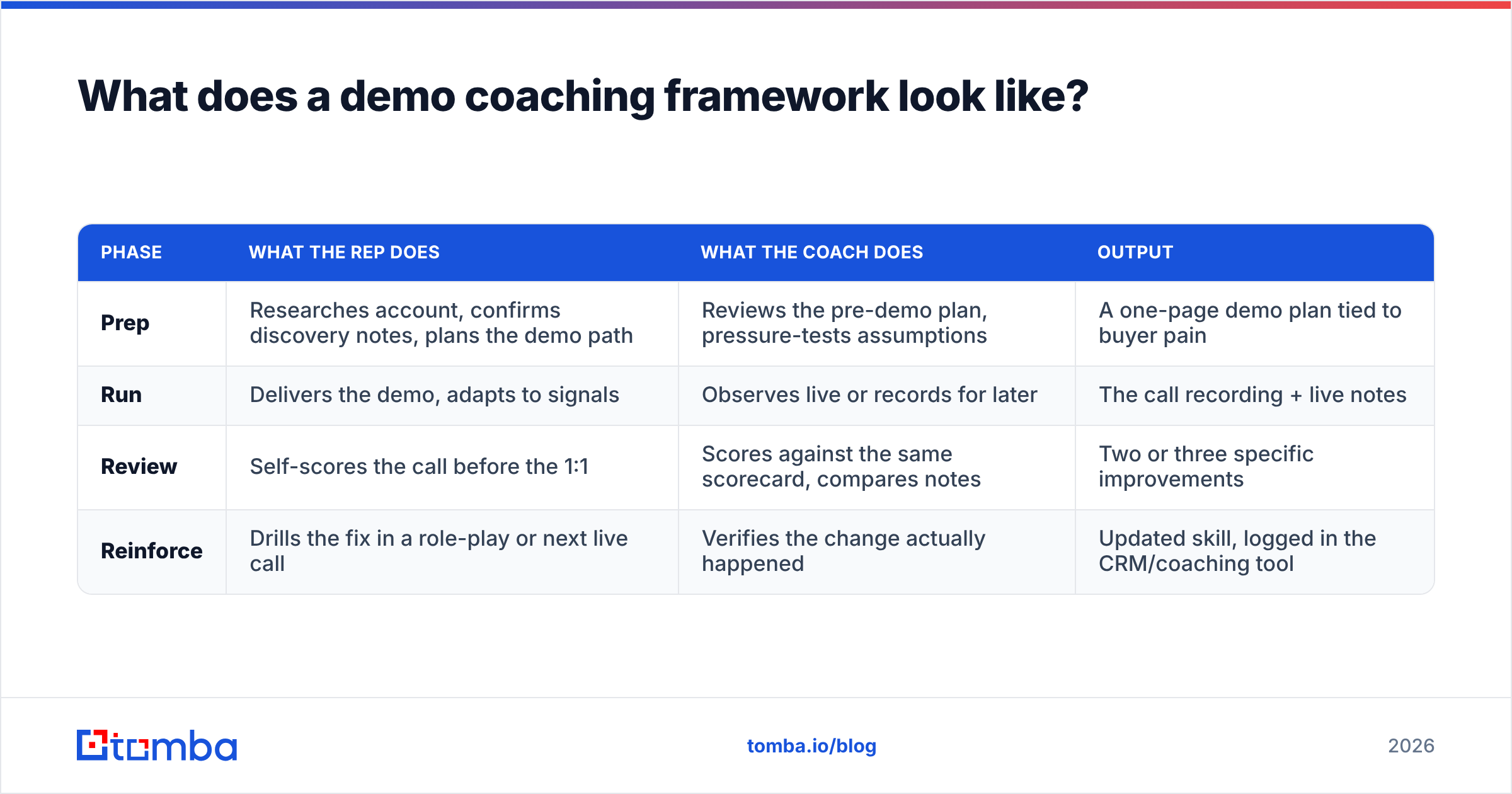
A good framework has four phases: prep, run, review, and reinforce. Here's how each maps to a real coaching action.
| Phase | What the rep does | What the coach does | Output |
|---|---|---|---|
| Prep | Researches account, confirms discovery notes, plans the demo path | Reviews the pre-demo plan, pressure-tests assumptions | A one-page demo plan tied to buyer pain |
| Run | Delivers the demo, adapts to signals | Observes live or records for later | The call recording + live notes |
| Review | Self-scores the call before the 1:1 | Scores against the same scorecard, compares notes | Two or three specific improvements |
| Reinforce | Drills the fix in a role-play or next live call | Verifies the change actually happened | Updated skill, logged in the CRM/coaching tool |
The self-score step is the one most teams skip and the one that changes everything. When a rep scores their own call before the manager does, the 1:1 stops being a verdict and becomes a comparison — and reps defend their own gaps far less.
What should a demo scorecard include?#
The scorecard is the backbone of demo coaching. Without it, "feedback" drifts by manager, by mood, and by how the quarter is going. With it, every rep is measured against the same bar.
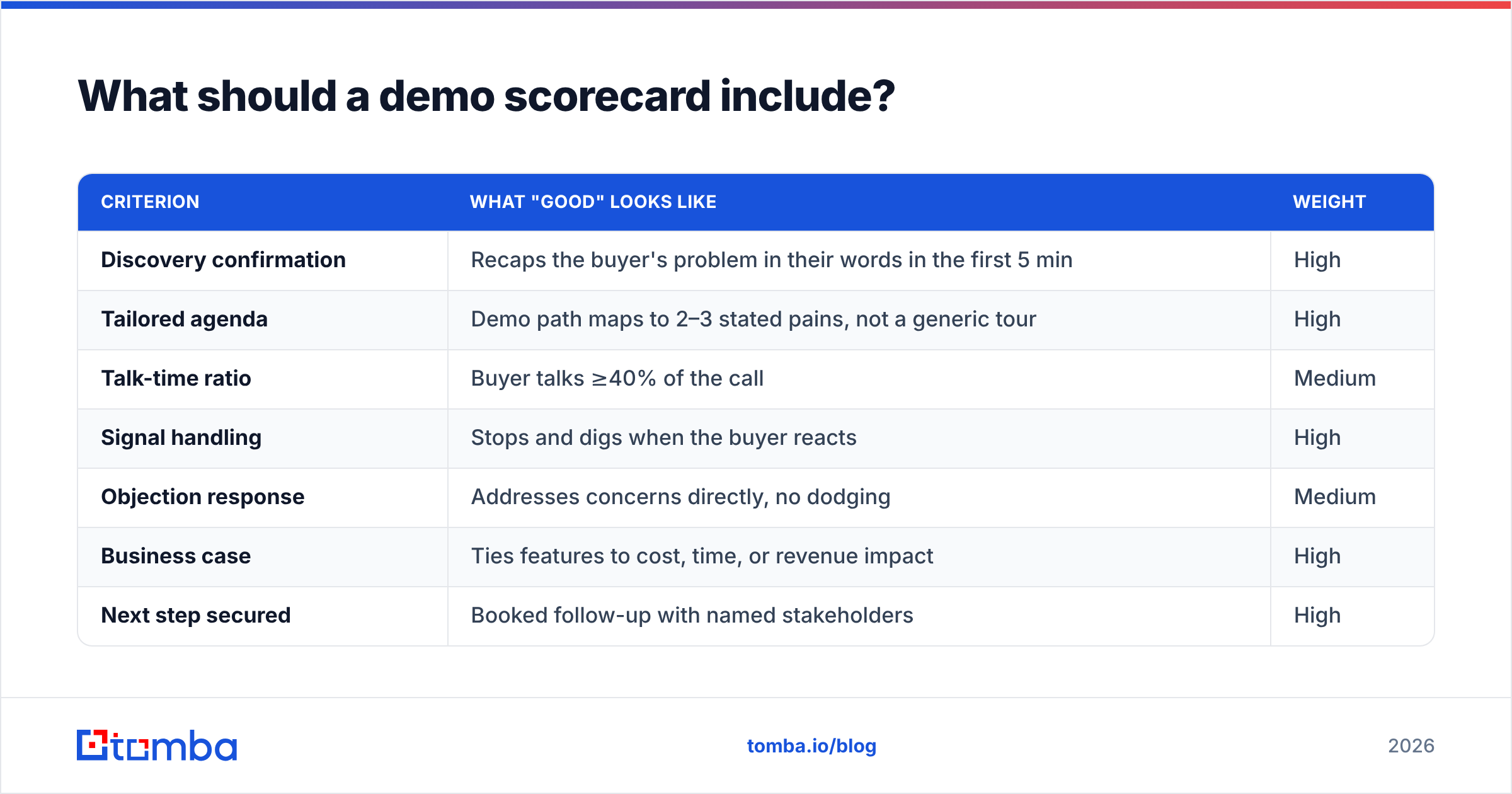
Keep it to 6–8 criteria, each scored 1–5 or simply met/not-met. Here's a proven starting set:
| Criterion | What "good" looks like | Weight |
|---|---|---|
| Discovery confirmation | Recaps the buyer's problem in their words in the first 5 min | High |
| Tailored agenda | Demo path maps to 2–3 stated pains, not a generic tour | High |
| Talk-time ratio | Buyer talks ≥40% of the call | Medium |
| Signal handling | Stops and digs when the buyer reacts | High |
| Objection response | Addresses concerns directly, no dodging | Medium |
| Business case | Ties features to cost, time, or revenue impact | High |
| Next step secured | Booked follow-up with named stakeholders | High |
| Multi-threading | Asks who else needs to be involved | Medium |
Resist the urge to add 20 rows. A scorecard nobody fills out coaches nobody. If you want a broader vendor-neutral view of what good conversation intelligence looks like, Gong and the sales tooling reviews on G2 are useful references for how teams operationalize this.
How do you run demo coaching that actually scales?#
The honest constraint is time. A front-line manager with eight reps can't sit in on every demo. Scaling demo coaching means mixing three modes.
- Live ride-alongs (highest signal, lowest scale). Reserve these for new hires and stalled reps. You catch real-time habits — like ignoring a buying signal — that recordings can flatten.
- Async call review (best scale-to-signal ratio). Reps submit one recording per week. You review at 1.5x, drop timestamped comments, and score against the card. Twenty minutes per rep, on your schedule.
- Peer review circles (culture multiplier). Reps review each other's calls in a weekly 30-minute session. Watching someone else miss a next step teaches faster than being told you missed yours.
A workable weekly cadence for a team of six to eight looks like this:
- Monday: each rep submits one demo recording + a self-score.
- Tuesday–Wednesday: manager reviews async, leaves two specific notes per call.
- Thursday: 20-minute 1:1 focused on one fix, not a laundry list.
- Friday: a 30-minute peer circle on one volunteer call.
One fix per week beats ten notes per call. Reps can only change one habit at a time, and a coach who lists ten things has effectively prioritized nothing.
What metrics prove demo coaching is working?#
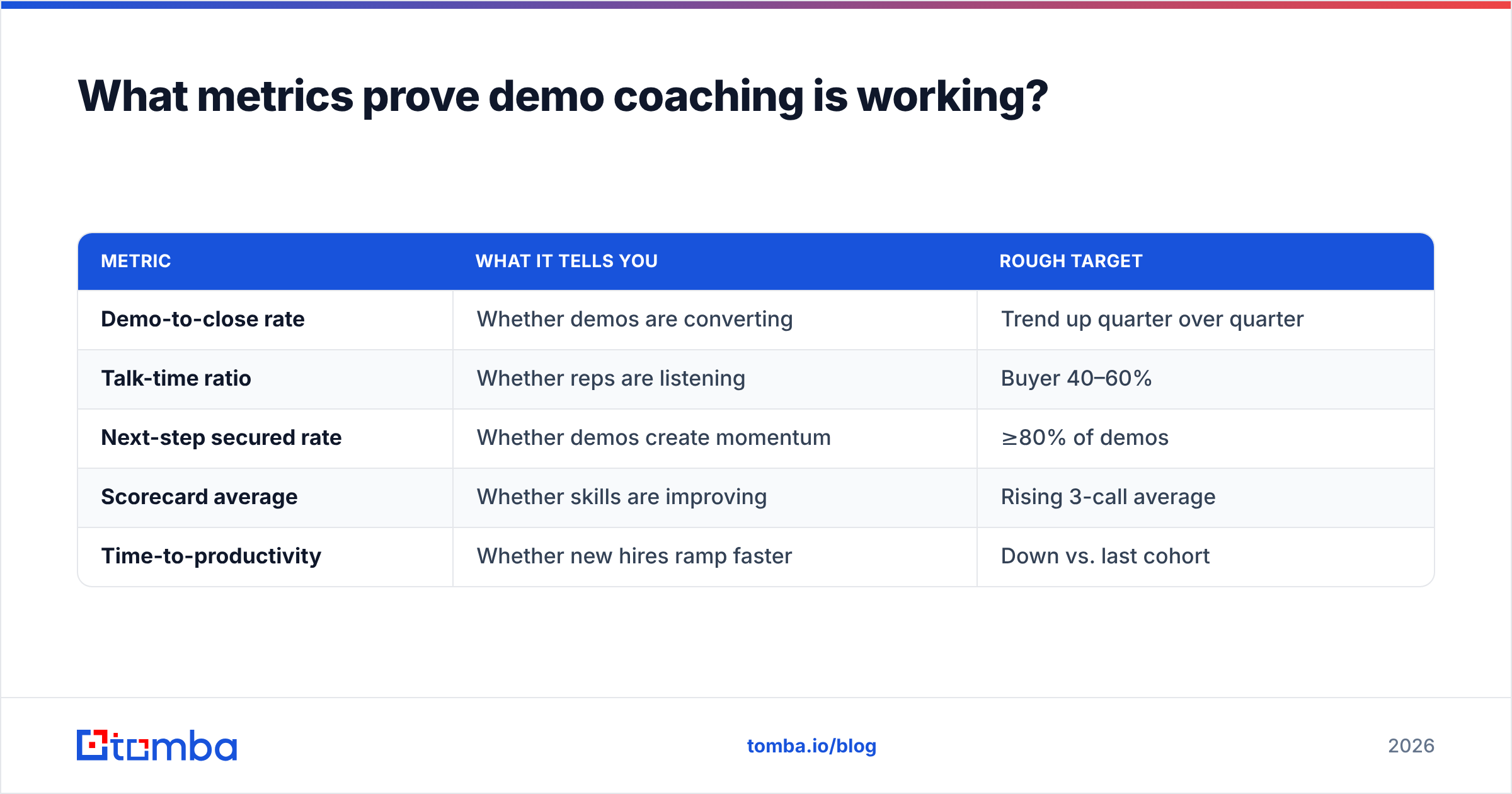
Coaching that doesn't move a number is theater. Track a small set and give them a quarter to respond.
| Metric | What it tells you | Rough target |
|---|---|---|
| Demo-to-close rate | Whether demos are converting | Trend up quarter over quarter |
| Talk-time ratio | Whether reps are listening | Buyer 40–60% |
| Next-step secured rate | Whether demos create momentum | ≥80% of demos |
| Scorecard average | Whether skills are improving | Rising 3-call average |
| Time-to-productivity | Whether new hires ramp faster | Down vs. last cohort |
The north-star metric is demo-to-close rate. Everything else is a leading indicator that explains why it's moving. If your scorecard averages climb but close rate is flat, your scorecard is measuring the wrong things — recalibrate the criteria toward business impact and next steps.
For deeper benchmarks on how top teams structure the demo stage of a deal, HubSpot's sales research library is a solid, vendor-neutral source of stage-by-stage conversion data to sanity-check your own numbers against.
How does prospecting quality affect demo coaching?#
Here's the part most enablement content skips: you can't coach your way out of bad demos if the demos are with bad-fit buyers. Coaching amplifies whatever pipeline you feed it.
If reps are demoing to people who were never going to buy — wrong title, wrong company size, no real pain — even a flawless demo won't close. That's a targeting problem masquerading as a skills problem. Before you blame the rep, check the inputs:
- Are meetings booked with actual decision-makers, or whoever replied first?
- Do reps have verified contact data so follow-ups reach the right inbox?
- Is the account enriched enough that the rep can tailor the demo before it starts?
This is where clean top-of-funnel data pays off downstream. When reps use accurate data enrichment to walk into a demo already knowing the account's tech stack, headcount, and role structure, the "tailored agenda" scorecard criterion goes up on its own. And when the follow-up depends on reaching a champion directly, having a verified phone finder number beats a fourth ignored email. Good coaching plus good data compounds; either one alone plateaus.
Demo coaching tools: what to look for#
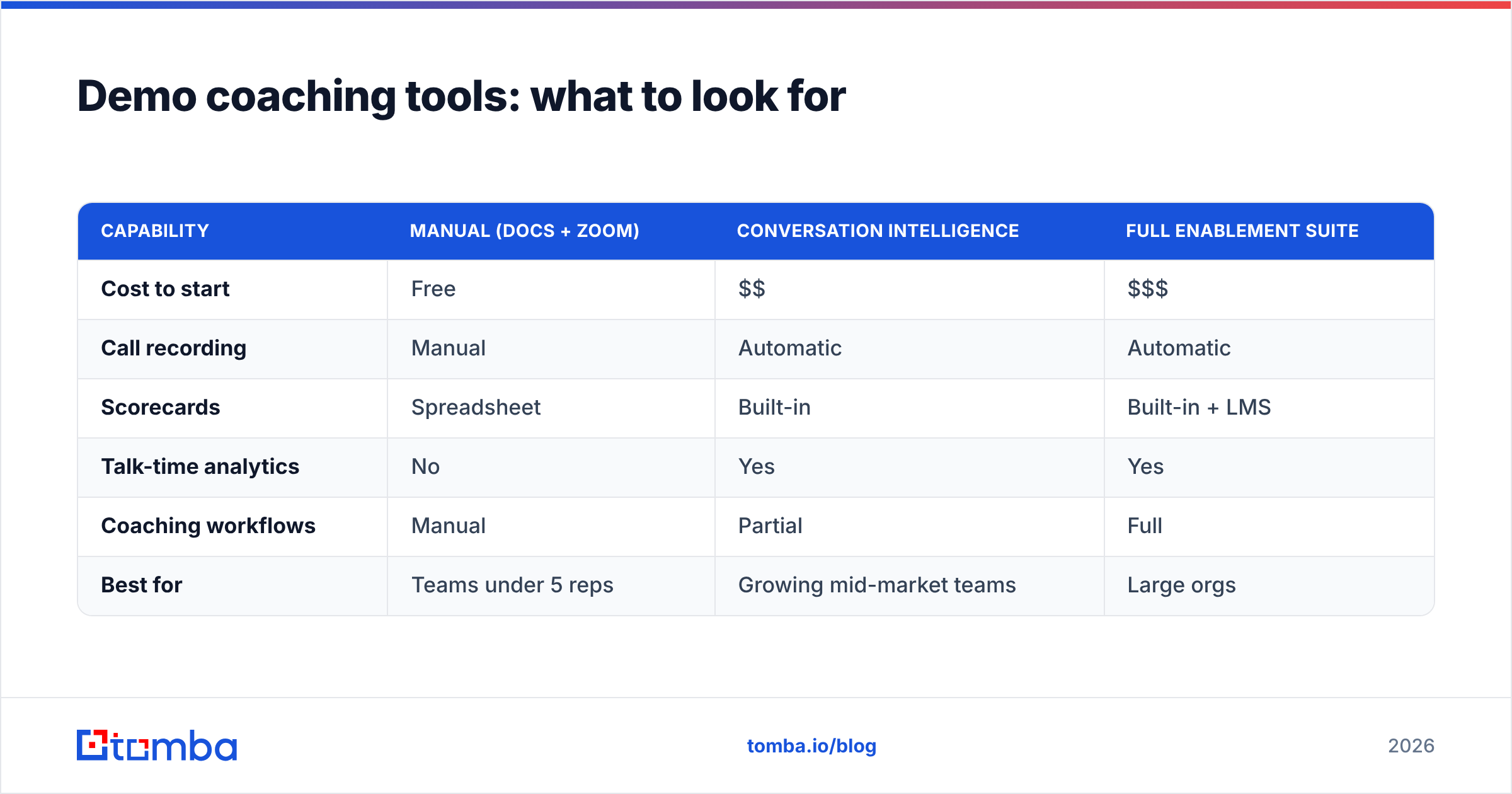
You don't need a big stack to start — a shared scorecard doc and recorded Zoom calls get you 80% of the way. But as you scale, tooling helps. Here's how the common options compare.
| Capability | Manual (docs + Zoom) | Conversation intelligence | Full enablement suite |
|---|---|---|---|
| Cost to start | Free | $$ | $$$ |
| Call recording | Manual | Automatic | Automatic |
| Scorecards | Spreadsheet | Built-in | Built-in + LMS |
| Talk-time analytics | No | Yes | Yes |
| Coaching workflows | Manual | Partial | Full |
| Best for | Teams under 5 reps | Growing mid-market teams | Large orgs |
Start manual, prove the process moves your demo-to-close rate, then buy tooling to remove the friction — not the other way around. Buying a platform before you have a coaching habit just gives you expensive recordings nobody reviews.
Common demo coaching mistakes to avoid#
- Coaching the pitch, ignoring discovery. If the questions are weak, the demo is doomed no matter how polished the delivery.
- Feedback sandwiches. "Great energy, but... great job overall" buries the one thing that matters. Be direct and specific.
- Scoring inconsistently. Two managers, two standards, zero fairness. Calibrate quarterly on the same call.
- Overloading the 1:1. Ten fixes equals zero fixes. Pick one.
- Never re-checking. If you don't verify the change on the next call, you didn't coach — you commented.
Frequently asked questions#
How often should you run demo coaching? Weekly for new hires in their first 90 days, biweekly for tenured reps. Consistency beats intensity — a short weekly review outperforms a monthly deep-dive nobody remembers.
Who should own demo coaching? Front-line sales managers own it, with enablement providing the scorecard, cadence, and calibration. If enablement owns it entirely, it becomes a compliance exercise; if managers own it with no framework, it becomes inconsistent.
Can you coach demos asynchronously? Yes, and for scale you should. Timestamped comments on recorded calls plus a rep self-score capture most of the value of a live ride-along at a fraction of the calendar cost.
Does demo coaching work for technical or product-led demos? Absolutely — the criteria shift toward "did the rep confirm the technical use case" and "did they map features to the buyer's workflow," but the prep-run-review-reinforce loop is identical.
Start with better inputs#
Demo coaching turns average reps into consistent closers — but only when they're demoing to the right people. The fastest way to lift your demo-to-close rate is to feed reps accurate, decision-maker-level contacts so every demo is with a buyer who can actually say yes.
Use the Tomba Email Finder to build clean, verified target lists and reach the champions who matter, then let your coaching do the rest. See Tomba pricing — from a free tier of 25 searches up to Growth at $99/mo — and give your team demos worth coaching.
Related guides#
Ready to find emails that actually work?
Join 150,000+ professionals who stopped guessing and started sending. Free credits on signup — no credit card required.
Get the Tomba newsletter
Practical outbound tactics and product updates — once every two weeks.
About the author