9 Best Dexiio Alternatives for B2B Data Collection in 2026
Dexi.io is powerful for web scraping, but it's overkill for most sales and RevOps teams. Here are 9 Dexiio alternatives that pull cleaner B2B contact data with far less setup.
Dexi.io (often searched as "Dexiio") is a capable visual web-scraping and data-extraction platform. But if your real goal is B2B contact data — emails, phone numbers, enriched company records — a general-purpose scraper is a heavy, brittle way to get there. This guide breaks down the nine best Dexiio alternatives for 2026, who each one is for, and where they quietly cost you more than the sticker price.
TL;DR: The Fastest Answer#
- Dexi.io is a scraping engine, not a data provider. You still have to build extractors, maintain selectors, and clean the output yourself.
- For B2B contact and email data, a purpose-built finder beats a scraper on accuracy, compliance, and time-to-value — Tomba, Apollo, and Clearbit-style enrichment lead here.
- For pure web/no-code scraping, Octoparse, Apify, and Browse AI are the closest like-for-like swaps.
- Cheapest honest entry point: Tomba's free tier (25 searches/mo) and a $49/mo Starter plan beat most scrapers once you factor in maintenance time.
- Pick by job, not by feature list. Scraping ≠ finding contacts. The table below maps each tool to the job it actually does well.
Why Look for a Dexiio Alternative at All?#
The short version: most teams that land on Dexi.io don't actually want a scraper — they want the data at the end of the scrape. Dexi.io hands you a robot-building toolkit. That's excellent when you're extracting product prices across 500 retail sites, and painful when you just need verified emails for 2,000 decision-makers.
Three recurring reasons people migrate:
- Maintenance tax. Selector-based extractors break every time a target site changes its markup. Someone on your team owns that upkeep forever.
- No verification layer. A scraper returns whatever the page shows. It won't tell you if an email is deliverable, a catch-all, or already dead.
- Compliance ambiguity. Scraping personal data from arbitrary sites raises GDPR/CCPA questions that a licensed B2B database with documented data sources sidesteps.
If you recognize your own workflow in that list, you're not looking for a better scraper. You're looking for a better source.
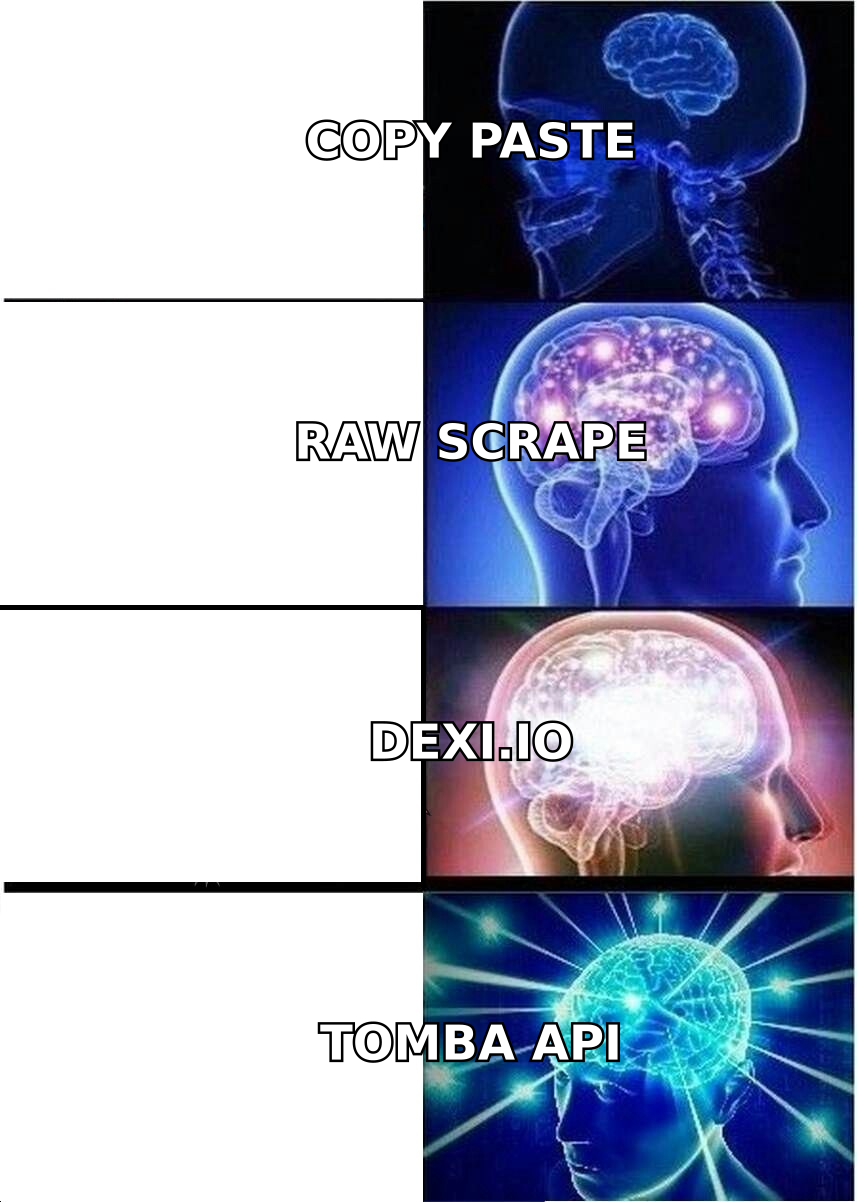
What Are the Best Dexiio Alternatives in 2026?#
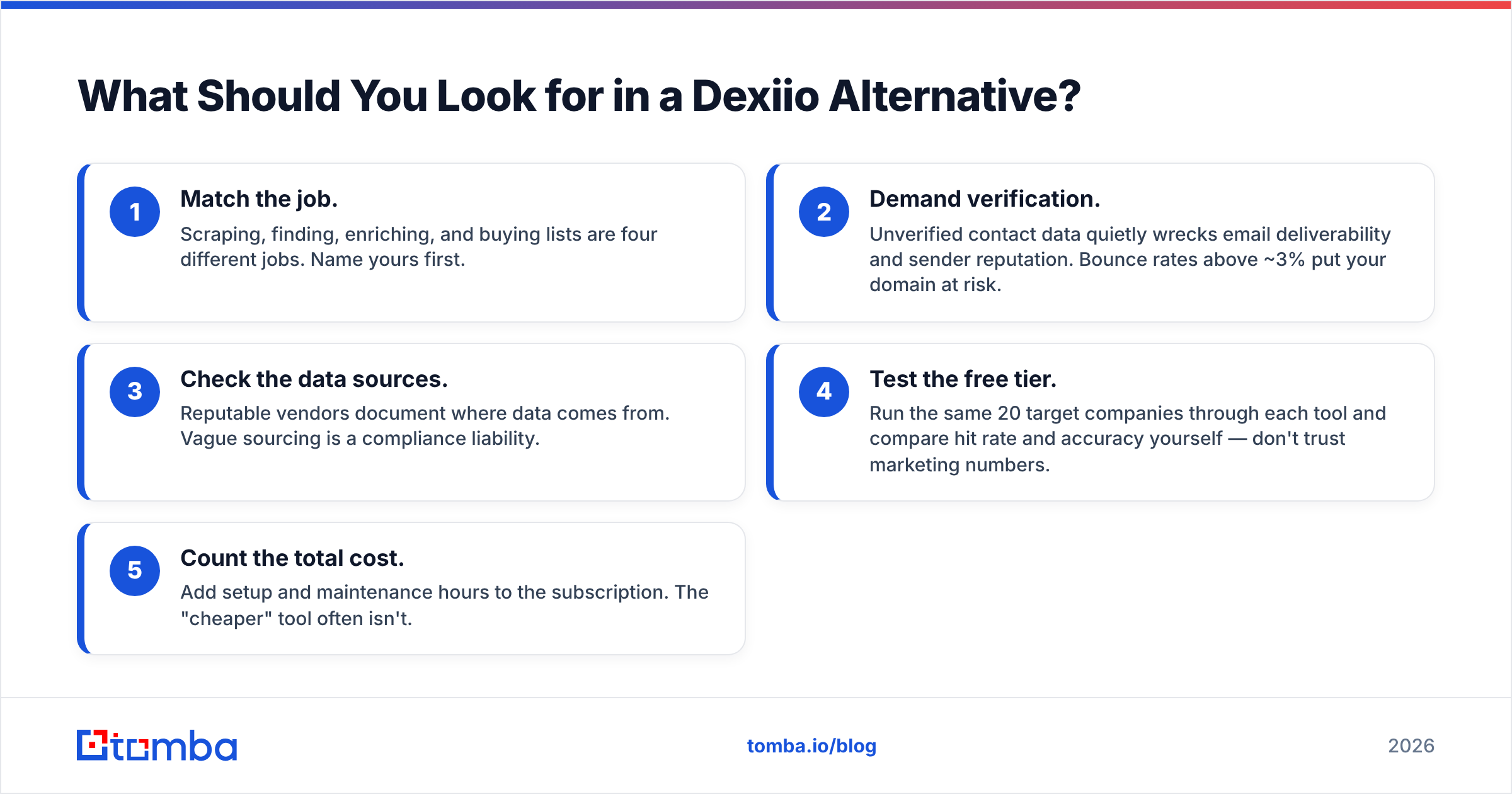
Here's the head-to-head. "Primary job" is the honest one-line summary of what each tool is actually built to do — read that column first.
| Tool | Primary job | Best for | Free tier | Entry price |
|---|---|---|---|---|
| Tomba | Email finding + verification | Sales, RevOps, outreach data | 25 searches/mo | $49/mo |
| Dexi.io | Visual web scraping | Custom extraction at scale | Trial only | Custom quote |
| Octoparse | No-code scraping | Non-devs scraping structured sites | 10k rows | ~$99/mo |
| Apify | Dev scraping platform | Engineers, custom actors | $5 credit/mo | $49/mo |
| Browse AI | Point-and-click monitoring | Watching pages for changes | 50 credits | ~$49/mo |
| Apollo | Sales database + engagement | All-in-one prospecting | Limited free | ~$49/mo |
| Clearbit | Enrichment + firmographics | Enriching existing records | No | Custom quote |
| Bright Data | Proxy + web data at scale | Enterprise data pipelines | Trial | Usage-based |
| BookYourData | Prebuilt B2B lists | Buying ready lead lists | Sample | Pay-per-lead |
Now the detail on each.
1. Tomba — Best for B2B Contact Data Without the Scraping#
If the data you're chasing is people — names, roles, emails, phones — start here. Instead of building an extractor and hoping the page renders the email, you query a domain and get structured, verified contacts back. The email finder works by domain, name, or company; the built-in email verifier tells you whether each address is deliverable before you send.
Where it wins over Dexi.io: zero selector maintenance, a real verification layer, a catch-all verifier for tricky domains, and clean CSV/API delivery. There's a free tier (25 searches/mo), and paid plans run from $49/mo — see full Tomba pricing.
Where Dexi.io still wins: if you need product data, prices, or non-contact content from arbitrary pages, Tomba isn't a scraper and won't pretend to be.
2. Octoparse — Closest No-Code Scraper Swap#
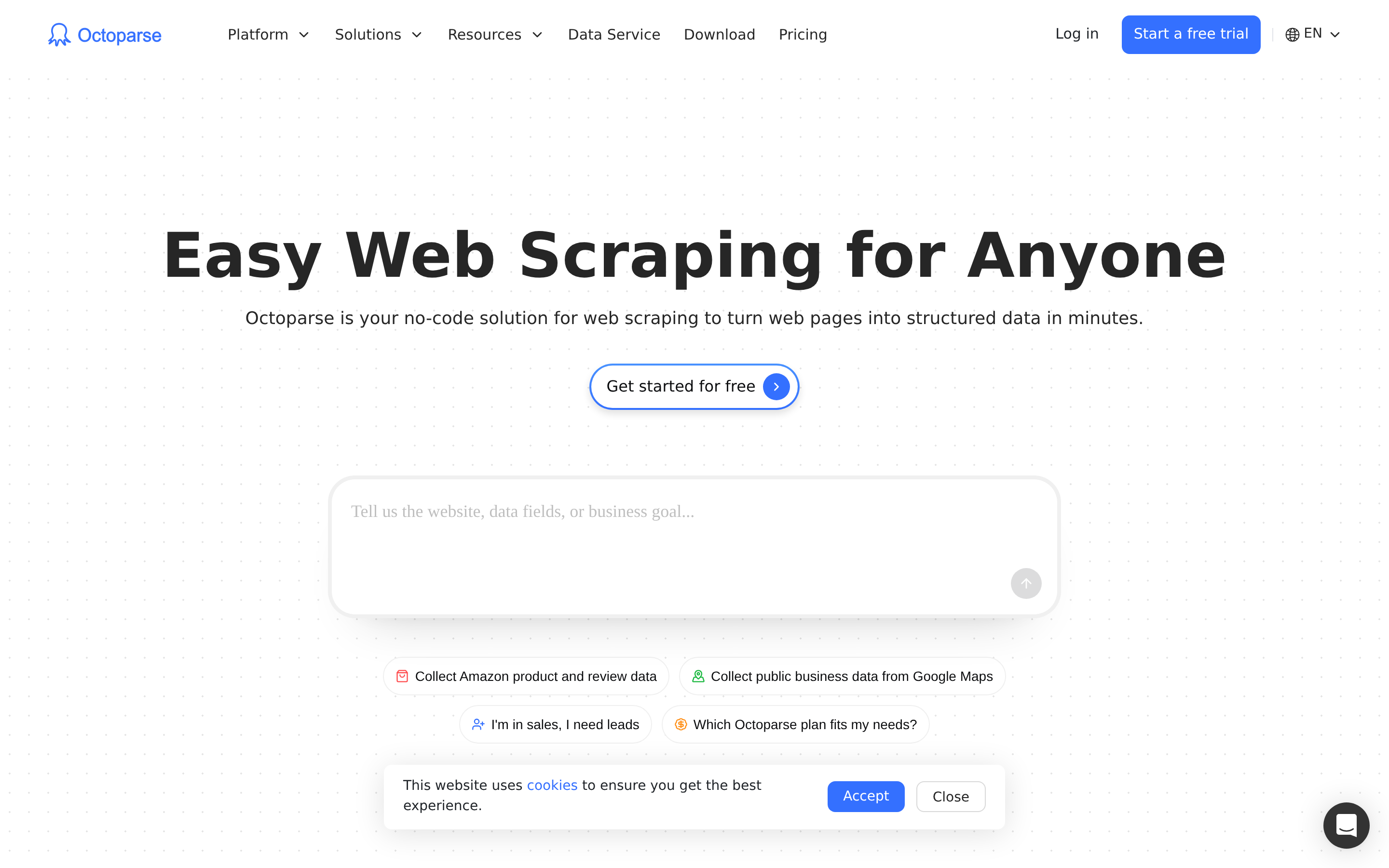
Octoparse is the most direct like-for-like replacement if you genuinely need visual scraping. Point-and-click workflow builder, cloud runs, scheduling, and templates for common sites. Non-developers get further with Octoparse than with Dexi.io's steeper learning curve. The catch is the same as any scraper: you own the maintenance, and there's no contact verification.
3. Apify — For Engineers Who Want Control#
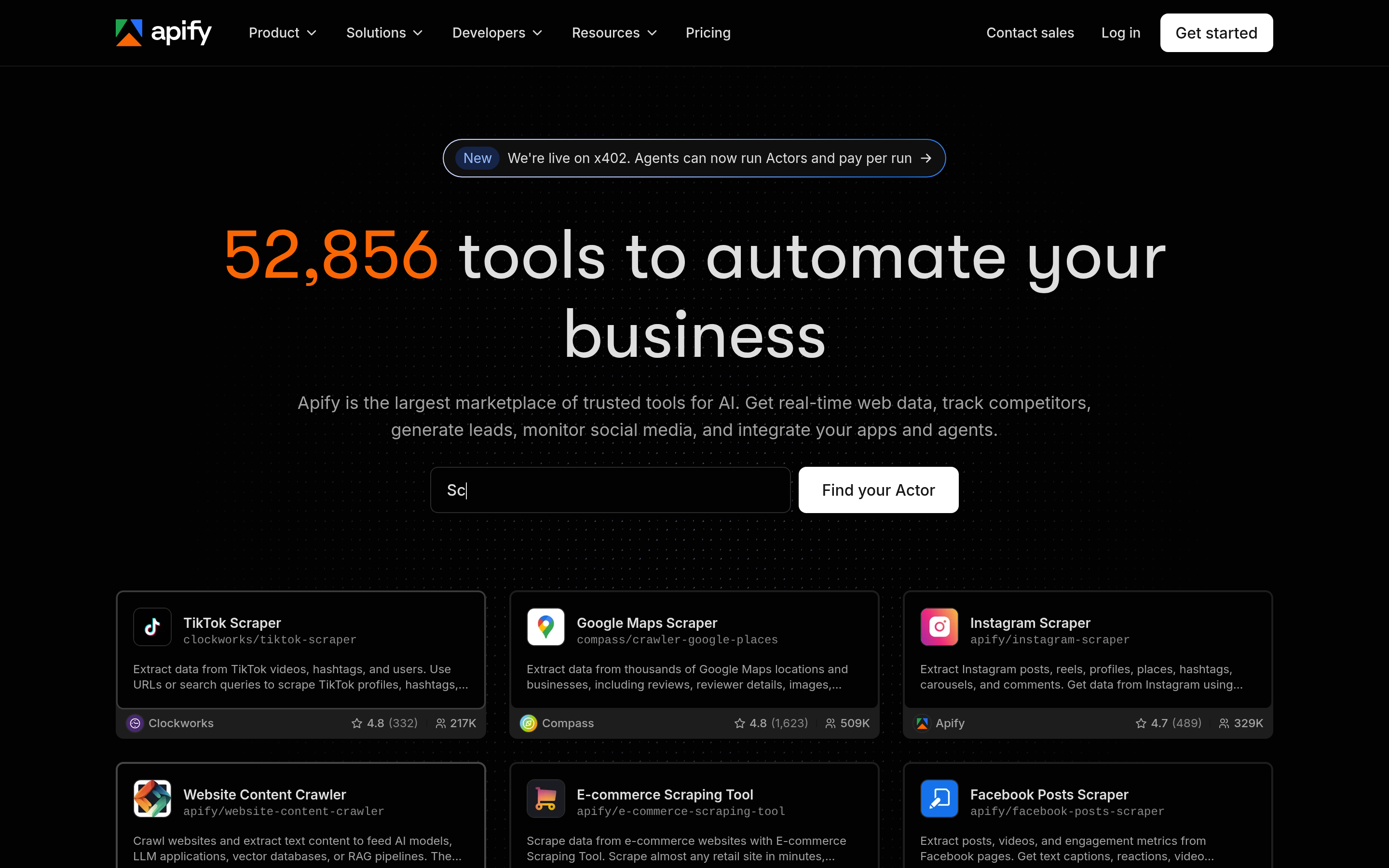
Apify is a developer-first scraping platform built around reusable "actors." If you have engineering time and want programmable, scalable extraction with proxy rotation and a real SDK, Apify is more flexible and better documented than Dexi.io. Pricing starts around $49/mo with usage-based credits. Not the pick for a non-technical sales team.
4. Browse AI — For Monitoring, Not Bulk Extraction#
Browse AI shines at a narrower job: watching specific pages and alerting you when they change (pricing, job postings, inventory). Dead-simple point-and-click setup. If your Dexi.io use case was really "tell me when X changes on this page," Browse AI does it with less overhead. For large-scale one-time extraction, look elsewhere.
5. Apollo — All-in-One Sales Data + Engagement#
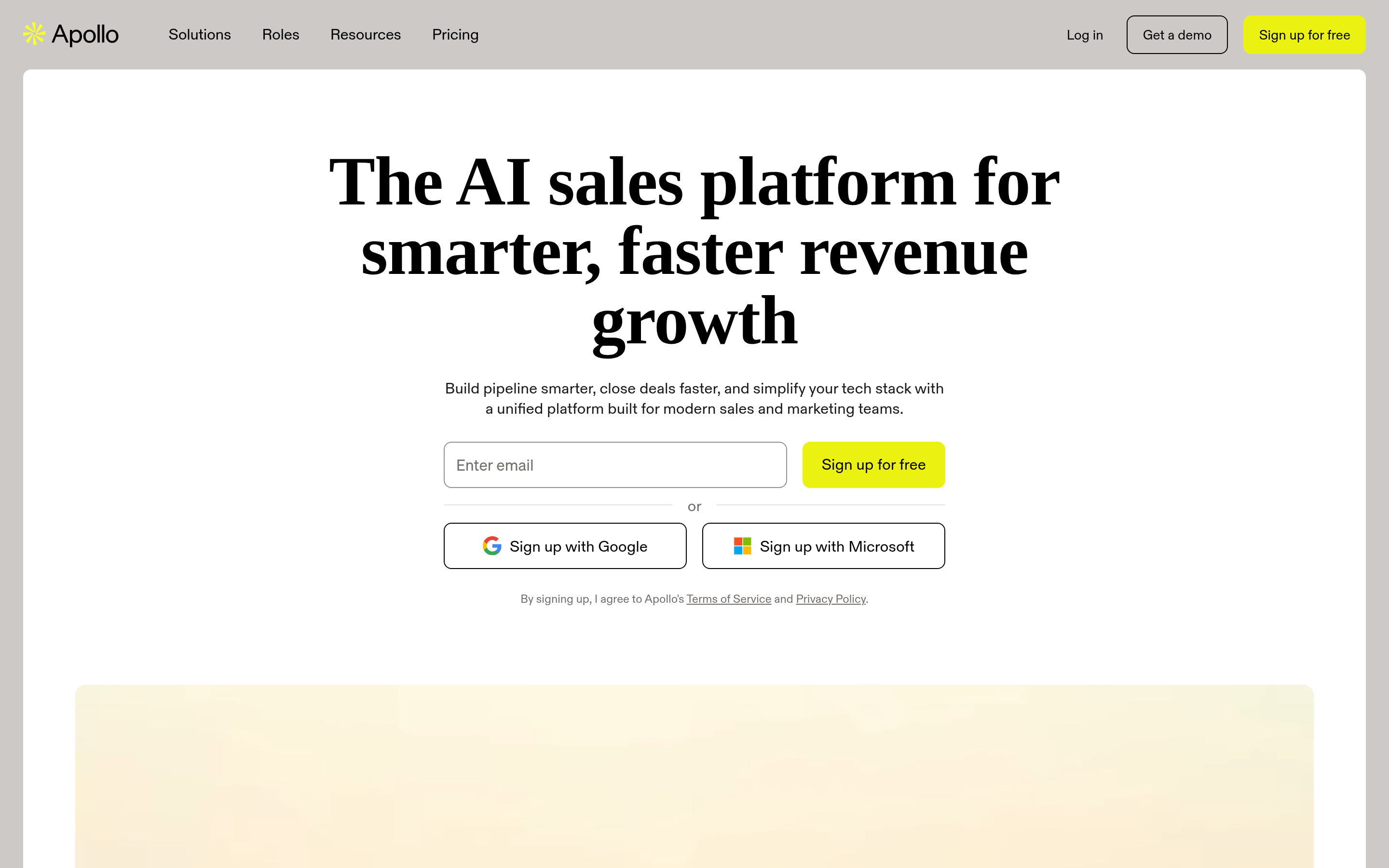
Apollo bundles a B2B contact database with sequences and a dialer. If you want prospecting data and the outreach tooling in one seat, it's a reasonable single-vendor bet. The trade-off is data accuracy that varies by region and industry, plus feature bloat you pay for whether you use it or not. Many teams pair a focused finder with their existing CRM instead — see this Apollo alternative breakdown.
6. Clearbit — Enrichment for Records You Already Have#
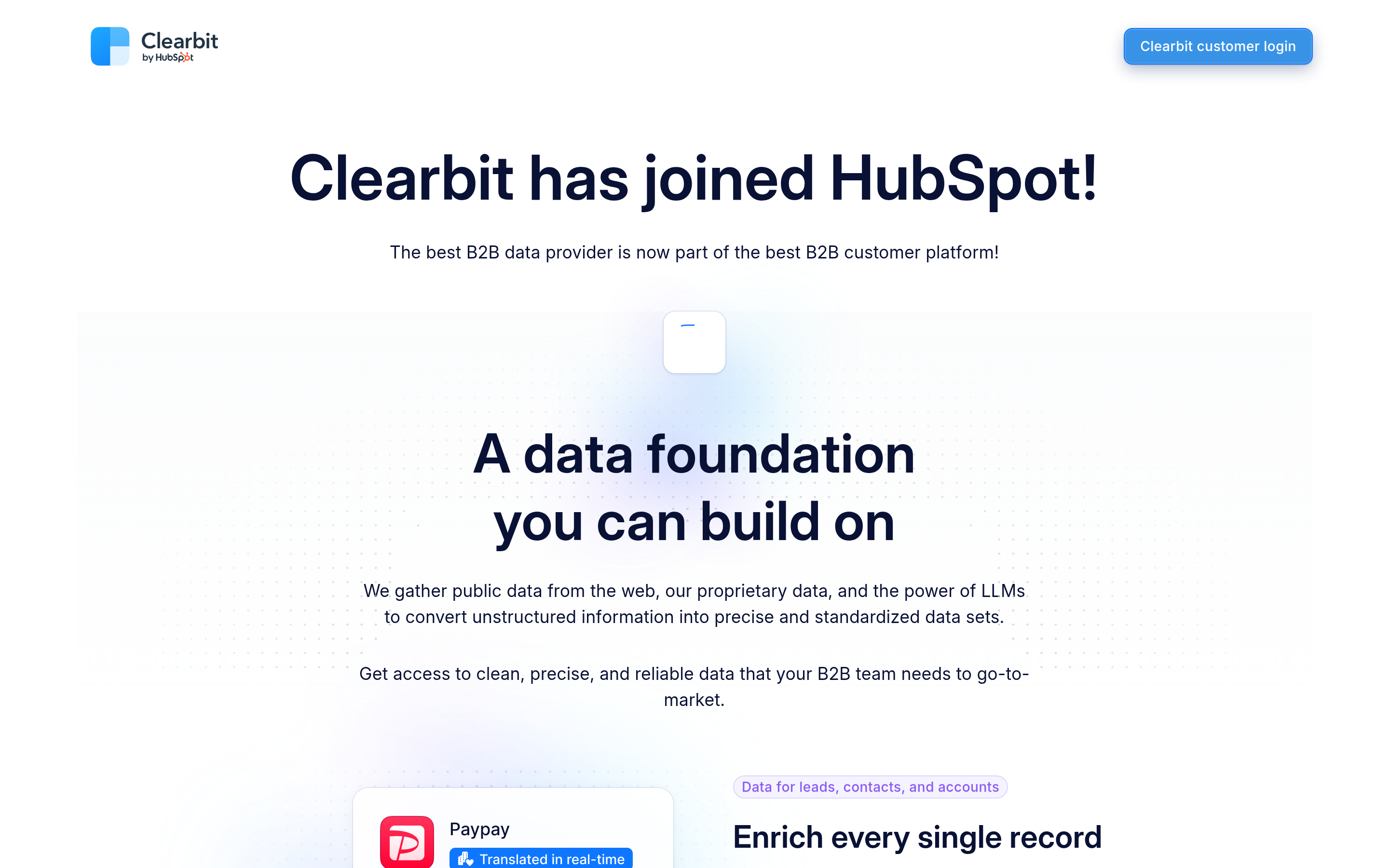
Clearbit (now part of HubSpot) is enrichment-first: feed it a domain or email and get firmographics back. It's not a discovery tool and has no free tier, so it fits teams enriching an existing pipeline rather than sourcing net-new contacts. For a lighter, standalone option, compare the Clearbit alternative route or Tomba's own data enrichment.
7. Bright Data — Enterprise-Scale Web Data#
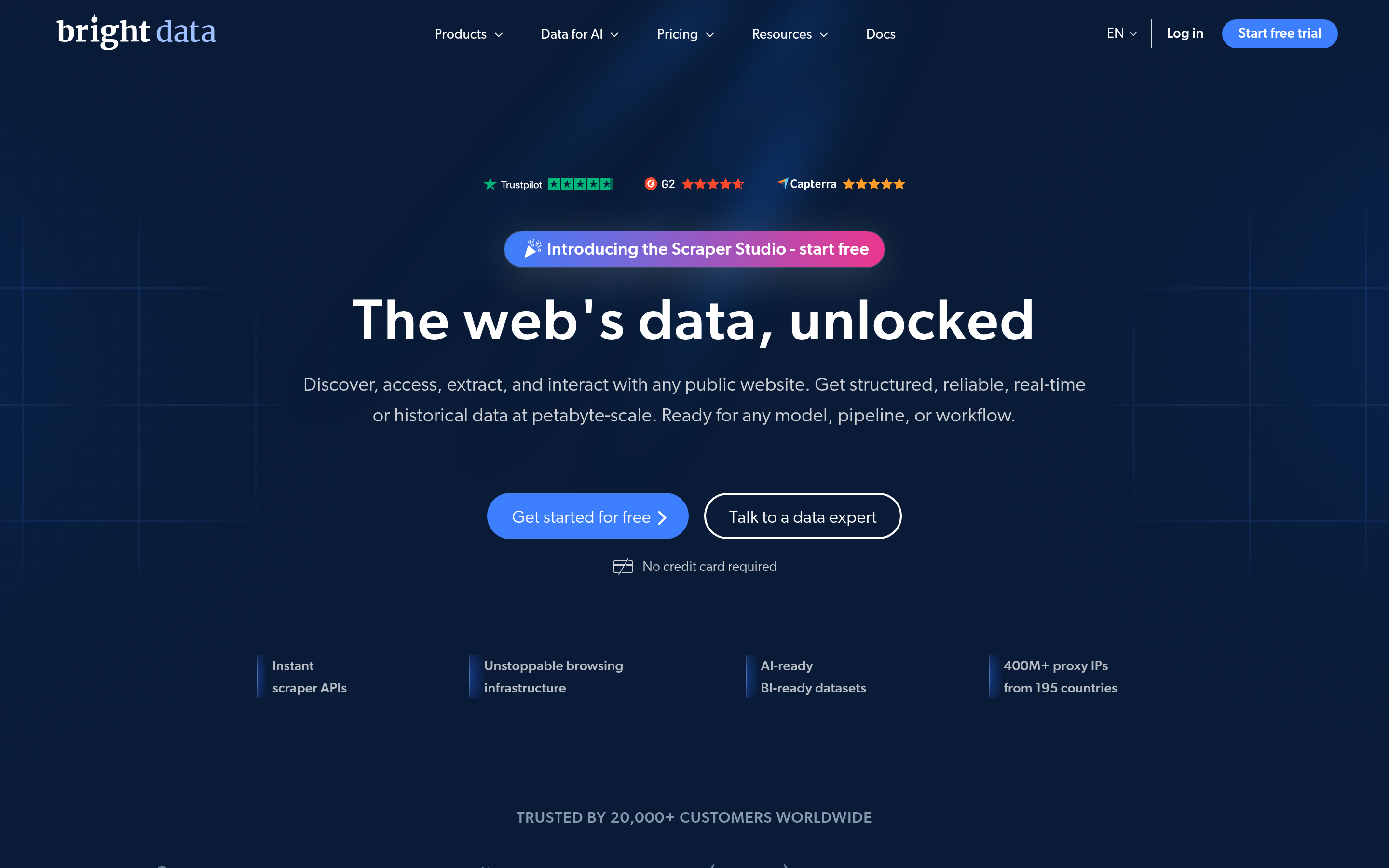
Bright Data is the heavyweight: massive proxy network, datasets, and web-scraping infrastructure priced by usage. It's genuinely more capable than Dexi.io at scale — and genuinely more expensive and complex. Only worth it if web data is a core part of your product or a large ongoing pipeline.
8. BookYourData — Buy Prebuilt Lists Instead#
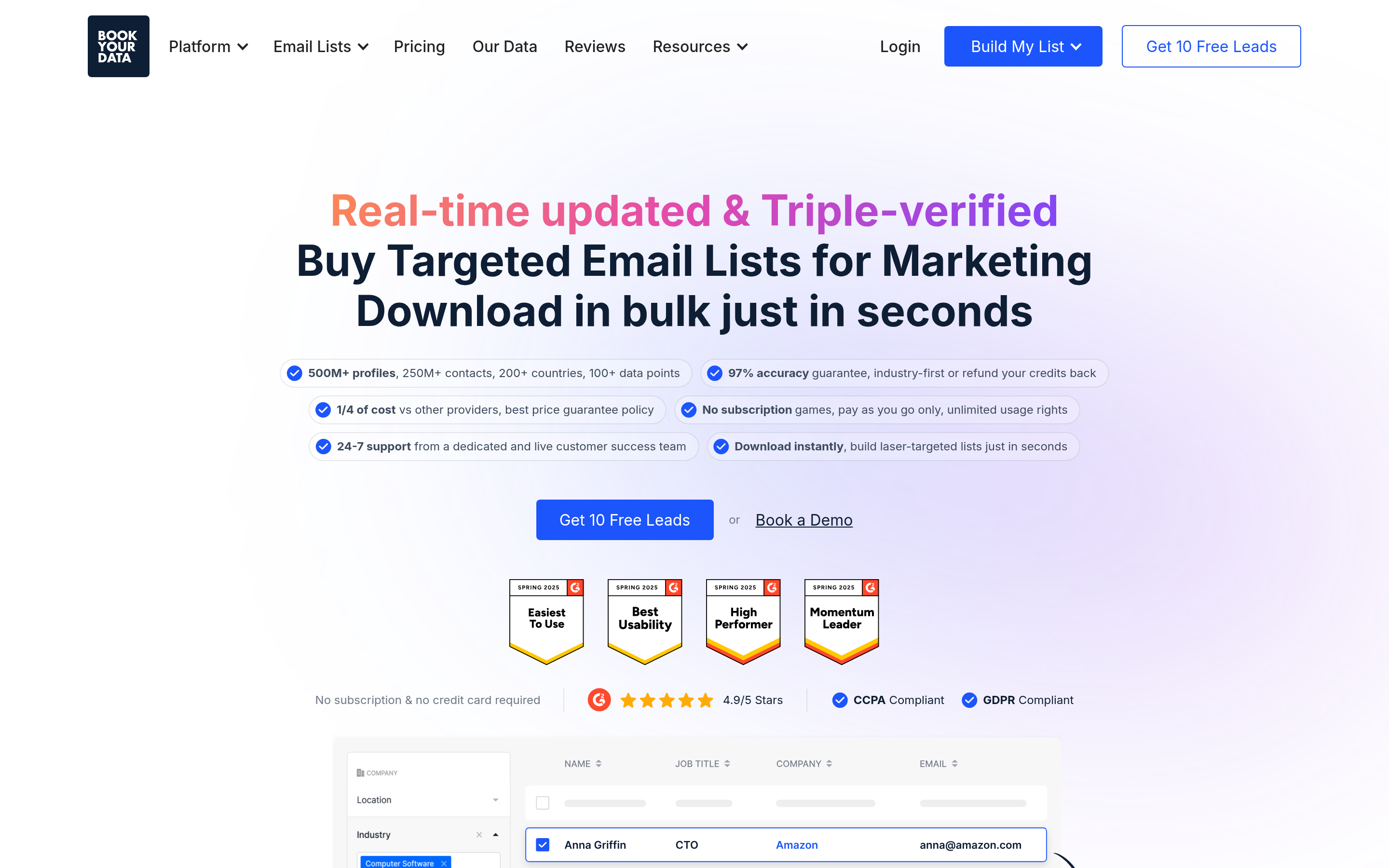
If you'd rather skip collection entirely, BookYourData sells prebuilt, filterable B2B lead lists on a pay-per-lead model with a claimed accuracy guarantee. It's a solid, respected option when you want ready-made lists for a specific ICP and don't need a repeatable in-house process. The trade-off versus a finder is freshness and flexibility — a static list ages, while an API query is always live.
9. Roll Your Own API — Only If You Have the Team#
You can combine an open-source scraper, a proxy provider, and a verification API into a homegrown pipeline. Teams with strong engineering do this. Just be honest about the total cost: build time, ongoing maintenance, proxy fees, and the verification service you'll still need to bolt on. For most teams it's cheaper to rent a finished email finder API than to staff one.

Scraper vs. Contact Finder: Which Do You Actually Need?#
This is the decision that determines everything else. Answer it before you compare prices.
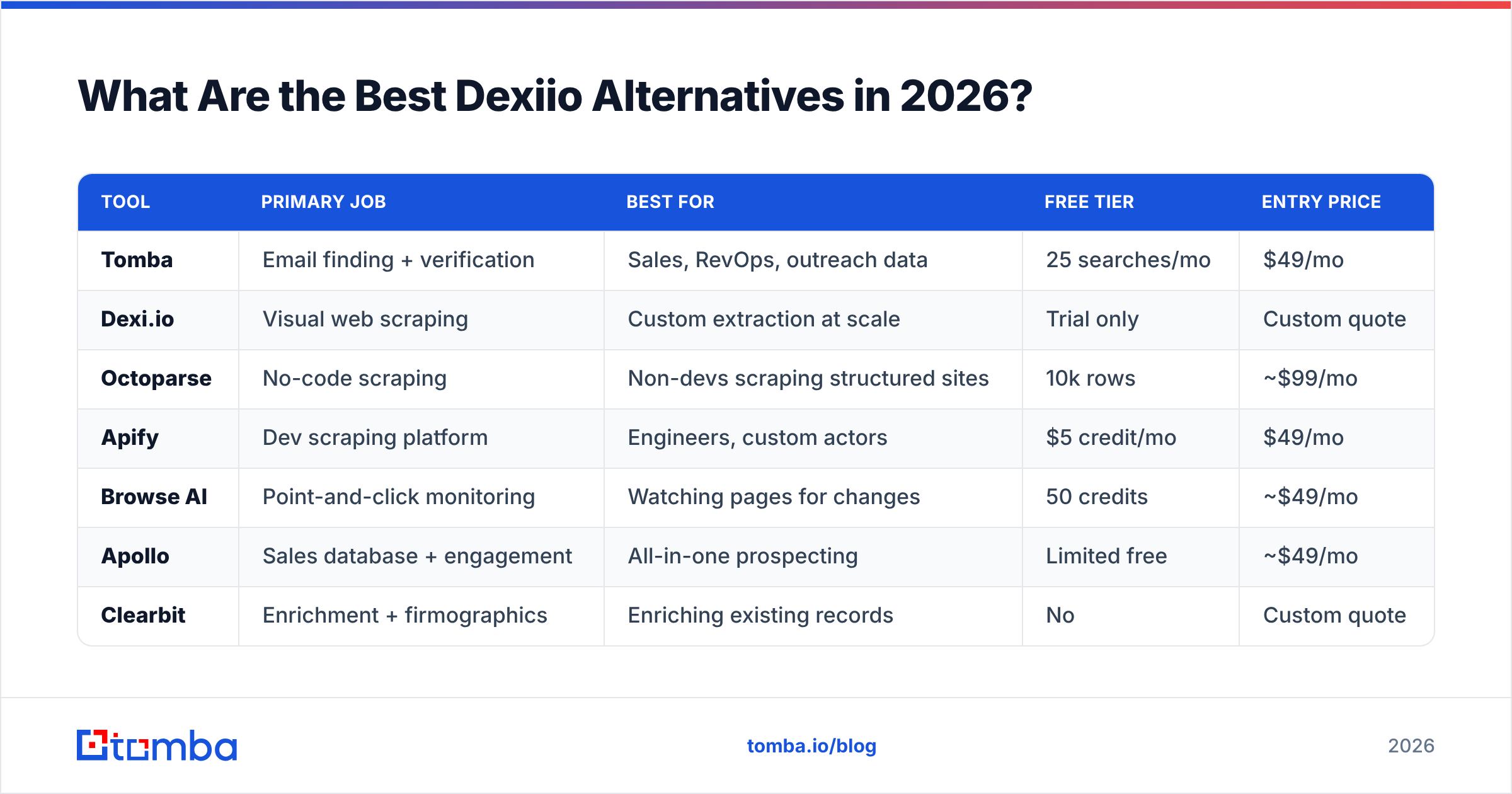
- Choose a scraper (Octoparse, Apify, Bright Data) when the data lives on web pages, isn't primarily contact info, and changes often enough that you need repeatable extraction — product catalogs, pricing pages, listings, reviews.
- Choose a contact finder (Tomba, Apollo) when you want people-level data — emails, phones, titles — delivered clean and verified, without owning any extraction logic.
- Choose enrichment (Clearbit, Tomba enrichment) when you already have partial records (a domain, a name) and need to fill in the gaps.
- Choose a prebuilt list (BookYourData) when you want a one-time, filtered lead list and don't need an ongoing process.
Dexi.io sits firmly in the first bucket. If your real target is the third or fourth, you've been forcing a scraping tool to do an enrichment job — which is exactly why it felt harder than it should.
How Much Do Dexiio Alternatives Cost?#
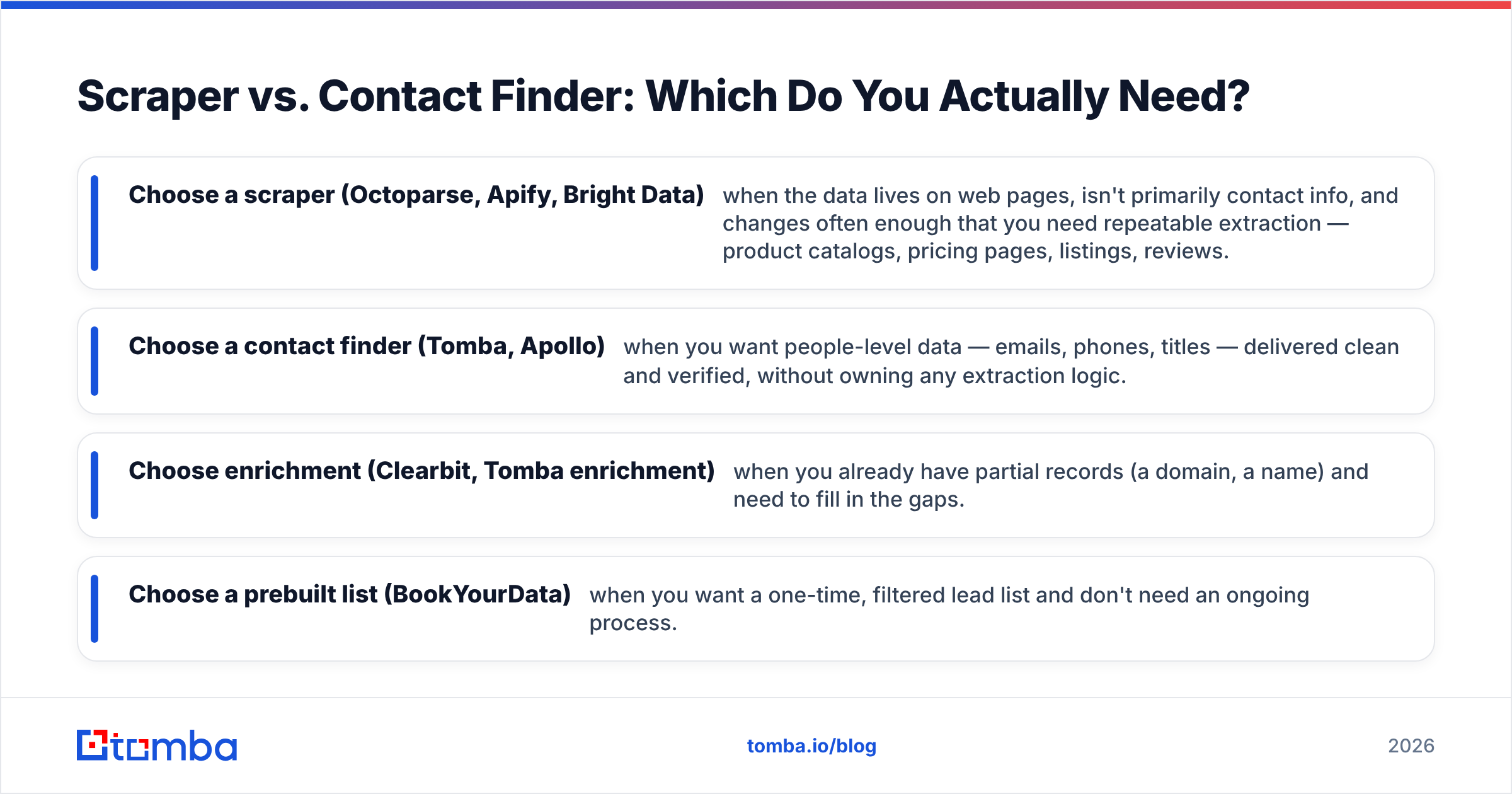
Sticker price is only half the story. A cheap scraper with a heavy maintenance tax often costs more than a slightly pricier finder that just works. Here's the honest comparison for a small sales team pulling contact data.
| Cost factor | Dexi.io / scrapers | Tomba (finder) |
|---|---|---|
| Base subscription | Custom / ~$99/mo | Free to $49/mo start |
| Setup time | Days (build extractors) | Minutes |
| Ongoing maintenance | High (selectors break) | None |
| Verification | Not included | Built in |
| Compliance overhead | Your responsibility | Licensed sources |
| Skill needed | Technical | Non-technical friendly |
For most sales, marketing, and RevOps teams, the finder path is cheaper in total cost of ownership even before you count the hours saved. If you're extracting non-contact web data at scale, the scraper's price is justified — just don't pay it to collect emails you could query in seconds.
What Should You Look for in a Dexiio Alternative?#
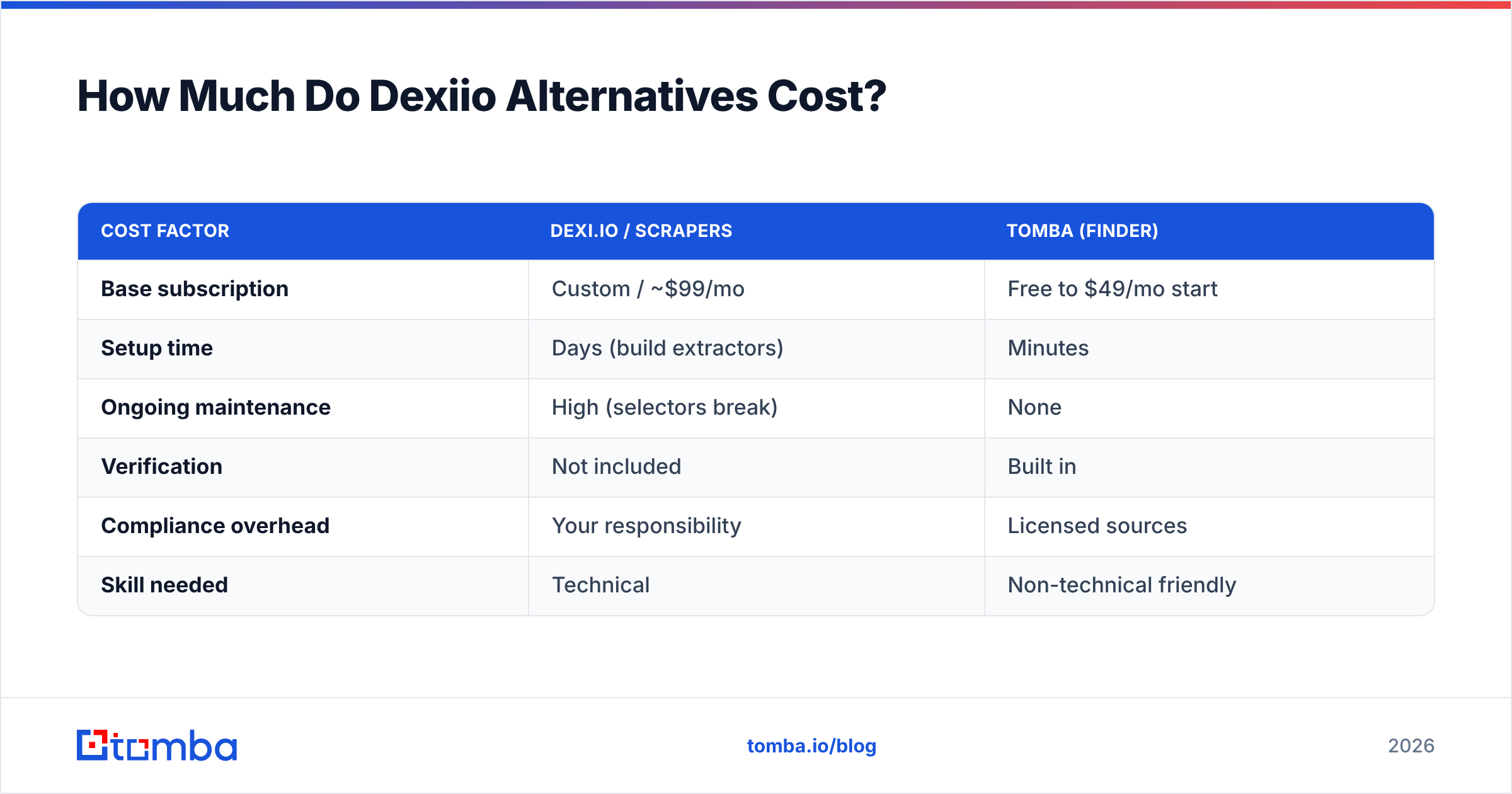
Use this five-point checklist to filter the field to the one or two tools that fit:
- Match the job. Scraping, finding, enriching, and buying lists are four different jobs. Name yours first.
- Demand verification. Unverified contact data quietly wrecks email deliverability and sender reputation. Bounce rates above ~3% put your domain at risk.
- Check the data sources. Reputable vendors document where data comes from. Vague sourcing is a compliance liability.
- Test the free tier. Run the same 20 target companies through each tool and compare hit rate and accuracy yourself — don't trust marketing numbers.
- Count the total cost. Add setup and maintenance hours to the subscription. The "cheaper" tool often isn't.
For a broader market view, cross-check vendor reviews on G2 or Capterra before committing, and read Dexi.io's own positioning on dexi.io to confirm it really is (or isn't) built for your use case.
Frequently Asked Questions#
Is Dexi.io still a good tool in 2026? Yes — for what it's designed for. As a visual web-scraping and extraction platform it remains capable. It just isn't a B2B contact-data provider, and using it as one is the most common reason people look for alternatives.
What's the best free Dexiio alternative? For contact data, Tomba's free tier (25 searches/mo) is the easiest no-cost start. For scraping, Apify's monthly free credit and Octoparse's free row allowance let you test without paying.
Do I need a scraper and a finder? Sometimes. Teams that scrape non-contact web data and need verified emails often run a scraper (Apify/Octoparse) alongside a finder like Tomba. But if contacts are your only goal, you only need the finder.
How do I keep scraped or found data compliant? Prefer vendors with documented, licensed data sources, verify addresses before sending to keep bounce rates low, and honor opt-outs. A licensed database shifts much of the sourcing burden off your shoulders compared with scraping arbitrary sites.
The Bottom Line#
Dexi.io is a strong scraper aimed at a specific problem: extracting web content at scale. If that's your problem, Octoparse, Apify, or Bright Data are the natural alternatives. But if you landed here because you actually need clean, verified B2B contacts — emails, phones, and enriched company data — a purpose-built finder will get you there faster, cheaper, and with far less to maintain.
Skip the extractor-building entirely: run your target domains through the Tomba Email Finder, verify every address on the way out, and export a clean list your reps can actually use. Start free with 25 searches, then scale to a $49/mo Starter plan only once it's paying for itself.
Related guides#
Ready to find emails that actually work?
Join 150,000+ professionals who stopped guessing and started sending. Free credits on signup — no credit card required.
Get the Tomba newsletter
Practical outbound tactics and product updates — once every two weeks.
About the author