Different Types of Sales Roles Explained: 2026 Team Guide
SDR, AE, AM, SE, RevOps — the modern sales org has more titles than ever. Here's what every role actually does, who it reports to, and how to hire them in the right order.
Different Types of Sales Roles Explained: 2026 Team Guide
Sales stopped being one job a long time ago. The person who books the meeting, the person who closes it, and the person who keeps the account alive are usually three different people now — and on a mature team, closer to six. If you are hiring, mapping a career path, or just trying to understand who does what, the different types of sales roles can feel like alphabet soup: SDR, BDR, AE, AM, SE, CSM, RevOps.
This guide decodes every major role on a modern B2B sales team, what each one is actually responsible for, roughly what they cost, and the order most companies hire them in.
TL;DR#
- Modern sales is specialized. The old "one rep does everything" model has split into prospecting, closing, and retention roles — each with its own skills and comp plan.
- The core four are SDR/BDR (pipeline), AE (closing), AM/CSM (retention and expansion), and Sales Engineer (technical proof).
- Support roles — Sales Ops, RevOps, and Sales Enablement — make the frontline roles more productive; they scale, they don't cold call.
- Hire in order: founder-led selling → first AE → SDR support → AM/CSM → ops. Skipping steps burns cash.
- Every role runs on data. Prospecting titles live or die on contact accuracy, which is why a reliable email finder sits under almost all of them.

Why are there so many different types of sales roles now?#
Specialization beats generalization once volume goes up. Think of a restaurant: a tiny café has one person taking orders, cooking, and clearing tables. A busy kitchen has a host, line cooks, servers, and a manager — not because it's fancy, but because splitting the work lets each station move faster and mess up less.
B2B sales followed the same path. When Aaron Ross wrote Predictable Revenue about the Salesforce model, he popularized splitting "hunters" who prospect from "closers" who run deals. That single idea — role specialization — is why the different types of sales roles multiplied. Each hand-off (lead → meeting → deal → renewal) became its own job with its own metrics.
The trade-off: more roles mean more coordination and more data flowing between people. A lead an SDR sourced has to reach the AE cleanly, or the whole assembly line jams.
What do the core sales roles actually do?#
There are four frontline roles that carry a deal from cold to renewed. Everything else supports these.
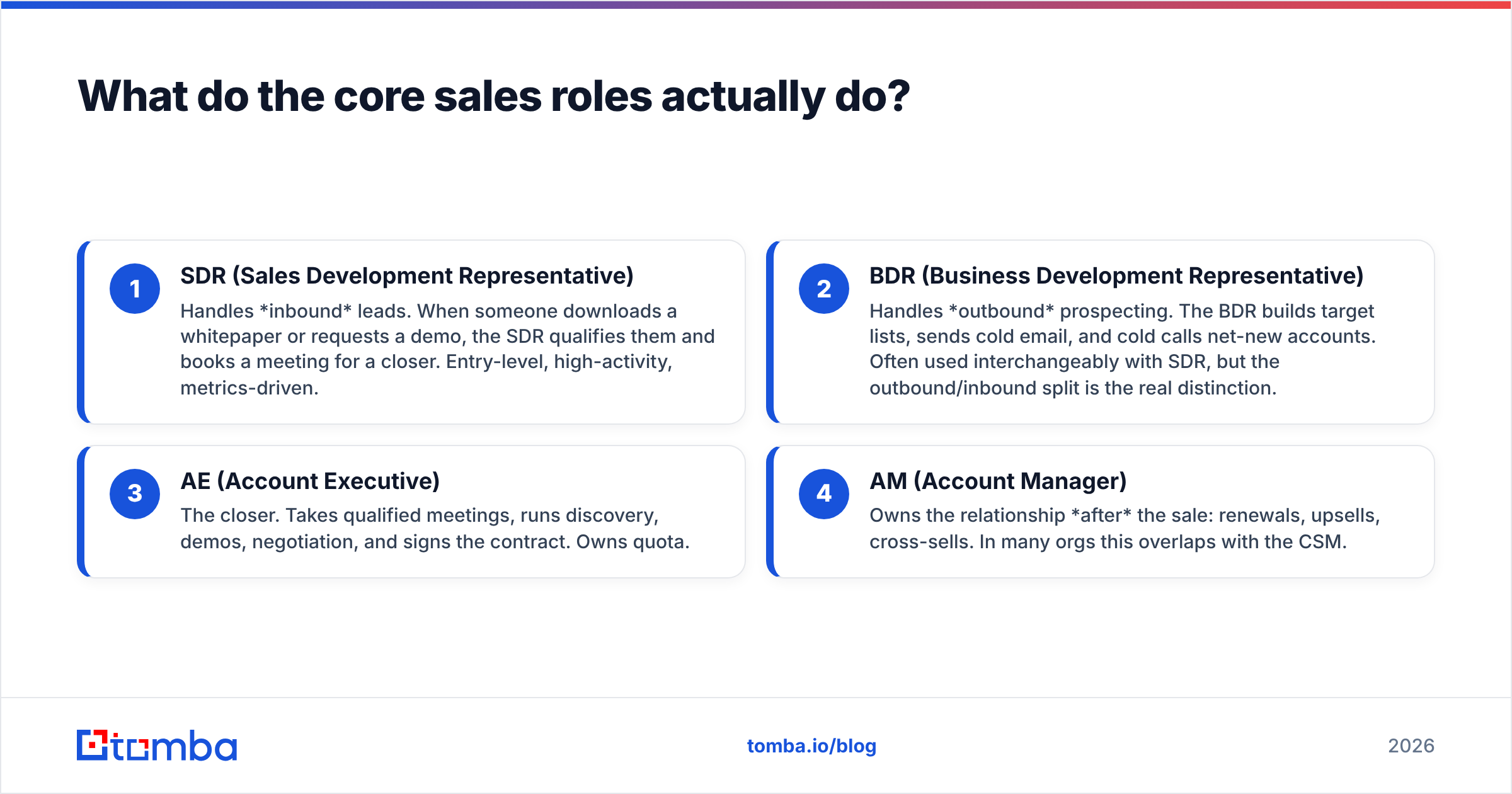
- SDR (Sales Development Representative) — Handles inbound leads. When someone downloads a whitepaper or requests a demo, the SDR qualifies them and books a meeting for a closer. Entry-level, high-activity, metrics-driven.
- BDR (Business Development Representative) — Handles outbound prospecting. The BDR builds target lists, sends cold email, and cold calls net-new accounts. Often used interchangeably with SDR, but the outbound/inbound split is the real distinction.
- AE (Account Executive) — The closer. Takes qualified meetings, runs discovery, demos, negotiation, and signs the contract. Owns quota.
- AM (Account Manager) — Owns the relationship after the sale: renewals, upsells, cross-sells. In many orgs this overlaps with the CSM.
The pipeline moves left to right, and each hand-off is a place where speed and data quality decide whether the deal survives. A BDR who works from a stale list wastes the AE's calendar; a good B2B database keeps the top of that funnel clean.

SDR vs BDR vs AE: how are they different?#
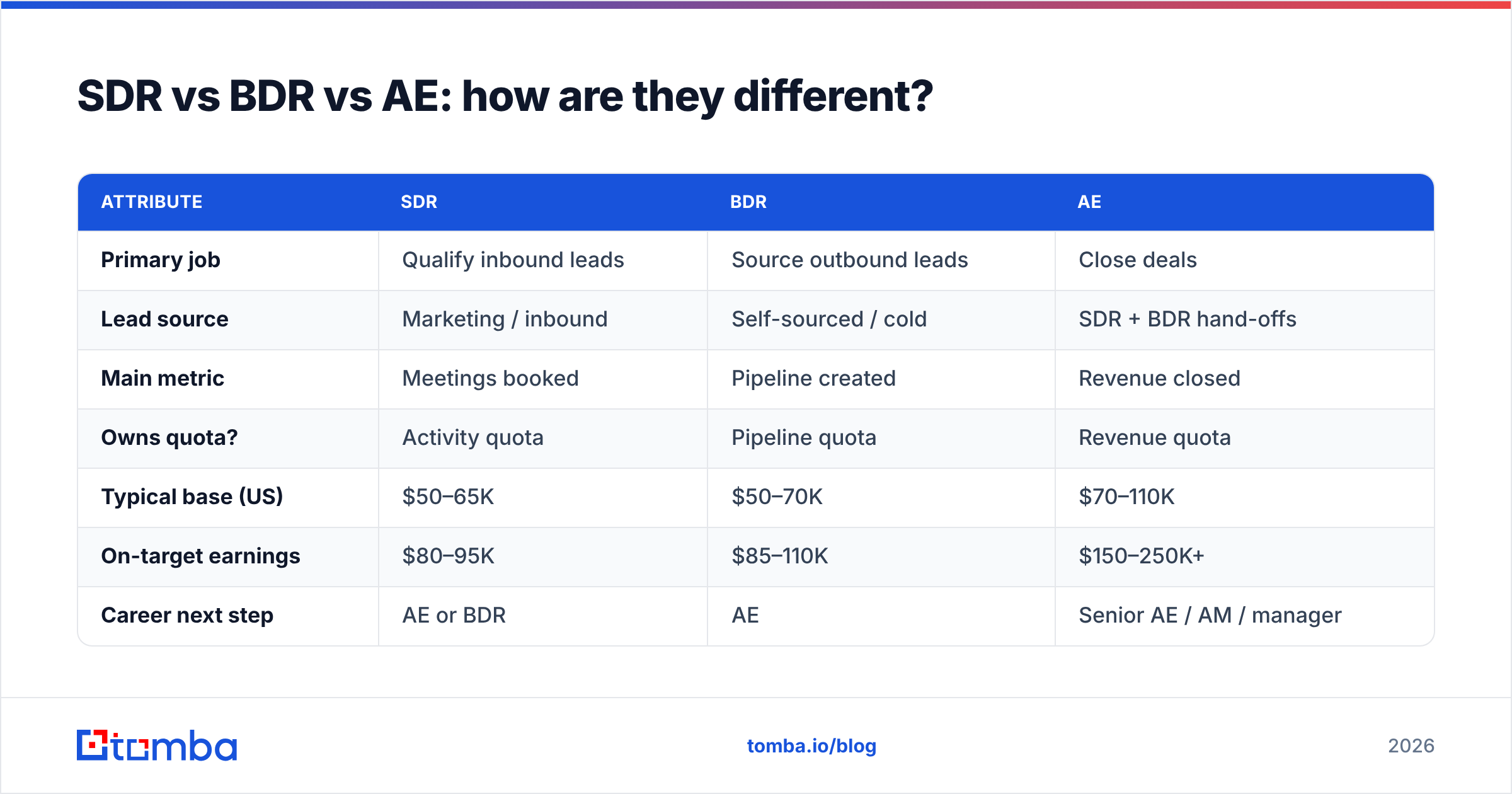
This is the comparison people get wrong most often, because titles vary by company. Here's the practical breakdown.
| Attribute | SDR | BDR | AE |
|---|---|---|---|
| Primary job | Qualify inbound leads | Source outbound leads | Close deals |
| Lead source | Marketing / inbound | Self-sourced / cold | SDR + BDR hand-offs |
| Main metric | Meetings booked | Pipeline created | Revenue closed |
| Owns quota? | Activity quota | Pipeline quota | Revenue quota |
| Typical base (US) | $50–65K | $50–70K | $70–110K |
| On-target earnings | $80–95K | $85–110K | $150–250K+ |
| Career next step | AE or BDR | AE | Senior AE / AM / manager |
The short version: SDRs react to interest, BDRs create it, and AEs convert it. A rep who does all three is either at a very small company or is quietly drowning. Both SDR and BDR roles depend on finding accurate contact details fast, which is why email verification is a standing line item on their tool stack — bounced emails don't just waste sends, they hurt sender reputation for the whole team.
What are the specialized and technical sales roles?#
Beyond the core four, larger deals pull in specialists.
- Sales Engineer (SE) / Solutions Consultant — The technical co-pilot on a deal. When a prospect asks "can it integrate with our stack?" the SE runs the proof-of-concept and answers the hard questions the AE can't. Essential in technical or enterprise sales.
- CSM (Customer Success Manager) — Focused on adoption and outcomes, not just renewal paperwork. A CSM makes sure the customer actually uses the product, which is what drives retention. Overlaps with AM but leans more consultative than commercial.
- Inside Sales Rep — Sells remotely (phone, email, video) rather than in-person. Most SaaS selling is inside sales now.
- Field Sales / Outside Sales Rep — Travels to close in person. Common in manufacturing, medical devices, and large enterprise contracts.
- Channel / Partnership Manager — Sells through partners and resellers rather than direct to end customers.
- Account Director / Strategic AE — Handles the largest, most complex accounts, often with a multi-person "pod" behind them.
Each of these becomes worth hiring at a different revenue stage. The SE shows up when deals get technical; the channel manager shows up when you have a product partners want to resell.
What are the sales support and leadership roles?#
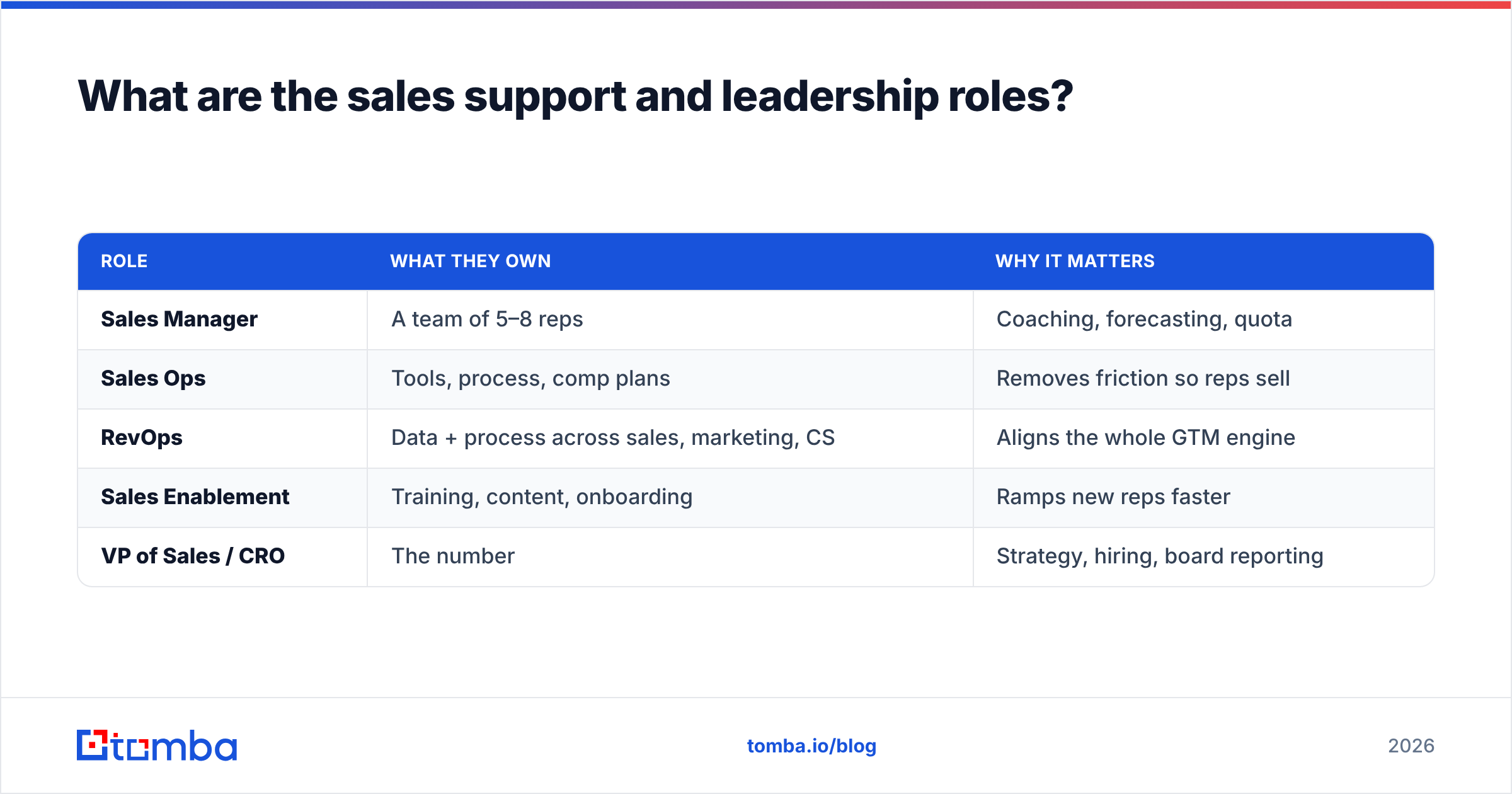
These roles don't carry a bag, but they make the people who do far more productive.
| Role | What they own | Why it matters |
|---|---|---|
| Sales Manager | A team of 5–8 reps | Coaching, forecasting, quota |
| Sales Ops | Tools, process, comp plans | Removes friction so reps sell |
| RevOps | Data + process across sales, marketing, CS | Aligns the whole GTM engine |
| Sales Enablement | Training, content, onboarding | Ramps new reps faster |
| VP of Sales / CRO | The number | Strategy, hiring, board reporting |
The rise of revenue operations is the biggest org-chart change of the last few years. Instead of sales, marketing, and customer success each running their own ops in silos, RevOps unifies the data and process across all three. If your reps complain that "the CRM is a mess" or "leads take three days to route," that's a RevOps gap, not a rep problem.
Sales Ops and RevOps also own the plumbing that connects tools together — CRM syncs, enrichment, routing. Teams that wire Tomba's data enrichment into their CRM through a clean HubSpot integration hand their reps complete records instead of half-filled lead cards.

How do the different sales roles fit into a career path?#
Most sales careers follow a fairly predictable ladder, and knowing it helps you both hire and plan.
- SDR / BDR — where most people start. 12–24 months proving you can generate pipeline.
- Account Executive — the first "closing" role and the biggest earnings jump. Many people stay here for years by choice.
- Senior AE / Strategic AE — bigger deals, bigger accounts, mentoring juniors.
- The fork — you either go management (Sales Manager → Director → VP → CRO) or stay an individual contributor on enterprise deals, where top reps out-earn many managers.
- Adjacent moves — strong AEs often move into Sales Enablement, RevOps, or Sales Engineering if they prefer building systems over carrying quota.
There's no single "correct" path. The best managers were not always the best reps, and some of the highest earners never manage anyone. What every rung shares is a dependence on finding and reaching the right people — a skill that compounds no matter which role you land in.
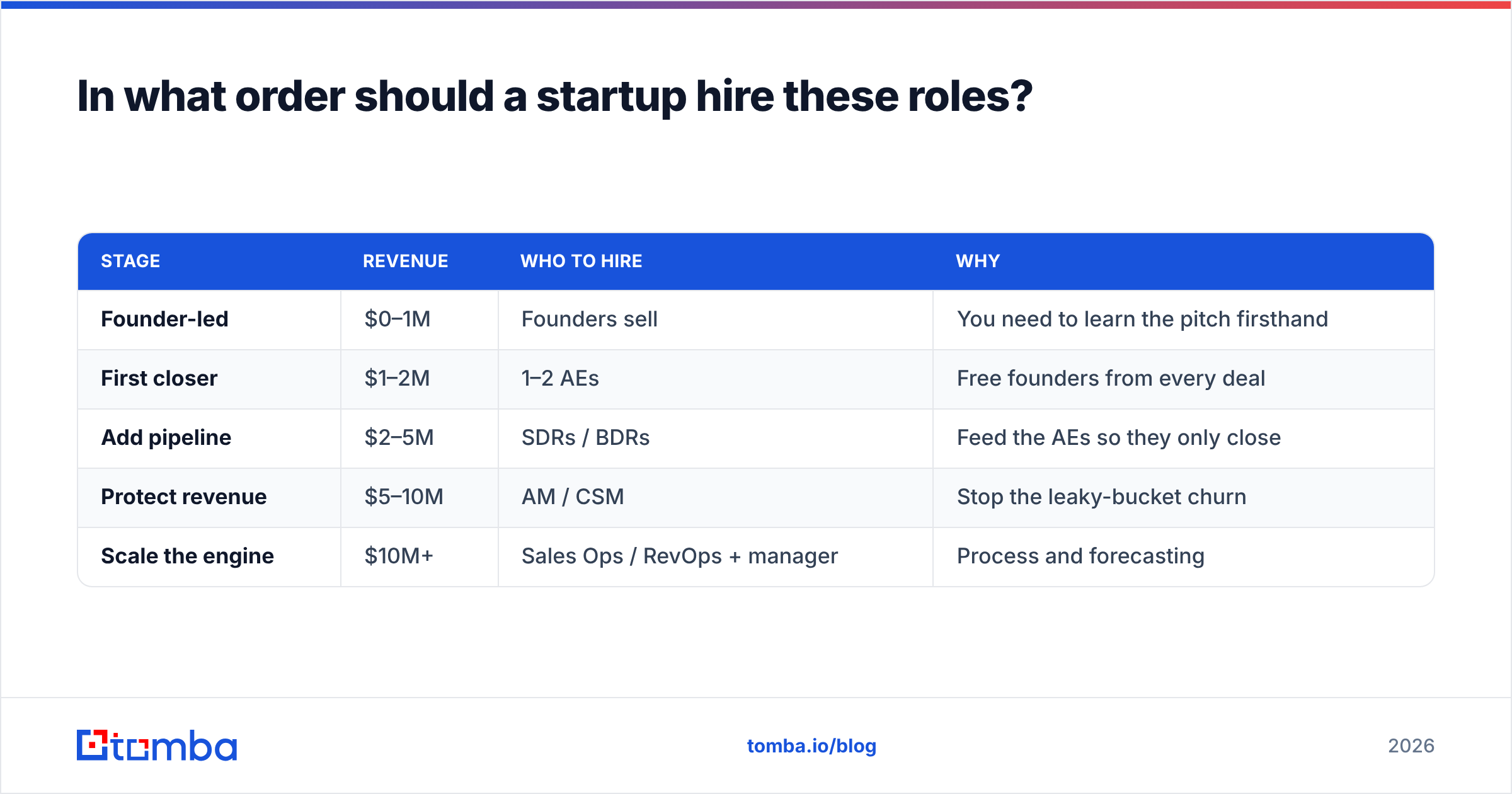
In what order should a startup hire these roles?#
Don't build the org chart above on day one. You'll go broke. Here's the sequence that works for most B2B companies.
| Stage | Revenue | Who to hire | Why |
|---|---|---|---|
| Founder-led | $0–1M | Founders sell | You need to learn the pitch firsthand |
| First closer | $1–2M | 1–2 AEs | Free founders from every deal |
| Add pipeline | $2–5M | SDRs / BDRs | Feed the AEs so they only close |
| Protect revenue | $5–10M | AM / CSM | Stop the leaky-bucket churn |
| Scale the engine | $10M+ | Sales Ops / RevOps + manager | Process and forecasting |
The most common mistake is hiring SDRs before you have a repeatable pitch, or hiring a VP of Sales to "figure it out" before founders have closed the first dozen deals themselves. Sell it yourself first, document what works, then hire specialists to run the playbook.
Whatever stage you're at, the constraint is usually the same: your reps can only sell to people they can actually reach. That's why lean teams lean hard on prospecting tools early — a single SDR armed with an accurate domain search can build the target lists that would otherwise need three junior hires.
How does data quality connect all these roles?#
Every role in this guide runs on contact data, and the failure modes rhyme. The BDR can't book meetings with bounced emails. The AE loses momentum when the CRM record is missing a phone number. The CSM can't reach the new champion after their contact leaves. RevOps spends half its week cleaning duplicate records.
According to industry research from firms like Gartner, B2B data decays at roughly 30% per year as people change jobs and companies restructure. That decay hits every role simultaneously. The teams that stay ahead treat contact data as shared infrastructure — enriched once, verified regularly, and available to SDR, AE, and CSM alike — rather than something each rep scrapes together alone.
This is also why comparing tools on raw price alone is a trap; a cheaper finder that returns bad addresses costs you the SDR's time, the AE's calendar, and the sender reputation of the whole domain. Reviewers on G2 consistently rank accuracy and verification above headline pricing for exactly this reason.
Which Tomba tool fits each sales role?#
If you're staffing any of the prospecting or account roles above, the bottleneck is almost always reaching the right person. Tomba's Email Finder gives SDRs, BDRs, and AEs verified professional emails by name, domain, or company — with a built-in verifier so bounces stay low and deliverability stays high. Start on the free tier (25 searches/month) to test accuracy against your own list, then scale to Starter at $49/mo or Growth at $99/mo as you add reps; full Tomba pricing is public. However your org chart is shaped, give every role the same clean data and you remove the single most common reason deals stall before they start.
Related guides#
Ready to find emails that actually work?
Join 150,000+ professionals who stopped guessing and started sending. Free credits on signup — no credit card required.
Get the Tomba newsletter
Practical outbound tactics and product updates — once every two weeks.
About the author