Digital Sales Enablement in 2026: The Complete Playbook
Digital sales enablement is where content, data, and tooling meet the rep at the moment of the deal. Here's the 2026 framework, the stack, and the metrics that actually move revenue — minus the vendor fluff.
TL;DR
- Digital sales enablement is the system of content, training, data, and tooling that gets your reps the right resource — at the right moment — inside the tools they already work in.
- It is not a content library. A PDF nobody opens is not enablement; a battlecard that surfaces the second a competitor is mentioned on a call is.
- The 2026 stack has four layers: content operations, rep readiness, buyer engagement, and revenue intelligence — glued together by clean CRM data.
- Bad contact data quietly breaks every layer. If your reps are emailing dead addresses, no amount of slick content saves the number.
- Start with data hygiene and one measurable play, not a 40-tool platform. Prove lift, then expand.
Digital sales enablement gets pitched as software you buy. It is actually a discipline you run. The tools matter, but the tools are the last 20%. The first 80% is deciding what "good" looks like for a rep in a live deal, then removing every obstacle between them and that outcome. This guide walks the whole model — what it is, the stack, how to measure it, and the mistakes that make expensive platforms sit unused.
What is digital sales enablement, really?#
Digital sales enablement is the practice of equipping salespeople with the content, data, training, and technology they need to sell effectively — delivered digitally, in-context, and measured against revenue.
Think of it like a pit crew in motorsport. The driver (your rep) is the one who wins the race, but they never touch a wrench, never refuel, never study tire wear on their own. A crew hands them exactly what they need, exactly when the car rolls in, and the whole operation is timed to the second. Enablement is the pit crew for your sales team. When it works, the rep barely notices it — the right case study, the right pricing sheet, the verified contact just appear.
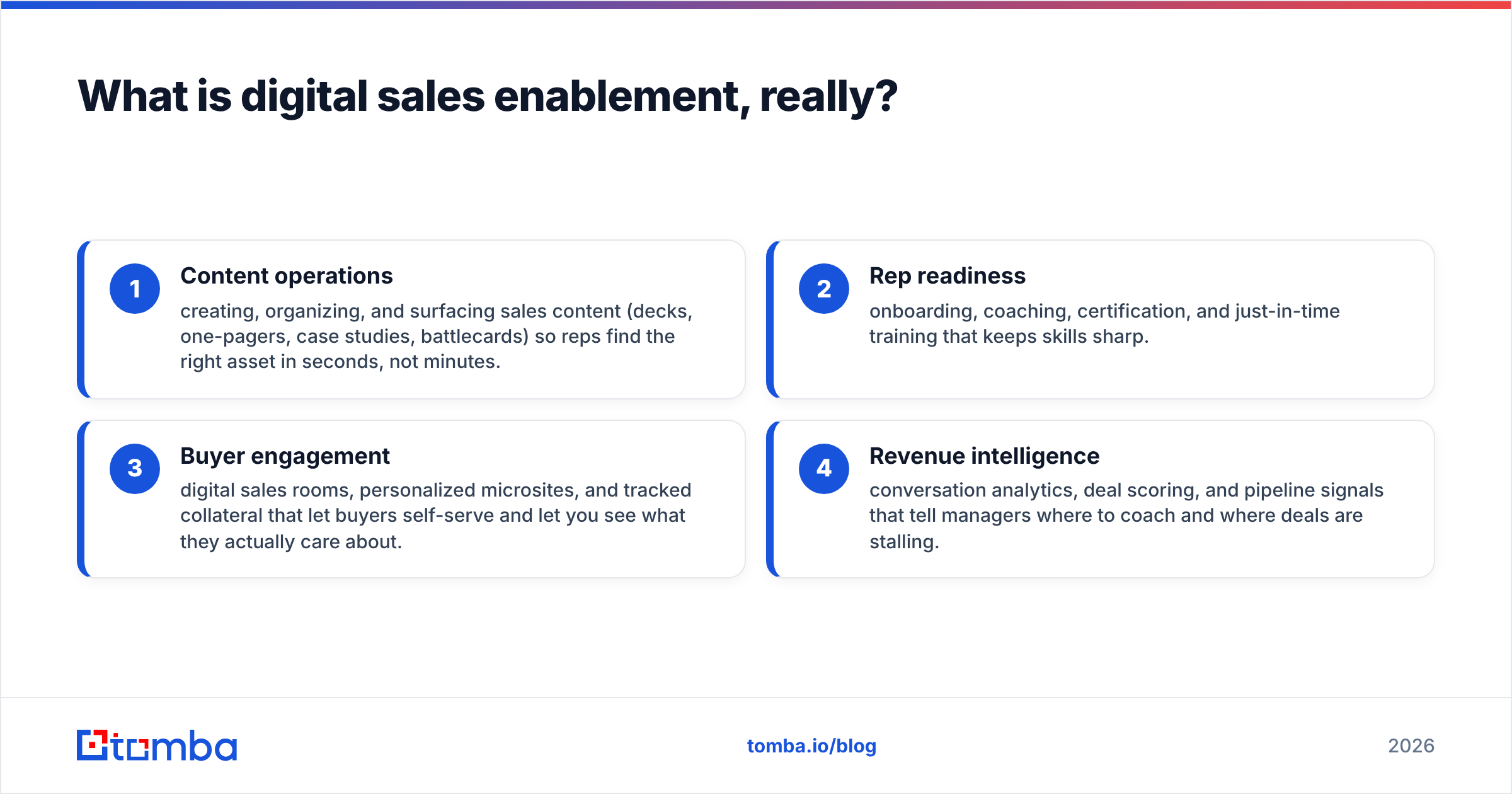
Technically, it spans four jobs:
- Content operations — creating, organizing, and surfacing sales content (decks, one-pagers, case studies, battlecards) so reps find the right asset in seconds, not minutes.
- Rep readiness — onboarding, coaching, certification, and just-in-time training that keeps skills sharp.
- Buyer engagement — digital sales rooms, personalized microsites, and tracked collateral that let buyers self-serve and let you see what they actually care about.
- Revenue intelligence — conversation analytics, deal scoring, and pipeline signals that tell managers where to coach and where deals are stalling.
The word "digital" is doing real work here. Old-school enablement was a shared drive and a quarterly training day. Digital sales enablement means the resource follows the rep into the CRM, the email client, the dialer, and the video call — and every interaction throws off data you can learn from.

Why does sales enablement fail so often?#
Most enablement programs fail for one of three reasons, and none of them is "we didn't buy enough software."
Reason one: content nobody uses. Studies from vendors like HubSpot and analysts at Gartner have repeatedly found that the majority of B2B sales content goes unused by reps. Marketing builds a beautiful asset library; reps can't find anything, so they rebuild slides from scratch the night before a call. If your enablement strategy starts and ends with a content portal, you have built a very expensive filing cabinet.
Reason two: no connection to the deal. Enablement that lives in a separate tab loses. The resource has to be one click away inside the workflow — the battlecard inside the CRM record, the pricing calculator inside the proposal tool, the verified email inside the prospecting view.
Reason three — the quiet killer: bad data. You can have world-class content and flawless training, and it all evaporates if the underlying contact data is wrong. A rep who spends the first hour of every day bouncing off dead inboxes and wrong-number voicemails is not enabled — they are sabotaged. This is why data enrichment and verification belong in any serious enablement conversation, not off in a "data ops" silo. Enablement is only as good as the record it acts on.
That last point is where a lot of "sales management and enablement" programs quietly break. Leaders invest in coaching frameworks and forget that the CRM is full of contacts who changed jobs eighteen months ago.
What are the core components of a digital sales enablement stack?#
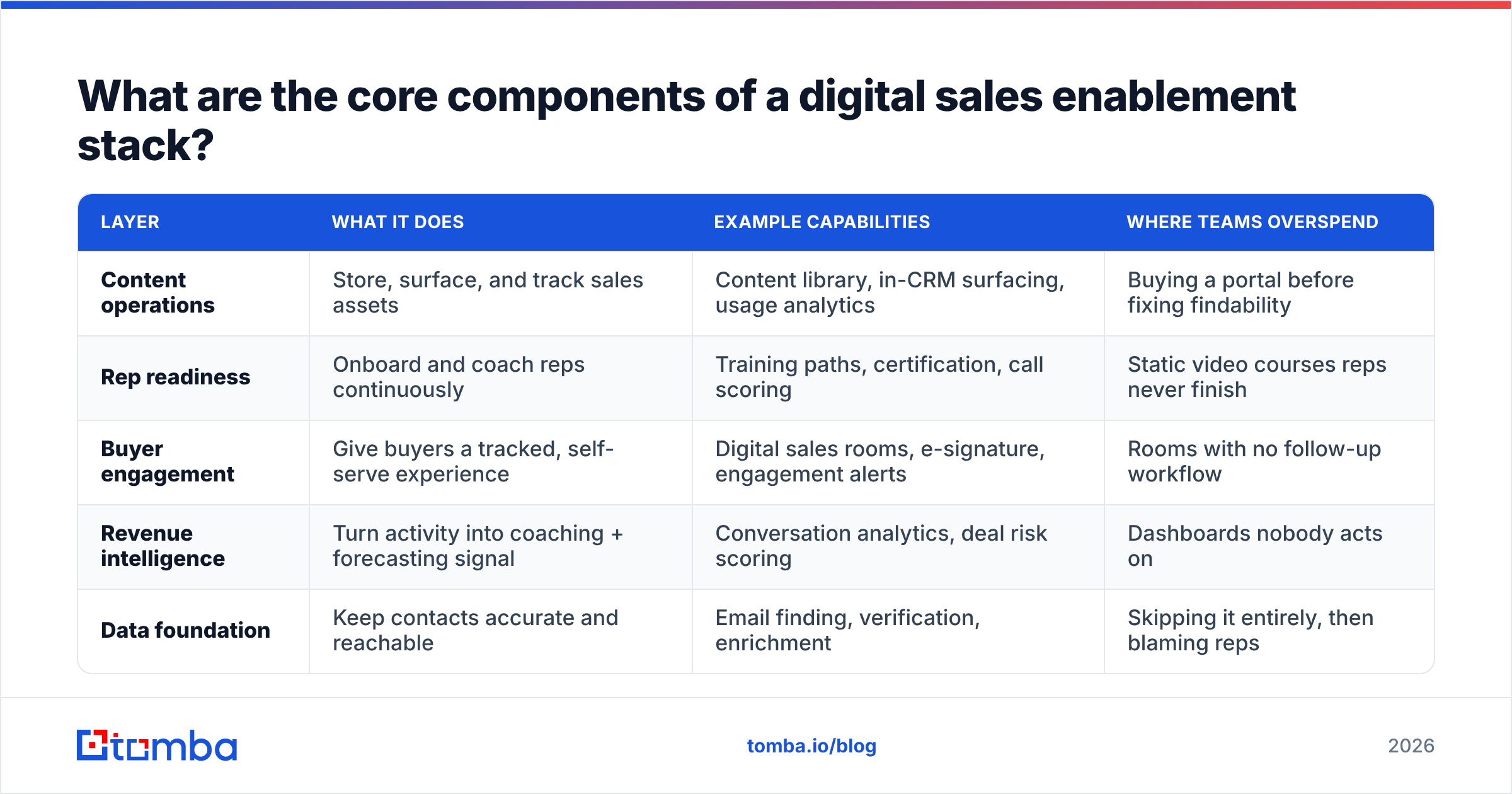
Below is the practical breakdown of the four layers, what each does, and where the money tends to go. Use it to audit what you already have before you buy anything new.
| Layer | What it does | Example capabilities | Where teams overspend |
|---|---|---|---|
| Content operations | Store, surface, and track sales assets | Content library, in-CRM surfacing, usage analytics | Buying a portal before fixing findability |
| Rep readiness | Onboard and coach reps continuously | Training paths, certification, call scoring | Static video courses reps never finish |
| Buyer engagement | Give buyers a tracked, self-serve experience | Digital sales rooms, e-signature, engagement alerts | Rooms with no follow-up workflow |
| Revenue intelligence | Turn activity into coaching + forecasting signal | Conversation analytics, deal risk scoring | Dashboards nobody acts on |
| Data foundation | Keep contacts accurate and reachable | Email finding, verification, enrichment | Skipping it entirely, then blaming reps |
Notice the data foundation sits at the bottom on purpose. It is load-bearing. The other four layers assume the person in the record is real, reachable, and current. When that assumption breaks, every metric above it degrades — open rates, connect rates, meeting-set rates, and eventually win rate.
A concrete example of the data layer in practice: before a rep runs a sequence, an enablement-minded ops team will run the list through a bulk email finder to fill gaps, then a verifier to strip risky addresses. The rep never sees the plumbing. They just see a clean, deliverable list — which is exactly the point of enablement.
How is digital sales enablement different from sales operations?#
They overlap, but they answer different questions. Sales operations asks "is the machine running efficiently?" — territory design, comp plans, CRM hygiene, forecasting accuracy. Digital sales enablement asks "is the rep ready and equipped to win this specific deal?" — content, coaching, messaging, and the in-the-moment assist.
Here is the clean split:
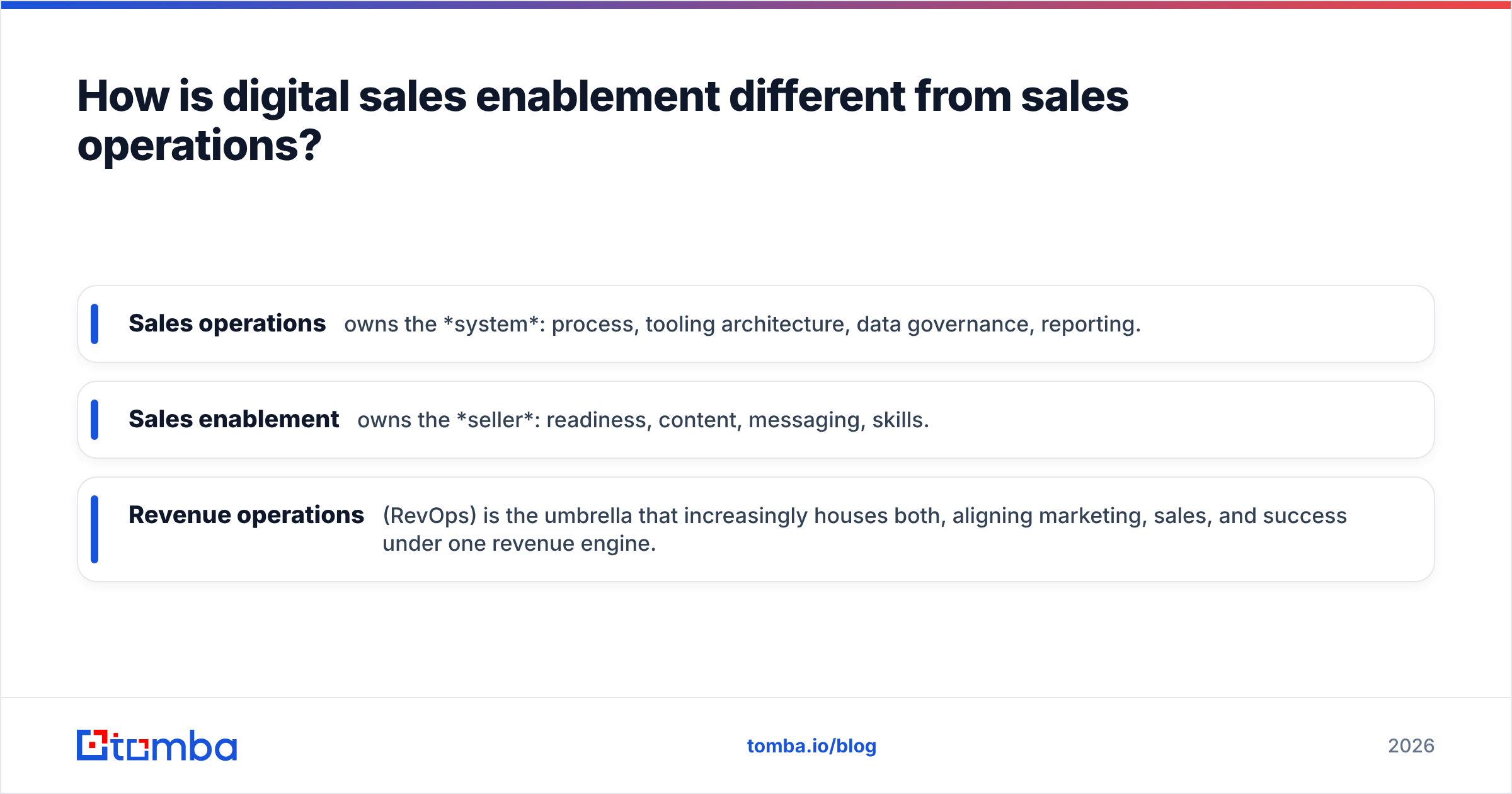
- Sales operations owns the system: process, tooling architecture, data governance, reporting.
- Sales enablement owns the seller: readiness, content, messaging, skills.
- Revenue operations (RevOps) is the umbrella that increasingly houses both, aligning marketing, sales, and success under one revenue engine.
In smaller companies one person wears all three hats. In larger ones they are distinct teams that must not operate in silos — because enablement decisions (which contacts to prioritize, which message to send) depend directly on the data quality that ops governs. When sales automation is layered on top, the line blurs further: automation executes the play, enablement designs it, ops keeps the data clean enough for both to work.
Which digital sales enablement tools do you actually need in 2026?#
You do not need one platform that claims to do everything. You need coverage across the layers, with the data foundation locked first. Here is a comparison of common tool categories so you can map your gaps.
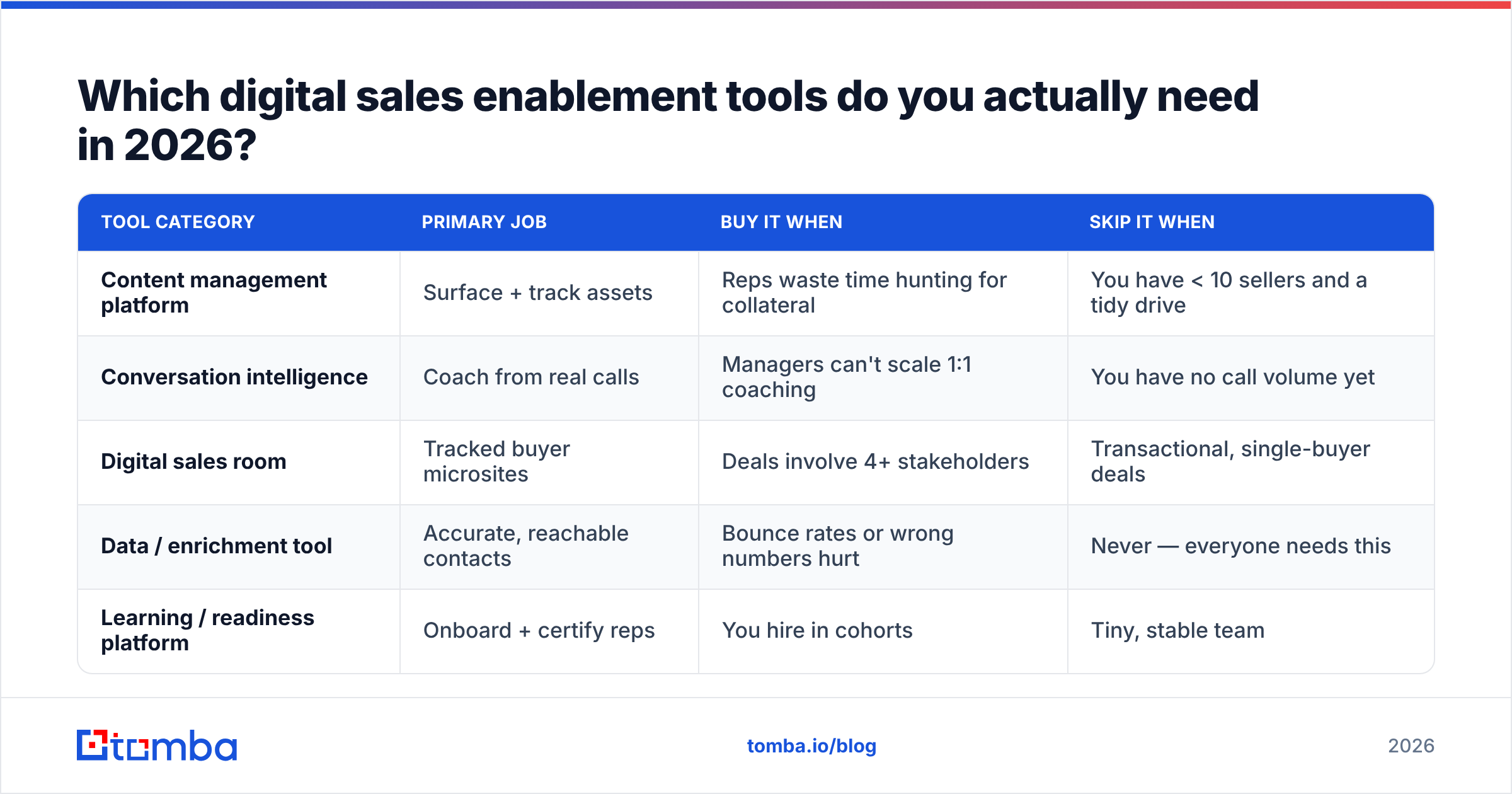
| Tool category | Primary job | Buy it when | Skip it when |
|---|---|---|---|
| Content management platform | Surface + track assets | Reps waste time hunting for collateral | You have < 10 sellers and a tidy drive |
| Conversation intelligence | Coach from real calls | Managers can't scale 1:1 coaching | You have no call volume yet |
| Digital sales room | Tracked buyer microsites | Deals involve 4+ stakeholders | Transactional, single-buyer deals |
| Data / enrichment tool | Accurate, reachable contacts | Bounce rates or wrong numbers hurt | Never — everyone needs this |
| Learning / readiness platform | Onboard + certify reps | You hire in cohorts | Tiny, stable team |
The pattern to internalize: the data layer is the only "always yes" row. Every other tool is situational. This is why teams building an enablement stack from scratch often start with an email finder and an email verifier — they are cheap, they compound value across every other layer, and they make your existing content and reps measurably more effective without changing anything else.
For the wider market landscape and peer reviews across these categories, G2's sales enablement grid is a reasonable neutral starting point. Treat vendor rankings as a shortlist generator, not gospel — the right tool depends on your motion, not the leaderboard.
How do you build a digital sales enablement program from scratch?#
Do not boil the ocean. Run this in order.
Step 1 — Fix the data foundation. Audit your CRM for bounce rates, missing fields, and stale contacts. Deduplicate, enrich, and verify. If reps are emailing addresses that bounce, nothing else you do will show clean numbers. This is unglamorous and it is where you get the fastest ROI.
Step 2 — Pick one measurable play. Not "improve enablement." Something like: "cut new-rep ramp time from 90 to 60 days" or "raise reply rates on outbound by fixing contact accuracy and messaging." One play, one metric.
Step 3 — Map the content and moment. For that play, identify the exact resources a rep needs and the exact moment they need them. Build or fix only those assets. Surface them in-workflow.
Step 4 — Instrument it. Decide how you will measure lift before you launch. Baseline the metric, ship the play, compare.
Step 5 — Coach on the gap. Use conversation and activity data to find where reps deviate, then coach specifically. Enablement without coaching is just content distribution.
Step 6 — Prove it, then expand. Once one play shows lift, use that win to fund the next layer. Programs that try to launch all four layers at once tend to collapse under their own weight.
This sequencing matters because enablement budgets get cut the moment they can't show revenue impact. A small, proven play protects the whole program.
What metrics prove digital sales enablement is working?#
Vanity metrics (content downloads, course completions) tell you activity, not impact. Tie enablement to the funnel instead:
- Ramp time — days for a new rep to hit full quota. Enablement should shorten it.
- Content utilization — percentage of sold deals that used enablement content. Rising utilization on won deals is the signal you want.
- Connect and reply rates — leading indicators that your data and messaging are working together. If these are low, look at contact accuracy before blaming copy.
- Win rate by segment — the lagging outcome. Slice it to see where enablement moves the needle.
- Deal velocity — time from first touch to closed-won. Digital sales rooms and better content should compress it.
The honest test: if you turned your enablement program off for a quarter, would any of these numbers move? If you can't answer that, you are running a content library, not an enablement program. And if your connect and reply rates are stuck no matter what you try, the culprit is almost always the data source — reps executing perfect plays against imperfect records.
Is digital sales enablement worth the investment?#
Yes — but only if you sequence it correctly and refuse to treat it as a software purchase. The teams that get burned are the ones who buy a flagship platform, roll it out to reps who don't trust the data inside it, and then wonder why adoption is 12%. The teams that win start with a clean data foundation, prove one play, and expand from evidence.
The uncomfortable truth is that the highest-leverage enablement investment for most B2B teams in 2026 is not another content tool or another coaching framework. It is making sure the person in the CRM record is real, current, and reachable. Everything else — the decks, the battlecards, the sales rooms, the intelligence dashboards — is amplification. Amplifying outreach to dead contacts just gets you louder failure.
Where does Tomba fit in your enablement stack?#
Enablement lives or dies on the accuracy of the contact your rep acts on. That is the layer Tomba is built for. Use the Tomba Email Finder to find verified professional emails by name, company, or domain, then keep your CRM clean so every downstream play — the content, the coaching, the sales rooms — fires against a real, reachable person instead of a bounce.
Start free with 25 searches a month, and when the numbers prove out, Tomba pricing scales from $49/mo Starter to Growth and Pro without you re-architecting anything. Fix the foundation first, and the rest of your enablement stack finally gets to do its job.
Related guides#
Ready to find emails that actually work?
Join 150,000+ professionals who stopped guessing and started sending. Free credits on signup — no credit card required.
Get the Tomba newsletter
Practical outbound tactics and product updates — once every two weeks.
About the author