Direct Sales Leads in 2026: How to Find and Qualify Them
Most direct sales lead lists are stale before you load them. Here's how to source, verify, and route direct sales leads that actually convert — with real cost math and a workflow you can copy.
TL;DR
- Direct sales leads are contacts you reach yourself — no channel partner, no marketing form, no inbound hand-raise. You source them, you qualify them, you own the first touch.
- The failure point is almost never the pitch. It's the data: a list with 18% invalid addresses burns your sender reputation before a single reply lands.
- Build lists from a defined ICP + a live source (job postings, funding events, tech signals), then verify every address before it enters a sequence.
- Real cost per usable lead ranges from roughly $0.10 to $2.00 depending on method. Cheap lists usually cost more once you price in bounces and rep damage.
- Measure connect rate, bounce rate, and reply-to-meeting rate per source — not total leads sourced. Volume is the vanity metric here.
What are direct sales leads?#
A direct sales lead is a prospect you contact yourself, without an intermediary. You found them, you researched them, and you initiated the conversation — by email, phone, or LinkedIn. Nobody filled out a demo form. Nobody clicked an ad.
The term gets used two ways, and the difference matters:
- B2B direct (outbound) sales leads — the dominant usage. A rep or SDR builds a target account list, finds the right person, and reaches out cold. This is what most of this guide covers.
- Direct selling leads — the direct selling industry sense: independent consultants selling consumer products person-to-person, where "leads" often means warm referrals and local network contacts.
Both share a structural trait that separates them from inbound: you control the timing and the targeting, but you also carry the full burden of relevance. An inbound lead has already signalled interest. A direct lead has not, so everything downstream — the data quality, the trigger, the first line of the email — has to do the work that the form fill would otherwise have done.
That's why direct lead generation is far more sensitive to data quality than inbound. An inbound lead with a typo'd email will email you again. A direct lead with a bad address just silently costs you a bounce.
Why do most direct sales lead lists fail?#
Four reasons, in order of how much damage they do.
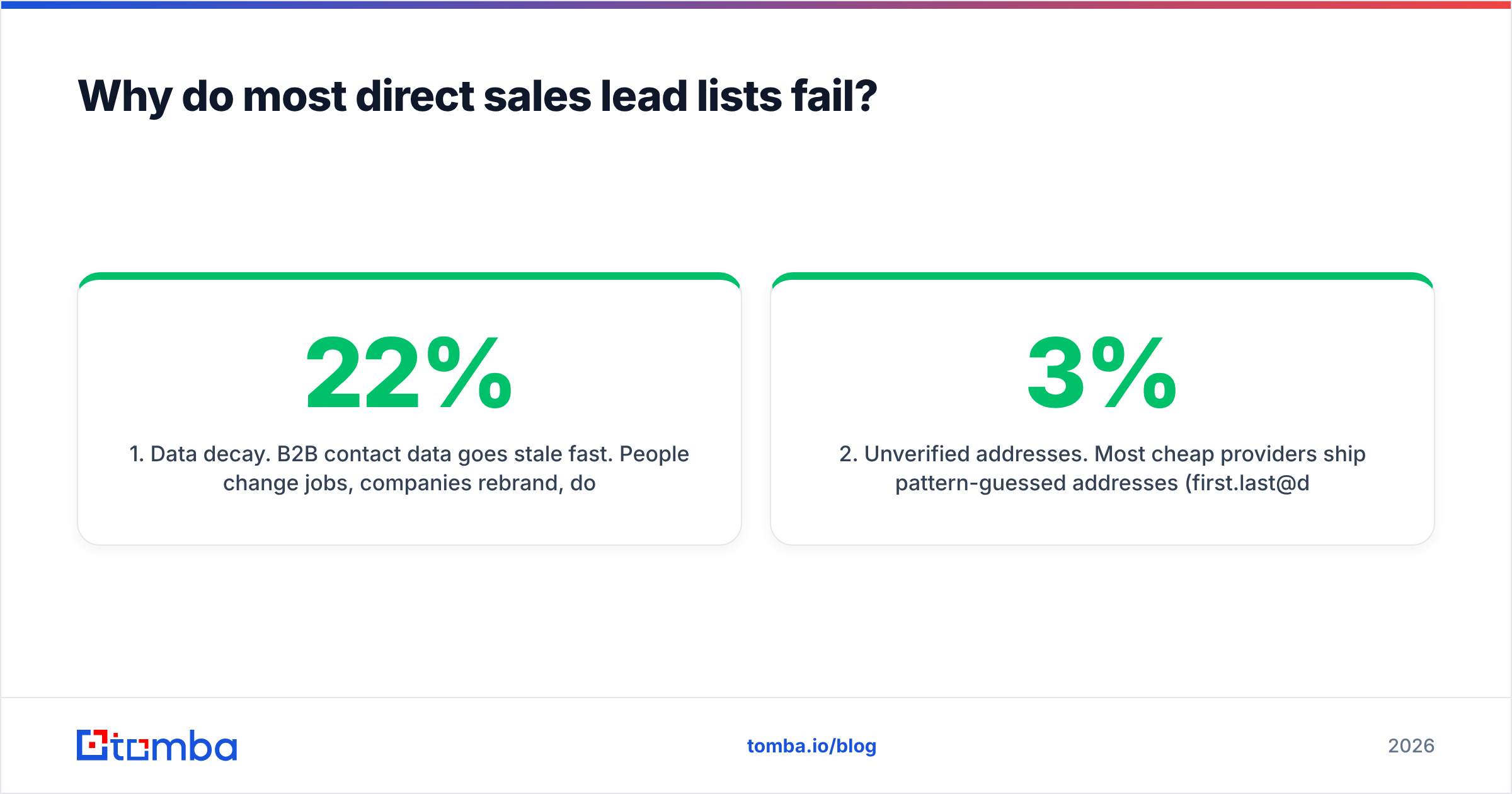
1. Data decay. B2B contact data goes stale fast. People change jobs, companies rebrand, domains migrate. Industry estimates put annual B2B database decay somewhere between 22% and 30% — meaning a list you bought 18 months ago is roughly half fiction. Nobody notices until the bounce report comes back.
2. Unverified addresses. Most cheap providers ship pattern-guessed addresses (first.last@domain.com) without ever checking whether the mailbox exists. Guessing is fine as a hypothesis. Shipping the guess as a verified contact is not. Once your bounce rate crosses roughly 2–3%, mailbox providers start throttling you, and your email deliverability problem becomes a revenue problem.
3. Wrong-persona targeting. A technically valid email for the wrong job title is still a wasted send. Filtering by company size and industry but not by function or seniority produces lists that look big and convert at nothing.
4. No trigger. Sending the same message to 5,000 accounts because they match a firmographic filter is not targeting, it's a lottery. Direct outreach works when there's a reason now — a new hire in the buying role, a funding round, a tech stack change, a job post describing the exact pain you solve.

Fixing #1 and #2 is a tooling problem, and it's the cheapest fix available. Fixing #3 and #4 is a strategy problem, and it's where the actual leverage sits.
Where do direct sales leads actually come from?#
Six sources, ranked by the quality of the leads they produce rather than by how easy they are:
- Hiring signals. A company posting for a "Revenue Operations Manager" is telling you it has a RevOps problem, a budget line, and a hiring manager who owns it. Job boards are the most under-used trigger source in outbound. Scrape the posting, identify the hiring manager, reach out referencing the role.
- Funding and expansion events. New capital means new tooling budget and a mandate to spend it within a few quarters. Crunchbase alerts, SEC filings, and local business journals all work. Timing window: 30–90 days post-announcement.
- Technographic signals. If you integrate with HubSpot, companies running HubSpot are pre-qualified. If you replace a specific competitor, companies running that competitor are your shortlist. A website tech stack check turns a domain into a qualification signal in one step.
- Domain-level discovery. You know the account, you need the people. Run a domain search against the company domain to pull the mailbox patterns and named contacts that already exist, instead of guessing formats.
- Content and author attribution. For content, media, and partnership outreach, the person who wrote the piece is the person to contact — not
info@. An author finder resolves a byline to a real address. - Purchased and licensed databases. Fastest to volume, most variable in quality. Reputable providers with human-verified data — BookYourData is a well-regarded example in this tier, with pay-as-you-go pricing and verified-on-download guarantees — can genuinely accelerate a cold start. The failure mode isn't buying data; it's buying data and skipping verification because you assumed the vendor did it.
The pattern across all six: start with a signal, then resolve the contact. Reversing that order — start with a contact list, then look for a reason to email it — is what produces 0.4% reply rates.
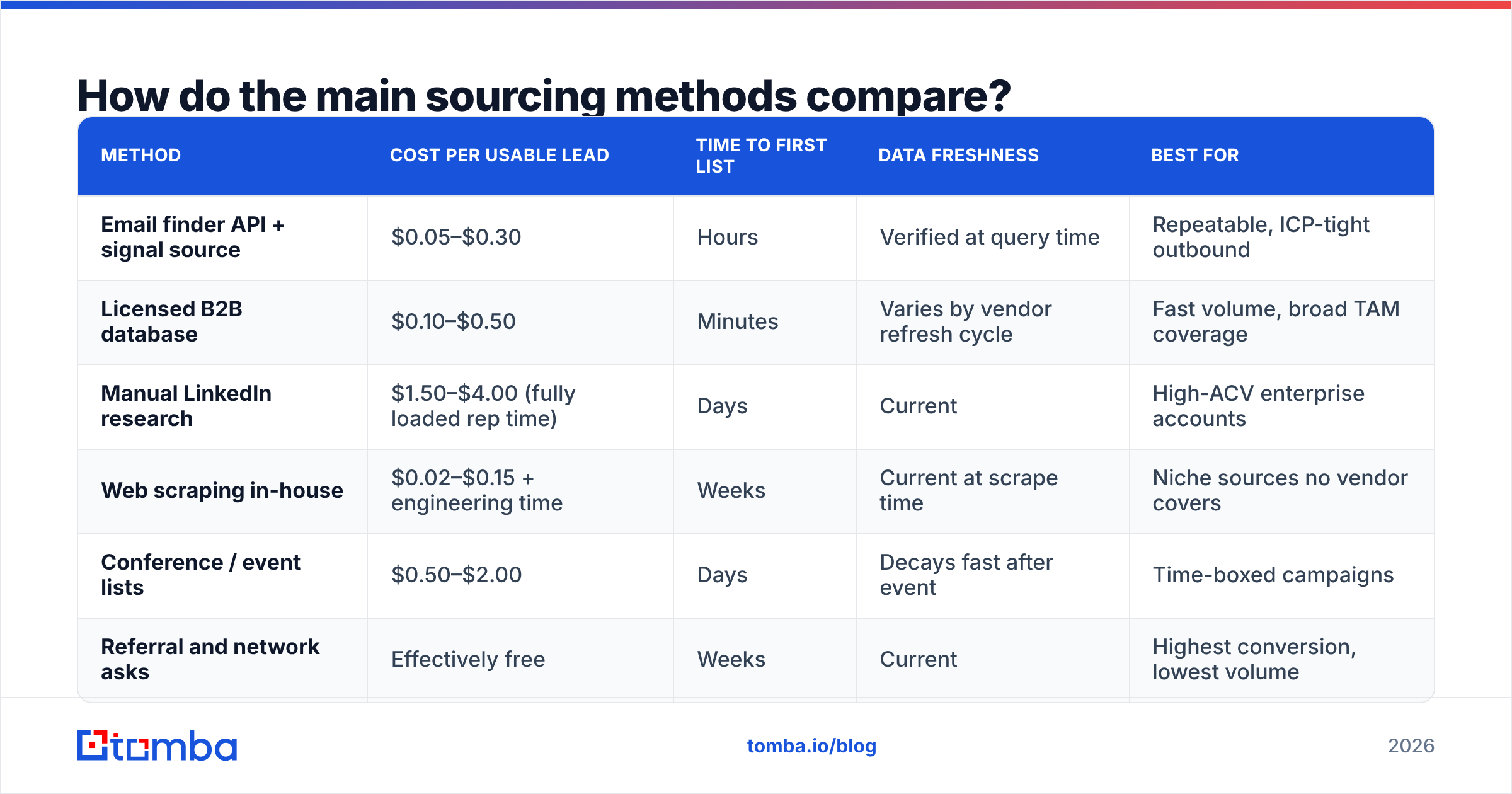
How do the main sourcing methods compare?#
| Method | Cost per usable lead | Time to first list | Data freshness | Best for |
|---|---|---|---|---|
| Email finder API + signal source | $0.05–$0.30 | Hours | Verified at query time | Repeatable, ICP-tight outbound |
| Licensed B2B database | $0.10–$0.50 | Minutes | Varies by vendor refresh cycle | Fast volume, broad TAM coverage |
| Manual LinkedIn research | $1.50–$4.00 (fully loaded rep time) | Days | Current | High-ACV enterprise accounts |
| Web scraping in-house | $0.02–$0.15 + engineering time | Weeks | Current at scrape time | Niche sources no vendor covers |
| Conference / event lists | $0.50–$2.00 | Days | Decays fast after event | Time-boxed campaigns |
| Referral and network asks | Effectively free | Weeks | Current | Highest conversion, lowest volume |
Two things worth reading out of that table. First, manual research is not "free" — a rep at a $70K base costs roughly $45/hour fully loaded, and 12 researched contacts an hour is generous. Second, the cheapest column is not the winning column. Referrals cost nothing per lead and convert best, but they don't scale; scraping is cheap per record and expensive in engineering weeks.
Most teams that get this right run a hybrid: a licensed or API-sourced base layer for coverage, manual enrichment on the top 10% of accounts by deal size, and referrals worked separately by AEs.
What has to be true before a direct lead enters a sequence?#
Treat this as a gate, not a checklist you review after the campaign fails. A lead passes or it doesn't.
- The address is verified, not inferred. Run every contact through an email verifier before it touches your sending domain. SMTP-level validation catches the mailboxes that pattern-matching invents.
- The catch-all question is resolved. Roughly one in five B2B domains is catch-all — it accepts everything, so standard verification returns "unknown." A catch-all verifier narrows those down instead of letting you either dump them (losing real prospects) or send blind (risking bounces).
- The persona matches, not just the firmographics. Title, seniority, and department. "Director" at a 40-person startup and "Director" at a 40,000-person enterprise are different buyers.
- There's a documented trigger. One sentence, written down: why this account, why now. If you can't write it, the lead isn't ready.
- It's deduped against your CRM. Emailing an open opportunity as a cold lead is the fastest way to lose credibility with your own AEs. Remove duplicates before import.
Teams that add the verification gate typically see bounce rates drop from the 8–15% range down under 2%. That single change usually moves reply rate more than any subject-line rewrite, because it's the difference between your emails landing in inboxes and landing in spam folders. HubSpot's sales research has consistently found data quality ranking above messaging as the top constraint reps report on outbound performance.
How much should direct sales leads cost?#
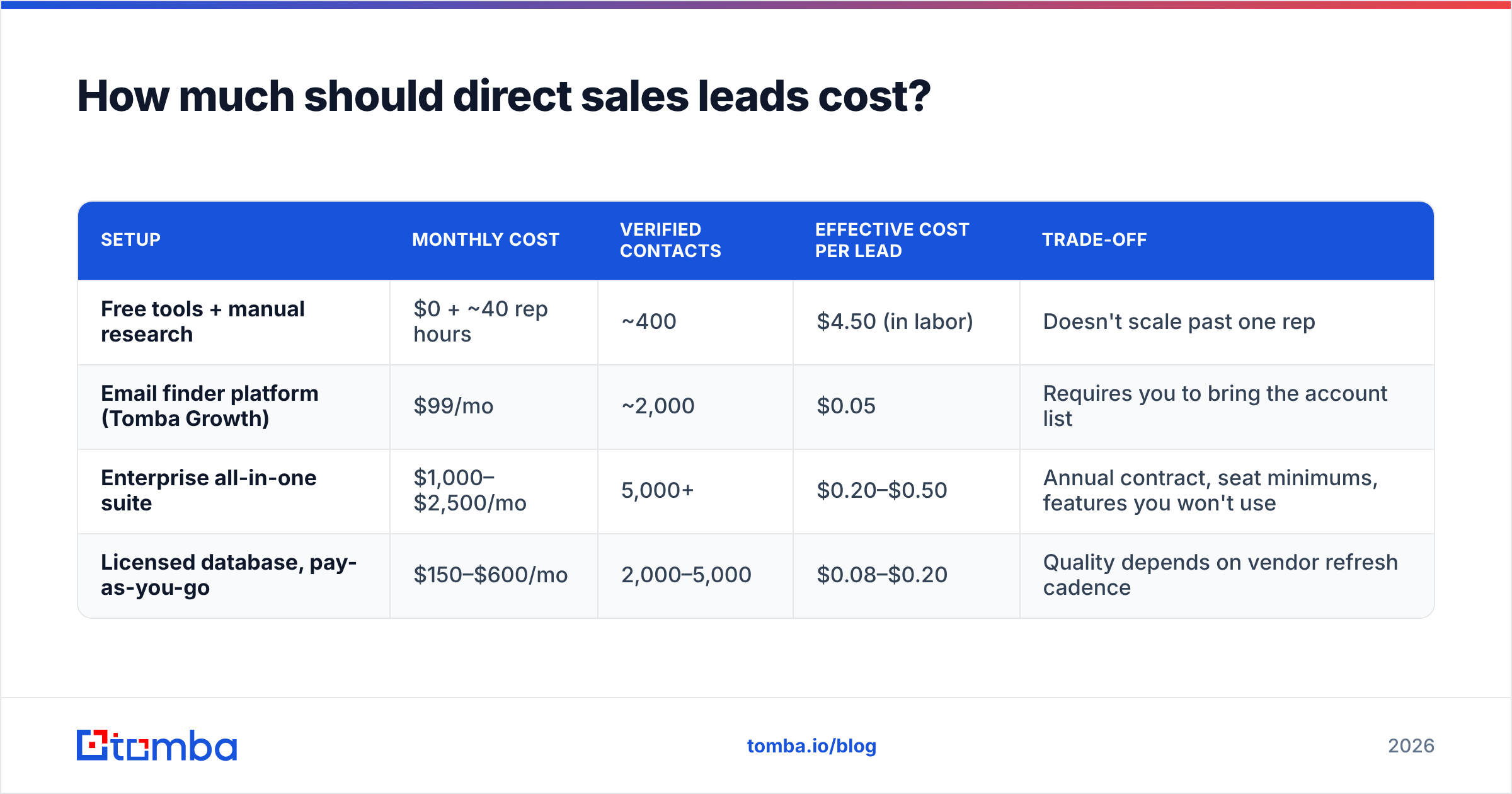
Here's the honest math on three common setups for a team that needs 2,000 verified contacts a month.
| Setup | Monthly cost | Verified contacts | Effective cost per lead | Trade-off |
|---|---|---|---|---|
| Free tools + manual research | $0 + ~40 rep hours | ~400 | $4.50 (in labor) | Doesn't scale past one rep |
| Email finder platform (Tomba Growth) | $99/mo | ~2,000 | $0.05 | Requires you to bring the account list |
| Enterprise all-in-one suite | $1,000–$2,500/mo | 5,000+ | $0.20–$0.50 | Annual contract, seat minimums, features you won't use |
| Licensed database, pay-as-you-go | $150–$600/mo | 2,000–5,000 | $0.08–$0.20 | Quality depends on vendor refresh cadence |
For reference, Tomba pricing runs a free tier at 25 searches/month, Starter at $49/mo, Growth at $99/mo, Pro at $249/mo, and custom Enterprise — which puts a fully verified 2,000-contact month in the $0.05/lead range without an annual commitment. Compare that against the all-in-one suites and the gap is mostly features: sequencing, dialers, and intent data bundled in whether you need them or not.
The number nobody puts on the invoice is the cost of a bad lead. A 12% bounce rate on 2,000 sends doesn't cost you 240 wasted emails. It costs you 2–4 weeks of degraded sender reputation across your whole domain, which taxes every campaign after it. Price verification as insurance, not as a line item.
If you're comparing vendors seriously, cross-check claimed accuracy rates against third-party reviews on G2's lead intelligence category rather than vendor landing pages. Self-reported accuracy figures are marketing; review-volume-weighted scores are closer to signal.
What does a working direct-lead workflow look like?#
Five steps, end to end, that a two-person team can run weekly.
Step 1 — Define the trigger list. Pick one signal and pull 100–300 accounts that fired it this week. Job postings for a specific role, funding announcements in your vertical, companies that just added a tool you integrate with. One signal per campaign, so you can attribute results.
Step 2 — Resolve accounts to people. For each domain, identify the 1–2 people in the buying role. An email finder does this by name + domain; for larger batches, a bulk email finder run handles the whole list in one pass. If you're working from LinkedIn profiles rather than names, a LinkedIn finder closes that gap.
Step 3 — Verify and segment. Verify everything. Split results into valid (send now), catch-all (send with a throttled, low-volume approach), and invalid (discard, or re-find with a different pattern). Never merge these three into one send.
Step 4 — Enrich for personalization. Pull the one detail that makes the first line specific: headcount, funding stage, the job post language itself. Data enrichment at this stage is what separates a relevant cold email from a mail merge. You need one true, specific sentence — not five.
Step 5 — Route and measure by source. Push to your CRM or sequencer with the source tagged. Salesforce's lead generation guide makes the same point from the CRM side: without source attribution on the lead record, you can't tell a bad list from a bad message, and you'll spend the next quarter rewriting copy that was never the problem.
How do you measure direct sales lead quality?#
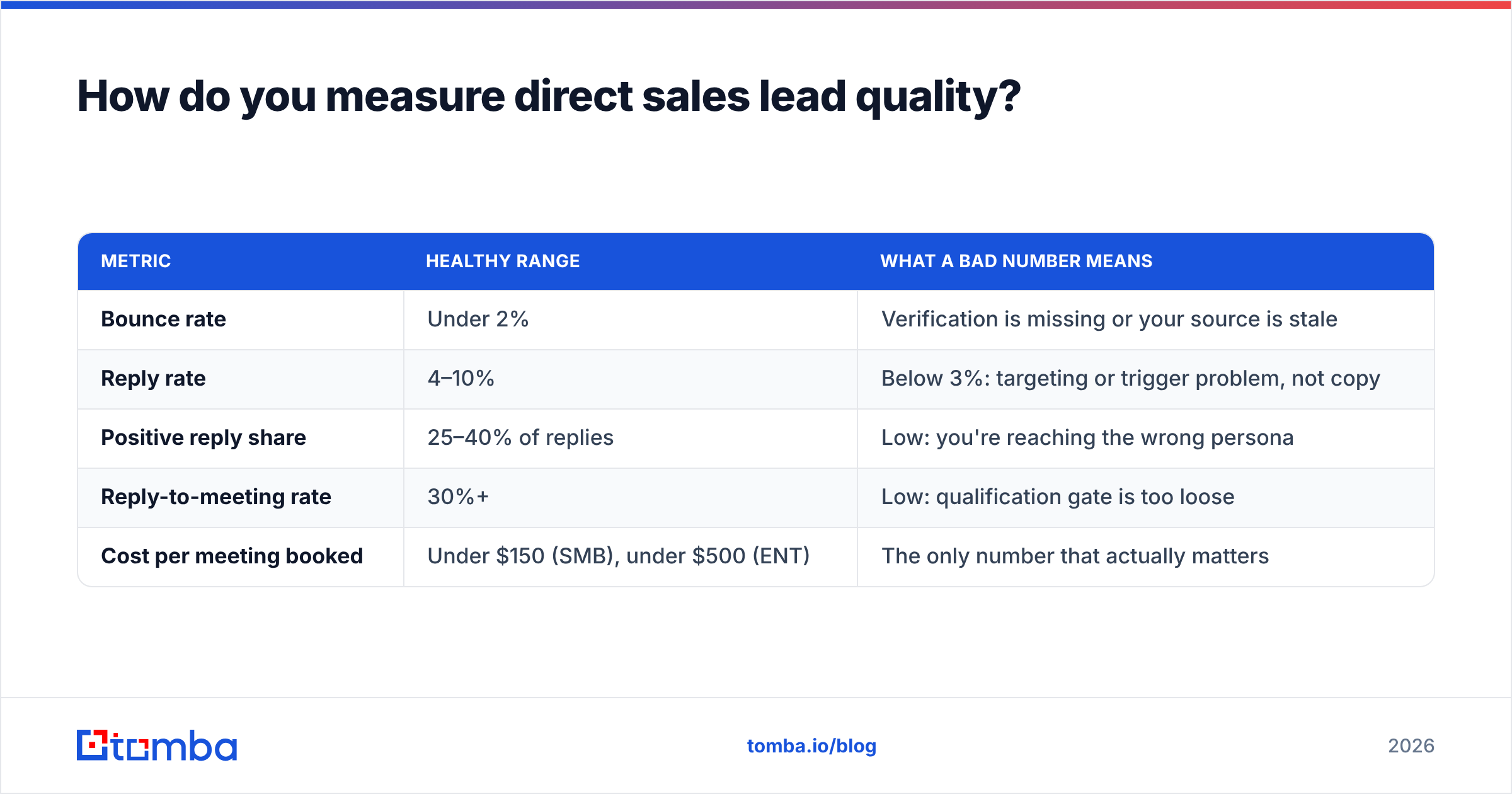
Four metrics, with the thresholds that indicate a healthy direct-lead engine:
| Metric | Healthy range | What a bad number means |
|---|---|---|
| Bounce rate | Under 2% | Verification is missing or your source is stale |
| Reply rate | 4–10% | Below 3%: targeting or trigger problem, not copy |
| Positive reply share | 25–40% of replies | Low: you're reaching the wrong persona |
| Reply-to-meeting rate | 30%+ | Low: qualification gate is too loose |
| Cost per meeting booked | Under $150 (SMB), under $500 (ENT) | The only number that actually matters |
Track all five per source, per week. The single most valuable habit in direct lead generation is killing a source that produces volume but no meetings, quickly, instead of scaling it because the lead count looked good in the dashboard. Your response rate by source is the fastest read on whether a list was worth buying.
Get verified direct sales leads without the bounce tax#
The gap between a direct lead list that books meetings and one that burns your domain is almost entirely verification and targeting — not budget, and not clever copy. Start with a signal, resolve the contact against a live source, verify before you send, and measure by source.
If you want that pipeline without stitching four tools together, the Tomba Email Finder resolves names and domains into verified professional addresses, with SMTP verification, catch-all handling, and bulk processing in the same workflow. The free tier gives you 25 searches to test accuracy against contacts you can already confirm — run it on your own team's addresses first, then decide.
Related guides#
Ready to find emails that actually work?
Join 150,000+ professionals who stopped guessing and started sending. Free credits on signup — no credit card required.
Get the Tomba newsletter
Practical outbound tactics and product updates — once every two weeks.
About the author